PAWS Pet Poison Plant Guide
Is American Bittersweet Poisonous to Dogs, Cats, Horses, and Livestock?
Yes—American Bittersweet, Celastrus scandens, should be treated as poisonous to dogs, cats, horses, livestock, and other animals that eat it. Veterinary poison references associate ingestion with nausea, vomiting, diarrhea, abdominal discomfort, appetite loss, depression, weakness, and uncommon tremors or seizures. The exact toxic principle responsible for this syndrome has not been established conclusively.
Some veterinary references list cardenolides and alkaloids, while others state that the plant may contain euonymin and sesquiterpene alkaloids. Direct chemical studies of authenticated American Bittersweet have identified celastrol and several other triterpenoid, sterol, resin-alcohol, lipid, and plant fractions, but they have not demonstrated which compound causes natural animal poisoning or established a dependable toxic dose. The colorful orange capsules, scarlet arils, and seeds create the most conspicuous household hazard, while horses and livestock may be exposed by browsing leaves and vines or gaining access to discarded clippings.
About this guide: This page provides general pet-poisoning information and cannot diagnose or treat an individual animal. For any suspected exposure, contact a veterinarian or animal poison-control service immediately. Do not induce vomiting, give medication, or attempt home decontamination unless directed by a veterinary professional.
American Bittersweet
Celastrus scandens L.
Accepted botanical synonyms include:
Celastrus bullatus L.
Euonymus scandens (L.) E.H.L.Krause
Evonymoides scandens (L.) Medik.
Celastraceae — Staff-Vine or Bittersweet Family
American Bittersweet; Bittersweet; Climbing Bittersweet; Shrubby Bittersweet; False Bittersweet; American Staff-Vine; Staff-Vine; Climbing Orange-Root; Orange-Root; Fever-Twig; Fever-Twitch; Jacob’s-Ladder; Waxwork
Celastrus bullatus L., Euonymus scandens (L.) E.H.L.Krause, and Evonymoides scandens (L.) Medik. are botanical synonyms of Celastrus scandens.
American Bittersweet should not be confused with Oriental Bittersweet, Asiatic Bittersweet, Asian Bittersweet, or Round-Leaved Bittersweet, which refer to the invasive species Celastrus orbiculatus.
Bittersweet and Woody Nightshade may also refer to Solanum dulcamara, an unrelated nightshade with purple flowers and red berries. Its steroidal glycoalkaloids produce a different poisoning syndrome.
Jacob’s-Ladder is an ambiguous name also used for Polemonium species. Waxwork may likewise appear as a name for other ornamental plants. Scientific identification is preferable during a suspected poisoning.
The Exact Toxic Principle Remains Unresolved
American Bittersweet is consistently classified as poisonous in veterinary and livestock references, but the exact compound responsible for naturally occurring illness has not been established conclusively.
Some veterinary listings identify cardenolides and alkaloids. Other listings use the more cautious description that the plant may contain euonymin and sesquiterpene alkaloids. Livestock references have historically attributed the poisoning to euonymin while acknowledging that the toxic principle is not definitely known.
These differing descriptions should not be combined into a claim that Celastrus scandens has a fully characterized mixture of proven cardenolides and sesquiterpene alkaloids. The most defensible public conclusion is that American Bittersweet contains biologically active phytochemicals and can produce gastrointestinal illness, weakness, and uncommon neurologic signs, while the exact causal compound and dose remain uncertain.
Direct Chemical Research on American Bittersweet
Exact-species phytochemical research on Celastrus scandens dates to the early twentieth century. Investigators examined the root bark, leaves, seeds, sterol fractions, resin alcohols, pigments, oils, and other extractable plant material.
Ole Gisvold published “The Pigments Contained in the Bark of the Root of Celastrus scandens” in 1939. Subsequent chemical literature identifies this work with the early isolation of celastrol from American Bittersweet root bark.
Celastrol is a quinone-methide pentacyclic triterpenoid. It is not a cardenolide, and it is not a sesquiterpene alkaloid. Purified celastrol is biologically active in experimental systems, but its isolation from root bark does not prove that it causes vomiting, diarrhea, weakness, or seizures after an animal eats fruits or leaves.
Gisvold later reported sterol and resin-alcohol fractions from C. scandens. Donald L. Cook and colleagues conducted a preliminary phytochemical investigation of the leaves and then examined their non-saponifiable material. Separate research analyzed oil from Bittersweet seeds.
These studies demonstrate that the species contains a chemically complex mixture rather than one simple poison. They did not constitute animal-feeding trials, establish the relative toxicity of leaves, roots, bark, fruits, or seeds, or identify a veterinary toxic dose.
Cardenolides Are Listed but Not Established by the Located Primary Studies
Cardenolides are steroid-like compounds capable of inhibiting the sodium-potassium pump involved in normal cell function, skeletal-muscle activity, and cardiac electrical conduction. This mechanism is well established for strongly cardioactive plants such as Oleander, Foxglove, and some milkweeds.
Some veterinary references list cardenolides for American Bittersweet, but the exact-species primary chemical studies reviewed did not identify a named cardenolide and connect it experimentally to natural C. scandens poisoning.
American Bittersweet therefore should not be portrayed as producing the same predictable digitalis-like syndrome as Oleander or Foxglove. Vomiting, diarrhea, weakness, and uncommon convulsions are the more consistently listed clinical concerns.
Cardiovascular assessment remains appropriate when an animal develops an abnormal pulse, pale gums, fainting, profound weakness, or collapse. Such abnormalities may result from dehydration, electrolyte loss, shock, another poisonous plant, medication, pesticide, underlying heart disease, or a presently uncharacterized American-Bittersweet constituent.
Euonymin Is a Historical Toxicology Term
Euonymin is an older name applied to bitter purgative material associated with members of Celastraceae, particularly plants historically used as medicinal emetics, laxatives, or cathartics.
It should not be presented as one purified modern toxin with a known molecular structure, veterinary dose, diagnostic test, and specific antidote. Historical reports may use the name for chemically mixed extracts or fractions rather than one uniform substance.
The term remains useful for understanding why older livestock references describe American Bittersweet as purgative and potentially capable of causing nausea, diarrhea, weakness, or prostration. It does not establish the exact chemistry of a contemporary exposure.
Sesquiterpene Alkaloids from Other Celastrus Species
Sesquiterpene alkaloids and related dihydroagarofuran compounds are well documented in parts of Celastraceae. Named compounds such as celapanine, celapanin, celapanigin, paniculatine, and other alkaloids have been isolated from Asian and tropical Celastrus species.
Those findings provide genus- and family-level chemical context but should not be copied automatically onto authenticated American Bittersweet. Plants within one genus may differ substantially in the identity, concentration, and distribution of their alkaloids.
The exact-species studies reviewed for C. scandens did not establish one of these named sesquiterpene alkaloids as the cause of its reported veterinary syndrome.
Fruit, Seeds, Leaves, and Other Plant Parts
All portions of the vine should be treated as potentially poisonous, including leaves, young shoots, flowers, orange fruit capsules, scarlet arils, seeds, sap, bark, woody stems, roots, and exposed root suckers.
The fruiting structures create the greatest practical household hazard because they are colorful, persistent, and easily swallowed. Each mature fruit consists of an orange capsule that opens to reveal scarlet fleshy arils surrounding the seeds. The red tissue should not be treated as a separate harmless berry.
Leaves and vines remain important grazing hazards. Horses, cattle, sheep, and goats may encounter foliage along wooded pasture margins, fences, hedgerows, or in piles of cut brush and landscape debris.
The relative toxin concentration of every tissue has not been determined. Emphasizing fruits and seeds as the most conspicuous exposure does not establish that foliage, bark, roots, dry vines, or dormant material is safe.
Roots and Bark Contain Biologically Active Material
Historical medicinal use focused heavily on the inner bark and roots, which were used in preparations intended to provoke vomiting, purgation, sweating, or other physiological effects.
Direct chemical studies of root bark identified pigments and biologically active triterpenoid material, while later work investigated antibiotic activity in root extracts. These findings confirm that underground and woody tissues are not chemically inert.
They do not establish that a pet chewing one exposed root receives the same dose or preparation used in a laboratory extract. Roots should nevertheless remain inaccessible, particularly when digging, transplanting, erosion, or vine removal exposes substantial material.
Dried Decorations and Foreign-Material Hazards
Fruiting branches are collected for wreaths, garlands, floral arrangements, centerpieces, and seasonal decorations. Drying does not provide a dependable guarantee that the vine, capsules, arils, or seeds have become harmless.
A decorative exposure may involve more than the plant itself. Floral wire, ribbon, hooks, pins, foam, glue, artificial snow, plastic berries, preservatives, paint, and other toxic plants may be swallowed with the branches.
Woody stems and decorative material can lodge in the mouth or esophagus or cause gastrointestinal obstruction. Persistent gagging, regurgitation, vomiting, abdominal enlargement, pain, or reduced stool may indicate retained material rather than continuing plant toxicity alone.
American and Oriental Bittersweet Should Not Be Chemically Merged
Oriental Bittersweet, Celastrus orbiculatus, is a separate Asian species. It has a much larger modern phytochemical literature, including numerous terpenoids, sesquiterpene esters, glycosides, and other compounds.
Those compounds should not be assigned automatically to C. scandens. The two vines can resemble one another and may hybridize, but botanical similarity does not prove identical chemical concentrations or toxic mechanisms.
An uncertain Celastrus exposure should still be treated cautiously while identification continues. Scientific uncertainty should lead to prevention and appropriate monitoring rather than an invented species-specific compound list.
Expected Toxicological Pattern
The best-supported practical syndrome is gastrointestinal irritation accompanied in some animals by weakness or depression. Nausea, vomiting, diarrhea, abdominal discomfort, and appetite reduction are the central concerns.
Tremors, convulsions, or seizures are recognized but uncommon. They may reflect a substantial exposure, dehydration, glucose or electrolyte abnormalities, another poisonous plant, pesticide, medication, mold toxin, or unrelated neurologic disease.
A predictable syndrome of severe cardiac glycoside poisoning, acute kidney failure, liver failure, respiratory paralysis, or progressive multisystem deterioration has not been established for ordinary American-Bittersweet ingestion.
Severe or atypical signs require investigation for another plant, environmental chemical, commercial decoration ingredient, foreign object, underlying disease, or mixed exposure.
No Dependable Safe or Toxic Dose
No safe fruit count, seed count, leaf weight, vine weight, root amount, celastrol concentration, cardenolide concentration, alkaloid concentration, or lethal dose has been established for an individual dog, cat, horse, livestock animal, rabbit, bird, reptile, or other pet.
Many minor exposures cause no signs or only transient gastrointestinal illness. Greater concern applies when a small animal consumes numerous fruits, a dog chews an entire decorative branch, a plant-chewing cat has repeated access, or livestock consume substantial foliage or clippings.
Risk depends on the plant part, amount swallowed and retained, animal species and size, underlying health, duration of vomiting or diarrhea, and whether another plant, chemical, decoration component, or foreign object was involved.
Cell-culture findings, purified-compound experiments, historical medicinal preparations, and chemical extraction yields cannot be converted into a safe fresh-plant amount for an animal.
Early Gastrointestinal Signs
The most likely signs are nausea, lip licking, repeated swallowing, excessive salivation, vomiting, reduced appetite, abdominal discomfort, diarrhea, depression, and unusual quietness. Signs may begin within several hours, although onset varies with the plant part, amount swallowed, stomach contents, and individual animal.
A dog may pace, eat grass, stretch repeatedly, assume a hunched posture, whine, or resist abdominal handling. A cat may hide, crouch, vomit, refuse food, groom less, or become less interactive.
One briefly mouthed leaf or fruit may cause no visible illness. Repeated vomiting or diarrhea after numerous missing fruits, seeds, or vine sections deserves more concern.
Vomiting, Diarrhea, and Dehydration
Vomiting may occur once after a small exposure or continue after a larger ingestion. Diarrhea may be soft or watery and may be accompanied by urgency, straining, or abdominal cramping.
Persistent gastrointestinal losses can cause dehydration, tacky or dry gums, sunken eyes, reduced urination, weakness, rapid heart rate, cool extremities, poor circulation, and electrolyte abnormalities.
Red blood, coffee-ground material, black tarry stool, severe abdominal enlargement, repeated unproductive retching, or marked focal pain is not expected after an uncomplicated minor exposure. These findings may indicate extensive gastrointestinal injury, obstruction, another toxic plant, medication, or unrelated disease.
Weakness and Depression
Weakness is a recognized American Bittersweet poisoning sign. It may reflect nausea, reduced food intake, dehydration, electrolyte loss, low blood pressure, or a more direct effect of the plant’s toxic compounds.
A mildly affected animal may simply sleep more or avoid normal activity. Progressive reluctance to stand, stumbling, weak pulses, pale gums, reduced responsiveness, inability to walk, or collapse requires prompt examination.
Continued appetite refusal is particularly important in cats, rabbits, and guinea pigs because prolonged poor intake can produce additional metabolic or gastrointestinal complications.
Tremors and Rare Seizures
Tremors, convulsions, or seizures are recognized but uncommon findings. They are not expected after one fruit or a minor leaf nibble.
Neurologic signs may reflect a substantial exposure, severe dehydration, electrolyte or glucose disturbance, another poisonous plant, pesticide, medication, tremorgenic mold, or unrelated neurologic disease.
Persistent tremors, severe incoordination, seizures, stupor, or loss of consciousness requires emergency veterinary care and broader diagnostic investigation.
Possible Cardiovascular Abnormalities
Because cardenolides are listed among the toxic principles, cardiovascular monitoring may be appropriate after a substantial ingestion or when weakness, collapse, or an abnormal pulse develops.
Severe rhythm abnormalities are not the usual documented presentation. An unusually slow, rapid, weak, or irregular heartbeat may also result from dehydration, potassium disturbance, shock, another toxic plant, medication, or underlying heart disease.
Pale or blue-gray gums, fainting, cold extremities, weak pulses, or collapse requires immediate examination, blood-pressure assessment, electrolyte testing, and electrocardiographic monitoring.
Horses and Livestock
Horses cannot vomit and may instead show salivation, feed refusal, depression, abdominal discomfort, diarrhea, weakness, or signs resembling colic.
Cattle, sheep, and goats may develop reduced appetite, purgation, diarrhea, depression, weakness, or prostration after consuming sufficient foliage or clippings.
Several affected animals or sudden severe illness should prompt examination of the entire pasture, brush pile, hay source, water supply, and all poisonous plants present. The mere presence of American Bittersweet does not prove that it caused every sign.
Expected Course and Atypical Signs
Most uncomplicated limited exposures improve within approximately twelve to forty-eight hours after access ends and hydration is maintained.
Persistent vomiting, diarrhea, food refusal, abdominal pain, weakness, tremors, or depression beyond the expected period requires reassessment for dehydration, obstruction, another toxin, aspiration, or incorrect plant identification.
Severe mouth swelling, acute kidney failure in a cat, jaundice, profound bleeding, respiratory paralysis, or rapid multisystem deterioration is not the expected American Bittersweet syndrome and should broaden the investigation immediately.
Plant Identity, Range, and Habitat
American Bittersweet, Celastrus scandens, is a deciduous woody twining vine native from central and eastern Canada through much of the northern, central, and eastern United States. It belongs to Celastraceae, the Staff-Vine or Bittersweet Family.
The vine occurs in woodland openings, thickets, hedgerows, fence rows, field edges, riverbanks, disturbed woods, rocky slopes, wetland margins, roadsides, and naturalized landscapes. It may trail along the ground, form a dense shrub-like mass, or climb more than thirty feet into surrounding vegetation.
American Bittersweet can sucker from its roots and form colonies. Mature stems become thick and woody and may tighten around young trees or shrubs. Although it is generally less aggressive than Oriental Bittersweet, an established vine can still damage small supporting vegetation.
Leaves, Stems, Roots, Flowers, and Fruit
Young stems are green to yellow-green and become gray-brown with age. Mature stems develop woody bark, while the long root system may display orange, red-orange, or yellow-orange inner tissue reflected in names such as Climbing Orange-Root.
The alternate deciduous leaves are generally elliptic, oblong, oval, or inversely egg-shaped. They usually taper to a pointed tip and have finely toothed margins. Leaf shape varies enough that one isolated leaf should not be used as the sole identification feature.
Small greenish-white to greenish-yellow flowers appear in late spring or early summer, primarily in branched terminal clusters. Plants are usually dioecious, with male and female flowers produced on separate vines, although some plants may bear occasional functionally complete flowers.
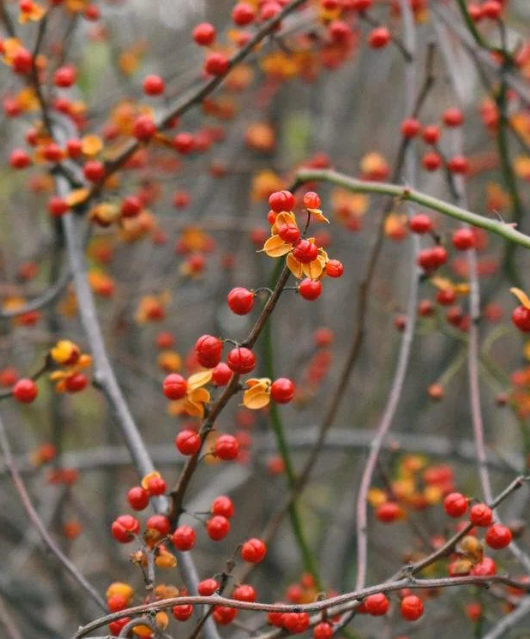
Female plants produce rounded orange to deep-orange capsules. When mature, each capsule opens into several valves and reveals bright scarlet fleshy arils surrounding the seeds. These dense fruit clusters are usually concentrated at the ends of branches and may remain conspicuous after the leaves fall.
American and Oriental Bittersweet
Oriental or Asian Bittersweet is Celastrus orbiculatus, an introduced invasive species that has become more common than American Bittersweet in many regions.
The location of the flowers and fruits is the most dependable field distinction. American Bittersweet usually produces larger terminal clusters at the ends of branches. Oriental Bittersweet generally produces smaller clusters in the leaf axils along the stem.
American Bittersweet usually has deeper orange capsules and more elongated pointed leaves. Oriental Bittersweet commonly has yellow to orange-yellow capsules and rounder leaves. Color and leaf shape overlap, however, and are less dependable than fruit-cluster position.
The two species can hybridize where they grow together. Hybrid vines may combine intermediate capsule color, leaf shape, and fruit position. For poisoning care, an uncertain *Celastrus* vine should be treated as potentially toxic while botanical identification continues.
Bittersweet Nightshade, Wahoo, and Other Look-Alikes
Bittersweet Nightshade or Woody Nightshade is Solanum dulcamara, an unrelated vine with purple star-shaped flowers, yellow centers, and elongated red berries. It contains steroidal glycoalkaloids and produces a different poisoning syndrome.
American Bittersweet is related to Wahoo and Burning Bush in the genus Euonymus. These relatives also produce colorful capsules and arils and contain their own toxic mixtures. They should not be treated as exact botanical or toxicologic substitutes.
Jacob’s-Ladder is more commonly applied to Polemonium species, while Waxwork and False Bittersweet may appear in other regional or horticultural contexts. Scientific identification is preferable whenever a poisoning is suspected.
Seasonal and Decorative Exposure
Leaves and young shoots become accessible during spring and remain a browsing concern throughout the growing season. Horses and livestock may reach vines growing along fences, woodland pasture margins, trees, or cut brush.
The greatest dog and household-pet exposure occurs during autumn and winter, when the orange capsules and scarlet arils become conspicuous and remain attached after leaf drop.
Fruiting branches are collected for wreaths, garlands, centerpieces, floral arrangements, gift wrapping, and winter decorations. Bringing them indoors creates an exposure for animals that would never encounter the living vine outdoors.
Dry fruits and seeds may fall onto floors, furniture, windowsills, bedding, or feeding areas. Cats may bat fruits from arrangements, while dogs may chew the entire branch. Floral wire, foam, ribbon, glue, hooks, artificial snow, and other included plants may create additional hazards.
Dogs, Cats, Horses, Livestock, and Other Animals
Dogs may eat fallen fruits, carry cut vines like sticks, dig around exposed roots, or chew wreaths and garlands. Numerous missing fruits or a swallowed decorative branch deserves more concern than one briefly mouthed leaf.
Cats may chew decorative foliage, play with loose fruits, or swallow plant residue while grooming. Continued feline food refusal requires attention even when vomiting has stopped.
Horses and livestock may browse foliage when desirable forage is limited or when vines are placed within reach during brush cutting, land clearing, storms, or fence maintenance. Goats should not be used deliberately to clear the vine from an enclosed area.
American Bittersweet should not be offered to rabbits, guinea pigs, poultry, or companion birds. Wildlife consumption of the fruits does not establish safety for captive animals with different diets, body sizes, and exposure quantities.
Diagnosis and Veterinary Assessment
No routine blood or urine test confirms American Bittersweet ingestion or measures its cardenolides or alkaloids. Diagnosis depends on accurate plant identification, the plant part and estimated amount eaten, compatible clinical signs, and exclusion of other toxins and foreign material.
Useful evidence includes terminal fruit clusters, capsules, arils, seeds, leaves, woody stems, roots, nursery labels, photographs of the living vine, decorative arrangements, vomited plant fragments, and an inventory of missing wire, ribbon, foam, hooks, or other objects.
Bloodwork may assess hydration, glucose, kidney values, and electrolyte abnormalities caused by vomiting or diarrhea. Blood-pressure measurement and electrocardiography may be appropriate after a large ingestion or when weakness, collapse, or an abnormal pulse develops.
Radiographs, ultrasound, contrast imaging, or endoscopy may be needed when a woody stem or decorative object may have been swallowed.
Prognosis and Prevention
The prognosis is good to excellent after most limited exposures. Poisoning appears uncommon, and many affected animals experience only temporary vomiting, diarrhea, abdominal discomfort, or appetite reduction.
The outlook becomes more guarded with persistent gastrointestinal losses, severe dehydration, weakness, collapse, seizures, aspiration, suspected cardiovascular abnormalities, or foreign-body obstruction.
Collect fallen capsules, arils, and seeds throughout autumn and winter. Avoid using fruiting branches in indoor decorations where animals can reach them.
Remove cut vines, roots, leaves, fruits, and clippings from paddocks, kennels, rabbit enclosures, poultry runs, and accessible compost or brush piles. When controlling vines outdoors, distinguish the native American species from invasive Oriental Bittersweet before broad removal, but prevent animal access to cut material from either species.
Immediate Steps After Exposure
- Stop further access. Move the animal away from the living vine, fallen fruit, seeds, exposed roots, cut branches, clippings, wreaths, garlands, and floral arrangements.
- Preserve the plant. Save terminal fruit clusters, capsules, arils, seeds, leaves, stems, roots, nursery labels, photographs, and any decorative arrangement involved.
- Determine what was eaten. Establish whether the animal swallowed fruit, seeds, leaves, bark, roots, woody stems, an entire twig, or an unidentified part of a mixed arrangement.
- Estimate the amount. Count missing fruits when possible and record the approximate time, animal’s weight, current signs, and whether vomiting or diarrhea has begun.
- Inspect for other hazards. Determine whether wire, ribbon, floral foam, pins, hooks, glue, artificial snow, preservatives, plastic berries, or another poisonous plant is missing.
- Remove only loose visible material. Lift fruit, seeds, leaves, bark, or twig pieces resting at the lips or front of the mouth when this can be done safely.
- Contact a veterinarian. Obtain guidance when more than a minor nibble was swallowed, numerous fruits are missing, the amount is uncertain, or any symptoms develop.
Do Not Attempt Unsupervised Home Treatment
- Do not induce vomiting automatically. Additional vomiting may worsen dehydration or aspiration risk, particularly when woody or sharp decorative material was swallowed.
- Do not give hydrogen peroxide, salt, mustard, syrup of ipecac, detergent, oil, or use manual gagging. These methods can cause gastric injury, aspiration, sodium poisoning, or airway trauma.
- Never use hydrogen peroxide as a feline emetic. It can severely injure a cat’s stomach and esophagus.
- Never attempt to induce vomiting in a horse. Horses cannot vomit.
- Do not give activated charcoal routinely. It is not required after every minor exposure and may be inhaled by a vomiting, weak, trembling, seizing, sedated, or poorly swallowing animal.
- Do not force milk, oil, food, water, or electrolyte products. These substances do not neutralize the plant and may be aspirated.
- Do not give antihistamines, human pain relievers, antidiarrheals, antacids, bismuth products, sucralfate, acid suppressants, or leftover prescriptions automatically. These medications are not American Bittersweet antidotes and may be inappropriate.
When Emergency Examination Is Required
- Persistent gastrointestinal illness: Repeated vomiting, inability to retain water, frequent watery diarrhea, blood, black stool, or severe abdominal pain requires examination.
- Dehydration or circulatory weakness: Dry or tacky gums, sunken eyes, reduced urination, pale gums, cool extremities, profound weakness, inability to stand, or collapse requires urgent treatment.
- Neurologic abnormalities: Persistent tremors, severe incoordination, seizures, stupor, or reduced responsiveness is an emergency.
- Possible cardiovascular effects: Fainting, weak pulses, pale or blue-gray gums, or an unusually slow, rapid, weak, or irregular heartbeat requires electrocardiographic and blood-pressure assessment.
- Choking or foreign material: Continuous gagging, frantic pawing, inability to swallow, blue-gray gums, or breathing difficulty may indicate a lodged twig, wire, hook, ribbon, or other object.
- Possible obstruction: Persistent vomiting, abdominal enlargement, reduced stool, worsening pain, or symptoms returning after initial improvement may indicate retained plant or decorative material.
Vomiting, Diarrhea, and Hydration Monitoring
Count vomiting and diarrhea episodes and note fruit capsules, scarlet arils, seeds, leaves, woody fragments, blood, coffee-ground material, black stool, wire, foam, ribbon, or other foreign material.
Fresh water may remain available when the animal is fully alert, swallowing normally, and not vomiting repeatedly. Do not syringe or pour water into the mouth.
Monitor gum moisture, eye position, activity, urination, abdominal comfort, and the ability to stand. An animal that vomits whenever it drinks may require injectable nausea control and subcutaneous or intravenous fluids.
Do not suppress diarrhea with an owner-selected medication before obstruction, another toxin, infection, severe dehydration, and cardiovascular status have been assessed.
Weakness, Tremors, and Seizures
Keep a weak or uncoordinated animal in a quiet, padded, single-level area away from stairs, pools, balconies, furniture edges, and slippery floors.
Do not repeatedly force the animal to stand or walk. Carry a small animal safely or use a blanket, stretcher, or two-person lift for a larger patient.
During a seizure, remove nearby hazards, reduce light and noise, keep hands away from the mouth, and seek immediate care. Do not place food, water, or medication in the mouth.
A brief video of tremors, gait changes, or unusual behavior may help the veterinarian when it can be recorded without delaying transport.
Veterinary Examination and Decontamination
The veterinarian will assess plant identity, the part and amount eaten, hydration, abdominal pain, mental status, coordination, blood pressure, pulse quality, heart rhythm, and possible foreign-material ingestion.
Professional emesis may be considered after a recent substantial fruit or seed ingestion in a fully alert, stable, asymptomatic dog that can protect its airway and has not swallowed sharp or woody material.
Emesis is inappropriate after vomiting, weakness, tremors, seizures, collapse, abnormal breathing, or impaired swallowing begins. It may also be inappropriate when wire, hooks, stiff twigs, ribbon, or other potentially injurious objects were swallowed.
Activated charcoal may be considered after a meaningful recent exposure when the animal remains neurologically normal and can protect its airway. It is not an automatic treatment for every damaged leaf or fruit.
Supportive and Monitoring-Based Veterinary Treatment
No established plant-specific antidote exists. Treatment is based on the animal’s actual gastrointestinal, neurologic, cardiovascular, and hydration findings.
Veterinarian-selected antiemetics such as maropitant or ondansetron may reduce continuing nausea and vomiting. Subcutaneous or intravenous fluids may replace losses and support circulation.
Electrolytes, glucose, kidney values, acid-base status, body weight, urine production, and blood pressure may require monitoring after persistent vomiting, diarrhea, weakness, or collapse.
Sucralfate may be considered when repeated vomiting, hematemesis, esophagitis, erosive gastritis, or documented mucosal injury indicates a need for barrier protection. It is not a Bittersweet antidote.
Significant tremors or seizures may require injectable anticonvulsant or muscle-relaxant medication, oxygen, airway protection, temperature monitoring, and correction of glucose or electrolyte abnormalities.
An abnormal pulse or collapse may justify electrocardiography and continuous rhythm monitoring. Documented rhythm or blood-pressure abnormalities require individualized treatment rather than routine administration of heart medication.
Foreign-Body and Decorative-Material Treatment
Radiographs, ultrasound, contrast imaging, or endoscopy may be required when a woody stem, wire, ribbon, foam, hook, pin, plastic item, or other decorative material may have been swallowed.
Do not pull deeply lodged twigs, wire, ribbon, string-like roots, or other material from the mouth or rectum without veterinary direction.
A retained object may require endoscopic or surgical removal. Continued vomiting or abdominal pain after the expected plant irritation should be improving increases concern for obstruction.
Horses and Livestock
Remove every exposed animal from the vine, fallen branches, clippings, brush piles, suspect hay, and woodland pasture margins. Examine all animals sharing access.
Do not drench or force water, oil, charcoal, feed, or medication into a weak, bloated, coughing, recumbent, seizing, or poorly swallowing animal.
Large-animal evaluation may include abdominal examination, hydration and electrolyte assessment, cardiovascular monitoring, fluid therapy, pain control, gastrointestinal support, and treatment of tremors or seizures.
Preserve representative vine and forage samples. A group outbreak requires examination of every toxic plant, chemical, and feed source rather than assuming American Bittersweet is the only exposure.
Prognosis and Recovery
The prognosis is good to excellent after most limited exposures. Mild vomiting, diarrhea, abdominal discomfort, appetite reduction, and lethargy generally improve within approximately twelve to forty-eight hours.
Improvement should include cessation of vomiting, firmer stool, renewed appetite, normal drinking and urination, stronger activity, and resolution of weakness.
The prognosis becomes more guarded after severe dehydration, collapse, persistent neurologic signs, documented cardiovascular abnormalities, aspiration, gastrointestinal bleeding, or foreign-body obstruction.
Frequently Asked Questions About American Bittersweet and Animal Poisoning
How poisonous is American Bittersweet to dogs and cats?
American Bittersweet is generally considered a low-severity poisonous plant, but it is not harmless. Dogs and cats may develop vomiting, diarrhea, abdominal discomfort, appetite loss, depression, and weakness. Tremors or seizures are possible but uncommon. A large fruit, seed, or vine ingestion can become more serious through dehydration, neurologic effects, possible cardiovascular abnormalities, aspiration, or obstruction.
What toxins are actually present?
Veterinary references identify cardenolides and alkaloids, while older descriptions state that the plant may contain euonymin and sesquiterpene alkaloids. The complete species-specific toxin mixture has not been fully characterized. Named compounds from other Celastrus species should not be assumed to occur in identical concentrations in Celastrus scandens.
Which parts of American Bittersweet are poisonous?
All portions should be treated as potentially poisonous, including leaves, young shoots, flowers, orange capsules, scarlet arils, seeds, sap, bark, woody stems, and roots. The fruits and seeds create the most conspicuous household hazard, while foliage and vines are important grazing exposures.
Are the scarlet parts berries?
No. The outer fruit is an orange capsule that splits open when mature. The bright scarlet material is a fleshy aril surrounding each seed. A pet eating the colorful fruit usually swallows capsule tissue, arils, and seeds together, so the entire structure should be treated as poisonous.
Can one fruit poison a dog?
One fruit may cause no signs, particularly in a large dog, but no dependable safe count exists. The risk is greater for small animals, numerous missing fruits, repeated access, swallowed seeds, or an entire decorative branch. The actual amount and patient should be discussed with a veterinarian rather than judged from a universal fruit-count rule.
What symptoms are most likely?
Vomiting, diarrhea, abdominal discomfort, appetite reduction, depression, and weakness are the best-supported signs. Persistent vomiting or diarrhea can cause dehydration and electrolyte abnormalities. Tremors and seizures are recognized but rare and warrant emergency care.
Can American Bittersweet affect the heart?
Cardenolides make cardiovascular effects biologically plausible, especially after a substantial ingestion. Severe rhythm abnormalities are not the usual documented presentation. An unusually slow, rapid, weak, or irregular heartbeat with pale gums, weakness, fainting, or collapse requires electrocardiography, blood-pressure measurement, and electrolyte assessment.
Can American Bittersweet cause seizures?
Seizures are listed as a rare possible sign. They are not expected after one briefly mouthed fruit or leaf. Tremors, severe incoordination, seizures, stupor, or loss of consciousness may indicate a large exposure, electrolyte or glucose disturbance, pesticide, another poisonous plant, medication, or unrelated neurologic disease.
How can American Bittersweet be distinguished from Oriental Bittersweet?
American Bittersweet generally produces dense flower and fruit clusters at the ends of branches. Oriental Bittersweet, Celastrus orbiculatus, usually produces smaller clusters in the leaf axils along the stem. American capsules are commonly deeper orange, while Oriental capsules are often yellow to orange-yellow, but cluster position is more dependable than color or leaf shape.
Can American and Oriental Bittersweet hybridize?
Yes. Hybrid plants may combine intermediate leaf shape, capsule color, and fruit-cluster position. Hybridization matters for conservation and removal decisions. For emergency animal care, any uncertain Celastrus vine should be treated as potentially poisonous while identification continues.
Is American Bittersweet the same as Bittersweet Nightshade?
No. Bittersweet Nightshade is Solanum dulcamara, an unrelated plant with purple star-shaped flowers and elongated red berries. It contains steroidal glycoalkaloids and has a different toxicology. The two plants share only part of a common name.
Is it the same as Wahoo or Burning Bush?
No. Wahoo and Burning Bush belong to the related genus Euonymus. Their colorful capsules and arils can resemble American Bittersweet fruit, and they have their own poisonous compounds. Related-family chemistry does not make the plants botanical or toxicologic synonyms.
Are dried branches and wreaths still dangerous?
Yes. Drying does not provide a dependable guarantee that the vine, fruits, or seeds are harmless. Wreaths and garlands may also contain wire, hooks, pins, foam, ribbon, glue, artificial snow, preservatives, or other poisonous plants. Fallen fruits and decorative debris should be collected immediately.
Can wildlife eat American Bittersweet safely?
Many wild birds and mammals eat the fruits and disperse the seeds. Their use of the plant does not establish safety for dogs, cats, horses, livestock, rabbits, or companion birds. Species differ in natural diet, metabolism, body size, and the amount consumed.
Is American Bittersweet poisonous to horses and livestock?
Yes. Horses may develop salivation, feed refusal, abdominal discomfort, diarrhea, depression, or weakness. Cattle, sheep, and goats may experience gastrointestinal irritation, weakness, or prostration after consuming sufficient foliage or clippings. Goats should not be used deliberately to clear the vine from an enclosed area.
Should I induce vomiting or give activated charcoal?
Do not induce vomiting at home. A veterinarian may consider professional emesis after a recent substantial fruit or seed ingestion in an alert, stable dog that has not swallowed woody or sharp material. Activated charcoal is not automatically required and can be aspirated by a vomiting, weak, trembling, seizing, or poorly swallowing animal.
How is American Bittersweet poisoning diagnosed and treated?
Diagnosis depends on identifying the plant, determining the part and amount eaten, and evaluating gastrointestinal, neurologic, cardiovascular, and hydration findings. There is no specific antidote. Treatment may include anti-nausea medication, fluids, electrolyte correction, blood-pressure and heart-rhythm monitoring, seizure control, and imaging or removal of swallowed woody or decorative material.
How long do symptoms last, and what is the prognosis?
Most uncomplicated limited exposures improve within approximately twelve to forty-eight hours. The prognosis is good to excellent when vomiting and diarrhea remain limited and hydration is maintained. Severe dehydration, collapse, seizures, documented cardiovascular abnormalities, aspiration, gastrointestinal bleeding, or foreign-body obstruction makes the outlook more guarded.