Tropic Snow Dumb Cane Raphides, Proteolytic Irritation, Oral Needle Injury, Eye Exposure, and Airway Swelling Risk
Is Tropic Snow Poisonous to Dogs, Cats, Horses, and Livestock?
Yes—Tropic Snow, Dieffenbachia seguine ‘Tropic Snow’, is poisonous to dogs, cats, horses, livestock, birds, rabbits, guinea pigs, reptiles, and other animals that chew it. This large dumb cane cultivar is still widely sold and searched as Dieffenbachia amoena ‘Tropic Snow’. Its leaves, thick cane-like stems, petioles, roots, sap, cuttings, offsets, spathes, spadices, fruiting structures, and pruning debris contain insoluble calcium oxalate crystals, especially needle-shaped raphides, together with Dieffenbachia-associated proteolytic material that can intensify local tissue injury.
The poisoning begins at the point of contact. Chewing crushes crystal-bearing idioblast cells and drives raphides into the lips, gums, tongue, palate, throat, esophagus, skin, or eyes. Signs often begin immediately and may include violent head shaking, pawing at the mouth, drooling, foaming, gagging, retching, vomiting in species that can vomit, oral swelling, hoarse vocalization, refusal to eat or drink, and eye pain after sap transfer. Most limited exposures are painful rather than fatal, but Tropic Snow deserves more concern than a mild “bad-taste” plant because Dieffenbachia has documented severe oropharyngeal injury, laryngeal swelling, and rare airway compromise.
Insoluble Dieffenbachia raphides are not the same hazard as soluble oxalate range plants or ethylene glycol poisoning. An uncomplicated Tropic Snow bite is not expected to cause primary kidney failure, permanent liver damage, systemic hypocalcemia, or widespread oxalate deposition. The practical emergencies are progressive mouth or throat swelling, inability to swallow saliva, aspiration risk, persistent vomiting or diarrhea, serious eye injury, food refusal in rabbits or guinea pigs, respiratory difficulty in birds or cats, and any severe sign that suggests airway obstruction, dehydration, oxygen deprivation, a mixed exposure, or another toxin.
About this guide: This page provides general pet-poisoning information and cannot diagnose or treat an individual animal. For any suspected exposure, contact a veterinarian or animal poison-control service immediately. Do not induce vomiting, give medication, or attempt home decontamination unless directed by a veterinary professional.
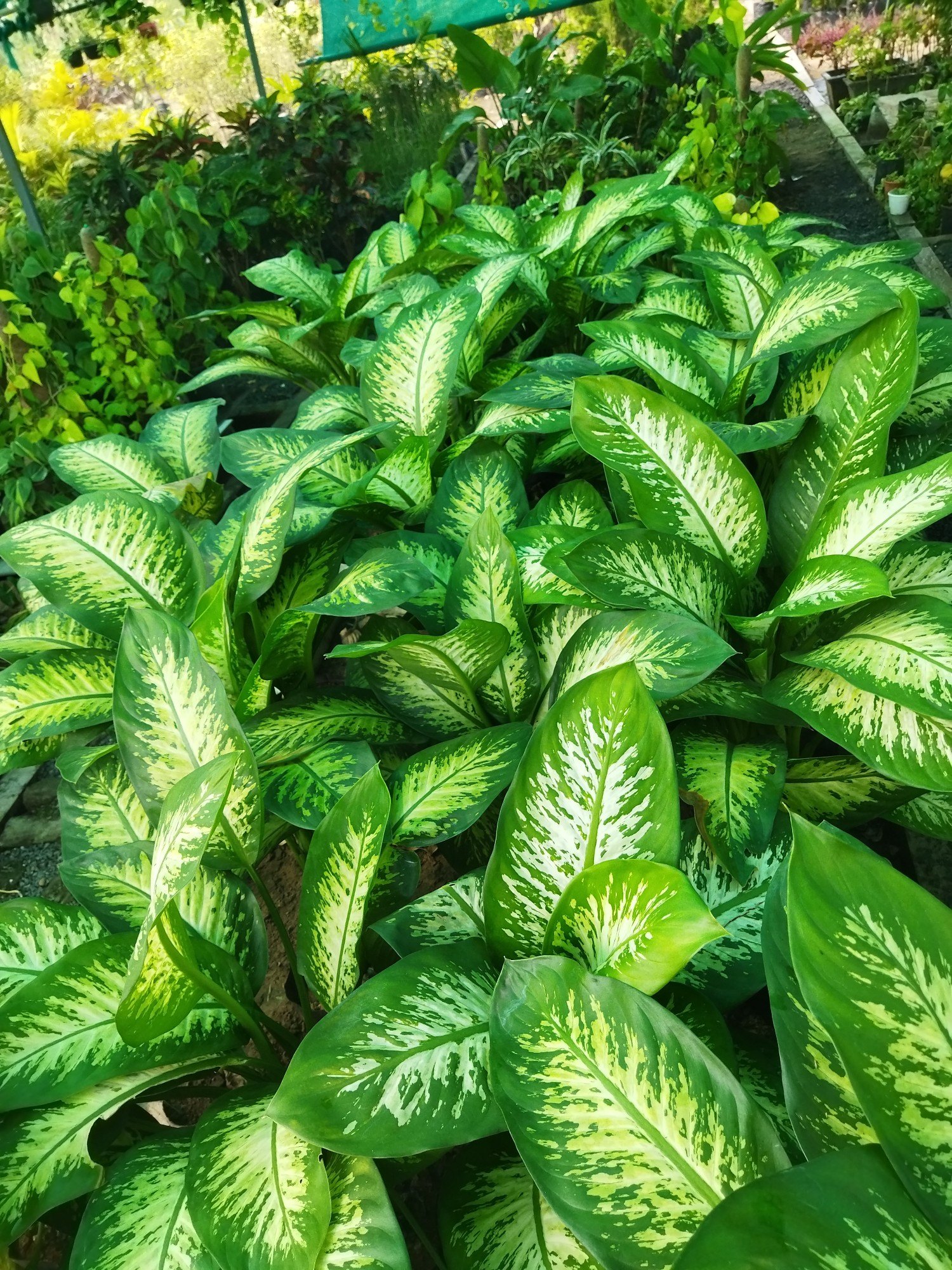
Tropic Snow
Dieffenbachia seguine (Jacq.) Schott ‘Tropic Snow’
Important historical, nursery, and toxicology-search names include:
- Dieffenbachia amoena W.Bull ‘Tropic Snow’
- Dieffenbachia ‘Tropic Snow’
- Dieffenbachia seguine var. seguine ‘Tropic Snow’
Important species-level synonyms and older names associated with the accepted species include:
- Arum seguine Jacq.
- Caladium seguine (Jacq.) Vent.
- Caladium maculatum Lodd.
- Dieffenbachia maculata (Lodd.) G.Don
- Dieffenbachia picta Schott
- Dieffenbachia seguine var. maculata (Lodd.) Engl.
Important non-synonym cultivar and plant-name confusion:
- Dieffenbachia ‘Exotica’ — separate compact dumb cane selection, not an exact synonym for Tropic Snow
- Dieffenbachia ‘Exotica Perfection’ or ‘Perfection’ — separate heavily variegated dumb cane selection, not Tropic Snow
- Dieffenbachia ‘Camille’ — separate smaller cultivar with a different growth habit and leaf pattern
- Dieffenbachia ‘Tropic Marianne’ — separate Tropic-series cultivar, not Tropic Snow
- Dieffenbachia ‘Tropic Sun’ — separate patented sport described in comparison with ‘Tropic Snow’
- Dieffenbachia oerstedii Schott — separate species; sometimes confused online with Tropic Snow but not the correct identification for this page
- Aglaonema, Philodendron, Epipremnum, Monstera, Spathiphyllum, and other variegated aroids — related or visually confused houseplants that share the broad insoluble-oxalate hazard but are not exact synonyms
Araceae — Arum Family
Tropic Snow is an aroid. That family placement matters clinically because many common houseplants in Araceae contain insoluble calcium oxalate crystals, but Dieffenbachia is especially important because its raphides, idioblast discharge behavior, and associated proteolytic material have been studied in unusual detail.
Tropic Snow; Tropic Snow Dumb Cane; Tropic Snow Dumbcane; Giant Dumb Cane; Giant Dumbcane; Charming Dieffenbachia; Dumb Cane; Dumbcane; Dumb Cane Plant; Leopard Lily; Mother-in-Law Plant; Dieffenbachia; Variegated Dumb Cane.
Historical and taxonomic search variations include Dieffenbachia seguine ‘Tropic Snow’, Dieffenbachia amoena ‘Tropic Snow’, Dieffenbachia ‘Tropic Snow’, Dieffenbachia seguine var. seguine ‘Tropic Snow’, Dieffenbachia amoena, Dieffenbachia picta, Dieffenbachia maculata, Caladium seguine, and Arum seguine.
Exotica, Exotica Perfection, Perfection, Camille, Tropic Marianne, Tropic Sun, Sparkle, Reflector, Snow, and other named Dieffenbachia selections are separate cultivars or trade plants rather than exact synonyms for Tropic Snow. “Dumb cane” and “Dieffenbachia” are broad names covering many species, hybrids, and cultivars. They belong in searches and emergency identification, but the cultivar context should not be erased when the plant label or image clearly shows Tropic Snow.
The Confirmed Toxic System in Tropic Snow
The main toxic system in Tropic Snow is not one ordinary dissolved poison circulating through the bloodstream. It is a contact-injury system built around insoluble calcium oxalate crystals, especially needle-shaped raphides, and Dieffenbachia-associated proteolytic material. The crystals are stored in specialized cells called idioblasts. When an animal bites, crushes, or tears the plant, those cells release crystal bundles into sap, saliva, and damaged plant tissue. The animal’s own chewing, tongue movement, swallowing, gagging, pawing, and attempts to spit out the plant then press the crystals into the lips, tongue, gums, palate, pharynx, esophagus, skin, or eye surface.
This is why Tropic Snow exposures can look dramatic even when the swallowed amount is small. The injury begins before digestion. It does not require liver metabolism, bacterial conversion, absorption into the blood, or passage into the kidneys. The animal is reacting to immediate tissue penetration and inflammation. A dog that suddenly throws down the leaf, a cat that drools and hides, a parrot that wipes its beak repeatedly, or a rabbit that stops eating after chewing a cane is showing a real tissue injury, not merely disliking the flavor.
The older PAWS page correctly emphasized that Dieffenbachia is more than a generic oxalate plant. Walter and Khanna’s chemical investigation of Dieffenbachia seguine, D. amoena, and D. picta reported L-asparagine, a proteolytic enzyme, and long sharp calcium oxalate raphides in examined material. That study matters directly for Tropic Snow because the cultivar has long been sold and indexed as D. amoena ‘Tropic Snow’, while current taxonomy places D. amoena within D. seguine. The most defensible public wording is therefore stronger than “suspected protease” but still careful: Dieffenbachia material has published evidence for raphides and proteolytic activity, while exact cultivar-to-cultivar quantitative differences for Tropic Snow are not established.
Idioblasts, Raphides, and Why the Plant Acts Like a Mouthful of Needles
Idioblasts are plant cells that differ from neighboring cells because they accumulate unusual contents such as crystals, oils, pigments, tannins, latex, mucilage, or other specialized material. In Dieffenbachia, idioblasts produce and store calcium oxalate crystals in several forms. Coté’s work on Dieffenbachia seguine documented a varied crystal-cell system rather than one uniform bag of identical needles. Different tissues may contain raphides, druses, prisms, crystal sand, and other forms arranged in cells with different shapes, positions, and developmental roles.
Raphides create the classic dumb-cane injury. They are long, narrow crystals packed in bundles and often embedded in a mucilaginous or gelatinous matrix. Under magnification, they are not soft fibers. They are sharp mineral structures capable of puncturing moist tissue. Some may be grooved, pointed, barbed, or otherwise shaped in ways that increase irritation. A single bite can release a large number across the tongue and mouth. The result is comparable to spreading thousands or millions of microscopic needles over a wet, moving, highly sensitive surface.
Rauber’s observations added another layer: Dieffenbachia idioblasts are not merely passive storage cells. The paper described specialized cells capable of forcibly shooting raphides after the cell tip is disrupted. That does not mean every exposed cell behaves like an identical spring-loaded dart gun, and it does not mean chewing pressure is irrelevant. The animal crushes tissue mechanically, tears cells open, smears sap, and drives released crystals into the mucosa. But the discharging-idioblast evidence explains why Dieffenbachia can produce an unusually intense and immediate reaction compared with a simple plant splinter.
The familiar “loaded spring” or “dart gun” explanation should be used as a practical illustration, not as a rigid universal mechanism. Dieffenbachia tissues contain multiple idioblast types, and crystal release may involve mechanical rupture, osmotic change, mucilage expansion, cell-wall behavior, saliva contact, and direct chewing pressure. The clinical endpoint is what matters most: crystal bundles reach the mouth, throat, eyes, or skin in a form that can puncture tissue and start inflammation almost immediately.
Proteolytic Material and the Needle Effect
Dieffenbachia has long been treated as one of the more injurious aroids because raphides alone do not fully explain every reported intensity of pain, swelling, and mucosal damage. Older chemical and toxicological work implicated calcium oxalate crystals, proteinaceous material, glycosidal or nitrogen-free material, and other plant constituents. Arditti and Rodriguez’s review is useful because it preserves that evidence history instead of pretending the topic was ever simple.
The proteolytic part matters clinically because proteases break down proteins. When plant tissue is intact, the animal’s mouth has surface barriers. Once raphides puncture those surfaces, a proteolytic constituent has a better route into tissue. This is the “needle effect”: the crystal makes the entry channel, and the accompanying irritating material can intensify injury through that channel. Experimental work in other raphide-containing plants supports this synergy concept, and Walter and Khanna’s Dieffenbachia chemistry work supports the presence of proteolytic activity in the Dieffenbachia material they examined.
The point should not be overstated into a fake precision. There is no owner-usable “enzyme dose,” and the exact amount of proteolytic activity in every Tropic Snow plant, every leaf position, every cane section, every cutting, and every dried piece is not known. Growing conditions, tissue age, cultivar selection, injury, storage, and drying could all matter. What is justified is a stronger clinical explanation: Tropic Snow is an insoluble-raphide aroid whose injury may be intensified by Dieffenbachia-associated proteolytic material, which helps explain why this genus can produce severe oral, pharyngeal, and ocular irritation out of proportion to the apparent size of the bite.
Inflammation, Swelling, and Why Antihistamines Are Not Antidotes
Once raphides puncture tissue, the body responds. Pain receptors fire. Local cells release inflammatory mediators. Blood vessels dilate. Fluid moves into the injured area. Kinins, histamine, prostaglandins, and related pathways may contribute to the redness, burning, tenderness, swelling, and increased secretions that follow. The inflammatory reaction is partly protective, but it becomes dangerous when it develops in confined anatomy such as the tongue base, pharynx, glottis, or larynx.
This is the reason the page should not describe Tropic Snow poisoning as a simple allergy. Histamine can participate in inflammation, but the initiating injury is mechanical crystal penetration with possible biochemical intensification from plant sap and proteolytic material. An antihistamine does not pull raphides out of tissue. A corticosteroid does not dissolve calcium oxalate crystals. Milk does not neutralize embedded needles. Activated charcoal does not clean the tongue. Some medications may be useful in selected veterinary patients, especially when swelling, pain, vomiting, ocular injury, or airway risk is being managed professionally, but they are not universal home antidotes.
That distinction also protects the animal from a common owner mistake. A drooling, gagging, painful animal may have impaired swallowing. Giving pills, liquid medications, milk, yogurt, food, or charcoal at home can add aspiration risk. Sedating medications can make airway assessment more difficult. The best first response is controlled removal of loose visible plant material, prevention of eye transfer, veterinary consultation, and emergency care when swelling, breathing, swallowing, or severe pain becomes more than mild.
Plant Parts, Propagation Pieces, and Pruning Debris
All parts of Tropic Snow should be treated as toxic or irritating. The broad variegated leaves create the most obvious exposures, but the thick cane-like stems, petioles, roots, sap, offsets, cuttings, spathes, spadices, fruiting structures, seeds, and pruning debris may contain crystal-bearing cells and irritating sap. The plant’s large, cane-forming habit creates a practical risk that smaller cultivars may not: a fallen cane section or cutting can look like a chew stick to a dog, a fibrous toy to a parrot, or browse to a rabbit or guinea pig.
Propagation deserves special attention. Cut Dieffenbachia canes are often placed in water, potting medium, plastic containers, jars, trays, or greenhouse benches while rooting. A curious animal may chew the cutting, drink contaminated water, lick sap from the cut end, or knock over the container and walk through residue. Propagation water should not be treated as a proven dissolved-toxin solution in the same way as a chemical concentrate, but it may contain sap, plant fragments, bacteria, fertilizer residues, rooting additives, or other contaminants. Because a cutting has fresh wounds and exposed sap, it should be kept behind the same barrier as the living plant.
Dried or wilted material should not be assumed harmless. Calcium oxalate is a mineral, not a volatile chemical that disappears when the leaf loses water. Drying may reduce free sap and may alter enzyme activity, but chewing dried canes, dried leaves, or old pruning waste can still expose the mouth to crystal-containing tissue. Compost, trash, vacuum debris, potting mix, and greenhouse sweepings can also contain fragments sharp enough or mixed enough to be clinically relevant for small animals.
Insoluble Oxalate Is Not Soluble-Oxalate Kidney Poisoning
Tropic Snow belongs in the insoluble-calcium-oxalate group, not the soluble-oxalate systemic-poisoning group. This distinction matters because the word “oxalate” often causes owners to jump to kidney failure. Soluble oxalate salts can be absorbed, bind circulating calcium, contribute to hypocalcemia, and deposit calcium oxalate in renal tubules. Ethylene glycol poisoning can also produce renal calcium oxalate deposition after metabolism. That is not the expected mechanism after an uncomplicated Dieffenbachia bite.
Dieffenbachia raphides are primarily contact structures. They injure the mouth, throat, skin, eyes, and gastrointestinal surfaces where they touch. Primary renal failure, permanent liver damage, systemic hypocalcemia, widespread oxalosis, and routine metabolic collapse are not expected direct effects of a simple Tropic Snow exposure. Severe dehydration from persistent vomiting or diarrhea could secondarily affect perfusion and kidney values. Prolonged airway obstruction could cause oxygen deprivation and secondary organ injury. Aspiration pneumonia, shock, pesticide exposure, fertilizer ingestion, another plant, medication exposure, or unrelated disease could also change the clinical picture.
That evidence boundary should be stated plainly because it prevents both underreaction and overreaction. The owner should not dismiss Tropic Snow as harmless because it usually acts locally. Local airway swelling can be life-threatening. But the owner also should not assume that every drooling episode means kidney failure is starting. Veterinary evaluation should be driven by the actual signs: mouth and throat injury, swallowing, breathing, hydration, eye involvement, species risk, and evidence of mixed exposure.
No Reliable Safe Dose Has Been Established
No dependable safe dose has been established for dogs, cats, horses, cattle, sheep, goats, pigs, poultry, rabbits, guinea pigs, birds, reptiles, or other animals. In many animals the immediate pain limits intake. That is why most Dieffenbachia exposures reported to poison centers are less severe than the plant’s worst historical reputation suggests. But pain-limited exposure is not the same as safety. A puppy may keep chewing through pain. A parrot may methodically shred a cane. A rabbit may gnaw a cutting and then stop eating. A livestock animal may encounter chopped ornamental waste mixed with other clippings.
The practical dose depends on far more than the number of leaves. It depends on the animal’s size, species, mouth anatomy, chewing style, plant part, tissue freshness, sap transfer, eye exposure, swallowing ability, airway swelling, vomiting, hydration, and whether other materials were involved. A single leaf-edge nibble by a large dog that immediately stops is not the same as a kitten with sap in both eyes, a rabbit that refuses food, or a dog that shredded several fresh cane sections. The page should therefore avoid fake thresholds such as “one bite is harmless” or “one leaf is fatal.”
Onset and Early Progression
Symptoms usually begin while the animal is chewing Tropic Snow or within minutes afterward. That rapid onset is one of the clues that the exposure is a contact raphide injury rather than an absorbed systemic poison. A dog or cat may suddenly release the leaf or cane, shake the head violently, paw at the mouth, rub the face, lick repeatedly, drool heavily, foam at the lips, gag, retch, cry, yelp, hide, or refuse to continue eating. The reaction can look dramatic because the mouth is highly sensitive and the crystals are being pressed into moving tissue.
Swelling may continue after chewing stops. The owner may see an animal that first seems panicked, then quiet, then reluctant to swallow. That quiet phase should not automatically be interpreted as recovery. An animal may become still because the mouth hurts, the throat is swelling, or swallowing has become difficult. The key questions are whether the animal can breathe quietly, swallow saliva, drink voluntarily, keep the airway clear, and begin to settle without worsening signs.
The course is usually localized and self-limiting after a small exploratory bite. Pain and drooling may improve over several hours. A larger exposure, fresh sap contact, prolonged chewing, eye exposure, or involvement of a small animal can create a more complicated course. The page should not promise immediate resolution, because documented Dieffenbachia cases include severe oropharyngeal edema, upper-airway compromise, mechanical ventilation, ocular injury, and prolonged mucosal damage in unusual cases.
Oral Burning, Drooling, and Loss of Normal Mouth Function
The lips, gums, tongue, palate, cheeks, and oral lining may become red, painful, tender, swollen, or visibly irritated. Saliva may pour from the mouth because swallowing hurts. Some animals hold the mouth partly open, smack the lips, chatter the jaws, rub the muzzle, or repeatedly approach and refuse food or water. Plant pieces can lodge between the teeth, along the gums, or at the back of the mouth, adding continued contact until removed professionally or safely cleared from the front of the mouth.
The common name “dumb cane” comes from this oral and pharyngeal effect. In people, speech can become temporarily impaired because the tongue and throat are painful and swollen. Animals can show the same functional problem in their own way. A dog’s bark may sound hoarse, weak, or raspy. A cat’s meow may change. Livestock vocalization may sound abnormal. Vocal change is not the most common sign, but when it occurs with drooling, swelling, choking, or respiratory noise, it deserves more concern than simple mouth irritation alone.
Gagging, Choking, Vomiting, and Esophageal Irritation
Gagging, retching, dry heaving, repeated swallowing, and choking motions occur when crystals and sap reach the back of the mouth, pharynx, or upper esophagus. Dogs, cats, pigs, and other animals capable of vomiting may vomit after the plant irritates the throat, esophagus, stomach, or upper intestinal tract. Vomiting does not remove raphides already embedded in the mouth or pharynx, and it may drag irritating material back across already injured tissue.
More substantial ingestion can produce appetite loss, nausea-like behavior, abdominal discomfort, depression, vomiting, or diarrhea. Persistent vomiting and diarrhea can cause dehydration, electrolyte abnormalities, weakness, and poor perfusion. Those consequences are secondary to fluid loss and systemic stress, not proof that insoluble Dieffenbachia crystals have entered the bloodstream and attacked the kidneys. Repeated vomiting also raises aspiration risk, especially when swelling, gagging, weakness, or poor swallowing is present.
Horses, rabbits, guinea pigs, and several other species cannot vomit. Their clinical picture may therefore look less dramatic at first even when the exposure is important. Salivation, painful chewing, feed refusal, repeated swallowing, coughing, abdominal discomfort, reduced fecal output, or depression may replace the vomiting seen in dogs and cats. A non-vomiting species can still develop serious mouth pain, dysphagia, aspiration, or secondary gastrointestinal complications.
Throat Swelling, Airway Signs, and Aspiration Risk
Progressive swelling of the tongue, pharynx, glottis, or larynx is the most important emergency complication. It is not the expected outcome of every bite, but it is real enough that the page must warn clearly. Warning signs include saliva pooling in the mouth, inability to swallow water, repeated choking, head and neck extension, noisy inspiration, open-mouth breathing, rapid shallow gasps, blue-gray gums, weakness, collapse, or panic associated with breathing effort.
Cats with open-mouth breathing should be treated as emergency patients. Small dogs and brachycephalic dogs have less airway reserve. Birds can deteriorate quickly when oral or upper-airway swelling interferes with breathing. Horses or livestock with feed, water, or saliva coming from the nostrils may have impaired swallowing, choke, or aspiration risk. In any species, an animal that cannot swallow normally should not be forced to drink, eat, take pills, or swallow charcoal.
Severe airway compromise from Dieffenbachia is uncommon compared with mild mouth irritation, but case literature documents serious outcomes. Some patients have required endotracheal intubation, intensive monitoring, mechanical ventilation, or prolonged recovery. That evidence does not mean every Tropic Snow bite is catastrophic. It means the emergency line is not “how much was swallowed” alone; it is whether the animal can breathe, swallow, protect the airway, and remain stable as swelling evolves.
Eye Exposure and Skin Contact
Sap entering an eye can cause intense pain, blinking, tearing, eyelid spasm, redness, conjunctival swelling, light sensitivity, corneal irritation, and reluctance to open the eye. An animal may rub the face on the floor, paw at the eye, or keep the eyelids clamped shut. Dieffenbachia-associated crystalline keratopathy and corneal injury are documented in human cases, and the same basic eye-surface risk is relevant to animals when sap or plant debris reaches the cornea.
Eye exposure can happen without a large ingestion. A cat may step in sap during pruning and later groom the paw. A dog may chew a cane and rub the muzzle. A parrot may shred a stem and wipe the beak. A rabbit may push the face into a fresh cutting. Persistent squinting, cloudiness, pain, light sensitivity, redness, or refusal to open the eye after gentle irrigation requires veterinary examination rather than watchful waiting.
Skin contact is usually less severe than mouth or eye contact, but sap can irritate sensitive skin, abrasions, lips, eyelids, and areas with thin hair coverage. People handling cut canes or leaves can also transfer sap to their own eyes and mouths. Gloves, handwashing, tool cleaning, and keeping animals away during pruning are part of poisoning prevention, not just plant-care advice.
Dogs and Cats
Dogs may chew leaves, petioles, thick canes, exposed roots, cuttings, offsets, or pruning debris. Puppies may treat cane sections as sticks. A bored dog may pull apart a floor plant and create a larger exposure than a single bite. Typical signs include sudden mouth pain, drooling, foaming, head shaking, pawing, muzzle rubbing, gagging, vomiting, food refusal, tongue swelling, hoarse barking, choking, and occasionally respiratory difficulty.
Cats may nibble leaf margins, chew a new shoot, walk through sap, or groom contaminated paws. They may drool, hide, paw at the mouth, repeatedly swallow, vomit, refuse food, squint, or show eye pain after sap transfer. Cats should be watched carefully because they may hide worsening signs. Open-mouth breathing, progressive swelling, inability to swallow saliva, or persistent eye pain is not a mild plant reaction.
Both dogs and cats may have mixed exposures from the same plant area. Potting soil, fertilizer granules, insecticide, plant labels, plastic clips, decorative stones, moss, rooting hormone, and other houseplants may be involved when a pet destroys a pot. Severe neurologic signs, kidney abnormalities, collapse, or marked cardiovascular changes should not be attributed automatically to Tropic Snow without checking for those other hazards.
Horses, Livestock, Poultry, and Camelids
Horses, cattle, sheep, goats, pigs, camelids, and poultry are unlikely to seek out an indoor floor plant in the usual household setting, but they can encounter Tropic Snow through discarded houseplants, greenhouse waste, interiorscape maintenance, storm-damaged tropical landscaping, or ornamental clippings dumped into a pen or pasture. The plant should never be treated as browse or mixed into a brush pile for animals.
Horses may show salivation, muzzle rubbing, repeated chewing motions, feed refusal, coughing, painful swallowing, oral redness, abnormal respiratory noise, diarrhea, depression, or reluctance to drink. Water, feed, or saliva coming from the nostrils raises concern for impaired swallowing, choke, or aspiration and requires prompt veterinary examination. Drenching a horse with water, oil, milk, charcoal, electrolytes, or medication can make aspiration more likely when swallowing is already compromised.
Livestock and poultry exposures often involve groups, not just one animal. When ornamental waste is dumped where animals can reach it, remove the whole pile and preserve samples. Look for mixed hazards: other ornamental plants, pesticides, herbicides, fertilizer, moldy debris, plastic ties, wire, mulch, and spoiled feed. A group problem should not be reduced to “they ate dumb cane” without evaluating the entire shared exposure.
Rabbits, Guinea Pigs, Birds, Reptiles, and Other Small Animals
Rabbits and guinea pigs are high-concern patients even when the original injury is local. They cannot vomit, and they rely on steady food intake for normal gastrointestinal function. After chewing Tropic Snow, they may drool, grind the teeth, rub the face, refuse food, sit quietly, produce fewer fecal pellets, or develop abdominal discomfort. Pain-induced food refusal can progress into gastrointestinal hypomotility or stasis, making the case more serious than a short episode of mouth irritation.
Birds, especially parrots, can create prolonged exposure by shredding leaves and canes with the beak. Signs may include beak wiping, head shaking, wet feathers around the mouth, regurgitation, refusal to eat, poor perching, voice change, respiratory distress, or weakness. Because birds have small body size and highly efficient respiratory systems, any breathing change after plant sap or oral injury should be handled promptly.
Reptiles and tortoises should not be offered Tropic Snow, Dieffenbachia cuttings, or contaminated greens. A reptile may not show mammal-like drooling or vomiting, so reduced appetite, abnormal swallowing, rubbing, lethargy, oral irritation, or breathing changes should be taken seriously. Safe browse lists for reptiles should never include unidentified ornamental aroids.
Expected Course, Prolonged Cases, and Prognosis
Most uncomplicated pet exposures improve substantially within several hours and resolve within about 12 to 24 hours. Mouth pain may make eating uncomfortable for part of the day, but a recovering animal should gradually swallow more normally, drool less, stop pawing, breathe quietly, and regain interest in food and water. Mild cases can still be frightening to watch because the first reaction may be intense.
More complicated cases can last longer. Significant mucosal ulceration, esophageal irritation, aspiration, corneal injury, persistent vomiting, dehydration, or laryngeal swelling may require treatment for several days. Rare severe human reports include much longer recovery after extensive upper-airway or mucosal injury, but a routine small pet bite is not expected to remain actively painful for weeks. Continuing signs after the first day deserve reassessment rather than assuming the normal course is simply slow.
The prognosis is generally good to excellent when breathing remains normal, swallowing returns, eye injury is absent or treated promptly, and the animal resumes eating. The prognosis becomes guarded when airway swelling, aspiration pneumonia, severe ocular injury, profound dehydration, prolonged food refusal, oxygen deprivation, or mixed exposure is present.
Signs That Do Not Fit an Uncomplicated Tropic Snow Bite
Convulsions, coma, primary kidney failure, permanent liver damage, marked cardiovascular instability, profound weakness, sudden death, severe neurologic disease, or dramatic bloodwork abnormalities are not characteristic direct effects of an ordinary insoluble-raphide exposure. These findings should trigger a broader investigation. Possible explanations include prolonged airway obstruction and oxygen deprivation, aspiration, severe dehydration, shock, pesticide exposure, fertilizer or medication ingestion, soluble-oxalate plants, ethylene glycol, another poisonous plant, foreign-body obstruction, or unrelated disease.
This point is important because houseplant incidents are often messy. The animal may have chewed more than one plant, swallowed potting media, eaten fertilizer, bitten a plastic label, broken a ceramic pot, or licked chemical residue from a treated plant. Tropic Snow can explain immediate mouth pain, drooling, swelling, gagging, vomiting, eye pain, and swallowing difficulty. It should not become a convenient explanation for every severe or delayed sign when the clinical pattern does not fit.
Tropic Snow Is a Cultivar, Not a Separate Wild Species
Tropic Snow is a named cultivated dumb cane selection, not a separate wild species. It has long been sold, patented, labeled, and discussed as Dieffenbachia amoena ‘Tropic Snow’, and that older name remains deeply embedded in nursery catalogs, plant labels, interiorscape inventories, university extension pages, medical literature, and poison-control searches. Current botanical treatment places Dieffenbachia amoena within the accepted species Dieffenbachia seguine, so the updated scientific presentation is Dieffenbachia seguine ‘Tropic Snow’.
The older name should not be deleted. It is one of the most important search bridges on the page. An owner may read D. amoena ‘Tropic Snow’ on a pot label while a modern botanical database uses D. seguine. A veterinarian may find older chemical literature indexed under D. amoena. A poison-control note may use the broad name Dieffenbachia. The page needs all of those names so the emergency does not stall over taxonomy.
Tropic Snow is also not an exact synonym for every other Dieffenbachia cultivar. Exotica, Exotica Perfection, Perfection, Camille, Tropic Marianne, Tropic Sun, Reflector, Snow, and other trade plants may share the same general insoluble-oxalate syndrome, but they are different selections. That distinction matters for identification, image matching, duplicate page control, and owner confidence. It matters less for immediate first aid, because any chewed Dieffenbachia should be treated as a raphide-and-sap exposure.
Native Species Background and Cultivated Houseplant Context
Dieffenbachia seguine is native from the Caribbean through tropical parts of Central and South America. Wild and naturalized Dieffenbachia plants grow in warm, moist, shaded to partly shaded habitats, including forest understory, disturbed tropical sites, and humid vegetation zones. Tropic Snow itself is a horticultural clone selected and propagated for the houseplant and interiorscape trade, not a naturally occurring wild population that pets usually encounter outdoors in temperate regions.
In practical PAWS terms, Tropic Snow is mainly an indoor and protected-culture hazard. It appears in homes, offices, malls, hotel lobbies, medical waiting rooms, veterinary reception areas, apartment common spaces, greenhouses, conservatories, plant shops, and tropical interiorscapes. In warm climates it may also be planted outdoors in shaded landscapes. The plant can become a large floor specimen, which changes exposure control. A compact plant can be moved to a high shelf. A mature Tropic Snow may have leaves, canes, dropped plant parts, and propagation material at animal level even when the pot itself is elevated.
Interior maintenance creates exposures that ordinary plant descriptions ignore. Workers may prune canes, remove yellowing leaves, cut propagation pieces, clean atrium beds, or haul clippings through spaces where pets, service dogs, office animals, livestock at greenhouse facilities, birds, or small mammals may investigate the debris. A plant does not need to be eaten from the pot to cause poisoning. A fresh cane segment on the floor, a discarded leaf in a trash basket, or sap on a grooming paw can be enough to produce a clinical problem.
How to Identify Tropic Snow
Tropic Snow is one of the larger dumb cane cultivars. It develops thick upright cane-like stems marked by rings or scars where older leaves detached. A young plant may look like a leafy pot of variegated foliage, but an established specimen becomes a substantial floor plant with a heavy cane and large spreading leaves. The stem texture and leaf arrangement help distinguish it from smaller, denser, bushier cultivars.
The leaves are broad, oblong to oval, pointed at the tip, and carried on thick sheathing petioles. They spread outward from the cane rather than forming a thin vine. The margins are usually dark green, while the interior of the blade carries creamy-white, pale yellow, or pale green variegation. In Tropic Snow, the pale center often feathers outward along the lateral veins and is framed by a green border and a green midrib or midrib-associated region. Lighting, maturity, fertilizer, and plant age can influence how bright or broad the variegation appears.
Identification should rely on the whole plant, not a single leaf. Many Dieffenbachia cultivars are variegated. A useful emergency photograph shows the entire plant, the cane, multiple leaves, the pot label, the chewed portion, and any cuttings or debris. A close-up of only a pale leaf section may not be enough to separate Tropic Snow from Exotica, Camille, Perfection, Tropic Marianne, or other variegated aroids. Fortunately, if the plant is clearly Dieffenbachia, immediate first aid is similar while the exact cultivar is clarified.
Dieffenbachia Compared With Other Variegated Aroids
Dieffenbachia is often confused with other large variegated houseplants. Aglaonema, Philodendron, Epipremnum, Monstera, Spathiphyllum, Alocasia, Caladium, Syngonium, and other aroids may also contain insoluble calcium oxalate crystals. The shared family hazard can be helpful in first aid, because mouth pain and drooling after chewing any of these plants should prompt the same basic safety steps: stop access, remove only loose visible material, protect the eyes, avoid home vomiting and forced liquids, and contact a veterinarian when signs are more than mild.
The differences still matter. Dieffenbachia has a long toxicological history because its oral injury can be unusually intense, and its idioblasts and proteolytic constituents have been studied directly. Monstera has climbing-vine and support-material hazards. Philodendron pages may need aerial-root and moss-pole context. Peace lily pages need floral-spathe confusion. Caladium and elephant-ear pages may involve bulbs, corms, tubers, or outdoor landscaping. Aroids are not interchangeable even when their first-response category overlaps.
Owners should not use a plant-identification app alone during an emergency. Apps may identify a variegated leaf as Dieffenbachia, Aglaonema, Philodendron, or “dumb cane” with uncertain confidence. The veterinarian or poison-control service needs photographs and a sample, plus the animal’s signs. If symptoms include seizures, coma, kidney failure, severe cardiovascular collapse, or profound weakness, the clinician should not stop at “it was probably dumb cane” without checking for other plants, pesticides, medication, potting additives, fertilizer, or another medical problem.
Why the Common Name Is “Dumb Cane”
The name “dumb cane” refers to temporary impairment of speech after oral exposure in people. Burning pain, swollen lips and tongue, reduced tongue movement, pharyngeal irritation, and inability to handle saliva can make normal speech difficult or impossible. Animals cannot report that sensation, but they show the same functional injury through drooling, mouth pawing, refusal to eat, gagging, hoarse vocalization, and distress when trying to swallow.
The name also carries a darker historical context. Dieffenbachia has appeared in ethnobotanical and toxicological literature because plant preparations were reportedly used to punish, silence, or abuse people. That history should not be sensationalized on a pet page, but it explains why the genus attracted medical attention long before modern houseplant poison databases existed. The plant’s reputation is not based only on vague folklore; it reflects a real ability to injure oral and upper-airway tissues.
At the same time, the historical name can distort modern owner risk perception in both directions. Some people hear “dumb cane” and assume every pet bite is likely fatal. Others assume the old name is merely dramatic folklore and ignore drooling, gagging, or swelling. The accurate middle position is stronger: Tropic Snow commonly causes painful local injury, most limited cases recover, and progressive swallowing or breathing problems require urgent care.
Crystal Anatomy in Dieffenbachia
Dieffenbachia is one of the better-studied aroids for crystal anatomy. Coté’s work on Dieffenbachia seguine documented multiple types of idioblasts producing calcium oxalate crystals in different tissues. This matters because the plant is not a uniform container of one crystal type. Leaves, petioles, stems, reproductive structures, and other tissues may differ in crystal forms, crystal density, cell arrangement, and exposure behavior.
For owners, the practical lesson is simple: do not assume that only the leaf blade is dangerous. Thick canes, petioles, cut stems, roots, flowers, spathes, spadices, offsets, and propagation pieces may all contain crystal-bearing tissue. The fact that one plant part looks woody, dry, fibrous, or less leafy does not make it safe. A dog chewing a cane section or a parrot shredding a petiole can create direct mouth exposure even if no leaf blade was swallowed.
For veterinarians and advanced readers, the anatomy helps explain why clinical effects can vary. A leaf-edge nibble, a cane chew, a sap-in-eye exposure, and a root-cutting exposure are not identical. Tissue type, freshness, mechanical crushing, sap transfer, and contact duration affect the injury. This is one reason dose prediction from “number of leaves” is unreliable.
Proteolytic Enzymes and Evidence Boundaries
The older page properly recognized that Tropic Snow is not just “calcium oxalate, period.” Walter and Khanna reported a proteolytic enzyme in Dieffenbachia material, and later reviews discussed proteinaceous and other constituents as part of the genus’s toxic history. That evidence justifies mentioning proteolytic material more confidently for Dieffenbachia than for many aroids where protease language is only speculative or copied from general houseplant summaries.
Still, the page should not imply that every Dieffenbachia cultivar has a measured, identical enzyme concentration or that a specific enzyme has been fully quantified in every Tropic Snow tissue. The direct evidence is genus/species-complex evidence involving D. seguine, D. amoena, and D. picta, not a modern cultivar-by-cultivar toxic-dose table. The honest claim is that Tropic Snow belongs to the Dieffenbachia group for which raphides and proteolytic activity are directly documented in relevant species names, and that those factors plausibly explain its strong local irritant effect.
This evidence boundary protects the article from two errors. One error is flattening Tropic Snow into a generic oxalate houseplant and losing the Dieffenbachia-specific science. The other is overstating precision by pretending the exact cultivar has a known enzyme profile, known toxic dose, or known plant-part ranking. The public copy should be strong, specific, and honest at the same time.
Severe Airway Cases Are Rare but Real
Most Dieffenbachia exposures reported in poison-center and clinical literature are mild to moderate, dominated by oral irritation, drooling, swelling, vomiting, and transient discomfort. That pattern matches the typical dog or cat that bites a leaf, reacts immediately, and stops. The pain response often limits ingestion, which is one reason death is uncommon compared with the plant’s historical reputation.
The severe edge of the syndrome should not be erased. Case literature describes upper-airway obstruction, painful oropharyngeal edema, inability to handle secretions, mechanical ventilation, and severe mucosal damage after Dieffenbachia exposure. These are not the routine outcome, but they prove that progressive tongue, pharyngeal, glottic, or laryngeal swelling is a real emergency pathway. A page that says only “mouth irritation” underwarns owners about the one complication that can kill quickly.
The right warning is calibrated: a single brief bite with improving drooling is usually not the same as an animal that is choking, cannot swallow saliva, has noisy inspiration, is extending the neck to breathe, or is turning blue-gray at the gums. The first may need veterinary guidance and observation. The second needs emergency examination and airway planning.
Dogs and Cats
Dogs often encounter Tropic Snow through behavior rather than appetite. Puppies chew canes because they resemble sticks. Bored dogs pull leaves from floor plants. Destructive dogs may shred the pot, soil, plant label, fertilizer, and plant together. A dog may also find fresh cuttings in a trash can or propagation tray. The actual exposure may include plant sap, potting mix, fertilizer, plastic, ceramic fragments, insecticide, or another houseplant.
Cats may create smaller but more complicated exposures. A cat may nibble a leaf margin, step in sap while walking near a pruned plant, or groom residue from the paws. Eye transfer is particularly plausible in cats because of grooming and face rubbing. A cat that hides after exposure may be difficult to monitor, so continuing drooling, refusal to eat, squinting, or open-mouth breathing should be treated seriously.
For both species, the goal is not to make the animal vomit or swallow home remedies. The goal is to stop exposure, prevent eye transfer, identify the plant and all mixed materials, assess breathing and swallowing, and involve a veterinarian if signs are more than mild. Small body size, brachycephalic anatomy, preexisting airway disease, repeated vomiting, eye pain, or inability to swallow lowers the threshold for urgent care.
Horses, Livestock, Poultry, and Facility Exposures
Tropic Snow is not a pasture weed in most PAWS reader settings, but horses and livestock can still be exposed. The most realistic routes are greenhouse waste, landscaping debris, discarded houseplants, interiorscape maintenance, storm cleanup, plant-shop disposal, and ornamental clippings dumped into a pen. Large animals may not recognize a tropical houseplant cutting as something to avoid, especially when it is mixed with other vegetation.
Horses cannot vomit. A horse that mouths or eats dumb cane may show salivation, repeated chewing motions, feed refusal, muzzle rubbing, coughing, abnormal swallowing, material from the nostrils, diarrhea, depression, or respiratory noise. The nostril sign is especially important because it can indicate impaired swallowing, choke, or aspiration risk. Drenching with water, oil, milk, charcoal, or medication is unsafe when swallowing is impaired.
Livestock and poultry exposures should be managed at the group level. Remove the entire suspect pile or bedding source, keep animals away from the area, and preserve samples. Inspect the debris for other plants, pesticides, herbicides, fertilizer, mold, plastic ties, wire, and treated potting media. Sudden severe group illness is not typical of a simple limited Dieffenbachia mouth exposure and should trigger a broader toxicologic investigation.
Birds, Rabbits, Guinea Pigs, Reptiles, and Exotics
Parrots and other birds can create high-contact exposures because they shred plants with the beak. A bird may not swallow much, but it may hold fibers in the mouth, work sap across the tongue, and transfer residue to the eyes or feathers. Wet feathers near the beak, beak wiping, regurgitation, refusal to eat, poor perching, voice change, or breathing difficulty after Dieffenbachia contact should prompt avian veterinary guidance.
Rabbits and guinea pigs are at risk because chewing is normal behavior and vomiting is not possible. A rabbit or guinea pig may chew a cane section, root piece, or leaf stalk and then stop eating because the mouth hurts. Reduced food intake can lead to reduced fecal output and gastrointestinal hypomotility. The original exposure may be localized to the mouth, but the species-specific consequence can become systemic because the gut slows down.
Reptiles and tortoises should not be given Dieffenbachia as browse or enclosure vegetation. Some keepers use houseplants for humidity, cover, or aesthetics, but Tropic Snow is not appropriate in any enclosure where the animal may mouth, climb through, or contaminate food with it. Reduced appetite, abnormal swallowing, mouth rubbing, lethargy, or breathing change after exposure deserves reptile-veterinary assessment.
Diagnosis and Veterinary Evaluation
Diagnosis usually depends on exposure history, immediate compatible signs, and plant identification. Useful evidence includes photographs of the entire plant, the variegated leaf pattern, the thick cane, the petiole base, the pot label, the exact chewed area, any propagation pieces, and any debris the animal may have contacted. If the plant was discarded or came from landscaping waste, preserve a representative sample with leaves and stem or cane tissue.
The veterinarian will assess the lips, gums, tongue, palate, pharynx, swallowing, breathing, hydration, abdominal comfort, vomiting, fecal output, and eyes. A painful animal may resist a full oral exam. Sedation may be needed in selected cases, but airway stability matters first when swelling is progressing. Eye exposure may require fluorescein staining and close corneal evaluation. Persistent vomiting, severe dehydration, respiratory distress, collapse, seizures, or findings inconsistent with localized injury may justify bloodwork, imaging, oxygen assessment, blood-gas analysis, or toxicology consultation.
No routine blood test confirms a Tropic Snow bite. Laboratory work is often unnecessary for a mild, clearly identified exposure that improves promptly. Testing becomes more useful when the clinical picture stops fitting the expected raphide pattern, when fluid loss is substantial, when aspiration is suspected, or when another toxin may be involved.
Prevention
Tropic Snow often outgrows casual prevention. A tabletop plant may be moved, but a mature floor specimen can place leaves and canes within reach of dogs, cats, children, and visiting animals. A high plant stand does not stop a climbing cat. A lobby plant may be accessible to service dogs. A greenhouse bench may drop leaves where rabbits, birds, or tortoises are temporarily housed. Real prevention means physical separation, not hoping the plant tastes bad.
Pruning and propagation are the highest-risk maintenance periods. Wear gloves, keep hands away from the face, clean tools and surfaces, and keep animals out of the work area. Do not leave cut canes in open jars, trays, buckets, sinks, trash cans, compost bins, or potting benches where animals can chew them or drink from them. Collect every cut leaf, cane section, root piece, offset, flower, and pot fragment immediately.
Label the plant with both names: Dieffenbachia seguine ‘Tropic Snow’ and Dieffenbachia amoena ‘Tropic Snow’. That label helps in an emergency because older and newer names both appear in literature and online records. If the plant is in a business, veterinary clinic, daycare, boarding facility, office, hotel, lobby, or greenhouse, staff should know that fallen leaves and pruning debris are not harmless trash around animals.
Immediate Steps After Exposure
Stop further chewing first. Move the animal away from the plant, fallen leaves, cut canes, roots, flowers, propagation pieces, pot debris, and pruning waste. Secure the source so no other animal can reach it. Check whether the animal is breathing normally, swallowing normally, alert, and safe to handle. A painful animal may bite, scratch, panic, or resist mouth handling, so do not turn first aid into a wrestling match.
- Remove only loose visible fragments: If the animal is alert, cooperative, and safe to handle, take plant pieces from the lips and very front of the mouth. Do not sweep deeply into the throat, pull on swallowed material, or place fingers near the teeth of a frightened animal.
- Gently wipe visible residue: Use a clean damp cloth on the lips, muzzle, and front of the mouth. A gentle small-volume rinse may be considered only when the animal is breathing normally, swallowing normally, and not gagging.
- Prevent eye transfer: Stop the animal from rubbing sap-covered paws, muzzle, feathers, or fur into the eyes. Cats and birds may transfer sap by grooming.
- Preserve identification evidence: Photograph the whole plant, variegated leaves, cane, label, cultivar name, chewed area, propagation setup, and any mixed pot or debris material. Save a representative plant piece in a sealed bag.
- Call a veterinarian or animal poison-control service: Report the animal’s species, weight, plant part, estimated amount, timing, drooling, vomiting, swallowing, breathing, eye contact, and whether potting media, fertilizer, pesticide, plastic, or another plant was involved.
For a mild bite in a stable animal, the veterinarian may advise observation and comfort measures. For swelling, repeated gagging, inability to swallow, eye pain, vomiting, breathing changes, or small-herbivore food refusal, the case needs more than home monitoring. The first call should be made early because airway swelling and aspiration risk become harder to manage after the animal deteriorates.
Skin, Coat, Paw, and Eye Decontamination
If sap is on the coat, paws, feathers, muzzle, or skin, prevent grooming and remove visible residue when the animal is stable enough. Wear gloves when handling cut canes, fresh sap, propagation pieces, or contaminated fur. Lukewarm water and a mild cleanser can be used on skin or coat, followed by thorough rinsing. Avoid hot water, rough scrubbing, and prolonged bathing when the animal is tremoring, weak, breathing abnormally, or already distressed.
Eye exposure is different from ordinary skin contact. If plant sap or debris enters an eye, gentle flushing with sterile saline or clean lukewarm water may reduce surface contamination, but persistent signs need veterinary care. Squinting, tearing, redness, cloudiness, eyelid spasm, light sensitivity, pawing, or refusal to open the eye may indicate corneal injury. Do not apply leftover eye drops, steroid drops, antibiotic ointments, contact-lens products, herbal rinses, or human eye medication unless a veterinarian directs it.
Owners often delay transport trying to bathe the animal perfectly. That can be a mistake. If the animal is choking, cannot swallow, has noisy breathing, is collapsing, or has severe eye pain, emergency evaluation takes priority. Basic prevention of grooming and safe removal of obvious sap is useful; delaying airway care is not.
Do Not Attempt Unsupervised Home Treatment
- Do not induce vomiting: Hydrogen peroxide, salt, mustard, syrup of ipecac, and manual gagging can worsen injury, cause aspiration, and drag irritating plant material back across the mouth and esophagus.
- Do not force water: Forced water may enter the lungs when swallowing is painful, the throat is swollen, or the animal is gagging.
- Do not give milk, yogurt, cheese, oil, bread, or food as an antidote: These do not remove embedded crystals and may be dangerous when swallowing is abnormal.
- Do not administer activated charcoal at home: Charcoal does not pull insoluble raphides out of oral tissue and can be aspirated by a drooling, gagging, vomiting, weak, sedated, or poorly swallowing animal.
- Do not give diphenhydramine automatically: Antihistamines do not remove raphides or reverse mechanical injury, and sedation can complicate assessment of airway function and swallowing.
- Do not give corticosteroids, Kapectolin, Kaopectate, sucralfate, loperamide, antacids, antiemetics, antibiotics, human pain medication, or leftover veterinary medication: These are not universal antidotes and may be wrong for the species, airway status, eye condition, hydration, or medical history.
- Do not drench horses or livestock: Never force water, oil, milk, charcoal, electrolyte solution, or medication into an animal that is coughing, choking, salivating, weak, recumbent, bloated, or unable to swallow normally.
The reason these prohibitions are strict is not that every Tropic Snow exposure is fatal. It is that the common home responses do not address the actual mechanism. The injury is already in the tissue. The crystals are in the mouth, throat, or eye surface. Adding liquids, pills, charcoal, or emetics can make swallowing and aspiration worse. Professional treatment is directed at pain, swelling, hydration, eye injury, nausea, and airway protection, not at a household chemical neutralization reaction.
When Emergency Examination Is Especially Important
- Breathing becomes noisy or difficult: Open-mouth breathing, neck extension, stridor, rapid shallow gasps, blue-gray gums, or increasing respiratory effort may indicate airway swelling.
- The animal cannot swallow normally: Saliva pooling, repeated choking, inability to swallow water, or material coming from the nostrils requires urgent assessment.
- Swelling continues to increase: Progressive tongue, facial, pharyngeal, or throat swelling can worsen after chewing has stopped.
- Vomiting or diarrhea is persistent: Continuing fluid loss can cause dehydration, electrolyte imbalance, weakness, and shock.
- The eye may have been exposed: Severe pain, persistent squinting, redness, cloudiness, light sensitivity, eyelid spasm, or refusal to open the eye requires prompt examination.
- Severe systemic signs develop: Tremors, seizures, collapse, coma, abnormal heart rhythm, profound weakness, or organ injury does not fit an uncomplicated raphide exposure and requires immediate investigation.
- A rabbit, guinea pig, bird, reptile, or other small animal stops eating: Food refusal can rapidly cause gastrointestinal stasis, weakness, and other secondary complications.
- A group exposure occurred: Livestock, poultry, greenhouse, shelter, boarding, or facility exposures require removal of all suspect material and review for mixed plant, pesticide, fertilizer, mold, or debris hazards.
Veterinary Examination
The veterinarian will examine the lips, tongue, gums, palate, oral cavity, pharynx, swallowing, respiratory effort, hydration, abdominal comfort, vomiting, fecal output, and eyes. Loose plant fragments may be removed, and the mouth can be gently wiped or irrigated under controlled conditions. A complete oral exam may require sedation in a painful animal, but airway stability must be assessed first when swelling is progressing.
Eye exposure may require topical anesthetic for examination, fluorescein staining, magnification, irrigation, and treatment of corneal injury. The veterinarian may also check whether the animal can swallow safely before allowing oral medication, food, or water. A painful mouth can hide a more dangerous swallowing problem.
Blood testing is not always needed. A mild, clearly identified exposure that improves quickly may not require laboratory work. Persistent vomiting, severe dehydration, respiratory distress, collapse, seizures, coma, abnormal mentation, kidney-value changes, or signs inconsistent with localized injury may justify bloodwork, imaging, oxygen assessment, blood-gas analysis, or toxicology consultation. The goal is to identify complications and rule out mixed exposures, not to find a routine “Dieffenbachia blood test.”
Professional Treatment
No antidote removes raphides already embedded in tissue. Treatment focuses on removing loose material, controlling pain, reducing nausea, maintaining hydration, protecting the eyes, supporting nutrition, and monitoring the airway. Veterinarian-selected analgesia may be needed because oral and pharyngeal injury is genuinely painful. Antiemetic medication may be used when vomiting is persistent or aspiration risk is rising. Fluids may be given when dehydration, reduced intake, vomiting, diarrhea, or shock is present.
Significant pharyngeal, glottic, or laryngeal swelling changes the case. Oxygen, careful sedation, anti-inflammatory treatment selected by the veterinarian, endotracheal intubation, or emergency airway intervention may be required. Mechanical ventilation may be needed when swelling, respiratory fatigue, aspiration, or airway compromise prevents adequate breathing. These severe interventions are not routine for every pet that bites a leaf, but they are the reason progressive breathing or swallowing signs must be treated as emergencies.
Activated charcoal and induced vomiting are not routine treatments for simple Dieffenbachia raphide injury. If the animal also swallowed another toxin, pesticide, medication, fertilizer, or a dangerous amount of another plant, the plan may change. In those cases, professional decontamination decisions must be based on timing, airway status, neurologic status, swallowing, aspiration risk, and the specific additional toxin.
Dogs and Cats
Dogs should be monitored for drooling, foaming, mouth pawing, vomiting, repeated swallowing, facial rubbing, tongue swelling, hoarse barking, refusal to drink, choking, and breathing changes. Bring the plant sample or photographs and any potting or product labels. A dog that destroyed the whole pot may have eaten more than Tropic Snow.
Cats should be monitored for drooling, hiding, pawing at the mouth, repeated swallowing, vomiting, refusal to eat, eye pain, and open-mouth breathing. Cats should not receive hydrogen peroxide as a home emetic. Because cats may hide and may transfer sap to the eye while grooming, continuing squinting, food refusal, or respiratory changes should not be dismissed after the initial drooling improves.
Horses, Livestock, Poultry, and Camelids
Move horses, cattle, sheep, goats, pigs, camelids, and poultry away from the plant, clipping pile, greenhouse waste, or discarded houseplant. Provide safe feed and clean water, but do not force oral intake. Save samples of the plant and any mixed waste, bedding, hay, potting media, or feed involved.
Horses cannot vomit. Salivation, painful chewing, feed refusal, coughing, water or feed from the nostrils, diarrhea, depression, and abnormal breathing are more relevant than waiting for vomiting. Do not drench affected animals. Forced liquids or medication can enter the lungs when swallowing is impaired. Group exposures should be handled as a facility problem: isolate the material, examine every exposed animal, and look for other toxins in the same pile.
Birds, Rabbits, Guinea Pigs, Reptiles, and Small Pets
Birds with beak wiping, regurgitation, wet feathers around the mouth, oral irritation, poor perching, voice change, refusal to eat, or breathing changes after Tropic Snow exposure need avian veterinary guidance. A parrot that shredded a cane may have had longer contact than a dog that took one bite.
Rabbits and guinea pigs that drool, grind the teeth, refuse food, produce fewer fecal pellets, become quiet, or show abdominal discomfort need prompt veterinary advice. They cannot vomit, and food refusal can become a gastrointestinal emergency. Reptiles and tortoises should be assessed if they were offered Tropic Snow or contaminated greens and then develop reduced appetite, abnormal swallowing, mouth rubbing, lethargy, or breathing changes.
Recovery, Monitoring, and Prognosis
Most animals recover completely after a limited Tropic Snow exposure. Pain, drooling, mouth pawing, and temporary food refusal often improve substantially within several hours, with uncomplicated recovery expected within about 12 to 24 hours. Recovery should mean more than “the animal stopped reacting.” The animal should be breathing quietly, swallowing saliva, showing improving comfort, and gradually resuming normal drinking and eating.
Continuing oral pain, inability to eat, vomiting, coughing, swallowing difficulty, respiratory noise, reduced fecal production, or eye pain deserves reassessment. Extensive oral injury, esophageal irritation, aspiration, corneal damage, dehydration, airway swelling, or prolonged food refusal may require treatment for several days.
Primary kidney failure and permanent liver damage are not expected from an uncomplicated bite. Organ failure, seizures, coma, cardiovascular collapse, or sudden death should prompt investigation for prolonged oxygen deprivation, severe dehydration, aspiration, pesticides, fertilizer, another plant, medication exposure, foreign-body complications, or an unrelated medical emergency.
Prevention After the Incident
Move Tropic Snow to a location animals cannot access. For a large floor specimen, a high shelf is often meaningless because leaves arch outward, canes shed sections, and animals may reach fallen debris. Closed rooms, secure plant enclosures, greenhouse barriers, or removal from animal areas are more reliable.
Collect every fallen leaf, cut cane, root piece, offset, flower, propagation piece, and pruning fragment immediately. Do not leave fresh cuttings in open containers where animals can chew them or drink from the water. Clean sap from tools, floors, tables, and plant stands. Label the plant with both Dieffenbachia seguine ‘Tropic Snow’ and Dieffenbachia amoena ‘Tropic Snow’ so future emergency identification is faster.
Frequently Asked Questions About Tropic Snow Poisoning
Is Tropic Snow poisonous to pets?
Yes. Tropic Snow is poisonous to animals that chew or crush it because its tissues contain insoluble calcium oxalate raphides and Dieffenbachia-associated proteolytic material. The injury begins where the plant contacts the body, especially the lips, tongue, mouth, throat, esophagus, eyes, and irritated skin. Most brief exposures are painful rather than fatal, but progressive swelling, breathing difficulty, inability to swallow saliva, serious eye exposure, or food refusal in rabbits and guinea pigs requires veterinary care.
Is Tropic Snow Dieffenbachia amoena or Dieffenbachia seguine?
The cultivar was traditionally sold and published as Dieffenbachia amoena ‘Tropic Snow’. Current botanical treatment places Dieffenbachia amoena within the accepted species Dieffenbachia seguine, so the updated name is Dieffenbachia seguine ‘Tropic Snow’. Both names should remain on the page because older labels, nursery records, medical literature, and poison-control searches still use the D. amoena name.
Is Tropic Snow the same cultivar as Exotica, Camille, or Perfection?
No. Exotica, Exotica Perfection, Perfection, Camille, Tropic Marianne, Tropic Sun, and similar names refer to other Dieffenbachia selections or trade plants. They share the same general insoluble-oxalate poisoning concern, but they are not exact synonyms for Tropic Snow. In an emergency, any chewed Dieffenbachia should be handled seriously while the exact cultivar is clarified with photographs and a plant sample.
What toxins occur in Tropic Snow?
The confirmed toxic structures are insoluble calcium oxalate crystals, especially needle-shaped raphides. Dieffenbachia material has also been reported to contain proteolytic enzyme activity, which can intensify tissue irritation after the raphides puncture the surface. The result is a local contact injury rather than a classic absorbed bloodstream poison.
How do Dieffenbachia raphides get out of the plant cells?
Chewing crushes plant tissue and damages specialized idioblast cells that contain crystal bundles. Some Dieffenbachia idioblasts have been described as capable of forcibly discharging raphides after the cell tip is disrupted, while ordinary chewing pressure also tears cells apart and drives crystals into tissue. Saliva, sap, cell pressure, and mechanical crushing all contribute to the animal’s mouth being exposed to sharp mineral needles.
Why does Tropic Snow hurt more than an ordinary plant splinter?
The exposure can involve enormous numbers of microscopic raphides spread across the lips, tongue, mouth, and throat. Those raphides puncture tissue while sap and proteolytic material contact the damaged area. The animal feels immediate pain, then inflammation adds redness, swelling, drooling, gagging, and difficulty swallowing. This combined mechanical and biochemical injury explains the dramatic reaction after even a small bite.
Which parts of Tropic Snow are poisonous?
Leaves, petioles, thick canes, roots, sap, spathes, spadices, flowers, fruiting structures, seeds, offsets, cuttings, propagation pieces, and pruning debris should all be treated as toxic or irritating. The large variegated leaves are the most obvious target, but cane sections and cuttings are especially tempting to dogs, parrots, rabbits, and guinea pigs because they resemble chewable sticks or fibrous plant material.
Can dried Tropic Snow still irritate animals?
Yes. Drying may reduce sap and may change enzyme activity, but calcium oxalate crystals are mineral structures and can persist in dried tissue. Dried leaves, cane sections, roots, and pruning debris should not be used as chew material, bedding, enrichment, browse, or compost access for pets, livestock, poultry, rabbits, guinea pigs, birds, reptiles, or tortoises.
How quickly do symptoms appear?
Signs usually begin immediately or within minutes because the crystals injure tissue as soon as the plant is chewed. An animal may suddenly release the plant, shake the head, paw at the mouth, drool, foam, gag, retch, vomit, or refuse food and water. Swelling can continue after chewing stops, so breathing and swallowing should be watched closely.
Can Tropic Snow block an animal’s airway?
Severe airway obstruction is uncommon, but it is possible. Progressive swelling of the tongue, pharynx, glottis, or larynx may interfere with swallowing and breathing. Noisy respiration, open-mouth breathing, neck extension, inability to swallow saliva, blue-gray gums, weakness, or collapse requires immediate emergency treatment. Do not force food, water, charcoal, or medication into an animal with possible throat swelling.
Can Tropic Snow cause eye injury?
Yes. Sap or crushed plant debris in the eye can cause severe pain, tearing, blinking, eyelid spasm, redness, light sensitivity, corneal irritation, and reluctance to open the eye. Flush gently with sterile saline or clean lukewarm water if it can be done safely, but persistent squinting, cloudiness, redness, or pain requires prompt veterinary examination.
Can Tropic Snow cause kidney or liver failure?
Primary kidney failure and permanent liver damage are not expected from an uncomplicated Tropic Snow bite. Dieffenbachia contains insoluble raphides that act mainly where they contact tissue, not soluble oxalates that circulate and deposit in the kidneys. Organ abnormalities suggest dehydration, oxygen deprivation, aspiration, another toxin, medication exposure, fertilizer or pesticide ingestion, or unrelated disease.
Can Tropic Snow cause seizures, coma, or death?
Seizures and coma are not characteristic direct effects of a routine raphide exposure. They could occur secondarily if severe airway swelling causes prolonged oxygen deprivation, or if aspiration, shock, severe dehydration, pesticide exposure, another plant, or another poison is involved. Fatal outcomes are rare, but severe airway compromise can become life-threatening without emergency treatment.
Should milk, yogurt, or cheese be given after ingestion?
No. Do not force dairy products. They do not remove crystals already embedded in tissue, and forced food or liquid may enter the lungs when swallowing is painful or the throat is swollen. A veterinarian may allow small amounts of water or another oral measure in a mild, stable case when swallowing is clearly normal, but dairy is not an antidote.
Should diphenhydramine be given for the swelling?
Do not give diphenhydramine automatically. Histamine may participate in the inflammatory response, but Dieffenbachia injury is also mechanical and proteolytic. An antihistamine cannot remove raphides, and sedation may interfere with evaluation of swallowing, weakness, and airway function. Medication should be selected by a veterinarian for the individual animal.
Should I induce vomiting or give activated charcoal?
No, unless a veterinarian specifically directs treatment after assessing the animal. Vomiting can re-expose the mouth and esophagus to irritating plant material and can be aspirated when swallowing is impaired. Activated charcoal does not extract crystals from tissue and can also be aspirated by a drooling, gagging, vomiting, weak, or poorly swallowing animal.
Is Tropic Snow poisonous to dogs?
Yes. Dogs may chew leaves, thick canes, exposed roots, cuttings, or pruning debris. Signs may include sudden mouth pain, drooling, foaming, head shaking, pawing at the mouth, gagging, vomiting, refusal to eat, tongue swelling, hoarse barking, choking, or breathing difficulty. Puppies and destructive chewers can create larger exposures by shredding canes or pulling apart the whole plant.
Is Tropic Snow poisonous to cats?
Yes. Cats may nibble leaf edges, chew new growth, step in sap, or groom contaminated paws. Drooling, hiding, repeated swallowing, pawing at the mouth, vomiting, refusal to eat, squinting, or eye pain can follow. Open-mouth breathing in a cat is an emergency sign, especially after a plant that can swell the mouth or throat.
Is Tropic Snow poisonous to horses and livestock?
Yes. Horses, cattle, sheep, goats, pigs, camelids, and poultry can be exposed through greenhouse waste, discarded houseplants, storm-damaged tropical landscaping, or ornamental clippings dumped into enclosures. Horses cannot vomit, so signs may include salivation, feed refusal, painful chewing, coughing, water or feed from the nostrils, diarrhea, depression, or respiratory noise. Do not drench an affected animal.
Is Tropic Snow dangerous to rabbits and guinea pigs?
Yes. Rabbits and guinea pigs may chew leaves, canes, roots, or cuttings and then stop eating because of mouth pain. They cannot vomit, so drooling, tooth grinding, food refusal, reduced fecal output, lethargy, or abdominal discomfort may be the key signs. Food refusal can progress into gastrointestinal hypomotility or stasis and should be handled promptly.
Can birds be poisoned by Tropic Snow?
Yes. Parrots and other birds can shred leaves and canes with the beak, creating prolonged contact with the tongue, mouth, and eyes. Beak wiping, wet feathers around the mouth, regurgitation, refusal to eat, poor perching, voice change, respiratory distress, or weakness after exposure requires avian veterinary guidance.
Can reptiles or tortoises eat Tropic Snow?
No. Tropic Snow should not be used as reptile browse, tortoise food, enclosure vegetation, or humidity cover in any enclosure where the animal may mouth or eat plants. Reduced appetite, abnormal swallowing, mouth rubbing, lethargy, or breathing changes after exposure should be discussed with a reptile veterinarian.
Can propagation water or cuttings be a problem?
Yes. Fresh cuttings expose sap and crystal-containing tissue, and animals may chew cane sections, lick cut ends, or drink from propagation containers. Propagation water may contain sap, plant fragments, bacteria, rooting additives, fertilizer residues, or other contaminants. Keep cuttings and propagation containers behind a barrier, not on counters, sinks, shelves, or greenhouse benches animals can reach.
What signs do not fit an uncomplicated Tropic Snow exposure?
Seizures, coma, primary kidney failure, permanent liver damage, profound weakness, marked cardiovascular instability, sudden death, or severe neurologic disease does not fit a simple localized raphide injury. Those signs require emergency care and investigation for airway obstruction with oxygen deprivation, aspiration, severe dehydration, pesticides, fertilizer, medication, another plant, foreign-body complications, or unrelated disease.
What is the usual prognosis?
The prognosis is good to excellent after most limited exposures. Oral pain, drooling, mouth pawing, and temporary food refusal often improve within several hours, with uncomplicated recovery in about 12 to 24 hours. Airway swelling, aspiration, serious eye injury, extensive mucosal ulceration, severe dehydration, or prolonged food refusal makes the case more complicated and may extend treatment for several days.
How can Tropic Snow poisoning be prevented?
Keep the plant in a room or enclosure animals cannot access, especially once it becomes a large floor specimen. Collect fallen leaves, cut canes, roots, offsets, flowers, propagation pieces, and pruning debris immediately. Wear gloves during pruning, wash tools and surfaces, keep cuttings out of reach, and label the plant with both Dieffenbachia seguine ‘Tropic Snow’ and Dieffenbachia amoena ‘Tropic Snow’ for faster emergency identification.