PAWS Pet Poison Plant Guide
Is Adam-and-Eve Poisonous to Dogs, Cats, Horses, and Livestock?
Yes—Adam-and-Eve, also called Wild Arum or Lords-and-Ladies, Arum maculatum, is poisonous to dogs, cats, horses, livestock, and other animals. All raw parts should be treated as toxic because they contain bundles of insoluble calcium oxalate crystals called raphides. Chewing the plant releases microscopic needle-like crystals into the lips, mouth, tongue, throat, and gastrointestinal tract, causing immediate burning pain, profuse drooling, head shaking, pawing at the mouth, gagging, vomiting, swelling, and difficulty swallowing.
Most animals stop chewing quickly because the plant produces immediate pain. Severe swelling around the pharynx or larynx is uncommon but can interfere with breathing, and a berry, tuber fragment, petiole, or other plant piece may create a simultaneous choking or obstruction hazard.
About this guide: This page provides general pet-poisoning information and cannot diagnose or treat an individual animal. For any suspected exposure, contact a veterinarian or animal poison-control service immediately. Do not induce vomiting, give medication, or attempt home decontamination unless directed by a veterinary professional.
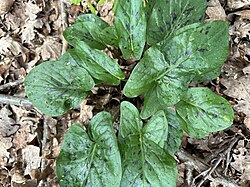
Adam-and-Eve
Arum maculatum L.
Important botanical synonyms and former names include:
Arisarum maculatum (L.) Raf.
Arum vernale Salisb.
Arum immaculatum (Rchb.) Rchb.
Arum byzantinum Blume
Arum maculatum var. immaculatum Rchb.
Arum maculatum f. immaculatum (Mutel) Topa
The unspotted forms represented by several historical names remain Arum maculatum. The absence of dark leaf markings does not establish another species or a safer plant.
Araceae Juss. — Arum or Aroid Family
Order: Alismatales
Adam-and-Eve, Adam and Eve, Wild Arum, Common Arum, Arum, Lords-and-Ladies, Lords and Ladies, Lord-and-Ladies, Cuckoo-Pint, Cuckoo Pint, Cuckoo Plant, Cuckoo-Pintle, Devils-and-Angels, Devils and Angels, Cows-and-Bulls, Cows and Bulls, Bobbins, Starch-Root, Starch Root, Naked Boys, Friar’s Cowl, Lamb-in-a-Pulpit, Adder’s Meat, Adder’s Root, Snake’s Meat, Snake’s Head, Arum maculatum, Arisarum maculatum, Arum immaculatum
“Adam-and-Eve” is highly ambiguous and is also applied to unrelated plants, including the North American putty-root orchid, Aplectrum hyemale. That orchid is not an exact synonym for Wild Arum.
Jack-in-the-Pulpit more properly identifies North American Arisaema species, especially Arisaema triphyllum. These plants are related calcium-oxalate-containing aroids but are not Arum maculatum.
Arum Lily commonly refers to Zantedeschia species, while Wake-Robin is widely applied to Trillium species in North America. Both names have also appeared historically in connection with Wild Arum, so neither should be used as the sole basis for identification.
Insoluble Calcium Oxalate Raphides
The confirmed toxic principle in Adam-and-Eve is insoluble calcium oxalate arranged in microscopic needle-shaped crystals called raphides. The crystals occur in bundles within specialized plant cells known as crystal idioblasts.
When an animal bites, crushes, tears, or digs into the plant, the damaged tissue releases raphides into the surrounding sap and contacted tissues. The crystals puncture and abrade the lips, gums, tongue, palate, pharynx, esophagus, skin, and eyes. Injury begins at the moment of contact rather than after the toxin has been digested or metabolized.
This direct mechanical action explains the plant’s rapid and dramatic effects. A dog or cat may drop the plant, shake the head, paw at the mouth, drool heavily, or cry out almost immediately after taking one bite.
Pain, Inflammation, and Swelling
Raphide penetration triggers pain, redness, inflammation, fluid movement into damaged tissue, and swelling. Oral tissues contain numerous sensory nerves and are especially sensitive, so a small quantity of plant material can cause substantial visible distress.
The tongue, lips, floor of the mouth, pharynx, and tissues surrounding the larynx may become edematous. Most reactions remain painful but localized. Progressive pharyngeal or laryngeal swelling is uncommon, yet it becomes an emergency when the animal cannot handle saliva, swallow normally, or move air freely.
Direct raphide injury should not automatically be described as an allergic reaction. Inflammation may involve histamine and other mediators, but the primary problem is physical tissue penetration by crystals. Antihistamines cannot remove embedded raphides or replace airway assessment.
Possible Enzymes and Additional Irritants
Proteolytic enzymes and other inflammation-promoting substances have been proposed as factors that intensify calcium-oxalate injury in members of Araceae. By entering tissue through the microscopic channels created by raphides, these compounds may increase pain, vascular leakage, and swelling.
The precise contribution of individual enzymes or proteins has not been established specifically enough in Arum maculatum to list them as separate confirmed veterinary toxins. Insoluble calcium oxalate remains the best-supported and clinically defining toxic principle.
Claims involving “aroin,” saponins, cyanogenic compounds, or other phytochemicals appear in portions of the historical, ethnobotanical, and human toxicology literature. These reports may be relevant to very large tuber ingestion or concentrated preparations, but they do not replace the established companion-animal syndrome of immediate raphide-mediated oral injury.
All Raw Plant Parts Should Be Treated as Toxic
The leaves, petioles, spathe, spadix, flowers, berries, seeds, sap, stems, and underground tuber should all be treated as unsafe in the raw state. No dependable pet-safe plant part or exposure quantity has been established.
The underground tuber is particularly important for dogs that dig or chew objects found during planting and garden cleanup. It contains dense moist tissue capable of releasing abundant irritating material when bitten.
The orange-red berries create a different seasonal hazard. They may remain on a conspicuous upright stalk after the leaves and spathe have withered, leaving an attractive cluster of fruit that no longer resembles the spring plant.
Drying, wilting, frost, mowing, or storage does not provide a dependable guarantee that the crystals have become harmless. Fallen berries, dried stalks, uprooted tubers, cut roots, and garden debris should remain inaccessible to animals.
Insoluble Oxalates Versus Soluble Oxalates
The insoluble calcium oxalate in Adam-and-Eve should not be confused with soluble oxalates found in plants that can produce systemic hypocalcemia and kidney injury. Insoluble raphides remain concentrated at contacted surfaces and ordinarily are not absorbed in a form that removes large quantities of calcium from the bloodstream.
Primary acute kidney failure, profound hypocalcemia, generalized tetany, and widespread oxalate deposition are therefore not expected after a typical Wild Arum exposure. Kidney abnormalities may still develop secondarily if prolonged vomiting, painful swallowing, or fluid loss causes severe dehydration.
Seizures, coma, primary liver failure, progressive kidney failure, or widespread multisystem disease should prompt investigation for a soluble-oxalate plant, pesticide, medication, caustic chemical, another toxic species, hypoxia, or unrelated illness.
No Dependable Safe Dose
No leaf area, berry count, tuber weight, or amount per kilogram has been established as safe or predictably dangerous. Severity depends on the tissue chewed, duration of contact, amount retained in the mouth, animal size, swallowing function, airway involvement, and whether other substances were ingested.
Immediate pain usually limits consumption, making a large swallowed dose uncommon. Puppies, food-motivated dogs, animals that shred plants rapidly, grazing animals with limited forage, and patients with impaired oral sensation may nevertheless consume more before stopping.
Soil, mulch, pesticide, fertilizer, plastic labels, sharp stakes, garden wire, and other plants may accompany the exposure and can produce signs outside the expected local irritant pattern.
Immediate Oral Pain and Distress
Clinical signs usually begin while the animal is chewing or within minutes. A dog or cat may abruptly drop the plant, cry out, shake the head violently, rub the muzzle, paw at the mouth, lick the lips, or resist examination.
Profuse drooling is especially characteristic. Saliva may drip continuously or form long ropes because the mouth is painful and swallowing has become uncomfortable. The lips, gums, tongue, palate, and inner cheeks may appear red, inflamed, or swollen.
Cats may display pain less openly than dogs. Hiding, crouching, wiping the mouth repeatedly with a paw, exaggerated tongue movements, sudden food refusal, and reluctance to groom can be the most obvious signs.
Gagging and Difficulty Swallowing
When irritation extends toward the rear of the mouth, pharynx, or esophagus, the animal may gag, retch, cough, swallow repeatedly, extend the neck, or allow saliva to pour from the mouth. Attempts to drink may trigger coughing or immediate withdrawal from the bowl.
The bark, meow, or other vocalization may become weak or hoarse. Food may be dropped from the mouth, and the animal may approach a meal but refuse to bite or swallow.
Continued gagging or repeated unsuccessful swallowing may also indicate a lodged berry, tuber fragment, leaf stalk, root, or other foreign material. The irritant exposure and mechanical obstruction can occur together.
Vomiting and Gastrointestinal Irritation
Dogs and cats may vomit after swallowing crystals, sap, berries, seeds, leaves, or pieces of tuber. Diarrhea, abdominal discomfort, appetite loss, depression, and lethargy may follow a more substantial ingestion.
One brief vomiting episode may resolve as oral irritation subsides. Repeated vomiting, inability to retain water, continuing diarrhea, or painful swallowing can lead to dehydration and electrolyte abnormalities.
Blood in vomit, black stool, pronounced abdominal swelling, repeated unproductive retching, or severe persistent pain is not expected after a minor bite. These findings may indicate extensive mucosal injury, a foreign body, another toxin, or unrelated gastrointestinal disease.
Rare Airway Compromise
Most swelling remains localized and does not obstruct airflow. Severe edema of the tongue, pharynx, epiglottis, or larynx is uncommon but potentially life-threatening.
Warning signs include rapidly increasing tongue or throat swelling, inability to close the mouth, inability to swallow saliva, noisy inspiration, open-mouth breathing in a cat, gasping, neck extension, exaggerated chest or abdominal movement, blue-gray mucous membranes, or collapse.
Mechanical obstruction from a berry cluster, tuber piece, or plant fragment must also be considered when choking or continuous gagging occurs. An animal displaying airway signs should not be forced to drink, eat, swallow medication, or receive charcoal.
Skin and Eye Exposure
Sap and crushed tissue on the skin may cause localized burning, redness, itching, swelling, licking, or irritant dermatitis. Thinly haired, damaged, or already inflamed areas may react more noticeably.
Plant residue on the coat creates a secondary oral exposure when the animal grooms. Contaminated paws may also transfer sap, soil, or crystals into the eyes.
Eye exposure can produce immediate tearing, blinking, squinting, conjunctival redness, eyelid swelling, discharge, cloudiness, or apparent visual difficulty. Persistent pain after irrigation may indicate retained debris, corneal abrasion, or ulceration.
Horses, Livestock, and Small Animals
Horses may develop salivation, head shaking, feed refusal, abnormal chewing, tongue or throat swelling, coughing, painful swallowing, colic-like discomfort, diarrhea, or respiratory distress. Horses cannot vomit.
Cattle, sheep, and goats may show repeated tongue movements, salivation, feed refusal, facial swelling, abnormal regurgitation, bloat, diarrhea, weakness, or breathing difficulty. Painful swallowing and regurgitation can increase aspiration risk.
Rabbits and guinea pigs cannot vomit. Oral pain may cause abrupt food refusal, reduced fecal production, tooth grinding, abdominal discomfort, or gastrointestinal stasis. Companion birds may wipe the beak, swallow repeatedly, regurgitate, alter vocalization, stop eating, or develop facial swelling.
Expected Course and Atypical Signs
Mild oral pain, drooling, and localized swelling often begin improving within several hours after plant residue is removed. Appetite and comfort may take approximately twelve to twenty-four hours to normalize after a limited exposure.
Continued drooling, vomiting, food refusal, marked pain, or swelling beyond the expected period requires reassessment for deeper injury, retained plant material, dehydration, aspiration, eye damage, or incorrect plant identification.
Convulsions, coma, profound hypocalcemia, primary kidney failure, liver failure, or progressive multisystem illness is not characteristic of uncomplicated insoluble-calcium-oxalate exposure. Those findings require immediate investigation for another or additional cause.
Plant Identity and Growth Cycle
Adam-and-Eve is a tuberous woodland perennial in the family Araceae. Its annual cycle produces several visually different stages: glossy arrow-shaped leaves, a hooded spathe surrounding a fleshy spadix, and a later upright cluster of orange-red berries.
Leaves emerge from the underground tuber during the cooler part of the growing season. Flowering commonly occurs in spring. After pollination, the spathe and much of the foliage may wither while the fruiting stalk remains and the berries ripen.
This seasonal change can make one plant look like several unrelated species. A spring photograph may show spotted leaves and a green hood, while a later photograph may show only a leafless spike of bright fruit.
Leaves, Spathe, Spadix, and Berries
The leaves are glossy and arrow-shaped to spear-shaped, with backward-pointing basal lobes. Dark purple or blackish spots may occur across the blade, but unspotted plants are common enough that the absence of markings does not rule out Arum maculatum.
The structure often called the flower consists of a pale green hood-like spathe surrounding a central fleshy spike called the spadix. Its exposed upper portion may be purple-brown, reddish, yellowish, or pale.
The actual flowers are small and arranged lower on the spadix inside the chamber formed by the spathe. After pollination, a compact upright spike of berries develops. The fruit changes from green to bright orange-red and may remain conspicuous after the foliage disappears.
The unusual paired appearance of spathe and spadix, followed by the contrasting berry spike, contributed to regional names such as Lords-and-Ladies, Adam-and-Eve, Devils-and-Angels, and Cows-and-Bulls.
Underground Tuber and Seasonal Exposure
The plant survives through a fleshy underground tuber. Dogs may expose it by digging in woodland soil, shaded garden beds, compost, or recently disturbed ground.
Planting, transplanting, garden renovation, autumn cleanup, and removal work can leave tubers and cut roots on the soil surface. An uprooted tuber may be more attractive to a dog than the intact growing plant because it resembles a root, bulb, or chew object.
Young leaves and the hooded inflorescence create the main spring exposure, while the isolated berry stalk becomes more important later in the season. Monitoring must therefore continue after the recognizable foliage has disappeared.
Habitat, Range, and Pet Encounters
Arum maculatum is native across much of Europe and extends into northern Türkiye and the western Caucasus. It grows primarily in temperate habitats.
Wild populations occur in deciduous woodland, forest edges, hedgerows, shaded banks, stream and river margins, roadside edges, churchyards, old gardens, and other moist or seasonally shaded areas.
Dogs may encounter the plant while exploring woodland or hedges. Cats may chew young leaves in shaded gardens. Horses and livestock may reach it beneath boundary hedges, along woodland pasture margins, or in discarded garden material.
Important Look-Alikes and Name Confusion
Italian Arum, Arum italicum, is a close relative and common ornamental look-alike. Its leaves often show prominent pale or silvery veins, but variable plants may be difficult to separate from Wild Arum outside flowering season. Both contain irritating calcium oxalate crystals, so first aid should not be delayed while attempting a perfect species identification.
Jack-in-the-Pulpit usually refers to Arisaema triphyllum and related North American species. These plants also produce a hooded spathe, central spadix, underground storage organ, and later cluster of red berries. They are botanically distinct but cause a similar raphide-mediated oral-pain syndrome.
Arum Lily commonly refers to Zantedeschia, including Calla Lilies. These aroids have larger ornamental spathes and a different growth form but share the insoluble-calcium-oxalate hazard.
Wake-Robin frequently identifies Trillium species in North America. Trilliums have a three-leaved arrangement and a three-petaled flower rather than an arum spathe and spadix. “Adam-and-Eve” may also identify the unrelated putty-root orchid, Aplectrum hyemale.
Dogs, Cats, Horses, and Other Animals
Dogs may chew emerging leaves, carry berry stalks, dig up tubers, or investigate discarded plants. Puppies and habitual diggers face the greatest risk of repeated contact or swallowing a large fragment.
Cats may chew young foliage, bat at berries, brush against damaged plants, or ingest residue while grooming. Open-mouth breathing in a cat is always an emergency, regardless of whether Wild Arum is the suspected cause.
Horses and grazing livestock usually stop eating because of the plant’s immediate acridity, but hungry animals, animals with little alternative forage, or groups exposed to contaminated clippings may consume more. Every animal sharing the same pasture, feed, or clipping source should be examined when signs develop.
Adam-and-Eve should not be offered as forage to rabbits, guinea pigs, birds, reptiles, or other pets. Wildlife consumption of berries does not establish safety for captive animals with different anatomy, diets, and metabolic responses.
Diagnosis and Differential Diagnosis
No routine blood test confirms exposure to insoluble calcium oxalate raphides. Diagnosis depends on plant identification, witnessed chewing, damaged leaves or berries, tuber access, fragments in the mouth or vomit, and the rapid onset of oral pain, drooling, swelling, or dysphagia.
Useful identification evidence includes the entire plant, arrow-shaped leaves, leaf spots or veins, the spathe and spadix, berry stalk, tuber fragments, photographs of the growing site, and any nursery label.
Similar signs can result from another raphide-containing aroid, a caustic chemical, electrical-cord burn, insect sting, allergic reaction, bone fragment, oral foreign body, thermal injury, medication, bait, or another toxic plant.
Bloodwork, electrolyte testing, imaging, airway examination, or other diagnostics may be appropriate after prolonged vomiting, dehydration, respiratory compromise, profound weakness, abnormal kidney values, or signs inconsistent with a localized irritant exposure.
Prognosis and Prevention
The prognosis is good to excellent for most limited exposures. Many animals improve substantially within several hours and recover fully within approximately twelve to twenty-four hours.
The outlook becomes more serious when swelling affects breathing, aspiration occurs, vomiting causes meaningful dehydration, an eye is injured, or a berry cluster, tuber piece, or other fragment becomes lodged.
Prevent exposure by supervising plant-chewing dogs in woodland and shaded gardens, removing berry stalks before pets investigate them, wearing gloves during removal, and placing tubers and clippings directly into a secured container.
Do not leave uprooted plants in accessible compost or brush piles. Recheck the soil and surrounding area during later seasons because missed tuber fragments and dispersed seeds may produce new plants.
Immediate Owner Actions
- Stop further exposure. Move the animal away from leaves, spathes, berry stalks, stems, sap, tubers, garden debris, and contaminated soil.
- Assess breathing first. Noisy respiration, open-mouth breathing in a cat, gasping, blue-gray gums, severe effort, or collapse requires immediate emergency transport.
- Check swallowing. Continuous gagging, pouring saliva, repeated unsuccessful swallowing, neck extension, or inability to drink may indicate severe swelling or lodged plant material.
- Remove only loose visible pieces. When the animal is calm and cooperative, lift away leaves, berries, seeds, or tuber fragments resting at the lips or front of the mouth. Do not perform a blind finger sweep.
- Gently wipe accessible residue. Use a damp cloth on the lips, gums, muzzle, and front of the mouth of an alert animal that is breathing and swallowing normally.
- Do not force water. Pouring or spraying water toward the throat can cause aspiration and does not dissolve crystals already embedded in tissue.
- Preserve identification evidence. Save leaves, the inflorescence, berry stalks, tuber pieces, photographs, the nursery label, and any material found in vomit.
- Wear gloves. Protect your own skin and eyes while handling the plant, contaminated fur, saliva, or vomit containing plant fragments.
Do Not Attempt Unsupervised Home Treatment
- Do not induce vomiting. Vomiting can re-expose the mouth, throat, and esophagus to abrasive plant material and is unsafe when swelling or dysphagia is present.
- Do not give hydrogen peroxide, salt, mustard, syrup of ipecac, detergent, oil, or use manual gagging. These methods can cause gastric injury, aspiration, sodium poisoning, or airway trauma.
- Never attempt to induce vomiting in a cat or horse. Hydrogen peroxide can severely injure a cat’s stomach and esophagus, and horses are physically unable to vomit.
- Do not force milk, yogurt, cheese, food, water, or medication. An animal with painful or impaired swallowing can aspirate material into the lungs.
- Do not give activated charcoal routinely. Charcoal does not remove crystals embedded in oral tissue and may be aspirated by a drooling, vomiting, swollen, weak, or poorly swallowing animal.
- Do not give diphenhydramine or another antihistamine as a substitute for airway care. Direct raphide injury is not simply an allergy, and significant swelling may require immediate injectable treatment and airway support.
- Do not give human pain relievers, antidiarrheals, antacids, bismuth products, sucralfate, or leftover prescriptions. These products are not antidotes and may add toxicity, interfere with examination, or be inappropriate for the species.
- Do not apply numbing gels, antiseptics, essential oils, peroxide, creams, or ointments inside the mouth. These products may worsen irritation or be toxic when swallowed.
When Emergency Examination Is Required
- Airway abnormalities: Increasing tongue or throat swelling, inability to close the mouth, noisy inspiration, open-mouth breathing, gasping, blue-gray gums, or collapse requires immediate care.
- Impaired swallowing: Inability to swallow saliva, continuous gagging, repeated regurgitation, neck extension, coughing after drinking, or complete refusal to swallow may indicate severe pharyngeal injury or obstruction.
- Persistent gastrointestinal illness: Repeated vomiting, inability to retain water, severe abdominal pain, bloody vomit, black stool, diarrhea, weakness, or signs of dehydration requires examination.
- Possible foreign body: A missing tuber piece, berry cluster, plastic label, stake, wire, or large plant fragment combined with gagging, vomiting, abdominal enlargement, or reduced stool may require imaging or removal.
- Eye injury: Continuing squinting, tearing, redness, discharge, cloudiness, eyelid swelling, or visual difficulty after irrigation needs prompt veterinary care.
- Atypical systemic signs: Seizures, coma, profound weakness, severe hypocalcemia, kidney failure, or liver abnormalities suggests another toxin, mixed ingestion, severe dehydration, hypoxia, or incorrect plant identification.
Skin, Coat, and Eye Exposure
Prevent grooming until sap and plant residue have been removed. Wearing gloves, wash exposed paws, muzzle, abdomen, or coat with lukewarm water and a mild species-appropriate cleanser. Rinse thoroughly without scrubbing aggressively.
Do not use bleach, alcohol, peroxide, solvents, concentrated vinegar, essential oils, or human medicated creams on the skin. Persistent redness, swelling, blistering, pain, itching, or self-trauma requires veterinary assessment.
If sap, soil, or plant material enters an eye, begin gentle irrigation with sterile saline or clean lukewarm water. Continue rinsing thoroughly while preventing the animal from rubbing the eye.
Do not scrape the eye or use tweezers, cotton swabs, cloth, human redness drops, or leftover eye medication. Continuing discomfort may require fluorescein staining, magnified examination, removal of retained debris, lubrication, and treatment of a corneal abrasion or ulcer.
Veterinary Examination and Decontamination
The veterinarian will first assess airway patency, breathing effort, oxygenation, tongue and pharyngeal swelling, secretion handling, swallowing ability, hydration, pain, and progression of signs.
The lips, gums, tongue, floor of the mouth, palate, spaces between the teeth, and visible pharynx may require examination. Controlled sedation may be necessary to locate and remove berries, tuber fragments, leaf stalks, or other material that cannot be examined safely in an awake animal.
Professional management focuses on gentle removal of accessible plant residue rather than induced vomiting. Activated charcoal and gastric lavage are not routine because the primary injury is local and mechanical. A mixed exposure may create a separate reason for decontamination after airway safety has been established.
Bloodwork is often unnecessary after a limited exposure that is improving. It may be appropriate after prolonged vomiting, dehydration, profound weakness, respiratory compromise, kidney abnormalities, or suspected ingestion of another plant or chemical.
Pain, Vomiting, and Fluid Support
Substantial oral or pharyngeal pain may require veterinarian-selected analgesia. Medication and route depend on species, swallowing ability, respiratory status, hydration, age, and concurrent disease.
Persistent nausea or vomiting may be treated with an antiemetic such as maropitant or ondansetron after obstruction, retained plant material, and another toxin have been considered.
Sucralfate may be considered when repeated vomiting, hematemesis, painful swallowing, esophagitis, or documented erosive injury indicates a need for mucosal protection. It creates a protective barrier rather than neutralizing raphides and can interfere with absorption of other medications.
Acid suppression is not routine for direct calcium-oxalate irritation. It may be selected when there is evidence of erosive gastritis, esophagitis, gastrointestinal bleeding, or another acid-related complication.
Oral, subcutaneous, or intravenous fluids may be used when drooling, vomiting, diarrhea, painful swallowing, or food and water refusal causes dehydration. Fluid therapy is individualized according to species, body weight, measured losses, circulation, urine production, and heart and kidney function.
Swelling and Airway Management
Veterinarian-selected antihistamines or corticosteroids may be considered when a histamine-mediated or substantial inflammatory component is suspected. Neither removes embedded crystals, and neither can be relied upon to protect a narrowing airway.
Progressive pharyngeal or laryngeal swelling may require supplemental oxygen, continuous oxygen monitoring, controlled sedation or anesthesia, suction of secretions, and endotracheal intubation.
Mechanical ventilation may be necessary when respiratory effort is inadequate. An emergency temporary tracheostomy may be required if severe upper-airway swelling or obstruction prevents oral intubation.
Coughing, fever, nasal discharge, abnormal lung sounds, or worsening respiratory effort after vomiting or impaired swallowing raises concern for aspiration. Thoracic imaging, oxygen, airway support, and antimicrobial treatment may be required when aspiration pneumonia is established or strongly suspected.
Horses, Livestock, and Small Herbivores
Remove every exposed horse or livestock animal from the plant, clippings, uprooted tubers, berry stalks, and contaminated forage. Examine all animals sharing the same pasture or feed source.
Do not drench or force water, oil, charcoal, feed, or medication into an animal that is salivating heavily, choking, bloated, weak, or swallowing poorly. Horses cannot vomit, and ruminants with abnormal regurgitation may aspirate.
Large-animal evaluation may include examination of the mouth and pharynx, airway endoscopy, hydration assessment, nasogastric evaluation, fluid therapy, pain control, and treatment of bloat, aspiration, or respiratory compromise.
Rabbits and guinea pigs cannot vomit. Reduced appetite, declining fecal production, abdominal distention, tooth grinding, diarrhea, or lethargy requires prompt veterinary care because gastrointestinal stasis can become more serious than the initial mouth irritation.
Prognosis and Recovery
The prognosis is good to excellent for most uncomplicated exposures. Mild oral pain, drooling, gagging, and localized swelling commonly improve substantially within several hours.
Full recovery is generally expected within approximately twelve to twenty-four hours after a limited exposure. Food intake may resume more slowly when the tongue, throat, or esophagus remains sore.
Persistent swelling, pain, vomiting, food refusal, or drooling requires reassessment. Recovery may be delayed by aspiration, eye injury, dehydration, extensive mucosal damage, or retained plant material.
The prognosis becomes more guarded when severe airway swelling prevents normal breathing, prolonged hypoxia occurs, aspiration pneumonia develops, or a tuber or berry cluster causes obstruction.
Frequently Asked Questions About Adam-and-Eve and Animal Poisoning
How poisonous is Adam-and-Eve to dogs and cats?
It can cause intense and immediate oral injury, but most animals stop chewing before consuming a large amount. The expected syndrome is mouth pain, drooling, head shaking, pawing, gagging, vomiting, swelling, and difficulty swallowing. Fatal poisoning is unusual, but severe throat swelling, aspiration, choking, or a lodged plant fragment can create a life-threatening emergency.
What toxin is in Arum maculatum, and how does it work?
The confirmed toxic principle is insoluble calcium oxalate stored as bundles of needle-shaped raphide crystals. Chewing ruptures specialized cells and releases the crystals into the mouth and throat, where they puncture soft tissues and trigger immediate pain, redness, inflammation, salivation, and swelling.
Which parts of Adam-and-Eve are poisonous?
All raw parts should be treated as poisonous, including leaves, petioles, spathe, spadix, flowers, berries, seeds, sap, stems, roots, and the underground tuber. The tuber is an important digging-dog hazard, while the bright berry stalk can remain accessible after the foliage has disappeared.
Are unspotted leaves safer than leaves with dark markings?
No. The name maculatum refers to spotting, but naturally unspotted plants and forms are common. The absence of purple or black leaf spots does not exclude Arum maculatum and does not indicate reduced toxicity.
Can Adam-and-Eve block a pet’s airway?
Severe airway-threatening swelling is uncommon but possible. A berry, tuber fragment, or other plant piece may also obstruct the throat mechanically. Rapidly increasing tongue or throat swelling, inability to swallow saliva, continuous gagging, noisy breathing, open-mouth breathing in a cat, blue-gray gums, gasping, or collapse requires immediate emergency care.
Can Wild Arum cause kidney failure or dangerously low calcium?
Ordinary Wild Arum poisoning involves insoluble calcium oxalate raphides and does not produce the systemic hypocalcemia or direct renal-crystal syndrome associated with soluble oxalate plants. Kidney abnormalities should prompt investigation for severe dehydration, another plant, ethylene glycol, medication, preexisting disease, or incorrect identification.
Is Adam-and-Eve the same plant as Italian Arum?
No. Italian Arum is Arum italicum, a closely related look-alike that often has pale or silvery leaf veins. Both contain insoluble calcium oxalate crystals and produce a similar oral-pain syndrome, so emergency care should not be delayed while the exact species is being separated.
Is it the same as Jack-in-the-Pulpit, Arum Lily, or Wake-Robin?
Not necessarily. Jack-in-the-Pulpit usually means Arisaema triphyllum; Arum Lily commonly means Zantedeschia; and Wake-Robin is widely used for Trillium. The first two are related raphide-containing aroids, while Trillium is botanically different. Common names alone are not dependable identification evidence.
Why can the orange-red berries appear without any leaves?
After spring flowering and pollination, the spathe and much of the foliage may wither before the berries mature. The resulting upright fruit cluster can appear to be an isolated plant. This seasonal change is one reason animals and owners may fail to connect the berries with the earlier arrow-shaped leaves.
Should I make my dog vomit or give activated charcoal?
No. Vomiting can drag abrasive plant material through an already injured throat and esophagus. Charcoal does not remove raphides embedded in tissue and can be aspirated by an animal that is drooling, vomiting, swollen, or swallowing poorly. Do not use hydrogen peroxide, salt, mustard, ipecac, or manual gagging.
Should I give milk, yogurt, cheese, or an antihistamine?
Do not force dairy products, water, food, or medication into an animal with mouth pain, gagging, swelling, or impaired swallowing because aspiration may be more dangerous than the original exposure. Antihistamines do not remove embedded crystals and should not delay emergency airway evaluation. Follow the treating veterinarian’s instructions.
How long should the symptoms last?
Mild oral pain, drooling, and localized swelling often improve within several hours, with full recovery generally expected within approximately twelve to twenty-four hours. Persistent swelling, vomiting, food refusal, eye pain, or drooling beyond that period suggests deeper injury, retained material, aspiration, dehydration, or another diagnosis.
Is Adam-and-Eve poisonous to horses, livestock, rabbits, and birds?
Yes, the raw plant should be kept away from all animals. Horses and livestock may develop salivation, oral swelling, feed refusal, painful swallowing, colic-like discomfort, diarrhea, or respiratory distress. Rabbits and guinea pigs may stop eating and develop gastrointestinal stasis, while birds may show beak wiping, regurgitation, altered vocalization, facial swelling, or appetite loss.
What is the prognosis after Adam-and-Eve exposure?
The prognosis is good to excellent for most limited exposures because immediate pain restricts ingestion and the injury is usually local. The outlook becomes more serious when swelling compromises breathing, aspiration occurs, vomiting causes dehydration, an eye is injured, or a berry cluster, tuber piece, or other fragment becomes lodged.