Payment Convenience, Tip Income, Checkout Flow, and Front-Desk Revenue
Dog Daycare Payment and Tip Income: How Easier Checkout Quietly Adds Real Money
Your checkout counter is a profit center. Treat it like one.
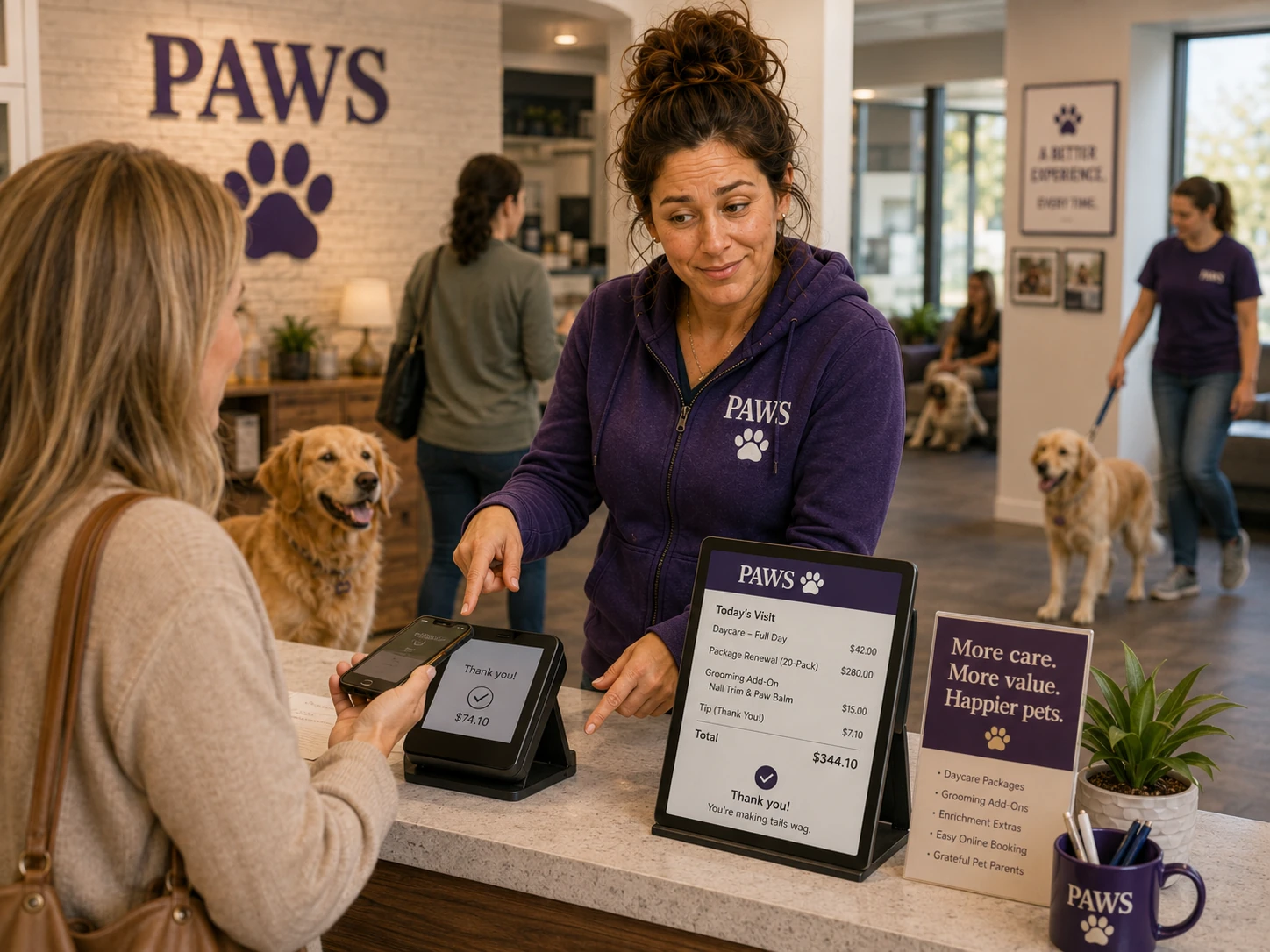
The easiest way to increase gross sales at a dog daycare is not always adding a new room, a new service, or some shiny business idea that sounds good until payroll walks in holding a baseball bat. Sometimes the easiest money is sitting right at the checkout counter.
If customers can pay faster, tip easier, buy packages without friction, keep a card on file, pay deposits online, tap their phone, approve an invoice, or use a membership without wrestling with the front desk, they are more likely to spend. That is not magic. That is convenience.
The old version of this idea was simple: accept credit cards and make sure the receipt has a tip line. That still matters, but the payment world has moved on. Today, the real money is in cards, chip readers, tap-to-pay, Apple Pay, Google Pay, online payments, card-on-file, deposits, recurring memberships, package sales, clean tip prompts, digital receipts, and a checkout system that does not depend on staff memory and a cash drawer held together by hope.
If your checkout is slow, awkward, cash-heavy, check-heavy, tip-blind, deposit-blind, package-blind, and not connected to your booking system, you are leaking money. Maybe not dramatically. Maybe not enough to notice in one day. But over weeks, months, and years, those little missed payments, missed tips, missed add-ons, missed deposits, and missed package sales add up like ants carrying off your sandwich.
⚠️
Operator warning: payment convenience is not optional anymore.
If your facility still runs checkout like it is 1998 with cash, checks, handwritten notes, staff memory, and awkward counter math, you are not being charmingly old school. You are creating friction, losing records, encouraging errors, slowing down checkout, and making the front desk carry financial risk it was never built to carry.
🗺️
Use This Page Like a Checkout Profit Map
This page is not about payment technology for the sake of payment technology. It is about making it easier for customers to spend money with your facility.
💳
Payment Convenience
Cards, chip, tap, digital wallets, card-on-file, online payments, and deposits reduce friction and help customers buy faster.
📲
Modern Payment Methods
Credit cards are not the upgrade anymore. They are the floor. Modern checkout needs more ways to pay.
🔐
Loss and Theft Control
Digital payments create records, reduce loose cash, limit bounced checks, and make end-of-day review less of a guessing game.
💸
Tip Income
A clean tip prompt can add real money without hounding customers or turning the front desk into a guilt booth.
📦
Deposits, Packages, and Card-on-File
Card-on-file and online payments help with no-shows, late fees, package renewals, memberships, and boarding deposits.
🧪
Checkout Leak Detector
Find the money leaks in your current checkout system before they keep nibbling at revenue.
🔄
Modern Checkout Reality
Credit cards used to make a daycare look modern. Now they are the bare minimum.
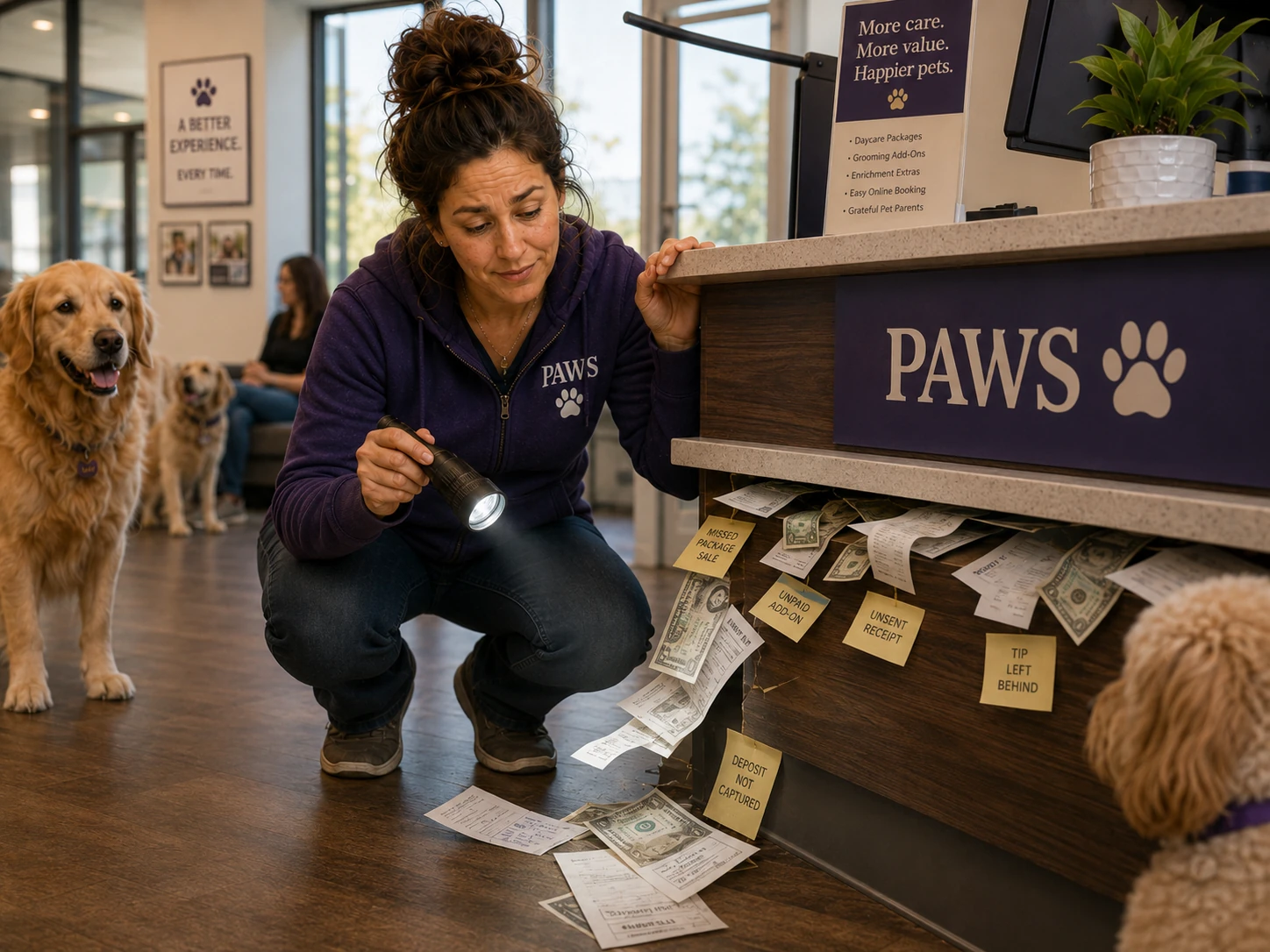
The old way of doing things was simple: accept credit cards because customers expect a professional business to take them. That was correct then, and it is still correct now. But today, “we accept credit cards” is not the full conversation. It is the floor.
Modern customers expect fast checkout. They expect to tap a card. They expect to use their phone. They expect digital receipts. They expect online payment links. They expect deposits to be simple. They expect packages to be easy to buy. They expect booking software to remember their payment method. They expect your checkout system to behave like a real business instead of a front desk scavenger hunt.
That does not mean you need every payment gadget invented by someone in a vest at a tech conference. It means your facility should remove stupid friction from the moments where customers are already willing to give you money.
💳
Cards Are the Floor
Credit and debit cards are expected in a professional service business. They are not a luxury feature.
📲
Tap Is Normal
Customers increasingly expect chip, tap-to-pay, Apple Pay, Google Pay, and other wallet-style payment options.
🔁
Card-on-File Matters
Deposits, memberships, no-show fees, recurring plans, and package renewals work better when payment is already connected to the account.
💳
Payment Convenience Creates More Sales
Every time checkout gets easier, customers have one less reason to pause, delay, forget, or say no.
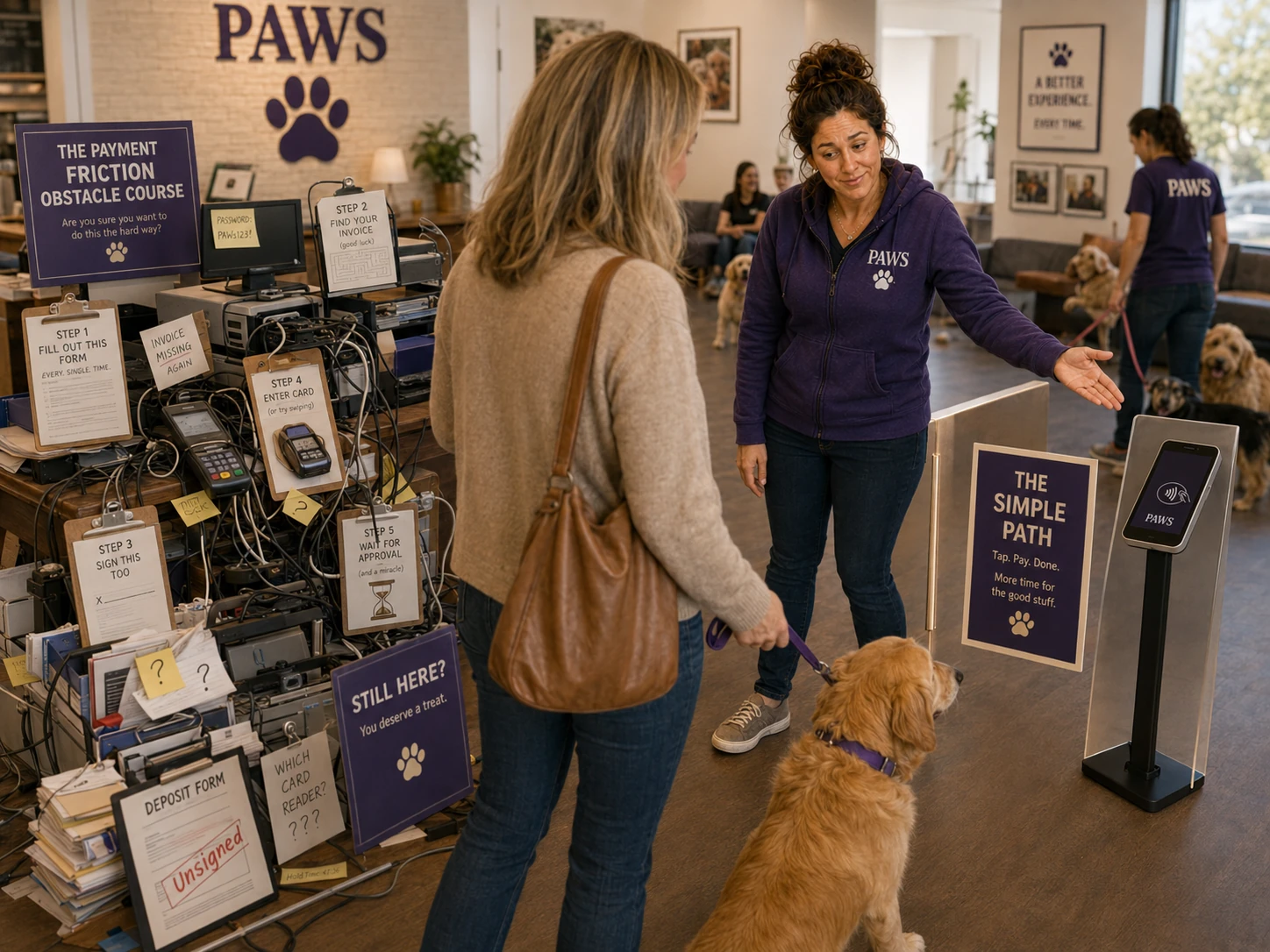
The basic business rule is simple: when it is easier to pay, people are more likely to pay. When it is easier to upgrade, people are more likely to upgrade. When it is easier to buy a package, people are more likely to buy a package. When it is easy to tip, people are more likely to tip. When it is easy to put a card on file, future purchases stop depending on whether the customer has their wallet, checkbook, or brain fully assembled that morning.
Dog daycare is a repeat-service business. That makes payment convenience more valuable than it would be in a one-time transaction business. Your customers are not buying one random thing and vanishing forever. They come back. They buy daycare days, packages, boarding nights, grooming, nail trims, baths, retail, training, enrichment, late pickup fees, holiday stays, and special add-ons. If every one of those purchases requires friction, you are making customers climb over a fence every time they want to spend with you.
Do not confuse “we can take payment” with “we make payment easy.” Those are not the same thing. A facility can technically accept money and still be terrible at checkout.
| Revenue Moment | Payment Friction | Better Payment Setup | Money Result |
|---|---|---|---|
| Daycare Packages | Customer has to ask, remember, or wait at the counter. | POS/package prompt, saved card, online purchase, membership option. | More prepaid revenue and fewer one-day-only transactions. |
| Boarding Deposits | Staff chases payment after booking. | Online deposit or card-on-file deposit at reservation. | Fewer soft bookings and less no-show nonsense. |
| Grooming Add-Ons | Baths, nails, de-sheds, and tips are forgotten at pickup. | Service add-ons attached to account and paid at checkout. | More captured add-on revenue. |
| Retail | Customer says, “I’ll grab it next time.” Famous last words. | Fast tap/card checkout and receipt. | Impulse purchases are easier to close. |
| Late Pickup Fees | Awkward staff conversation or “we’ll charge next time.” | Written policy plus card-on-file authorization. | Fees are actually collected instead of becoming staff anxiety. |
| Enrichment / Extras | Add-ons are mentioned but not paid cleanly. | Selectable add-ons in software or checkout flow. | Small extras become repeatable revenue instead of random luck. |
📌
Operator rule
Convenience is not just customer service. Convenience is a revenue tool. If paying you is annoying, customers will still pay sometimes. They just will not buy as much, as fast, or as often as they could.
📲
Modern Payment Methods Your Dog Daycare Should Consider
You do not need every option on earth. You do need enough options that checkout does not feel like a punishment.
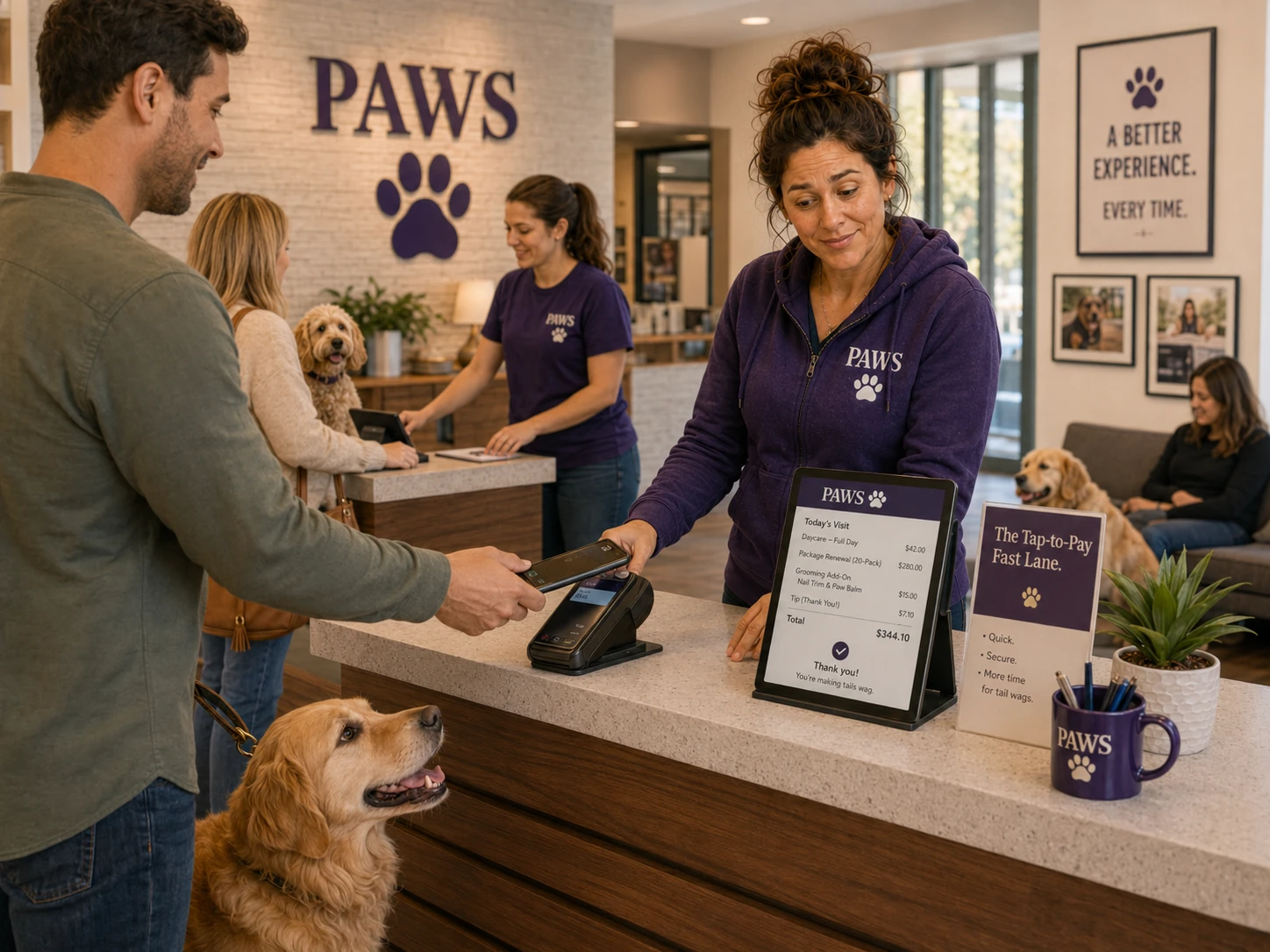
A dog daycare does not need to become a bank, a fintech company, or a science fair project with receipts. But it does need a professional payment setup. The right mix depends on your software, processor, service model, customer base, and how much recurring or reservation-based revenue you sell.
The goal is not to accept every weird payment method someone mentions on the internet. The goal is to accept the methods that make it easier to sell daycare, grooming, boarding, packages, deposits, tips, memberships, and add-ons.
| Payment Method | Best Use | Watch For |
|---|---|---|
| Credit / Debit Cards | Daily checkout, daycare packages, grooming, boarding, retail, add-ons. | Processing fees, chargebacks, manual-entry fees, processor statement confusion. |
| Chip Reader | In-person secure card payments at the front desk. | Slow or outdated terminals can create checkout lines and staff frustration. |
| Tap-to-Pay Cards | Fast in-person checkout when customers use contactless cards. | Make sure staff know how to use it instead of treating the terminal like a haunted object. |
| Apple Pay / Google Pay | Fast phone/watch payments for customers who do not want to pull out a card. | Make sure your terminal or payment app supports contactless wallet payments. |
| Card-on-File | Memberships, packages, boarding deposits, grooming reservations, late pickup fees, no-show fees. | Requires clear written authorization and a clean policy. Do not cowboy this. |
| Online Payment Links | Deposits, invoices, balances, missed payments, remote package purchases. | Needs clean tracking so staff do not lose track of what was paid and what was promised. |
| Recurring Membership Billing | Monthly daycare plans, memberships, subscriptions, enrichment bundles. | Needs cancellation rules, failed-payment process, and clear customer terms. |
| Cash | Backup option for customers who insist on it. | Drawer counts, theft risk, staff mistakes, tip confusion, and end-of-day reconciliation. |
| Checks | Limited backup option, if you choose to accept them. | Bounced checks, delayed failures, bank fees, lost checks, and awkward collection conversations. |
🔐
Credit Cards and Digital Payments Reduce Loss, Theft, and Sloppy Records
Cleaner payment records are not just accounting fluff. They help protect the money coming through the front desk.
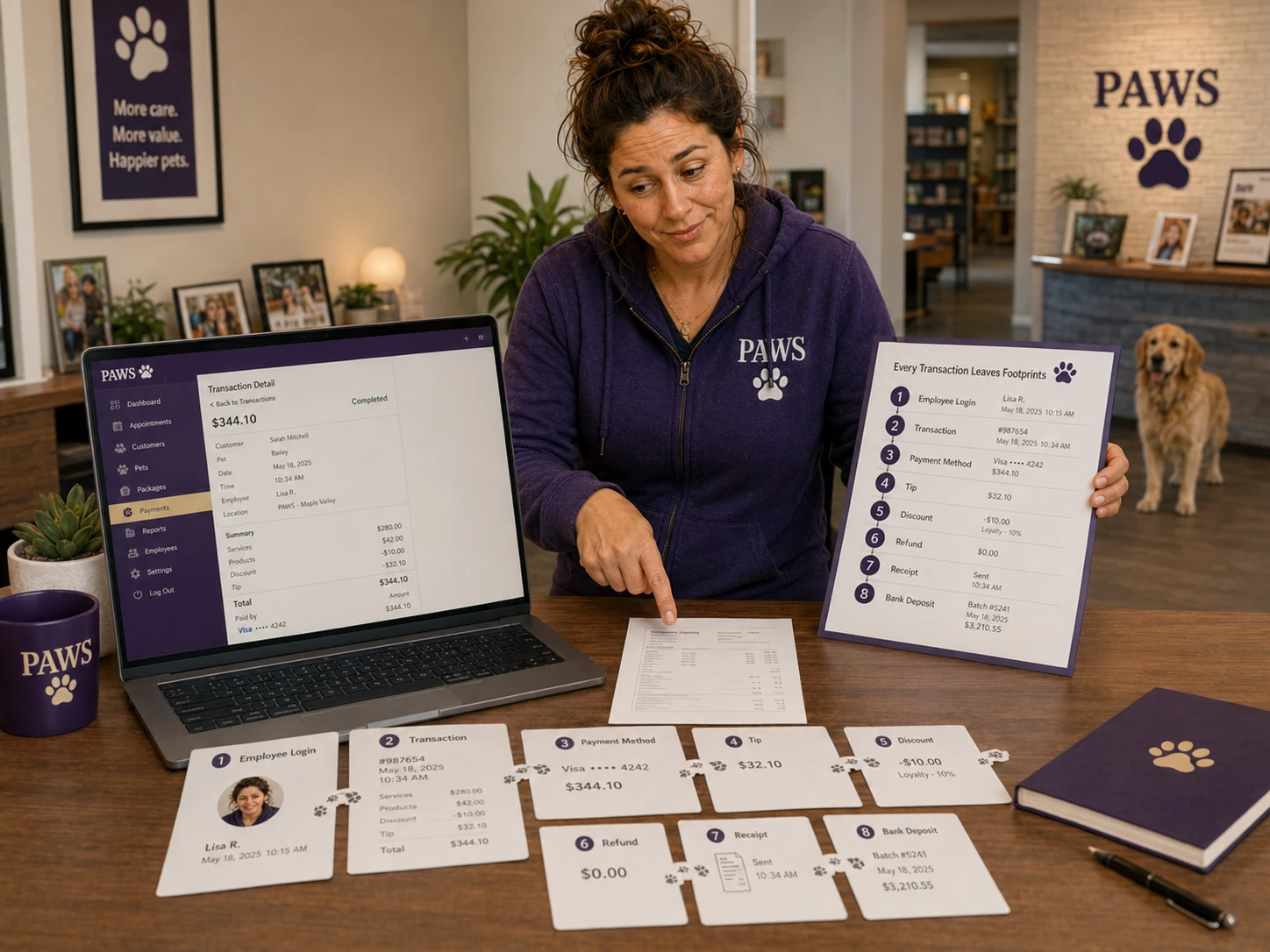
In a busy dog daycare, the front desk can handle a ridiculous number of small transactions. Daycare payments, package purchases, boarding deposits, grooming charges, nail trims, retail, late pickup fees, add-ons, refunds, tips, and adjustments all move through the same choke point. If that choke point is mostly cash, checks, handwritten notes, and “I think Sarah already paid,” you are going to lose money.
Credit cards and digital payments do not eliminate every problem, but they create a cleaner trail. You get transaction records. You get timestamps. You can see refunds, voids, tips, discounts, and who processed what. You can reconcile deposits. You can review daily totals. You can stop pretending the cash drawer is a personality test.
This matters because you cannot be glued to the counter every minute. You have dogs, staff, cleaning, customers, barking, accidents, tours, incidents, and the daily circus to manage. Eventually, employees will check customers in and out. A payment system with records protects you from honest mistakes, sloppy habits, and dishonest behavior.
💵
Less Loose Cash
Less cash means fewer drawer shortages, fewer “who took what?” arguments, and fewer little leaks hiding in the day.
🧾
Fewer Check Problems
Card payments reduce bounced checks, lost checks, bank fees, and the joyless hobby of chasing money after the dog already went home.
📊
Cleaner Records
Transaction IDs, receipts, staff logins, and daily reports help you find problems before they become folklore.
⚠️
Cash-control warning
Cash is not evil. But cash with weak drawer controls, weak receipts, weak staff accountability, and no end-of-day process is not “simple.” It is a little money swamp behind the front desk.
💸
Tip Income: The Quiet Money Sitting at Checkout
A tip option can add real money without turning the counter into a guilt trap.
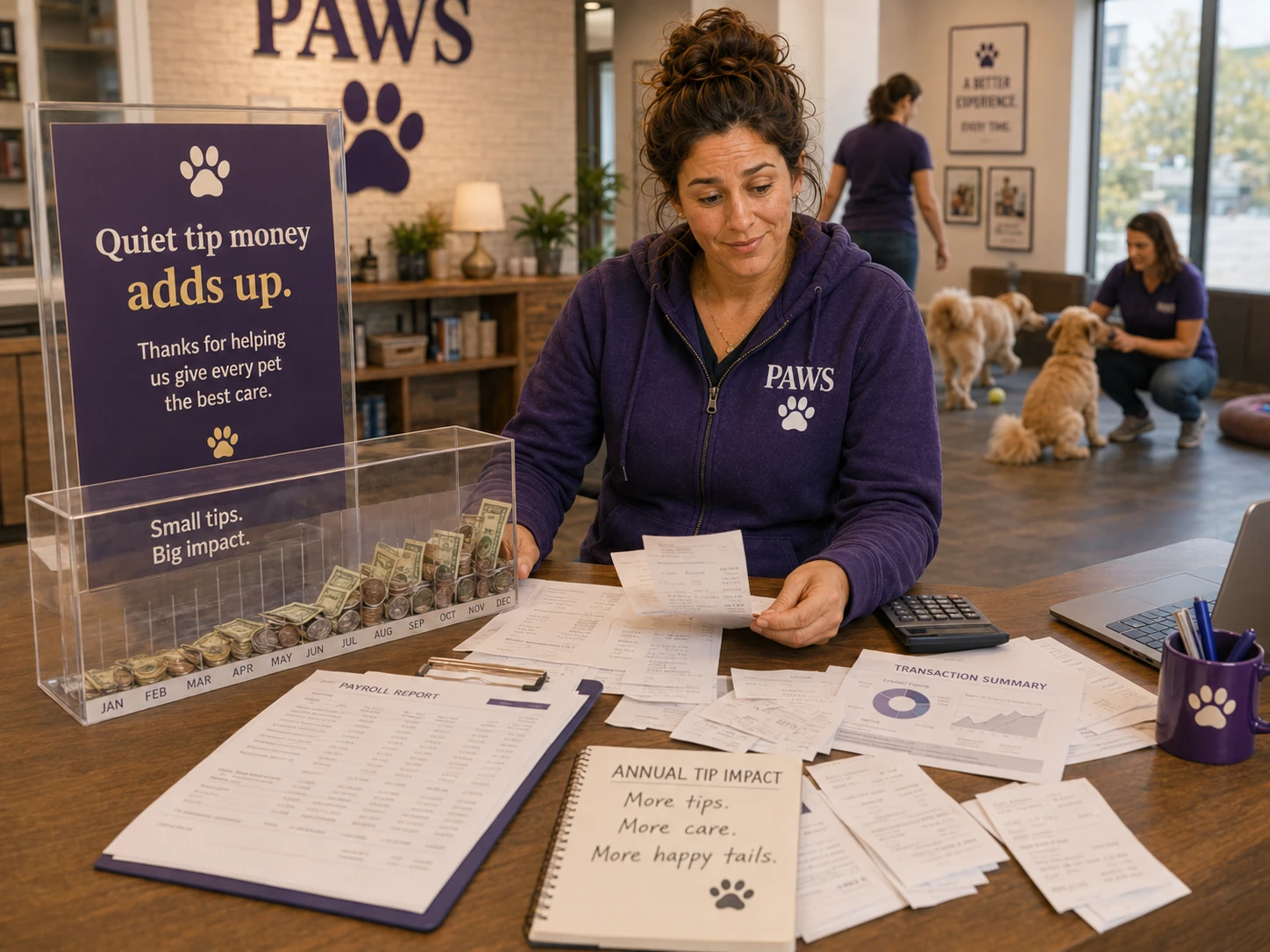
Dog daycare is a service business. Customers are not just buying a thing off a shelf. They are paying you to care for something they love. Your staff are handling dogs, cleaning messes, preventing fights, managing nervous animals, feeding, supervising, bathing, grooming, checking in customers, answering questions, mopping biological crimes, and somehow smiling while a lobby full of dogs acts like every door opening is a jailbreak.
There is nothing wrong with making tipping available. The old version of this idea was simple: make sure the credit card receipt has a place for a tip. That still works in some setups. But today, the tip opportunity can also be built into the POS screen, card reader, digital receipt, online invoice, grooming checkout, boarding pickup, holiday boarding flow, or customer account.
The trick is to make tipping easy without making it gross. A customer should not feel ambushed. Staff should not hover like tip goblins. The “no tip” option should be visible. The tip prompt should be clean, optional, and professional. You are not begging. You are making it easy for happy customers to reward the people taking care of their dogs.
| Tip Opportunity | How It Works | Why It Can Add Money |
|---|---|---|
| POS Tip Prompt | Customer sees an optional tip screen during card or tap checkout. | Tip option is visible at the exact moment the customer is paying. |
| Printed Receipt Tip Line | Paper receipt includes a tip line and total line. | Still useful for facilities that use signed receipts or counter checkout. |
| Digital Receipt Tip Option | Tip option appears in text/email receipt or payment flow. | Works well for customers who prefer digital checkout. |
| Grooming Tip | Customer can tip groomer, bather, or grooming team. | Grooming customers already understand tipping better than many daycare customers. |
| Holiday Boarding Tip | Customers can tip staff during holiday pickups or boarding checkout. | Holiday care is labor-heavy, emotional, and often appreciated by customers. |
| Daycare Staff Tip | Optional tip at checkout or account payment. | Small tips repeated across frequent customers can add up fast. |
📌
Tip-income rule
Do not beg for tips. Do not shame customers. Do not make the front desk weird. Just make the option easy, visible, professional, and voluntary. Happy customers will use it.
🙃
How to Ask for Tips Without Being Gross
The tip option should feel normal, not like the customer has been cornered by a tablet with feelings.
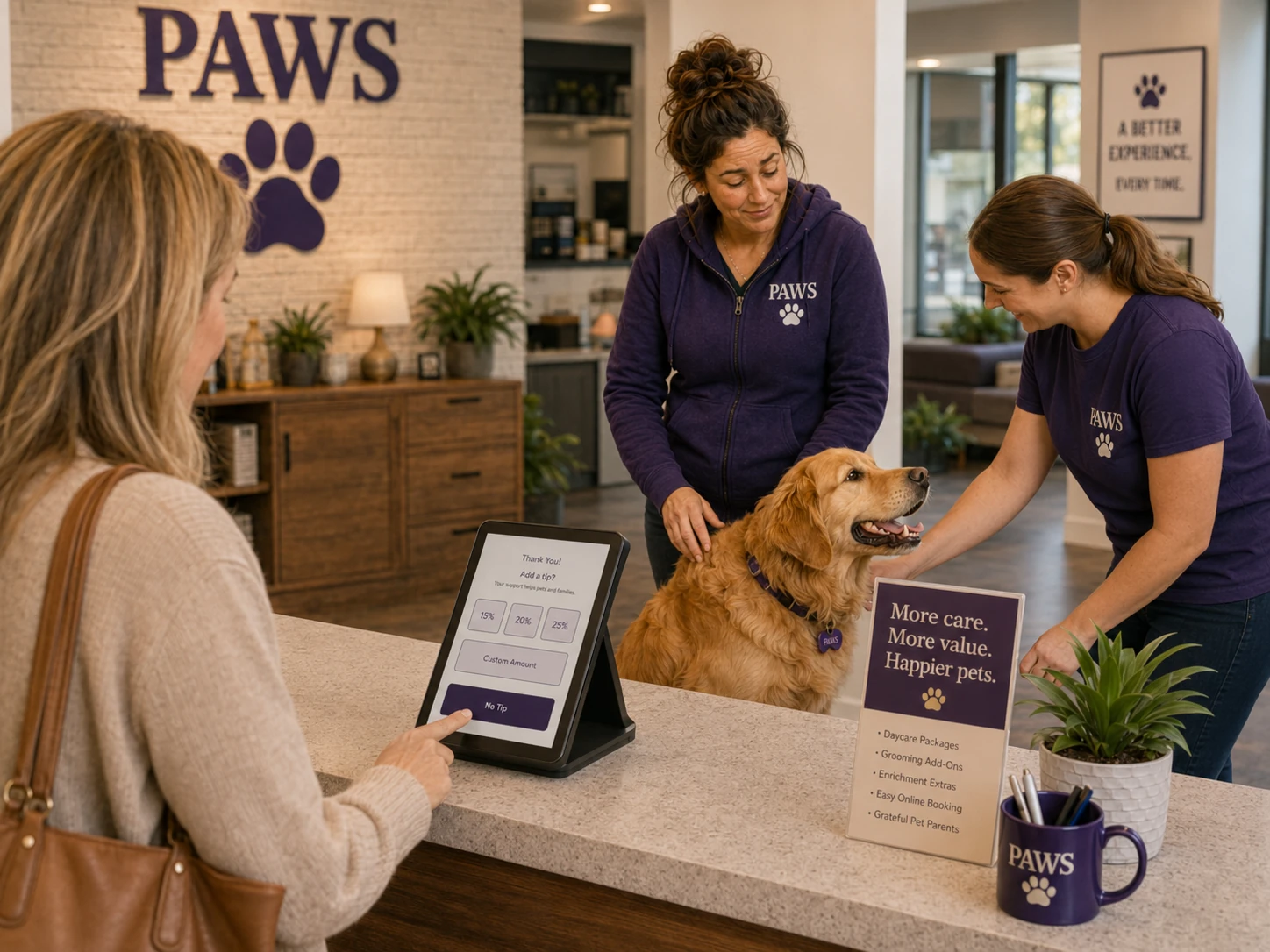
Digital tipping can add money, but it can also annoy people if you do it badly. Nobody likes feeling mugged by a tip screen. Nobody likes the employee staring at them while the “25%, 30%, 35%” buttons glow like a moral judgment panel. And nobody wants to feel like “no tip” means they hate dogs.
The best tip setup is calm. It is optional. It is clear. It uses reasonable choices. It has a custom option. It has a no-tip option. Staff do not comment. Staff do not hover. Staff do not make faces. The customer taps what they want and moves on with their life.
This is where dog daycare has a stronger argument than a lot of random tip prompts. Your staff are not just sliding an $8 muffin across a counter and asking for applause. They are handling animals. They are cleaning. They are supervising. They are keeping dogs safe. They are doing real service work. A voluntary tip option is not outrageous. Acting like the customer owes you one is.
🤝
Make It Optional
No guilt. No pressure. No weird staff commentary. Just a clean option for customers who want to tip.
🎛️
Use Reasonable Prompts
A few sensible percentages or dollar amounts beat a screen that looks like it was designed by a ransom note.
🤐
Train Staff to Shut Up
The screen can ask. Staff should not hover, hint, nudge, sigh, stare, or narrate the customer’s choice like sports commentary.
🧾
Tip Policy: Who Gets the Money?
A tip system without a policy becomes staff drama with a receipt printer.
Before you turn on tip prompts, decide where the money goes. This does not need to be complicated, but it does need to be clear. Tips can become a morale booster, but unclear tips can also become a tiny civil war in the lobby.
Are tips pooled by shift? Do grooming tips go to the groomer only? Does the bather share? Do boarding tips go to kennel staff? Does the front desk participate? Are managers excluded? How are cash tips handled? How are card tips paid out? Are tips shown through payroll? How do refunds or chargebacks affect tips? Decide this before the first customer taps a button.
| Tip Policy Question | Decision to Make | Why It Matters |
|---|---|---|
| Daycare Tips | Pool by shift, distribute by hours worked, or assign another clear method. | Daycare is usually team-based, so the tip policy should match the labor reality. |
| Grooming Tips | Decide whether groomer, bather, or grooming team shares the tip. | Grooming often creates service-specific customer appreciation. |
| Boarding / Holiday Tips | Decide whether tips go to boarding staff, pooled staff, or shift teams. | Holiday labor is heavy and staff need clarity. |
| Cash Tips | Set a written process for collection, recording, and distribution. | Cash tips without a system create suspicion fast. |
| Card Tips | Decide how they are reported, paid out, and reconciled. | Card tips leave records. Treat them like records exist, because they do. |
| Manager / Owner Role | Get payroll/accounting guidance before including supervisors or managers in any tip pool. | Do not turn a morale tool into a compliance headache. |
⚠️
Tip-policy warning
Tips are not mystery money. Track them, report them, and run them through the right payroll/accounting process. Do not build staff motivation on a shoebox full of undocumented tip chaos.
🧮
Card Fees: Stop Whining and Price Correctly
Processing fees matter. So does not making checkout harder than it needs to be.
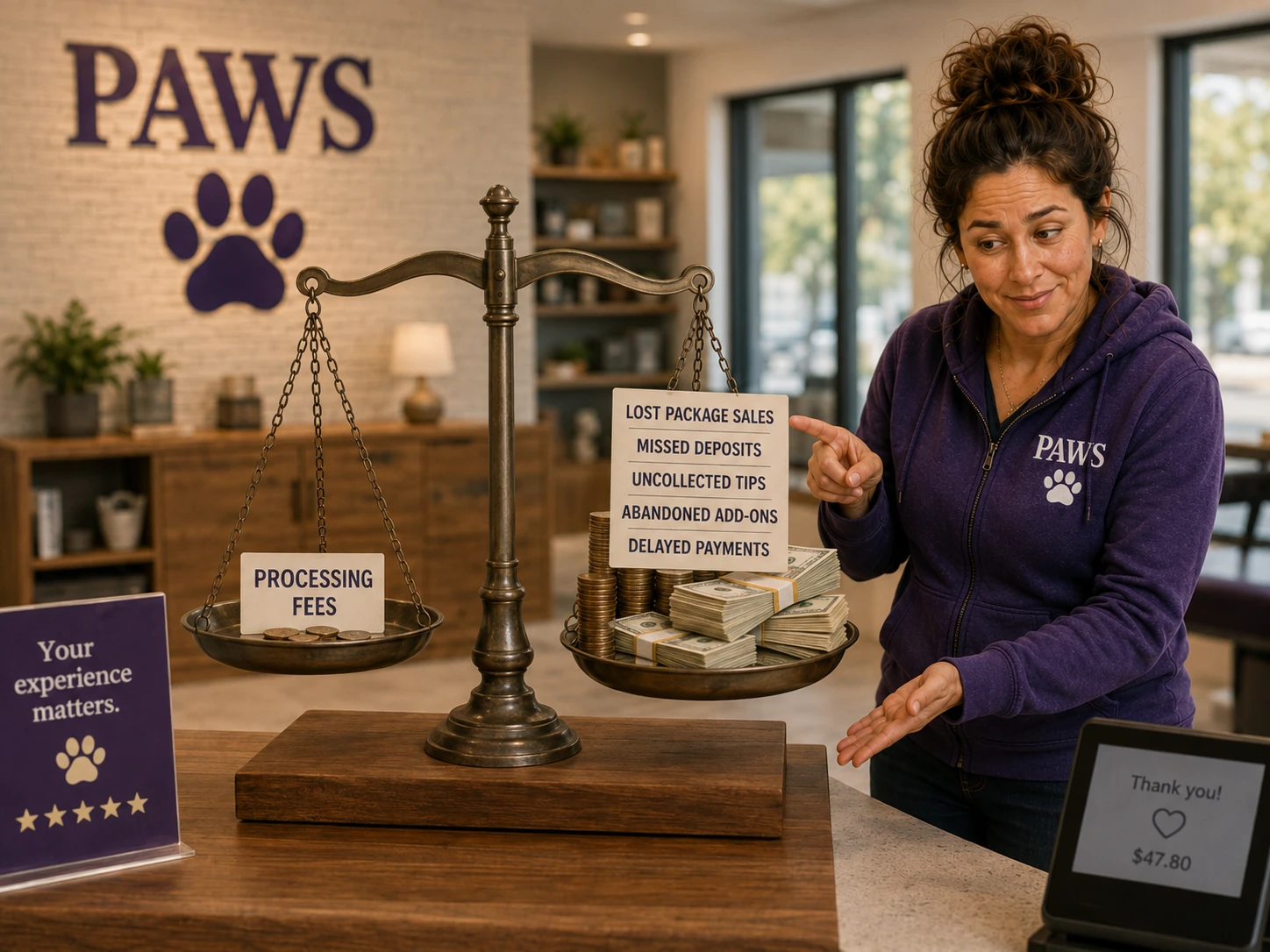
Yes, credit card processing costs money. So does shampoo. So does payroll. So does rent. So does insurance. Welcome to business. The answer is not to make customers dig for cash, write checks, or wait while your staff manually enters payment into a system that looks like it was last updated during dial-up.
Refusing modern payment because of processing fees is usually fake savings. You may save a small percentage while losing package sales, tips, deposits, memberships, add-ons, and customer convenience. That is not smart. That is stepping over dollars to pick up processing-fee pennies.
The better answer is to price correctly. Build payment costs into your rates. Use packages and memberships. Avoid excessive manual entry when possible. Review your processor statement. Understand what your software charges. Do not choose a system only because the advertised rate looks pretty. Sometimes the “cheap” processor gets expensive once software, hardware, keyed transactions, chargebacks, and support are dragged into the room.
🏷️
Price for Reality
Build normal payment costs into your service pricing instead of acting shocked every month when the processor charges you.
🔍
Watch the Full Cost
Look at software fees, hardware, monthly fees, keyed rates, online rates, chargeback fees, and support — not just the shiny headline number.
📈
Measure the Upside
Convenience can increase package sales, tip income, deposits, recurring revenue, and collection speed. Count that too.
📦
Deposits, Packages, Memberships, and Card-on-File
This is where payment convenience gets stronger than simple checkout.
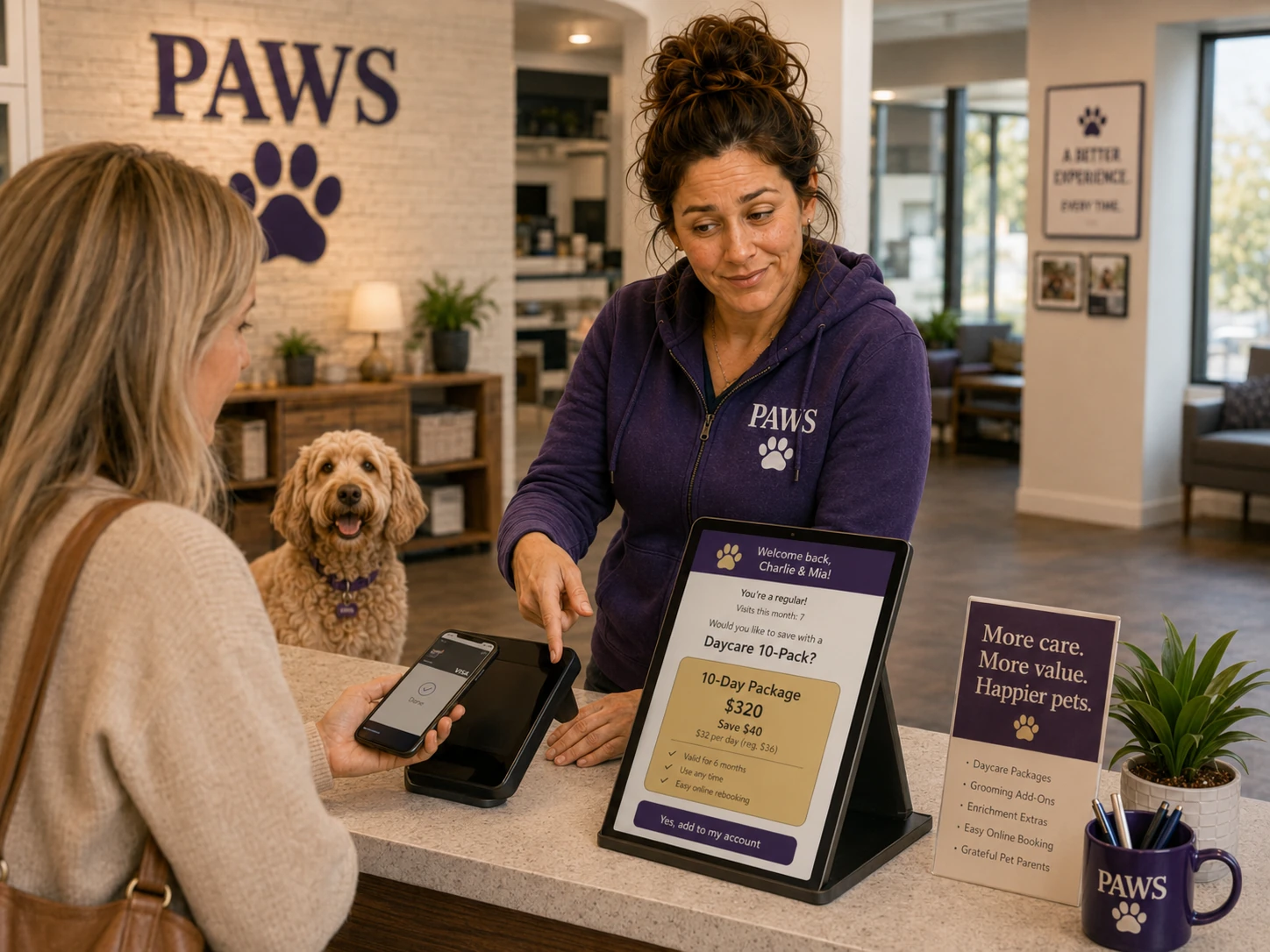
Taking a card at the counter is useful. Keeping payment connected to the customer account is more useful. Card-on-file, online deposits, prepaid packages, and recurring memberships turn checkout from “customer pays today” into a system that supports the whole business model.
Boarding deposits become easier to collect. Grooming appointment deposits become easier to enforce. Late pickup fees stop being awkward. Packages can renew faster. Membership billing can create steadier monthly cash flow. Add-ons can be paid without another front-desk circus. No-show fees become real instead of theoretical. The customer can buy more without the whole transaction needing to restart from zero.
This does not mean you randomly charge people whenever you feel like it. That is how you create chargebacks, angry customers, and bad reviews. Card-on-file needs clear authorization, written policies, receipts, and staff who understand what can and cannot be charged.
| Payment Tool | Revenue Use | Why It Helps |
|---|---|---|
| Card-on-File | Late fees, packages, memberships, no-show fees, recurring services. | Reduces awkward collection and makes repeat purchases easier. |
| Boarding Deposits | Holiday stays, peak weekends, high-demand reservations. | Separates serious customers from “maybe” customers who block your inventory. |
| Grooming Deposits | New clients, long appointments, specialty grooms, high no-show risk. | Protects groomer schedule and lost production time. |
| Daycare Packages | Prepaid visit bundles or monthly plans. | Increases upfront cash and encourages repeat use. |
| Memberships | Monthly daycare, enrichment, grooming maintenance, or VIP-style plans. | Creates recurring revenue and reduces constant one-off selling. |
| Online Payment Links | Balances, invoices, deposits, missed payments, remote package purchases. | Lets customers pay without returning to the front desk or playing phone tag. |
📌
Card-on-file rule
Card-on-file is powerful because it removes friction. But it only works cleanly when the customer has authorized it, the policy is written, the staff understands it, and receipts are clear. Do not turn a revenue tool into a trust problem.
🧪
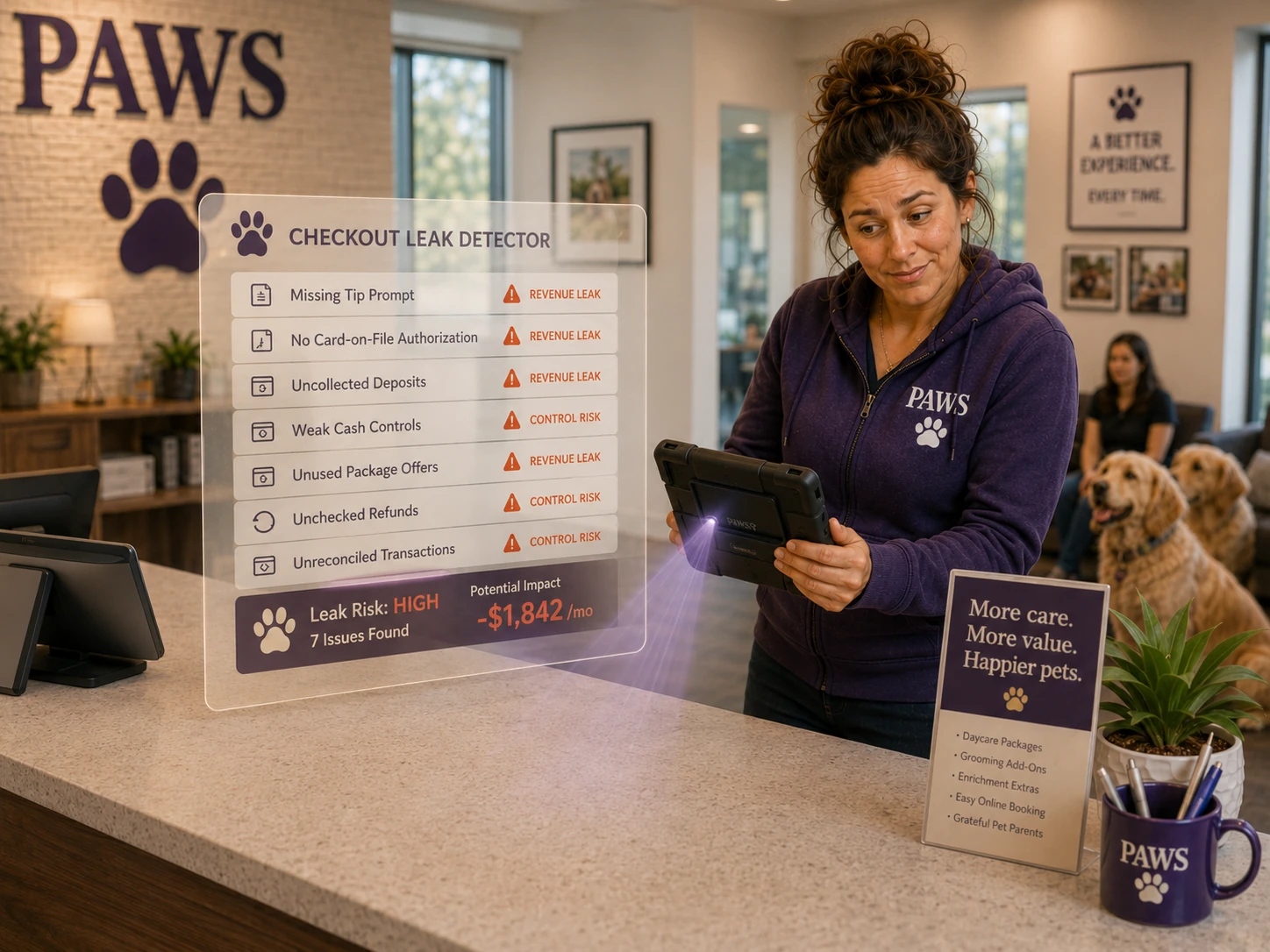
Checkout Leak Detector
This quick checker points out where your payment setup may be leaking money: convenience, tips, deposits, packages, cash control, or follow-up payments.
Pick what your facility already does well.
The checker will point out the checkout areas most likely leaking extra income or creating avoidable money problems.
📈
Payment Convenience Revenue Examples
Do not worship example math. Use it to see how small checkout changes stack into real money.
The money from payment convenience usually does not arrive like a parade. It shows up quietly. A few more tips. A few more packages. A deposit that actually gets collected. A no-show fee that does not turn into a staff argument. A membership that renews automatically. A grooming add-on that gets paid instead of forgotten. Small, boring, repeatable money.
That kind of money matters because dog daycare is a repeat business. Little improvements repeat too.
| Checkout Improvement | Simple Example | Annualized Impact | Operator Read |
|---|---|---|---|
| Tip Prompt | 20 customers leave an average extra $3 per week. | $3,120 per year. | That is real money for staff morale, and it came from making the option easy. |
| Better Package Selling | Two extra customers per week buy a $200 package instead of single visits. | $20,800 in prepaid package volume. | Not all new money, but better cash flow and stronger retention. |
| Boarding Deposits | Five peak-season bookings per month pay a $50 deposit that used to be skipped. | $3,000 in collected deposits. | More serious reservations and fewer soft holds on valuable boarding space. |
| Card-on-File Fees | Late pickup/no-show fees actually get collected instead of waived awkwardly. | Depends on policy and volume. | The win is not just the fee. It is customer behavior changing because the policy has teeth. |
| Online Payment Links | Customers pay balances before pickup or before boarding drop-off. | Reduces chasing and front-desk bottlenecks. | Less “I forgot my wallet” theater at the worst possible time. |
🧮
Do not get drunk on example math.
Your numbers depend on customer volume, pricing, staff training, software, tip settings, and whether your front desk actually uses the system. The point is not that every facility gets the same result. The point is that checkout friction has a cost, and convenience has value.
💰
The Simple Checkout Money Stack
The goal is not to make checkout fancy. The goal is to make checkout produce more money with less friction, fewer missed charges, and fewer awkward front-desk conversations.
A strong payment setup does three simple things. It makes paying easy. It makes extra spending easy. It makes appreciation easy. That is the whole stack. Not complicated. Not tech-bro nonsense. Just practical checkout money that adds up because the customer is already standing there ready to spend.
Most facilities do not lose payment money in one dramatic explosion. They lose it in little drips. A package not offered. A tip option not shown. A deposit not collected. A late fee waived because the conversation felt awkward. A grooming add-on forgotten at checkout. A customer who would have bought more if the process had not felt like trying to renew a passport at a bait shop.
Fix the checkout stack and the business gets easier to pay, easier to upgrade, easier to tip, and easier to manage. That is how boring payment systems quietly become profit tools.
💳
Make Paying Easy
Cards, chip readers, tap-to-pay, Apple Pay, Google Pay, online payments, card-on-file, and digital receipts all reduce friction. The less effort it takes to pay, the fewer chances customers have to pause, forget, delay, or make your front desk chase money like a loose dog in a parking lot.
📦
Make Extra Spending Easy
Packages, deposits, memberships, grooming add-ons, retail, enrichment, late pickup fees, boarding upgrades, and recurring plans all sell better when the payment system supports them. If the front desk has to manually rebuild the wheel every time, the wheel gets left in the ditch.
💸
Make Appreciation Easy
Clean tip prompts, digital tip options, printed tip lines, service-specific tipping, clear tip policy, and trained staff make it easy for happy customers to reward the team. No begging. No guilt screen nonsense. No employee hovering like a donation goblin.
📌
Operator rule
If checkout only collects the exact invoice and nothing else, it is underworking. A good checkout system should collect payment, offer the right upgrade, capture the tip opportunity, document the transaction, and make the next sale easier. That is not pushy. That is running the counter like it belongs to the business.
🗣️
Front Desk Payment Scripts
Your staff should not be inventing money conversations while the lobby is barking.
Payment scripts keep checkout professional. They also prevent staff from sounding apologetic about normal business policies. If you sell packages, require deposits, use card-on-file, offer tips, or charge late pickup fees, your team needs clean language.
💸
Tip Screen Script
“The screen will ask about a tip for the team. It is completely optional. You can choose any option that works for you.”
💳
Card-on-File Script
“We can keep a card securely on file for packages, deposits, or approved charges so checkout is faster next time.”
🌙
Boarding Deposit Script
“To hold the boarding reservation, we collect a deposit today. That keeps the space reserved and applies according to our booking policy.”
📦
Package Script
“Since you are using daycare regularly, a package may save time at checkout and keep visits prepaid. Would you like me to show you the options?”
🧾
Receipt Script
“Your receipt can be texted or emailed. It will show today’s services, tips if any, and the payment method used.”
📅
Rebook Script
“Would you like to schedule the next grooming/daycare package/boarding stay while we already have your account open?”
🚫
Common Payment and Tip Income Mistakes
These are the little checkout mistakes that quietly eat money while everyone blames “slow sales.”
💸
No Tip Option
Happy customers cannot tip electronically if the system never gives them the chance.
🙃
Awkward Tip Pressure
A tip prompt is fine. A staff member hovering like a donation goblin is not fine.
🧾
No Card-on-File Authorization
Card-on-file is useful only when customer authorization and policy are clear.
📦
Not Offering Packages
If regular customers are paying one visit at a time forever, you may be missing package and membership revenue.
🔐
Weak Refund Controls
Refunds, voids, discounts, and write-offs need review. Otherwise the payment system becomes a snack machine for mistakes.
💵
Cash Drawer Chaos
Cash without drawer counts, receipt rules, and daily reconciliation is not simple. It is fog with dollar signs in it.
📉
Ignoring Processing Costs
Do not ignore fees, but do not let fee panic make checkout harder and cost you bigger money.
🧠
No Staff Training
The best POS system in the world still fails if staff do not know how to sell packages, collect deposits, and explain tip prompts.
❓
Dog Daycare Payment and Tip Income FAQ
Detailed answers to the payment-method, card-on-file, deposit, package, membership, tipping, payroll, processing-fee, cash-control, reconciliation, refund, chargeback, recurring-billing, and checkout-measurement questions that determine whether the front desk captures revenue or quietly leaks it.
Which payment methods should a dog daycare accept?
At minimum, the facility should support dependable credit and debit card payments. Chip, tap-to-pay, Apple Pay, Google Pay, online payment links, and card-on-file can reduce checkout friction and support deposits, packages, memberships, and remote balances. Cash may remain a backup option, but it should not be the only practical way to pay. Select methods that integrate cleanly with the booking, POS, accounting, and receipt systems the staff actually uses.
Does accepting more payment methods really increase revenue?
It can because convenience removes points where customers delay, forget, or abandon a purchase. A repeat customer is more likely to renew a package, add grooming, leave a tip, pay a deposit, or buy retail when the transaction can be completed immediately. The revenue gain does not come from technology alone; the offer, pricing, staff training, and checkout workflow still matter. The payment system simply stops standing in the way.
Should a daycare require a card on file?
Card-on-file can be valuable for repeat clients, memberships, boarding or grooming deposits, approved late fees, no-show charges, and remote balances. The customer should provide clear authorization, understand which charges may be processed, and receive receipts. Staff should not use a stored card outside the written policy. A powerful collection tool becomes a trust and chargeback problem when authorization is vague.
How should boarding and grooming deposits be handled?
State the deposit amount, when it is charged, whether it is refundable or transferable, the cancellation deadline, and how it applies to the final invoice. Collect the deposit when the reservation is confirmed rather than relying on staff to chase it later. Peak boarding space and long grooming appointments have real opportunity cost when a customer cancels. The policy should be visible before payment and applied consistently.
Can packages and memberships improve cash flow?
Yes. Prepaid packages bring cash into the business earlier and encourage repeat use, while recurring memberships can create more predictable monthly revenue. The price still needs to protect realized revenue after discounts and heavy usage. Terms should address expiration, rollover, cancellations, failed payments, pauses, refunds, and transferability. A package is useful only when the software and staff can track it accurately.
How should package offers appear at checkout?
The best offer is timely, relevant, and easy to complete. A regular customer approaching the end of a package can be shown the renewal on the customer-facing screen or prompted by trained staff while the account is already open. The offer should explain the visits, price, expiration, and savings without creating a long sales presentation. A package opportunity disappears when the customer has to remember to call back later.
Should dog daycare customers be asked for tips?
A voluntary tip option is reasonable in an animal-care service business. Staff handle dogs, clean messes, supervise groups, assist customers, and often perform labor customers genuinely appreciate. The prompt should remain optional, professional, and easy to decline. The business should never imply that a dog will receive better or worse care based on tipping.
What makes a tip screen feel professional instead of pushy?
Use sensible percentage or dollar options, a custom amount, and a clearly visible no-tip choice. Let the customer make the decision privately while staff focus on the dog, receipt, or next task. Employees should not hover, comment, sigh, or explain which button they hope the customer selects. The screen may present the opportunity; the staff should not turn it into emotional pressure.
Who should receive daycare, boarding, and grooming tips?
The answer should be established in a written policy that fits the services and applicable wage law. Daycare or boarding tips may be pooled by shift or distributed by hours, while grooming tips may be assigned to the groomer or shared with a bather under a defined rule. Cash and electronic tips should be recorded and distributed consistently. Obtain qualified payroll or legal guidance before including owners, managers, or supervisors in a tip pool.
How should electronic tips be recorded and paid?
Electronic tips should remain connected to the transaction, employee or service category, payroll record, and payout method. The business needs a process for refunds, chargebacks, corrected transactions, cash tips, and tip-pool calculations. Staff should be able to understand how the amount on the checkout screen becomes the amount they receive. A shoebox or handwritten mystery ledger is not a tip system.
Are credit-card processing fees worth paying?
Processing fees are a normal operating cost when modern payment options improve collection speed, package sales, deposits, tips, and customer convenience. The correct comparison is not fees versus free; it is total payment cost versus the sales and control the system supports. Build normal costs into pricing and review the full processor statement. Saving a small percentage can be expensive when difficult checkout suppresses larger purchases.
What processor costs should be reviewed besides the advertised rate?
Review monthly fees, software subscriptions, terminal costs, online and keyed-entry rates, chargeback fees, PCI-related charges, payout timing, refund treatment, support, contract length, cancellation terms, and hardware replacement. Also examine whether the processor integrates with the daycare software and accounting workflow. A low headline rate can become expensive after every required component is added. Compare the complete operating cost.
How do digital payments reduce theft and mistakes?
Digital transactions create timestamps, employee logins, receipts, payment methods, tips, discounts, refunds, voids, and deposit records. That trail makes honest errors easier to correct and suspicious activity easier to identify. It also reduces the amount of loose cash moving through the front desk. Technology does not replace management, but it gives management better evidence.
What cash controls should remain if the daycare accepts cash?
Use a defined opening drawer, individual or controlled access, required receipts, documented paid-outs, shift or closing counts, discrepancy review, and prompt deposits. Cash tips should be separated and recorded according to policy. Staff should never borrow from the drawer, exchange undocumented money, or treat shortages as normal. A small amount of cash still requires a complete control process.
How often should payments be reconciled?
Reconcile daily whenever practical. Compare POS totals, processor transactions, cash, checks, tips, refunds, voids, discounts, deposits, packages, memberships, and bank payouts. Investigate differences while the employees and events are still fresh. Waiting until month-end allows small mistakes to become difficult stories with no reliable answer.
Who should be allowed to issue refunds, voids, and discounts?
Use individual employee logins and permission levels based on responsibility. Larger refunds, unusual discounts, voids, write-offs, and manual price changes should require manager approval or review. The report should identify who completed the action and why. Controls protect trustworthy employees as much as they protect the business.
How should chargebacks be prevented and handled?
Use recognizable business names on statements, clear service descriptions, signed policies, receipts, accurate cancellation terms, documented communications, and proof that the service was authorized and delivered. Respond to disputes promptly with organized records rather than emotion. A chargeback may still occur even when the business acted correctly. Good documentation gives the processor a usable record to review.
What should happen when a recurring membership payment fails?
The software should identify the failure, notify the customer, request an updated payment method, and apply the written grace-period or suspension rule. Staff should not allow failed accounts to continue indefinitely because the conversation feels awkward. The process should distinguish a temporary card issue from a customer attempting to cancel. Clear terms and courteous communication protect both revenue and trust.
Which checkout numbers should be reviewed every month?
Review payment volume by method, processor cost, tips, package and membership sales, deposits collected, failed recurring charges, refunds, voids, discounts, chargebacks, cash discrepancies, online balances, and time spent completing checkout. Compare those figures with staff training and customer complaints. The goal is not merely faster transactions. It is better collection, cleaner records, and more captured revenue.
What is the biggest payment-system mistake a dog daycare can make?
The biggest mistake is treating checkout as a passive cash register instead of an operating system. Weak checkout misses deposits, tips, packages, memberships, add-ons, receipts, and accountability while making staff invent money conversations during a busy lobby. Build the policies, permissions, payment methods, reports, and scripts before expecting the front desk to perform consistently. The customer already has a reason to pay; the system should make that moment easy and controlled.
🐾
The Bottom Line on Payment and Tip Income
Better payment systems do not just process money. They create money, protect money, document money, and reduce checkout chaos.
This is not the flashiest additional-income strategy. Nobody opens a dog daycare because they dream of card readers, tip prompts, and end-of-day reports. But this is one of the easiest places to stop leaking money and start collecting money that customers were already willing to spend.
Take modern payments. Make tipping easy. Use card-on-file where appropriate. Sell packages. Collect deposits. Reduce cash and check nonsense. Train the front desk. Review the reports. Make checkout fast, professional, and profitable.
The best part is that this does not require a new building, a new service department, or a new payroll monster. It requires taking the moment where customers already have their wallet out and making that moment work harder for the business.