Cash Flow and Survival
Dog Daycare Opening Cash Flow Analysis: Why Good Facilities Still Run Out of Money
A dog daycare can have demand, happy customers, and a strong long-term future and still get crushed in the opening months if the cash reserve and revenue ramp are not planned correctly.
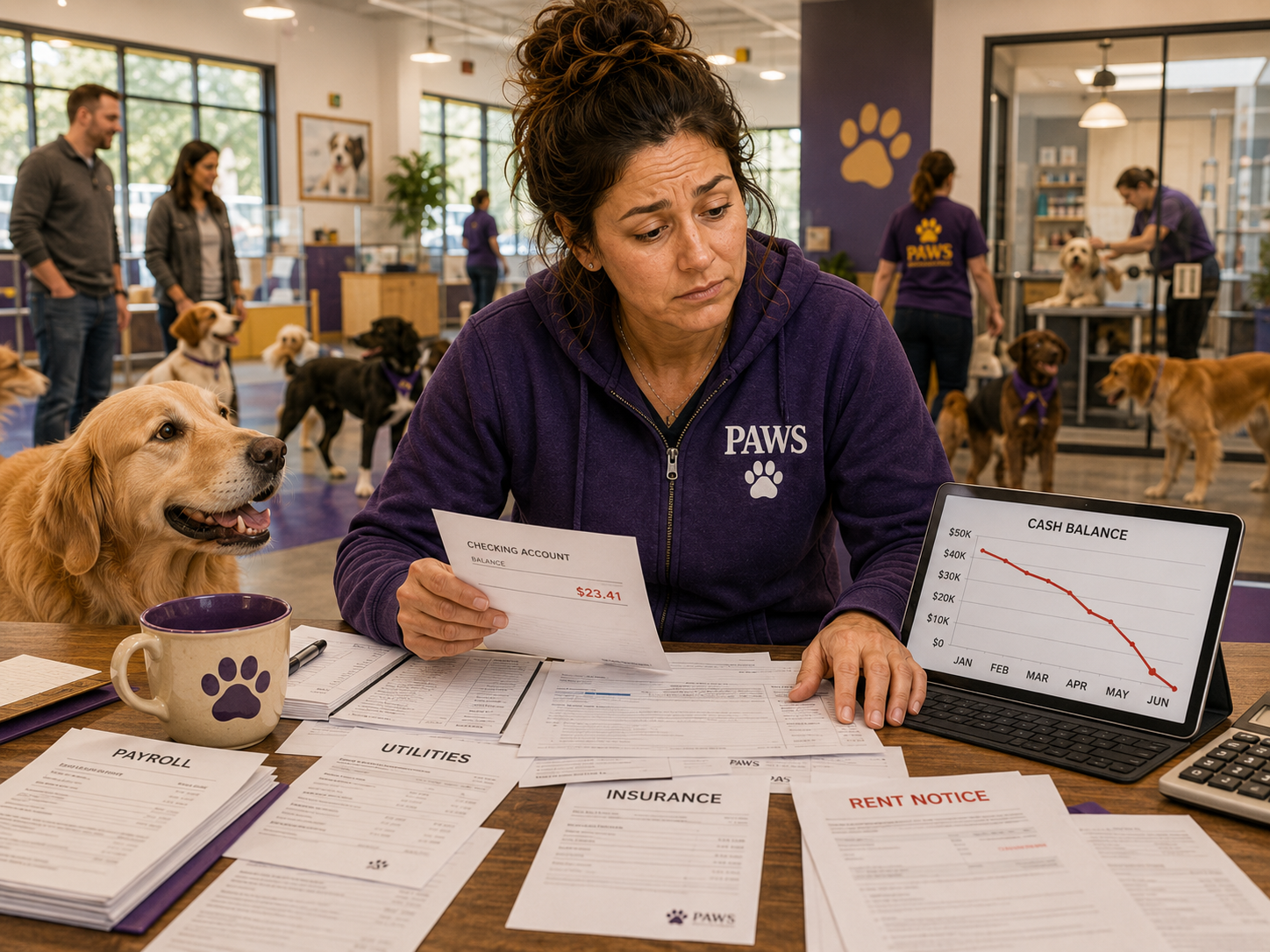
In the previous cash-reserve discussion, we talked about why a new dog daycare needs enough money to survive the opening months. This section takes that deeper by walking through an actual dog daycare that opened in April 2016 and showing how the numbers developed as the business started to gain traction. This section aims to take the cash-reserve discussion deeper by analyzing what actually happens when the bills arrive before the customer base has fully matured.
The important thing to understand is that in the real world, with real customers, expenses and unpredictability not everything will behave as expected. Revenue builds unevenly. Some services grow faster than others. Advertising hits early. Equipment fails. Small repairs appear. Animals can be injured requiring vet bills. Customer miss appointments or no show. Auditing and profit/loss analysis may be off as Kennel Software reports and accounting reports sometimes do not match perfectly because refunds, credits, coupons, and non-taxable adjustments can be handled differently from one system to another.
This is all normal. The point is not to pretend everything will be perfect from opening day and numbers will reconcile perfectly neat across every report. The point is to understand what the trend is telling you and what the operator should learn from it.
The facility used in this example operated with what I call the triple-feed business model: dog daycare, dog grooming, and dog boarding feeding customers and revenue into one another. That matters because daycare by itself can take time to mature. Grooming brings in customers who may not have tried daycare. Boarding customers see the value of daycare when their dogs play during the day. Daycare customers become grooming and boarding customers because they already trust the facility.
This is the kind of service mix that can help keep a new facility afloat while the business is still growing. It gives the operator more than one way to bring people through the door, more than one reason for customers to come back, and more than one revenue stream to support the overhead.
That does not mean you should open recklessly or build something twice as large as the market can support. A smaller, well-managed, customer-service-oriented facility can outperform a larger facility that is bloated with rent, payroll, and wasted space. In the beginning, why pay for a 6,000-square-foot burden if a smaller facility can generate the same gross with better control? As the business grows, grow the facility
The point of this page is not to make the numbers look exciting. The point is to understand the climb. Cash flow is what keeps the business breathing while trust, repeat use, grooming volume, boarding demand, and daycare attendance are still building.
This is where a lot of new operators miss the lesson. The business is not just “dog daycare.” The business is the relationship with the customer and the service structure built around that relationship. If you provide several useful services under one roof, and you provide them well, each service can help support the others while the facility is still growing..
This is not theory. This page walks through a real dog daycare facility, real operating numbers, real software records, real profit-and-loss notes, and the kind of opening-month surprises that can make or break a new facility.
⚠️
The First Hard Truth: Profit and Cash Are Not the Same Thing
A business can look fine on paper and still run out of money in real life.
New owners mix these up all the time. Profit is an accounting result. Cash flow is survival. If a facility is expected to be profitable later, but it burns cash faster than it builds customers in the opening months, that future profit does not save it.
What matters at the beginning is whether the business has enough cash reserve to absorb slow client growth, seasonal softness, payroll timing, opening-month inefficiencies, and the little surprises that never seem to appear on the optimistic version of the spreadsheet.
A dog daycare can be busy and still be unhealthy. It can have dogs in the building and still be underpriced. It can have customers who love the service and still not have enough cash to cover payroll, rent, insurance, utilities, cleaning, software, repairs, and taxes. That is why opening cash flow needs to be treated as survival math, not just accounting paperwork.
💸
Cash Leaves First
Deposits, rent, utilities, payroll, insurance, supplies, and repairs do not wait for your customer count to catch up.
📈
Revenue Usually Ramps
Most facilities do not open at full strength. Revenue builds in layers as awareness, trust, repeat use, and service mix develop.
🫁
Reserve Creates Breathing Room
Cash reserve buys time. Time lets the operator improve the service, refine pricing, tighten staffing, and build recurring volume.
🧭
What Opening Cash Flow Really Means
The question is not whether money comes in. The question is whether enough money comes in, soon enough, consistently enough.
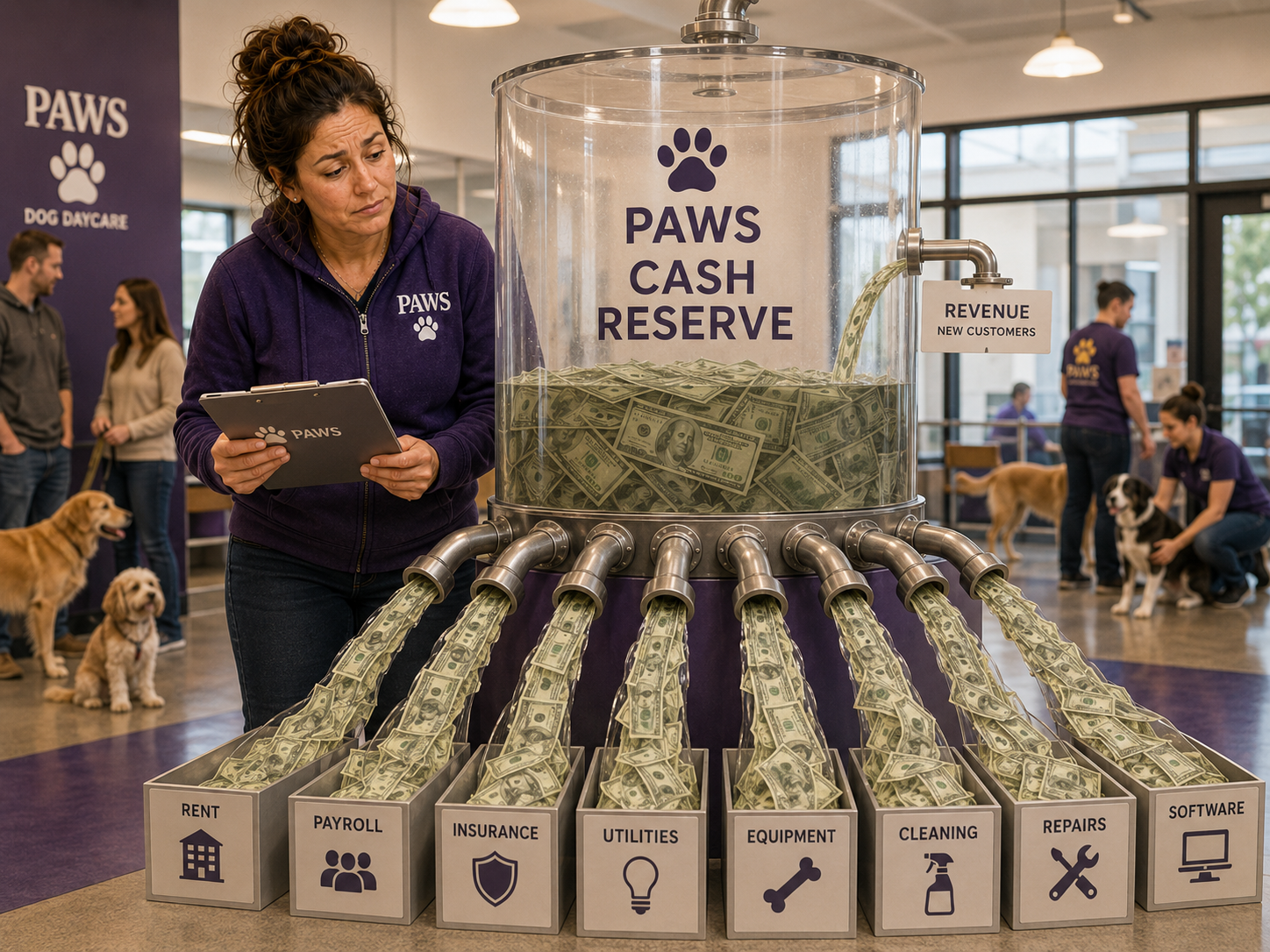
Cash flow at opening is the movement of money into and out of the business while the facility is still trying to stabilize. You are usually dealing with a new client base, trial customers, inconsistent volume, imperfect staffing efficiency, incomplete service penetration, and fixed costs that do not care how new you are.
Good operators understand that the opening phase is not just “open the doors and watch the money come in.” It is a ramp period. Your marketing is still proving itself. Word of mouth is still forming. Customers are still testing the service. Staff is still settling in. Systems are still getting polished.
That means the first few months are usually not a clean reflection of what the business can eventually become. The problem is that your expenses are already fully real while your revenue is still immature.
🔥
Why the Opening Months Are Dangerous
Most facilities do not fail because the owner loves dogs too little. They fail because the math is weak, the reserve is thin, or the ramp takes longer than expected.
01
Slow Revenue Build
Customers come in gradually, not all at once. You need enough reserve to survive before recurring volume is stable.
02
Fixed Cost Burden
Rent, insurance, software, utilities, merchant fees, waste removal, and core operating expenses do not care that the business is new.
03
Payroll Timing
Staff must be paid whether or not the week felt busy. Poor staffing control can destroy early cash flow fast.
04
Opening Inefficiency
New systems, training gaps, waste, and operational friction are normal. Plan for them instead of pretending they will not happen.
05
Build-Out Surprises
Repairs, signage, drainage, HVAC, fencing, noise control, equipment fixes, and odds-and-ends can pile up after the doors open.
06
Service Mix Lag
Daycare, boarding, grooming, and add-ons may mature at different speeds. A blended model usually stabilizes revenue better than one-service dependence.
The operator lesson is simple: do not assume the first month tells you the truth. It usually does not. What matters is whether the trend is heading in the right direction and whether the business has the reserve to stay alive while that trend develops.
🏢
Case Study From a Real Facility
This example is useful because it shows a real operating pattern: a small facility, multiple services, modest staffing, and revenue that built over time.
📍
Location
Florida, commercial location in the city, positioned along a major commuter route.
🐾
Services
Dog daycare, dog grooming, dog boarding, and a small amount of retail.
👥
Staffing
Two people, husband and wife, which kept payroll lean while the facility was still building volume.
| Facility Area | Approximate Space | Operator Note |
|---|---|---|
| Little Dog Area | 600 sq. ft. | Separate space helps manage size, temperament, and safety. |
| Big Dog Area | 1,000 sq. ft. | The larger group area carries much of the daycare function. |
| Grooming Area | 150 sq. ft. | Small space, but powerful revenue contribution when managed correctly. |
| Boarding Area | 400 sq. ft. | Four 6-foot by 9-foot pet suites supported overnight and holiday revenue. |
| Office | 200 sq. ft. | Administrative control matters more than glamour. |
| Lobby / Traffic Areas | 250 sq. ft. | Customer flow, check-in, check-out, and first impressions all matter. |
The operator lesson here is important: This facility did not have to be huge to be profitable. A smaller efficiently -managed, facility can work when it is customer-service oriented, properly staffed, and designed around services that feed one another.
In the beginning, why pay twice the rent for a 6,000-square-foot facility if a smaller facility can generate the same gross and higher net with better control? Bigger is not automatically better. Bigger rent, bigger payroll, bigger cleaning burden, bigger utilities, bigger repair exposure, and more room for bigger mistakes that can eat a new operator alive before the customer base has time to mature.
As the business grows, grow the facility. Do not let a massive lease on a huge facility force the business into a position where it needs to grow faster than the market will support.
The goal is not to build the prettiest burden in town. The goal is to build a business that can survive long enough to become strong.
⚠️
The First Hard Truth: Profit and Cash Are Not the Same Thing
A business can look fine on paper and still run out of money in real life.
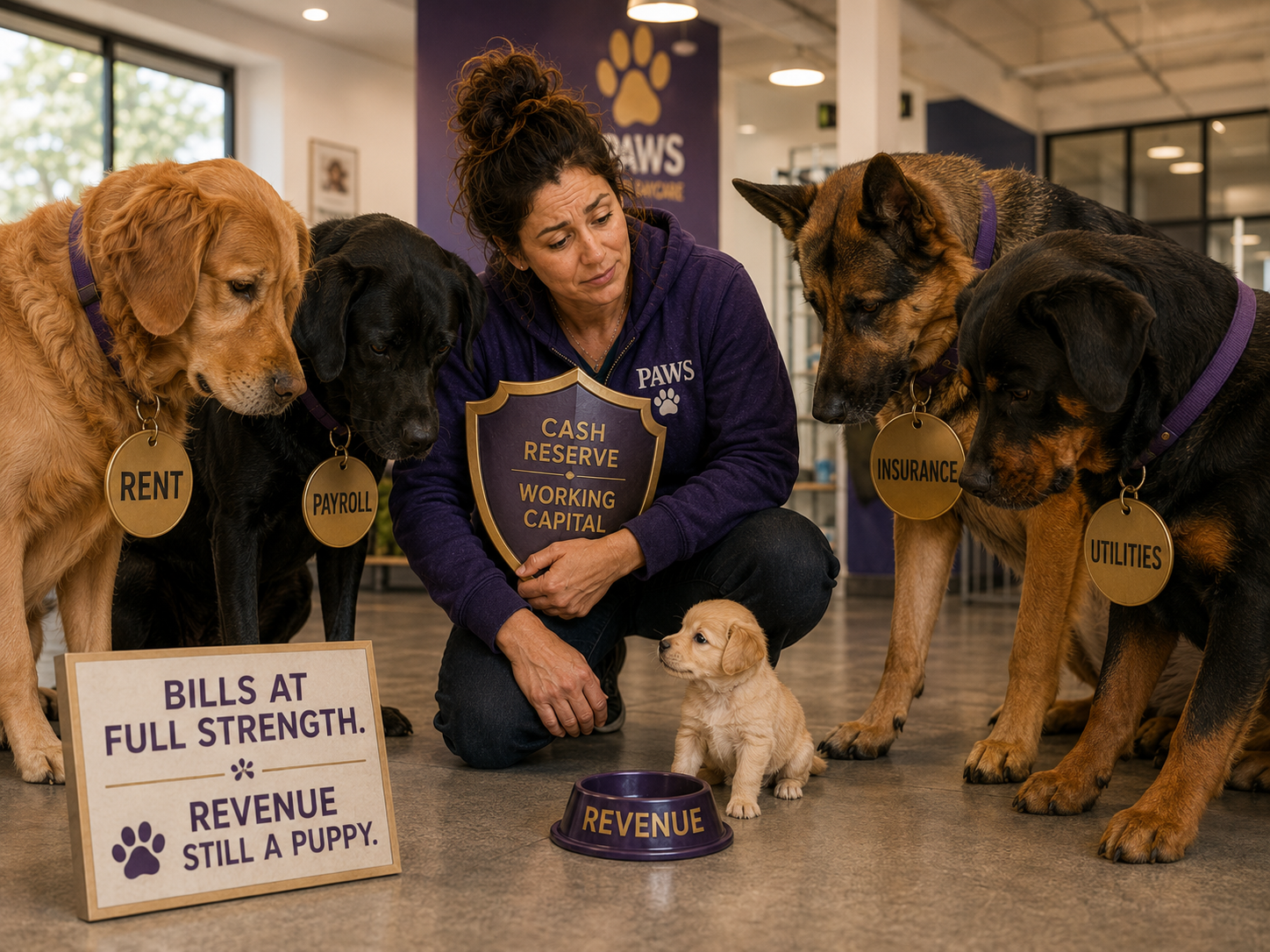
New owners mix these up all the time. Profit is an accounting result. Cash flow is survival. If a facility is expected to be profitable later, but it burns cash faster than it builds customers in the opening months, that future profit does not save it.
What matters at the beginning is whether the business has enough cash reserve to absorb slow client growth, seasonal softness, payroll timing, opening-month inefficiencies, equipment surprises, small repairs, and the little costs that never seem to appear on the optimistic version of the spreadsheet.
A dog daycare can be busy and still be unhealthy. It can have dogs in the building and still be underpriced. It can have customers who love the service and still not have enough cash to cover rent, insurance, utilities, cleaning, software, repairs, payroll pressure, taxes, and owner survival.
That is why opening cash flow needs to be treated as survival math, not just accounting paperwork.
💸
Cash Leaves First
Deposits, rent, utilities, insurance, supplies, repairs, merchant fees, and software do not wait for your customer count to catch up.
📈
Revenue Usually Ramps
Most facilities do not open at full strength. Revenue builds in layers as awareness, trust, repeat use, and service mix develop.
🫁
Reserve Creates Breathing Room
Cash reserve buys time. Time lets the operator improve the service, refine pricing, tighten staffing, and build recurring volume.
🧾
Software Reports and Profit-and-Loss Sheets Will Not Always Match Perfectly
This is one of those real-world details that matters more than people think.
There can be some variation between the dog daycare software reports and the QuickBooks-style profit-and-loss sheets. Both can come from the same facility and still show differences. That does not automatically mean something is wrong.
Refunds, credits, coupons, package adjustments, customer account credits, and internal software corrections may be handled differently by daycare software than by accounting software. Some items may not need to be entered into QuickBooks at all if they have no effect on the taxable situation.
The operator lesson is this: do not panic over small reporting differences before you understand what each system is tracking. Daycare software is often operational. Accounting software is financial and tax-oriented. You need both, but you also need to understand what each one is telling you.
🔁
The Triple-Feed Business Model
Daycare, grooming, and boarding should not be treated as isolated services. When planned correctly, each one feeds the others.
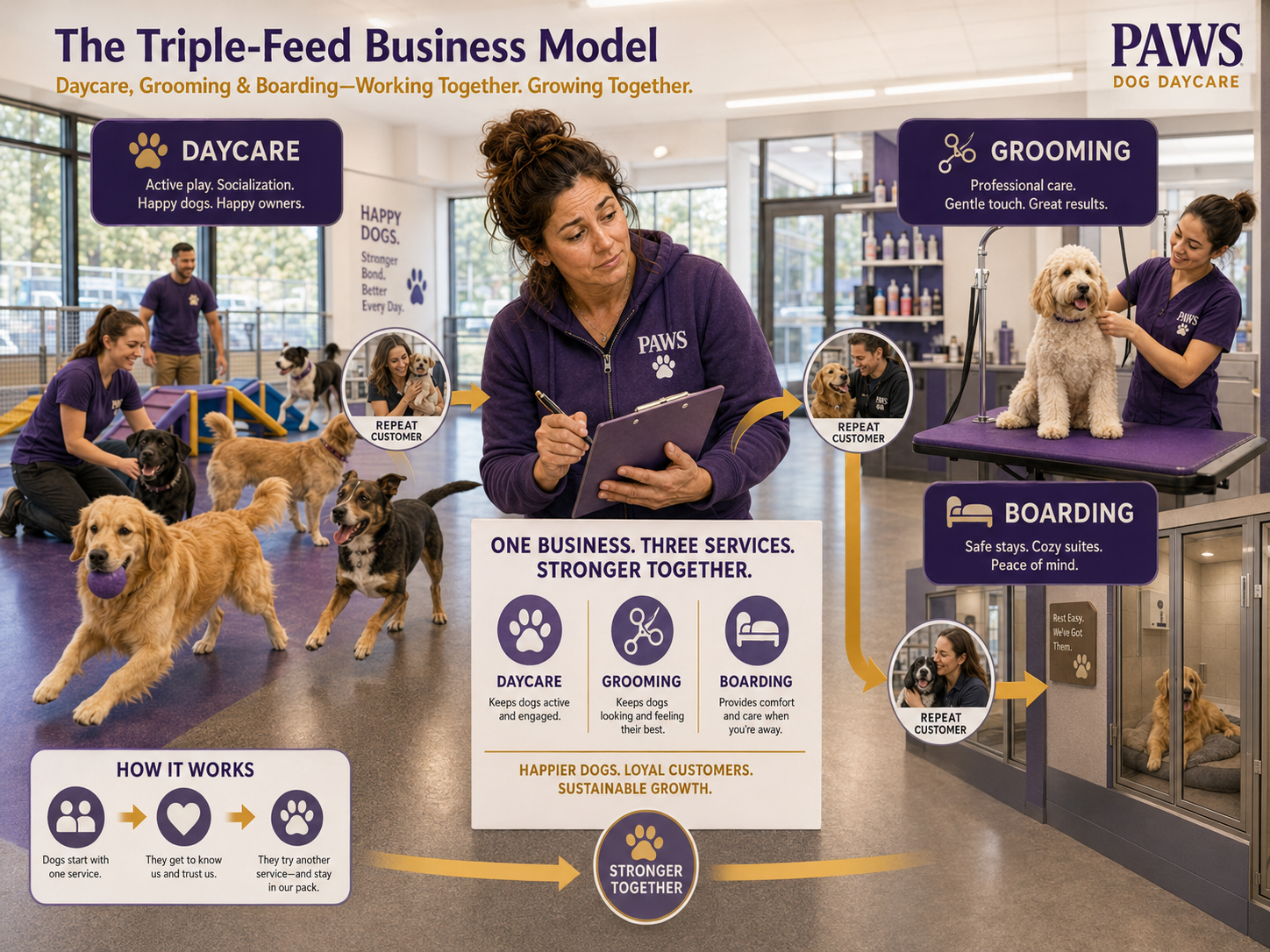
Customers who come in for grooming now have the option of letting their dog play before and after the groom instead of leaving the dog crated at a standard grooming shop. Boarding customers see their dogs enjoying daytime play and often become daycare customers. Daycare customers already trust the facility, so when they need boarding or grooming, they are less likely to shop around
In our society of convenience, people are inclined to use businesses that provide several services in one place, especially when the service involves something as personal as their dog. If they already trust you with the dog, you have a major advantage when they need another service you offer.
This is one of the unique advantages of the dog daycare industry. You are not just selling a transaction. You are building daily and weekly relationships with customers around an animal they love. A client may see a veterinarian every few months. A daycare client may see you several times a week.
Think about it. How many times a week do you eat at your favorite restaurant or go to your local barber? Maybe once every couple of weeks. You may know the waitress or barber by name, but the relationship is usually still based mostly on paying for a service.
Your daycare customers may see you every day. They will listen to what their dog did, who their dog played with, who their dog’s friends are, and whether their dog had a good day. Every day that you successfully provide joy, safety, structure, and confidence for the dog they love, they grow a little closer to you and your facility.
That relationship makes it much harder for them to take their dog somewhere else for a service you also offer. That is not a gimmick. That is relationship-based business. That is why offering more than daycare matters if you intend to generate serious revenue in this industry.
That is why offering more than daycare matters. If you intend to generate serious revenue in this industry, the business should be designed so services support each other instead of standing alone.
🛁
Grooming Feeds Daycare
Grooming customers see the facility, meet the staff, watch the dogs, and may become daycare or boarding clients later.
🏨
Boarding Feeds Grooming
Boarding creates natural bath, groom, nail trim, and pickup-day add-on opportunities.
🐕
Daycare Feeds Everything
Daycare builds trust and routine, which makes customers more likely to use every other service you offer.
📊
Example Opening Revenue Ramp
This example shows how revenue can build across months and across services. The real lesson is not the exact numbers. The lesson is how long it can take before the business starts to feel stable.
📅
Opening Month
April starts at just $782.99 in total revenue.
🚀
End of Year
By December, total revenue reaches $16,027.12.
🏨
Strongest Category
Boarding leads the example at $34,949.81 for the period shown.
🛁
Revenue Mix Matters
Grooming, daycare, and boarding each help carry the facility differently over time.
| Month | Total | Boarding | Grooming | Services | Daycare |
|---|---|---|---|---|---|
| Apr | $782.99 | $80.00 | $488.99 | $40.00 | $82.00 |
| May | $3,838.50 | $778.80 | $1,689.97 | $260.00 | $328.00 |
| Jun | $7,572.66 | $2,755.40 | $3,207.91 | $57.00 | $990.00 |
| Jul | $8,740.83 | $3,154.05 | $2,934.98 | $90.00 | $1,861.80 |
| Aug | $10,265.18 | $3,259.00 | $2,833.30 | $77.00 | $2,878.00 |
| Sep | $12,241.89 | $5,971.40 | $3,130.65 | $77.00 | $2,351.00 |
| Oct | $12,460.29 | $6,629.70 | $2,650.66 | $53.00 | $2,421.99 |
| Nov | $12,729.31 | $5,411.45 | $4,262.26 | $65.00 | $2,422.00 |
| Dec | $16,027.12 | $6,910.00 | $4,735.62 | $213.50 | $2,468.00 |
| Total | $84,658.78 | $34,949.81 | $25,934.34 | $932.50 | $15,756.99 |
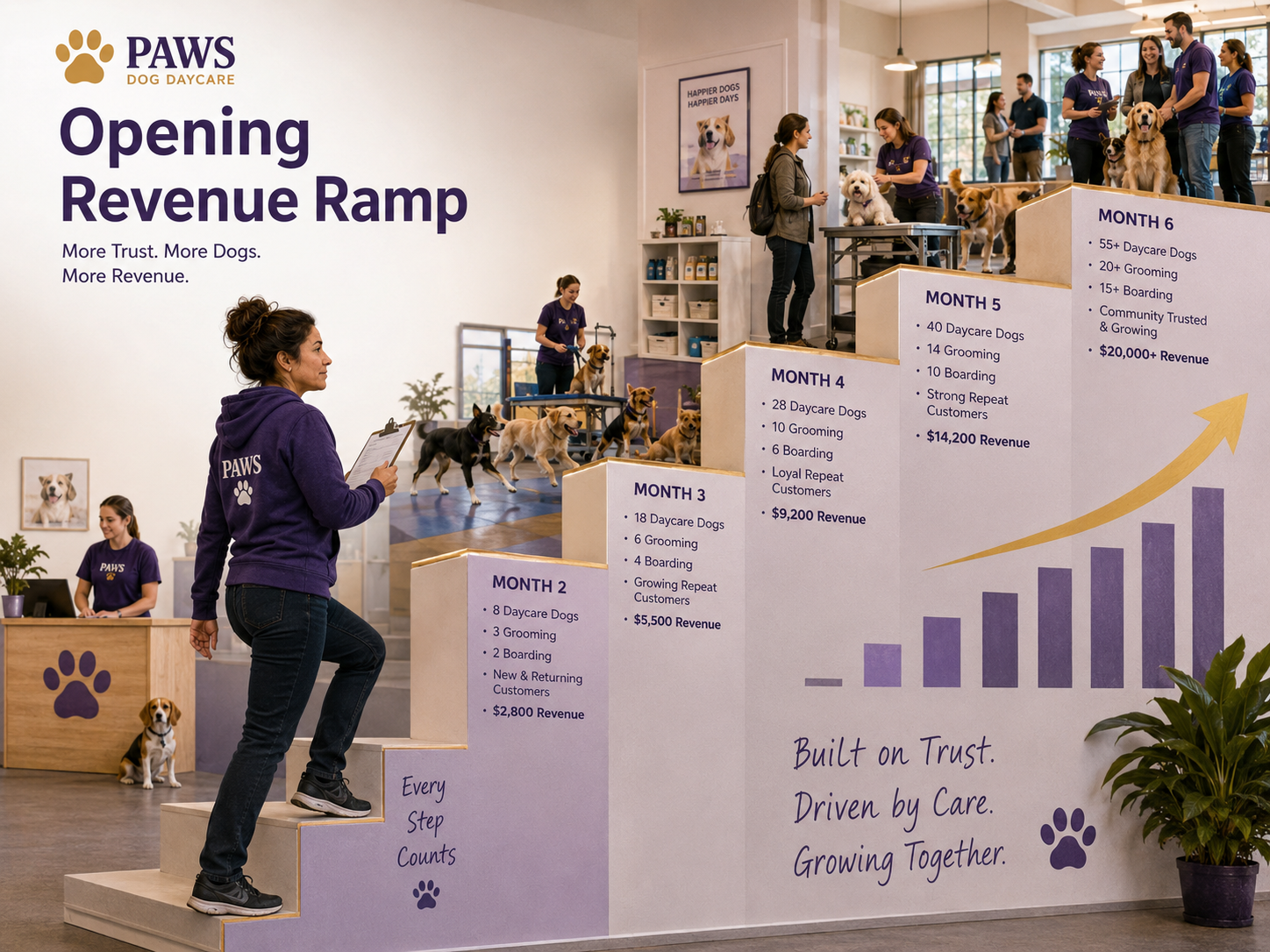
Look closely at what this is telling you. The business does not open at full strength. It climbs. It learns. It layers services. It builds repeat use. It becomes more predictable over time. That is exactly why the owner needs enough reserve to get through the earlier, thinner months.
What becomes apparent is that by advertising sparingly, networking heavily, and providing great customer and dog service, this facility increased revenue each month of operation. You will also notice the huge spike in December. Dog boarding and dog grooming can be off the charts and busier than you imagine during the holiday season.
This is why I do not like oversized starts unless the market and the cash reserve justify them. A smaller, efficient facility can make sense when it is managed tightly and the services feed one another. Bigger is not automatically better. Bigger rent, bigger payroll, bigger cleaning burden, bigger utility bills, and bigger mistakes can eat a new operator alive before the customer base has time to mature.
📊
What the Opening-Year Numbers Are Actually Telling You
These charts are not decoration. They show the operator lesson: the business climbed because multiple services fed one another while customer trust and repeat use developed.
Total Income Per Month
Revenue does not open at full strength. It climbs as customers test the facility, return, refer, board, groom, and start using more than one service.
Revenue Mix for the Period Shown
This is why the triple-feed model matters. Boarding, grooming, and daycare do not behave exactly the same way, and that can help stabilize the business.
Operator read: if this had been daycare only, the business would have been far more fragile. The blended model gave the facility more ways to earn while the customer base matured.
📈
Check-Out Growth and the Press Spike
A publicity spike is useful, but it is not the same thing as stable recurring business. The operator’s job is to convert attention into repeat use.
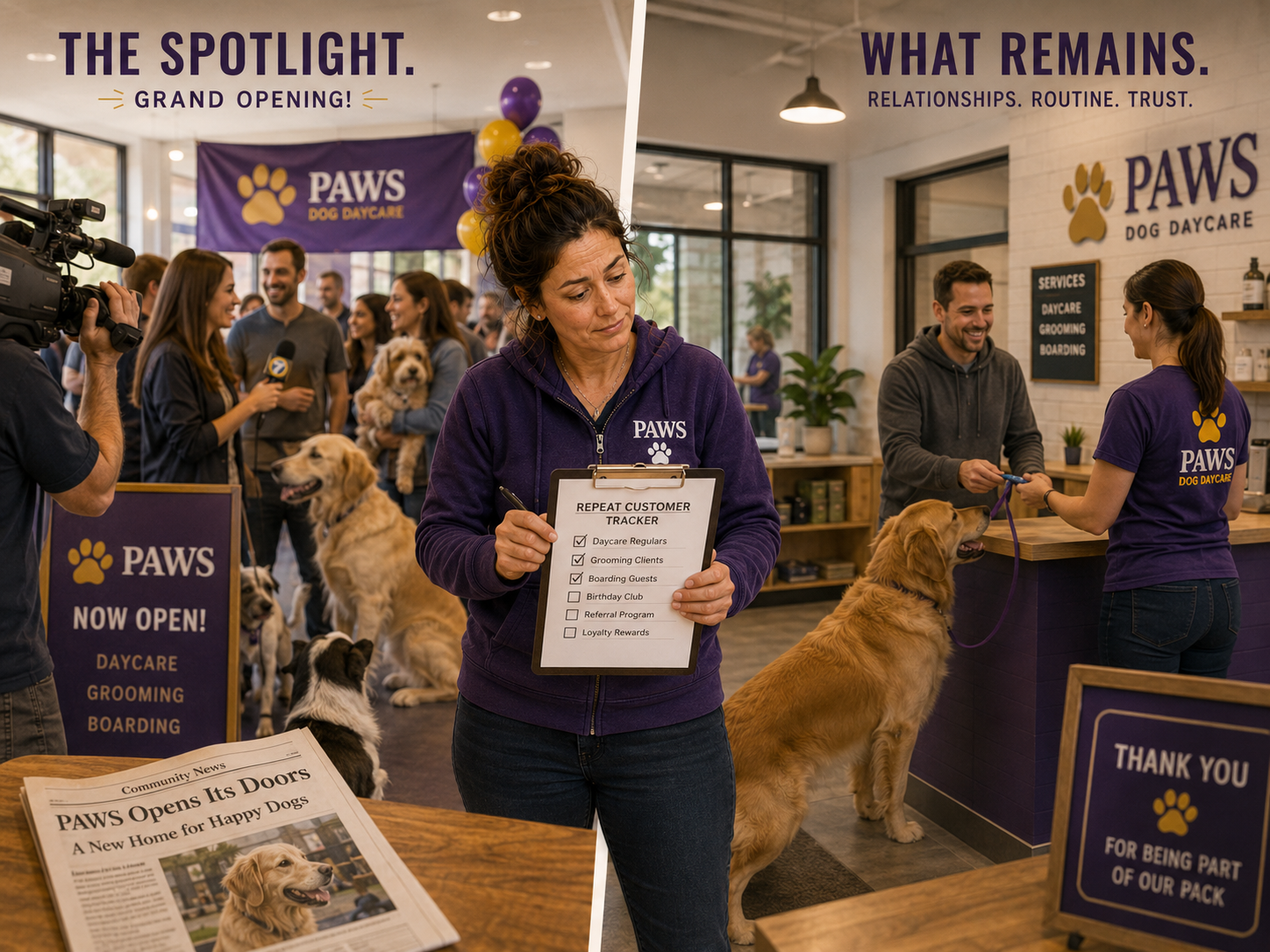
The check-out trend showed an initial customer spike in August. This was the result of a large full-color article that came out toward the end of July in an affluent local publication. That attention then led to local television coverage, with segments running on the evening news. That kind of attention can absolutely help. It gets people talking. It gets dogs through the door. It creates trial.
But press does not magically fix the business. Some of those “try it out” customers will disappear once the excitement dies down. The important question is whether enough of that attention turns into repeat daycare, boarding reservations, grooming appointments, referrals, and word-of-mouth momentum.
In this example, the stronger lesson is what happened after the spike. Daycare dropped back from the press-driven burst, but steady business continued to grow. Daycare moved into a more predictable growth pattern, while the press also created boarding and grooming customers that continued building the business by feeding the overall long term revenue stream.
That is the lesson. The press spike is not the business. The business is what remains after the spike is gone.
Operator read: do not mistake a publicity spike for a stable business. The business is built by what happens after the spike: repeat daycare, boarding reservations, grooming appointments, referrals, and trust.
📰
Press Creates Trial
A strong article or TV segment can create a surge of first-time visits, but trial customers are not the same thing as stable recurring customers.
🔁
Retention Creates Stability
The money is in converting attention into repeat daycare, boarding, grooming, and customer loyalty.
🏨
Boarding Extends the Value
Press may bring people in for daycare, but the trust created can turn into boarding and grooming revenue later.
The actual check-out totals for the first eight months were 2,759 total check-outs and 1,790 daycare visits, meaning daycare visits represented 64.88% of check-outs. Averaged out, that equals roughly 14 dogs per day at the facility boarding or in daycare over the course of the first eight months.
For a newly established dog daycare, especially considering the first three months were almost nil, that is a solid operating pattern. It shows the facility was starting to gain real traction.
📦
What the Service Mix Is Teaching You
Daycare gets most of the attention, but the entire service mix is what often stabilizes the business.
| Category | Example Total | What It Suggests |
|---|---|---|
| Boarding | $34,949.81 | Often becomes a powerful support category because it reaches beyond weekday commuter use. |
| Grooming | $25,934.34 | Brings in customers who may not need daycare and helps smooth revenue across the week. |
| Daycare | $15,756.99 | Important core service, but it may take time to mature and usually depends heavily on routine behavior. |
| Services / Add-Ons | $932.50 | Smaller on their own, but helpful for ticket growth and customer retention when handled properly. |
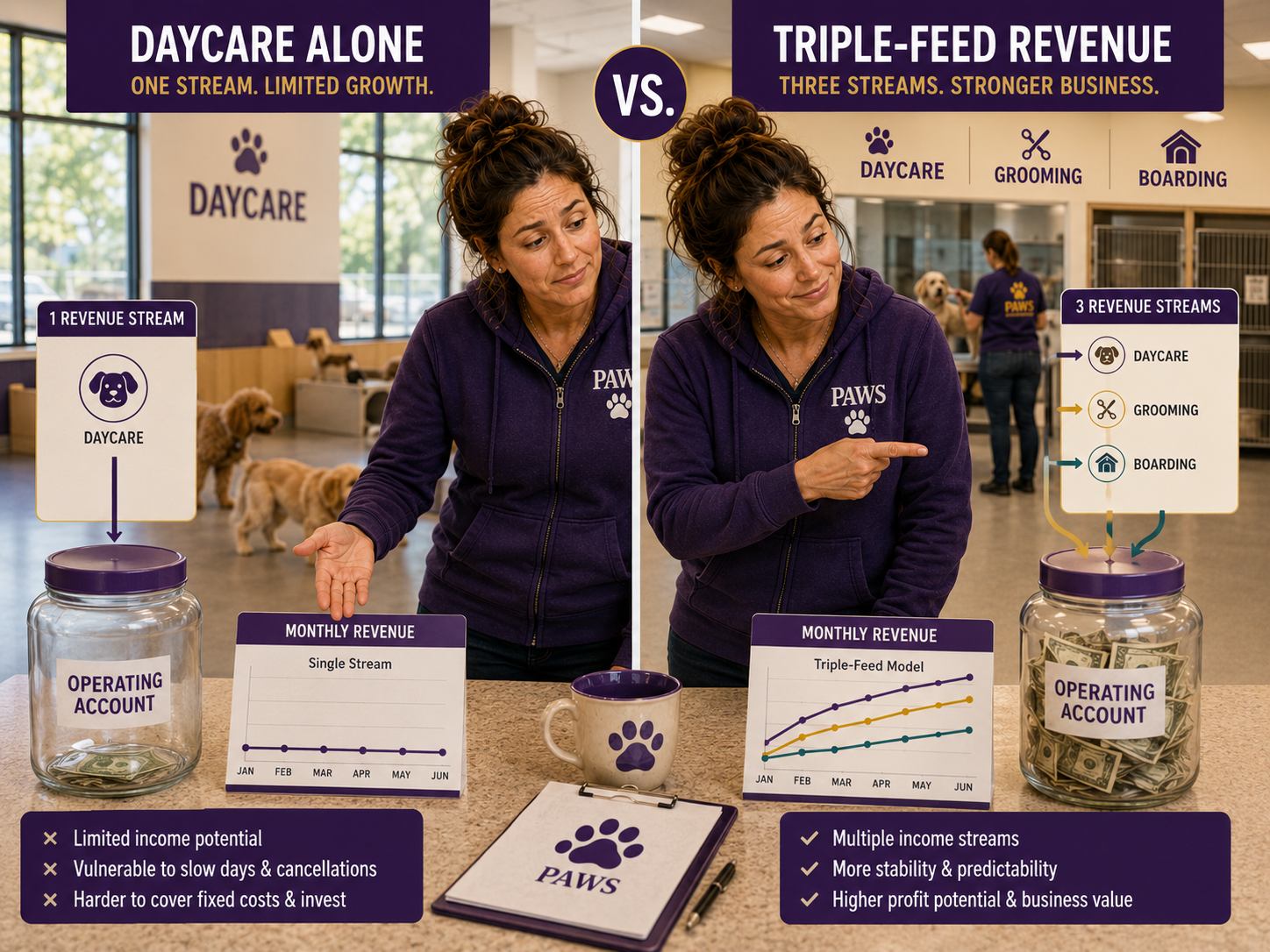
This is one of the reasons a well-designed pet-care facility is stronger than a one-dimensional concept. If daycare is soft for a stretch, grooming or boarding may help carry the load. If grooming is weak for a month, daycare memberships or boarding spikes may compensate.
The broader lesson is that diversified revenue gives the business more ways to survive. That does not mean you throw every possible service into the building without a plan. It means the facility should be designed so each service supports the others without overwhelming the operator, the staff, or the customer experience.
The gross profit records show the same lesson. Even when daycare check-ins dropped after the press spike, gross profit still rose because boarding and grooming helped carry the business. That is exactly why the triple-feed model matters.
📝
Operator Notes From the First Four Months
The charts show the numbers. These notes explain what was actually happening inside the business.
This is where the real education is. A profit-and-loss statement can show you the number, but it does not always tell you why that number happened or what the operator should learn from it.
01
Retail Grew Because Traffic Grew
This company only carried a small retail section: collars, leads, and home-baked dog treats. But as the number of customers increased, impulse sales at the counter increased with it. Retail did not have to be the main business to add useful revenue.
02
Grooming Carried the Business Early
Daycare was still slow in May, but grooming carried the company. The ability to let dogs play and socialize before and after grooms brought in customers while daycare was still maturing.
03
The Second Month Mattered
The second month showed a major increase in sales and net profit while operating costs decreased. That is the kind of early movement you want to see, but you still need reserve because one good month does not make the business stable.
04
Commission Was Also Training
The groomer received a 50% commission on grooms performed. During this period, the owner should be watching and learning. If you can eventually do some of the work yourself, you keep more money in the business.
05
Advertising Was Front-Loaded
Most advertising was spent early to tell people the business existed. Do not expect people to beat a path to your door if you fail to let them know you are open.
06
Cheap Equipment Can Become Expensive
The facility originally used an outdated office computer because it was cheap. It crashed four days into operation. That is exactly the kind of opening-month problem that does not look dramatic in a business plan but creates real operational drag.
07
Miscellaneous Means Real Stuff
Purses, shampoo, nail clippers, mop buckets, towels, lunch with local rescue contacts, and other small items all show up somewhere. These are not glamorous costs, but they are real costs.
08
Safety Upgrades Matter
Additional repairs included double gates outside to reduce the chance of escape. That is not cosmetic. In dog daycare, containment and traffic flow are business survival issues.
09
A First-Month Loss Is Normal
The first month showed a loss. That is not shocking. That is why cash reserves exist. The mistake is not losing money in month one. The mistake is opening with no realistic plan for surviving that loss.
📉
Month-to-Month Profit-and-Loss Lessons
The first four months show the kind of movement a new operator needs to study carefully.
🌱
April to May
May showed a major improvement over April. Daycare was still slow, but grooming and boarding helped carry the facility. This is exactly why a blended service model matters in the early months.
📈
May to June
June showed the business beginning to turn. Retail was still not the main driver, but grooming and boarding became meaningful. The owner also had a better computer setup after the early crash.
🚀
June to July
By the fourth month, daycare had caught up to the other services and showed strong growth. That is a company destined for success if the operator stays disciplined.
This is the part new owners need to slow down and study. A new facility is not judged by one number. You have to look at the pattern. Is revenue moving in the right direction? Are expenses stabilizing? Are services feeding one another? Is the customer base starting to return? Is the business becoming less fragile with each month?
At the same time, do not confuse improvement with safety. The fact that the numbers are getting better does not mean you can start pulling money out too early, cutting marketing too soon, or ignoring operational problems. The beginning is where you build the habits that either protect the facility or slowly drain it.
🧮
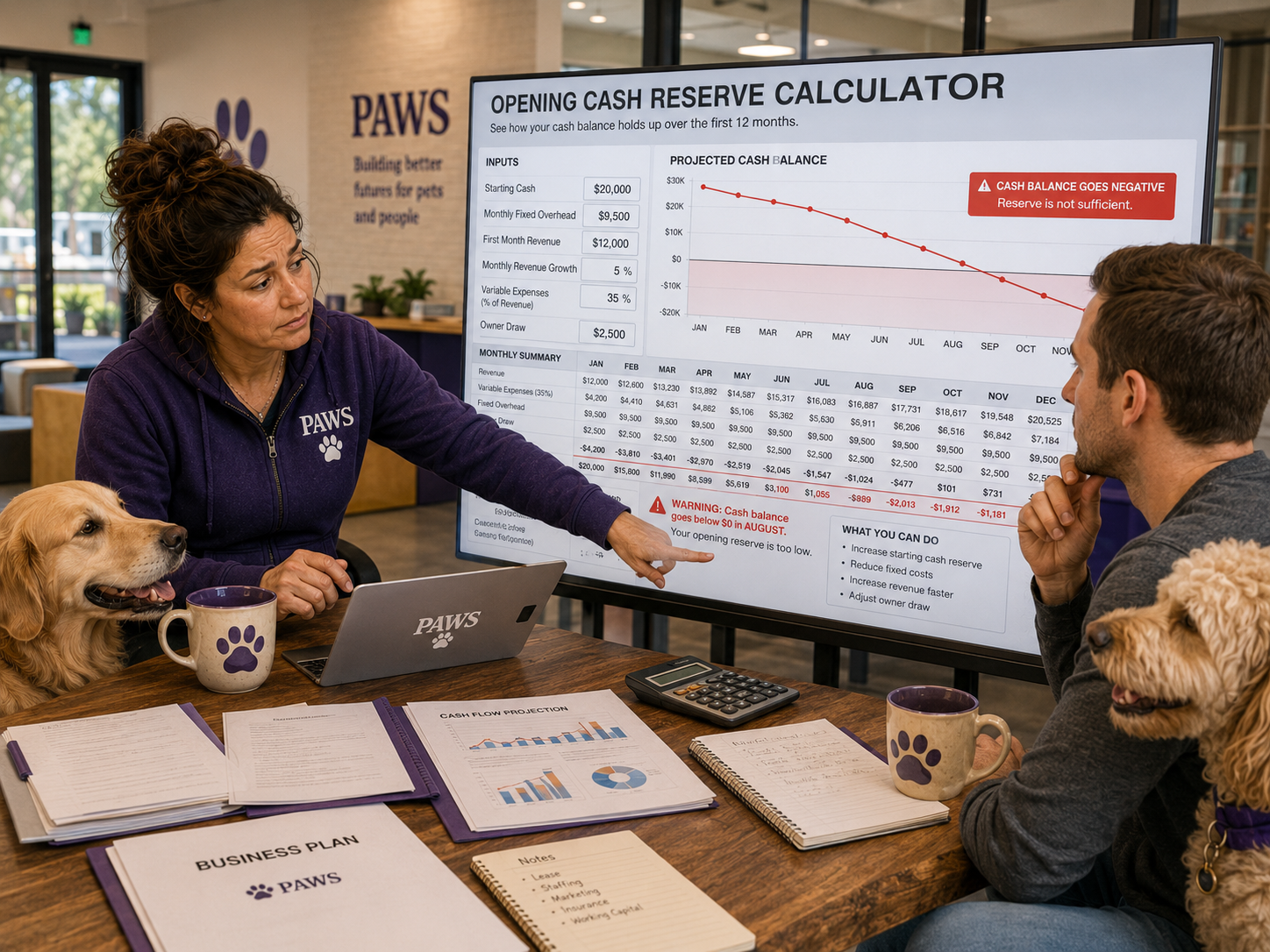
Opening Cash Reserve Calculator
Use this to pressure-test your opening assumptions. This is not a guarantee. It is a blunt planning tool designed to reveal whether your starting cash reserve is in the neighborhood of reality.
| Month | Revenue | Variable Expense | Fixed Overhead | Owner Draw | Net Cash Flow | Ending Cash |
|---|
Operator warning: this calculator does not replace a full financial model. It is here to keep you honest. If the reserve is thin, the opening period can get ugly very quickly.
🧠
Operator Warnings That Matter More Than People Think
This is the part people skip when they are in love with the idea.

First, do not assume your first few good weeks mean you are safe. A couple of strong boarding weekends or a burst of grooming activity does not mean the business is stable.
Second, do not treat “busy” as the same thing as “healthy.” A facility can be physically busy and still be underpriced, overstaffed, badly scheduled, or bleeding money through weak controls.
Third, do not starve the business right when it needs patience. New owners often panic too early, cut marketing too quickly, cut staff too recklessly, or stop making the upgrades that would have helped the facility gain traction.
Finally, do not confuse survival with success. Making it through the first six months is not the finish line. It is just proof that the business lived long enough to keep earning the right to improve.
✅
Opening Cash Flow Checklist
Before you open, these questions should have answers.
- How many months of reserve do you have if revenue grows slower than expected?
- What are your true fixed monthly costs, not your optimistic guess?
- How much working capital is needed before recurring daycare volume stabilizes?
- Which revenue categories are expected to carry the business early: daycare, grooming, boarding, or a blend?
- What happens if payroll runs higher than planned for the first few months?
- What happens if HVAC, drainage, fencing, cleaning equipment, or repairs hit early?
- At what revenue level does the business cover fixed overhead plus variable costs?
- What is your plan if customer growth takes twice as long as you hoped?
- Are your prices supporting survival, or are they just designed to feel “competitive”?
- Can the business survive without you stripping it of needed cash too early?
❓
Opening Cash Flow FAQ
These are the questions serious operators usually ask once they realize why this page matters.
How much cash reserve should a dog daycare have before opening?
There is no single universal number because rent, payroll, build-out burden, market speed, pricing, service mix, and personal owner needs vary. The better question is whether your reserve can carry the business through a slow ramp without forcing panic decisions.
Can a dog daycare be profitable and still have cash-flow problems?
Absolutely. That happens all the time. On paper, the business may be heading toward profitability, but if the timing of cash in and cash out is bad, the business can still get choked early.
Why do multi-service facilities often have stronger cash flow?
Because they have more than one revenue engine. Daycare, boarding, grooming, training, retail, and add-ons do not always peak at the same time or for the same reason. That diversity can make the business more resilient.
What is the biggest cash-flow mistake new owners make?
Underestimating how long it takes to build dependable recurring volume and underestimating how much money disappears before the business feels stable.
Should I wait to open until I have more reserve?
In many cases, yes. It is usually better to open with enough breathing room than to open too soon and spend the first few months terrified.
🧭
Where to Go Next
Cash flow is only one part of the picture. The next step is making sure the location, pricing, and overall financial structure support the business you are trying to build.
📍
Selecting a Location
Traffic, zoning, visibility, parking, lease terms, and access all affect whether the business can function cleanly.
🏷️
Dog Daycare Pricing
Pricing has to support payroll, rent, insurance, cleaning, software, and actual profit, not just “feel affordable.”
📊
Profit & Loss Simulator
Run the numbers on utilization, staffing, pricing, overhead, and break-even assumptions before committing real money.
👥
Dog Daycare Demographics
Make sure the client base is really there before relying on optimistic revenue assumptions.