Service Stacking and Business Strategy
Dog Daycare Is a Service, Not the Whole Business
Daycare may be the front door, but it is not automatically enough to create freedom.
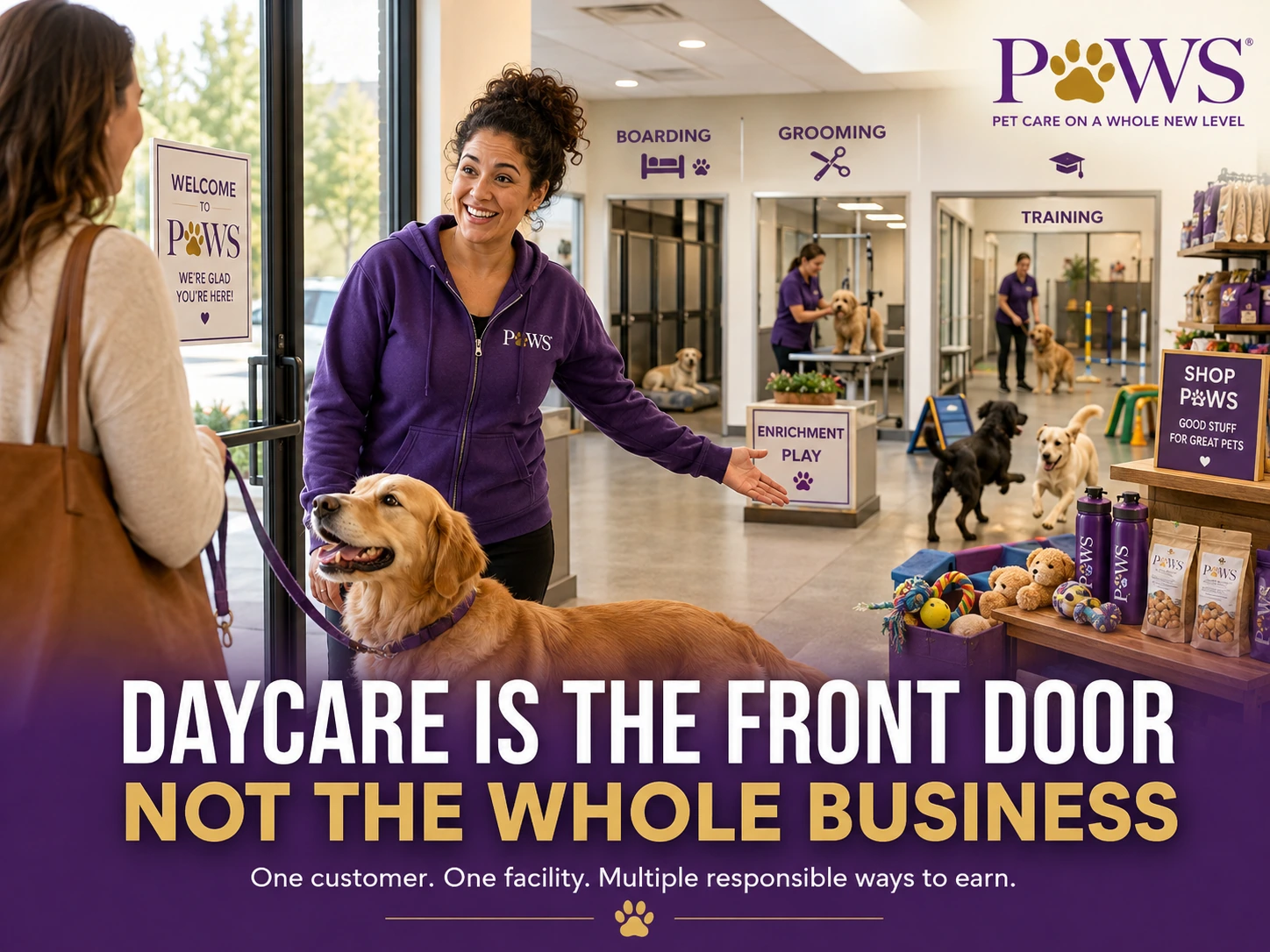
One of the biggest mistakes people make when entering this industry is thinking that “dog daycare” is the entire business. It is not. Dog daycare is one service inside a larger pet services business.
Daycare may be the front door, but it is not automatically enough to create freedom. If the only way the business survives is with you sitting at the counter, cleaning rooms, answering phones, breaking up arguments, doing paperwork, calling clients, running dogs, handling complaints, cleaning urine, chasing marketing, and going home dog tired every night, you did not build freedom. You bought yourself a job with fleas.
In many cities and locales, simply offering dog daycare will not be enough to take you from semi-comfortable to truly successful. If eking out a living, paying your bills, working inside the business every day, and maybe putting away enough to take a yearly vacation here and there is your idea of success, then daycare-only thinking may be enough for you.
If, however, you want the freedom to work on the business instead of being forced to work in the business forever, then you need to understand the full pet services revenue stack.
📌
Core business rule
Dog daycare gets people through the door. The business becomes powerful when daycare, boarding, grooming, training, add-ons, owner trust, pricing, staff, and systems all work together under one roof.
🗺️
Use This Page Like an Income Strategy Map
The goal is not to add random services. The goal is to build a pet services business that can breathe.
🪤
The Daycare-Only Trap
How a cute little daycare can become the hardest job you ever bought yourself.
🔧
In vs On the Business
The difference between owning a business and being trapped as its lowest-paid emergency plug.
👞
The Cobbler Problem
Your business is your child. Do not leave it barefoot while caring for everyone else’s dogs.
🏢
Not Just Daycare
Why “doggy daycare business” can be the wrong mental model from the beginning.
💰
Revenue Stack
Boarding, grooming, training, retail, tips, website conversion, and lesser add-ons.
📈
Market Reality
Pet care spending is already multi-service. The customer is not only buying daycare.
🧭
What to Add First
Do not add services randomly. Add the next service your building, staff, market, and customers can support.
🧮
Revenue Quality
Gross revenue is not freedom if the service eats staff, space, margin, and your remaining will to live.
🧊
Why Owners Freeze
Some people can sign a lease but freeze when the topic turns to grooming, boarding, or training.
🏠
Under One Roof
The advantage of selling multiple pet services to the same customer base from one location.
👥
Owners Pay the Bills
Dog skills matter. But dogs do not buy grooming packages, boarding upgrades, or training help.
✅
Readiness Check
Questions that tell you whether you are building a business or just a daily obligation.
🪤
The Daycare-Only Trap
A room full of dogs can feel like a business and still only be a job with a lease.
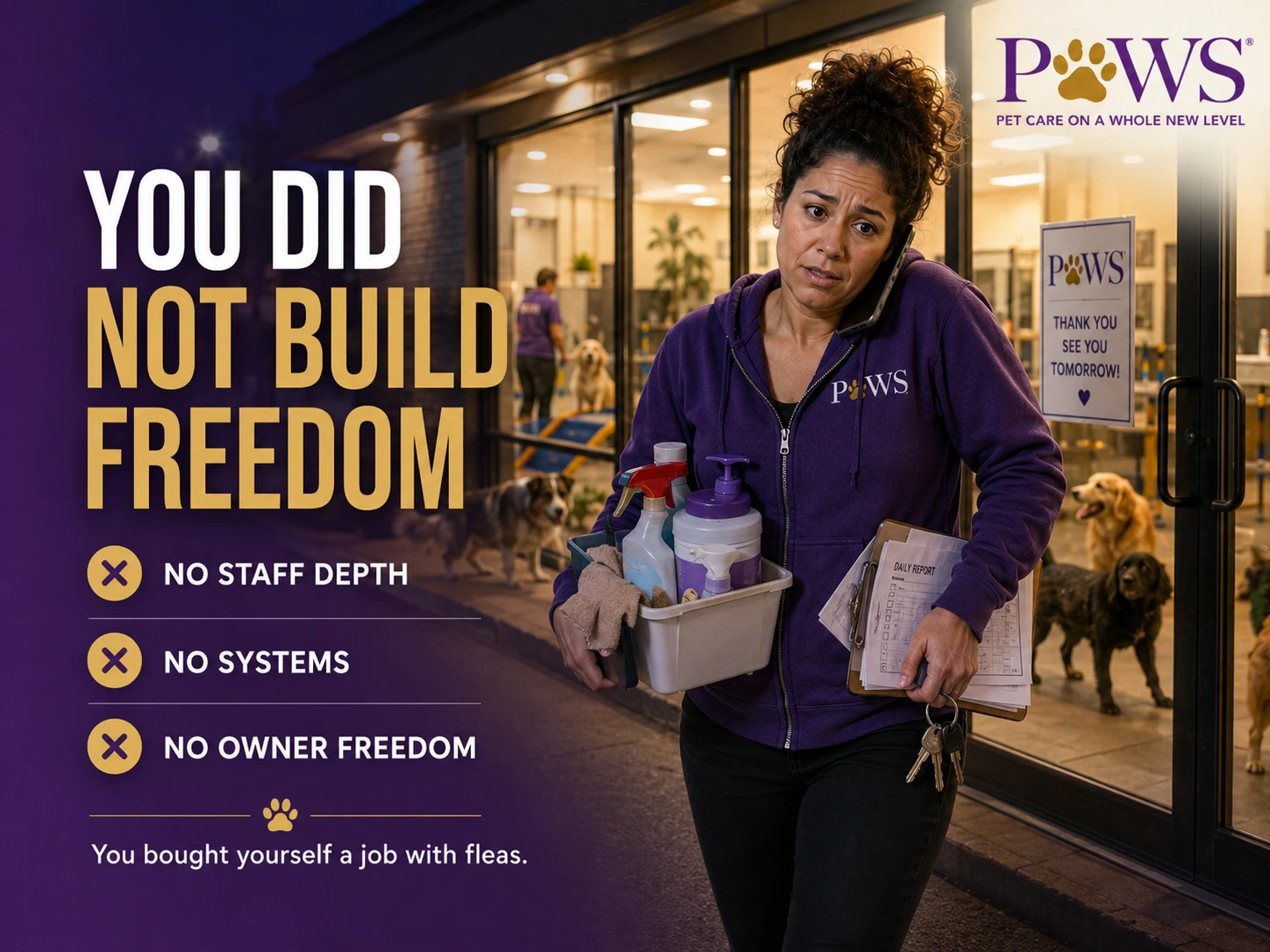
A lot of people enter the industry with the idea that dog daycare alone is the path to financial independence. They picture dogs playing, owners paying, staff smiling, and the business producing money because the concept is cute and the demand feels obvious.
The problem is that cute does not pay payroll. Demand does not automatically pay rent. A full room does not automatically mean profit. And being busy is not the same as being successful.
If daycare is the only major service you offer, every slow day hurts. Every empty spot hurts. Every holiday shift hurts. Every staffing issue hurts. Every rent increase hurts. Every price-sensitive client hurts. Every competitor with boarding, grooming, packages, and add-ons has more ways to make money from the same type of customer you are trying to survive on.
This is how some owners end up as the local mom-and-pop dog drop-off shop that offers one simple service and nothing else. They effectively choose to eliminate the possibility of earning tens to hundreds of thousands of dollars in potential additional revenue each year by refusing to offer a wider range of services.
Maybe they are intimidated. Maybe they do not know grooming. Maybe boarding scares them. Maybe training feels complicated. Maybe retail sounds like inventory hell. Maybe they think keeping the business simple keeps the business safe.
Simple can still fail. A simple business with too little income depth is not safe. It is just easier to understand while it slowly corners you.
The trap should be measured through owner dependence. If every callout, absence, customer complaint, dog move, maintenance problem, and closing task still returns to the owner, the business may have revenue without management depth.
A daycare-only model needs exceptional pricing, safe capacity, repeat demand, labor control, and utilization to carry the full operation. When those numbers are not strong enough, additional services may create income depth—but only after the core daycare systems work.
⚠️
Daycare-only warning
If one service has to carry the rent, payroll, insurance, owner pay, marketing, repairs, cleaning, debt, taxes, and profit, that one service better be strong enough to pull a sled uphill in July.
🔧
Working In the Business vs Working On the Business
One version has you trapped in the daily machine. The other gives you enough oxygen to improve the machine.
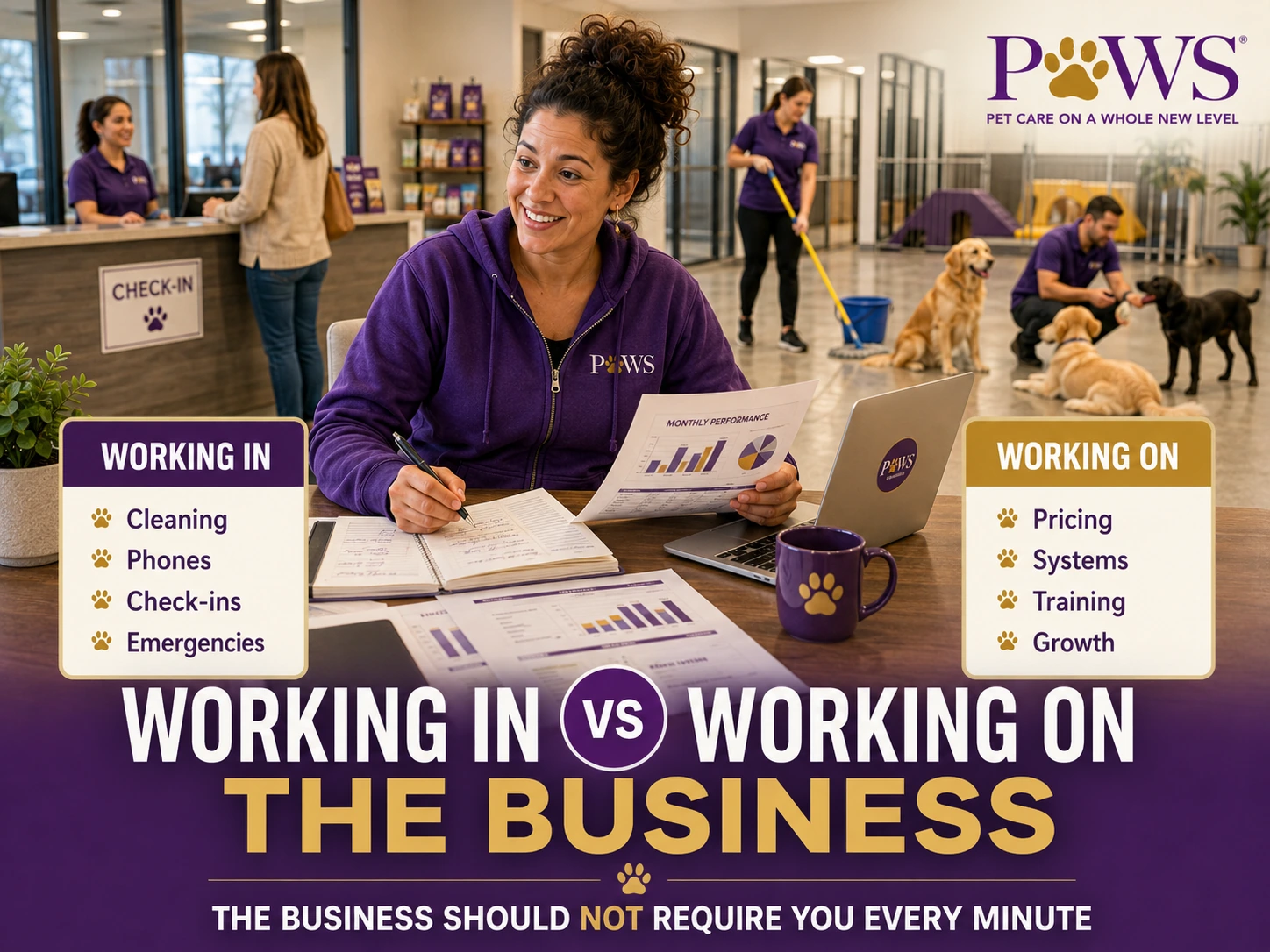
Working on the business means you have sufficient income coming in to allow you to hire the employees required to afford you the time to look at the business from the outside and make the strategic changes necessary to stay relevant and provide excellent service to your customers.
Being forced to work in the business means exactly what it sounds like. You are the one sitting at the counter every day. You are checking dogs in and out. You are cleaning the play areas. You are cleaning the boarding suites. You are doing the paperwork, setting appointments, calling clients, handling customers, putting out fires, making marketing decisions, going to rescue events, taking sick dogs to the vet, and going home dog tired each day knowing that tomorrow you will wake up at 6 a.m. to do it all over again.
That cycle will repeat each and every day until you burn out, which will be reflected in your attitude toward clients, their pets, the quality of service you provide, and the upkeep of your facility. Or it repeats until a more business-savvy competitor figures out how to out-earn, out-system, and out-service you.
Working on the business requires scheduled time and usable information. The owner needs reports on attendance, labor, service mix, pricing, incidents, customer retention, maintenance, marketing performance, and staff capability instead of relying on how busy the building felt.
The goal is not for the owner to avoid the operation. The goal is for the owner to inspect, train, plan, and improve without being the only employee capable of completing routine work or resolving every predictable problem.
Swipe left/right to see the full table.
| Working In the Business | Working On the Business |
|---|---|
| You are required for daily survival. | The business can function while you improve it. |
| You clean, check in dogs, answer calls, handle complaints, and cover every staffing hole. | You train staff, inspect systems, review numbers, adjust pricing, and fix weak spots. |
| Your day is reactive. The business throws problems, and you catch them with your face. | Your day has room for planning, marketing, service design, hiring, training, and quality control. |
| You are exhausted, irritable, and one sick employee away from living at the facility. | You are still responsible, but you are not the only thing holding the walls up. |
| The business owns you. | You own the business. |
👞
The Cobbler’s Children Go Unshod
You can spend every day caring for everyone else’s dogs while your own business sits in the corner barefoot.
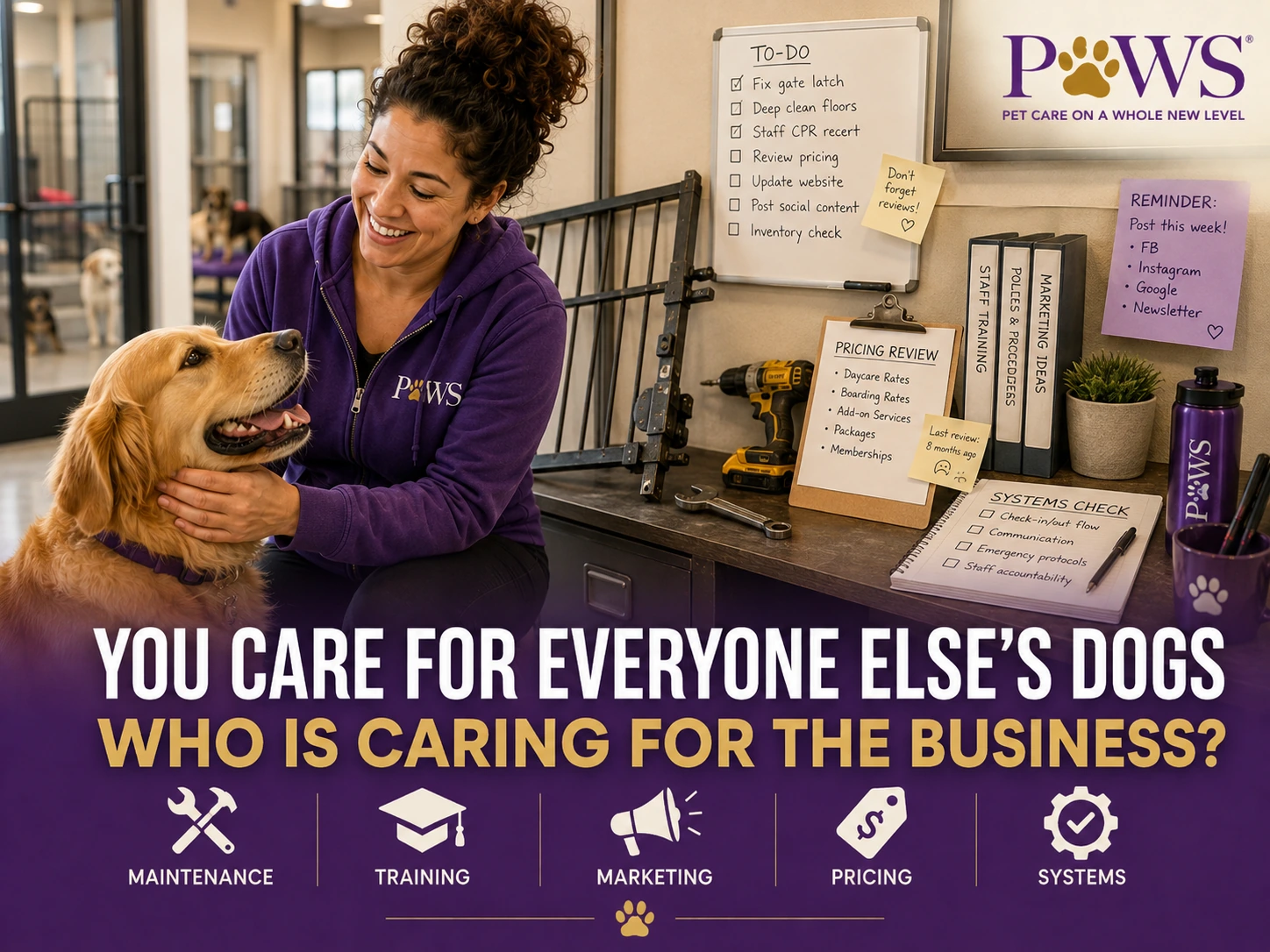
History tends to repeat itself, and little in our modern time is actually new. The old saying is, “The son of the shoemaker has no shoes,” or “the cobbler’s children go unshod.”
The meaning is simple. The shoemaker is always too busy making shoes for other people to make a pair for his own child. In other words, we often get so tied up in our work and providing for others that we forget to take care of our own.
In this business, your business is your child. It is your baby. It needs you to grow. It needs you to survive. It needs systems, services, pricing, staff, training, marketing, cleaning standards, policies, forms, and enough income depth to breathe.
If you are so busy working for others every day that you cannot work on the business itself, it will eventually suffer. Maybe it does not die all at once. Maybe it dies slowly. A little less maintenance. A little less staff training. A little more owner frustration. A little more odor. A little more broken equipment. A little more “I’ll fix that later” until later never comes.
You can love the dogs and still neglect the business. And if the business dies, all that love becomes a sad story with unpaid invoices.
Business maintenance should be scheduled like animal care. Pricing review, equipment inspection, staff training, policy updates, website work, financial review, deep cleaning, facility repair, and customer follow-up need owners, deadlines, and documentation.
Tasks that remain in the owner’s head are easy to postpone during busy weeks. A recurring management calendar turns business care into an operating responsibility instead of a promise to handle it when things slow down.
📌
Operator translation
A pet care business needs care too. If every dollar and every hour are consumed by survival, the business never gets the shoes it needs to walk.
🏢
Dog Daycare Is Not the Entire Business
If you define the business too narrowly, you cap the business before it even opens.
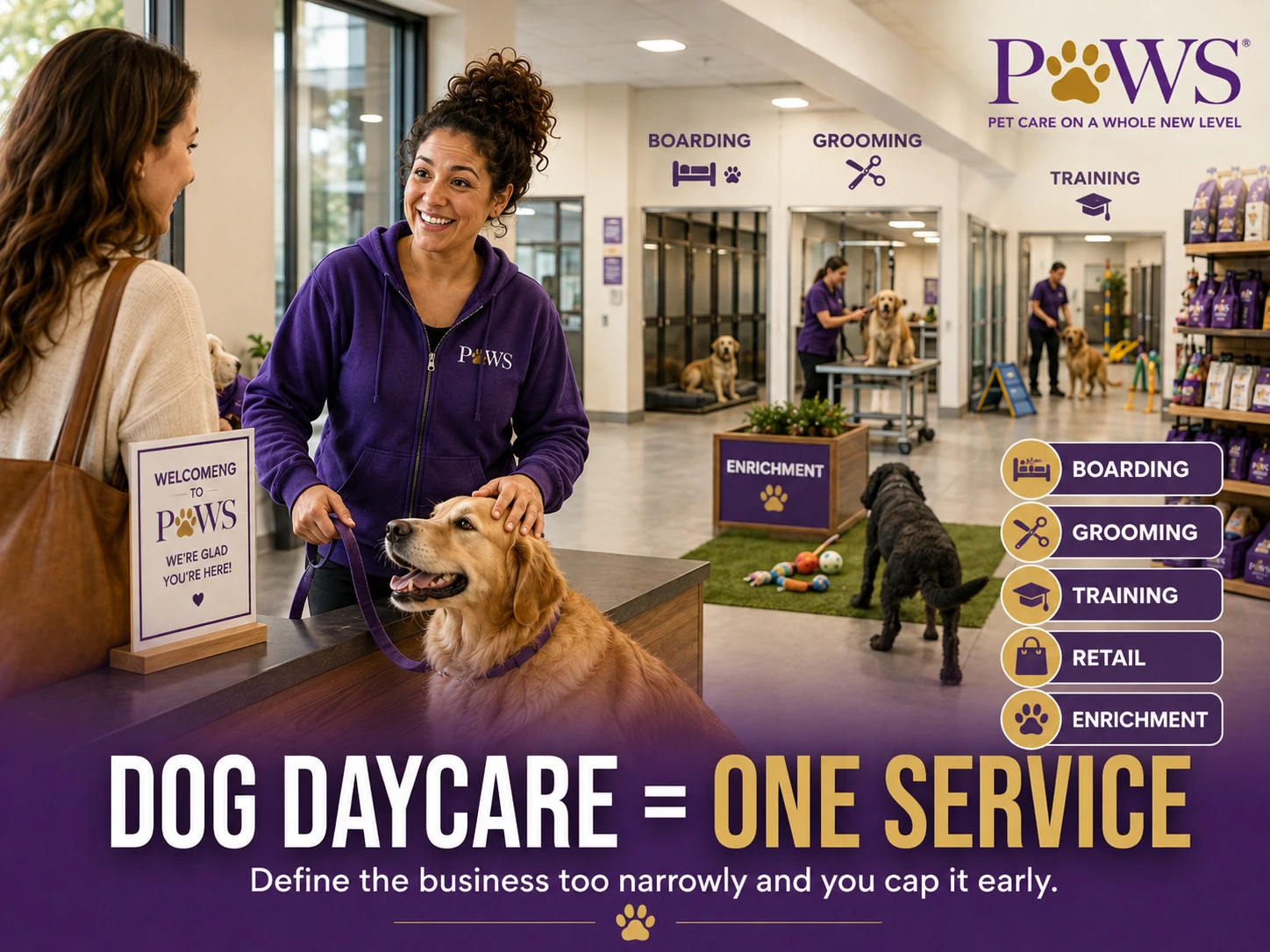
In simplest terms, dog daycare is the service of providing a location for owners to drop their dogs off to be watched, entertained, exercised, and socialized during the day.
That is a service. It is not automatically the entire business.
Many individuals wishing to start in this industry mistakenly view dog daycare not as one service of the business, but as the entirety of the business. That mistake limits the revenue stream from the beginning.
I view dog daycare not as the entire business, but as one of many services offered by a pet care business at the location. The term “doggy daycare business” can be a misnomer in much the same way it would be a misnomer to call a Super Walmart a grocery store. Yes, it sells groceries. It also sells furniture, automotive services, household goods, pharmacy items, electronics, clothes, and half the known universe stacked under fluorescent lights.
Same idea here. Your goal should be controlled diversity. You want the capability to provide as many appropriate pet-related services to your pet-owning clients from your location as possible, without turning the business into an unmanaged mess.
The broader model should influence the building before opening. Rooms, plumbing, electrical service, storage, customer flow, software, staffing, and intake systems can either support future services or make every expansion expensive and disruptive.
Controlled diversity does not require launching everything at once. It requires preserving the ability to add appropriate services without designing the entire operation around daycare alone.
⚠️
Business model warning
If you think daycare is the whole business, you will design, price, staff, and market like daycare is the whole business. That mistake can cap your income before you ever open the doors.
📈
The Market Is Already a Multi-Service Market
The customer is not only spending money on daycare. The pet care market already proves that.
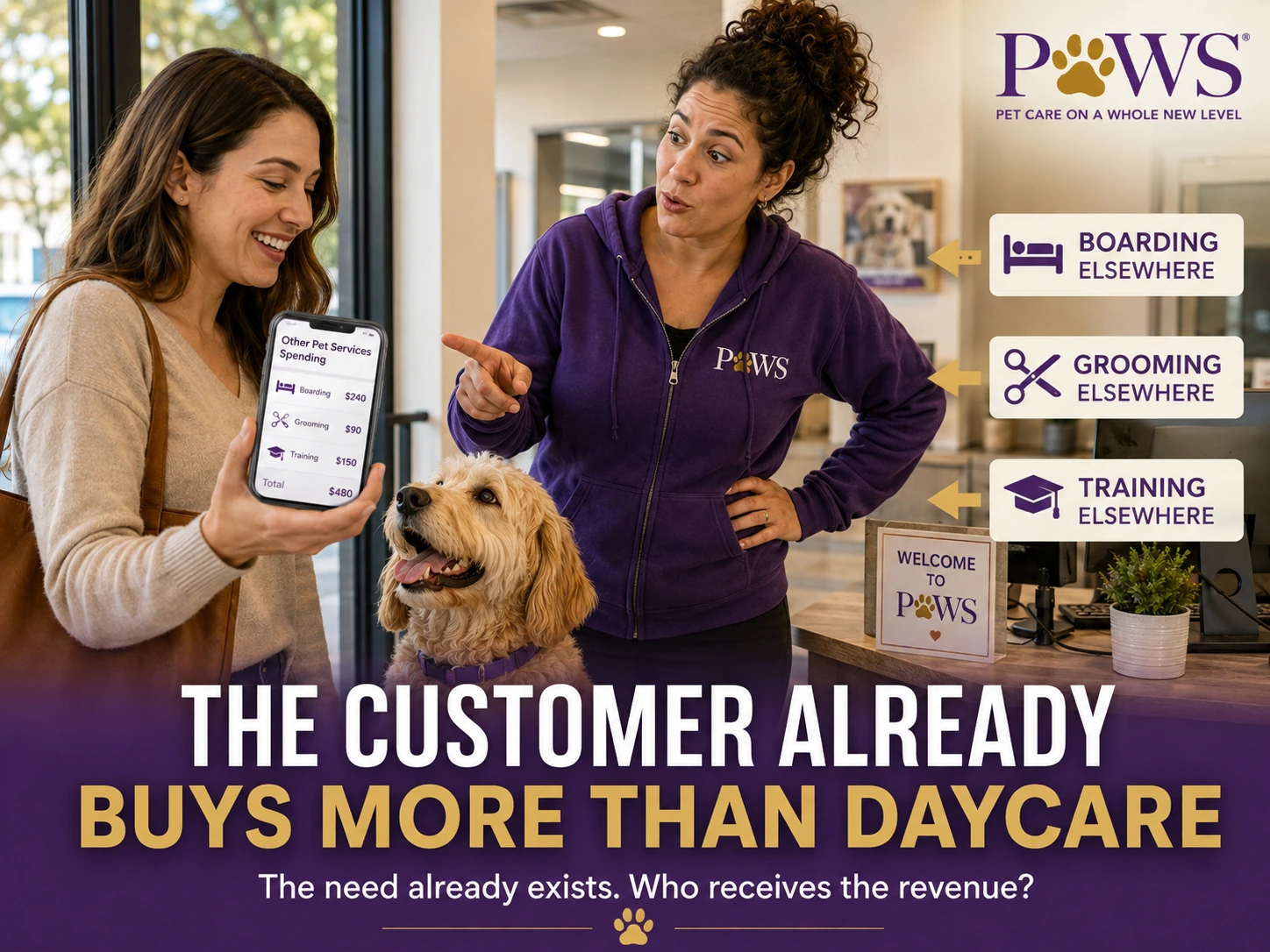
This is not theory. The pet industry is not some tiny hobby category where everyone buys a bag of food and calls it a day. Pet owners spend money across food, veterinary care, supplies, boarding, grooming, training, walking, sitting, insurance, treats, add-ons, and convenience services.
That matters because the daycare-only owner is often standing in the middle of a much larger customer relationship and only charging for one piece of it.
Think about the customer already walking through your door. They have a dog. That dog may need daycare during the week, boarding during travel, grooming every few weeks, training when behavior gets stupid, nail trims, baths, exit baths after boarding, add-on playtime, photo updates, birthday treats, medication handling, special feeding, and sometimes a calm human being to explain what the dog actually needs.
The question is not whether the pet owner spends money on more than daycare. Many already do. The question is whether they spend that money with you, with the groomer down the street, with the boarding kennel across town, with the trainer they found online, or with the competitor who figured out the full relationship before you did.
That is why service stacking matters. You are not inventing needs out of thin air. You are recognizing needs that already exist around the same animal, the same owner, and the same trust relationship.
Operators should document which services customers already purchase elsewhere and why. Repeated questions about boarding, baths, nail trims, training, transportation, or enrichment provide stronger demand evidence than a service idea chosen because a competitor offers it.
Revenue leakage is not automatically recoverable. The business must still earn the customer’s trust, deliver the service well, price it correctly, and avoid weakening the core operation. Existing demand identifies an opportunity, not a guaranteed margin.
📌
Operator translation
The money is already moving through the pet care market. A daycare-only business may simply be watching that money walk out the door and get spent somewhere else.
💰
The Pet Services Revenue Stack
One location. One customer base. Multiple responsible ways to earn.
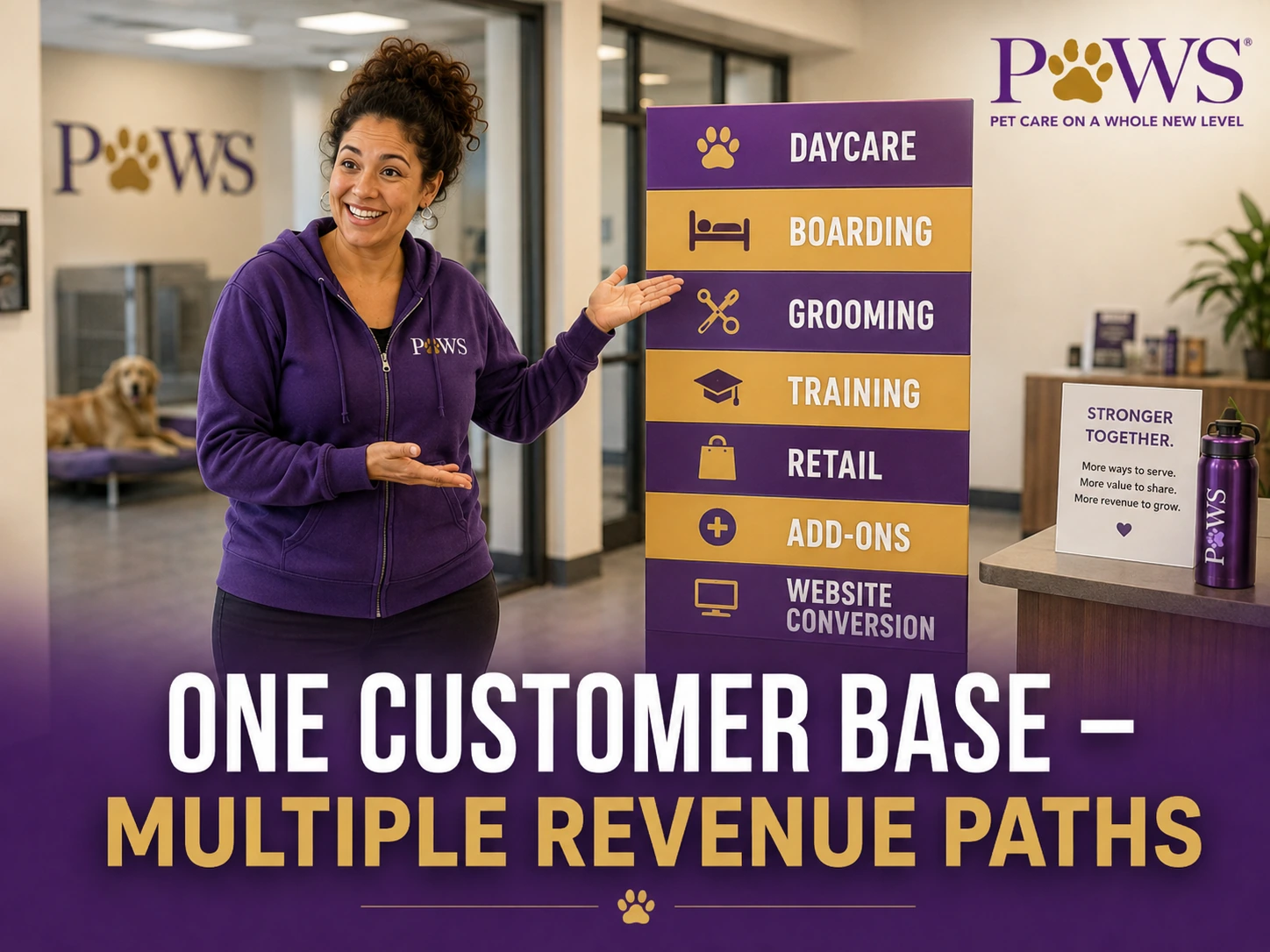
The unique advantage of owning and operating a pet services business is that you can, if you choose, offer a variety of services from one location.
Why be a simple dog daycare when you can be a pet services business that provides dog daycare, pet boarding, pet grooming, training, and carefully selected pet-related retail from the same location?
Once you understand how these services operate and generate revenue, you begin to see the building differently. The playroom is not just a playroom. The boarding suites are not just rooms. The grooming area is not just a tub and table. The website is not just a brochure. The front desk is not just a place to swipe cards. The customer relationship itself becomes an asset.
A healthy stack should be evaluated as a connected system. Daycare can generate recurring traffic, boarding can use overnight capacity, grooming can attach to pickup, training can address behavior needs, and selected retail can solve problems exposed by the service.
Track the contribution of each service separately. Revenue, labor, supplies, refunds, discounts, management time, facility use, and customer retention should be visible so a busy service cannot hide weak margin behind total sales.
Swipe left/right to see the full table.
| Income Area | Why It Matters | Main Control Problem | Deeper Page |
|---|---|---|---|
| Dog daycare | Gets dogs and owners through the door, builds routine, creates daily activity, and feeds other services. | Capacity, staffing, behavior control, pricing, sanitation, owner expectations. | Income intro |
| Boarding | Uses the facility outside normal daycare hours and can become a major revenue driver. | Overnight responsibility, illness, staffing, bedding, feeding, meds, emergencies, owner anxiety. | Boarding income |
| Grooming | Recurring maintenance service with strong convenience value for customers already trusting you with the dog. | Skilled labor, quality control, injury risk, matted pets, pricing, owner expectations. | Grooming income |
| Training | Monetizes behavior problems, owner frustration, puppy needs, and dogs that need more than play. | Skill, honesty, scope, results claims, behavior risk, owner follow-through. | Training income |
| Retail | Can add convenience and ticket value when curated around what customers actually buy. | Inventory cash trap, low turnover, bad buying, clutter, expiration, storage. | Retail income |
| Credit card and tip income | Small percentages, fee decisions, tip prompts, and payment structure add up over time. | Processing costs, staff expectations, tip handling, customer friction. | Card and tip income |
| Website income | The website pre-sells trust, answers objections, explains services, and improves conversion before the phone rings. | Weak copy, poor design, missing proof, unclear pricing, bad service pages. | Website income |
| Lesser add-ons | Small services can increase ticket value, fill gaps, and make customers feel like they are doing extra for the dog. | Too many messy add-ons, staff distraction, low-margin nonsense, poor tracking. | Lesser services |
📌
Operator translation
The money is not in randomly selling more things. The money is in building services that fit the same customer, the same dog, the same facility, the same trust relationship, and the same operating system.
🧭
What Service Should You Add First?
The answer is not “whatever sounds exciting.” That is how people buy equipment they later dust around.
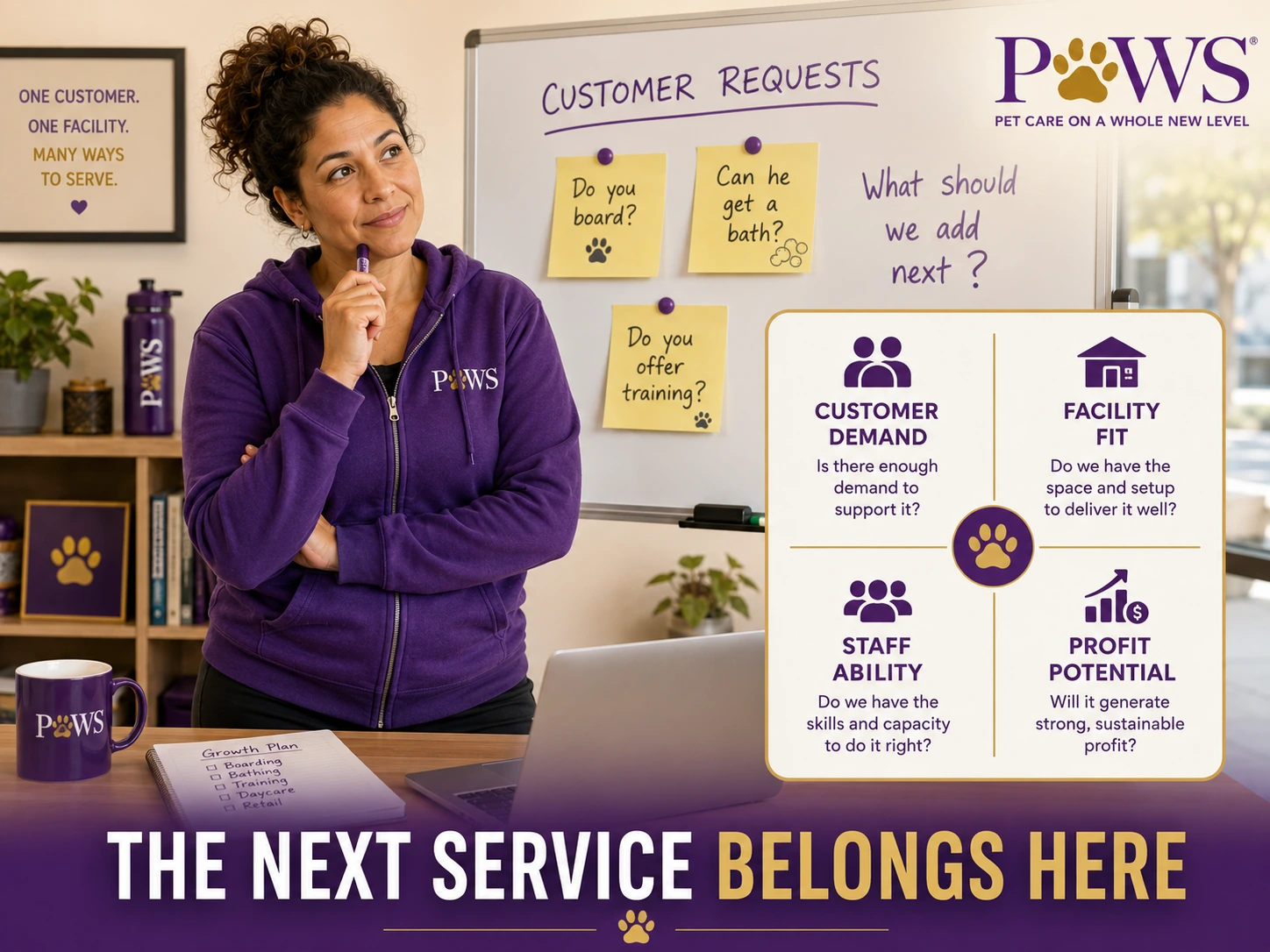
The first service to add should usually be the one that fits four things at the same time: customer demand, facility fit, staff ability, and profit potential.
Customer demand means people are already asking for it, needing it, or buying it somewhere else. Facility fit means the building can actually support the service without ruining the operation you already have. Staff ability means you have, or can hire, the skill to deliver the service without faking competence. Profit potential means the service makes money after labor, supplies, space, scheduling, cleanup, risk, management, and headaches are counted.
A lot of owners get this backward. They add the service that sounds impressive instead of the service the business is ready to deliver. That is how a daycare adds grooming with no groomer, retail with no buying discipline, training with no trainer, or boarding with no overnight control plan.
The best next service is often already waving its arms at you. Customers ask, “Do you board?” “Can he get a bath before pickup?” “Do you trim nails?” “Do you know anyone who can help with pulling on leash?” “Can I buy that shampoo here?” “Can she get extra one-on-one time while boarding?”
That is demand talking. Listen before a competitor does.
Score each candidate service before committing capital. Estimate demand, price, direct labor, supplies, equipment, construction, insurance, scheduling, space conflicts, training time, management load, and the number of sales required to recover the investment.
A small pilot can answer questions before a full launch. Limited baths, controlled enrichment, or a narrow retail test may reveal demand and workflow problems without committing the business to a large permanent expansion.
Swipe left/right to see the full table.
| Possible Next Service | Good Sign | Danger Sign | Operator Move |
|---|---|---|---|
| Boarding | Customers already ask where the dog can stay overnight, and the facility has safe room capacity. | You have no overnight policies, feeding controls, medication process, emergency plan, or staff coverage. | Build the boarding operating system before selling overnight stays. |
| Grooming | Daycare and boarding clients already want baths, nail trims, exit baths, or full grooms. | You have no qualified groomer, no matted-pet policy, no injury documentation, and no pricing control. | Start with controlled services or hire real skill before offering full grooming. |
| Training | Owners regularly ask about behavior problems, puppies, leash pulling, manners, or daycare behavior issues. | You are tempted to promise results you cannot honestly deliver. | Offer only what you can safely and ethically support. |
| Retail | Customers repeatedly ask for products connected to services you already provide. | You want to fill the lobby with inventory because empty shelves make you nervous. | Start narrow, track turns, and sell products that solve real problems. |
| Lesser add-ons | Customers want small upgrades: one-on-one time, treats, photos, cuddle time, exit baths, enrichment, or special handling. | Add-ons confuse staff, slow the schedule, or are not tracked correctly. | Create a short, clean menu that staff can actually deliver. |
⚠️
First-service rule
Add the service where customer demand, staff skill, facility design, policy control, and profit overlap. If one of those pieces is missing, fix it before you sell the promise.
🧊
Why People Avoid Additional Services
Some people are brave enough to sign a lease, but freeze when the conversation turns to grooming.
What I find shocking is how many people with a desire to enter this industry shortchange themselves by ignoring the services that can make the business stronger.
For what reason, I do not know. Perhaps some are intimidated by the thought of offering grooming, training, retail, boarding, or other services. I find this interesting because they obviously have the entrepreneurial spirit to enter the industry, but at the same time are paralyzed by the fear of failure when it comes to offering anything but daycare.
It is strange. Some people will sign a commercial lease, build a facility, hire staff, buy equipment, invite a room full of dogs to run around under their insurance policy, and then act like adding grooming is where the real danger begins.
The fear is understandable, but it still has to be dealt with. You may not know how to groom. Fine. Hire the right groomer and learn the business side. You may not know training. Fine. Build relationships and only offer what you can honestly deliver. You may not understand retail. Fine. Start small and avoid turning your lobby into a cash-eating flea market.
The answer is not to stay small because you are afraid. The answer is to learn, plan, test, price correctly, hire carefully, and add services in a controlled way.
Fear becomes useful when it identifies a real capability gap. The owner should name what is missing—skill, staffing, capital, space, insurance, policy, scheduling, or management—and decide whether to build it, hire it, partner for it, or reject the service.
The dangerous response is either permanent avoidance or impulsive expansion. Controlled learning and staged testing sit between those extremes.
⚠️
Fear warning
Do not confuse simple with safe. A daycare-only business may be easier to understand, but that does not mean it has enough revenue depth to survive, hire, grow, and give you freedom.
⚠️
Do Not Add Services Like an Idiot
Diversity does not mean chaos. More revenue can also mean more ways to screw up.
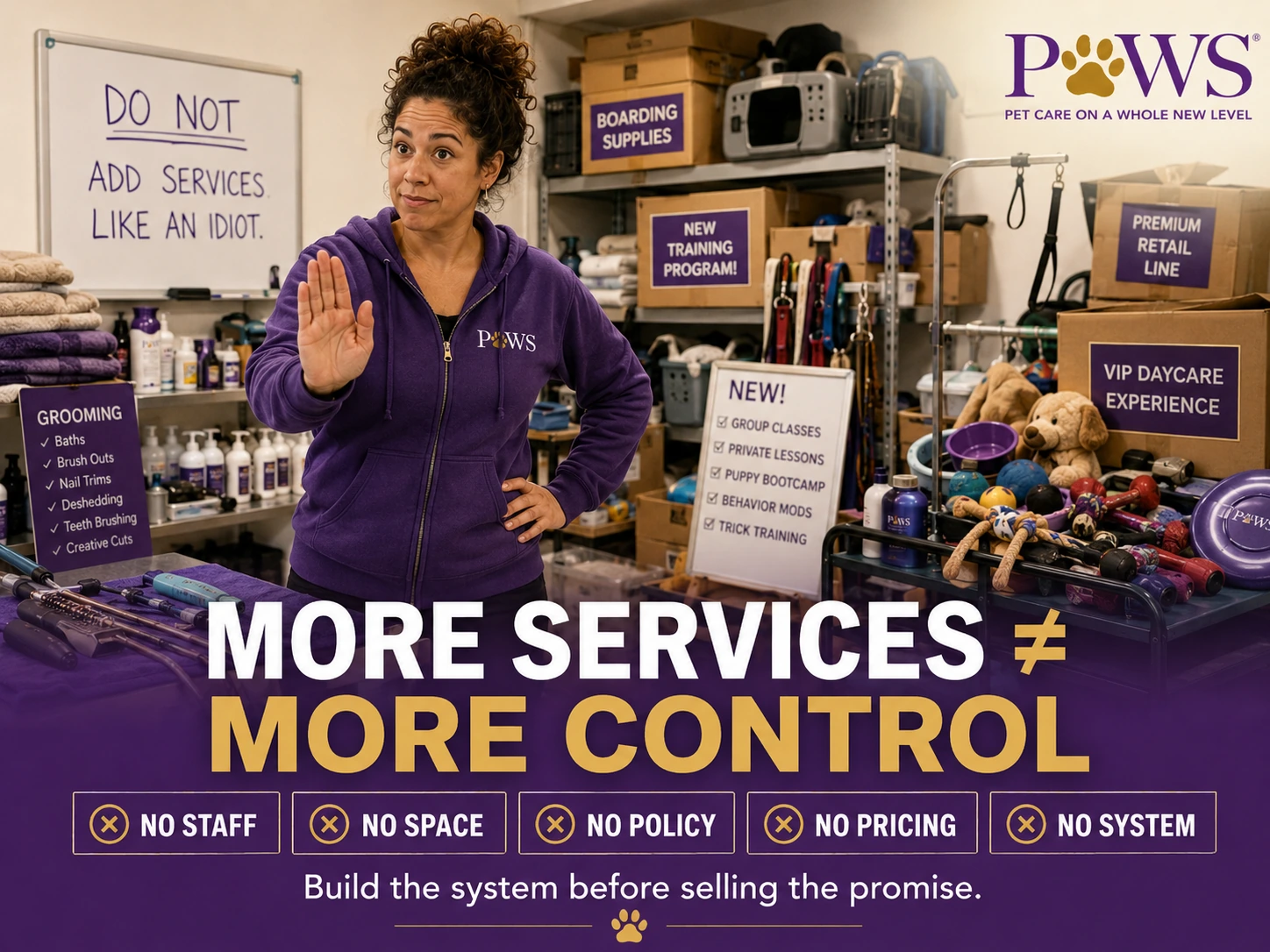
This page is not telling you to throw grooming, boarding, training, retail, parties, cakes, shuttle service, dog yoga, and a tiny canine hat boutique into the building by Friday.
Adding services without staff, space, pricing, training, insurance, sanitation control, scheduling, forms, policies, and customer communication is not business growth. It is just building a bigger machine to jam.
Boarding brings overnight responsibility. Grooming brings skilled labor and injury risk. Training brings behavior claims and owner expectations. Retail ties up cash. Add-ons can clutter staff workflow. Website conversion requires actual service clarity. Credit card and tip structure affects staff and customer experience.
The goal is controlled service stacking. Add the services that fit your market, facility, staff, risk tolerance, pricing, and customer base. Build the system before you sell the promise.
Every service needs an owner inside the organization. Someone must control pricing, scheduling, quality, supplies, forms, incidents, customer communication, staff training, and the decision to stop selling the service when the operation cannot deliver it safely.
Launch criteria should be written before marketing begins. The business should know what must be complete, what capacity is available, how quality will be inspected, and which conditions trigger a pause or rollback.
- Do not sell a service before you understand the labor, risk, pricing, and staff requirements.
- Do not let one weak add-on damage the trust created by your core service.
- Do not add retail inventory just because the lobby has empty wall space.
- Do not add boarding without overnight policies, emergency plans, feeding controls, medication rules, and staff coverage.
- Do not add grooming without skilled labor, matted-pet policies, injury documentation, pricing rules, and client scripts.
- Do not add training unless you can be honest about what you can and cannot safely deliver.
🧮
Gross Revenue Is Not the Same as Owner Freedom
A service can bring in money and still be a bad deal if it eats the business from the inside.
This is where people get stupid with revenue. They hear a service can add money, so they assume the service is automatically good. Not true.
Gross revenue is the money coming in. It is not the money you keep. It is not the time you get back. It is not proof the service is healthy. A service can create sales while quietly consuming labor, space, staff attention, equipment, management time, cleaning time, insurance exposure, customer-service energy, and every remaining scrap of your patience.
The whole point of stacking services is not to become busier. Busy is easy. Any fool can become busy. The point is to build income depth that helps the business hire, stabilize, improve, and give the owner room to think.
A good added service should do at least one of three things: increase profit, improve customer retention, or make better use of capacity you already have. The best services do all three.
A bad added service creates activity but no freedom. It makes the schedule uglier, the staff crankier, the lobby messier, the customers more confused, and the owner more trapped.
Measure contribution by service after direct labor, supplies, payment costs, discounts, rework, refunds, equipment, cleaning, and the operational space consumed. Then consider whether the service improves retention or creates useful traffic for another profitable service.
Owner time also has a cost. A service that appears profitable only because the owner performs skilled work without pay may be creating disguised labor rather than scalable business value.
Swipe left/right to see the full table.
| Revenue Question | Good Answer | Bad Answer |
|---|---|---|
| Does the service produce real margin? | Labor, supplies, space, and management time still leave profit. | It looks busy but barely pays for itself. |
| Does it fit the same customer relationship? | The same clients already trust you and naturally need the service. | You are chasing a totally different customer for no good reason. |
| Does it use the facility better? | It uses unused rooms, off-peak time, existing traffic, or existing staff skill. | It crowds the building, disrupts core services, or creates traffic-flow problems. |
| Can staff deliver it consistently? | The service has training, checklists, pricing, forms, and quality control. | Everyone does it differently and nobody knows what was promised. |
| Does it reduce owner dependence? | The service can be delegated and managed through systems. | The owner becomes the only person who can fix the new mess. |
| Does it strengthen trust? | The service makes customers more loyal and more likely to use the facility again. | A weak add-on damages the reputation built by the core service. |
📌
Operator translation
The goal is not more chaos with a cash register attached. The goal is better revenue, better retention, better use of the building, and less dependence on the owner being everywhere at once.
🏠
The Under-One-Roof Advantage
A standalone groomer has to win the customer cold. You may already have the dog walking through your door.
I can tell you now that I have never opened a standalone dog grooming salon, pet boarding kennel, or pet food store. But I have opened and offered all of these services combined from a single location on multiple occasions.
I also know how much these services can matter when they are incorporated under one roof. When you operate daycare, boarding, grooming, training, and selected retail from one location, you learn the intimate details of how each service operates, how each service generates revenue, and how each service feeds the others.
The customer who trusts you for daycare may consider boarding because the dog already knows the building. The boarding customer may add a bath before pickup. The grooming customer may ask about daycare because the dog has energy. The daycare customer may need training because the dog is becoming a problem at home. The training customer may become a daycare customer after structure improves.
That is the power of one location, one customer relationship, one brand, one intake system, one website, one file, one staff ecosystem, and one trust path.
The advantage becomes stronger when records and communication move with the customer. One profile can support health information, behavior notes, feeding instructions, service history, preferences, and recommendations across the facility.
Cross-service conversion should remain relevant and honest. Staff should recommend the next service because it solves a customer or dog need, not because every checkout has become a sales ambush.
Swipe left/right to see the full table.
| Customer Starts With | Natural Next Service | Why It Converts |
|---|---|---|
| Daycare | Boarding | The dog already knows the facility, staff, smells, and routine. |
| Boarding | Exit bath or grooming | The owner wants the dog clean before coming home. |
| Grooming | Daycare | The owner sees the facility and learns the business offers daily care. |
| Daycare behavior issue | Training | The owner already trusts your observation of the dog’s behavior. |
| Boarding anxiety | One-on-one time, comfort add-ons, or structured care | The owner wants to feel like the dog received individual attention. |
| Grooming maintenance | Brushes, shampoos, combs, or coat-care tools | Retail works when it solves a problem the service just exposed. |
👥
Dogs Do Not Pay the Bills; Their Owners Do
Dog skills matter, but owner trust is what converts services into revenue.
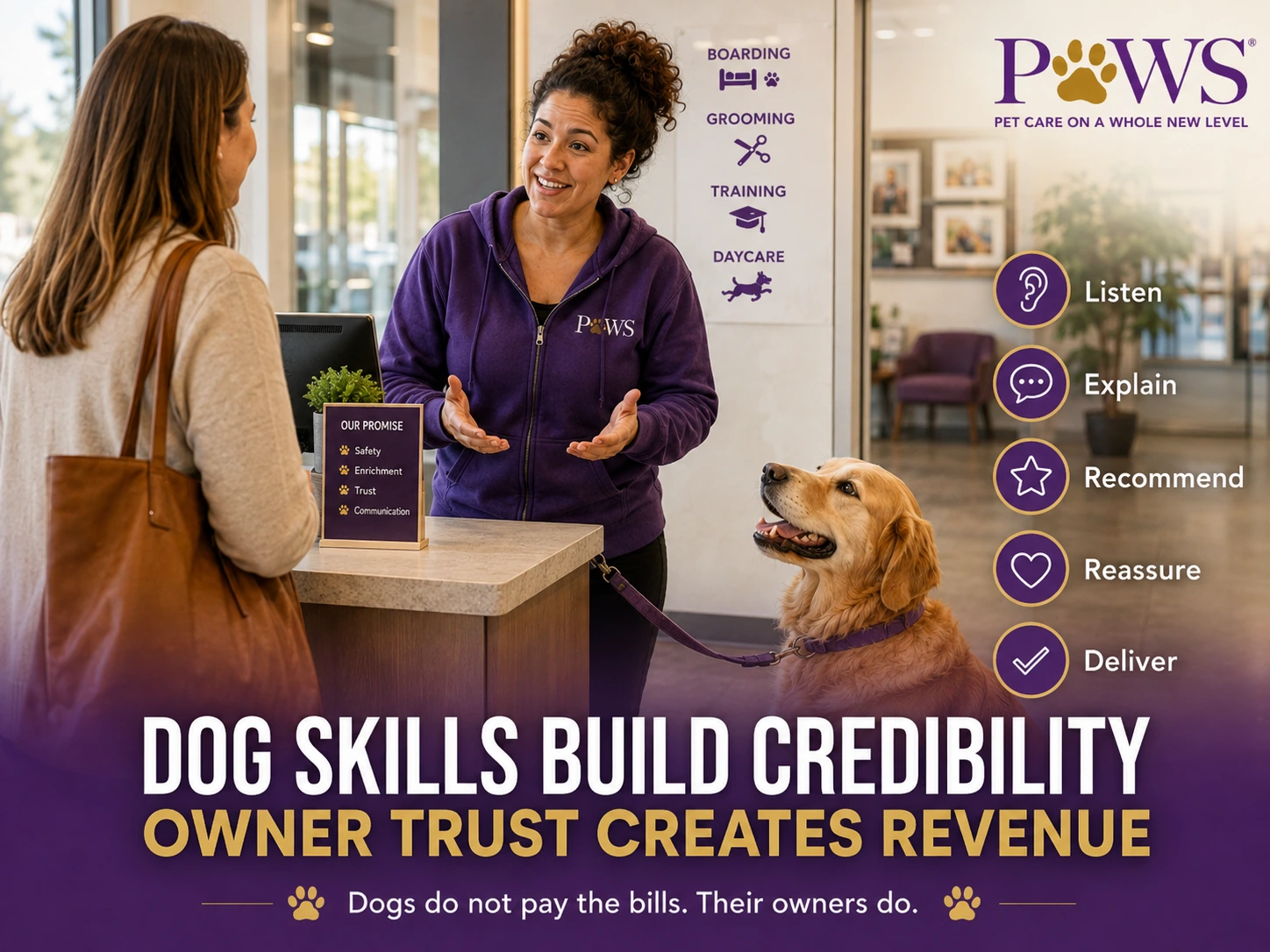
Contrary to what you may believe or may have heard, in the business of pet care it is not only your money management, dog handling, or advertising prowess that will make or break you.
It is your ability to communicate clearly with pet-owning clients, understand what they are requesting, understand what kind of person they are, and translate their emotional wants into services the business can safely and profitably provide.
While it is beneficial to have dog skills, dogs do not pay the bills. Their owners do. Therefore, it is the owners you must befriend, convince, educate, reassure, correct, and build trust with in order to stay in business.
This may sound easy, especially if you are the amiable people-oriented type. It is not always easy. Why? Because you are dealing with what many clients believe is their child, best friend, routine, emotional anchor, old buddy, or family member.
The revenue stack only works if the owner trusts you. Grooming, boarding, training, add-ons, and retail are not sold to dogs. They are sold to owners who believe you understand their animal and will not screw it up.
Trust is built through accurate expectations. Staff should explain what the service includes, what it cannot promise, what they observed, why they recommend a change, and what the customer should expect next.
The strongest recommendations connect the dog’s actual needs with a service the business can deliver well. Overselling may increase one invoice and damage the relationship that supports every future invoice.
✅
Revenue Stack Readiness Check
These questions tell you whether you are building a business or just feeding a daily obligation.
Readiness should be reviewed service by service rather than answered once for the entire business. A facility may be prepared for simple baths but not full grooming, or prepared for limited boarding but not high-volume holiday occupancy.
The check should end with a decision: launch, pilot, delay, redesign, hire, or decline. A readiness table that does not change the service plan is only paperwork.
Revisit the answers after staffing, pricing, space, customer demand, or operating conditions change. Readiness is not permanent.
Swipe left/right to see the full table.
| Question | If Yes | If No |
|---|---|---|
| Can daycare alone cover rent, payroll, insurance, owner pay, taxes, repairs, debt, and profit? | You may have breathing room, but still need to protect against slow seasons and competition. | You need to look seriously at pricing, capacity, costs, and additional services. |
| Can the business run without you sitting at the counter every day? | You are closer to working on the business. | You are still the plug in the drain. |
| Do customers already ask for grooming, boarding, training, baths, or add-ons? | Demand is already speaking. Listen before a competitor does. | Research demand before adding services blindly. |
| Do you have staff skill for the next service? | Build the system, policies, pricing, and quality controls. | Do not sell what you cannot deliver. |
| Do your forms and policies support the service? | You are less likely to get surprised by owner conflict or liability problems. | Fix forms and communication before selling the service. |
| Does the service fit your space, traffic flow, staffing, cleaning, and schedule? | The service may support the business instead of disrupting it. | The service may create more chaos than profit. |
⚠️
Readiness warning
A new service should solve a business problem, serve a customer need, and produce profit. If it only creates more mess, more stress, and more staff confusion, it is not growth. It is a new way to bleed.
❓
Dog Daycare Income Strategy FAQ for Pet Care Operators
Detailed answers about daycare-only survival, service stacking, profitability, owner freedom, boarding, grooming, training, retail, customer trust, and controlled expansion.
Can a dog daycare survive on daycare alone?
Sometimes. The answer depends on safe capacity, attendance, price, payroll, rent, debt, insurance, owner compensation, competition, and seasonal demand. A daycare-only model can survive while still leaving the owner trapped in daily labor. The financial test should include profit, cash reserves, staff depth, facility maintenance, and whether the owner can step away from routine operations.
Why is dog daycare considered one service instead of the whole business?
Daycare is one way a pet-care facility earns from an established customer relationship. The same customers may also need boarding, grooming, training, baths, nail care, enrichment, transportation, selected retail, or other controlled add-ons. Defining the company as a broader pet-services business allows the building, staffing, software, forms, and marketing to support more than one revenue path.
What is the daycare-only trap?
The trap occurs when one service must carry every expense and the owner becomes the permanent solution to every staffing, cleaning, customer, maintenance, and dog-handling problem. The business may look busy but remain fragile because a slow week, rent increase, labor problem, or competitor affects the only major revenue stream.
What does working on the business actually require?
It requires protected management time and accurate information. The owner should review pricing, labor, attendance, service mix, incidents, customer retention, staff performance, marketing, maintenance, and cash flow. The goal is to improve systems and train people rather than spending every hour completing routine tasks the operation should be able to delegate.
How can an owner stop being required for every daily task?
Document recurring work, assign responsibility, train staff, create checklists and escalation rules, measure performance, and build enough margin to pay for staffing depth. Delegation is not simply leaving the building. The owner must create a system that allows routine work to continue and makes exceptions visible before they become emergencies.
What is the pet-services revenue stack?
It is a group of related services sold to the same pet-owning customer base through one trusted operation. Daycare may generate recurring traffic, boarding may use overnight capacity, grooming may attach to pickup, training may address behavior needs, and selected add-ons or retail may solve problems already visible to the staff. Each layer must still be profitable and controlled.
Which service should a daycare add first?
Choose the service where customer demand, facility fit, staff capability, policy control, and profit potential overlap. Review what customers repeatedly request, calculate the full cost of delivery, confirm space and scheduling, and determine who will manage quality. The most exciting service is not necessarily the best first service.
Should every daycare add boarding?
No. Boarding can use the facility beyond daytime hours and may create strong revenue, but it adds overnight responsibility, feeding, medication, staffing, bedding, illness, emergency response, occupancy control, and owner communication. The facility should add it only when the building, insurance, forms, staff, and procedures can support it.
Should every daycare add grooming?
No. Grooming can convert well because customers already trust the facility, but it requires skilled labor, scheduling, sanitation, equipment, matted-pet policies, injury documentation, quality control, and pricing discipline. A weak grooming operation can damage the trust built by daycare and boarding.
Can training become a good daycare add-on?
Yes, when the business has qualified skill, honest scope, clear methods, safe handling, suitable space, documentation, and realistic owner expectations. Training should not be sold as a vague promise to fix every behavior problem. The service must define what it addresses, what owner participation is required, and when referral is appropriate.
Is retail worth adding to a daycare?
Retail can work when it is narrow, useful, and connected to needs the facility already sees. Products tied to grooming, training, enrichment, feeding, or convenience may convert naturally. Retail becomes a problem when inventory is purchased without demand data, turns slowly, expires, crowds the lobby, or ties up cash needed for the core operation.
How should a business evaluate smaller add-ons?
Calculate the price, labor, supplies, scheduling, staff complexity, and delivery consistency for each add-on. A short menu of trackable services may increase ticket value and customer satisfaction. A large menu that staff forget, misdeliver, or fail to record creates refunds and confusion instead of dependable margin.
Why is gross revenue not the same as profit or owner freedom?
Gross revenue is only the money collected. It does not account for labor, supplies, equipment, cleaning, payment costs, refunds, space, management time, insurance exposure, or rework. A service can increase sales while making the owner more necessary and the operation less stable. Revenue quality depends on margin, retention, capacity use, and delegation.
How should service profitability be measured?
Track each service separately. Include direct labor, payroll burden, supplies, discounts, payment fees, equipment, cleaning, refunds, rework, management time, and the space or capacity consumed. Also measure customer retention and whether the service produces useful demand for another profitable service. Total company sales can hide a weak individual service.
What does the under-one-roof advantage mean?
The facility can use one location, brand, customer relationship, intake system, records, staff ecosystem, and website to support several related needs. A daycare customer may board, a boarding customer may add grooming, and a behavior concern may lead to training. The advantage works only when every service remains organized and trustworthy.
Why do owner communication skills matter so much?
Dogs receive the service, but owners decide whether to buy, return, upgrade, refer, or complain. Staff must listen, explain observations, set accurate expectations, recommend appropriate services, and communicate problems without exaggeration or avoidance. Dog-handling credibility opens the conversation; reliable communication converts it into long-term trust.
What if the owner does not know how to perform the added service?
The owner does not have to personally groom, train, or perform every specialty service, but the business must possess real capability. Hire qualified staff, learn the operating requirements, write policies, price correctly, inspect quality, and understand when the service should be declined. Ownership does not replace technical competence.
How can a daycare test a service before fully launching it?
Use a controlled pilot with limited customers, hours, capacity, and a defined review period. Track demand, labor, supplies, schedule conflicts, customer feedback, errors, margin, and effects on the core operation. Establish launch criteria and stop conditions before advertising broadly or making a large permanent investment.
When should a proposed service be delayed or rejected?
Delay or reject it when staff skill, space, insurance, forms, pricing, scheduling, sanitation, safety, demand, or management ownership is missing. A service should also be rejected when it disrupts more profitable work, damages customer trust, or depends on the owner performing unpaid labor indefinitely.
What is the main goal of adding services?
The goal is to create profitable income depth that improves customer retention, uses the facility well, funds staff and maintenance, strengthens cash reserves, and reduces dependence on the owner. The goal is not to create the longest menu or the busiest building. Controlled services should make the business stronger and more capable of operating without constant emergency intervention.
🐾
The Bottom Line: Do Not Build Yourself a Job With Fleas
If daycare is the whole plan, the plan may be too thin.
It is important that you do not limit yourself, and more importantly your ability to maximize the profit potential of your business, by being afraid to offer a broader range of services to the pet-owning clients who come through your doors.
Dog daycare is a powerful service. It creates routine, trust, relationships, daily traffic, and brand visibility. But dog daycare alone is not automatically enough to build wealth, owner freedom, staff depth, facility improvement, and long-term competitive strength.
If your dream is to work yourself into the ground inside a building full of dogs, daycare-only thinking may get you there. If your dream is to build a business that can breathe, hire, improve, compete, and eventually give you freedom, you need to understand the full pet services revenue stack.
Build the business like a pet services business. Daycare may be the front door. It should not be the only room in the house.
Income depth should create resilience, not merely activity. The service stack should help fund staff depth, facility upkeep, training, marketing, owner compensation, cash reserves, and the time required to improve the operation.
The business becomes more valuable when customers can trust several well-run services, staff can deliver them consistently, and the owner is no longer the only person preventing routine work from collapsing.