Facility and Location Planning
How to Select a Location to Start a Dog Daycare
The building you choose can make the business easier to run, harder to run, cheaper to open, more expensive to operate, easier to market, harder to staff, or impossible to approve. Location is not just real estate. It is zoning, traffic, build-out cost, customer convenience, safety, odor, noise, utilities, cleaning, expansion, and long-term survival.
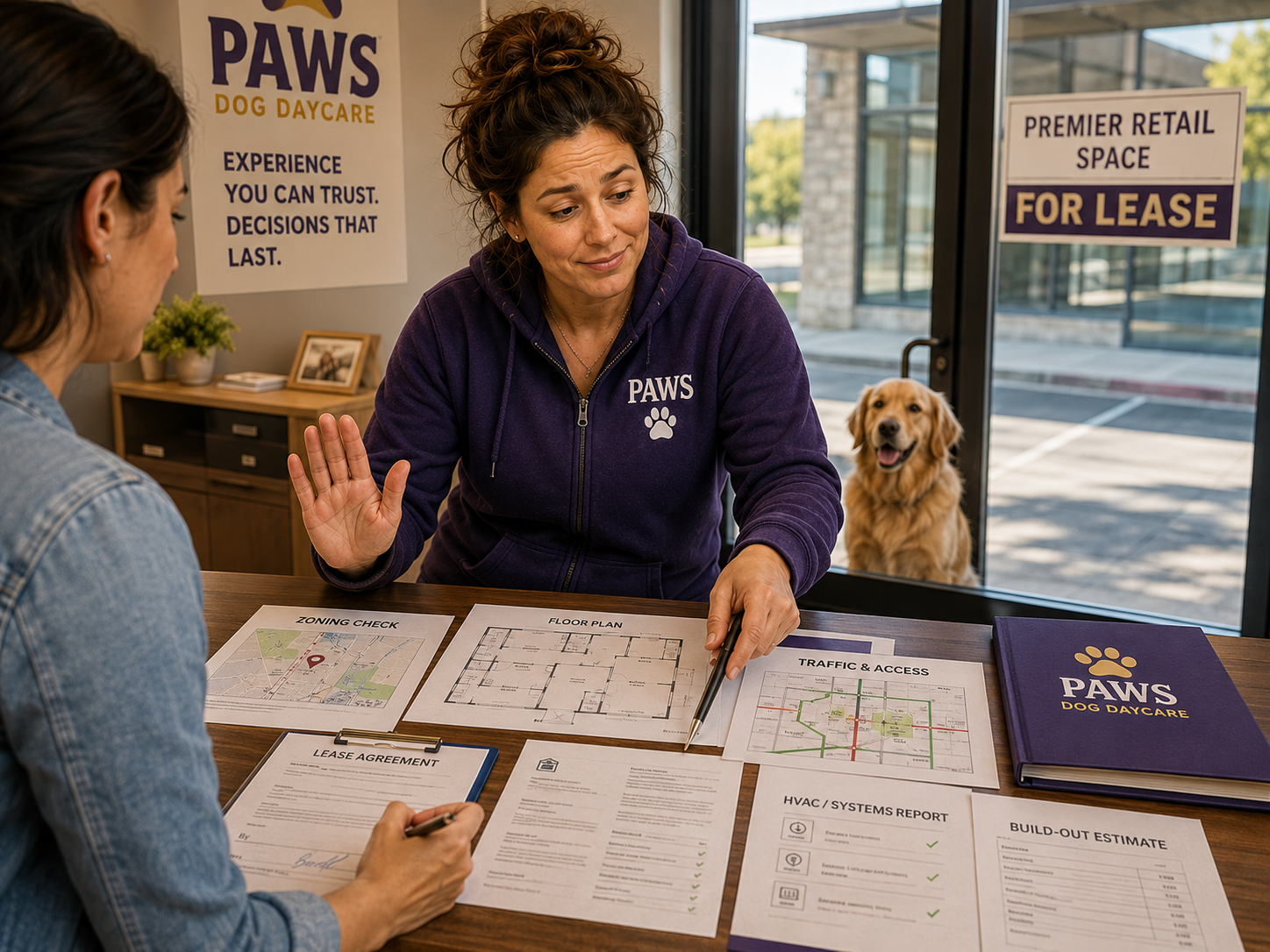
One of the hardest things about starting a dog daycare is choosing a location. This will not only affect the type and number of customers you receive, but your build-out costs, operating costs, approval risk, customer convenience, and future growth.
The single most important factor is zoning. There is nothing I, your contractor, your landlord, your real estate agent, your favorite dog trainer, or anyone else can provide to you that will allow you to operate a dog daycare in an area where the local zoning authority will not permit it.
That is the first hard truth. Before you fall in love with the building, before you start measuring play yards, before you imagine where the lobby will go, before you picture the dogs playing in the back, you need to know whether the use is legally allowed. If it is not allowed, the perfect building may be nothing more than a very expensive distraction.
This is one of those areas where new owners can waste a lot of money because they get excited too early. They find a cheap building, a good-looking building, or a building with a landlord who says, “I do not see why that would be a problem.” That is not enough. The landlord does not get the final vote. The zoning office, building department, fire marshal, health department, animal-control office, business-license office, and sometimes neighboring tenants or property owners may all become part of the process.
The goal is not to find a building that looks good in a tour. The goal is to find a building that can legally, physically, financially, and operationally support a dog daycare facility.
🔗
Jump to the Part of the Location Decision You Need
Choosing a dog daycare location is not one decision. It is zoning, lease risk, traffic, build-out, utilities, layout, cleaning, insurance, and whether the building can survive real operations.
⚖️
Zoning First
Start with whether the use is allowed before you fall in love with the building.
🧩
Approval Chain
Understand zoning, fire, permits, licensing, landlord, and insurance before signing.
🧭
Decision Tree
Force the building through the yes/no sequence before money starts disappearing.
🧾
Lease Risk
Rent is only one part of the lease. Build-out rights and contingencies matter.
👣
Property Walkthrough
Walk the building like an operator, not like a shopper admiring the lobby.
🚗
Traffic Test
Test the route when customers would actually drop off and pick up dogs.
🧊
Cost Iceberg
Cheap rent can hide HVAC, flooring, drains, gates, permits, signage, and repairs.
❄️
HVAC / Air Quality
If the air is bad before you open, it may be miserable once the dogs arrive.
🚰
Plumbing / Drains
Cleaning, grooming, sinks, drains, dirty water, and odor control all start here.
📐
Usable Dog Space
4,000 square feet on paper is not 4,000 square feet of dog daycare.
📊
Location Score
Score the site honestly before excitement turns into a lease obligation.
🎥
CAD Walkthroughs
Use the facility walkthrough videos to think through layout, flow, and support space.
🧭
Before You Even Tour the Building
Do not waste half a day walking through buildings that should have been eliminated before you ever got in the car.
Before you tour a building, you should already know five things: the zoning district, the likely permitted use category, the asking rent, the customer route, and the rough build-out risk. If you do not know those things yet, you are not really touring as an operator. You are just looking at space and hoping it works.
That is how people get themselves in trouble. They fall in love with a cheap building or a pretty lobby before they know whether dogs are allowed, whether outdoor play is allowed, whether grooming or boarding changes the use, whether the lease allows build-out, or whether the property is even convenient to the customer base.
I do not care how good the building looks in pictures. If the zoning is wrong, the traffic is wrong, the HVAC is weak, the floors are a nightmare, the plumbing is in the wrong place, and the lease traps you into paying for a business you cannot operate, then the building is wrong.
⚖️
Zoning District
Know the exact zoning classification for the parcel before you spend time designing the facility in your head.
🚗
Customer Route
Know whether the location fits the customer’s normal drive, not just whether it looks close on a map.
💸
Build-Out Risk
Know whether the cheap rent is hiding expensive floors, plumbing, HVAC, drainage, fencing, and permit problems.
⚖️
Start With Zoning Before You Start Shopping Seriously
Zoning can kill the deal before the first dog ever walks through the door.
You are first going to have to do your research. That usually means looking online at your local city and county zoning ordinances, calling or visiting the local planning and zoning office, and asking the right questions before you commit money to a property.
In many places, you may find that “dog daycare” is mentioned nowhere in the zoning code. That does not automatically mean the business is prohibited. It may simply mean the code has not caught up with the industry. Dog daycare is still a newer business category compared to older code language like kennel, pet shop, animal hospital, grooming salon, veterinary clinic, boarding kennel, poodle parlor, pet-services business, indoor recreation, or animal-care use.
This is where presentation matters. If you walk into the zoning office and present your business as something brand new, unheard of, noisy, messy, and full of unleashed dogs, you may invite more scrutiny, more fees, more hearings, and more delay than necessary. If grooming is allowed, explain that you offer grooming and supervised daytime care. If pet retail is allowed, explain that you provide retail and pet-care services. If kennels or boarding facilities are addressed, explain how your business is similar and how it is different.
The point is not to mislead anyone. The point is to describe the business in terms local government already understands. If the code mentions groomers, pet stores, kennels, animal hospitals, or boarding facilities, study those categories carefully. Write a well-put-together letter, cite the local code sections, and explain why your proposed use is compatible with an allowed or conditionally allowed use.
Get the picture: do not push hard on the “new idea” angle unless you have to. Local government will generally be more than happy to charge large fees for special exemptions, conditional-use applications, zoning hearings, variances, public notice, engineering reviews, and attorney time if you accidentally frame your business as something the code cannot place.
📚
Read the Code
Look for terms like kennel, grooming, pet shop, animal care, veterinary, boarding, indoor recreation, commercial recreation, or pet services.
📝
Frame the Use Carefully
Explain the business in language the zoning office already understands. Do not make it sound stranger than it is.
📌
Get It in Writing
A phone conversation is not enough. Get a written zoning confirmation, staff interpretation, conditional-use path, or permit requirement before committing money.
🧾
The Zoning Workflow: Do This in Order
Zoning is not where you guess. Zoning is where you slow down and build the record before money starts disappearing.
The mistake is walking into the zoning office and saying, “I want to open a new type of business called a dog daycare,” then waiting for the government to decide what box to put you in. That may invite questions, delays, hearings, and fees you might have avoided by doing your homework first.
Study the local code before you ask for an answer. Look for businesses that are comparable: pet store, groomer, poodle parlor, kennel, boarding kennel, animal hospital, veterinary clinic, pet-services business, indoor recreation, commercial recreation, or animal-care use. Then explain your business in a way that fits the code language that already exists.
The point is not to mislead anyone. The point is to avoid making the business sound stranger than it is. If grooming is allowed, explain that grooming is one of your services. If pet retail is allowed, explain the retail component. If kennels or boarding are addressed, explain whether you do or do not offer overnight care. Get the picture: do not push hard on “new and unheard of” unless you want the local government to treat it that way.
| Step | What You Do | Operator Reason |
|---|---|---|
| 1. Identify the parcel | Get the exact address, parcel number, zoning district, and jurisdiction. | Do not rely on neighborhood assumptions. The exact parcel matters. |
| 2. Pull the zoning code | Find permitted uses, conditional uses, special exceptions, and prohibited uses. | You need to know whether this is a normal approval, a hearing, or a dead end. |
| 3. Search comparable uses | Look for grooming, kennel, boarding, pet store, animal care, veterinary, or indoor recreation language. | Dog daycare may not be named, but related uses may already be allowed. |
| 4. Separate each service | Ask whether daycare, grooming, boarding, retail, bathing, and outdoor play are each allowed. | Approval for one service does not automatically approve all services. |
| 5. Ask zoning staff in writing | Email the address, use description, service list, outdoor-use question, and animal-capacity question. | A phone call is not enough when a lease and build-out money are on the line. |
| 6. Get the path confirmed | Written confirmation, conditional-use process, special-exception process, or denial. | You need to know the cost, time, risk, and approval path before signing. |
| 7. Protect the lease | Do not become fully bound until zoning, build-out rights, insurance, and approvals are confirmed. | The lease should not trap you in a building that cannot legally operate. |
🚫
Do Not Let the Landlord Sell You a Zoning Assumption
A landlord may be helpful. A landlord may also be wrong.
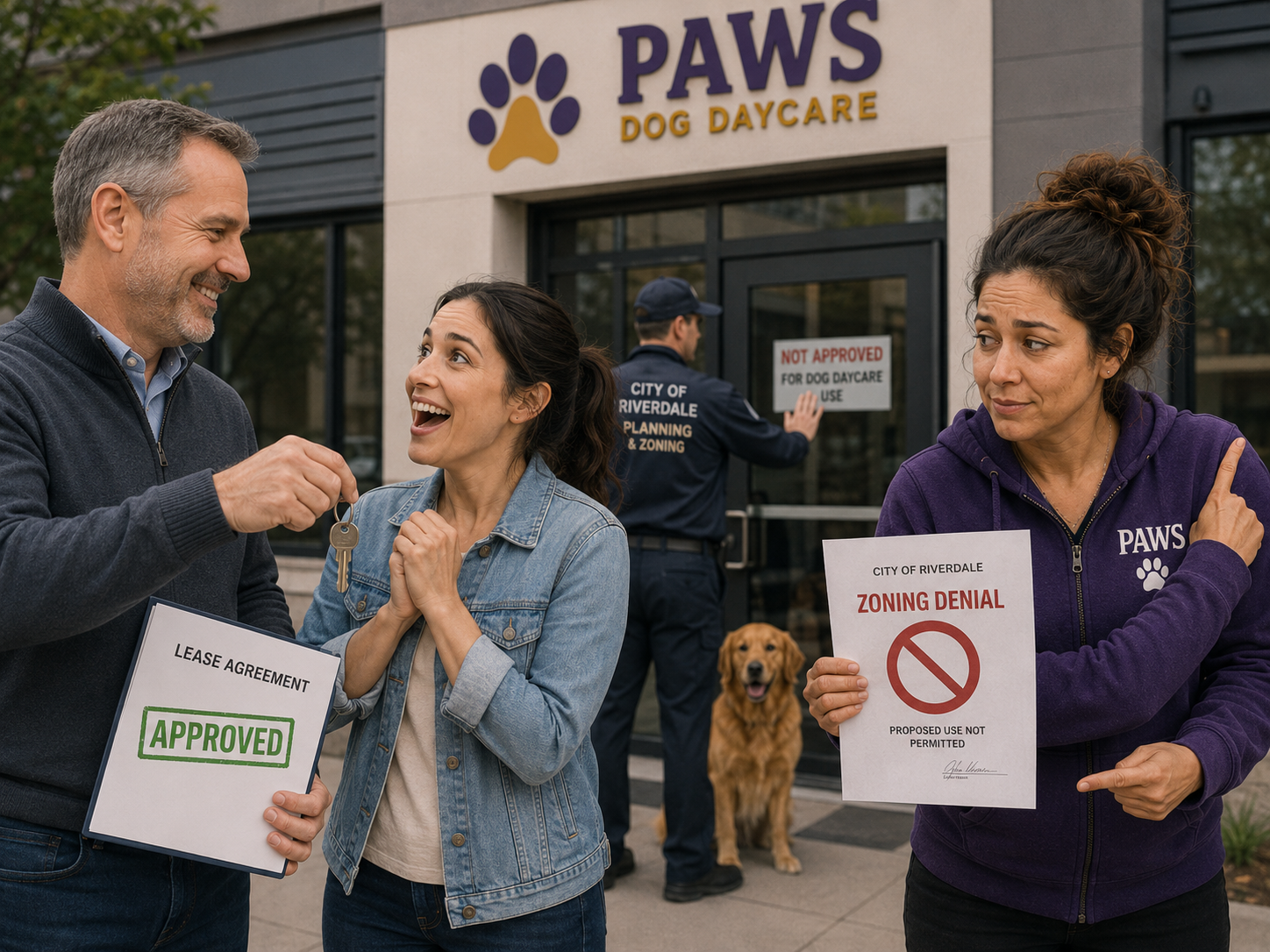
A landlord wants the building leased. A real estate agent wants the deal closed. Neither one may fully understand dog daycare operations, animal-use zoning, boarding restrictions, noise complaints, odor complaints, parking requirements, or the difference between grooming and group dog play.
A landlord may say, “That should be fine,” because the last tenant was a retail store, a warehouse, a gym, a salon, or a light industrial use. That does not mean your use is fine. Dogs change the analysis. Noise changes the analysis. Overnight boarding changes the analysis. Outdoor play changes the analysis. Waste handling changes the analysis. Grooming plumbing changes the analysis. Fire, occupancy, and insurance issues may also change the analysis.
Before you sign, you need to know whether the property can legally support the business you actually intend to operate, not just the watered-down version you described during the first tour.
⚠️
Operator warning
Do not sign a lease because someone “thinks” dog daycare should be allowed. If the use is wrong, the building is wrong. Cheap rent does not fix illegal use.
📄
What to Ask the Zoning Office Before You Commit
You want clear answers before you start spending serious money.
| Question | Why It Matters | Operator Note |
|---|---|---|
| Is dog daycare allowed at this address? | This is the first yes-or-no issue. | Ask about the exact parcel, not just the general neighborhood. |
| Is grooming allowed? | Grooming may be treated differently from daycare or boarding. | If grooming is allowed, that may help frame the business as a pet-service use. |
| Is overnight boarding allowed? | Boarding often triggers different rules than daytime care. | Do not assume daycare approval includes boarding. |
| Is outdoor play allowed? | Outdoor dog areas can raise noise, waste, fencing, and neighbor issues. | A building may work for indoor daycare but fail for outdoor play. |
| Is a conditional use, special exception, or variance required? | This affects cost, timing, risk, and public hearing exposure. | Get the process and timeline before signing. |
| Are there distance restrictions? | Some animal uses may be restricted near homes, schools, churches, parks, or food uses. | Distance rules can quietly destroy an otherwise promising site. |
| Are there parking requirements? | Drop-off and pickup traffic can become a problem quickly. | Morning congestion matters more than a quiet mid-day tour. |
| Are there animal-capacity limits? | The code or permit may limit how many dogs you can have. | A low dog limit can make the business model fail even if approval is granted. |
| What inspections or permits are required? | You may need zoning, business license, building permits, fire review, animal-control approval, or health-related review. | Approval is usually a chain, not one magic stamp. |
🧩
The Approval Chain: Zoning Is First, But It May Not Be Last
New owners often think approval is one magic stamp. It usually is not.
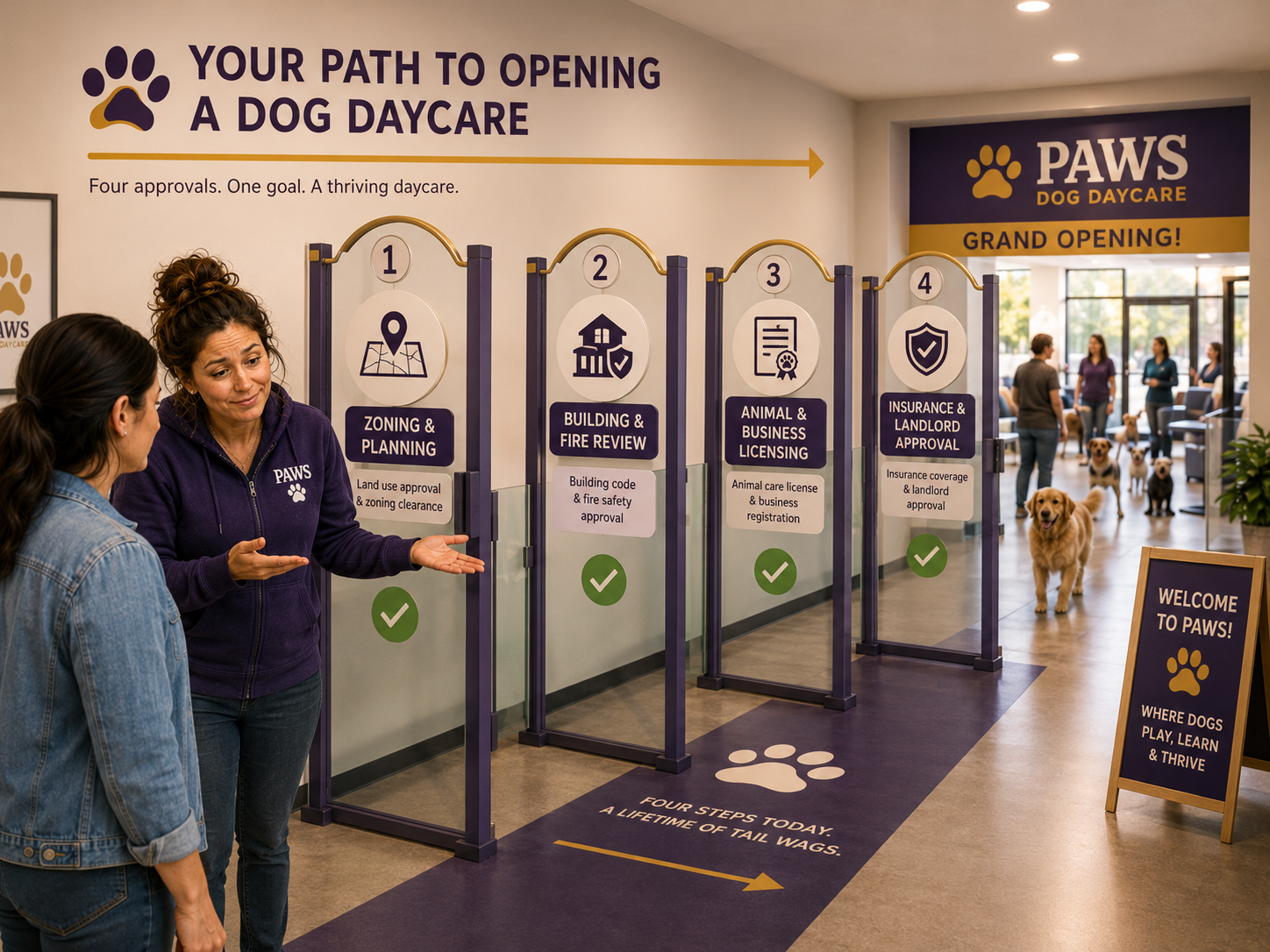
Zoning is the first gate, but it may not be the only gate. A dog daycare can touch zoning, building permits, business licensing, fire review, animal-control rules, sign permits, outdoor-use approval, landlord approval, and insurance underwriting.
Do not assume that one “yes” means the whole project is approved. You need to know the full chain before you commit serious money. A building can be properly zoned and still fail because the fire marshal does not like the layout, the landlord will not allow plumbing changes, outdoor play is not approved, the sign ordinance kills visibility, or the insurer will not cover the use you intend to operate.
1
Zoning / Planning
Confirms whether the use is allowed, conditional, prohibited, or requires a hearing.
Start with zoning →
2
Building / Fire
Reviews occupancy, exits, interior work, fire safety, signage, and code-related changes.
Review approvals →
3
Animal / Business License
May address business licensing, animal use, kennel rules, boarding, sanitation, and local operating requirements.
Check local rules →
4
Insurance / Landlord
Confirms whether the activity can actually be insured and whether the lease allows the build-out and use.
Check coverage →
🛑
Operator warning
Do not sign based on one friendly conversation. You need to know who has the power to stop the business before the first dog ever arrives.
🧭
Dog Daycare Location Decision Tree
This is where a lot of people get in trouble. They fall in love with the rent, the square footage, or the location before they force the property through the approval chain. A dog daycare location is not viable because it looks right. It is viable when the use, the landlord, the city, the layout, and the economics all agree.
1
Zoning Allowed?
Is dog daycare allowed at the exact address, not just somewhere in the general area?
No → Walk away or seek formal approval before spending money.
2
Written Confirmation?
Do you have zoning confirmation, a staff interpretation, or a clear conditional-use path in writing?
No → Do not rely on a phone conversation.
3
All Services Addressed?
Are daycare, grooming, boarding, retail, bathing, and outdoor play each addressed separately?
No → The business model may not be fully approved.
4
Lease Protected?
Does the lease protect you if zoning, inspections, insurance, or build-out approvals fail?
No → Renegotiate before signing.
5
Building Systems Workable?
Are HVAC, plumbing, drains, flooring, electrical, sound, and outdoor areas realistically workable?
No → Cheap rent may be hiding expensive problems.
6
Traffic and Drop-Off Work?
Can customers reach the site easily during real morning and evening traffic?
No → The location may fight repeat use.
7
Build-Out Cost Survivable?
Can the business survive rent, build-out, permits, opening costs, payroll, marketing, and cash reserve?
No → The building may be asking more than the business can safely give.
✅
Proceed
Zoning, lease, systems, traffic, insurance, and economics all make sense.
⚠️
Renegotiate
The site may work, but only if the lease, build-out, approvals, or landlord terms improve.
🚫
Walk Away
The use is unclear, approvals are weak, the building is expensive to fix, or the business cannot survive the risk.
🛡️
Insurance Feasibility: Approval Does Not Matter If You Cannot Insure It
A building can be zoned correctly and still be a bad deal if the insurance side is ugly, unavailable, or more expensive than the business can support.
Before you sign, confirm that the location and the actual services you intend to offer can be insured. Do not just ask whether you can get “business insurance.” That is too vague. Dog daycare has real exposure: bites, injuries, escapes, property damage, customer claims, employee injuries, outdoor play, boarding, grooming, transport, and landlord-required coverage limits.
If the lease requires certain liability limits, additional insured language, property coverage, or waiver terms, you need to know whether a carrier will write that coverage before you are trapped in the lease.
🐕
Use Coverage
Confirm daycare, boarding, grooming, outdoor play, retail, bathing, and transport if transport will be offered.
📄
Lease Requirements
Confirm the required limits, additional insured terms, property requirements, and landlord insurance language.
⚠️
Claim Exposure
Bites, escapes, injuries, damaged property, employee issues, and customer claims need to be part of the insurance conversation.
🛡️
Operator warning
Do not wait until after signing to find out that the carrier will not cover outdoor play, boarding, grooming, transport, or the landlord’s required limits.
🏢
Leasing Versus Purchasing a Dog Daycare Building
This decision depends on cash, risk tolerance, long-term goals, property availability, and how much control you need.
The next decision you will have to make is whether to lease a facility or purchase it outright. This depends on the amount of cash you have available, your long-term goals, the quality of available properties, the cost of build-out, and whether you are trying to preserve working capital for the business itself.
There is no universal answer. Leasing can be smart because it preserves cash and limits real estate exposure. Purchasing can be smart because it gives you control and may be cheaper in the long run. The wrong answer is choosing either option without understanding what it does to your opening cash reserve, monthly overhead, build-out risk, and future flexibility.
Factors Favoring Leasing
- Cash flow: Leasing can conserve cash because the initial cost may be limited to rent, deposit, insurance, and build-out items.
- Credit limitations: A new company may not have the credit history or financial strength to support a mortgage on good terms.
- Maintenance exposure: Some building maintenance may remain the landlord’s responsibility, depending on the lease.
- Property availability: You may not find a suitable property for sale in the right zoning district.
- Market flexibility: If the site works now but cannot support future growth, a lease may let you move later.
- Tax treatment: Rent is generally treated as a business expense, subject to proper accounting advice.
Factors Favoring Purchasing
- Long-term savings: Purchasing may be cheaper over time because you are not paying a landlord’s profit premium forever.
- Location security: If you find the right location and build the business there, ownership can protect you from being forced out.
- Control: Dog daycare build-outs can require substantial changes. Owning gives more control over renovations and future expansion.
- Limited lease options: There may be few or no suitable lease properties in your market.
- Appreciation: If the property is in an appreciating area, the real estate itself may become part of your long-term return.
- Depreciation and interest: Ownership may create tax advantages, but this should be reviewed with a qualified tax professional.
In either instance, you gain the use of an asset. The advantage to leasing is that if you have a strict budget, your initial cash outlay may be lower than if you purchase an entire building. The advantage to purchasing is that in the long run you may pay less than if you lease, and you may also benefit from appreciation in the property.
But do not let the real estate decision starve the operating business. A beautiful building does not help if you have no money left for fencing, flooring, HVAC, insurance, payroll, software, drainage, cleaning, marketing, and reserves.
♿
Customer Entry, Accessibility, and Compliance Costs
This does not need to become a giant legal essay, but it belongs in the hidden-cost conversation.
When you evaluate a location, look at how customers actually enter and use the front of the facility. Parking, ramps, door width, thresholds, restroom access, lobby space, counter height, customer flow, and public entry areas may matter more than people expect, especially when alterations or build-out work trigger additional compliance review.
You are not just building dog space. You are building a customer-facing business. If the entry, parking, restroom, lobby, or front counter creates compliance problems, that can become another hidden cost before opening.
🧾
Lease Terms Can Hurt You as Much as Bad Rent
Rent is only one part of the lease. The clauses around it can matter just as much.
New owners often look at the monthly rent and stop there. That is dangerous. The lease controls what you can change, who pays for repairs, whether you can add plumbing, whether you can install fencing, whether you can vent odor, what happens if zoning approval is denied, what happens if neighbors complain, and whether you can get out if the property cannot legally or physically support the business.
Do not treat a commercial lease like a simple rental agreement. A dog daycare lease should be reviewed carefully, preferably by someone who understands commercial leasing and the type of modifications this business may require.
| Lease Issue | Why It Matters | Operator Warning |
|---|---|---|
| Use clause | Controls what business activities are permitted. | Make sure daycare, grooming, boarding, retail, washing, and outdoor use are covered if you intend to offer them. |
| Zoning contingency | Protects you if government approval is denied. | Do not get trapped in a lease for a business the property cannot legally operate. |
| Build-out rights | Controls whether you can modify walls, floors, plumbing, drains, fencing, HVAC, and interior layout. | Dog daycare usually requires changes. Get permission clearly. |
| Repair responsibility | Determines who pays for HVAC, roof, plumbing, electrical, parking lot, and structural issues. | A cheap lease can become expensive if repairs are pushed onto you. |
| Noise and nuisance language | Dogs make noise. Neighbor complaints can become a lease issue. | Know whether complaints can be used to declare default. |
| Insurance requirements | Commercial leases often require specific coverage limits. | Confirm insurance is available and affordable before signing. |
| Renewal options | Protects the location if the business succeeds. | Do not build a customer base only to lose the location after the first term. |
| Assignment / sublease | Affects your ability to sell the business or exit. | If the business grows, transfer rights may matter. |
🛑
Plain-English Lease Contingencies You Should Be Thinking About
This is not legal advice, but it is the operator reality: the lease should not trap you before the property is proven usable.
A dog daycare lease needs more protection than a simple office lease. You are not just putting desks in a room. You may need drains, sinks, fencing, floor coating, gates, HVAC changes, sound control, outdoor-use permission, signage, cameras, and inspection approvals.
Before you become fully committed, the lease should give you a path to confirm that the property can actually support the business. The details should be handled with a qualified professional, but as the operator, you need to understand what you are trying to protect.
| Contingency / Protection | Plain-English Meaning | Why It Matters |
|---|---|---|
| Zoning approval | The lease should not fully bind you if the use is not allowed. | You do not want rent on a building where dog daycare cannot legally operate. |
| Animal-use confirmation | Daycare, boarding, grooming, outdoor play, and retail should be separately understood. | One approved service does not automatically approve the full business model. |
| Build-out permission | You need the right to modify floors, plumbing, walls, gates, HVAC, drains, signage, and layout. | A landlord saying “we can talk about that later” is not enough. |
| Inspection feasibility | Building, fire, business-license, and animal-control issues should be workable. | A failed inspection can delay opening and burn cash. |
| Insurance availability | You should confirm that the business and location can be insured at the required limits. | The lease may require coverage you cannot obtain or afford. |
| Early termination path | If approvals fail, there should be a clean way out. | Without this, you may pay for a useless building. |
👣
Walk the Property Like an Operator
Do not start by admiring the lobby. Start outside, where the customer and the problems actually arrive.
When you physically tour a building, do not walk in like a customer and say, “This could be cute.” Walk in like the person who has to operate it, clean it, cool it, insure it, staff it, pay for it, and survive the first year in it.
Start in the parking lot. Watch the traffic. Look at the turns. Look at the neighboring businesses. Look at where customers would park at 7:30 in the morning when they are late for work and holding a dog on a leash. Then walk the outside of the building. Look for outdoor space, drainage, fencing possibilities, trash placement, noise issues, and what the neighbors will see and hear.
Only after that should you walk inside and start thinking about lobby, play areas, office, grooming, boarding, cleaning, storage, staff movement, dog movement, gates, drains, HVAC, flooring, electrical, and emergency flow.
1 Parking Lot
Can customers unload dogs safely during real drop-off traffic?
2 Neighbors
Who will hear barking, smell waste, or complain about traffic?
3 Zoning / Use
Does the exact parcel legally support the services you intend to offer?
4 Outdoor Area
Can fencing, drainage, shade, supervision, and waste control actually work?
5 Lobby / Drop-Off
Can customers, leashes, doors, and dogs move safely at busy times?
6 Play Space
Can groups be separated and supervised without blind spots?
7 HVAC
Can the system handle dogs, people, odor, humidity, and heat?
8 Plumbing / Drains
Where does dirty water go after real cleaning?
9 Flooring
Can it be removed, sealed, coated, drained, and cleaned?
10 Electrical
Can the building support office systems, fans, grooming, cameras, and growth?
11 Sound
Will shared walls, neighbors, or outdoor play create complaints?
12 Lease / Build-Out
Does the lease allow the changes the business actually needs?
| Tour Step | What to Look At | Operator Question |
|---|---|---|
| 1. Street approach | Visibility, turns, traffic speed, signage, road access. | Will customers see it and reach it without irritation? |
| 2. Parking lot | Spaces, stacking, lighting, safe dog unloading, morning flow. | Can three or four customers arrive at once without chaos? |
| 3. Neighbor check | Residential edges, shared walls, quiet tenants, restaurants, medical offices, schools. | Who is going to complain about noise, odor, traffic, or dogs? |
| 4. Exterior perimeter | Outdoor play, fencing, drainage, shade, trash, waste, delivery access. | Can the outside be useful without becoming a liability? |
| 5. Lobby / entry | Door control, customer line, leash handling, dog handoff, visibility. | Can customers and dogs move safely at busy times? |
| 6. Dog areas | Group separation, blind corners, gates, staff sightlines, emergency separation. | Can staff control the room, or will the room control the staff? |
| 7. Utility systems | HVAC, plumbing, drains, electrical, ventilation, filtration. | Can the building handle dogs, water, odor, heat, and cleaning? |
| 8. Back-of-house | Storage, laundry, trash, chemicals, food, records, staff space. | Where does all the ugly daily stuff go? |
📍
Location, Location, Location Still Matters
Convenience can be the difference between a customer using you every week and a customer loving the idea but never coming back.
Location is one of the most important factors you need to consider when choosing a building for your dog daycare. On average, people are only willing to drive a limited distance to take their dog to daycare. Many customers will not drive across town, fight traffic, burn gas, sit in summer heat, and add time to their morning just so their dog can attend daycare when the dog can sit at home for free.
That does not mean every customer lives within a perfect circle around your building. Real service areas follow commuter routes, traffic patterns, school drop-off routes, employment centers, neighborhoods, bridges, highways, turns, parking lots, and convenience. A location along a major commuter route can be much stronger than a cheaper building tucked away in a spot people have no natural reason to pass.
Ideally, you should know the local commuter route in your area and try to position yourself along or near that route. The more convenient your location, the more people will use your services. A location along the main highway or commuter corridor may cost more to rent, but it may bring in far more customers than an inconvenient location that is difficult to reach.
There is another part of location that people do not always like to talk about: you are known by the company you keep. If you start up in an industrial park full of half-disassembled cars, dumpsters, heavy equipment, and auto-body shops, it may not reflect as well on your business as a clean, visible, easy-to-access location near other customer-facing businesses.
That said, zoning may force you into a lower-quality commercial or light-industrial area. That does not automatically kill the idea, but it means you need to be honest about what the location does to customer perception, convenience, signage, traffic, odor, noise, and marketing.
🚗
Commuter Route
Strong daycare locations fit into the customer’s normal routine. The less backtracking, the better.
👀
Visibility
A visible site can act like daily advertising. Hidden locations may require more paid marketing just to be noticed.
🅿️
Access
Parking, safe turns, drop-off flow, and pickup flow matter more than people realize until the lobby is full and cars are stacking up.
⏰
The Traffic and Drop-Off Test
Do not judge the location at 2:00 in the afternoon when nobody is trying to get to work.
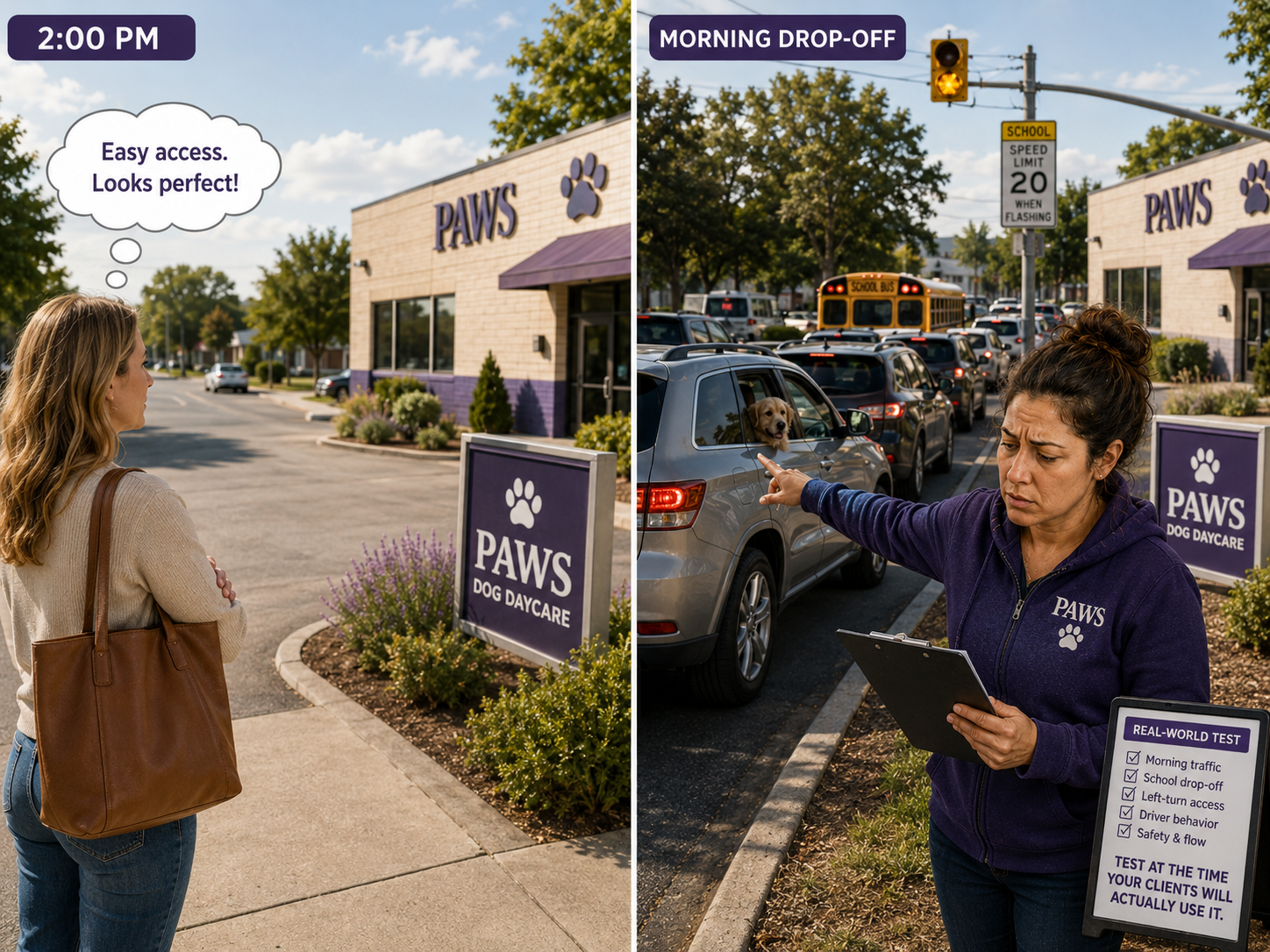
If you are serious about a building, drive the route when your customers would actually use it. Drive it at 7:30 a.m., 8:15 a.m., 5:15 p.m., and 6:00 p.m. A building that feels easy at lunchtime may be a mess during real drop-off and pickup hours.
Check the left turns. Check the traffic lights. Check school zones. Check whether cars back up. Check whether customers can pull in and out safely with a dog in the car. Check whether the sun hits the parking lot in a way that makes summer drop-off miserable. Check whether a nervous dog can safely get from the car to the door.
Many people will love the idea of daycare but will stop using it if the morning routine becomes a pain. Convenience is not a small detail. Convenience is part of the product.
🌅
Morning Drop-Off
Test the route when customers are late, rushed, and trying to get to work.
🚦
Traffic Friction
Bad turns, poor lights, school zones, and road congestion can kill repeat use.
🐕
Dog Safety
A location is weaker if customers have to unload dogs near traffic, blind corners, or tight parking.
🌆
Evening Pickup
Test the site when everyone is tired, traffic is heavier, and the lobby may be busy.
🧊
The Cheap-Building Cost Iceberg
This is why cheap rent can become expensive rent. The monthly lease rate is the part people see. The part that buries them is everything the building cannot currently do.
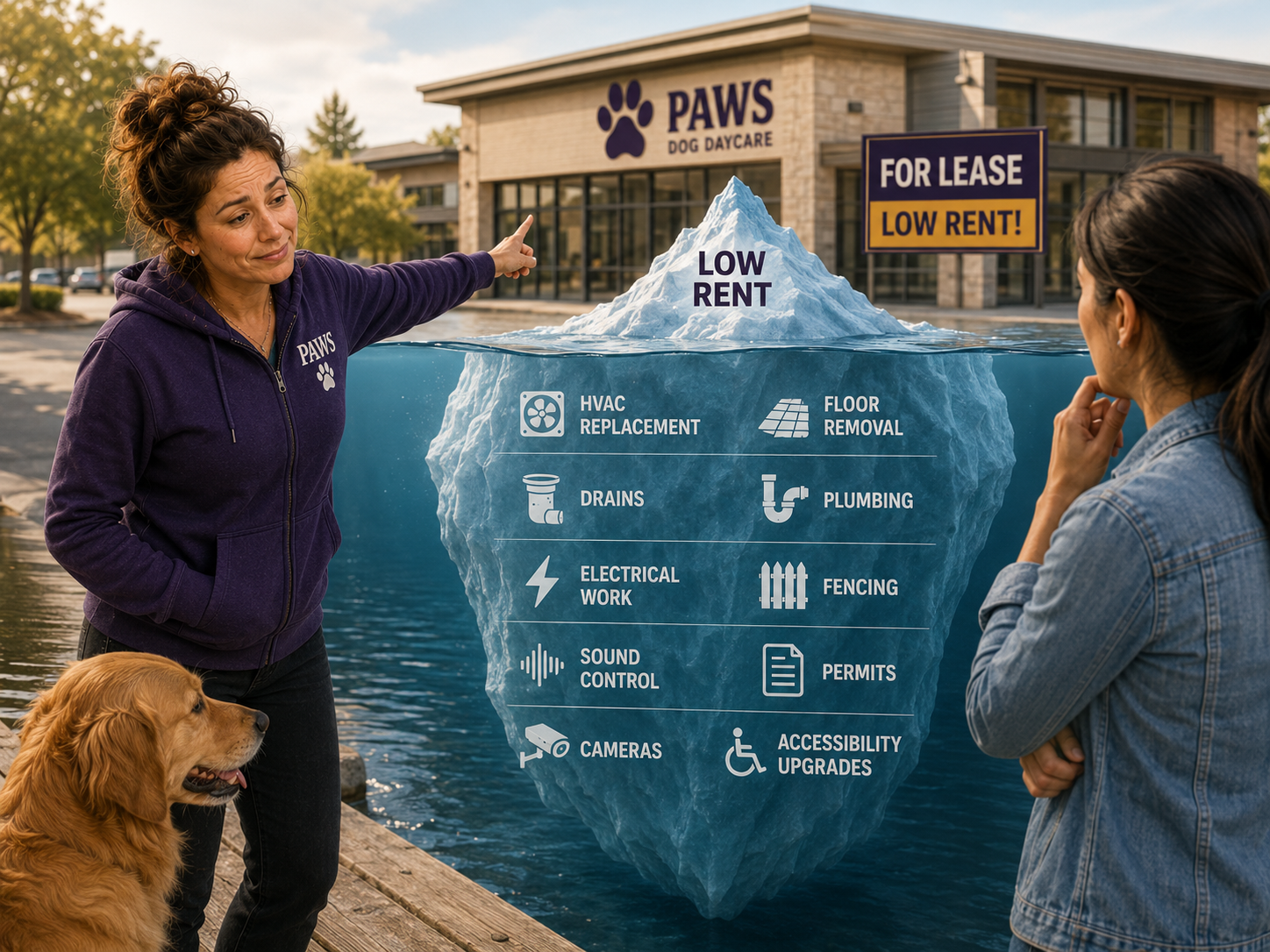
A cheap building can be a great opportunity, or it can be a trap. The problem is that rent is easy to compare. Build-out pain is harder to see until you are already committed.
Dog daycare is hard on buildings. Dogs create heat, odor, water, waste, sound, hair, traffic, and cleaning demand. A building that worked fine for a retail store or warehouse may need serious money before it works for animal care.
Visible Cost Monthly Rent
The number everyone sees first. Useful, but incomplete.
💸
Operator warning
A building with cheap rent and expensive problems is not cheap. It is just hiding the bill until later.
🌳
Outside Area: Helpful, Marketable, But Not a Magic Fix
Outdoor space can help, but it also creates fencing, supervision, waste, heat, noise, drainage, and neighbor issues.
An outside area is not always a requirement to operate a dog daycare facility successfully, but it is nice to have when it is designed and managed correctly. It gives the dogs a break from being inside and gives you a chance to thoroughly mop and clean the inside area while they are outside playing.
It also adds another dimension to your business that you can sell during tours. One of the most common questions potential clients ask when they enter the facility is, “Where do the dogs go to the bathroom?” It is useful to have a good answer, both as a selling point and as an additional space for the dogs to use.
But do not fool yourself. Even with an outside area, the dogs in your care will still relieve themselves numerous times during the day inside your facility. This is a labor-intensive business either way.
Outdoor areas also create their own problems. You need secure fencing, double-gate entry, shade, drainage, supervision, waste removal, cleaning systems, escape prevention, and noise control. A bad outdoor setup can create complaints, injuries, odor, mud, fence fighting, and escape risk. Outdoor space is an asset only if it is controlled.
👂
Neighbor, Noise, and Odor Risk
Dogs do not operate quietly, and neighbors do not always care that you are trying to start a business.
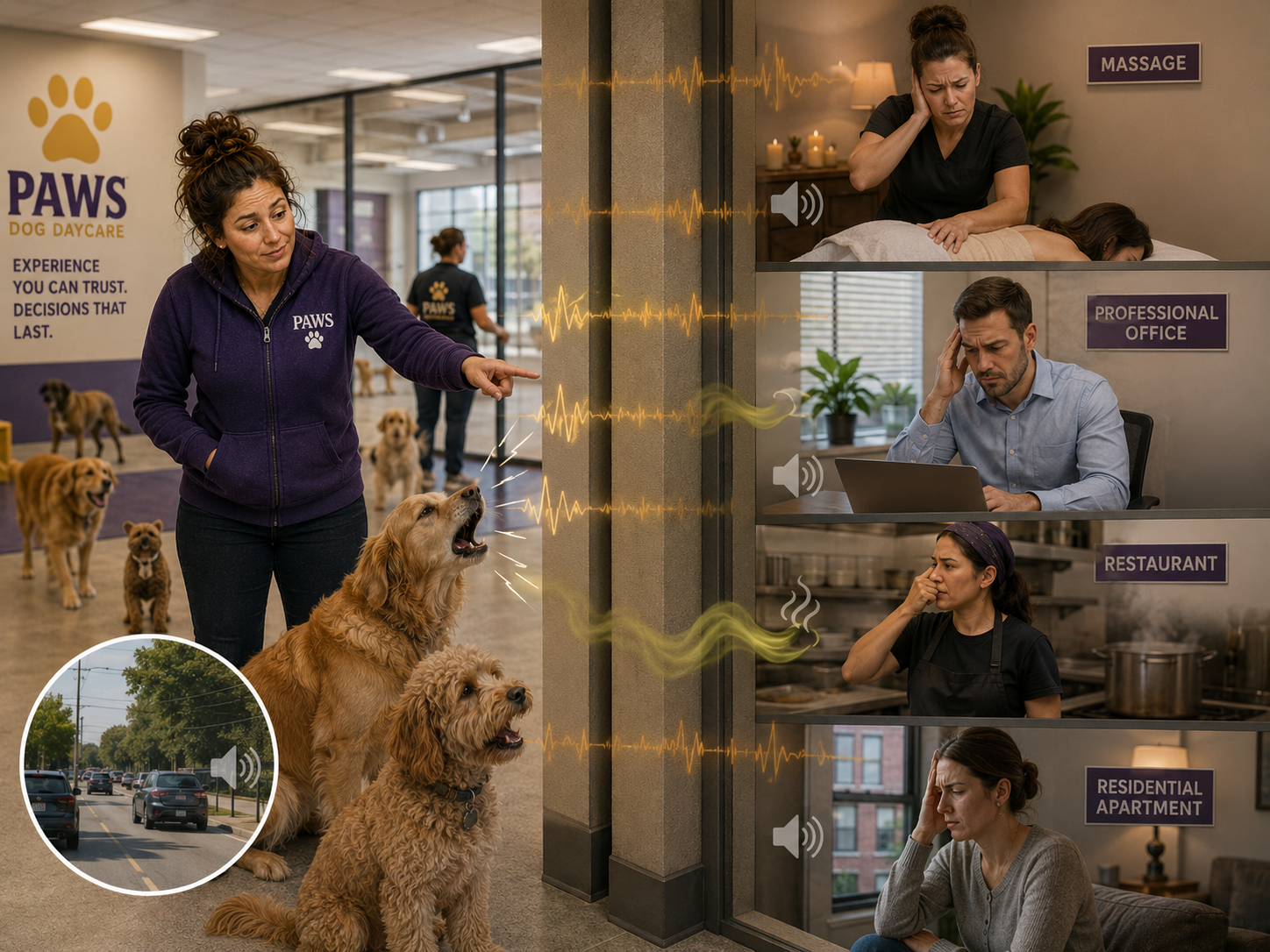
One of the easiest things to underestimate is how other people will react to the facility. Dogs bark. Dogs play. Staff clean. Customers arrive. Trash goes out. Outdoor areas create sound and waste issues. Grooming dryers make noise. Drop-off and pickup create traffic.
If you share walls with quiet tenants, medical offices, professional offices, restaurants, apartments, or anything else sensitive to noise and odor, you need to think carefully before signing. You may be the one operating the business, but the neighbors may become the reason the landlord, zoning office, or city starts paying attention.
This does not mean you cannot operate near other businesses. It means you need to know what kind of neighbors you are getting. A dog daycare next to a warehouse may be fine. A dog daycare next to a massage studio, therapist office, or restaurant may become a fight before you ever reach full capacity.
| Risk | What to Look For | Operator Warning |
|---|---|---|
| Shared walls | Quiet tenants, thin walls, echoing rooms, no insulation. | Happy dogs playing can sound very different to the tenant next door. |
| Residential edge | Homes, apartments, patios, nearby backyards. | Outdoor play, barking, and odor can trigger complaints. |
| Food businesses | Restaurants, cafes, food prep, grocery, shared trash areas. | Waste, odor, flies, and perception can become problems. |
| Professional offices | Medical, counseling, massage, legal, financial, quiet appointment-based tenants. | They may not appreciate play noise, barking, or busy drop-off traffic. |
| Outdoor play | Fence line, drainage, neighbor visibility, barking direction. | Outdoor space is useful only if it can be controlled. |
❄️
Air Conditioning, Ventilation, and Filtration
If the system is barely doing the job before you open, it may be miserable once the dogs arrive.
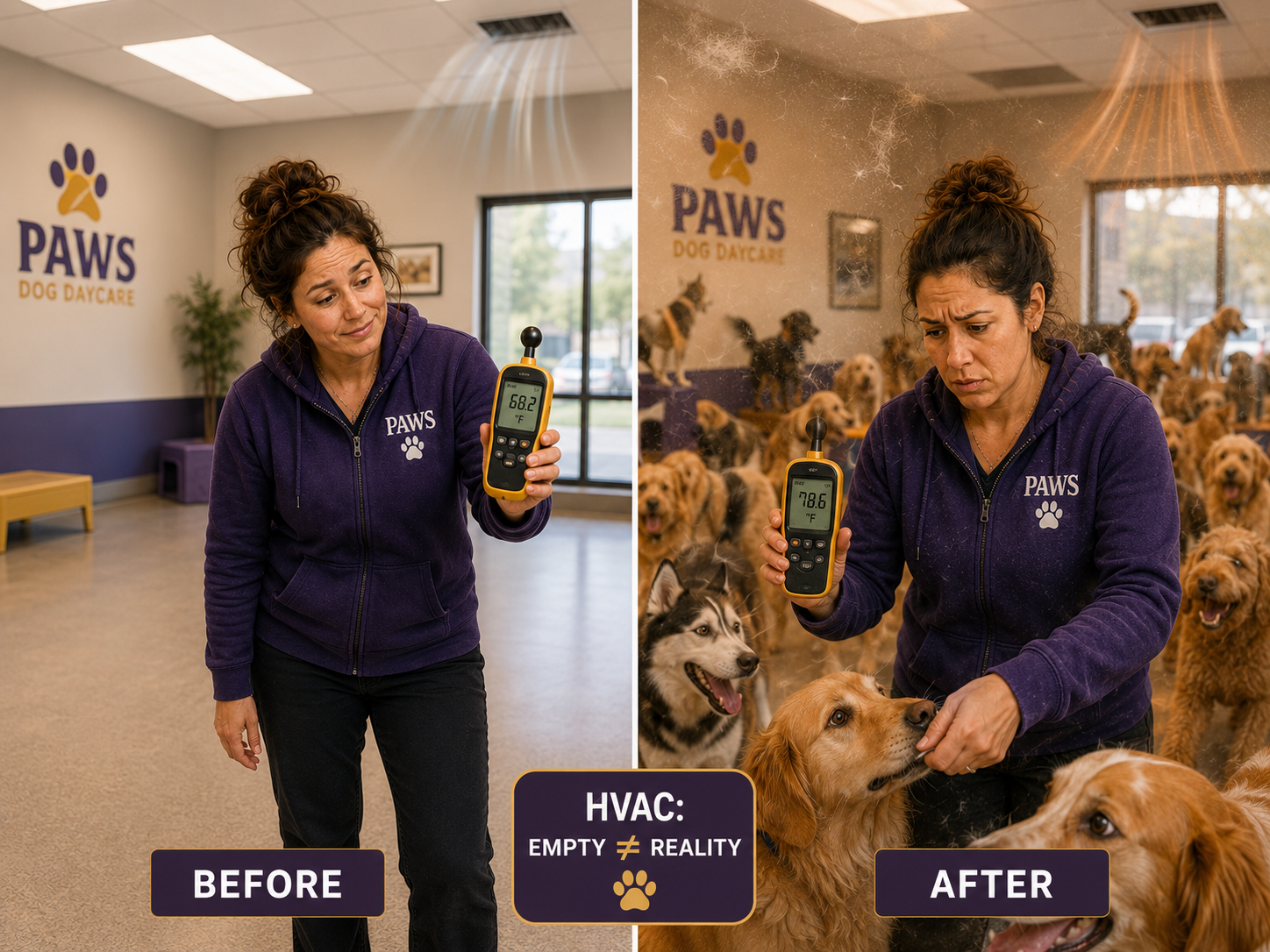
If the air conditioning is barely doing the job before you open, it will be miserable inside once you have 25 or 30 dogs with a natural body temperature ranging roughly from 99.5 to 102.5 degrees Fahrenheit. A large number of dogs indoors can raise the temperature inside the building quickly.
Your customers will also feel uncomfortable, and it will reflect poorly on the facility if it is hot, stale, humid, or smelly inside. People may forgive a lot when they first tour a new facility, but odor and heat are not small things in a dog daycare. They affect customer confidence immediately.
You also need to look at the filtration setup. Is the intake near the floor where hair, dander, dust, and cleaning residue may collect, or is it on the ceiling? Is it accessible for cleaning? Is there only one filter at the air handler, or is there a return filter plus an air-handler filter? Is there enough air movement? Is there any fresh-air exchange? Is odor control possible? Is UV filtration available or practical?
You do not need to turn the facility into a laboratory, but you do need to understand that dog daycare is hard on HVAC. Hair, dander, moisture, cleaning chemicals, odor, and body heat are part of the business.
🌡️
Operator warning
If you open in a hot climate with weak HVAC, you may end up fighting heat, odor, customer complaints, dog stress, and high electric bills from day one.
🚰
Plumbing, Drains, Sinks, and Grooming Expansion
Water management is not optional in this business.
You need to take note of where all plumbing fixtures are and how they will fit into your final design. You will absolutely need a deep sink for changing mop water, cleaning bowls, cleaning toys, rinsing equipment, and everything in between.
Look at where a deep sink can be added in relation to the existing plumbing. Look at whether the current setup allows you to grow the business later by adding grooming services, dog washing, laundry, bathing stations, or additional cleaning areas.
Plumbing can become expensive quickly. Concrete cutting, drain installation, hot-water capacity, backflow requirements, floor slope, cleanouts, grease or hair management, and code requirements can all affect cost. Do not assume a cheap open room is cheap to convert.
🪣
Deep Sink
Mop water, bowls, toys, buckets, tools, and general cleaning require a practical wash area.
🛁
Grooming Growth
If grooming may be added later, evaluate plumbing before the lease is signed.
💧
Drainage
Poor drainage turns cleaning into a daily fight and can increase odor, labor, and sanitation problems.
💦
Drainage and Washdown Reality
Cleaning is not a theory in dog daycare. It is daily labor, and the building either helps you or fights you.
A deep sink matters, but it is only part of the water-management problem. You need to know where mop water goes, where wash water goes, how floors slope, whether drains exist, whether drains are allowed, and whether hair, debris, urine, feces, disinfectant, and dirty water can be managed without turning the facility into a daily battle.
If there are no floor drains and no realistic way to add them, that does not automatically kill the building, but it changes your cleaning system. It may mean more mopping, more wet-vac use, more labor, more odor risk, and more attention to flooring and sealing.
Poor drainage is not just inconvenient. Standing water can create odor, slip risks, sanitation issues, and unhappy customers. The cleaner the facility is, the more confidence people have leaving their dogs with you.
🪣
Mop Path
Where does dirty mop water go, and how far does staff have to carry it?
🧽
Washdown Path
Can the floor be cleaned efficiently, or will every cleaning become a wet mess?
🦠
Odor Path
If water, urine, and disinfectant have nowhere to go, odor control becomes harder every day.
🔇
Insulation, Sound, and Neighbor Problems
Happy dogs playing can get loud. Do not pretend sound will not matter.
There are two main reasons you want to check the current insulation status of the building. The first is utility cost. It takes a lot of dogs in daycare to offset a high monthly electric bill. If the building is poorly insulated, you may be paying every month for that problem.
The second reason is sound. If you are sharing a building with other tenants, the sound of dogs playing can become a major issue. Barking, play noise, gate noise, cleaning equipment, dryers, traffic, and customer flow can all become problems if the building was not designed for animal use.
Sound control is not just about being a good neighbor. It is business protection. If neighboring tenants complain, the landlord complains, or nearby residents complain, your operation can become more stressful and more expensive very quickly.
⚡
Electrical Capacity and Future Growth
You may not need much electricity on day one, but the building should allow you to grow.
In the beginning, there may not be a lot of electrical equipment required to open a dog daycare facility. You need adequate outlets to run your office, computer, phone, internet equipment, printers, cameras, cleaning equipment, fans, and basic systems.
Preferably, you want one or two outlets on different breakers if you intend to use items that pull high amperage, such as industrial fans, dehumidifiers, localized air conditioning units, dryers, bathing equipment, or grooming equipment.
You should check whether the design allows you to grow. Is the breaker panel modern? Is there empty breaker space? Is additional amperage available? Can cameras, dryers, grooming tables, washers, dryers, fans, air purifiers, and office systems be supported later?
Electrical limitations may not look exciting during a property tour, but they can become expensive during build-out.
🏷️
Signage, Visibility, and Being Found
A visible location is only useful if customers can actually see you, find you, and remember you.
Visibility is not just whether the building sits near a road. Can you put a sign where people will see it? Is the sign blocked by trees, poles, other tenants, parked vehicles, or the angle of traffic? Can the sign be lit? Does the landlord restrict signage? Does the city restrict signage? Can customers identify the entrance quickly?
A hidden location can still work, but it usually needs stronger marketing, better referrals, stronger Google visibility, better reviews, clearer directions, and better customer communication. A visible site can act like daily advertising if the rest of the business is strong.
The problem is paying visible-location rent without actually getting visible-location benefits. Do not pay for exposure that the sign ordinance, landlord, building layout, or traffic angle will not let you use.
🧼
Flooring: Whatever Is There May Need to Go
Flooring is one of the places where a “cheap” building can become expensive.
Whatever the flooring is now, unless it is bare concrete or another truly usable surface, it probably needs to go away. This can be a low-effort job if it is carpet with tack strips in the corners. It can be a nightmare if it is glued-down commercial carpet, laminate, old vinyl composition tile, or anything else that has to be scraped, ground, removed, or remediated.
Dog daycare play areas are generally concrete with a proper coating system, sealed surface, or rubberized flooring designed for animal use. Office areas should be tile or another non-porous durable surface that is easy to clean and does not become a nesting place for hair, germs, odor, and bacteria.
Do not judge flooring by how it looks during a tour. Judge it by how it will perform after months of urine, water, disinfectant, mopping, claws, staff traffic, dog traffic, and cleaning.
🧼
Operator warning
If the flooring cannot be cleaned, sealed, drained, and maintained, the building is already fighting you.
🧱
Interior Layout and Build-Out Reality
Dog daycare is unlike most businesses. You probably will not just slide into a space and start operating.
Because dog daycare is unlike other businesses, it is unlikely that you will be able to move in without making substantial modifications to the existing interior. You need to make sure you have the ability to remove what is currently there and that the building can handle what you plan to install.
What anchor points do you have in the ceiling? Can fencing or panel systems be safely installed? If you plan on adding chain-link-style enclosures or fixed partitions that need to be cemented into the floor, where are the plumbing lines in the slab? Are there floor drains? Is there enough width for safe dog movement, staff movement, and emergency access?
What restrictions does the landlord have concerning renovation? Can you cut concrete? Add plumbing? Install fencing? Modify HVAC? Add exhaust? Add cameras? Add signage? Add gates? Add soundproofing? Remove carpet? Paint floors? Change doors?
These are the items you need to consider before signing on the dotted line.
🛡️
Safety, Flow, and Containment
A dog daycare building is not just a room. It is a controlled movement system.
When you evaluate a building, think about how dogs, customers, and staff will move through it. Where do dogs enter? Where do customers stand? Where do leashes come off? Where do dogs wait? Where do staff separate groups? Where does a nervous dog go? Where does an injured dog go? Where does a dog go if it needs to be removed from group play quickly?
Double-gate systems, controlled lobby access, secure play areas, safe handoff points, visual barriers, emergency exits, and staff-only zones all matter. A facility can look open and spacious during a tour but still be unsafe if the flow is wrong.
Do not design only for the good days. Design for the dog that bolts, the customer who opens the wrong door, the dog that slips a collar, the employee carrying mop water, the group that gets too excited, the dog that needs to be separated, and the customer arriving during the busiest five minutes of the morning.
📐
Dog Capacity and Layout Math
Square footage is not capacity until you subtract everything the dogs cannot actually use.
A building may look large on paper, but not all square footage becomes usable dog space. You have to subtract lobby, office, grooming, bathing, boarding, isolation, storage, staff areas, laundry, utility areas, hallways, gates, traffic lanes, and dead space.
This is where people fool themselves. They lease 4,000 square feet and start thinking like they have 4,000 square feet of daycare. They do not. They may only have half of that as practical play space once the building is divided into the areas needed to operate safely.
The real question is not “how big is the building?” The real question is “how many dogs can this building safely, legally, and profitably handle after the operation is designed?”
| Space Category | Why It Reduces Play Capacity | Operator Question |
|---|---|---|
| Lobby / customer area | Needed for check-in, check-out, payments, tours, and handoff. | Can customers move safely without dogs crowding the door? |
| Office / records | Needed for software, vaccination records, calls, payments, and administration. | Can the business be controlled without clutter? |
| Grooming / bathing | Useful revenue space, but it is not daycare play space. | Does the revenue justify the footprint? |
| Boarding / rest areas | Needed for overnight care, feeding, rest, and separation. | Does boarding help revenue enough to justify the area? |
| Isolation / quiet area | Needed for sick, nervous, injured, overstimulated, or separated dogs. | Where does the problem dog go without disrupting the whole building? |
| Storage / laundry / cleaning | Needed for towels, chemicals, food, bowls, leashes, gates, beds, tools, and waste handling. | Where does all the daily mess live? |
| Traffic lanes / gates | Needed for safe movement and group separation. | Can staff move dogs without bottlenecks and unsafe crossings? |
Gross Building Area 4,000 sq. ft.
This is the number on the flyer. It is not the number that tells you how many dogs the building can safely handle.
= Practical Dog Space
A building may sound big on paper and still be too small in practice. The square footage that pays is not the square footage on the flyer. It is the square footage that safely works for dogs, staff, cleaning, traffic flow, and supervision.
🎥
Real Facility Layout Walkthroughs
Some of this becomes easier to understand when you can see a facility as a moving layout instead of just reading about it. These walk-through examples show the kind of practical planning that goes into room flow, separation, support space, and usable square footage.
These are planning examples, not magic templates. The point is to train your eye to think in terms of flow, visibility, separation, support space, customer entry, staff movement, and operating practicality.
Facility Walkthrough Example 1
Conceptual dog daycare layout and room-flow walkthrough showing how usable space, dog areas, and support areas work together.
Facility Walkthrough Example 2
Facility concept showing room division, support areas, customer-facing space, and the kind of planning that should happen before build-out money is spent.
🚑
Emergency, Sick-Dog, and Separation Space
Do not design only for the good days. The building also has to work when something goes wrong.
A dog daycare building needs a plan for the dog that gets sick, the dog that gets hurt, the dog that is overstimulated, the dog that starts a fight, the dog that needs to be removed from group play, and the dog waiting for a parent to pick up after an incident.
If every square foot is used for open play, you may have nowhere to put problems when they happen. That is not efficient. That is risky.
You need at least one practical place where a dog can be separated safely without blocking the lobby, disrupting staff, creating a customer scene, or forcing the dog into an unsafe corner.
🤒
Sick Dog
Where does a dog go if it vomits, has diarrhea, coughs, or needs to be isolated until pickup?
⚠️
Behavior Incident
Where does a dog go after a fight, bite, or overstimulation problem?
🧘
Quiet Hold
Where does a nervous, senior, recovering, or overwhelmed dog rest away from group pressure?
👷
Staff Workflow: Bad Layout Becomes Payroll
Every extra step, blind corner, awkward gate, and bad mop path becomes labor cost.
A bad layout does not just annoy staff. It costs money. If employees have to walk too far for mop water, cannot see the whole play area, have to cross through one group to reach another group, or cannot separate dogs quickly, the building is making the job harder than it needs to be.
Labor is one of the biggest pressures in this business. A building that requires more staff movement, more cleaning time, more supervision blind spots, and more inefficient handling will quietly cost money every day.
When you tour the building, imagine one employee trying to supervise a group, answer a customer question, clean an accident, grab a leash, separate a dog, and refill water. If the building makes all of that harder, the building is not neutral. It is working against you.
👷
Operator warning
Layout is payroll. A bad building may force you to staff around problems that should have been solved by choosing or designing the space better.
🧺
Laundry, Trash, Storage, Chemicals, and Waste
The ugly daily stuff needs a home, or it ends up everywhere.
Dog daycare creates a surprising amount of stuff: towels, mop heads, bowls, leashes, collars, beds, blankets, toys, food, medications, cleaning chemicals, paper records, extra gates, tools, trash, poop waste, and laundry. If the building has no real storage plan, the facility can start looking disorganized fast.
Where do soiled towels go? Where do clean towels go? Where does dog waste go before pickup? Where do chemicals sit so customers and dogs cannot access them? Where do food bags go? Where do you put the equipment you only need sometimes but absolutely need when something happens?
This is not glamorous, but it matters. A dog daycare with no back-of-house plan becomes a cluttered mess, and clutter makes cleaning, safety, tours, and staff efficiency worse.
🧺
Laundry
Soiled and clean items need separate, practical locations.
🗑️
Waste
Dog waste, trash, and odor control need a plan before opening.
🧴
Chemicals
Cleaning supplies must be accessible to staff but secure from dogs and customers.
📦
Storage
Food, bowls, leashes, toys, gates, tools, and records need organized space.
✅
Dog Daycare Building Evaluation Checklist
Before committing to a building, you should be able to answer these questions.
- Is dog daycare clearly allowed at this address?
- Is grooming allowed?
- Is overnight boarding allowed if you intend to offer it?
- Is outdoor play allowed?
- Will a conditional use, special exception, variance, or hearing be required?
- Can you get zoning approval or interpretation in writing?
- Is the location convenient to the actual customer base?
- Is the site near a commuter route, employment center, or high-demand neighborhood?
- Is parking adequate for morning drop-off and evening pickup?
- Can customers enter and exit safely without awkward turns or traffic problems?
- Is the building large enough without being oversized and financially dangerous?
- Can the building expand with the business later?
- Is HVAC strong enough for dogs, people, odor, humidity, and heat?
- Can ventilation and filtration be improved?
- Is plumbing adequate for sinks, cleaning, grooming, bathing, and possible laundry?
- Can flooring be removed, sealed, coated, drained, and cleaned properly?
- Can sound be controlled enough to avoid tenant or neighbor problems?
- Is electrical service adequate for office systems, fans, dehumidifiers, grooming, cameras, and future equipment?
- Can fencing, double gates, partitions, and safety systems be installed?
- Does the lease allow the build-out you actually need?
- Who pays for HVAC, plumbing, roof, electrical, drainage, parking-lot, and structural repairs?
- Can the business survive the rent while the customer base is still growing?
📊
Simple Location Scorecard
Use this as a practical way to compare buildings. A cheap building with several weak scores may be more expensive than it looks.
| Factor | Weak Site | Good Site | Strong Site |
|---|---|---|---|
| Zoning | Unclear or likely hearing required | Possible with staff confirmation | Clearly allowed in writing |
| Customer Convenience | Hidden, awkward, or out of route | Reasonably accessible | Easy commuter-route location |
| Parking / Drop-Off | Tight, unsafe, or congested | Acceptable with management | Easy, visible, and safe |
| HVAC / Air Quality | Already weak before opening | Usable but may need upgrades | Strong system with room to improve filtration |
| Plumbing | Hard to add sinks, grooming, drains | Possible with moderate work | Well-positioned for cleaning and expansion |
| Flooring | Expensive removal or poor surface | Manageable prep required | Easy path to sealed, cleanable flooring |
| Noise / Neighbors | Shared walls and complaint risk | Manageable with insulation and rules | Low conflict risk |
| Lease Flexibility | Restrictive and risky | Negotiable | Use, build-out, contingency, and renewal terms are strong |
📊
Interactive Dog Daycare Location Score Calculator
This is not a legal opinion, municipal approval, or financial guarantee. It is a reality check. If the score is ugly, that does not always mean the deal is impossible. It usually means the building is asking for more money, more compromise, or more risk than it first appeared.
Score the site honestly.
Change the fields above to pressure-test the building before you fall in love with it.
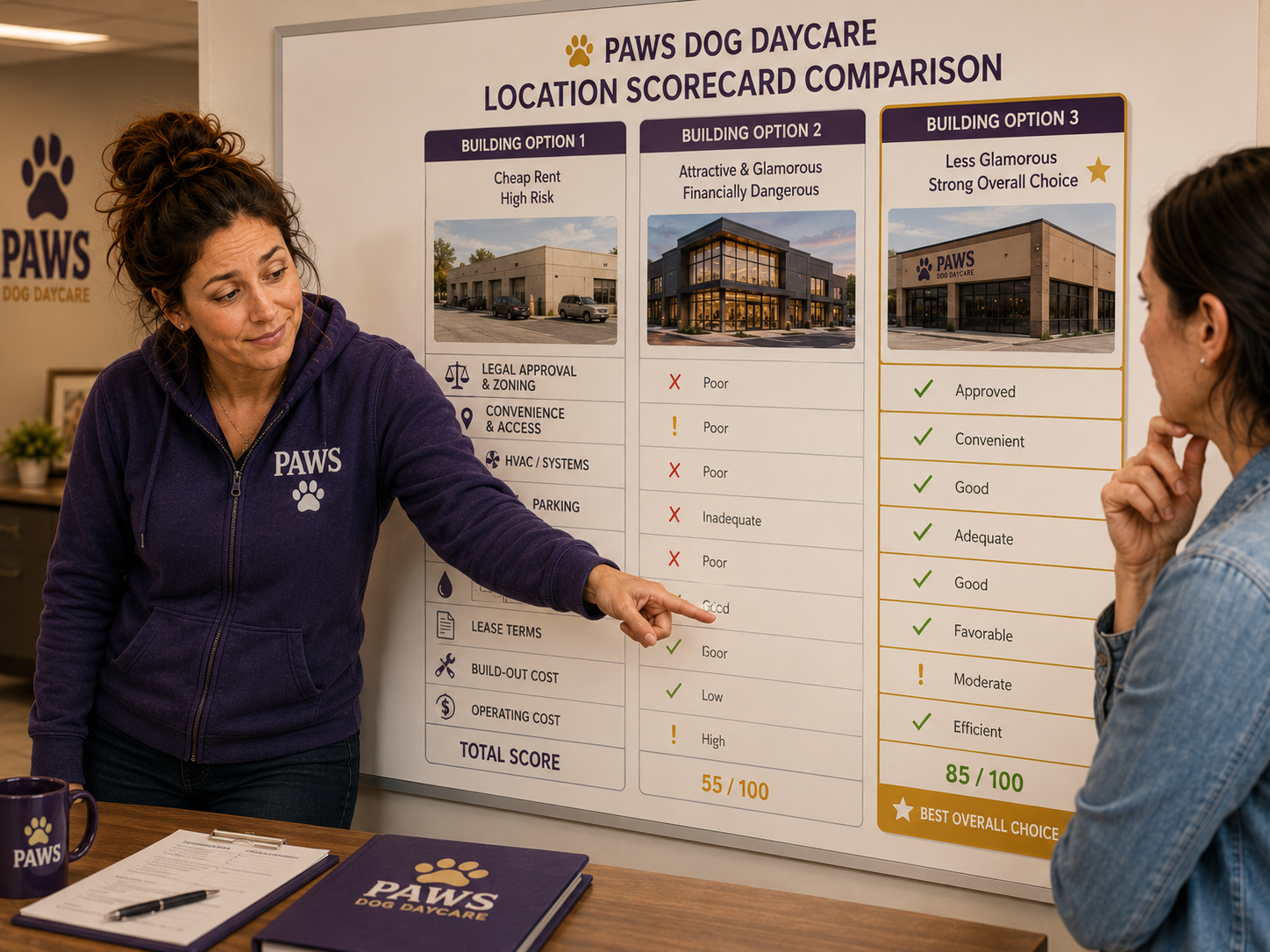
Do not use a scorecard to make the decision for you. Use it to keep yourself honest. A building with cheap rent can still lose if zoning is risky, HVAC is weak, plumbing is expensive, parking is bad, and the customer base has no convenient reason to go there.
The right building is not always the prettiest building. It is the building that gives the business the best chance to operate legally, cleanly, safely, affordably, and conveniently.
🧠
Operator Warnings Before You Sign
This is the part people skip when they want the building badly.
01
Cheap Rent Can Be Expensive
A cheap building with bad HVAC, bad flooring, bad parking, bad plumbing, bad visibility, and bad zoning can become the most expensive option.
02
Do Not Overbuild Too Early
A massive facility can force the business to grow faster than the market will support. Empty space still costs money.
03
Noise Is Not Theoretical
Dogs bark. Dogs play. Staff clean. Customers arrive. If the neighbors are wrong, the building may become a constant fight.
04
Outdoor Space Has Strings
Outdoor areas can sell tours, but they also bring fencing, waste, drainage, heat, supervision, and noise concerns.
05
Build-Out Can Eat Cash
Floors, drains, sinks, HVAC, walls, gates, signage, permits, and repairs can burn through reserves before the business is stable.
06
The Lease Can Trap You
If the use clause, repair clause, renovation clause, or zoning contingency is wrong, you may be stuck with a building that cannot support the business.
🚦
Deal-Killer Red Flags and Green-Light Signs
Some buildings need negotiation. Some buildings need repairs. Some buildings need to be walked away from.
Deal-Killer Red Flags
- Unclear zoning and no written confirmation.
- Daycare allowed, but boarding, outdoor play, or grooming not addressed.
- Landlord will not allow the build-out the business requires.
- Lease has no zoning or approval contingency.
- Weak HVAC in a hot climate or poor ventilation path.
- No realistic plumbing, deep sink, bathing, or drainage path.
- Flooring removal or floor prep is a major unknown.
- Bad parking, unsafe turns, or poor drop-off flow.
- Shared walls with quiet or complaint-prone tenants.
- No usable signage or visibility despite paying for the location.
- Insurance cannot be obtained at required limits or for intended services.
- Rent requires full-volume revenue before the business has time to mature.
Green-Light Signs
- Written zoning confirmation or clear approval path.
- Daycare, grooming, boarding, retail, and outdoor use are separately addressed.
- Location fits the customer’s actual commute or daily routine.
- Parking and drop-off work during real morning and evening traffic.
- HVAC can realistically handle dogs, odor, humidity, and heat.
- Plumbing and drainage can support cleaning and future grooming growth.
- Flooring can be removed, sealed, coated, drained, and maintained.
- Neighbor mix is compatible with dog noise, traffic, and waste handling.
- Lease allows the build-out and protects you if approvals fail.
- Insurance is available and fits lease requirements.
- Rent leaves enough cash for build-out, payroll, marketing, and reserve.
- The building can grow with the business instead of trapping it.
❓
Dog Daycare Location FAQ
Detailed answers to the zoning, lease, traffic, build-out, HVAC, plumbing, neighbor, insurance, capacity, and operating questions that should be answered before a building is allowed to become a business obligation.
What zoning classification is best for a dog daycare?
There is no universal zoning label because every city and county organizes animal-related uses differently. Dog daycare may appear under kennel, boarding kennel, grooming, pet services, animal care, veterinary, pet retail, indoor recreation, commercial recreation, or another local category. The correct answer depends on the exact parcel, the services you plan to offer, whether dogs will stay overnight, and whether outdoor play is included. Do not rely on the zoning of the neighborhood in general. Confirm the exact address and the full service mix with the authority that has jurisdiction over that property.
Is a landlord’s approval enough to operate a dog daycare?
No. A landlord can agree to lease the property, but the landlord cannot grant municipal land-use approval, waive building-code requirements, approve fire occupancy, issue an animal-care license, or guarantee that an insurer will cover the operation. Landlords and commercial agents may sincerely believe the use will be acceptable and still be wrong. Before signing, confirm zoning, building and fire requirements, licensing, outdoor-use rules, insurance feasibility, and the landlord’s written approval for the actual build-out. A key and a signed lease do not make an illegal or uninsurable use legal.
Should daycare, grooming, boarding, retail, bathing, and outdoor play be approved separately?
Yes. Approval for one service does not automatically approve the others. A municipality may allow grooming but treat group dog play as a kennel use, allow daytime care but restrict overnight boarding, or allow indoor animal care while prohibiting outdoor runs near residential property. The lease may also describe permitted use more narrowly than the business plan. List every service you intend to provide now or may realistically add later, then ask for written confirmation of how each one is treated. A partial approval can leave the business with a building that supports only part of the revenue model.
How much zoning confirmation should I have before signing a lease?
You should have more than a casual phone conversation or a verbal “it should be fine.” At minimum, obtain a written staff interpretation, zoning verification, permitted-use confirmation, conditional-use path, special-exception requirement, or formal denial for the exact address and proposed services. If approval requires a hearing, public notice, variance, site plan, engineering review, or neighbor input, understand the cost, timing, and risk before becoming fully obligated. The stronger the financial commitment, the stronger the written record should be. A lease should not become unconditional while the legal use is still a guess.
What is the difference between permitted use, conditional use, special exception, and variance?
A permitted use is generally allowed in the district when the normal requirements are met. A conditional use or special exception may be allowed only after an application, review, hearing, operating conditions, or approval by a board or commission. A variance usually asks for relief from a specific zoning requirement and may be harder to obtain because the applicant often must satisfy a legal hardship standard. The terminology varies by jurisdiction, so do not assume the words mean exactly the same thing everywhere. What matters is knowing which process applies, who decides, how long it takes, what it costs, and whether the lease protects you if approval fails.
What lease protections matter most for a dog daycare location?
The lease should address the full permitted use, zoning and approval contingencies, build-out rights, repair responsibility, noise and nuisance language, insurance requirements, signage, outdoor use, renewal options, assignment rights, and a clean exit if required approvals cannot be obtained. Dog daycare commonly needs flooring work, drains, plumbing, sinks, fencing, gates, HVAC changes, ventilation, cameras, sound control, and signage. Those changes should not depend on a vague promise to discuss them later. Commercial lease language can shift major costs and risks to the tenant, so the document should be reviewed before the property becomes emotionally or financially difficult to walk away from.
Is it usually better to lease or buy a dog daycare building?
Neither choice is automatically better. Leasing may preserve cash for build-out, payroll, insurance, equipment, marketing, and opening reserves, while purchasing may provide long-term control, property appreciation, and protection from losing a successful location. The correct decision depends on financing, available cash, local real estate, zoning certainty, renovation cost, monthly carrying cost, and the operator’s long-term plan. The property decision should not starve the operating business. Owning a building is not an advantage if the company has no working capital left to survive the opening ramp.
How important is customer convenience when choosing a dog daycare location?
Convenience is part of the service, not a minor real-estate detail. Recurring daycare customers must fit drop-off and pickup into work, school, traffic, errands, and family routines. A location that looks close on a map may be inconvenient because of bridges, school zones, left turns, congestion, one-way streets, poor parking, or backtracking. Test the route during real customer hours and from the neighborhoods or employment centers you expect to serve. A building can be attractive, affordable, and legally approved and still underperform because using it every week is too much trouble.
When should I test traffic and parking around a proposed location?
Test the property when customers will actually arrive: early morning drop-off, evening pickup, school traffic, rush hour, and any time nearby businesses are busiest. Drive every approach, make the turns, enter the lot, park, and imagine several customers unloading dogs at once. Check sightlines, lighting, stacking space, pedestrian movement, nervous-dog handling, and whether vehicles can leave safely. A quiet 2:00 p.m. property tour can hide the exact traffic pattern that will frustrate customers five days a week. Repeat use depends on what the route feels like when people are rushed and tired.
Can a dog daycare succeed in an industrial or light-industrial area?
Yes, and those districts may sometimes be more accepting of animal uses, noise, parking demand, and outdoor activity. But industrial zoning does not automatically make the site a good customer location. Evaluate cleanliness, lighting, road condition, neighboring uses, vehicle traffic, personal safety, signage, visibility, and whether customers will feel comfortable leaving their dogs there. Heavy equipment, auto repair, truck traffic, poorly maintained properties, and hidden entrances can weaken perception and convenience. The site still has to work as a customer-facing service business, not merely as a place where zoning allows dogs.
Do I need outdoor play space to operate a dog daycare?
Not always. A well-designed indoor daycare can operate successfully without outdoor play, depending on local rules, building size, staffing, cleaning systems, exercise structure, and customer expectations. Outdoor space can improve tours, rotation, enrichment, cleaning flexibility, and marketing, but it also creates fencing, double-gate, drainage, waste, heat, mud, supervision, escape, and noise problems. Confirm that outdoor use is legally allowed and compatible with the lease and neighboring properties. Outdoor space is valuable only when it can be operated safely and controlled consistently.
What hidden building costs are easiest to underestimate?
HVAC replacement, flooring removal, concrete preparation, floor drains, plumbing, hot-water capacity, electrical upgrades, fencing, gates, sound control, accessibility work, permits, signage, cameras, outdoor drainage, and odor-control improvements are common surprises. Low rent is easy to compare because it appears as one monthly number. Conversion cost is harder to see because it is spread across contractors, permits, repairs, delays, and systems that were never designed for animal care. Price the work before treating the property as a bargain. Cheap rent does not compensate for a building that consumes the opening reserve before the first customer arrives.
How do I know whether the HVAC system is adequate for dog daycare?
Do not judge the system only while the building is empty. Dogs, staff, moisture, hair, dander, cleaning chemicals, bathing, dryers, and repeated door openings change the heat and air-quality load. Have the system evaluated for capacity, condition, filtration, fresh-air exchange, humidity control, return placement, maintenance access, and upgrade potential. Ask what happens when the room contains the number of dogs the business model expects on a hot or humid day. A system that barely maintains comfort during a quiet tour may become an expensive operational failure under real use.
Are floor drains required for a dog daycare?
Not every facility is legally required to have floor drains, and some successful operations use other cleaning systems. However, the absence of drains changes labor, flooring, odor control, wet-vac use, mop handling, and the way dirty water must be managed. Determine whether drains can legally and physically be added, where wastewater is allowed to go, how floors slope, and whether hair and debris create plumbing concerns. A building without drains may still work, but the cleaning plan must be realistic. If water has nowhere efficient to go, staff will pay for that limitation every day.
What should I look for in flooring before leasing a location?
Evaluate what is present, what must be removed, what lies underneath, and whether the final surface can be sealed, cleaned, disinfected, repaired, and maintained under heavy dog and staff traffic. Glued commercial carpet, old tile, damaged concrete, unknown adhesives, cracks, moisture problems, and uneven slabs can create expensive preparation work. Do not choose flooring based only on appearance or softness. The surface has to tolerate urine, water, disinfectant, claws, equipment, repeated cleaning, and long operating hours without becoming porous, slippery, damaged, or permanently odorous.
How serious are neighboring-tenant, barking, and odor risks?
They can be serious enough to damage the lease or restrict the operation. Shared walls with massage studios, counseling offices, medical practices, professional offices, restaurants, apartments, or other quiet uses can turn ordinary dog activity into recurring complaints. Evaluate wall construction, ceilings, vibration paths, outdoor fence lines, trash areas, prevailing airflow, parking overlap, and the direction barking will travel. Also read the lease’s nuisance and default language carefully. The daycare may operate normally inside and still become unacceptable to the people next door.
How much building space do I actually need?
Start with the service mix, safe dog volume, staffing model, and financial capacity rather than an arbitrary square-foot target. Gross building area is not usable dog space. Lobby, office, grooming, bathing, boarding, isolation, storage, laundry, utilities, staff areas, hallways, gates, and circulation all reduce the area available for supervised play. A smaller efficient layout may outperform a larger building filled with dead space and higher rent. Calculate the practical operating footprint after every required function has a place.
How should I compare two or more possible dog daycare locations?
Use the same written scorecard for every property and score zoning certainty, rent burden, traffic, parking, HVAC, plumbing, flooring, outdoor use, neighbor risk, build-out cost, lease terms, insurance, usable dog space, signage, and expansion potential. Do not allow one exciting feature to erase several serious weaknesses. A glamorous building with expensive systems and poor access may be worse than a plain building with strong approvals, workable utilities, safe parking, and reasonable conversion cost. The score does not make the decision for you; it exposes where emotion may be hiding risk.
When should I speak with an insurance agent about the location?
Before the lease becomes fully binding. Give the agent the exact address, services, expected dog volume, outdoor-play plan, boarding and grooming details, transportation plans, landlord coverage requirements, and any unusual property conditions. Confirm that the intended operation can be covered and that required limits, additional-insured language, property coverage, and exclusions are workable. A building can pass zoning and still fail the business if insurance is unavailable, unaffordable, or excludes a major part of the service model. Insurance feasibility belongs in the approval chain, not at the end of it.
What is the clearest sign that I should walk away from a building?
Walk away when the use is unclear, approvals are weak, the lease offers no protection, the landlord will not allow required work, insurance is uncertain, or the conversion cost threatens the company’s survival. Also pay attention when several smaller weaknesses stack together: difficult traffic, weak HVAC, poor drainage, expensive flooring, bad neighbors, limited signage, and rent that assumes immediate full capacity. A property does not need one dramatic defect to be wrong. Sometimes the correct decision is recognizing that the building is asking the business to solve too many expensive problems at once.
🧭
Where to Go Next
Location connects directly to cost, demographics, pricing, build-out, and daily operations.
💰
Dog Daycare Start-Up Costs
Study the cost categories before you commit to a building that creates more expenses than the business can handle.
👥
Dog Daycare Demographics
Make sure the customer base is actually there before relying on optimistic location assumptions.
🏗️
Dog Daycare Interior
Layout, flooring, gates, group separation, cleaning, and customer flow all affect the building decision.
📊
Opening Cash Flow Analysis
Make sure the building’s rent and build-out costs do not starve the business before it stabilizes.
🧠
The Building Has to Earn the Lease
Do not let excitement make the decision for you.
The building has to earn the lease. It has to make sense legally, financially, physically, and operationally. It has to support the services you intend to offer. It has to be convenient enough for customers to use. It has to be cleanable enough for staff to maintain. It has to be safe enough for dogs to move through. It has to be affordable enough for the business to survive while the client base is still growing.
A building can look good and still be wrong. A building can be cheap and still be expensive. A building can be large and still be inefficient. A building can be legally possible and still be operationally miserable.
This is why you slow down. You do not choose a dog daycare location because it feels exciting during the first tour. You choose it because, after zoning, traffic, lease terms, build-out, utilities, cleaning, safety, workflow, noise, and cost are all examined, the building still makes sense.