Pre-Opening Marketing, Local Search, Reviews, Advertising, Community Networking, and Growth
Dog Daycare Marketing and Advertising: Get Customers Before Costs Eat You Alive
Marketing is how strangers become leads, leads become customers, customers become regulars, and regulars become reputation.
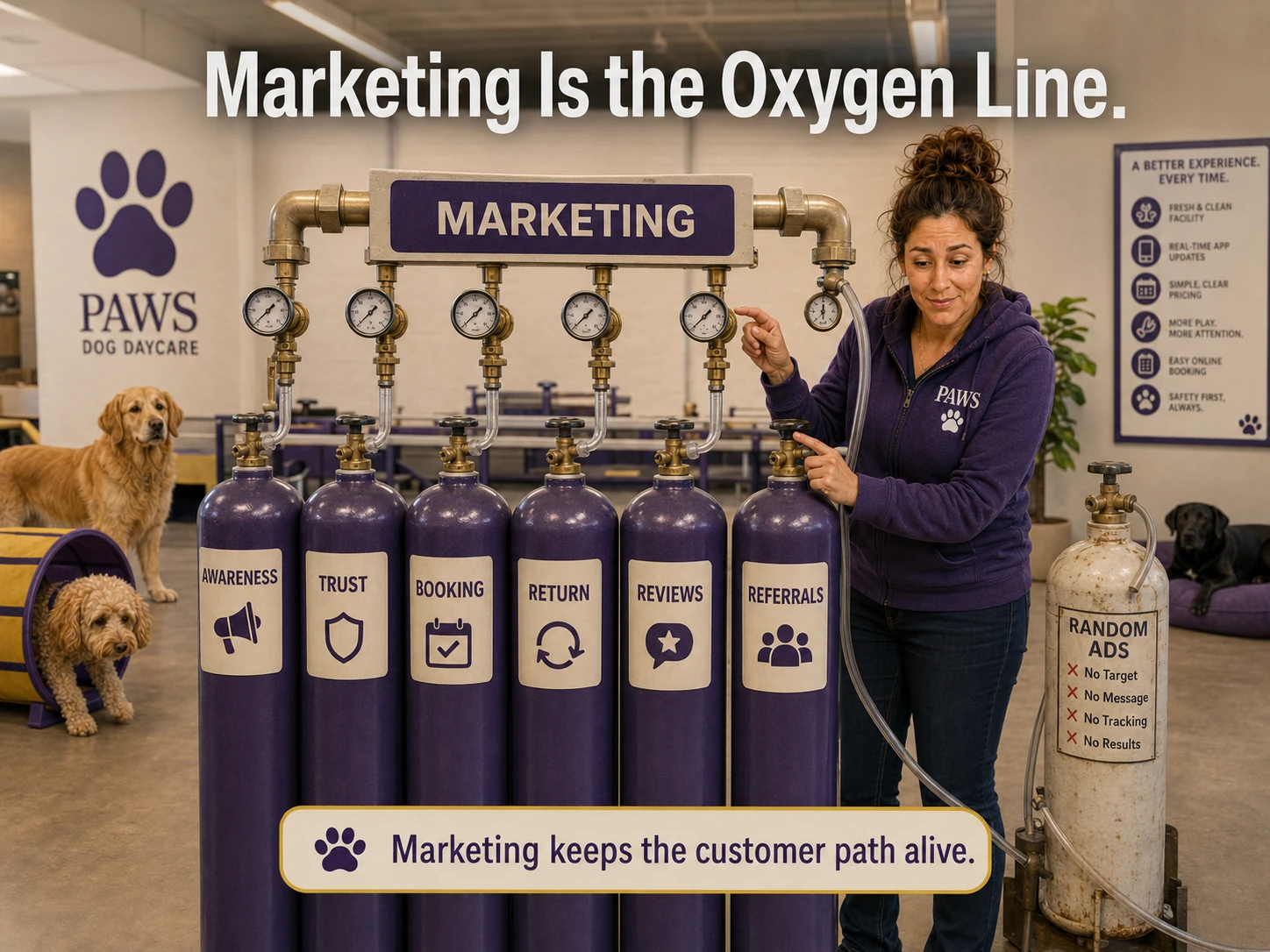
You can build the largest, cleanest, most beautiful dog daycare in your county. You can have webcams, heated floors, fancy play equipment, premium grooming, boarding suites, great signage, and a lobby that looks like a golden retriever got accepted into business school. But if customers do not know you exist, trust you, find you, understand you, and book with you, the building just becomes an expensive barking museum.
Marketing is not decoration. Marketing is oxygen. It is how the business starts building awareness before opening, creates momentum during launch, and keeps growing after the shiny newness wears off.
A dog daycare does not need random advertising. It needs a local trust machine: people find you, believe you, book you, review you, return, and tell someone else. Everything else is just noise with an invoice.
This page is the marketing and advertising hub. Use it to understand the main moving parts, then jump into the detailed advertising pages that match where you are in the business: pre-opening, launch, operating, post-opening growth, signage, website marketing, vet networking, rescue/community outreach, traditional media, and ineffective advertising.
⚠️
Operator warning: marketing starts before opening.
If your marketing starts when the doors open, you are already late. Rent has already started. Payroll is stretching. Utilities are running. Insurance is billing. The landlord is not giving you a “still building awareness” discount. Pre-opening marketing matters because you need a warm audience before the first official daycare day.
🫁
Marketing Is Oxygen, Not Decoration
Advertising is not just “getting your name out there.” That phrase is where lazy marketing goes to nap.
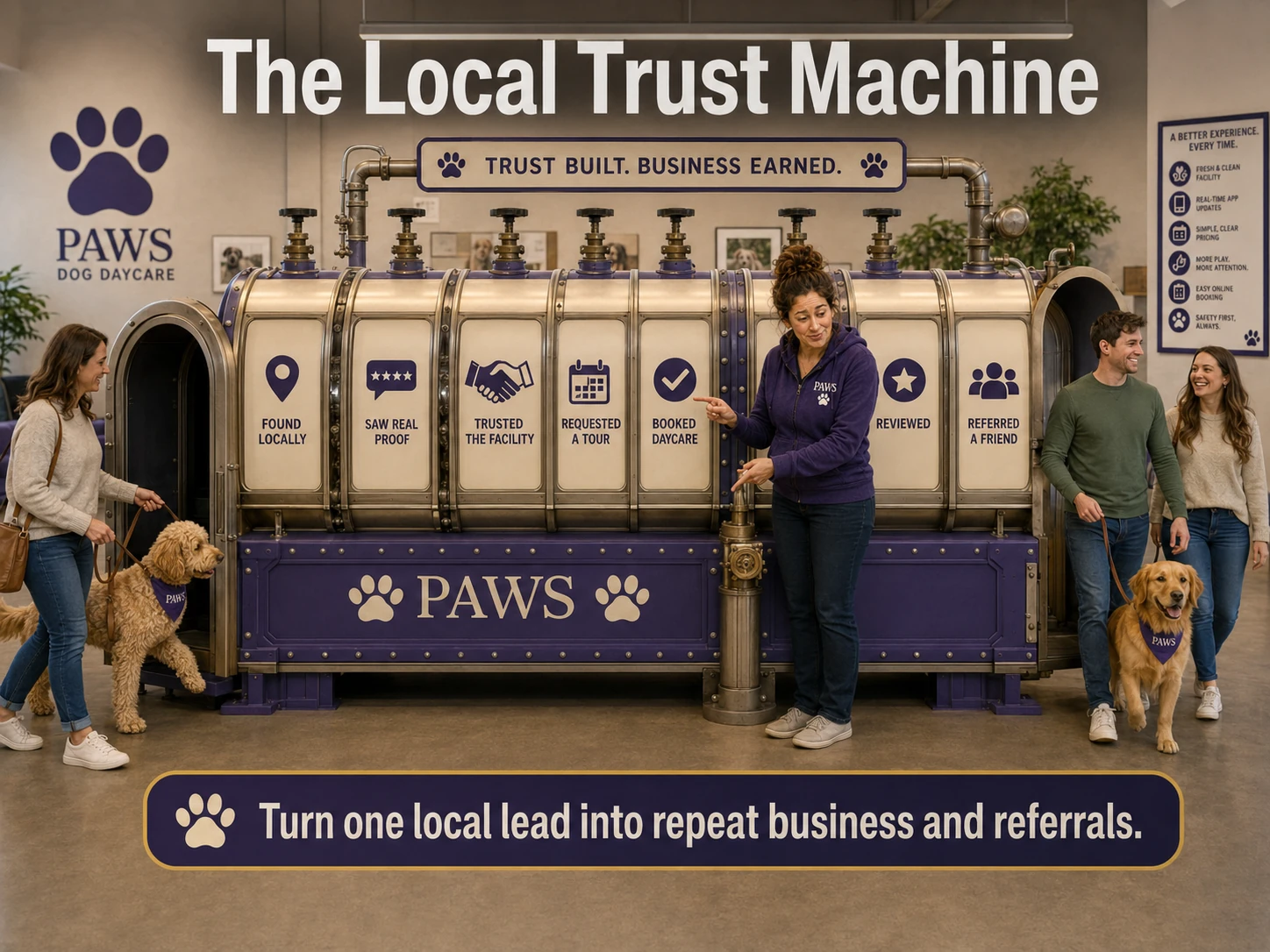
The purpose of marketing is not to make the business look busy. The purpose is to move local dog owners through a path: they become aware of you, understand what you offer, trust the facility, take the next step, bring the dog in, return, review, refer, and hopefully become part of the normal rhythm of your business.
That is why random advertising is so dangerous. A newspaper ad, radio spot, boosted post, flyer, event booth, or Google ad can all have a place. But if they do not connect to a clear offer, real proof, strong website, easy contact path, and follow-up system, they can become little money bonfires with your logo on them.
Dog daycare is local. That matters. You are not trying to reach everyone. You are trying to reach the right people within the real service area who own dogs, have the income, need the service, trust professional pet care, and can reasonably get to your facility.
If you market like a random business shouting into the void, you waste money. If you market like a local trust machine, the pieces start working together.
📌
The core marketing rule
Marketing should not just create attention. It should create useful attention from the right local people, then move those people toward a tour, booking request, phone call, form submission, review, referral, or repeat visit.
📚
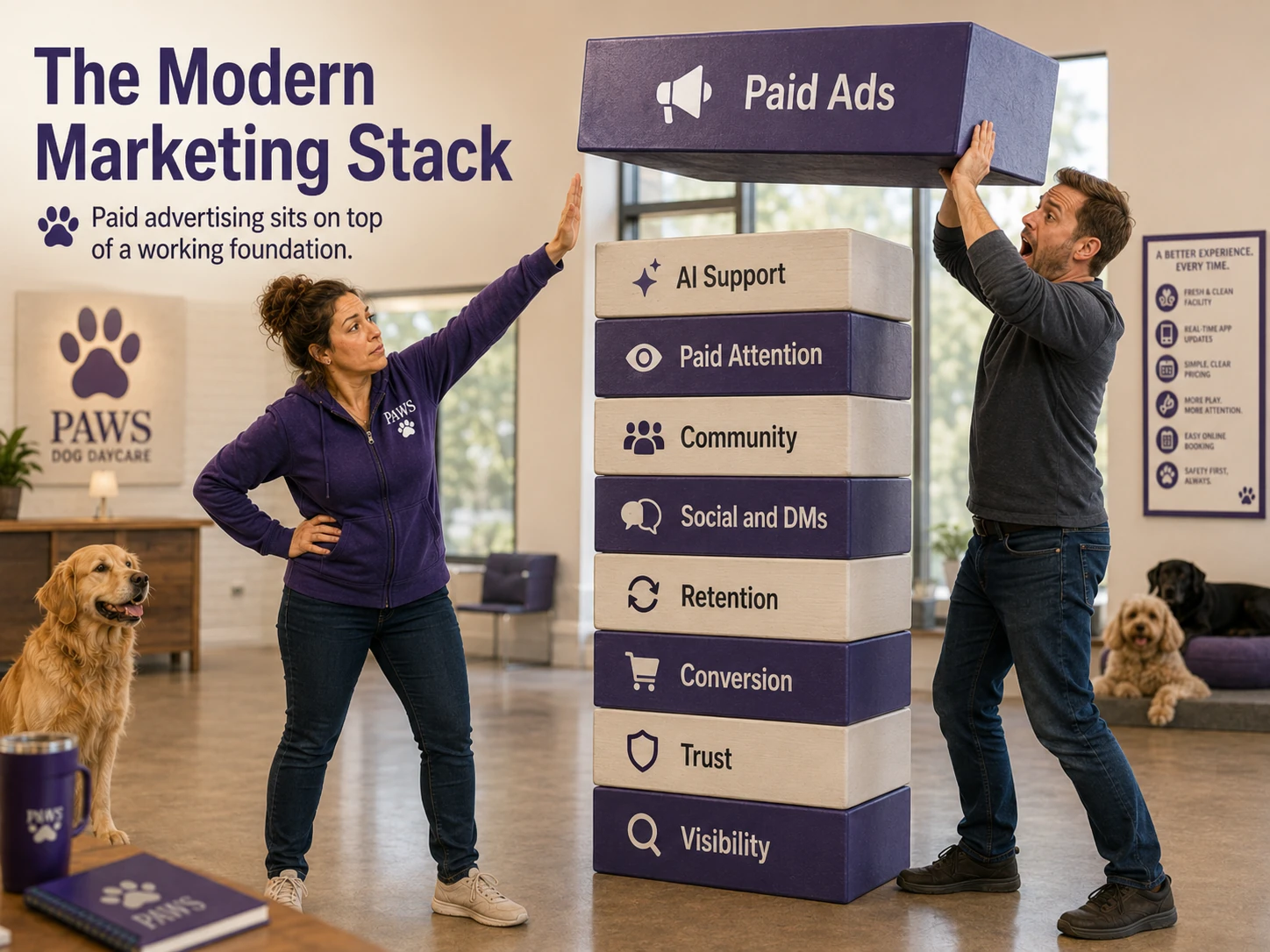
The Modern Dog Daycare Marketing Stack
The common mistake is treating every advertising medium like it deserves equal weight. It does not. Build the stack first.
👀
Visibility
Google Business Profile, local SEO, website pages, signage, maps, directories, citations, social profiles, and street visibility.
🤝
Trust
Reviews, real facility photos, staff bios, safety content, policies, testimonials, clean branding, social proof, and professional presentation.
📞
Conversion
Clear service pages, pricing guidance, new customer steps, booking requests, phone, text, chat, tour scheduling, and follow-up.
🔁
Retention
Email, SMS, reminders, package renewals, membership offers, reactivation, loyalty, review requests, referral campaigns, and service updates.
📱
Social and DM Engine
Organic posts, paid ads, reels, short videos, comments, DMs, Messenger, WhatsApp, local groups, retargeting, and customer proof.
🏘️
Community
Veterinarians, groomers, trainers, rescues, pet stores, apartment complexes, local events, shelters, neighborhood groups, and business partners.
💵
Paid Attention
Google ads, Meta ads, print, radio, TV, direct mail, sponsorships, and events — only after you know what the ad is supposed to do.
🤖
AI Support Layer
AI can draft ads, organize content ideas, summarize leads, suggest follow-up, analyze reviews, and speed up marketing work — but it should not run loose in the kennel.
🗺️
Use This Page Like a Marketing Map
Pick the path that matches your current stage. Do not start with random ads just because someone sold you a “great package.” Great for whom? Them or you?
🚧
Pre-Opening Marketing
Build local awareness, a waitlist, tour interest, website visibility, and community trust before the rent clock starts chewing.
🎉
Launch and Opening Advertising
Grand opening, tours, trial days, local paid ads, flyers, referral cards, community events, and first customer proof.
📈
Post-Opening Growth
Reviews, referrals, reactivation, package renewal, service updates, local SEO, social proof, and repeat-customer systems.
📍
Google and Local Search
Reviews, referrals, reactivation, package renewal, service updates, local SEO, social proof, and repeat-customer systems.
🌐
Website and Service Pages
The website should explain, prove, convert, and route customers toward daycare, boarding, grooming, training, and tours.
🌐
Reviews and Reputation
Reviews are trust currency. Do not wait until someone angry writes a novel before you decide reputation matters.
📱
Social Media Advertising, DMs, and Photo Proof
Facebook, Instagram, TikTok, YouTube Shorts, X, Nextdoor, DMs, comments, retargeting, and real dog content can create attention when they point toward booking.
🤖
AI Marketing and Advertising
AI can help with ad ideas, content calendars, follow-up messages, review themes, lead routing, and campaign testing — if a human keeps it on a leash.
🪧
Signage and Street Visibility
If your sign cannot be read by a normal human driving past at normal speed, congratulations, you bought wall art.
🏥
Vet and Community Networking
Veterinarians, groomers, trainers, rescues, pet stores, apartments, shelters, and local partners can help build credibility.
🐾
Rescue and Event Marketing
Rescue events, adoption days, vaccine clinics, photo events, and local partnerships can build visibility if managed safely.
📻
Paid Ads and Traditional Media
Newspaper, radio, TV, directories, direct mail, and local sponsorships may still have a place, but they need a reason to exist.
🚫
Ineffective Advertising Mistakes
Bad marketing is not just waste. It can delay growth while the business bleeds money and the owner blames “the market.”
🚧
Pre-Opening Marketing: Build the Runway Before the Plane Moves
Pre-opening marketing is not bragging before you open. It is building a customer runway so the plane does not take off into a cornfield.
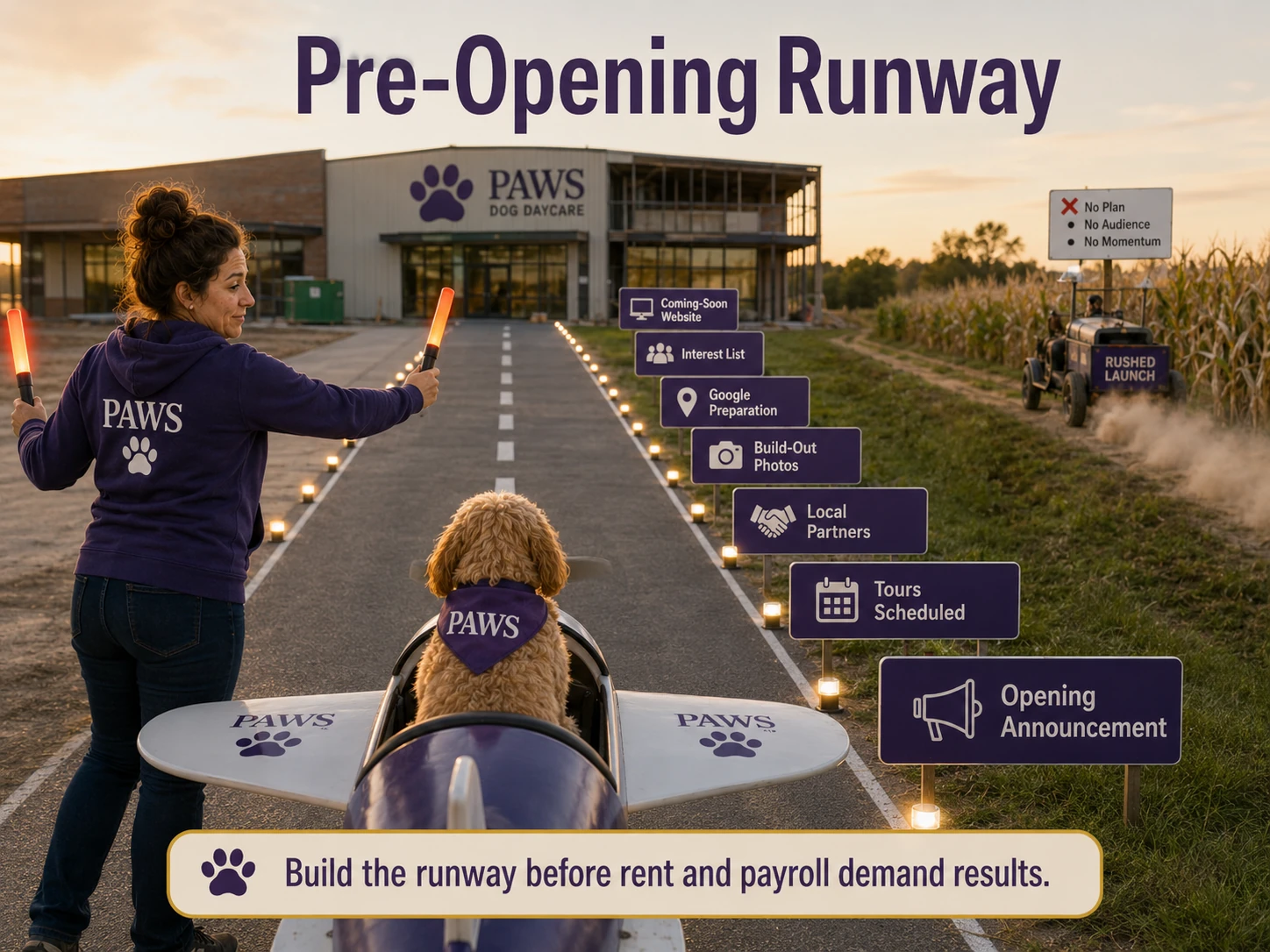
Do not wait until opening day to begin convincing the local market you exist. The business should already be visible before the doors open. The website should exist. The coming-soon page should collect interest. The Google presence should be prepared when eligible. Local pet people should have heard the name. Neighborhood groups should have seen updates. The first tours should not depend on somebody accidentally driving past and wondering if the paw-print banner means daycare, grooming, or a cult for Labradors.
Pre-opening marketing gives you something priceless: early signals. Are people interested? Are they asking about daycare, boarding, grooming, training, pricing, hours, vaccinations, temperament testing, or tours? Those questions help shape the opening plan.
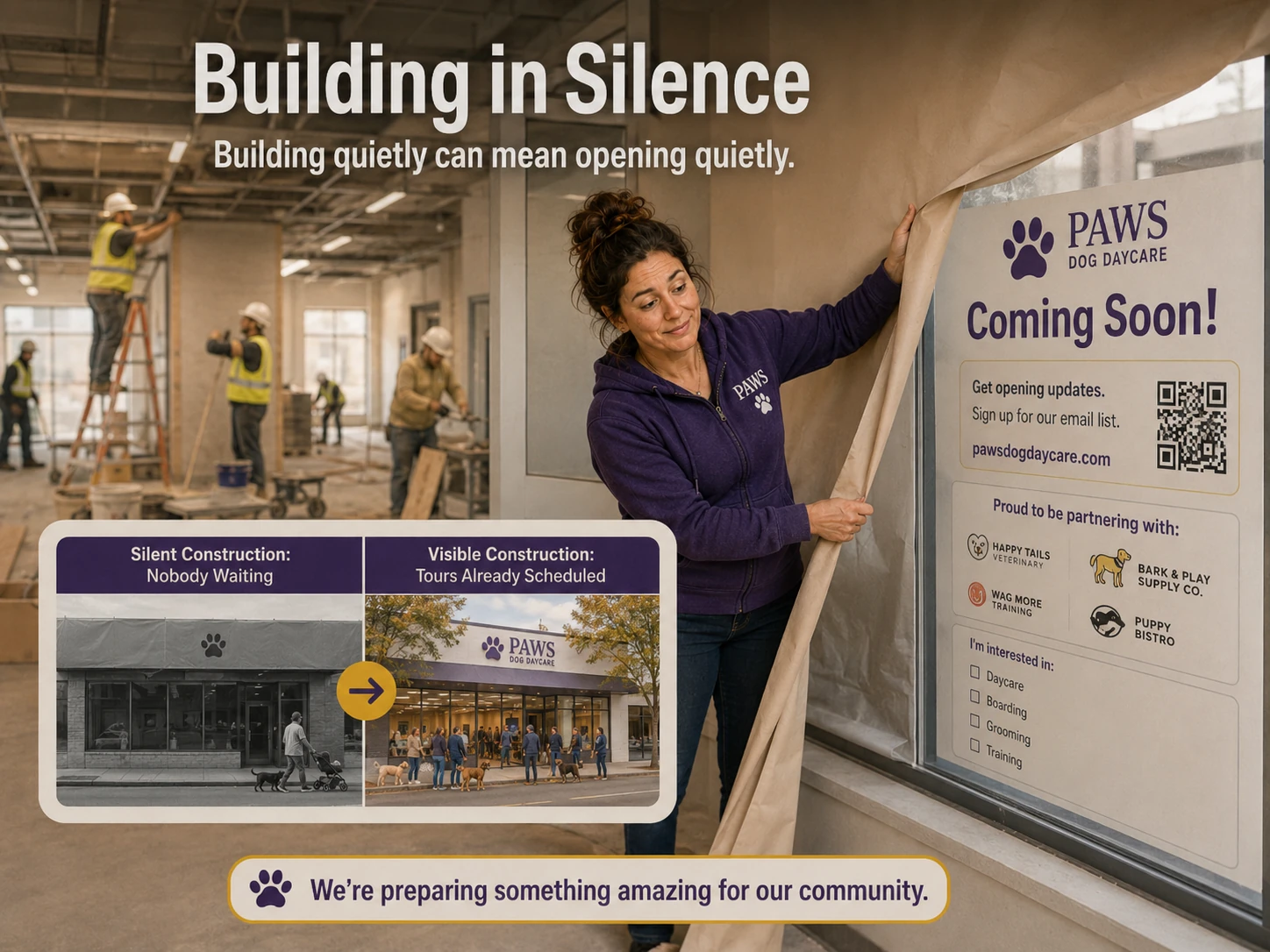
If you build in silence, you open into silence. Silence is not peaceful when rent is due.
- Create a coming-soon page with service area, planned services, opening timeline, and interest form.
- Build an email or SMS interest list for tours, updates, and opening announcements.
- Prepare Google Business Profile information when eligible and keep business information accurate.
- Post facility build-out updates with real photos instead of stock puppies grinning like they just refinanced a mortgage.
- Start local outreach to vets, groomers, trainers, rescues, apartment managers, pet stores, and community groups.
- Use signage, banners, or window graphics if allowed by the lease and local rules.
- Prepare the opening offer, but do not discount so hard you train customers to wait for desperation.
🎉
Launch and Opening Advertising: The First 90 Days Matter
The first 90 days are not the time to sit quietly and hope dog owners develop psychic powers.
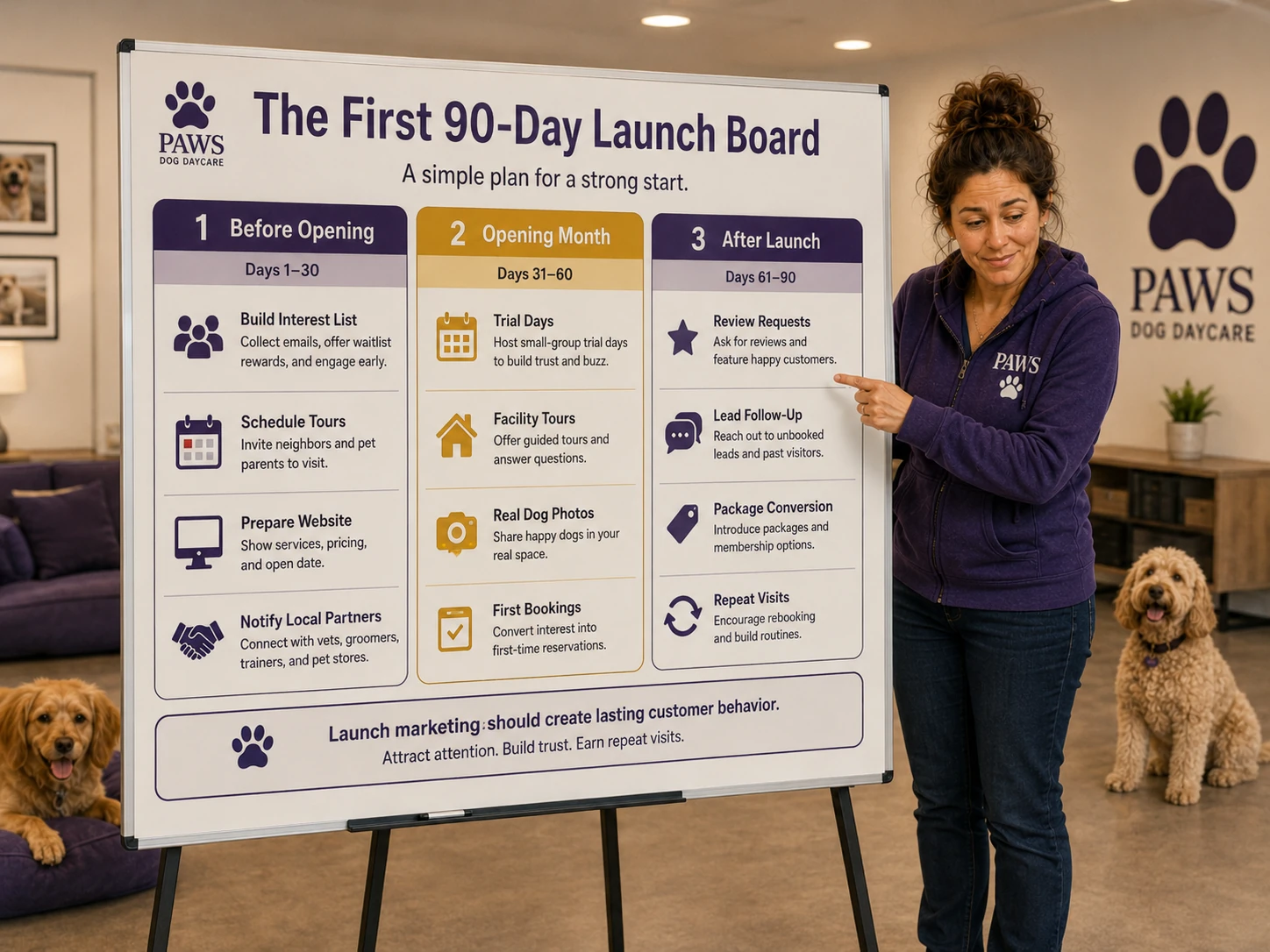
Opening is not just “unlock the door and wait.” The launch window is when the market is most curious, the story is newest, and the business has a chance to build early momentum. Use that window.
The opening period should create tours, trial days, first bookings, first reviews, first happy dog photos, first local partnerships, and first repeat customers. If the launch only creates one-time curiosity, the business still has to start over when the novelty wears off.
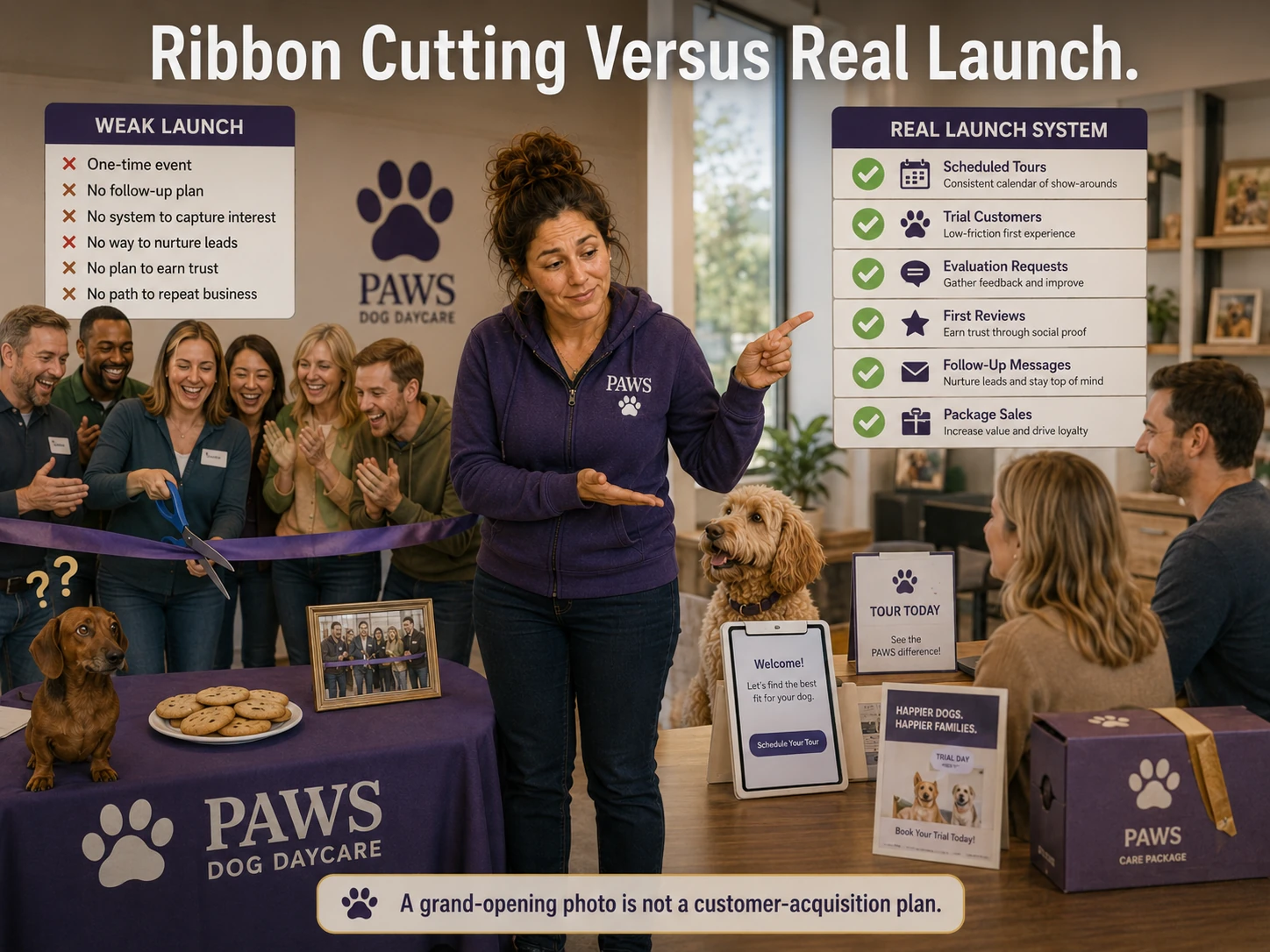
Grand opening events can help, but they are not magic. A ribbon cutting with six people, a tray of cookies, and one confused dachshund is not a marketing strategy. It is a photo opportunity. The real strategy is what happens before, during, and after the event.
📣
Before Launch
Build the list, schedule tours, prepare service pages, create local ads, notify partners, and make sure the booking/contact_us.htm path actually works.
🐕
During Launch
Run tours, trial days, opening offers, local posts, community outreach, first photo proof, staff introductions, and customer education.
🔁
After Launch
Follow up with leads, request honest reviews, convert trial customers, build packages, and keep the facility from becoming yesterday’s news.
📈
Post-Opening Growth: Marketing After the Newness Wears Off
This is where a lot of owners get lazy, which is adorable if rent is also willing to get lazy. It is not.
Once the grand opening buzz fades, marketing becomes a system. You need reviews, referrals, reactivation, retention, service announcements, package renewals, customer stories, Google updates, website improvements, and reasons for people to remember you exist.
Most facilities do not need a new marketing miracle every week. They need consistent follow-up. Did the customer book a second visit? Did the grooming client know daycare exists? Did the boarding customer know exit baths are available? Did happy customers get an easy review link? Did lapsed customers get a friendly “we have not seen Max in a while” reminder? Did the website answer the questions people actually ask?
Growth is not always louder advertising. Sometimes growth is plugging the quiet leaks.
- Request reviews after positive customer experiences without bribing or pressuring customers.
- Create a referral process that staff can explain in ten seconds.
- Use email/SMS reminders for package renewals, grooming, boarding, daycare attendance, and reactivation.
- Update Google Business Profile and the website with real facility photos and useful service information.
- Promote seasonal offers, enrichment, grooming, boarding, training, and events when they fit the customer.
- Track lead source, tour requests, conversion, repeat visits, and customer lifetime value.
📍
Google Business Profile and Local Search
Your Google listing is not a cute online business card. It is the front door for people who have never met you.
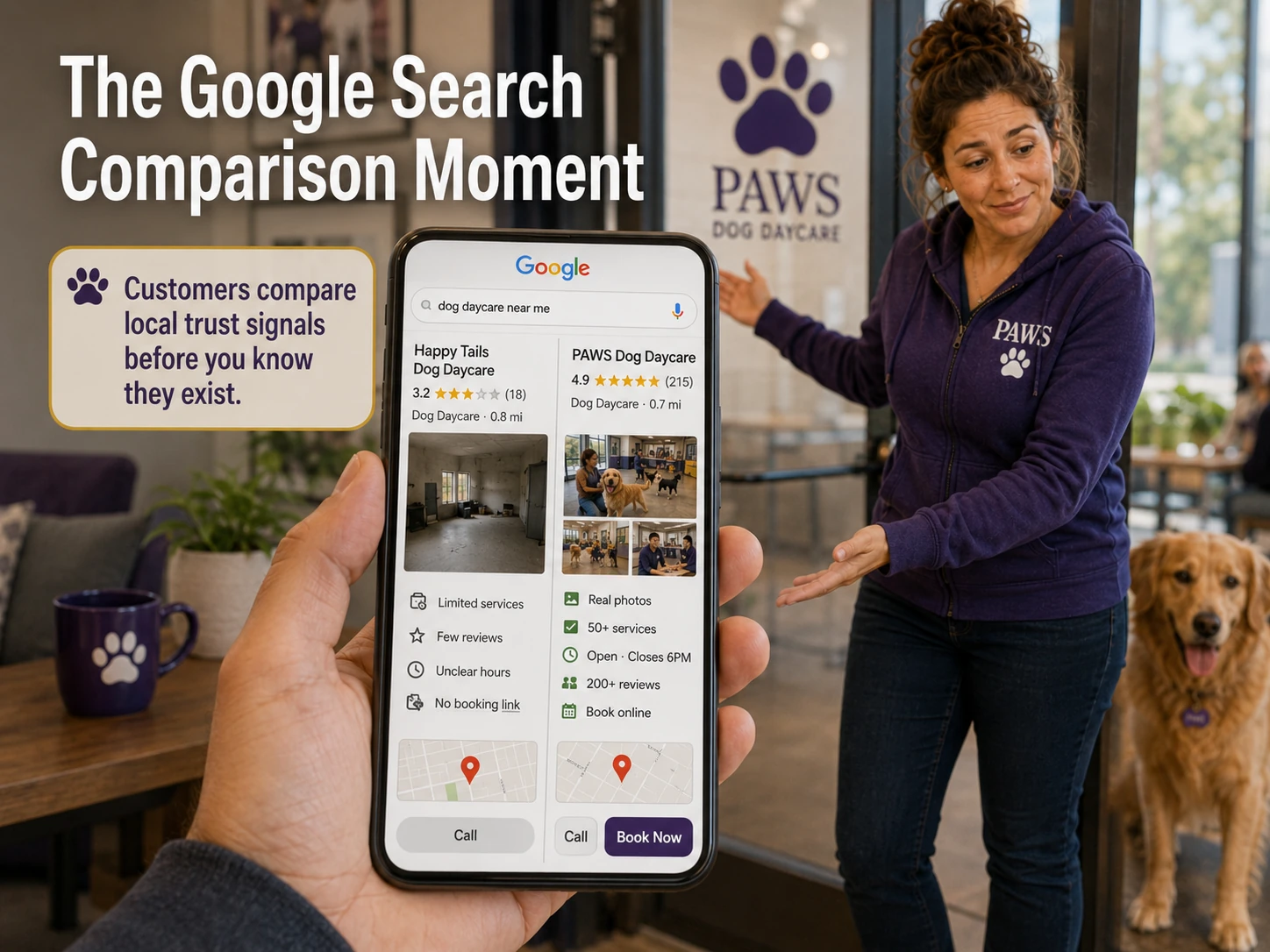
For many local dog daycare customers, the decision starts with search. They type something like “dog daycare near me,” “dog boarding near me,” “dog grooming near me,” or “puppy daycare near me,” and then they compare what appears. If your competitor has strong photos, clean service information, better reviews, and an easier path to contact, guess where the customer goes?
A complete and accurate Google Business Profile helps customers understand what you do, where you are, and when they can visit. Google’s local search system considers relevance, distance, and prominence, so your business information, reviews, visibility, and online reputation matter.
Your profile should be treated like a living asset, not something you claimed once and abandoned like a treadmill in February.
📌
Profile Basics
Correct name, address, phone, hours, categories, services, website, appointment/contact_us.htm links, and business description.
📷
Photo Proof
Real photos of the facility, staff, playrooms, grooming area, boarding spaces, entry, signage, and happy dogs when allowed.
⭐
Review System
Ask real customers for honest reviews, respond professionally, and never try to buy fake love from the internet.
⚠️
Review warning
Do not pay for reviews, discount for reviews, pressure customers for reviews, or create fake review activity. Build a clean review process. Fake reputation is like cheap flooring: sooner or later, the smell comes through.
🌐
Website and Service Pages: Stop Saying “We Love Dogs” and Start Selling Trust
Everyone loves dogs. That is the admission ticket. It is not a marketing plan.
A dog daycare website should not be a digital brochure lying face-down in a ditch. It should explain the service, show the facility, answer common questions, reduce fear, build trust, and move the customer toward the next step.
The website needs real service pages: daycare, boarding, grooming, training, pricing, new customer process, vaccination requirements, temperament testing, photos, staff, safety, FAQs, booking/contact_us.htm forms, and location information. Each page should answer what the customer is silently asking: “Can I trust you with my dog?”
A website that just says “we love dogs” is not marketing. Tell customers why your building is safer, cleaner, smarter, better supervised, more professional, and worth the drive.
| Website Page / Feature | Why It Matters | Operator Warning |
|---|---|---|
| Dog Daycare Page | Explains group play, temperament testing, schedule, safety, pricing guidance, and customer process. | If the daycare page is vague, customers assume the operation is vague too. |
| Boarding Page | Shows where dogs sleep, how feeding/meds work, pickup/drop-off rules, and safety expectations. | Boarding customers are anxious. Do not make them hunt for basic trust signals. |
| Grooming Page | Explains services, pricing ranges, scheduling, add-ons, and what makes the groomer/facility trustworthy. | “We groom dogs” is not enough. Every shop says that. |
| New Customer Page | Reduces friction by explaining vaccines, forms, temperament test, first day, and how to book. | Confused customers delay booking. Delayed booking is money wandering off. |
| Real Facility Photos | Builds trust because people want to see where the dog is going. | Stock photos are fine as filler, but they should not be the whole personality. |
| Booking / Contact Path | Turns interest into action through forms, phone, text, chat, tour request, or portal. | If the customer has to solve a puzzle to contact you, they may contact someone else. |
⭐
Reviews and Reputation: Trust Currency for Local Dog Businesses
Do not wait until an angry customer writes a novel online before you decide reviews matter.
Reviews are not optional anymore. They are part of how customers compare local dog businesses before they ever call. A strong review profile can help reduce fear, prove the facility is active, and show that real people trust you with their dogs.
The correct review strategy is simple: deliver a good service, ask real customers for honest reviews, make the review link easy to use, respond professionally, and use strong review excerpts on the website when appropriate.
The wrong strategy is buying reviews, offering discounts for reviews, asking staff or friends to fake it, review-gating, or acting like a desperate raccoon trying to collect stars from strangers.
✅
Good Review Practice
Ask satisfied real customers for honest feedback after a good experience, then make the link easy.
🚫
Do Not Get Cute
No fake reviews, paid reviews, discount-for-review schemes, staff reviews, or “only leave one if it is five stars” nonsense.
💬
Respond Like an Adult
Thank good reviewers. Address bad reviews professionally. Do not start a public cage fight with a customer.
📌
Review rule
Your review process should be clean enough that you would not be embarrassed explaining it to Google, a customer, or a judge. That is a surprisingly useful standard in business.
🤖
AI in Dog Daycare Marketing and Advertising
AI can help your marketing move faster, but it should not be allowed to drive the van, answer medical questions, invent prices, or become Skynet with a booking link.
AI now belongs in the marketing conversation because it is already showing up everywhere: ad platforms, search campaigns, content tools, chat systems, email systems, review analysis, customer messaging, image tools, video tools, and website workflows.
Used correctly, AI can help a dog daycare owner move faster. It can draft ad variations, suggest content ideas, turn FAQs into posts, build a social calendar, summarize customer questions, analyze review themes, write first drafts of emails, create follow-up scripts, brainstorm event names, tighten service-page copy, and help staff respond to common questions without sounding like they were raised by a printer.
Used badly, AI can make you sound generic, make promises your facility cannot keep, hallucinate policies, invent pricing, mishandle complaints, give unsafe advice, disclose customer information, or answer a serious dog-health question like it is guessing on a game show.
The correct way to use AI is as a helper, not as the owner. AI can draft. AI can sort. AI can suggest. AI can summarize. AI can remind. AI can help create the first ugly version so the human does not stare at a blank screen like it owes them money. But the human still approves the message, the offer, the policy, the price, and anything involving safety, medical issues, complaints, refunds, dog injuries, or customer trust.
| AI Use | Good Use | Bad Use |
|---|---|---|
| Ad Copy | Draft multiple versions for daycare tours, grooming openings, boarding reminders, events, and local offers. | Publishing generic robot fluff that sounds like every other business with paws in the logo. |
| Content Calendar | Plan posts around birthdays, holidays, grooming, safety tips, puppy season, boarding holidays, events, and customer questions. | Letting AI invent posts that do not match the actual facility, staff, services, photos, or voice. |
| DM / Chat Drafts | Draft answers for hours, vaccine rules, tour steps, temperament testing, pricing guidance, and booking links. | Letting AI handle angry customers, injured dogs, medical questions, refund fights, or serious complaints without a human. |
| Review Analysis | Summarize common review themes: staff friendliness, cleanliness, trust, communication, grooming quality, booking issues, or pricing concerns. | Generating fake reviews, fake testimonials, fake customer quotes, or anything that smells like fraud in a costume. |
| Email / SMS Follow-Up | Draft reminders for tours, reactivation, package renewals, grooming openings, boarding deposits, vaccine updates, and review requests. | Sending messages without consent, opt-out rules, accurate customer data, or human review. |
| Ad Platform AI | Use platform tools for bidding, targeting, creative testing, and campaign optimization while still tracking real business outcomes. | Letting the platform spend money because the dashboard says things are “optimized” while the lobby is still quiet. |
🧠
AI for Ideas
Use it for content themes, ad angles, FAQs, blog outlines, event ideas, captions, scripts, and campaign variations.
⚙️
AI for Workflow
Use it to summarize leads, draft follow-up, organize review themes, sort common questions, and keep marketing from living in one tired person’s head.
🧯
AI Needs Guardrails
No medical advice, no made-up policies, no invented prices, no fake reviews, no privacy leaks, and no robot handling grenades because it learned how to say “I understand your concern.”
⚠️
AI warning
AI can help you market faster. It should not independently approve dogs, diagnose illness, promise boarding space, waive fees, override policy, answer injury complaints, respond to death or medical incidents, or publish claims you cannot support. The robot gets a leash too.
🔗
Future deep-dive page
This hub should point into a dedicated AI marketing page covering AI ad workflows, social calendars, lead follow-up, chat guardrails, review analysis, content drafts, privacy rules, and what humans must still approve before the robot starts acting like it owns the place.
🪧
Signage and Street Visibility
If your sign cannot be read by a normal human driving past at normal speed, congratulations, you bought wall art.
Signage is still real marketing. A local dog daycare needs to be found, remembered, and understood. The sign should tell people who you are, what you do, and where to go without requiring them to slow down, squint, and emotionally invest in your font choice.
Good signage can include the building sign, window graphics, coming-soon banner, directional signs, parking signs, drop-off signs, vehicle decals, event signs, and clear service language. A sign that only looks good when you are standing six feet away is not doing the job from the road.
And yes, QR codes can be useful, but only where they make sense. Do not put a tiny QR code on a roadside sign and expect drivers to scan it like they are piloting a drone with their forehead.
🏥
Vet and Community Networking
Networking is not walking into a vet office with flyers and a smile so fake it needs rabies tags.
Veterinarians can be valuable relationships, but they are not referral vending machines. Most good vets are protective of their clients. They do not want to send dogs to a facility that feels unsafe, sloppy, pushy, or poorly operated.
The goal is not to “get vets to send you customers.” The goal is to become a facility that good local pet professionals are comfortable knowing exists. That means professional introduction materials, clear vaccine policies, emergency vet relationships, staff-to-staff courtesy, facility tours when appropriate, and no pushy nonsense.
Community networking is broader than vets. Groomers, trainers, rescues, shelters, pet stores, dog walkers, poop-scoop companies, apartments, neighborhood groups, and local events can all become part of the awareness machine if you treat the relationships properly.
📄
Professional Packet
Service overview, vaccine requirements, safety standards, contact info, referral cards, and clear explanation of who you serve.
🤝
Real Relationship
Be useful, respectful, consistent, and trustworthy. Do not make every conversation feel like a sales ambush.
🚫
No Flyer Dumping
Dropping off a stack of flyers and vanishing is not networking. That is littering with branding.
🐾
Rescue and Event Marketing
Community events can build trust and visibility, but they still need rules because dogs, strangers, leashes, and liability love chaos.
Rescue partnerships and pet events can create goodwill, local visibility, social content, and future customers. Adoption events, rescue sponsorships, vaccine clinics, microchip days, pet safety events, puppy socials, holiday photo days, local vendor days, and fundraisers can all help the facility become part of the pet community.
But events are not free magic. Outside dogs, unknown behavior, disease risk, crowd control, insurance, sanitation, parking, waivers, vendor rules, and staff coverage all matter.
Rescue events are great until twelve strangers, six unknown dogs, two crying kids, and one leash-reactive shepherd turn your lobby into a rodeo. Plan the space.
- Use written agreements with rescues, vendors, clinics, photographers, or event partners.
- Separate outside event dogs from active daycare dogs when needed.
- Control entry, exits, parking, lobby flow, staff assignments, and cleanup.
- Clarify who handles payment, complaints, records, liability, setup, and cleanup.
- Use events to create goodwill, leads, content, and community trust — not just a busy Saturday.
📻
Traditional Media: Newspaper, Radio, TV, Directories, and Direct Mail
Some traditional advertising can still work. Some of it is where old ad budgets go to die quietly in a drawer.
The marketing world changed, but that does not mean every older advertising method is worthless. It means the purpose changed. Newspaper, radio, TV, directories, and direct mail should not be treated like automatic first moves. They should be evaluated by market, budget, message, tracking, timing, offer, and whether they connect to a real conversion path.
A local community paper may help if the audience is right. Direct mail can work if the geography and offer are tight. Radio can create awareness if the message is memorable and the budget is not fantasy money. Local TV can be useful for awareness or events, but it is rarely the first move for a small startup unless the cost is unusually reasonable or the angle is strong.
Yellow Pages used to be where customers went to find you. Now directories are mostly about citation consistency, local listings, Google, Apple Maps, Bing Places, Yelp, chamber listings, and making sure the business is not invisible or wrong across the internet.
| Older Medium | Modern Reframe | Use It When | Do Not Use It When |
|---|---|---|---|
| Newspaper | Local print, community papers, event guides, sponsored community stories, local credibility. | The readership matches your customer and the ad supports an event, opening, or specific offer. | You are buying it because someone said “people still read this” without proof. |
| Yellow Pages | Local directories, citation consistency, Google, Apple Maps, Bing Places, Yelp, chamber listings. | You are cleaning up local listings and name/address/phone consistency. | You are paying heavily for directory placement no one can prove produces customers. |
| Radio | Local awareness tool with a memorable message, event, or offer. | The station audience matches your local customer and the campaign has repetition. | You expect one short ad to make the phone explode like a cartoon. |
| Television | Awareness, community sponsorship, local feature, or event support. | The cost is manageable and the creative actually builds trust. | You need immediate measurable bookings and have no website or follow-up path. |
| Direct Mail | Targeted neighborhood reach, new mover offers, event invitations, or local awareness. | The geography is tight and the offer routes people to a strong website or booking path. | You blast random postcards into the void and call it strategy. |
📲
Telemarketing Is Basically Dead — Use Permission-Based Follow-Up
Cold-calling random pet owners is not the hill a modern dog daycare needs to die on.
Telemarketing used to appear in advertising discussions because phone calls were a bigger part of local business outreach. Today, cold telemarketing is usually a bad fit for a dog daycare. It can annoy people, create compliance issues, waste staff time, and make the business feel like it escaped from a call center with a leash.
The better version is permission-based follow-up. Someone fills out a form, requests information, joins a waitlist, asks about grooming, books a tour, attends an event, downloads a guide, or gives permission for updates. Now you have a reason to follow up.
That follow-up can happen through email, SMS, phone, booking software reminders, review links, package renewal notices, grooming appointment reminders, boarding deposit reminders, vaccine update reminders, and reactivation messages.
⚠️
Compliance warning
Do not treat phone, text, or email outreach like a playground with no fence. Telemarketing, SMS, email, consent, Do Not Call rules, and customer privacy all have rules. Get proper guidance before turning your front desk into a tiny call center with dog hair.
✅
Better Follow-Up
Tour requests, interest forms, waitlists, customer portal reminders, grooming reminders, review requests, and package renewals.
🚫
Bad Idea
Cold-calling random people because someone found a list and now the business wants to cosplay as a telemarketing boiler room.
🧾
Track Permission
Know who opted in, what they opted into, how they can opt out, and what your software is allowed to send.
🚫
Ineffective Advertising: Money Leaving the Building Wearing a Tiny Hat
Advertising that cannot be tracked is not automatically bad. Advertising nobody remembers, nobody responds to, and nobody measures is the problem.
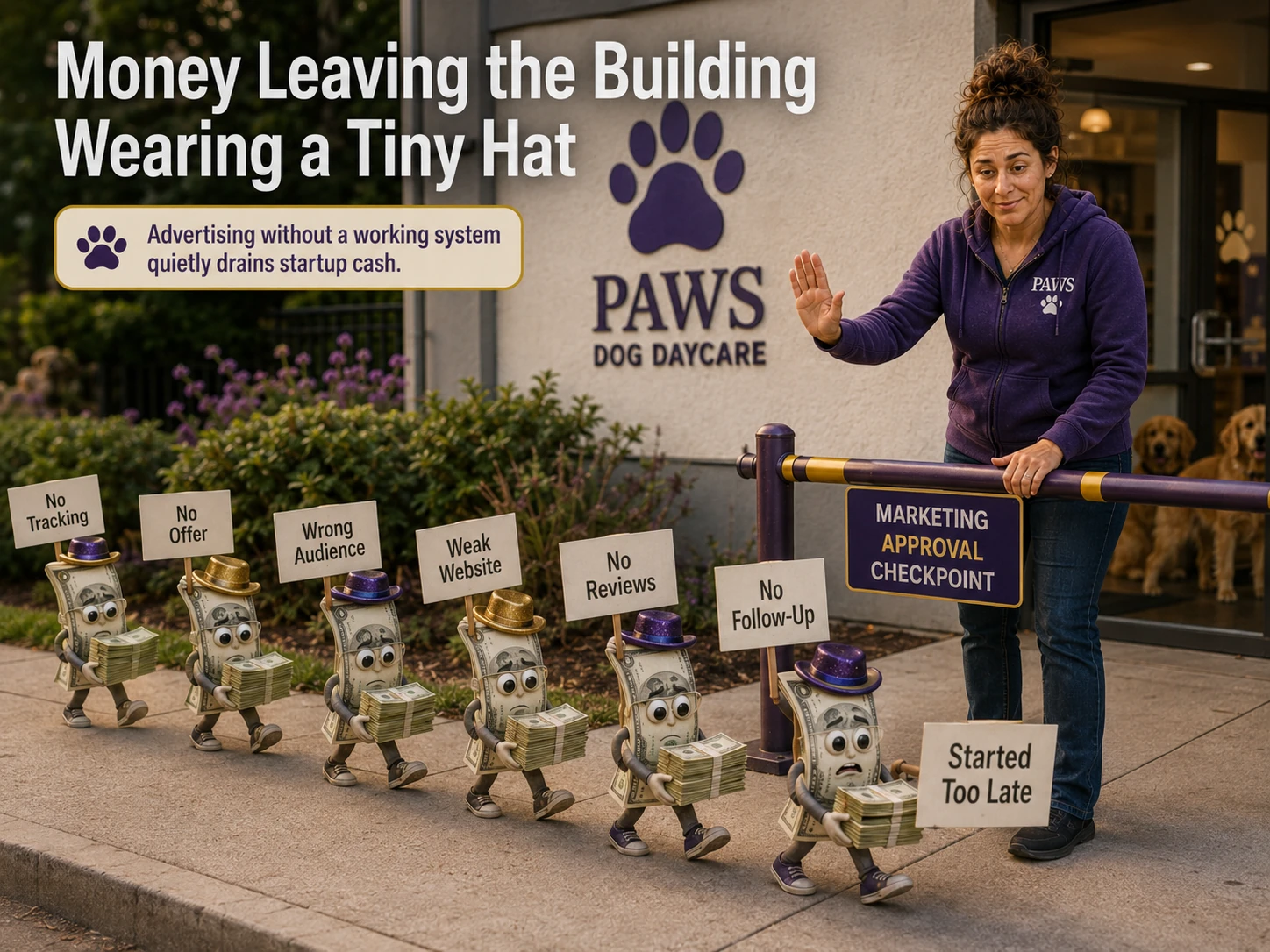
Bad advertising usually does not look bad when you buy it. It looks exciting. It comes with a salesperson, a deadline, a discount, a glossy example, a “limited space available” pitch, or a little voice in your head saying, “Well, we probably should be doing something.”
Something is not a strategy. Something is how the business spends $900 and later says, “I do not know if it worked.”
Ineffective advertising happens when the business has no clear audience, no real offer, no tracking, no follow-up, no website conversion path, no reviews, no local search foundation, and no idea what the ad is supposed to accomplish.
⏰
Starting Too Late
Marketing after opening is late. Rent already started and did not ask if your Facebook page was ready.
🌐
Weak Website
Running ads to a weak page is like inviting people to dinner and serving them a picture of soup.
⭐
No Reviews
Customers compare trust signals. A facility with no reviews feels risky unless everything else is extremely strong.
📸
No Real Photos
Customers want to see where the dog is going, not just stock puppies smiling in fields like they own mutual funds.
🏷️
Discount Panic
Discounts can work, but desperation discounts can train customers to wait until you panic again.
📊
No Tracking
If you cannot tell what brought the customer in, you cannot tell what deserves more money.
🧭
Pick the Marketing Path That Matches Your Stage
No giant widget. No checkbox swamp. Just pick where you are and stop spending money like a confused raccoon at a print shop.
🔎
Still Planning?
Start with market research, website structure, coming-soon page, service pages, Google preparation, local networking, and a waitlist.
🚧
Opening Soon?
Focus on launch ads, tours, trial days, community outreach, signage, social proof, first photos, and first review process.
📈
Already Open?
Fix reviews, local SEO, website conversion, referrals, retention, service cross-selling, package renewals, and customer follow-up.
🩸
Bleeding Money?
Track leads, conversion, pricing, offers, repeat visits, payroll pressure, service mix, reviews, and whether ads are sending people into a dead-end website.
❓
Dog Daycare Marketing and Advertising FAQ
Detailed answers to the pre-opening, launch, local-search, website, review, social-media, AI, paid-advertising, traditional-media, community, budget, tracking, and conversion questions that determine whether marketing creates paying local customers or quietly burns cash.
When should marketing begin for a new dog daycare?
Marketing should begin before opening, once the business has enough certainty about the location, service area, planned services, and likely timeline to communicate responsibly. A coming-soon page, interest list, local outreach, construction updates, and launch plan can build awareness before rent and payroll demand results. Do not publish dates or promises that are still guesses. The goal is a warm audience, not premature hype.
What is the first marketing foundation to build?
Start with local visibility, real trust proof, and a clear conversion path. That usually means a complete website, accurate Google Business Profile when eligible, real facility photos, useful service pages, pricing guidance, reviews, signage, and obvious ways to request a tour or evaluation. Paid advertising should sit on top of that foundation. Sending more traffic into a weak system simply creates faster waste.
How early should a coming-soon page go live?
Publish it when the project is real enough that the business can identify the planned service area, core services, and a responsible opening range. The page should collect interest, explain what is being built, and provide updates without pretending every permit or construction date is guaranteed. Keep the information current as the project changes. An abandoned coming-soon page can damage trust before opening.
What should be collected from a pre-opening interest list?
Collect the customer’s name, contact preference, general location, dog information, services of interest, and permission for updates. Keep the form short enough that people complete it. Use the list to announce tours, evaluations, opening dates, boarding availability, grooming, training, or other relevant services. Consent and opt-out handling should be built into the communication process.
What should a dog daycare market before the building opens?
Market the service concept, location or service area, safety approach, evaluation process, planned daycare and boarding model, facility progress, staff expertise, and the next step for interested owners. Real construction photos and useful explanations usually outperform generic stock-dog posts. Avoid making claims about finished features that are not yet certain. Customers should understand what is coming and how to join the opening pipeline.
How should the first 90 days be marketed?
Treat the period as three connected stages: pre-launch, opening, and follow-through. Before launch, build the list, prepare the website, schedule tours, and notify partners. During launch, capture evaluations, trial customers, bookings, photos, and first reviews. After launch, follow up with leads, convert trials into repeat visits, sell packages, and keep the business from becoming yesterday’s news.
Is a grand-opening event enough?
No. A ribbon cutting or open house is useful only when it feeds a larger system. Collect contact information, schedule tours, explain services, route dog owners into evaluations, and follow up afterward. Track which attendees become paying customers. A crowded Saturday with no customer capture is entertainment, not a launch strategy.
What makes Google Business Profile important?
Many local dog owners begin with Google Search or Maps and compare photos, reviews, hours, services, distance, and booking convenience before contacting anyone. The profile should be complete, accurate, active, and consistent with the website. Real facility photos and honest reviews reduce uncertainty. A neglected profile can lose the customer before the front desk knows the search occurred.
How should the website support marketing?
The website should explain each major service, show the actual facility, answer common questions, provide pricing guidance, build trust, and make the next action obvious. Visitors should be able to call, request an evaluation, submit boarding dates, ask about grooming, schedule a tour, or reach the customer portal. Every advertising channel should land on a page that matches the promise. A homepage alone cannot carry every campaign.
How important are reviews?
Reviews are trust currency for a local animal-care business. Ask real customers for honest feedback after positive experiences and make the review link easy to use. Respond professionally to both positive and negative reviews. Do not buy reviews, review-gate, pressure customers, or use discounts to manufacture praise.
How should social media be used?
Use social media to provide proof, stay visible, show real dogs and staff, answer common questions, promote events, and direct customers toward a useful next step. Organic posting, paid reach, DMs, and retargeting are different tools and should be managed differently. Likes are not the final business outcome. Track messages, forms, tours, evaluations, and bookings generated from the channel.
Which social platforms should a daycare prioritize?
Prioritize the platforms used by the local customer base and that the team can maintain consistently. Facebook and Instagram are often strong for local visibility, proof, events, reviews, and messaging, while short-form video can broaden attention when the business can produce useful content. Nextdoor and local groups may matter in specific communities. A smaller number of active, well-managed channels is better than abandoned profiles everywhere.
Can AI help with dog daycare marketing?
Yes. AI can draft ad variations, organize content calendars, summarize review themes, suggest follow-up, create first drafts of emails, and help staff answer common questions. A human must still approve claims, prices, policies, images, and anything involving safety, medical issues, incidents, refunds, or complaints. AI should speed up controlled work rather than invent the business.
Should a daycare use paid Google or social ads?
Paid ads can help after the website, local profile, reviews, offer, tracking, and follow-up path are working. Start with a specific goal such as evaluation requests, grooming openings, boarding dates, tours, or a launch event. Use geographic targeting that matches the real service area. Do not buy broad awareness while the booking path is broken.
Are newspaper, radio, television, or direct mail still useful?
Sometimes. Their value depends on the local audience, geography, repetition, message, cost, offer, and ability to track response. A community paper, local radio campaign, targeted postcard, or event sponsorship may work when it reaches the right dog owners and points toward a strong website or booking path. Do not buy traditional media merely because a salesperson created urgency.
How should local veterinarians and pet businesses be approached?
Build professional relationships instead of treating them like referral vending machines. Provide accurate service information, vaccine requirements, contact details, safety standards, and a reason the other business can trust the facility. Be respectful of their time and customers. One useful relationship is worth more than a stack of abandoned flyers.
Are rescue events and community events good marketing?
They can build trust, awareness, content, and community relationships when planned safely. Written agreements, dog separation, disease control, parking, staffing, waivers, vendor responsibilities, and cleanup should be addressed in advance. Capture leads and provide a next step rather than measuring success only by attendance. Busy is not the same as profitable.
How much should a dog daycare spend on marketing?
The budget depends on the stage of the business, competition, service area, cash flow, capacity, service mix, and growth target. A startup may need more pre-opening and launch spending, while an established facility may gain more from reviews, retention, referrals, reactivation, and website improvement. Build the budget around specific goals and measured channels. Do not let the latest salesperson determine the plan.
Which marketing numbers should be tracked?
Track lead source, website landing page, calls, forms, tours, temperament evaluations, first bookings, repeat visits, package sales, boarding and grooming conversions, reviews, referrals, ad spend, acquisition cost, and customer lifetime value where practical. Also track response time and follow-up completion. A channel that creates cheap leads but no customers is not working. Review the numbers monthly and during active launch campaigns more frequently.
What is the biggest dog daycare advertising mistake?
The biggest mistake is buying attention before the customer-acquisition machine works. A weak website, poor local profile, missing reviews, hidden booking path, slow follow-up, unclear offer, and no tracking will waste almost any advertising budget. Repair the machine first. Then scale the channels that produce qualified local customers and repeat revenue.
🐾
The Bottom Line: Build the Local Trust Machine
Marketing is not “buy ads.” Marketing is the system that turns local awareness into paying, returning customers.
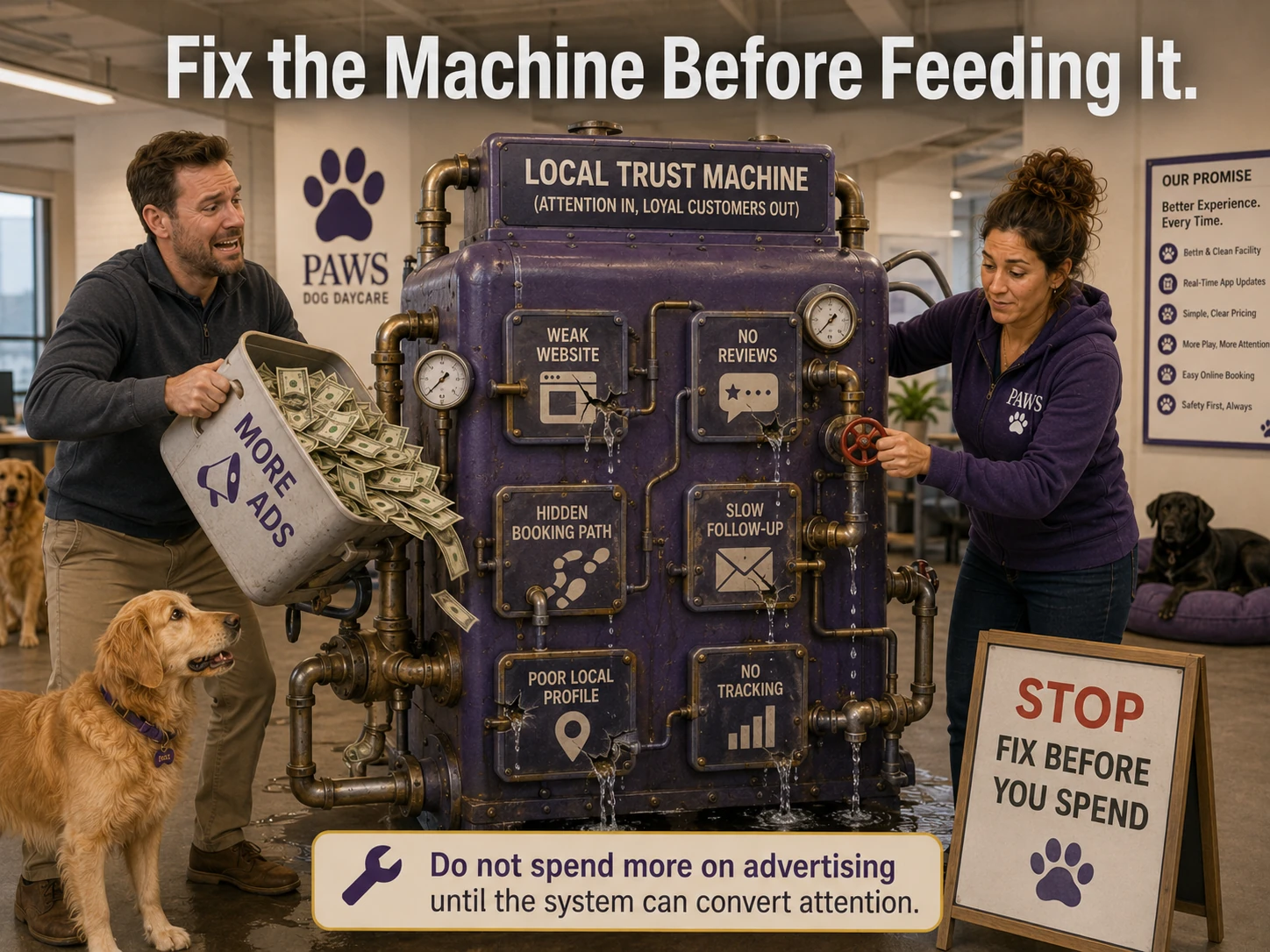
A dog daycare needs more than a beautiful building. It needs people to know it exists. Then they need to trust it. Then they need a clear path to book. Then they need a good enough experience to return, review, and tell someone else.
That is the machine.
Pre-opening marketing builds the runway. Launch marketing fills the first wave. Post-opening marketing keeps the business from fading into the background. Reviews build trust. Website pages convert interest. Signage makes the facility visible. Community relationships build credibility. Traditional media only works when it supports a real strategy.
Do not buy random advertising because the business feels quiet. Fix the machine. Then feed the machine.
📱
Social Media Advertising, DMs, and Photo Proof
Social media is not a magic vending machine where you post a Labrador in a party hat and payroll disappears. But it matters now, and pretending it does not is just nostalgia with Wi-Fi.
A modern dog daycare has to treat social media as part of the advertising system. Facebook, Instagram, TikTok, YouTube Shorts, X, Nextdoor, Messenger, DMs, local groups, short video, retargeting, and comment threads can all affect whether customers notice you, trust you, message you, book a tour, or quietly choose the other facility with better proof.
Today, social media has to be part of the marketing conversation. Not because every dog daycare needs to dance on TikTok like a caffeinated golden retriever. Because customers now look for proof everywhere. They look at your website, Google listing, photos, reviews, Facebook page, Instagram, short videos, comments, messages, and whether the business looks alive or abandoned.
Social media advertising is different from just posting. Posting is proof and presence. Advertising is paid distribution. DMs and messaging are lead handling. Retargeting is follow-up. Short video is attention. Reviews and comments are trust signals. These are different tools. If you throw them all into one bucket called “social media,” you end up with the marketing equivalent of a toy box after three toddlers and a beagle got into it.
The big rule is simple: social media should move people somewhere useful. Toward a tour request. Toward a temperament test. Toward a daycare package. Toward grooming. Toward boarding. Toward a phone call, message, form, booking link, review, referral, or event signup.
📸
Organic Proof
Post real facility photos, happy dogs, staff moments, safety reminders, birthday dogs, grooming results, events, and behind-the-scenes proof that the business is alive.
💵
Paid Reach
Use paid ads for local awareness, tours, trial days, grooming openings, boarding reminders, hiring, events, and retargeting people who already showed interest.
💬
DM Conversion
If customers message, answer quickly and route them to the next step. “Thanks for reaching out” is not a sales process. It is a polite speed bump.
⚠️
Social media warning
Do not build the whole marketing plan around social media applause. Likes do not pay rent unless they turn into leads, bookings, repeat customers, reviews, or referrals. A viral dog video is cute. A booked temperament test is better.
🔗
Future deep-dive page
Browse the dedicated social advertising pages below covering Facebook, Instagram, TikTok, short video, local groups, paid ads, retargeting, DMs, content calendars, photo permissions, and what not to post unless you enjoy creating your own evidence.