Licensing, Permits, and Local Approval
Dog Daycare Licensing Requirements: What You Need Before You Open
Do not assume that “I have a business license” means you are legally approved to operate a dog daycare.
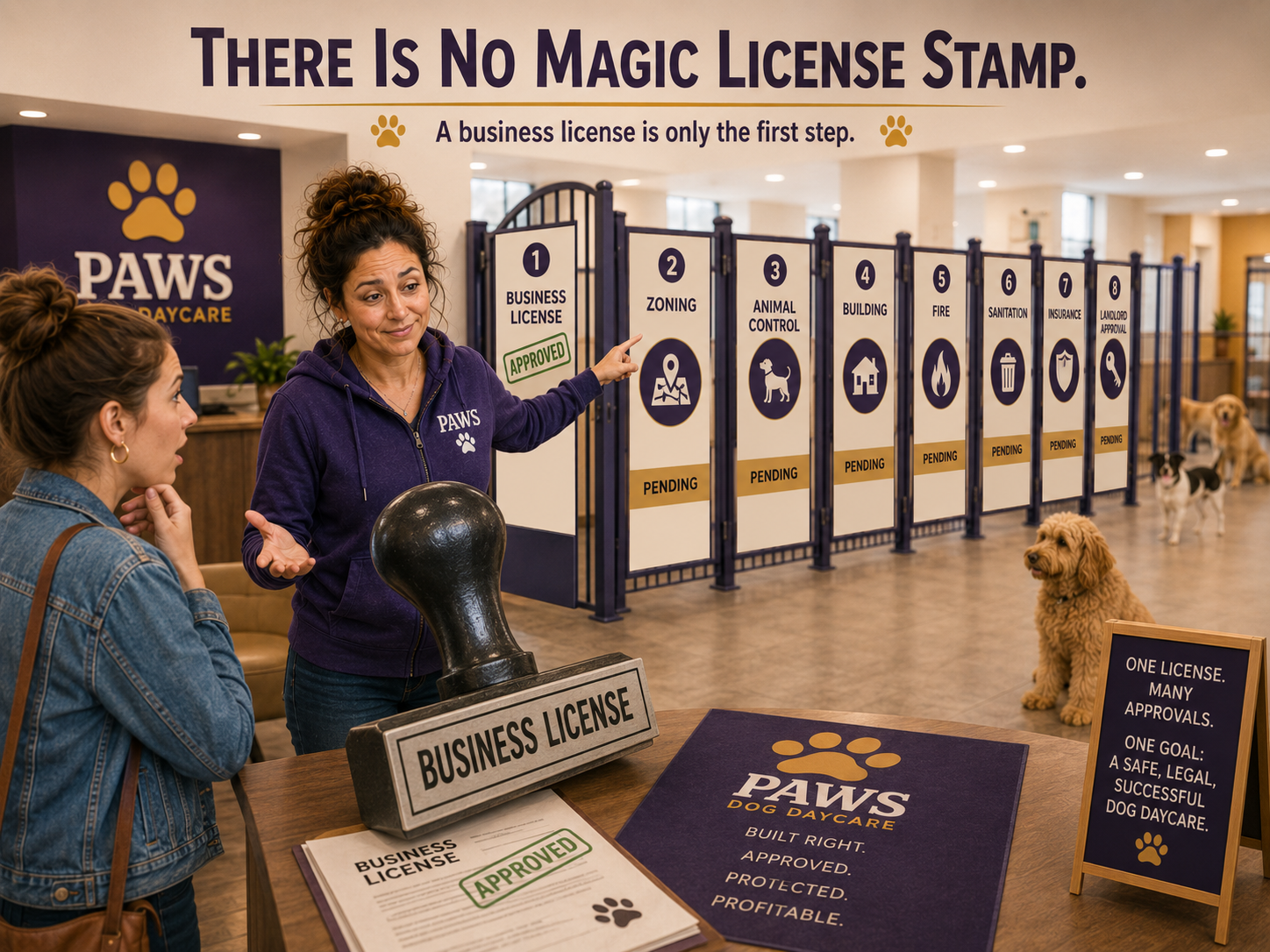
One of the most dangerous mistakes a new dog daycare owner can make is treating licensing like a small paperwork issue that can be handled after the lease is signed, after the build-out starts, or after the website goes live. Licensing is not a formality. It is part of the approval chain that determines whether the business can legally open, what services it can offer, how the facility must be operated, and what inspections or records may be required.
This is very much a regional issue. Some areas treat dog daycare like a boarding kennel. Some treat it as an animal-care facility. Some treat daycare, overnight boarding, grooming, retail, training, outdoor play, and transport as separate issues. Some places barely know what to call it. That does not mean you are free to guess. It means you have to do the work before committing money.
There are typically no federal licensure requirements to “open a dog daycare” in the way most people think of that phrase. However, federal rules may apply to certain animal-related businesses depending on what they actually do. Typically the ordinary dog daycare or pet resort owner will only be forced to deal with local, county, city, zoning, business-license, animal-control, health, sanitation, fire, building, and state-level rules.
The right question is not, “Do I need a license?” The right question is, “What approvals, permits, inspections, records, zoning decisions, animal-control rules, health requirements, fire/building requirements, and state or local licenses apply to the exact services I intend to offer at this exact address?”
⚠️
Operator warning: approval is usually a chain, not one magic stamp.
You may need zoning approval, a business license, an animal-related permit, fire review, building permits, health or sanitation review, waste-handling approval, state animal-facility approval, landlord approval, and insurance confirmation before the business is truly safe to open.
🗺️
Use This Page Like a Licensing Workbook
This is a long page because licensing is not one cute little checkbox. Use the map below to jump to the part of the approval process you are actually working on.
🧭
Start Here
Understand why dog daycare licensing is local first and why one answer rarely covers the whole business.
🛑
Before the Lease
Do not let excitement, a landlord, or a cheap building get ahead of zoning, licensing, and approval reality.
🔤
Code Wording Trap
The local code may not say “dog daycare,” even when the business is regulated under older animal-use language.
🏢
Change of Use
The building itself may become the problem once dogs, staff, grooming, drains, customers, and overnight care enter the picture.
🐕
Service Mix
Daycare, boarding, grooming, transport, retail, training, outdoor play, and animal transfer can trigger different rules.
🗃️
Research Packet
Gather property, service-model, and operating facts before calling anyone for approval.
🧩
Approval Map
Know who to contact first, second, third, and why each office can stop or reshape the project.
☎️
Call Script
Use better wording so you do not get a useless half-answer from the wrong department.
📊
Trigger Matrix
See how add-ons like boarding, grooming, outdoor play, transport, and rescue activity change the approval path.
🇺🇸
Federal Triggers
Most ordinary daycare is local/state-first, but some animal-business activity needs a harder regulatory look.
📝
Contact Log
Track names, dates, answers, deadlines, inspections, fees, and written confirmation.
🔁
After Opening
Approval is not the finish line. Renewals, inspections, records, complaints, and expansion changes still matter.
🧭
The Short Answer: Dog Daycare Licensing Is Local First
There is no universal dog daycare license that works everywhere. The rules change by state, county, city, zoning district, service mix, and sometimes even by the exact parcel.
In most cases, a dog daycare facility will need to start with the local city or county administration office, planning and zoning department, animal-control office, business-license office, and any local department that handles kennel permits, animal boarding, sanitation, fire, building, or health inspections.
Some areas may have a specific dog daycare license. Others may not use the phrase “dog daycare” at all. They may classify the business under boarding kennel, commercial kennel, pet-care facility, animal-care facility, pet services, grooming salon, animal boarding, veterinary-adjacent use, indoor recreation, or another older zoning or licensing category.
That matters because the word you use can affect the answer you get. If the local code does not mention dog daycare, do not assume the business is automatically allowed. Also do not assume it is automatically prohibited. You need to find the closest regulated category and ask for a written interpretation of how your exact service model will be treated.
🏛️
City / County
Business license, zoning clearance, animal-use approval, building permits, fire review, local kennel permits, and sanitation rules often start here.
🌎
State / Agriculture
Some states regulate boarding kennels, animal shelters, animal-care facilities, commercial kennels, or similar businesses through agriculture or animal-health agencies.
🇺🇸
Federal / Special Activity
Standard local daycare may not be federally licensed, but federal rules may matter if you sell, transport, import, exhibit, broker, transfer, or otherwise handle animals in regulated ways.
🔤
The Code May Not Say “Dog Daycare”
This is one of the reasons people get bad answers. They search the local code for the exact phrase “dog daycare,” find nothing, and assume that means something it may not mean.
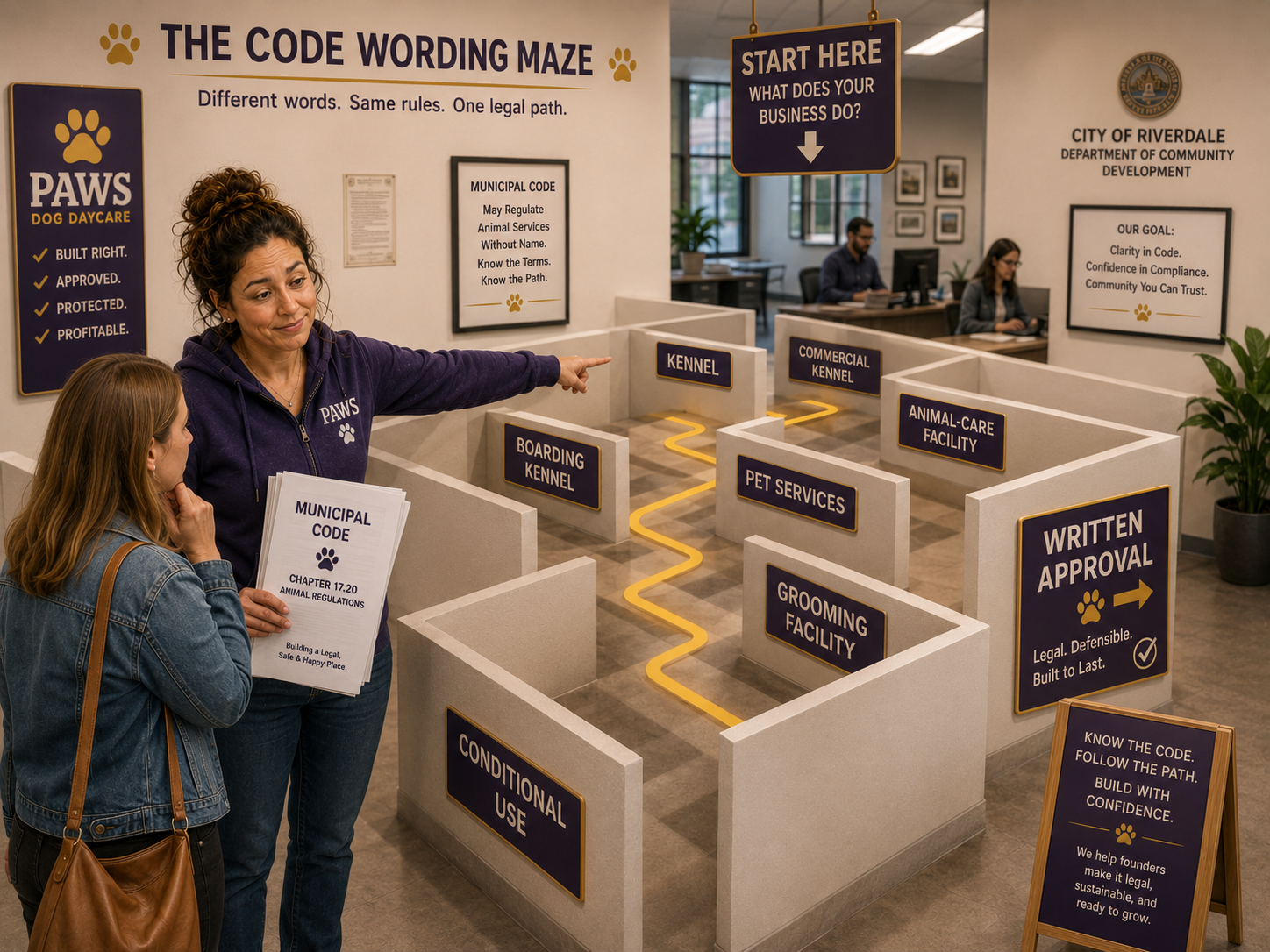
Many city and county codes were written before modern dog daycare became common. The code may not use the phrase “dog daycare” at all. That does not mean the business is unregulated. It may be tucked under an older animal-use category, a kennel category, a boarding category, a pet-service category, or a conditional-use section that was written long before anyone was selling supervised group play as a standalone service.
This is where new owners can get cute and get themselves in trouble. They read the code like a loophole hunt instead of an approval process. That is a bad way to gamble with lease money. Your job is not to win a word game with city hall. Your job is to find out what category the property and service model actually fall under before you start spending.
🐾
Kennel
Some jurisdictions may treat daycare as a kennel use even if dogs do not sleep overnight.
🏠
Boarding Kennel
Overnight care can push the business into boarding language quickly.
🐕
Commercial Kennel
The word “commercial” may matter because you are caring for dogs for compensation.
📋
Animal Boarding
Boarding language may apply even when the owner thinks of the business as daycare-first.
🧼
Pet-Care Services
Some codes place daycare, bathing, grooming, and related services under broader pet-service language.
🏥
Animal-Care Facility
This can include several animal-handling uses that do not fit neatly into older kennel language.
🛁
Grooming Facility
Grooming and bathing may trigger separate plumbing, sanitation, wastewater, or use questions.
🏢
Indoor Animal Use
Some codes focus less on the service name and more on animals being kept or handled indoors.
⚕️
Veterinary-Adjacent Use
Animal-care uses may be grouped near veterinary, boarding, grooming, or related animal-service categories.
🎾
Commercial Recreation
Group play, classes, customer traffic, and indoor activity can sometimes raise broader use-category questions.
⚖️
Special Exception
The use may not be allowed automatically but may be possible through a special approval process.
🧾
Conditional Use
Approval may come with conditions on hours, outdoor play, noise, capacity, fencing, waste, or inspections.
📌
Operator rule
Do not stop researching just because the code does not say “dog daycare.” Ask what category the city or county uses for customer-owned dogs receiving supervised care, boarding, grooming, training, transport, or outdoor play at a commercial property.
🛑
Do This Before You Sign the Lease
Licensing should be investigated before rent, deposits, build-out, equipment, signs, plumbing, flooring, and marketing start draining cash.
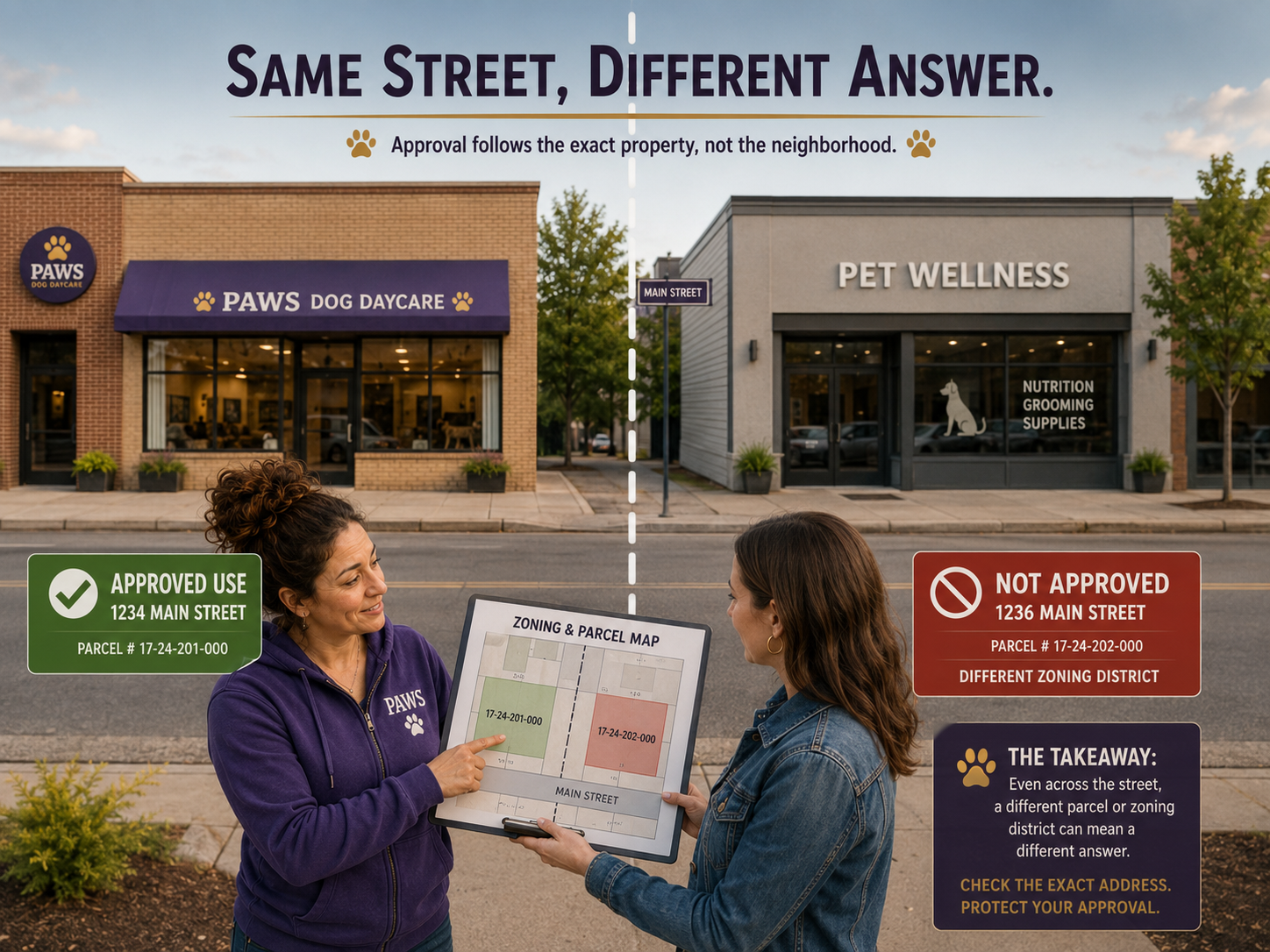
You are going to have to contact your local county or city administration office and review the city and county ordinances specific to your location to determine exactly what the license requirements are for a dog daycare facility in your area.
That means you need to ask about the exact address, not just the general neighborhood. A property across the street, across a zoning boundary, outside city limits, inside city limits, or inside a different overlay district may receive a different answer.
Do not let the landlord, broker, or real estate agent sell you a zoning or licensing assumption. A landlord may say, “That should be fine,” because the prior tenant was a gym, retail store, warehouse, salon, or office. Dogs change the analysis. Outdoor play changes the analysis. Overnight boarding changes the analysis. Grooming changes the plumbing and chemical conversation. Animal waste changes the sanitation conversation. Barking changes the neighbor conversation.
If the license path is unclear, the lease should protect you. You do not want to become financially trapped in a building that cannot legally support the business you intend to operate.
📌
Practical rule
If you cannot explain the licensing path in writing before signing, you are not ready to sign. You may still be able to pursue the site, but you should not be gambling blindly with lease liability and build-out money.
🏢
Your Problem May Be the Building, Not the Dog Daycare License
A lot of new owners think licensing is only an animal-control issue. Sometimes the bigger problem is that the building itself changes category once the business is described honestly.
Your issue may not be the dog daycare license. Your issue may be that the city sees the building differently once dogs, customers, employees, grooming tubs, drains, outdoor play, overnight care, odor, noise, and higher occupancy enter the picture.
A space that worked for retail, office, warehouse, salon, light industrial, or general commercial use may not automatically work for a dog daycare. Dogs change the building conversation. Customers dropping off and picking up dogs change the traffic conversation. Staff working around animals change the occupancy conversation. Grooming tubs and drains change the plumbing conversation. Outdoor play changes the zoning, noise, neighbor, drainage, and fencing conversation.
That is why “the landlord says it used to be a business” is not enough. Of course it used to be a business. That does not mean it is approved for this business.
| Building Issue | Why It Can Matter | What to Ask |
|---|---|---|
| Change of Use | The city may classify the new animal-care use differently than the prior tenant’s use. | Does this business require change-of-use review or approval? |
| Certificate of Occupancy | The building may need a new or updated certificate before the business can legally open. | Is a new, revised, or inspected certificate of occupancy required? |
| Fire and Life Safety | Exits, alarms, sprinklers, occupancy loads, separation, and emergency access can become issues. | What does the fire marshal need to review before opening? |
| Plumbing and Drains | Cleaning, bathing, grooming, mop water, waste, and dirty water need somewhere legal and practical to go. | Are floor drains, grooming tubs, backflow prevention, or wastewater review required? |
| HVAC and Ventilation | Dogs, odor, humidity, cleaning chemicals, staff, and customers can expose weak airflow fast. | Can the HVAC system handle the intended animal-care use? |
| Parking and Drop-Off | A daycare may create concentrated morning and evening vehicle traffic. | Does the site meet parking, loading, customer access, and traffic expectations? |
| Outdoor Area | Outdoor dog use may trigger fencing, noise, drainage, supervision, setback, and waste questions. | Is outdoor dog use approved, limited, conditional, or prohibited? |
🛑
Do not let the building sneak up on you.
You can have a business license, a landlord who likes you, and a logo ready to go, and still be stopped because the building, occupancy, fire review, plumbing, or use classification does not work.
🐕
Separate Each Service Before You Ask for Approval
Do not ask one vague question. Daycare, boarding, grooming, bathing, retail, training, transport, and outdoor play can be treated differently.
| Service / Activity | Why It Matters | Operator Question |
|---|---|---|
| Daycare | Supervised daytime group care may be treated as pet services, animal care, kennel use, indoor recreation, or another local category. | Is daytime dog daycare allowed at this exact address? |
| Overnight Boarding | Boarding often triggers kennel licensing, animal boarding rules, capacity limits, inspections, sanitation requirements, and different zoning scrutiny. | If dogs stay overnight, is a kennel or boarding license required? |
| Grooming / Bathing | Grooming can raise plumbing, drainage, chemical, backflow-prevention, wastewater, pesticide, and environmental questions. | Is grooming allowed, and are special plumbing or wastewater controls required? |
| Outdoor Play | Outdoor dog areas can trigger noise, fencing, waste, drainage, supervision, setback, and neighbor issues. | Is outdoor play allowed, limited, conditional, or prohibited? |
| Retail | Retail sales may be allowed where animal boarding is not, or may require separate sales-tax/business registration. | Can I sell food, toys, collars, treats, or other pet-care products? |
| Training / Classes | Group classes may affect occupancy, parking, hours, noise, and customer traffic. | Are group classes allowed as part of the same business? |
| Transport / Pickup | Transport can create insurance, vehicle, animal-handling, and potentially federal or state registration questions depending on the model. | If I pick up or transport dogs for compensation, what additional rules apply? |
| Rescue / Adoption / Sales | Animal transfer, adoption, brokerage, import, sale, or exhibition can change the regulatory analysis completely. | Does my business model involve any activity beyond customer-owned pets receiving services? |
🗃️
Before You Call Anyone: Build a Licensing Research Packet
Do not call city hall, animal control, or the zoning office with a half-formed idea and expect a clean answer. Have the facts in front of you first.
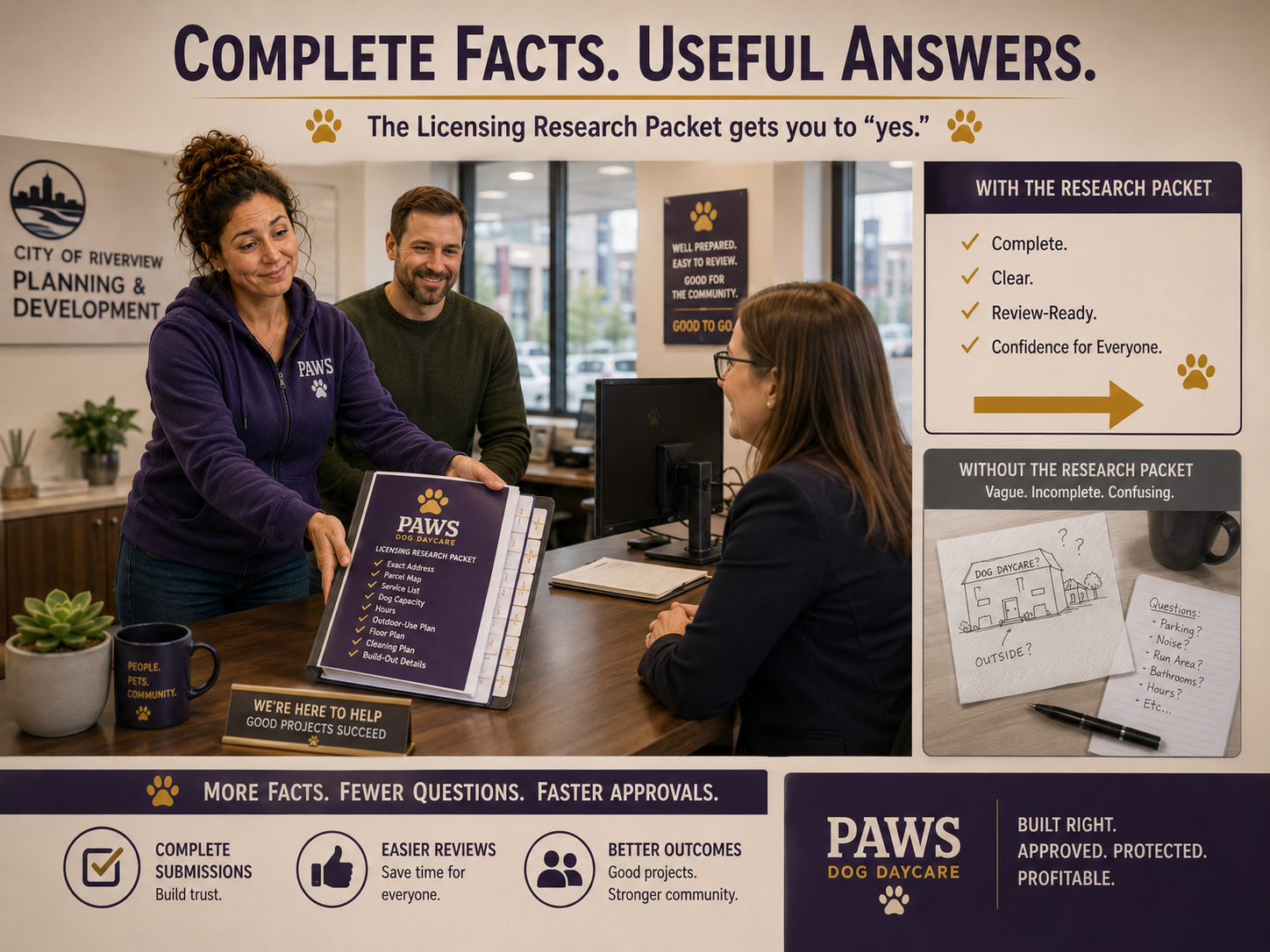
One reason new owners get bad answers is because they ask vague questions. “Can I open a dog daycare?” is not enough. The person on the other end may not know whether you mean daytime daycare only, overnight boarding, grooming, outdoor play, retail sales, transport, training, or some combination of all of it.
Before you call anyone, put together a basic licensing research packet. This does not have to be fancy. It just needs to be complete enough that the agency can understand the exact property, the exact service model, and the exact kind of animal-care business you are trying to operate.
Property Information
- Exact property address.
- Parcel number, if available.
- City and county jurisdiction.
- Zoning district or zoning classification.
- Landlord, property manager, or building owner contact.
- Total building square footage.
- Estimated indoor area available for dog use.
- Estimated outdoor area, if any.
Service Model Information
- Whether dogs will be there for daytime daycare only.
- Whether dogs will stay overnight.
- Whether grooming, bathing, or nail trims will be offered.
- Whether transport, pickup, or delivery will be offered.
- Whether retail products will be sold.
- Whether training classes will be offered.
- Whether rescue, adoption, sale, or animal-transfer activity is involved.
- Whether outdoor play will be part of the business.
Operating Assumptions
- Estimated dog capacity.
- Planned hours of operation.
- Expected number of employees per shift.
- Waste-disposal plan.
- Cleaning and sanitation plan.
- Vaccination policy.
- Flooring, drainage, and plumbing assumptions.
- Any planned fencing, gates, drains, tubs, kennels, signs, or structural changes.
📌
Operator rule
If you do not know what you are asking permission to operate, the city cannot give you a useful answer. Get your facts together before you start making calls.
🧭
Who to Contact First: The Dog Daycare Approval Map
Licensing is not one phone call. It is a chain of people who can each stop, delay, limit, or reshape the business.
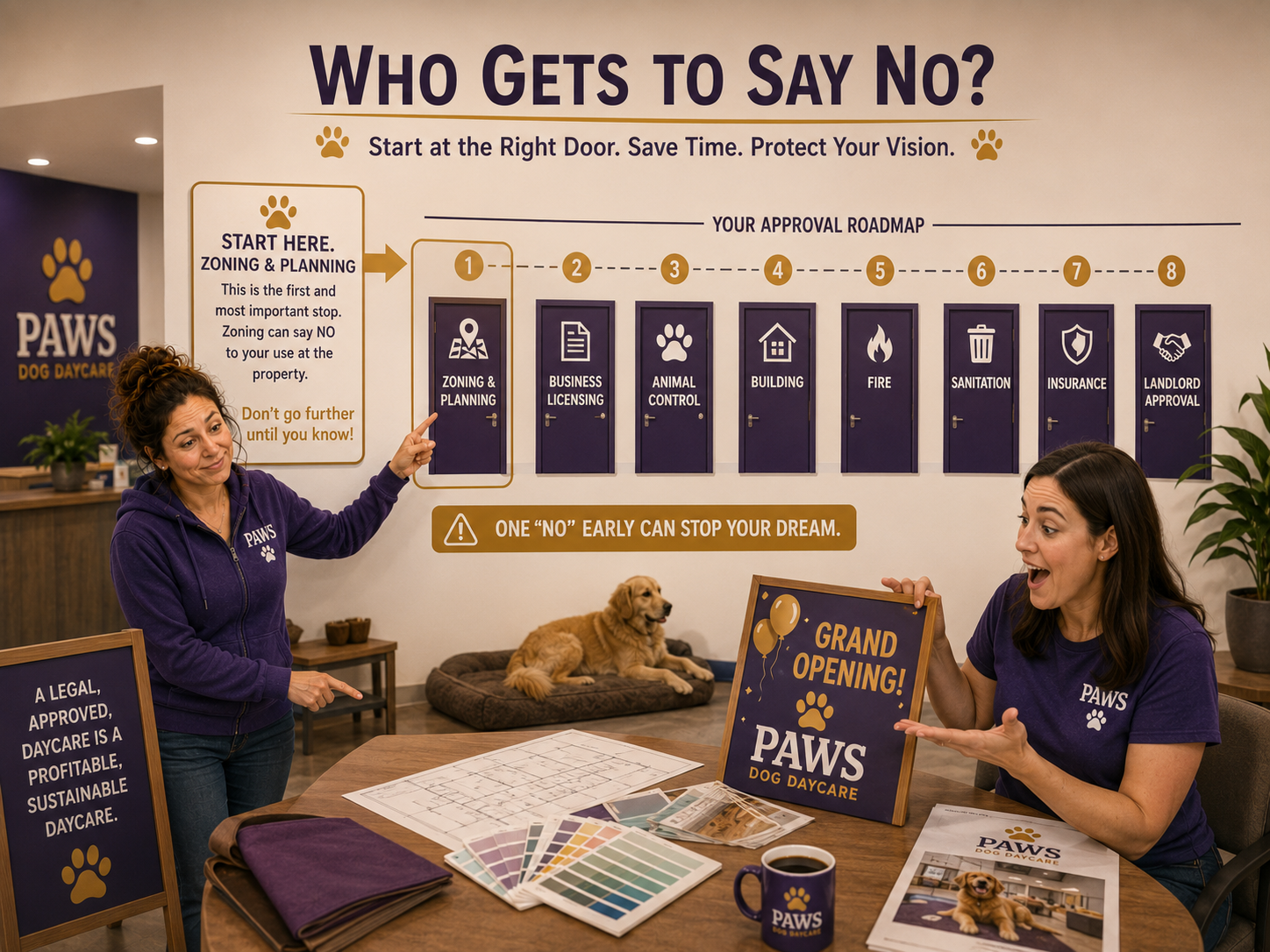
The order matters. Start with the people who can tell you whether the use is allowed at the property. Then move into licensing, building, fire, sanitation, state rules, insurance, and landlord approval. Do not spend weeks pricing dog bowls and lobby furniture while the most important approval question is still unanswered.
2
Business License
Can this business operate in this city or county, and what general business registration is required?
3
Animal Control / Kennel Licensing
Is this treated as dog daycare, kennel, boarding, animal care, commercial kennel, or another regulated animal use?
4
Building Department
Does the building need permits, occupancy review, accessibility review, or change-of-use approval?
5
Fire Marshal
What do exits, alarms, sprinklers, occupancy, separation, and emergency access require?
6
Health / Sanitation / Wastewater
How will cleaning, drainage, grooming wastewater, animal waste, disinfectants, odor, and pest control be handled?
7
State Agriculture / Animal Health
Does the state regulate boarding kennels, commercial kennels, animal-care facilities, shelters, dealers, or related animal businesses?
8
Insurance Carrier
Will the exact service model, dog count, facility, lease, and activity mix be covered?
9
Landlord
Will the lease allow dogs, noise, odor, outdoor use, grooming tubs, drains, fencing, signage, inspections, and build-out?
☎️
Copy/Paste Call and Email Script
Do not call and say, “Can I open a dog daycare?” That is how you get a half-answer from the wrong person.
Use specific language. You are not trying to sound impressive. You are trying to get a clear answer from the correct office before you sign a lease or spend build-out money.
✉️
Copy this into your email or use it as your phone script.
Hello, I am evaluating a commercial property at [PROPERTY ADDRESS] before signing a lease. I need written guidance on whether the following animal-care business use is allowed at this exact address.
The proposed business would include [DAYTIME DOG DAYCARE / OVERNIGHT BOARDING / GROOMING / BATHING / TRAINING / RETAIL / TRANSPORT / OUTDOOR PLAY / OTHER SERVICES]. Dogs would be customer-owned pets receiving services from the business. The estimated maximum number of dogs on site would be [NUMBER], with planned hours of operation from [HOURS].
Can you please tell me what zoning category, business license, animal-care license, kennel or boarding permit, inspection, fire/building review, sanitation review, state approval, or other approval may be required before this business can legally operate at this address?
If your office is not the correct office for one of these questions, please tell me which department or agency I should contact next. I would also appreciate written confirmation or a written explanation of the applicable process so I can evaluate the property before committing to a lease.
Add this when contacting zoning
I am specifically asking whether the proposed use is permitted by right, conditional, prohibited, or subject to special exception, variance, interpretation, hearing, or other discretionary approval.
Add this when contacting animal control or licensing
I am specifically asking whether the business is treated as dog daycare, kennel, boarding kennel, commercial kennel, animal-care facility, pet-care service, grooming facility, or another regulated animal use.
Add this when contacting building or fire
I am specifically asking whether this use creates a change of occupancy, change of use, fire review, building permit, exit requirement, sprinkler issue, alarm issue, or inspection requirement.
Add this when contacting health, sanitation, or wastewater
I am specifically asking about animal waste, cleaning water, grooming wastewater, drains, backflow prevention, disinfectants, flea or tick products, solid waste, odor, pest control, and any inspection requirements.
🔍
What Inspectors Usually Care About
Licensing is not just about paying a fee. The inspection side is where the business has to prove it can operate cleanly, safely, and responsibly.
In many areas, dog daycare license requirements and applications are similar to boarding kennel requirements. That can mean inspections by local officials on an annual basis or before renewal. The purpose is usually to make sure proper sanitation methods are followed, infectious disease risk is reduced, vaccination records are maintained, and animal waste is handled correctly.
Inspectors may also look at the facility itself: flooring, walls, drainage, water access, ventilation, cleaning systems, storage, waste disposal, separation areas, kennels or rooms, outdoor areas, fencing, emergency exits, fire safety, occupancy, and whether the business is operating within the services it was approved to provide.
This is why licensing should be part of facility design. You do not want to finish the build-out and then learn that your cleaning system, drainage plan, outdoor area, isolation space, ventilation, or record-keeping process does not satisfy the local inspector.
🧽
Sanitation
Cleaning methods, disinfectants, mop water, floor surfaces, odor control, waste handling, drainage, and disease-prevention practices matter.
💉
Vaccination Records
Most facilities need an organized way to track rabies, core vaccines, Bordetella, expiration dates, reminders, and customer compliance.
🗑️
Waste Handling
Solid waste, trash storage, poop disposal, dirty water, grooming waste, hair, odor, and pickup areas can all become inspection issues.
🧩
Service Model Trigger Matrix
The licensing answer changes when the service model changes. Daycare only is not the same thing as daycare plus boarding, grooming, transport, retail, outdoor play, or animal transfer.
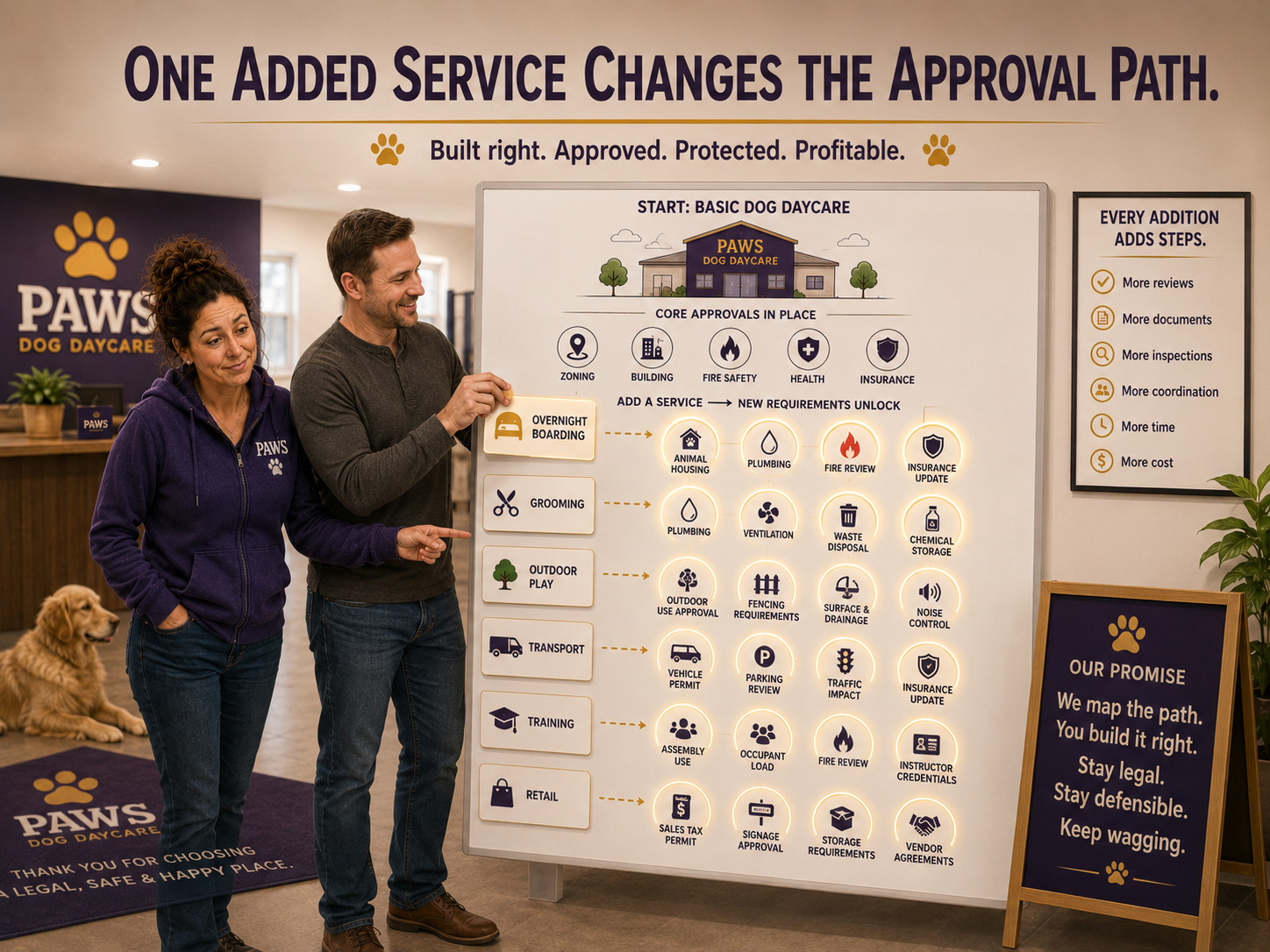
This is where new owners get themselves in trouble. They ask about “dog daycare,” get a general answer, and then quietly add boarding, grooming, outdoor yards, pickup service, retail, baths, nail trims, training classes, or rescue activity later. Each add-on can change the approval path.
Use this matrix as a planning tool. It does not replace local guidance, but it shows you which doors may need to be opened before you assume the business is clear.
| Service Model | Possible Approval Triggers | Operator Warning |
|---|---|---|
| Daycare only | Zoning, business license, animal-control review, insurance, sanitation, building/fire review. | Even without overnight boarding, groups of dogs, staff, customers, waste, cleaning, noise, and traffic can still trigger review. |
| Daycare + overnight boarding | Kennel or boarding license, animal housing rules, inspections, sanitation, staffing, fire/building review, insurance. | If dogs sleep there, do not assume ordinary daycare approval is enough. |
| Daycare + grooming or bathing | Plumbing, drainage, wastewater, backflow prevention, chemical storage, pesticide product review, sanitation, insurance. | Grooming is not just buying a tub. Water, drains, hair, chemicals, and wastewater can create a separate approval problem. |
| Daycare + outdoor play | Zoning, fencing, setbacks, noise, odor, waste, drainage, supervision, neighbor complaints, outdoor-use limits. | Outdoor space is marketable, but it can also be the thing that gets the project limited or denied. |
| Daycare + retail | Business license, sales-tax registration, product storage, insurance, local retail-use rules. | Retail may be simple, but it still needs to be included in the business model you disclose and insure. |
| Daycare + training classes | Occupancy, parking, hours, noise, customer traffic, insurance, group-use review. | Training can change the number of people and cars on site, not just the number of dogs. |
| Daycare + transport or pickup | Commercial auto insurance, animal transport rules, state or federal review depending on the model, customer agreements. | Transport adds vehicle risk, custody risk, timing risk, and insurance questions. |
| Daycare + rescue, adoption, sale, brokerage, import, exhibition, or transfer activity | State animal-facility review, federal Animal Welfare Act review, dealer/exhibitor/transport/registration questions, records. | Once you move beyond customer-owned pets receiving services, the regulatory picture can change fast. |
🇺🇸
When Federal Rules Enter the Conversation
Most ordinary dog daycares are local and state approval problems first. But “most” is not the same thing as “always.”
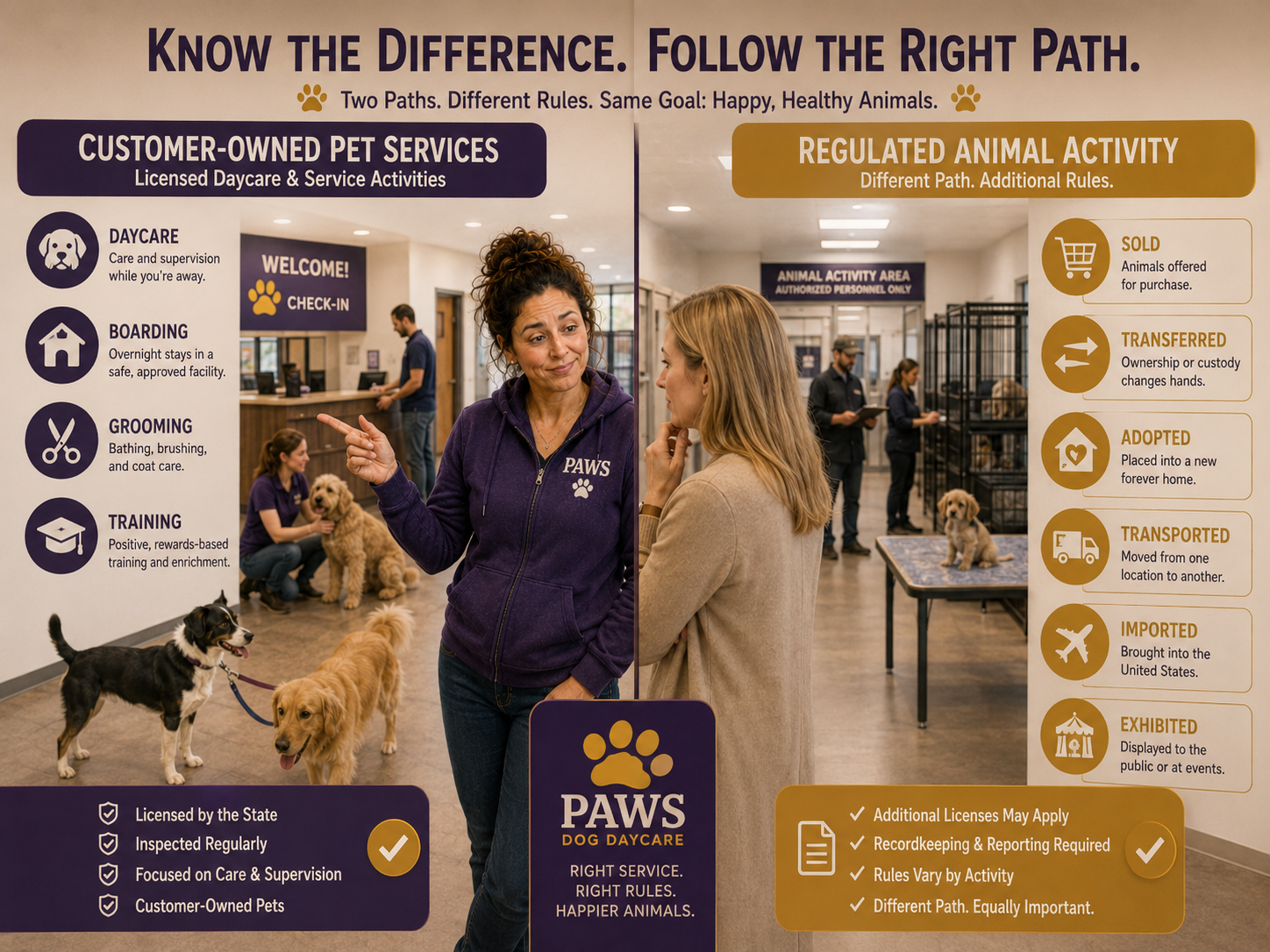
If your business is simply caring for customer-owned dogs through daycare, boarding, grooming, training, or similar local services, the main approval path will usually begin with zoning, business licensing, animal-control rules, state animal-facility rules, inspections, insurance, and the lease.
But if the business model starts drifting into animal sale, import, transport, exhibition, brokerage, rescue or adoption transfer, animals owned by the business, animals moved between parties, or anything beyond customer-owned pets receiving ordinary services, slow down and verify whether state or federal animal-business rules are triggered.
This is not the place to be casual. Do not assume “dog daycare” magically covers every animal-related activity you might bolt onto the business later. The minute the business is no longer just customer-owned dogs receiving services, the regulatory picture can change.
Usually local/state first
Daycare, boarding, grooming, training, retail, outdoor play, vaccination records, sanitation, inspections, fire review, and lease approval are usually handled through local, county, city, state, insurer, and landlord channels.
Stop and verify
Animal sale, import, transport, exhibition, brokerage, rescue, adoption transfer, animals owned by the business, or animals being moved between parties can create a different regulatory conversation.
Do not guess
Ask the correct state and federal contacts whether your exact activity is regulated, whether registration or licensing is required, and what records, inspections, or operating limits apply.
📌
Operator rule
A normal daycare business and an animal-transfer, sale, transport, exhibition, or brokerage activity are not the same thing. Keep the service model clean, and verify anything that moves beyond customer-owned pets receiving services.
📋
Records You Should Be Ready to Maintain
A clean building helps. Clean records help even more when something goes wrong.
- Current vaccination records for each dog using daycare, boarding, grooming, or training services.
- Signed service agreements, waivers, releases, and customer acknowledgments.
- Emergency contact information and veterinarian information for each customer.
- Temperament test results, behavior notes, restriction notes, and group-play suitability records.
- Incident reports for bites, fights, injuries, illness, escapes, complaints, or unusual events.
- Medication instructions, feeding instructions, allergy notes, and special-care notes when applicable.
- Cleaning schedules, disinfectant logs, kennel/playroom cleaning records, and outbreak-response documentation.
- Waste-disposal procedures, trash pickup arrangements, and solid-waste handling information.
- Employee training records for dog handling, cleaning, safety, emergency response, and customer procedures.
- Inspection reports, license renewals, correspondence with regulators, and written approvals.
- Insurance certificates, landlord approvals, lease-use permission, and required additional-insured documentation.
- Material Safety Data Sheets or chemical information for disinfectants, shampoos, pest-control products, and cleaning supplies.
🛁
Grooming Can Change the Licensing Conversation
Grooming looks like an easy add-on, but it can raise plumbing, wastewater, chemical, and environmental questions.
Those who choose to offer grooming services may need approval not only from local government, but potentially from environmental, plumbing, wastewater, or health-related authorities depending on the jurisdiction.
The original PAWS manual specifically warned that flea and tick shampoos can contain pesticide ingredients and may require specialized disposal procedures or specialized plumbing equipment to prevent backwards suction of hazardous chemicals into the city potable water supply. That warning still belongs here because it is exactly the kind of issue a new owner may not think about until the inspector, plumber, landlord, or city brings it up.
If grooming is part of the business, ask direct questions before build-out. Can you install tubs? Are floor drains allowed? Is backflow prevention required? What happens to wastewater? Are hair traps or special filtration needed? Are flea/tick products restricted? Are there rules about shampoo storage, chemical labeling, or discharge into the sewer system?
🚰
Operator warning
Do not add grooming to your plan without talking to zoning, plumbing, health, wastewater, environmental, landlord, and insurance contacts. The revenue may be attractive, but the build-out and compliance requirements need to be understood first.
🧾
Dog Daycare Licensing Workflow: Do This in Order
This is the practical sequence. Do not start with the application fee. Start by figuring out who gets to say no.
| Step | What You Do | Why It Matters |
|---|---|---|
| 1. Identify the exact property | Get the address, parcel number, city/county jurisdiction, zoning district, and landlord contact. | The exact parcel determines which rules apply. |
| 2. List every intended service | Daycare, boarding, grooming, bathing, training, retail, transport, outdoor play, events, rescue/adoption, or other services. | Approval for one service does not automatically approve every service. |
| 3. Confirm zoning first | Ask planning/zoning whether the exact use is allowed, conditional, prohibited, or requires interpretation. | A license application is useless if the use is not allowed at the address. |
| 4. Ask animal control / licensing | Find out whether dog daycare, kennel, boarding, grooming, or animal-care permits are required. | This may control inspections, capacity, records, renewals, and operating rules. |
| 5. Ask building and fire | Check occupancy, exits, fire review, interior build-out, signage, sprinklers, alarms, and customer/staff access. | The building must be usable, not just approved on paper. |
| 6. Ask health/sanitation/wastewater | Review cleaning systems, waste disposal, drains, grooming wastewater, backflow, solid waste, and pest control. | Dog daycare is a cleaning-heavy business; sanitation is not optional. |
| 7. Check state rules | Contact state agriculture, animal health, or other relevant agencies if animal facilities are regulated statewide. | Some states regulate boarding, kennels, animal-care facilities, or commercial animal establishments. |
| 8. Check federal special activity | Review USDA/APHIS only if your model involves regulated sale, import, transport, exhibition, brokerage, transfer, or similar activity. | Most local dog daycares are not federal-license problems, but do not ignore special activities. |
| 9. Confirm insurance | Make sure the intended services and the required license/lease conditions can be insured. | Approval does not help if the business cannot get coverage at workable limits. |
| 10. Protect the lease | Do not become fully bound until approval, licensing, inspections, insurance, and build-out permission are clear. | The lease should not trap you in a building you cannot legally operate. |
☎️
What to Ask Before You Commit Money
Do not call the city and say, “Can I open a dog daycare?” That question is too vague. Ask precise questions.
Ask the zoning office
- Is dog daycare allowed at this exact address?
- What use category does the city/county place dog daycare under?
- Is overnight boarding treated differently?
- Is grooming treated differently?
- Is outdoor play allowed?
- Are there distance restrictions from homes, schools, churches, food uses, or other sensitive uses?
- Is a conditional use, special exception, variance, or hearing required?
- Can I get the answer or interpretation in writing?
Ask licensing / animal control
- Is a dog daycare license required?
- Is this treated as a kennel, boarding kennel, commercial kennel, or animal-care facility?
- Are annual inspections required?
- Are vaccination records required and what vaccines must be tracked?
- Are animal-capacity limits imposed by license, square footage, staffing, or enclosure rules?
- Are written cleaning, disease-control, or waste-disposal procedures required?
- Are there special rules for grooming, bathing, wastewater, or chemical products?
- What are the fees, renewal dates, and penalties for noncompliance?
🧩
The Approval Chain for a Dog Daycare Facility
This is why licensing should be planned with location, lease, insurance, and build-out — not after them.
3
Building / Fire
Determines whether the space, exits, occupancy, signage, and build-out are workable.
4
Insurance / Lease
Determines whether the approved operation can actually be covered and legally performed under the lease.
🛑
Do not reverse the order.
If you sign the lease first, start construction second, and ask about licensing third, you may discover too late that the building, service mix, outdoor area, grooming plan, or boarding model does not work.
🚫
Common Licensing Mistakes New Owners Make
Most of these mistakes happen because the owner gets excited before the approval path is real.
01
Assuming “No Federal License” Means “No License”
The ordinary licensing problem is usually local or state, not federal. That does not mean the business is unregulated.
02
Ignoring Overnight Boarding
If dogs sleep there, assume kennel or boarding rules may apply until the proper authority tells you otherwise in writing.
03
Treating Grooming Like a Small Add-On
Grooming can affect plumbing, drains, backflow prevention, wastewater, chemicals, insurance, and inspection requirements.
04
Relying on Verbal Answers
A friendly phone conversation is not enough when lease liability, construction money, permits, and opening timelines are on the line.
05
Forgetting Records and Inspections
Vaccination records, cleaning systems, animal records, waste procedures, incident logs, and renewal documents matter after the doors open.
06
Letting the Lease Get Ahead of Approval
A lease without approval contingencies can trap you in a building that the city, county, landlord, insurer, or inspector will not let you use properly.
✅
Pre-Opening Licensing Checklist
Before opening, you should be able to answer these questions without guessing.
- Do you know the exact zoning classification for the property?
- Do you know whether dog daycare is allowed at the exact address?
- Do you know whether overnight boarding is allowed?
- Do you know whether grooming and bathing are allowed?
- Do you know whether outdoor play is allowed?
- Do you know whether a local animal-care, kennel, boarding, or daycare license is required?
- Do you know whether state agriculture or animal-health approval applies?
- Do you know whether any federal regulated activity applies to your business model?
- Do you know what inspections are required before opening?
- Do you know whether annual inspections or license renewals are required?
- Do you know the vaccination-record requirements?
- Do you know the sanitation, waste, drainage, and cleaning expectations?
- Do you know whether grooming chemicals, flea products, wastewater, or backflow prevention create extra requirements?
- Do you know whether fire, building, occupancy, signage, or accessibility review is required?
- Do you know whether the lease allows the business, services, renovations, fencing, plumbing, and inspections you need?
- Do you know whether your insurance carrier will cover every service you intend to offer?
- Do you have written confirmation or a clear written path for the approvals that matter?
📝
Copy This Into Your Planning File: Licensing Contact Log
A serious licensing review needs a paper trail. Not because paperwork is exciting, but because memory is garbage when lease money, build-out money, and opening dates are on the line.
Keep a contact log from the first phone call. Save emails. Save written interpretations. Save permit notes. Save names, dates, departments, and follow-up items. If someone gives you a verbal answer, document who said it, when they said it, and what office they worked for. Then ask for written confirmation whenever the answer matters.
If the answer matters enough to spend money on, it matters enough to save.
| Planning Field | What to Record | Why It Matters |
|---|---|---|
| Agency / Department | Zoning, licensing, animal control, building, fire, health, wastewater, state agriculture, insurer, landlord, or other contact. | You need to know which office gave which answer. |
| Person Contacted | Name, title, department, phone number, email address, and office location if available. | “Someone at the city said it was fine” is not a record. |
| Date and Method | Phone call, email, meeting, application submission, inspection, written interpretation, or official notice. | Timelines matter when lease deadlines and opening schedules start moving. |
| Question Asked | The exact question you asked, including the address and services discussed. | A vague question produces a vague answer. Record the actual question. |
| Answer Received | The answer, limitation, warning, next step, or referral you were given. | This helps you avoid mixing up zoning, licensing, building, fire, and sanitation answers. |
| Written Confirmation? | Yes, no, pending, requested, or not available. | A written answer is stronger than a phone-memory version of an answer. |
| Fee / Deadline | Application fees, inspection fees, renewal deadlines, hearing dates, permit timelines, or appeal dates. | Missed deadlines can delay the opening or kill the plan. |
| Inspection Required? | Pre-opening, annual, renewal, fire, building, animal-control, health, sanitation, or wastewater inspection. | You need to know what has to happen before the doors open. |
| Lease Contingency Needed? | Zoning contingency, permit contingency, licensing contingency, build-out approval, landlord permission, or exit clause. | The lease should not trap you before the approval path is real. |
| Follow-Up Needed | Next department to contact, documents to submit, written answer to request, meeting to schedule, or professional to consult. | Licensing research only helps if someone actually follows through. |
📂
Build the proof file as you go.
Save zoning emails, written interpretations, permit applications, inspection reports, license approvals, renewal notices, fire marshal notes, building department notes, health or sanitation notes, state agency correspondence, insurance certificates, lease-use approval, landlord build-out permission, plumbing approvals, and outdoor-area approvals.
🔁
After Opening: Staying Approved Is Part of the Job
Approval is not the finish line. A dog daycare can get into trouble months later because the owner treated licensing like a one-time errand instead of an operating responsibility.
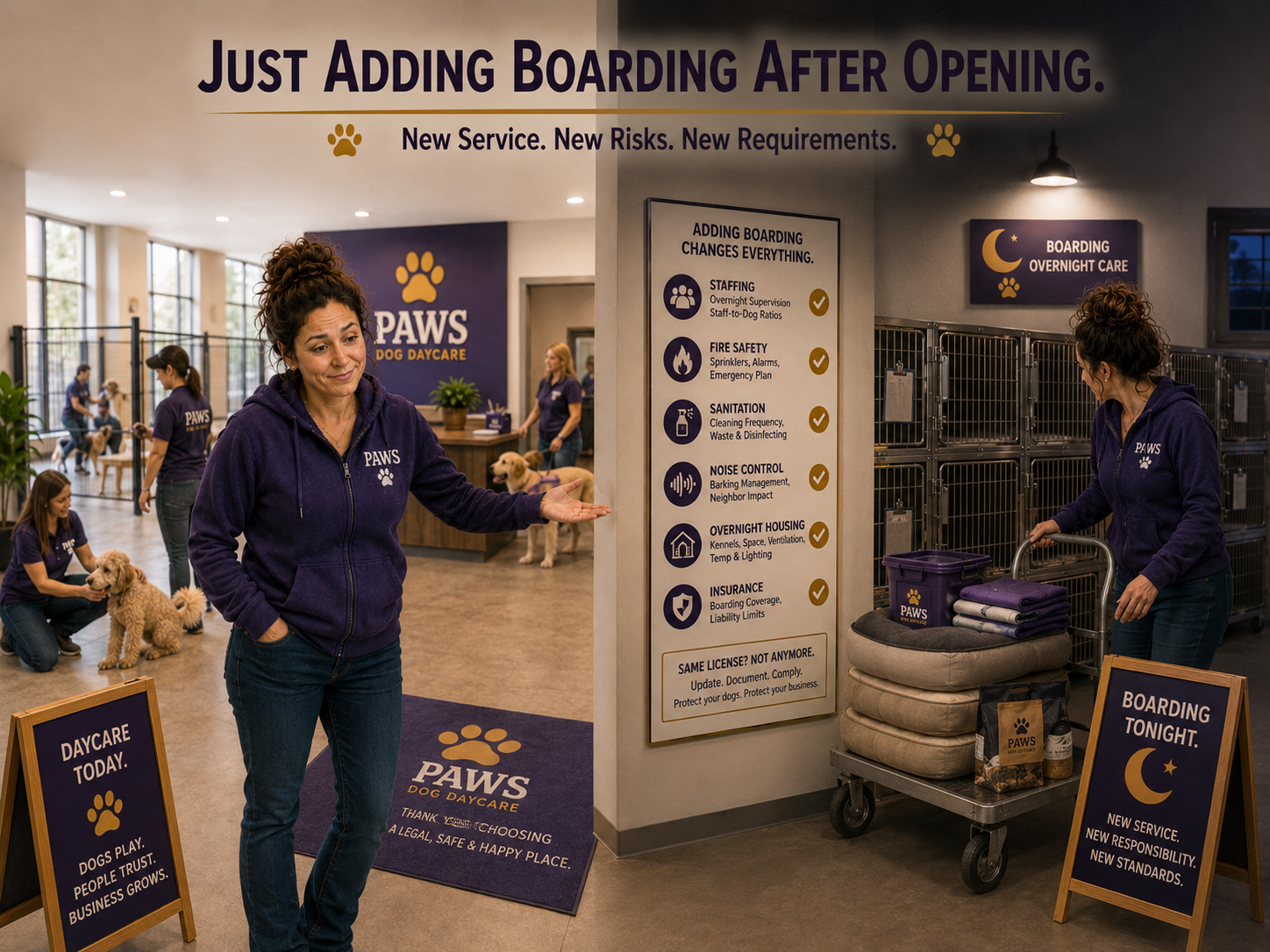
Once the doors open, the licensing work does not disappear. You may have renewals, inspections, vaccination-record updates, cleaning logs, incident documentation, complaint records, insurance renewals, lease obligations, and approval limits that still have to be managed.
This is also where owners create problems by “just adding” services later. Adding grooming later is not just buying a tub. Adding boarding later is not just putting dogs in a room overnight. Expanding capacity, changing hours, using outdoor space differently, moving locations, or adding transport can require new review.
| Compliance Item | What to Track | Operator Warning |
|---|---|---|
| License Renewals | Renewal dates, forms, fees, inspections, updated records, and proof of continued eligibility. | Do not let a license expire because no one put the renewal date on a calendar. |
| Annual Inspections | Animal-control, health, sanitation, building, fire, or other recurring inspection requirements. | The facility should be inspection-ready on a normal Tuesday, not just when someone is coming. |
| Vaccination Expiration Tracking | Rabies, Bordetella, core vaccine records, expiration dates, reminders, exceptions, and enforcement. | A vaccination policy that is not tracked is just decoration. |
| Cleaning Logs | Playroom cleaning, kennel cleaning, disinfectant use, outbreak cleaning, mop water, waste, and sanitation schedules. | If there is a complaint, illness, or inspection issue, clean records can matter as much as clean floors. |
| Incident Reports | Bites, fights, injuries, escapes, illness, customer complaints, staff mistakes, medication issues, and unusual events. | Write it down when it happens. Reconstructing incidents later is where businesses start sounding sloppy. |
| Complaint Records | Neighbor complaints, barking complaints, odor complaints, waste complaints, customer complaints, and regulatory contact. | Complaints are not just customer-service issues. They can become licensing and zoning issues. |
| Insurance Renewals | Policy dates, coverage limits, exclusions, additional insureds, service changes, dog-count changes, and lease requirements. | If the business adds services, the insurance needs to know before the claim happens. |
| Lease Compliance | Approved use, build-out limits, signage, outdoor areas, waste storage, inspections, insurance certificates, and landlord notices. | The lease can be a compliance document, not just a rent bill. |
| Adding Grooming Later | Plumbing, drains, wastewater, backflow prevention, chemical storage, shampoo products, odor, staffing, and insurance. | Grooming is not automatically approved just because daycare is open. |
| Adding Boarding Later | Kennel rules, overnight staffing, fire/building review, animal housing, sanitation, noise, capacity, and insurance. | Overnight dogs can change the entire regulatory picture. |
| Expansion Approval | Higher dog capacity, new rooms, outdoor expansion, different hours, more staff, more traffic, or added services. | Growth can trigger new review. Do not assume the original approval covers the bigger version of the business. |
| Moving Locations | New zoning, new license review, new inspections, new lease, new build-out, new fire review, and new neighbors. | A license or approval at one address does not automatically travel with you. |
🧠
Operator rule
Getting approved is the first test. Staying approved is the operating discipline. Treat renewals, inspections, records, complaints, and service changes like part of the business, because they are.
❓
Dog Daycare Licensing FAQ
Detailed answers to the zoning, licensing, inspection, service-model, lease, building, sanitation, insurance, recordkeeping, renewal, and expansion questions that should be resolved before opening or changing the business.
Is there one universal license for opening a dog daycare?
No. There is no single universal license that automatically authorizes a dog daycare everywhere. The approval path can involve zoning, a general business license, animal-control or kennel licensing, building and fire review, sanitation or wastewater requirements, state animal-facility rules, landlord approval, and insurance confirmation. The exact combination depends on the jurisdiction, property, services, dog capacity, outdoor use, and whether animals remain overnight. A general business license may be required, but it is only one gate in the larger approval chain.
Do I need a federal license to operate an ordinary dog daycare?
Most ordinary facilities caring for customer-owned dogs are local and state approval problems first, not federal licensing problems. Federal review may become relevant when the business moves beyond normal customer-owned pet services into regulated sale, brokerage, import, transport, exhibition, transfer, rescue, adoption, or other covered animal activity. Do not assume that the dog daycare label protects every service added later. When the business owns animals, transfers animals between parties, transports them under a regulated model, or uses them in another commercial activity, verify the federal and state implications before proceeding.
Is a dog daycare license the same as a kennel or boarding license?
It may be, but that depends entirely on local law. Some jurisdictions have a specific dog daycare category, while others regulate the business under kennel, boarding kennel, commercial kennel, animal-care facility, pet services, or another older code term. Daytime-only care may still fall under kennel language even when no dogs sleep overnight. Adding overnight boarding makes kennel or boarding rules more likely and may change staffing, housing, sanitation, fire, noise, capacity, and inspection requirements.
What should I verify before signing a lease?
Verify that the exact address can legally support every intended service and that the lease permits the required operation and build-out. That means confirming zoning, licensing, outdoor use, boarding, grooming, animal capacity, building and fire review, sanitation, wastewater, signage, insurance, and landlord approval. The lease should protect you if required approvals cannot be obtained or if the property cannot support the work the business needs. A landlord’s opinion, a broker’s confidence, or a prior tenant’s use is not a substitute for written approval.
Why must zoning be checked for the exact address and parcel?
Zoning follows the exact parcel, district, overlay, property conditions, and local interpretation—not the general neighborhood. Two buildings on the same street can receive different answers because they sit in different districts, have different use histories, or are subject to different restrictions. A nearby kennel, groomer, or veterinary practice does not prove that your property is approved for daycare. Provide the exact address and parcel number and request written confirmation of how the proposed service model is classified.
What if the local code never uses the phrase “dog daycare”?
Search by activity rather than by one modern business label. Relevant terms may include kennel, boarding kennel, commercial kennel, animal boarding, pet-care services, grooming facility, animal-care facility, indoor animal use, commercial recreation, special exception, or conditional use. Describe what the business will actually do: customer-owned dogs, daytime group care, overnight housing, grooming, outdoor play, training, transport, retail, or other services. Then ask the correct office to identify the applicable classification in writing.
Should daycare, boarding, grooming, training, retail, transport, and outdoor play be approved separately?
Yes. Approval for one service does not automatically approve the others. Overnight boarding may trigger kennel or housing rules; grooming may trigger plumbing, wastewater, backflow, and chemical requirements; outdoor play may trigger fencing, drainage, noise, setback, and neighbor review; transport may trigger vehicle and insurance issues; and training or retail may change occupancy, parking, sales-tax, or use questions. List every planned service before seeking approval so the answer reflects the business you intend to operate rather than a stripped-down version used only to obtain an initial yes.
Which agency should I contact first?
Start with the authority that can prohibit the use at the proposed property, usually planning or zoning. If the use is not permitted, there is little value in working through later licenses, inspections, furniture, equipment, or marketing. After zoning, move through business licensing, animal control or kennel licensing, building, fire, sanitation or wastewater, state animal-health or agriculture offices when applicable, the insurance carrier, and the landlord. Keep a written contact log because no single office may have authority over the entire project.
What information should I prepare before contacting officials?
Prepare the exact address and parcel, zoning district, landlord information, total and usable square footage, proposed services, maximum dog capacity, hours, staffing assumptions, outdoor-use plan, floor plan, cleaning and waste plan, vaccination policy, plumbing and drainage assumptions, and intended build-out. Vague questions produce vague answers. Officials can give more useful guidance when they understand the actual property and service model. Save the questions asked, the person contacted, the answer received, and whether written confirmation was provided.
Will the building need a change-of-use or occupancy review?
It may. A space previously used for retail, office, warehouse, salon, or general commercial activity may be treated differently once dogs, staff, customers, grooming tubs, drains, overnight care, outdoor areas, odor, noise, and concentrated drop-off traffic are introduced. Building and fire officials may review occupancy, exits, alarms, sprinklers, accessibility, interior separation, plumbing, ventilation, and emergency access. Do not assume that because the prior tenant legally occupied the building, the same building is automatically approved for animal care.
Will inspections be required before opening or during renewal?
Many jurisdictions require a pre-opening inspection, and some require annual or renewal inspections. Inspectors may review sanitation, vaccination records, waste handling, drainage, ventilation, flooring, cleaning systems, chemical storage, outdoor areas, animal housing, separation space, fire safety, occupancy, and whether the business is operating within its approved service model. Design the facility with inspection requirements in mind. Discovering after construction that the cleaning, drainage, isolation, or record system is unacceptable is far more expensive than resolving it during planning.
Are vaccination records usually required?
Most serious daycare and boarding operations should expect to maintain organized vaccination records even though the exact required vaccines and enforcement rules vary. The business needs a system for collecting documents, tracking expiration dates, sending reminders, recording exceptions, and preventing dogs with expired records from being admitted contrary to policy. Licensing authorities, insurers, veterinarians, and the business itself may impose overlapping expectations. A written vaccination policy is useless if nobody consistently tracks compliance.
Does grooming require a separate license or approval?
It may not require a separate business license everywhere, but it can create a separate approval and build-out conversation. Grooming and bathing can trigger plumbing, drains, hot-water capacity, wastewater discharge, backflow prevention, hair traps, ventilation, chemical storage, pesticide-product handling, sanitation, and insurance questions. Ask zoning, building, plumbing, wastewater, environmental, landlord, and insurance contacts before installing tubs or marketing grooming. The fact that daycare is approved does not automatically mean grooming is approved.
Does adding overnight boarding later require new approval?
Very possibly. Keeping dogs overnight is not merely extending daycare hours. Boarding may change the license category, animal-housing standards, staffing, fire and building review, temperature and ventilation expectations, sanitation procedures, feeding and medication records, noise concerns, insurance coverage, and liability. Review the change before advertising or accepting overnight reservations. An original daytime-care approval may not cover the expanded operation.
Can outdoor play create separate licensing or zoning issues?
Yes. Outdoor dog use can trigger fencing, double-gate, setback, supervision, waste, drainage, lighting, noise, odor, hours-of-use, and neighbor concerns. A building may be approved for indoor animal care while outdoor play is limited, conditional, or prohibited. Ask specifically about outdoor dog activity rather than assuming that approval of the indoor use includes the yard. The outdoor area must also be permitted by the lease and covered by insurance.
What records should a licensed dog daycare be prepared to maintain?
Common records include vaccination documents, customer agreements, emergency and veterinarian contacts, temperament results, behavior restrictions, incident reports, medication and feeding instructions, cleaning and disinfectant logs, waste procedures, employee training records, inspection reports, licenses, renewals, insurance certificates, landlord approvals, and chemical information. The required list varies, but clean records help during inspections, complaints, incidents, insurance claims, and ownership transitions. If an approval or operating rule matters, document it and keep it retrievable.
Should licensing and zoning answers be obtained in writing?
Yes. A phone call can help identify the correct office or process, but it should not be the only foundation for a lease, build-out, or opening decision. Request written zoning confirmation, written interpretations, permit instructions, inspection requirements, license applications, emails, or formal decisions whenever possible. Record the name, title, department, date, exact question, and answer. If the answer matters enough to spend money on, it matters enough to preserve.
Can the landlord or real estate agent confirm that the business is legal?
No. The landlord can approve the lease and the physical changes allowed under it, but cannot replace zoning, licensing, building, fire, sanitation, state, or insurance approval. Real estate agents may be helpful but may not understand the distinction between grooming, daycare, boarding, outdoor play, animal housing, and regulated kennel use. Treat their statements as part of the property discussion, not as government authorization. The lease should be contingent on the approvals that control the actual business.
What happens if I add services, increase dog capacity, change hours, or move?
Recheck the approval chain before making the change. Added services can trigger new licenses, inspections, plumbing, fire, insurance, parking, staffing, waste, or zoning review. Higher capacity may exceed permit, square-footage, enclosure, parking, or staffing limits. Longer hours or outdoor use may affect neighbors and operating conditions. Moving locations normally requires a new parcel-specific zoning review, new lease approval, new inspections, and often new licenses because approvals do not automatically travel with the business.
What is the biggest licensing mistake new owners make?
They allow the lease, construction, or business excitement to move faster than the approval record. They assume one business license covers the entire operation, rely on verbal statements, fail to separate services, or ask about licensing only after money has been committed. The safer sequence is property and service-model research, zoning confirmation, licensing and inspection review, insurance confirmation, lease protection, written approvals, and then build-out. Licensing is not an afterthought; it is part of deciding whether the business is viable.
🧠
The Bottom Line
Licensing is not the exciting part of opening a dog daycare. That is exactly why it gets people in trouble.
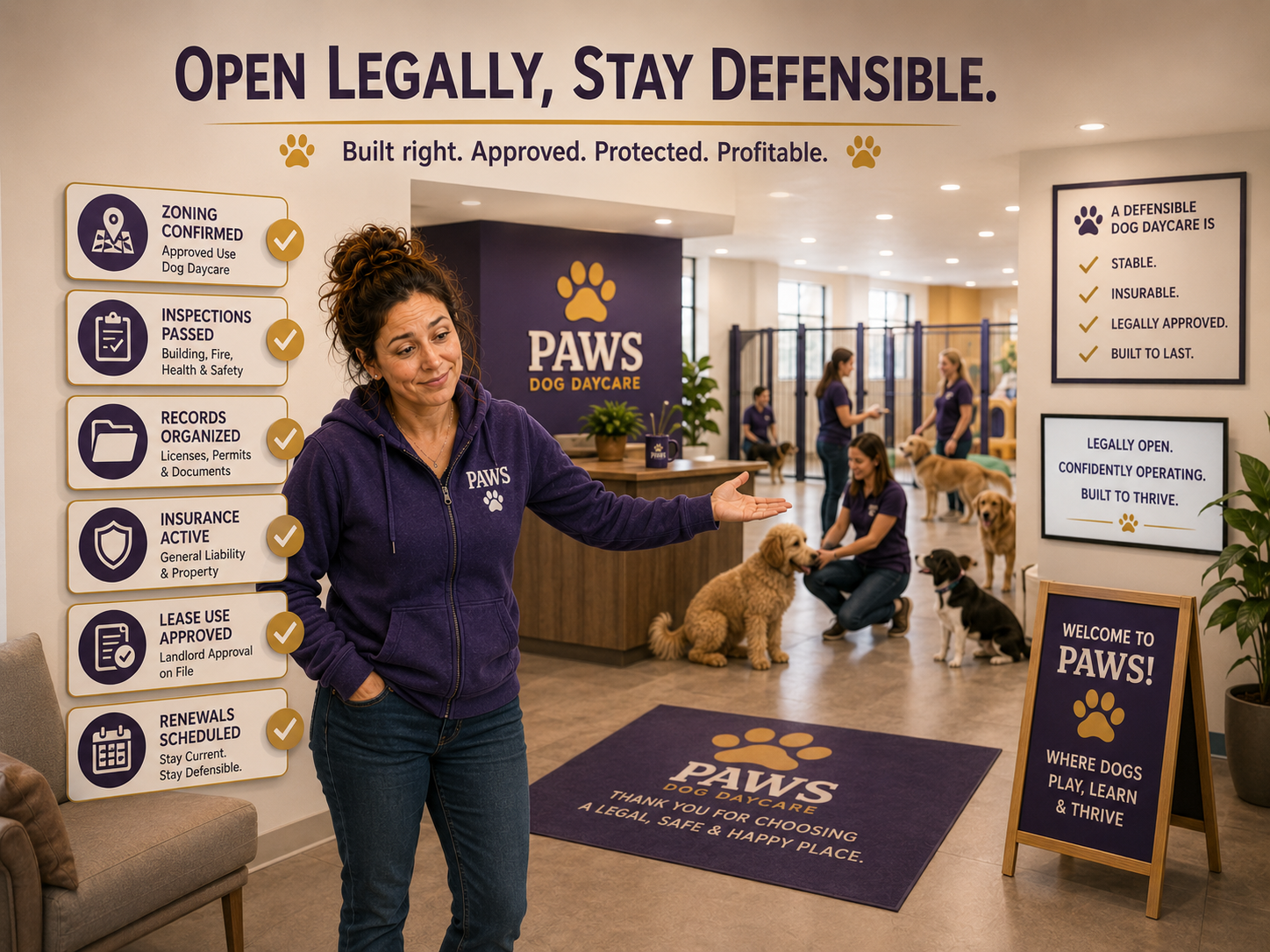
Most people want to think about the dogs, the playrooms, the logo, the name, the website, the lobby, the grand opening, and the customers. That is natural. But none of that matters if the business cannot legally operate, cannot pass inspection, cannot get insured, cannot satisfy the lease, or cannot document the records required to keep dogs safe and regulators satisfied.
Licensing is one of those areas where guessing can get expensive. Slow down, ask the right offices, separate the services, get written answers, protect the lease, and do not let excitement move faster than approval.
A properly licensed dog daycare is not just more professional. It is more stable, more defensible, easier to insure, easier to sell to customers, and much less likely to be blindsided by an inspector, landlord, neighbor, city official, or insurance carrier after the money is already spent.