Franchise, Consultant, Independent Startup, Existing Facility, Royalties, Brand Recognition, Operating Systems, and Long-Term Control
Doggy Daycare Franchise: What Are You Really Buying?
A blunt operator guide to dog daycare franchise decisions, long-term royalties, startup help, consultants, independent ownership, and whether the logo is really worth the leash attached to it.
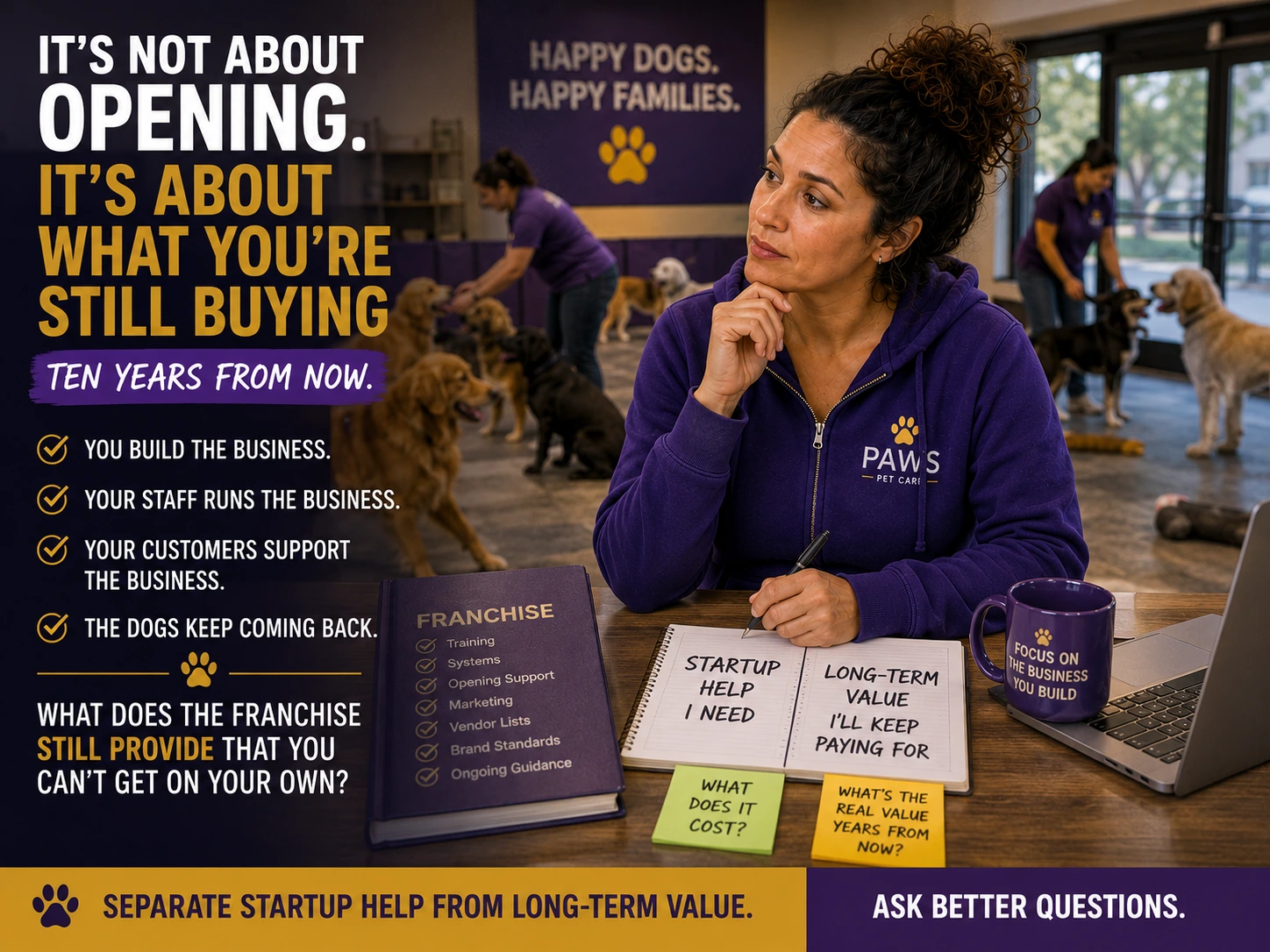
Can a doggy daycare franchise can help you open? That is not the hard question. The hard question is what you are still buying five, ten, or fifteen years later when the business is running, the staff knows the routine, the customers know the building, the dogs know the front door, and the royalty still comes off the top.
Search for “dog daycare franchise” or “doggy daycare franchise” and a lot of what you find is written by people trying to sell you one. That does not make all of it wrong. It just means the page has a job. Its job is to make the franchise look attractive. This page has a different job. This page asks whether buying a dog daycare franchise makes sense in the first place.
And before you sell yourself short, let’s be honest about who is probably reading this. If you are seriously considering a dog daycare franchise, you are probably not broke, helpless, or stupid. Not a lot of people have an extra franchise fee sitting around, access to serious financing, or the ability to even think about building out a commercial pet-care facility. Unless you inherited Rockefeller money and accidentally tripped into a bank account, you probably did something right to get here.
You may have built a career. You may have owned another business. You may have managed money, people, projects, property, sales, operations, or some other adult responsibility that required more than watching motivational videos and buying a mug that says “Boss.” So do not let fear make you believe you are automatically incapable of learning this business.
This is not a franchise hit piece. A franchise can provide training, a startup roadmap, opening support, brand standards, manuals, software guidance, vendor lists, marketing materials, peer support, and operating structure. That is not worthless. The problem is that much of that value may be front-loaded. You may need it badly before opening and during the first year. Then the business becomes your local operation, run by your staff, in your building, with your customers, your payroll, your cleaning problems, your reviews, your dog fights, your grooming appointments, your boarding dogs, and your local reputation.
So the real question is not “Are dog daycare franchises good or bad?” That is too lazy. The real question is: what measurable long-term value does the franchise continue to provide after the startup hand-holding is over?
And one more thing: do not confuse a polished franchise sales process with a business education. A franchise company may have a very smooth path for moving interested buyers from inquiry form to phone call to discovery call to higher-level conversation. That is sales. Your job is not to be impressed by the path. Your job is to stop at every step and ask whether the long-term value is real.
⚠️
Operator warning: fear is not due diligence.
Some franchise sales pitches work because they make the business sound more mysterious than it is. They make you feel like you will fail without the mothership, the binder, the logo, the approved vendor list, the conference calls, and the “proven system.” Maybe you need some of that. Maybe you do not. But fear is a terrible reason to sign a long-term agreement.
A franchise may give you confidence. Just make sure you know the price of that confidence. If you need help for one year, be careful signing something that makes you pay for ten, fifteen, or twenty. A logo does not mop the floor. A royalty does not break up the dog fight. A franchise agreement does not make payroll easier when the room is half empty.
🍔
A Dog Daycare Franchise Is Not McDonald’s
This is the comparison people need to make before they get dazzled by the franchise deck.
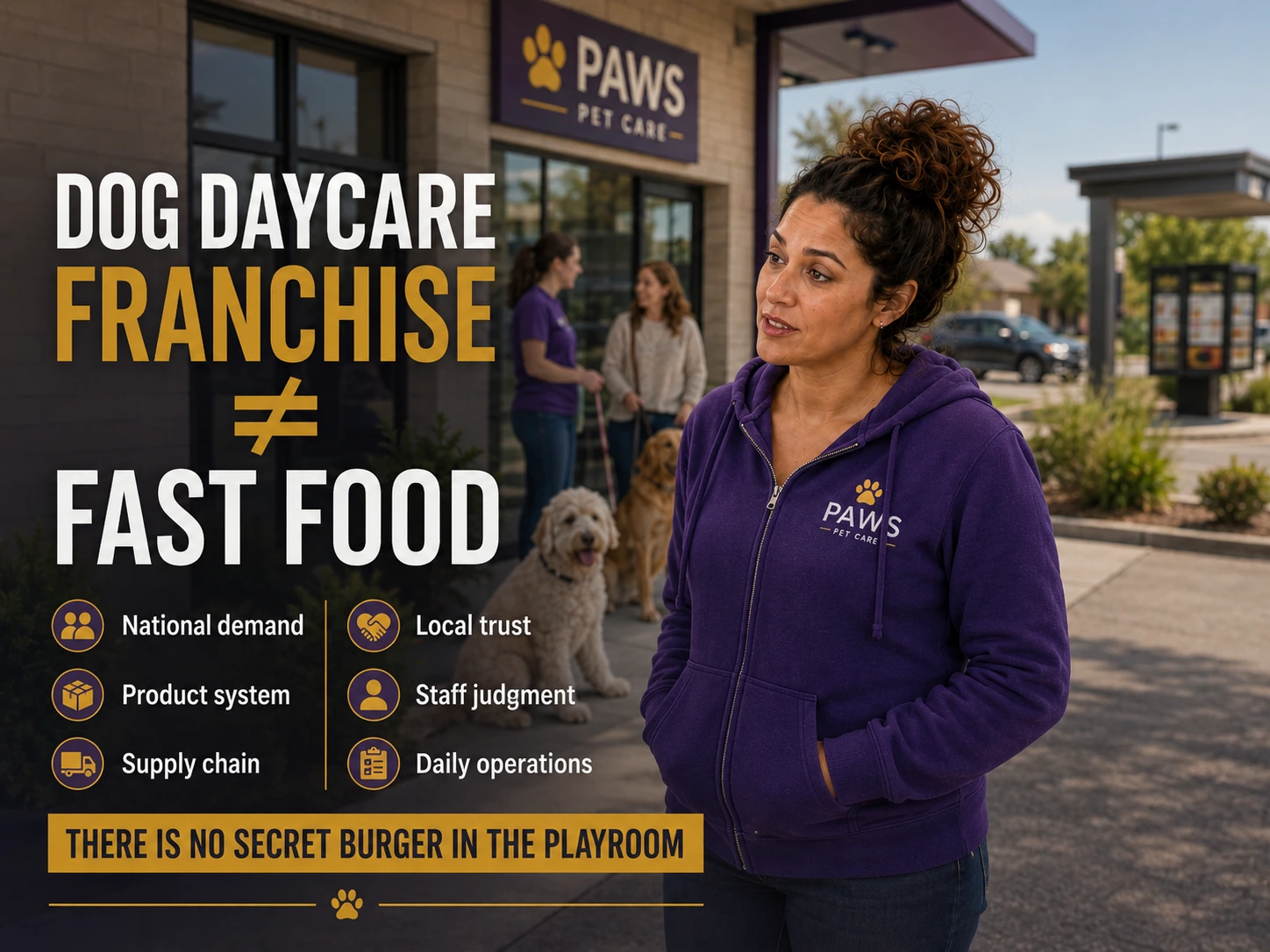
A major food franchise is often selling a giant machine: national brand recognition, product consistency, customer expectation, supply chains, menu systems, purchasing power, national advertising, operating processes, and a product the public already understands. A customer sees the golden arches and already knows what is inside before the car turns into the lot.
Dog daycare is different. There is no secret burger in the back room. There is no national french fry pipeline necessary to keep the dogs playing. There is no proprietary daycare ingredient that only arrives on the corporate truck every Thursday morning. Dog daycare is a simple business model wrapped around industry-specific operating risk.
That does not mean it is easy. It means the buyer has to separate the simple model from the hard operation. The model is simple: customers pay you to care for dogs through daycare, boarding, grooming, training, retail, enrichment, baths, nail trims, and related services. The operation is where people get punched in the face: payroll, staff turnover, cleaning, disease control, dog fights, injuries, noise, smell, insurance, customer complaints, lease problems, zoning, capacity limits, and bad temperament decisions.
Those problems are real. They can also be taught, managed, documented, trained, priced, staffed, and systemized. So before buying a dog daycare franchise, the buyer needs to ask: am I buying knowledge I could obtain another way, or am I buying long-term value that only this franchise can provide?
The comparison should focus on the source of customer demand. In a heavily standardized food franchise, the brand and product system may create immediate national expectations. In dog daycare, the customer often chooses a location because of convenience, tours, reviews, staff confidence, cleanliness, hours, service mix, and trust in the local operation.
A buyer should separate transferable operating knowledge from exclusive franchise value. Intake systems, cleaning protocols, staffing plans, behavior procedures, pricing, software, and marketing can all matter without necessarily being unique to one franchisor.
📌
The core question
A franchise can be valuable. But in dog daycare, the value has to be proven. Do not assume the value exists just because the sales material has happy dogs, bright colors, and a phrase like “proven system” wearing a little marketing hat.
⏳
Startup Help Is Not the Same Thing as Long-Term Value
This is where the franchise decision stops being emotional and starts being math.

A good dog daycare franchise may help with the startup roadmap, facility design standards, training, operating manuals, brand standards, software setup, vendor suggestions, marketing templates, opening support, hiring systems, policy templates, pricing guidance, and coaching. That can matter, especially for a first-time owner who has never signed a commercial lease, hired kennel staff, priced daycare packages, written vaccination rules, handled an outbreak, or watched a playgroup go from cute to chaos in seven seconds.
The problem is not that startup help has no value. The problem is that startup help and long-term value are two different things. A buyer may need heavy help before opening. A buyer may need help during the first year. But after the building is open, the staff is trained, the customer base is growing, the cleaning routine is built, the software is running, and the local reputation is being created by the actual operation, what is the franchise still selling every month?
That question matters because royalties and advertising fees are not tiny decorative charges. They come out of the business while the owner is also paying rent, payroll, insurance, utilities, debt service, software fees, repair costs, cleaning supplies, taxes, workers’ compensation, marketing, and whatever else decided to break that week.
If the franchise keeps creating real value, fine. Prove it. But if the ongoing value is mostly startup confidence from five years ago, the buyer may be paying forever for a problem that only existed at the beginning.
Build a value timeline before signing. List what the franchise provides before opening, during the first year, after the manager and staff are trained, and during later renewal years. Then assign a realistic dollar value to each benefit instead of treating support as one permanent undivided promise.
The year-five analysis should include what would be lost if the agreement ended: consumer demand, protected territory, operating updates, software, purchasing savings, training, recruiting help, crisis support, resale value, and any services the independent business would need to replace.
⚠️
The year-five question
What are you still buying in year five that you could not buy, hire, learn, build, or manage yourself? If nobody can answer that clearly, slow down before signing anything with a long tail and sharp teeth.
🧠
Do Not Sell Yourself Short Just Because the Startup Feels Big
If you have the money and discipline to seriously consider this business, you may be more capable than the sales pitch wants you to believe.
Opening a dog daycare is a serious project. The investment can be large. The lease can be dangerous. The build-out can get ugly. The staffing can wear you down. The first six months can make your bank account look like it got dragged behind a truck. Nobody should pretend this is easy.
But do not confuse “serious” with “impossible.” Dog daycare is not a laboratory, a hospital, an airline, or a nuclear reactor. It is a business model you can learn if you are willing to study, plan, ask questions, hire the right experts, and stop pretending enthusiasm is a financial plan.
If you have gotten far enough in life to have the capital, credit, confidence, or investor backing to consider opening a pet-care facility, you are probably already ahead of the average bear. You may not know dog daycare yet. Fine. Learn it. You may not understand zoning yet. Fine. Research it. You may not know flooring, drainage, odor control, dog-handling systems, pricing, software, staffing, or disease control yet. Fine. Those are problems to solve, not proof that you need to rent someone else’s brand forever.
A lot of capable people come from structured careers. Maybe they were executives, managers, finance people, real estate people, corporate professionals, medical professionals, military officers, engineers, salespeople, or operators inside larger organizations. They know how to work. They know how to manage pressure. They know how to learn. But when they step outside the corporate walls, the blank page scares them. That fear can make a franchise look like a life raft.
Sometimes it is a life raft. Sometimes it is a very expensive security blanket with a royalty clause sewn into the corner.
Confidence should come from assembling the right expert team rather than pretending the owner must know everything personally. Franchise counsel, a commercial lease attorney, accountant, contractor, HVAC specialist, insurance broker, dog-care operator, and local marketing professional can solve different parts of the startup problem without one company controlling every answer.
The disciplined independent buyer also needs a project plan, decision deadlines, written budgets, contingency cash, and a willingness to stop when the numbers fail. Independence is not freedom from structure; it is responsibility for building and enforcing the structure yourself.
📌
The self-check
Do not ask, “Can I do this with no help?” That is the wrong question. Ask, “What help do I actually need, how long do I need it, and do I need to give up a percentage of gross sales for years to get it?”
🧱
What a Dog Daycare Franchise May Actually Provide
A good franchise is not selling nothing. The buyer just has to separate real value from expensive comfort.
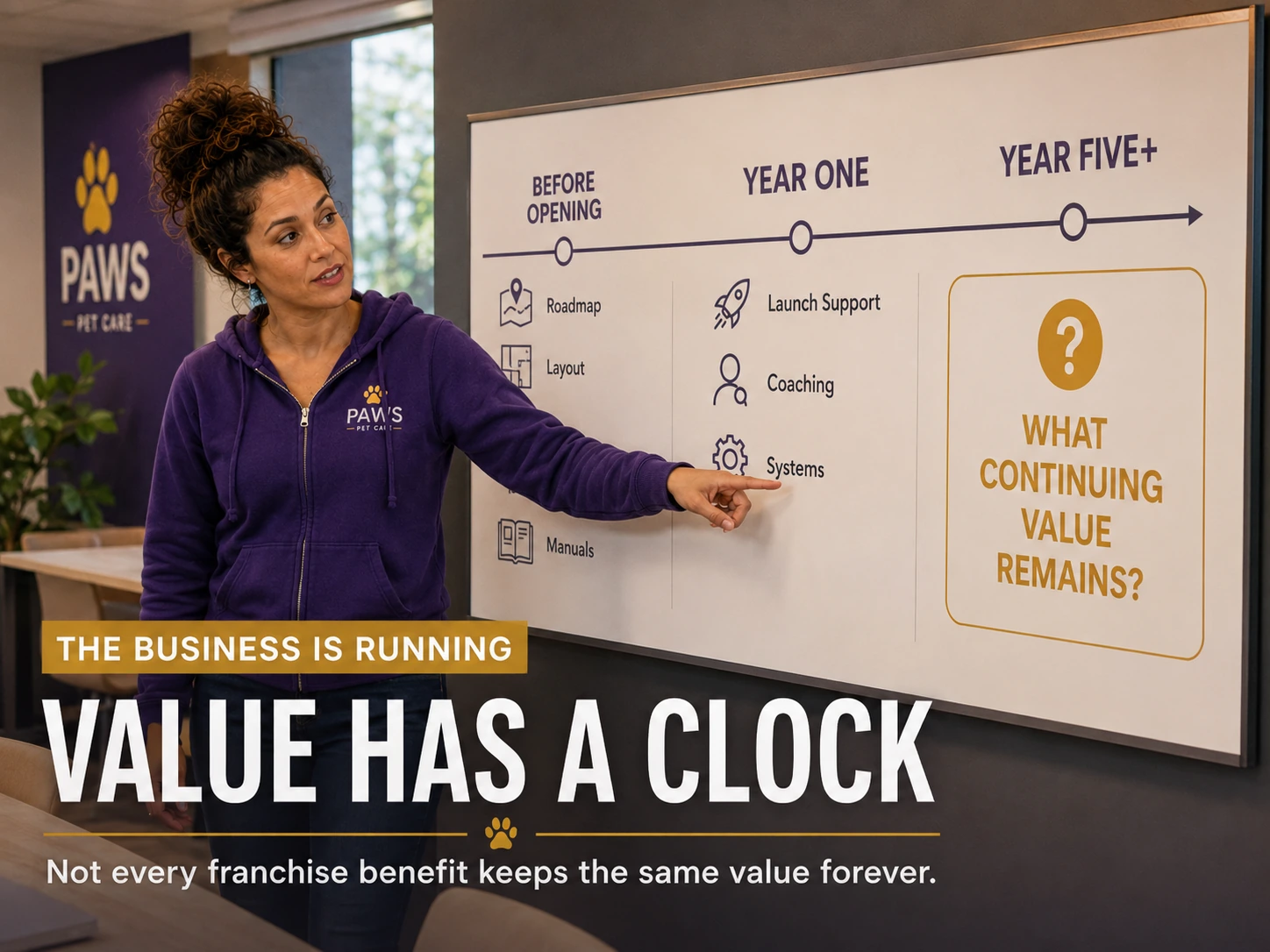
A serious franchise system may package a lot of useful things: a site-selection process, layout guidance, brand standards, training, operating procedures, marketing templates, approved vendors, staff systems, forms, software, reporting, customer-service expectations, safety standards, cleaning protocols, disease-control procedures, opening timelines, and support calls.
That is the fair side of the argument. For a new owner, that structure can reduce confusion. It can prevent some dumb mistakes. It can give a nervous buyer a checklist instead of a blank wall. That has value.
But value has a clock. Something that is extremely useful before opening may be much less valuable once the business is running. A manual that helped you survive year one does not automatically justify a royalty in year nine. A vendor list that helped you start does not automatically mean you should give up vendor freedom forever. A marketing template that helped with grand opening does not mean the brand is generating local demand five years later.
Measure each asset by frequency of use and financial effect. A support call that solves a major staffing or disease-control problem may be valuable, while a required vendor that costs more every month may destroy value elsewhere in the same system.
The correct comparison is net value after fees, restrictions, required purchases, lost flexibility, and implementation cost. A long list of franchise benefits can still produce weak economics if the owner pays heavily for assets that are rarely used or easily replaced.
| Franchise Asset | Real Startup Value | Long-Term Question |
|---|---|---|
| Startup roadmap | Helps a new owner know what comes next before opening. | Once the business is open, what ongoing value does this still provide? |
| Facility layout standards | Can prevent bad room flow, unsafe gates, poor customer entry, and expensive design mistakes. | Are the standards flexible enough for your building, market, budget, and local code issues? |
| Operating manual | Gives a first-time owner procedures for intake, cleaning, staff, safety, incidents, and daily routines. | Is it actively updated and useful, or is it old paper you already absorbed? |
| Training | Helps owners and managers understand the system before launch. | How much training continues after opening, and is it solving real current problems? |
| Approved vendors | May reduce research time and standardize quality. | Are they cheaper, better, and safer, or just mandatory? |
| Marketing support | May provide launch materials, brand assets, templates, and campaign ideas. | Does it create actual local leads, or are you still doing all the local hustle yourself? |
| Software | Can organize reservations, client records, vaccines, payments, and reporting. | Is it better than independent pet-care software, or just required software with a brand wrapper? |
| Brand name | May help if local dog owners already know and trust it. | Do customers choose the brand, or do they choose the local staff, reviews, location, and facility? |
🏖️
The Timeshare Problem: Buying Confidence With a Long Tail
A franchise pitch can start to feel like a timeshare presentation if the pressure is high and the fear button keeps getting pushed.
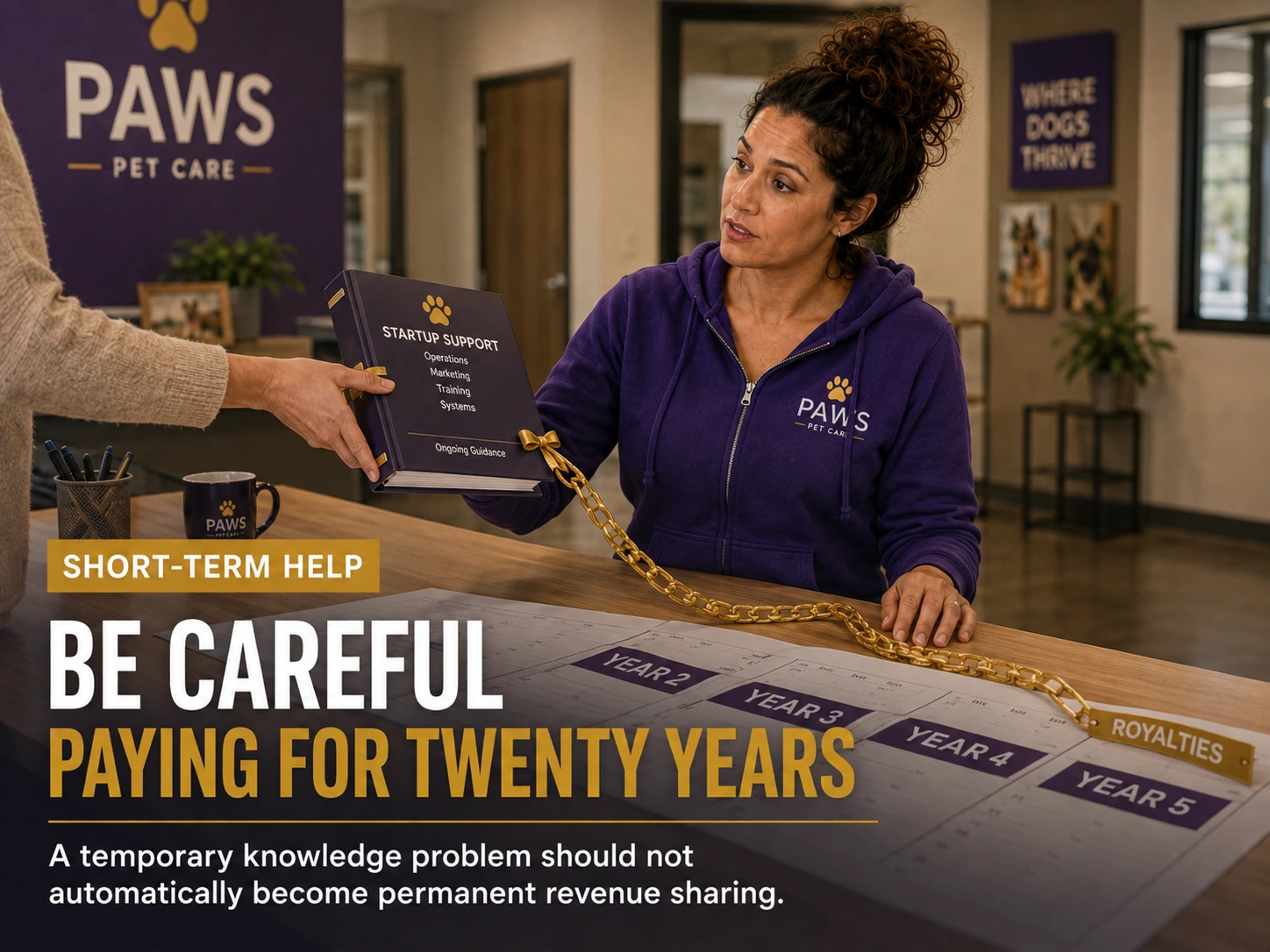
The uncomfortable truth is that some franchise opportunities are sold with a lot of emotional pressure. Not always. Not every company. Not every salesperson. But the pattern exists: make the buyer feel excited, make the business sound complicated, make the system sound essential, make independent startup feel reckless, and make the franchise feel like the safe adult choice.
That is where buyers need to slow down. Safe compared to what? Safe at what cost? Safe for whom? A franchise can reduce certain startup risks, but it can also create different risks: long-term royalties, advertising fees, required vendors, brand restrictions, remodel obligations, renewal questions, resale limits, reporting requirements, and contract default exposure.
In other words, the franchise may reduce the fear of opening while creating a long-term financial and control obligation. That might be worth it. But the buyer needs to see it clearly.
Do not let a polished sales process turn a temporary fear problem into a permanent payment structure. If you need six months of education, get six months of education. If you need a consultant, hire a consultant. If you need a lawyer, hire a lawyer. If you need software, buy software. If you need a manual, buy a manual. But do not automatically buy a long-term royalty obligation because the startup phase made your stomach hurt.
Pressure should trigger verification, not acceleration. Buyers should ask for time to review the FDD, model the full fee stack, contact current and former franchisees, compare independent alternatives, and have counsel explain the exit, renewal, transfer, default, and vendor provisions.
A legitimate opportunity should survive a slower decision process. If the value depends on urgency, exclusivity, flattering access, or fear that the buyer will miss a narrow window, the buyer should distinguish the investment case from the sales technique.
⚠️
The long-tail warning
A one-year knowledge problem should not automatically become a twenty-year revenue-sharing problem. That is the math you need to stare at before signing anything.
☎️
The Franchise Sales Funnel: When the Buyer Starts Feeling Like the Applicant
The process can feel like a timeshare pitch because it makes you feel selected, guided, warmed up, and moved toward a decision.
I have been in the dog daycare and pet-care industry for more than two decades. At one point, I went through the inquiry process with multiple dog daycare franchise companies just to understand how the franchise side of the industry worked. I wanted to see the process, hear the pitch, ask the questions, and understand what a serious buyer would experience.
I will also own this part completely: I was doing research. I was not there with any real interest in purchasing a dog daycare franchise. I went into the process knowing I was not going to write a check. While that may have wasted some salespeople’s time, and I am not going to pretend otherwise, that is business. Sometimes the only way to understand a sales process is to walk through enough of it to see how it actually works.
This is no different from opening a dog daycare and secret-shopping your competitors. You call around and ask what they charge for daycare. You ask what boarding includes. You ask about grooming, packages, temperament tests, vaccines, holiday rules, late fees, and cancellation policies. You study their websites. You look at their reviews. You compare their offers. You are not doing that because you plan to bring your golden doodle in next Tuesday. You are doing it because market research matters. You are doing it because you are trying to take their customers, cut into their gross revenues, and put your business in a position to beat theirs. In a perfect world, you open strong enough that the weak operators are left standing outside the window like Tiny Tim while your lobby fills up. Nothing personal. That is business.
Franchise research is the same idea, just with bigger numbers and a more polished sales machine. You cannot exactly call a franchise company and say, “Hey, I am just mapping your buyer funnel and figuring out how you sell this thing.” That conversation is not going very far. So if you want to understand the process, you sometimes have to enter the process.
So what did I learn? The pattern was fairly similar regardless of the company. First you fill out the form. Then they want to know your financial picture. Then come the scheduled calls. Then maybe a regional person. Then maybe someone higher up. Then you are made to feel like you are moving through a special process, almost like you should feel lucky to get the next conversation. It starts to feel less like neutral education and more like a guided sales road.
And this is where the psychology gets interesting. A franchise sales process can start making you feel less like the buyer and more like the applicant. They tell you they do not accept everyone. They talk about fit. They talk about your background, your drive, your funds, your experience, your personality, and how you seem like the kind of person who could really succeed in their system.
That flattery works because it hits the exact nerve a nervous buyer already has exposed. You are considering a large investment. You want reassurance. You want to know you are not crazy for thinking about it. Then someone on the other end of the phone tells you that you are different, serious, qualified, impressive, and maybe even special enough to be part of their brand.
That is not an accident. That is sales.
A franchisor should qualify buyers. They should not sell franchises to anyone with a pulse and a bank statement. They should want people who are funded, serious, stable, and capable. Fine. But you also need to recognize when qualification turns into emotional momentum.
You can be flattered into moving forward. You can be warmed up by staged access to higher-ups who supposedly do not talk to just anybody. First it is one call, then another call, then maybe you get moved up to the big person, and suddenly the whole thing starts feeling like you are being admitted through velvet ropes instead of being sold a franchise. That is where smart people get loose with their guard. The process starts feeling like one of those hotel-ballroom investment seminars where the real action is the package being sold at the back of the room.
That “we do not accept everyone” line is especially powerful. Maybe it is true. Maybe they really do reject weak candidates. But it also changes the buyer’s posture. Instead of thinking, “I am evaluating this investment,” the buyer starts thinking, “I hope they approve me.” That is a dangerous little mental flip when you are the one bringing the money, signing the lease, carrying the debt, and living with the agreement.
The problem is not that a company has a sales process. The problem is when the buyer confuses the sales process with due diligence. They are not the same thing. A salesperson’s job is to move you forward. Your job is to slow the deal down long enough for the boring numbers, contracts, fees, restrictions, and long-term obligations to get a vote.
The buyer should maintain a written question log through every call. Record each claim, the person who made it, the supporting document promised, and whether the answer appears in the FDD or agreement. A confident conversation should never substitute for written terms.
The posture changes when the buyer sets milestones: no deposit before document review, no site commitment before zoning and lease analysis, no financial assumption without support, and no reliance on verbal exceptions that the contract does not preserve.
⚠️
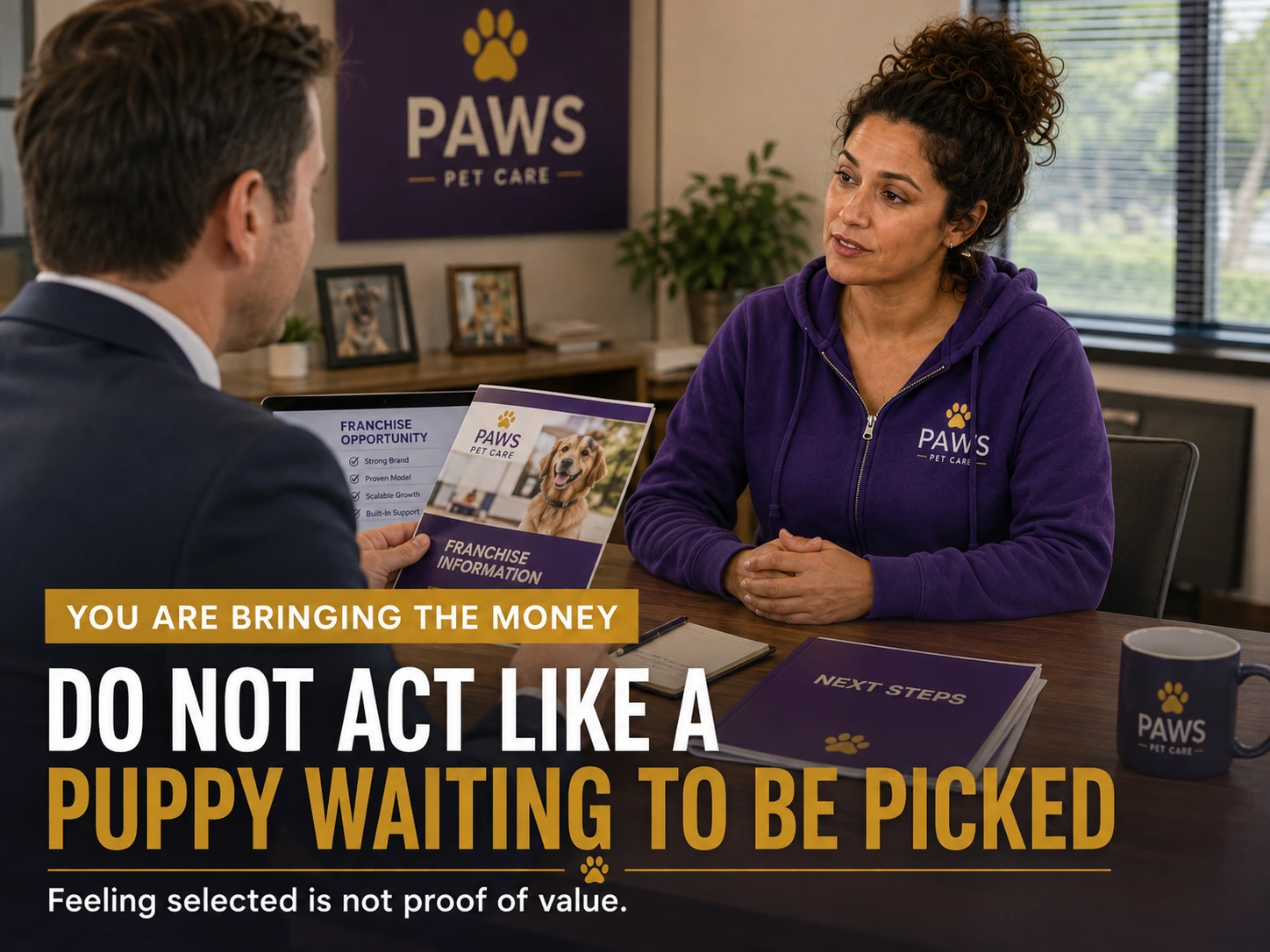
Do not act like a puppy waiting to be picked.
You are not there hoping the franchise company adopts you from the business shelter. You are the buyer. You are the one bringing the money, signing the lease, taking the risk, hiring the staff, carrying the debt, and living with the agreement. Feeling selected is not proof of value.
A scheduled call is not validation. A friendly regional rep is not proof of value. A “next step” is not due diligence. A polished process can make the buyer feel chosen, but the buyer still has to ask what they are buying, what it costs, what it controls, what happens if they want out, and what value is still there after the opening excitement wears off.
🗺️
Use This Hub Like a Dog Daycare Franchise Decision Map
Work through the major choices before a franchise salesperson, broker, consultant, landlord, or seller starts steering the conversation for you.
⚖️
Dog Daycare Franchise vs. Independent Startup
The apples-to-apples comparison: support versus control, royalties versus freedom, brand standards versus local flexibility, and whether the franchise creates enough long-term value.
💵
Dog Daycare Franchise Costs
The franchise fee is not the cost of opening. Build-out, rent, HVAC, flooring, drainage, equipment, software, payroll ramp-up, marketing, debt service, and working capital matter.
🧾
Dog Daycare Franchise Royalties
Royalties usually come off revenue, not whatever is left after the business survives the month. This page asks what the franchisor keeps providing after the startup period.
📣
Dog Daycare Franchise Brand Recognition
Known by franchise buyers is not the same as known by local dog owners. This page tests whether the brand actually creates customer demand in your market.
🍟
The Golden Arches Test
If the dog daycare logo came off the building tomorrow, would the same dogs still show up? That question cuts through a lot of franchise glitter.
📄
Dog Daycare Franchise FDD
The happy brochure dog is not the contract. The FDD is where fees, obligations, territory, supplier restrictions, renewal, termination, transfers, and financial claims start showing teeth.
📚
Dog Daycare Franchise Operating System
Manuals, procedures, training, safety systems, cleaning rules, software, staff standards, and daily operating checklists can help. But is the rulebook still worth paying for after you learn the business?
🔒
Franchise Control, Approved Vendors, and Forced Upgrades
A franchise is not just help. It is help with a leash attached: standards, inspections, approved vendors, remodel rules, signage rules, marketing approval, and contract teeth.
📢
Dog Daycare Franchise Marketing Support
National brand, ad fund, marketing templates, local SEO, reviews, events, vet visits, referral tracking, social media, and the local grind that still fills the building.
🧠
Dog Daycare Consultant vs. Franchise
A consultant should help you avoid expensive mistakes and then get out of your pocket. A franchise may help you avoid expensive mistakes and then stay there.
🔧
Starting an Independent Dog Daycare
Independent does not mean winging it. It means you build the system instead of renting someone else’s, and you keep the upside without royalty drag.
🏚️
Buying an Existing Dog Daycare
Some existing dog daycares are real businesses. Some are owner-funded hobbies with a customer list, a tired mop bucket, and a fantasy asking price.
🧰
Dog Daycare Startup Help Options
Franchise, consultant, manual, software, templates, lawyer, accountant, contractor, trainer, acquisition broker — match the help to the actual problem.
🧭
Franchise, Independent, Consultant, or Existing Business?
Do not ask which one sounds safest. Ask which one solves the actual problem without creating a larger one.
Use this table to compare the problem each path solves rather than treating one option as automatically safe. The same owner may need a consultant for facility planning, an attorney for the lease, independent software, and a manual without needing a permanent franchise relationship.
Build a total-cost and control comparison for each path. Include startup fees, ongoing fees, owner time, contract restrictions, replacement systems, resale implications, and the quality of help available when the business is already operating.
| Path | What You Are Buying | Where It Helps | Where It Can Bite You |
|---|---|---|---|
| Franchise | Brand, startup system, training, standards, manuals, support, and permission to operate under someone else’s name. | Can help first-time owners who need structure, opening support, training, and a defined operating model. | Upfront cost, royalties, ad funds, restrictions, approved vendors, contract control, forced upgrades, resale rules, and long-term royalty drag. |
| Independent Startup | Full control, local brand, flexible service mix, pricing freedom, vendor freedom, and no royalty obligation. | Strong fit for owners willing to build systems, hire help where needed, and learn the business without renting someone else’s brand. | No franchise playbook. Every bad lease, bad price, bad hire, bad floor, bad policy, and bad marketing decision belongs to you. |
| Consultant-Guided Startup | Knowledge, review, planning help, facility guidance, pricing support, policy review, and operator experience for a defined fee or timeline. | Useful when the owner needs help with specific decisions but does not want a permanent royalty relationship. | Consultants vary wildly. A good one saves money. A bad one sells confidence, buzzwords, and recycled advice in a shiny binder. |
| Existing Business Purchase | Customers, lease, equipment, staff, reputation, records, and an operation that may already have cash flow. | Can reduce startup time if the numbers, lease, staff, facility, reputation, and systems are clean. | Hidden liabilities, fake add-backs, weak records, deferred maintenance, staff problems, disease history, customer churn, and fantasy valuations. |
| Manual / Templates / Software Stack | Planning tools, forms, calculators, software, checklists, policies, and structured learning at a lower cost. | Good for owners who are disciplined enough to do the work and smart enough to hire experts for legal, financial, lease, and construction issues. | Tools do not execute themselves. Buying a manual and ignoring the numbers is just procrastination with a receipt. |
📚
The Operating System Question: Playbook or Expensive Rulebook?
A franchise operating system can be useful. That does not mean the buyer should stop thinking.
One of the better arguments for a dog daycare franchise is that it may give the owner a complete operating system. That can include intake procedures, vaccination rules, dog evaluation standards, cleaning routines, daily checklists, staff training, incident reporting, customer-service scripts, safety requirements, software procedures, marketing calendars, and facility standards.
That is useful, especially in the beginning. But let’s not pretend these systems are carved into stone tablets and handed down from Mount Franchise. Dog daycare systems can be learned, built, bought, customized, improved, and documented. The question is not whether systems matter. Of course they matter. The question is whether you need to pay a percentage of gross sales for years to access them.
But a rulebook is not magic. Once you learn the business, the question changes. The issue is no longer whether the system helped you start. The issue is whether the system keeps improving your operation enough to justify the continuing cost and control.
Independent owners still need operating systems. They still need forms, policies, cleaning logs, disease-control rules, employee training, intake procedures, incident reports, vaccination tracking, and customer communication standards. The difference is that independent owners build, buy, hire, and customize those systems instead of operating inside a franchisor’s rulebook.
Evaluate whether the system is merely complete or actually effective. Ask how often procedures are updated, who makes changes after incidents or outbreaks, how compliance is measured, and whether franchisees can show improved labor, safety, conversion, or customer retention from using the system.
Independent owners should compare the cost of building equivalent systems through manuals, software, consultants, trainers, legal forms, and internal management time. The comparison should include execution and updating, not only the purchase price of documents.
🧠
The useful rulebook test
A franchise manual can save you from stupid mistakes. It does not automatically justify paying a royalty forever after you already learned how to run the place.
📢
Marketing Support: National Brand or Local Hustle?
A franchise may provide marketing support. That does not mean the logo fills the playrooms.
Marketing support can mean a lot of things. It can mean brand standards, logos, brochures, templates, launch campaigns, social media rules, email examples, grand opening guidance, ad fund materials, national awareness, local marketing plans, review strategy, or a list of suggested outreach activities.
Some of that can be helpful. But the buyer needs to ask what creates actual local customer demand. Dog daycare is local. Customers care about convenience, trust, reviews, cleanliness, staff, tours, temperament testing, hours, pricing, boarding availability, grooming convenience, and whether they feel safe leaving their dog with you.
If the franchise brand was enough by itself, why does the local owner still need local SEO, Google Business Profile work, online reviews, vet visits, apartment outreach, events, referral programs, email follow-up, social media photos, phone scripts, tour conversion, and constant relationship-building in the community?
That is not a trick question. It is the reality of this business. A franchise may provide marketing tools. The owner still needs to turn those tools into local customers. A template is not a tour request. An ad fund is not a full playroom. A logo on a brochure does not replace the grind of getting known in your own market.
🎯
Marketing support test
Ask how many actual leads, tours, temperament tests, daycare packages, boarding reservations, grooming appointments, and paying customers the franchise marketing system creates in your type of market. “Brand awareness” is nice. Deposits are nicer.
📣
Brand Recognition: Known by Dog Owners or Known by Franchise Buyers?
Those are not the same thing, and confusing them can get expensive.
Showing up when someone searches “dog daycare franchise” does not automatically mean local dog owners know the brand. It may mean the franchisor knows how to advertise franchise opportunities. That helps the franchisor sell franchises. It does not automatically fill your daycare rooms, grooming schedule, boarding suites, or temperament test calendar.
Before buying a franchise, ask normal dog owners in the actual service area if they know the brand. Not franchise brokers. Not people at a franchise expo. Not people who already live inside the pet industry. Normal dog owners with dogs, jobs, wallets, commutes, and a need for daycare, boarding, grooming, or training.
If they do not know the brand, then you may not be buying customer demand. You may be buying the right to build local customer demand under someone else’s sign.
Local recognition can be tested before the sale closes. Use consumer surveys, branded and unbranded search data, customer interviews, competitor reviews, referral sources, and conversations with franchisees in comparable markets. The question is whether the name changes buying behavior in the proposed territory.
Brand value should also be separated from the location’s own reputation. Once local reviews, staff relationships, grooming quality, and customer routines become established, determine how much continuing demand is generated by corporate identity versus the local team.
- Ask ten normal dog owners in the service area if they recognize the brand.
- Ask whether the brand name alone would make them more likely to book a tour.
- Compare the franchise brand against local independent facilities with strong reviews.
- Check whether local search results show consumer demand or franchise-development advertising.
- Ask existing franchisees how many customers came in because of the brand name itself.
- Ask whether national advertising creates actual local leads or just general brand noise.
🎯
The local brand test
If the customer chooses you because of the staff, reviews, location, convenience, cleanliness, groomer, tours, pricing, and local reputation, then the franchise brand may not be the thing doing the heavy lifting.
🍟
The Golden Arches Test
If the logo came off the building tomorrow, what would actually happen?
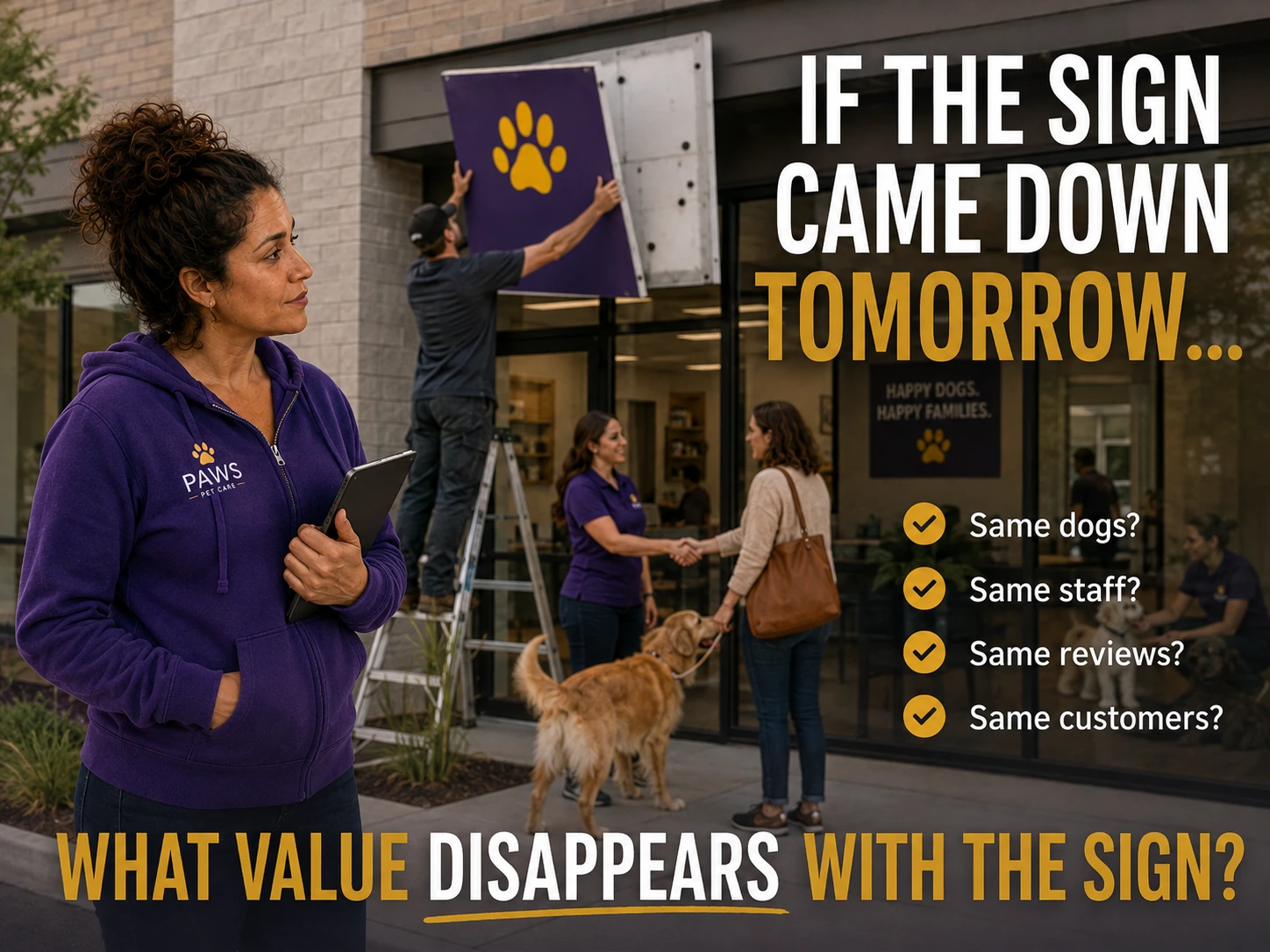
If a McDonald’s franchise loses the golden arches, the menu, the supply chain, the national brand, the product standards, the advertising machine, and the customer expectation, that location is no longer the same business the next morning. Customers did not pull in because they wanted “a building with sandwiches.” They pulled in because it was McDonald’s.
Now run the same test on a dog daycare franchise. If the franchise name came off the building tomorrow, would the same daycare dogs still show up? Would the same boarding customers still arrive? Would grooming appointments still walk through the door? Would the same local customers still trust the same staff in the same building with the same dogs?
In many dog daycare operations, the answer may be yes. Not perfectly. Rebranding is annoying. Software migration can be a pain. Signs, websites, forms, uniforms, email addresses, listings, and policies may need to change. But the business may not collapse, because the customer relationship may be tied more to the local facility than the franchise logo.
That does not mean the brand has no value. It means the buyer needs to identify exactly how much value the brand creates and whether that value justifies the long-term fee structure.
Run the test as a replacement-cost exercise. Estimate the cost of new signs, website migration, software conversion, forms, uniforms, email, listings, customer notices, and local rebranding. Then compare that one-time disruption with the remaining years of royalty and advertising obligations.
The test is not an argument that rebranding is easy or contractually available. It is a way to identify where economic value truly sits: in the trademark, the operating system, the territory, the staff, the facility, the reviews, or the customer relationships.
| If This Disappears | Does the Business Collapse? | What the Buyer Should Ask |
|---|---|---|
| Franchise Name / Logo | Maybe, if customers truly know and choose the brand. Maybe not, if loyalty is local. | Do customers come because of the brand or because of the facility, staff, reviews, and convenience? |
| Software | Usually painful, not fatal. | Is the software truly proprietary, or could comparable pet-care software be purchased elsewhere? |
| Vendor List | Usually not fatal. | Do vendors save money and improve quality, or are they just approved vendors with limited choice? |
| Operating Manual | Valuable early, less unique once the business is trained and running. | Is the manual still actively useful, updated, and better than what the owner could build or buy? |
| National Advertising | Only valuable if it creates real local demand. | Does the ad fund generate leads for this location, or mostly support the larger brand/franchise machine? |
| Franchise Support | Depends on the quality and specificity of the support. | Does support solve real operating problems, or is it mostly meetings, reminders, and cheerful emails? |
🧾
The Royalty Problem: The Franchisor Eats First
A royalty on gross sales is not the franchisor sharing your profit. It comes off before you know what you actually kept.
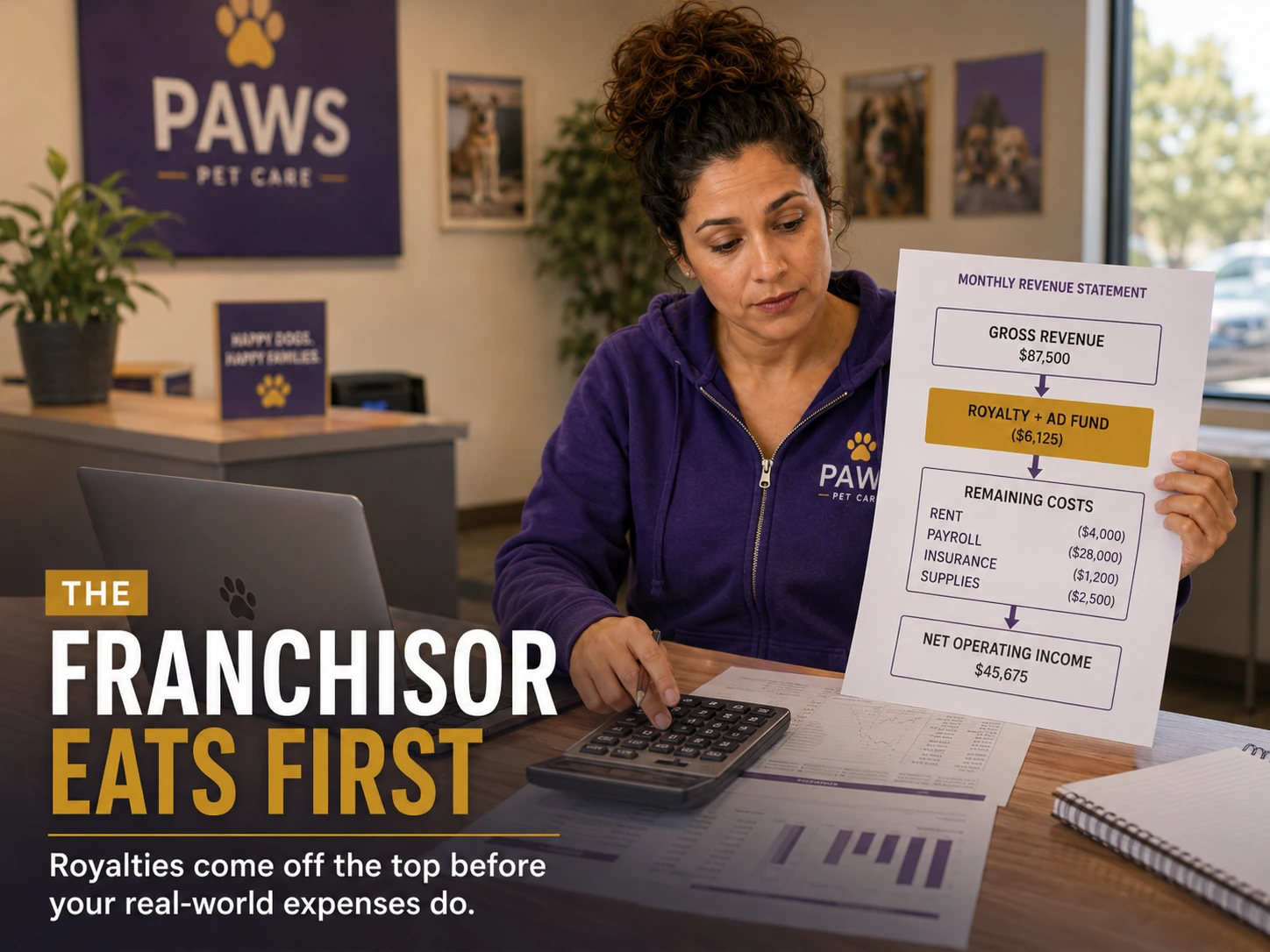
Franchise royalties are often based on revenue or gross sales. That means the franchisor may get paid before the owner knows whether the month was actually profitable. The daycare may look busy. The gross sales may look fine. But rent, payroll, insurance, utilities, debt, cleaning chemicals, software, repairs, advertising, payroll taxes, workers’ compensation, and staff turnover may still chew the bottom line down to a sad little nub.
That is why the royalty question has to be brutal. Not emotional. Brutal.
What is the franchisor still doing every month that justifies taking a percentage from the top line? Is the brand bringing customers? Is the national advertising helping your location? Is the software meaningfully better? Are vendor savings real? Is the ongoing coaching solving problems? Is the franchisee network valuable? Are the operating updates current? Is the territory protected? Is the system improving your profit enough to justify what it costs?
Maybe the answer is yes. If so, fine. But make the value prove itself. Do not let fear, excitement, sales pressure, or a polished franchise deck answer the question for you.
Model the fee stack under several operating conditions, not only the franchisor’s preferred revenue example. Test slow ramp-up, normal payroll, rent increases, manager coverage, repairs, debt service, and lower-margin service mixes. A fee that feels manageable at peak occupancy may be painful during ordinary months.
The owner should also calculate what the same dollars could fund independently: additional management coverage, local advertising, facility maintenance, staff training, debt reduction, cash reserves, or owner compensation. The cost of a royalty includes the alternative use of the cash.
🧮
Run the long-dollar math
A royalty percentage sounds small until you stack it across five, ten, fifteen, or twenty years of gross revenue. Use the calculator below and make the number stare back at you.
🧮
PAWS Royalty Drag Calculator
Punch in gross revenue, royalty percentage, and ad fund percentage. Then look at what comes off the top before rent, payroll, insurance, cleaning, debt, repairs, and reality get paid.
This is not a full franchise financial model. It is a pain meter. It shows how a small-looking percentage turns into real money when it rides on gross sales year after year.
🔒
Control, Approved Vendors, Forced Upgrades, and Contract Teeth
A franchise is not just help. It is also control. Read that sentence twice.
You may own the local business entity, but you do not fully own the rules of the business you are operating. You are using the franchisor’s brand and system under a contract. That contract can affect what services you offer, how the facility looks, what software you use, what vendors you buy from, what standards you must meet, how you advertise, whether you can sell, whether you can renew, and what happens if you default.
Approved vendors can be useful if they save money, improve quality, simplify purchasing, or prevent bad products from entering the system. They can also become a problem if the required vendor is more expensive, slower, weaker, or connected to corporate markups. “Approved” does not automatically mean “best deal.”
Forced upgrades are another issue. You may finally be above water, finally getting payroll under control, finally building profit, and then corporate decides the brand needs new colors, new signage, new lobby standards, new flooring, new software, new uniforms, or new design requirements. Maybe the upgrade is smart. Maybe it helps. Maybe it is necessary. But it is not free, and the timing may not care that your local business is already carrying debt like a Saint Bernard wearing a backpack full of bricks.
⚠️
Contract warning
Do not rely on the salesperson’s explanation of control, default, renewal, transfer, termination, vendor rules, ad fund rules, or upgrade obligations. Hire a franchise attorney. The sales deck is not the contract. The contract is where the teeth are.
🔍
The Dog Daycare Franchise Prove-It Test
Do not ask if the pitch sounds good. Make every claim prove itself.
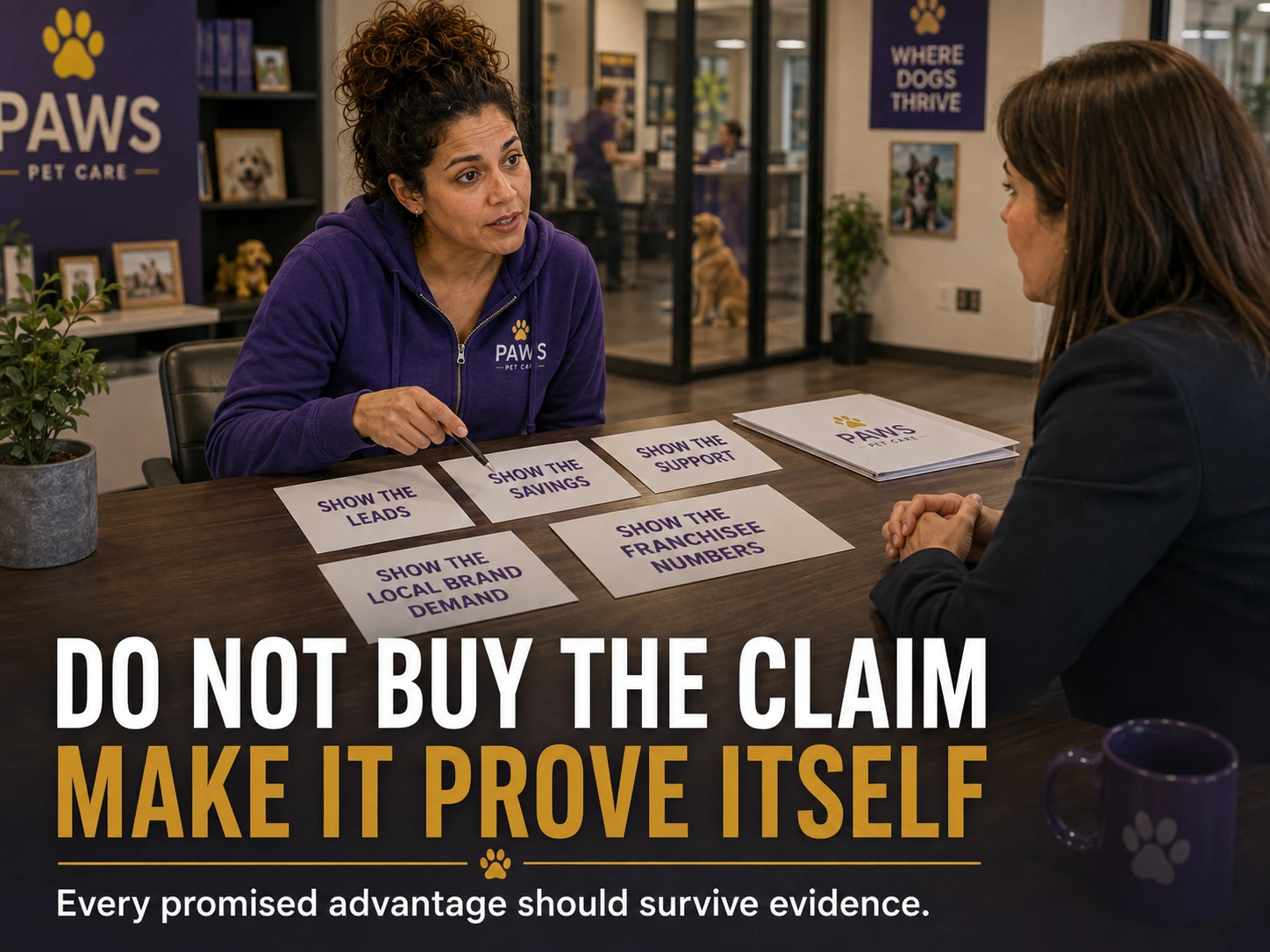
The prove-it test converts sales language into evidence. Every material claim should lead to a document, number, demonstration, contract provision, franchisee example, or local-market result that the buyer can independently examine.
The buyer should decide in advance what proof would be sufficient. A marketing claim may require lead and conversion data. A vendor claim may require comparable quotes. A support claim may require examples from current franchisees who used that support during a real operating problem.
When the franchisor cannot provide the requested evidence, record the uncertainty instead of allowing the sales process to fill the gap with confidence. An unproven benefit should not receive full value in the investment model.
| Franchise Claim | The Question to Force | Why It Matters |
|---|---|---|
| “We have a known brand.” | Known by whom — local dog owners or franchise buyers? | Brand value only matters if it creates customer trust and demand in your market. |
| “We provide marketing.” | Does that mean real leads, local campaigns, national awareness, templates, or franchise sales advertising? | Marketing materials are not the same as customers walking through the door. |
| “We have proprietary software.” | Is it actually proprietary, or is it replaceable pet-care software with a branded coat of paint? | Software can be useful, but software is not magic and usually does not justify a royalty by itself. |
| “We have vendor relationships.” | Do the vendors save money, improve quality, or just limit your choice? | Required vendors can help or hurt. The spreadsheet gets to vote. |
| “We provide training.” | How much training, who provides it, how hands-on is it, and how useful is it after year one? | Training can be valuable, but front-loaded training is not automatically long-term value. |
| “We offer ongoing support.” | Support doing what — hiring, cleaning, disease outbreaks, dog fights, pricing, reviews, payroll, marketing, or just check-in calls? | “Support” is a mushy word. Make it specific or it turns into fog with an invoice. |
| “We have a proven model.” | Proven where, with what rent, what payroll, what owner involvement, what market size, and what service mix? | A model that works in one market may not survive your rent, wages, zoning, competition, or customer base. |
| “We have a discovery process.” | Is this process educating you, qualifying you, or mainly moving you toward the next sales step? | A staged sales funnel can make a buyer feel special. Feeling special is not the same as proving the numbers, contract, territory, support, or long-term value. |
| “You get a protected territory.” | Protected from what, how large, for how long, and under what exceptions? | A territory clause that sounds good may be weaker than the buyer thinks. |
| “You can be semi-absentee.” | Who is managing the dogs, staff, customers, cleaning, incidents, payroll, reviews, and complaints while you are absent? | Dog daycare is not passive income. Dogs do not run shift meetings. |
| “Our franchisees do well.” | Show financial-performance support, closures, transfers, franchisee contacts, and boring numbers that can actually be checked. | Happy averages and cute facility photos are not due diligence. |
| “We have a complete system.” | Which parts are valuable before opening, which parts are valuable after opening, and which parts could be built or bought independently? | A system has value. But the buyer needs to know whether the system is worth the long-term cost and control. |
| “We help with local marketing.” | Does that help produce actual local tours, bookings, reviews, and repeat customers? | Local dog daycare demand is local. A brochure template does not fill a playroom by itself. |
🧠
Consultant vs. Franchise: Pay for Knowledge or Pay Forever?
This is not complicated. It is a different kind of value exchange.
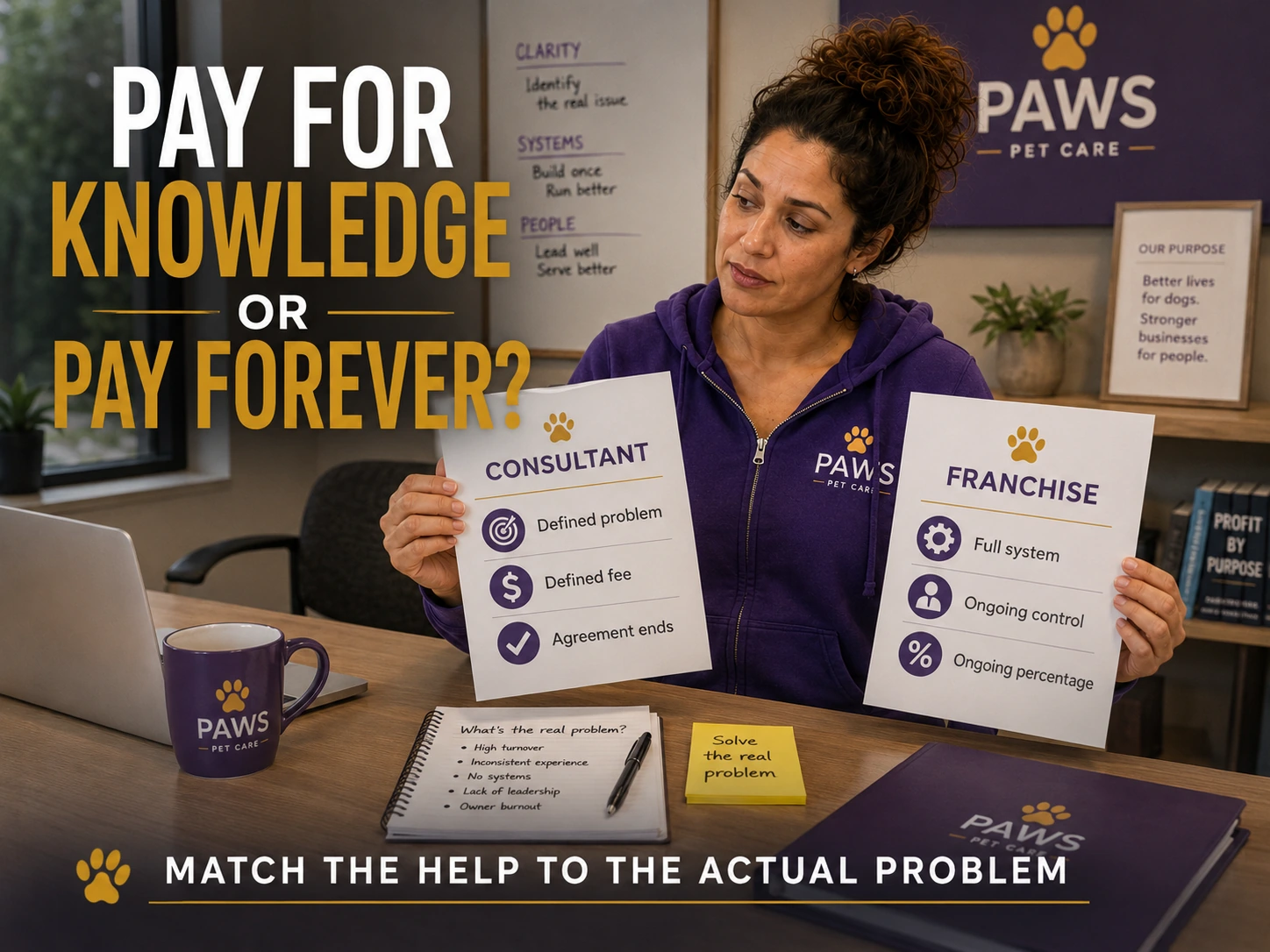
A consultant should help you avoid expensive mistakes and then get out of your pocket. A franchise may help you avoid expensive mistakes and then stay in your pocket for the life of the agreement. That does not make consulting automatically better. Some consultants are excellent. Some are useless. Some sell real operator knowledge. Some sell warm motivational fog and a PDF with paw prints.
But structurally, consulting is different. You can hire help for a defined problem: facility layout, pricing, startup costs, staff training, policy review, cleaning protocols, disease-control planning, temperament-test procedures, marketing, website structure, or buying an existing facility. The agreement can end. The business remains yours.
That matters because not every owner needs a franchise. Some need a lawyer, a calculator, a better lease, a cleaning protocol, a realistic payroll model, a facility review, and someone honest enough to tell them their numbers stink.
Compare the scope precisely. A consultant may provide analysis and recommendations without implementation, while a franchise may provide forms, training, peer support, brand standards, and continuing oversight. The correct choice depends on which capability the owner lacks and how long the gap will exist.
Contract structure matters as much as price. Define deliverables, timelines, access, ownership of documents, follow-up, conflicts of interest, vendor compensation, and what happens when advice proves unusable. A one-time engagement should still be subjected to due diligence.
✅
When a Dog Daycare Franchise Might Actually Make Sense
A franchise can fit the right buyer. The point is to know why it fits before the agreement owns a piece of your gross revenue.
A franchise may make sense when the buyer has enough capital, wants a defined system, values brand standards, needs structured training, prefers operating inside an existing model, and is comfortable trading control for support. Some people are wired for structure. That is not an insult. Plenty of successful people built their careers inside large organizations where systems, departments, policies, reporting, and hierarchy were normal.
If that is you, a franchise may feel natural. You may not want a blank page. You may want the checklist, the brand standards, the training schedule, the approved layout, the software path, the peer group, and someone to call when the wheels wobble. There is nothing wrong with wanting structure.
The dangerous part is paying forever for structure you only needed at the beginning. The franchise has to prove that the long-term value is still there after the business is open, staffed, marketed, cleaned, reviewed, and locally known.
- You have enough liquid capital and working capital to survive the ramp-up without choking the business.
- You want structure more than total control.
- The franchise has real recognition or a strong reason to matter in your specific market.
- The training and operating system are detailed, current, and dog-business specific.
- Existing franchisees give honest positive feedback privately, not just on curated sales calls.
- The FDD, contract, territory, fees, vendor rules, renewal terms, and transfer rules survive review by a real franchise attorney.
- The long-term support is specific enough to justify the long-term fees.
🚫
When a Franchise May Be Expensive Fear Management
Sometimes the buyer is not buying value. Sometimes the buyer is buying comfort because the startup process is scary.
A franchise may be the wrong move if the buyer wants control, dislikes operating under rules, does not have enough working capital, cannot absorb royalties, does not understand the lease, has not validated local demand, or is relying on the logo to make up for weak numbers.
It may also be the wrong move if the brand has little local recognition, the vendor advantages are weak, the software is replaceable, the marketing support is vague, the territory is thin, the FDD raises red flags, the required upgrades are expensive, or the buyer is mostly signing because they are scared to build independently.
Fear is understandable. Opening a dog daycare is a lot. But fear should lead to research, planning, consulting, legal review, cash-flow modeling, market research, facility review, and better decisions. Fear should not automatically lead to a long-term royalty obligation because someone with a polished pitch deck said “proven system” seventeen times.
⚠️
Blunt test
If the same customers, same dogs, same staff, same groomer, same building, and same local reviews would keep the business alive after the logo came down, then the buyer needs to ask exactly what the franchise is still selling ten years later.
🏚️
Buying an Existing Dog Daycare: Shortcut or Dumpster Fire With Customers?
Buying existing can be smart. It can also be how you pay real money for someone else’s problems.
Buying an existing dog daycare may give you customers, staff, equipment, a lease, reviews, revenue history, vendor accounts, phone numbers, software records, and a faster path into operation. That can be valuable. But only if the numbers are real, the lease is usable, the staff is worth keeping, the reputation is clean, and the facility is not hiding deferred maintenance like a raccoon in the ceiling.
A lot of small pet businesses are overpriced. Sellers may price based on emotion, “potential,” gross revenue, owner effort they forgot to value, or add-backs that look better on paper than they do in real life. The buyer needs tax returns, P&Ls, payroll records, lease documents, revenue by service, customer retention, incident history, disease history, insurance claims, reviews, staff turnover, equipment condition, zoning compliance, and a clear picture of what it would cost to replace the owner’s labor.
📄
Before You Sign Anything, Read the Boring Pages
The boring pages are where expensive surprises like to hide.
Franchise opportunities come with disclosure documents, agreements, fee schedules, territory language, supplier rules, advertising rules, renewal rules, transfer rules, default language, termination terms, and financial-performance language. Read them. Then pay a franchise attorney to read them. Then ask existing franchisees what the documents look like in real life.
Do not make a franchise decision from a webinar, discovery day, franchise broker conversation, cheerful testimonial, or facility photo with dogs looking like they just heard an inspirational podcast. The documents matter. The current franchisees matter. The ugly questions matter.
Create a verification file for every material claim. Include the FDD section, agreement language, franchisee interview notes, vendor quotes, software comparisons, territory map, fee calculations, local demand evidence, and counsel or accountant comments. The file should show what was proven, what remains uncertain, and what the buyer accepted as risk.
Speak with former and transferred franchisees as well as successful current owners. Closures, resales, disputes, and underperforming locations may reveal support limits, exit friction, required spending, or market assumptions that polished discovery calls do not emphasize.
- Read the Franchise Disclosure Document carefully, especially fees, supplier restrictions, training, territory, renewal, termination, transfer, financial performance representations, outlet history, and contracts.
- Speak privately with existing and former franchisees when possible.
- Ask how much local marketing they still had to do themselves.
- Ask what support they received after opening, not just during launch.
- Ask whether required vendors saved money or limited choice.
- Ask whether the ad fund created measurable local leads.
- Ask what they wish they had known before signing.
- Have a franchise attorney review the agreement before paying or signing.
❓
Doggy Daycare Franchise FAQ
Detailed answers about franchise value, royalties, brand recognition, operating systems, contract control, territory, consultants, independent ownership, due diligence, and the year-five test.
Is a dog daycare franchise worth it?
It may be worth it when the brand, training, opening support, operating system, territory, purchasing, marketing, peer network, and continuing assistance create more value than the franchise fee, royalty, ad fund, restrictions, and lost flexibility cost. The buyer should model that value by year and verify it with documents and franchisee evidence rather than relying on confidence from the sales process.
Is a dog daycare franchise comparable to buying a major fast-food franchise?
Not automatically. A major food brand may create national product recognition and customer demand before the location opens. Dog daycare depends heavily on local convenience, staff judgment, cleanliness, reviews, tours, behavior systems, service mix, and trust. A dog daycare franchisor must prove how much consumer demand and operating advantage its specific brand creates in the proposed market.
What is the biggest mistake buyers make when evaluating a dog daycare franchise?
A common mistake is treating startup help as permanent value. Layout guidance, manuals, training, vendor introductions, software setup, and opening support may be extremely useful early. The buyer must still identify what the franchisor will provide in later years and whether that continuing benefit justifies the continuing fees and restrictions.
Are franchise royalties normally based on profit?
Many royalties are calculated from revenue or gross sales rather than net profit. The franchisor may therefore be paid before the location covers payroll, rent, insurance, utilities, debt, repairs, cleaning, local advertising, taxes, and owner compensation. Buyers should model the full fee stack under slow, normal, and strong operating conditions.
How should I calculate the long-term cost of royalties and advertising fees?
Apply the combined percentage to realistic annual revenue for the entire expected term, then test revenue growth, slow ramp-up, inflation, renewals, and required spending. Compare the total with what the same cash could fund independently, such as management coverage, local marketing, debt reduction, maintenance, training, reserves, or owner compensation.
What should I ask before buying a dog daycare franchise?
Ask what local consumers know about the brand, what measurable leads the marketing system creates, what support continues after opening, whether required vendors save money, how the software compares with independent options, how territories are protected, what upgrades may be required, what exits and transfers cost, and what current and former franchisees say when the franchisor is not on the call.
How can I tell whether the franchise brand has real local value?
Test recognition among ordinary dog owners in the actual service area, review branded search demand, compare local competitors, and ask comparable franchisees how many customers selected them because of the name. Separate corporate brand value from the location’s own reviews, staff relationships, convenience, grooming quality, and community reputation.
What is the Golden Arches test for a dog daycare franchise?
Ask what would remain if the franchise identity disappeared. Identify whether customers, dogs, staff, reviews, grooming relationships, service routines, and local trust would continue. Then estimate the cost of replacing signs, software, forms, listings, and branding. The exercise reveals where economic value truly sits, even when the contract does not permit a simple exit.
Is hiring a consultant better than buying a franchise?
It depends on the capability gap. A consultant can provide targeted help for a defined fee and period, while a franchise may provide a broader system, brand, training, standards, and continuing oversight. Compare deliverables, implementation support, duration, conflicts, document ownership, and whether the owner needs temporary expertise or an ongoing operating relationship.
Can I start a dog daycare without a franchise?
Yes, but independent does not mean improvised. The owner still needs market research, zoning, lease review, capital planning, facility design, insurance, software, pricing, cleaning, disease control, staff training, intake standards, forms, incident procedures, marketing, and management systems. Independent ownership trades franchise control for direct responsibility.
Am I capable of opening independently if I have never operated dog daycare?
Possibly, provided you approach the knowledge gaps as a project. Hire the right legal, financial, construction, insurance, marketing, and dog-care experts; use written budgets and timelines; verify local demand; and preserve enough cash to survive the ramp-up. The question is not whether you need help, but which help you need and for how long.
What is a franchise operating system?
It is the collection of manuals, standards, training, forms, software, reporting, safety rules, marketing procedures, facility requirements, and support used to make locations operate consistently. Buyers should ask how often it is updated, how compliance is measured, what outcomes it improves, and whether equivalent systems could be built or purchased independently.
What does franchise control mean in practical terms?
The agreement may control signage, design, services, vendors, software, advertising, social media, inspections, reporting, operating standards, remodels, transfers, renewals, and default remedies. Those controls may protect the brand, but they also limit local flexibility and can require spending at times that do not match the location’s cash position.
What should protected territory actually protect me from?
Review the territory map, duration, renewal conditions, online sales rules, national accounts, alternate channels, nearby corporate or franchise locations, relocations, and exceptions. A territory can sound strong in conversation while the contract preserves important ways for competing brand activity to enter or affect the market.
What should I ask current and former franchisees?
Ask about total opening cost, time to break even, owner hours, manager quality, staff turnover, local marketing, ad-fund results, vendor pricing, software, required upgrades, support after launch, disputes, transfer experience, renewal concerns, and what they wish they had known. Former and transferred owners can reveal problems that curated reference calls may not surface.
Why can the franchise process feel like a timeshare or selection interview?
Many franchise systems use staged calls, financial qualification, discovery steps, and access to higher-level representatives. That may be legitimate qualification, but it also creates momentum and makes the buyer feel chosen. The buyer should keep the correct posture: the franchisor is evaluating the buyer, and the buyer is evaluating a long-term investment even more rigorously.
What should I read before signing a franchise agreement?
Review the FDD, agreement, all fee schedules, territory provisions, supplier and software rules, training obligations, ad-fund language, remodel requirements, renewal, transfer, termination, default, post-term restrictions, dispute provisions, and any financial-performance representation. A franchise attorney and qualified accountant should explain how those terms affect the actual investment model.
When might a dog daycare franchise make sense?
It may fit a well-capitalized buyer who prefers structure, values brand standards, wants a defined launch process, accepts operating restrictions, and verifies that the ongoing system creates measurable value. The agreement should survive legal review, the local market should support the model, and current franchisees should confirm that support continues after opening.
When is a franchise likely to be expensive fear management?
Warning signs include weak local recognition, vague marketing claims, replaceable software, expensive required vendors, thin territory protection, unclear continuing support, insufficient working capital, or a buyer signing mainly because independent startup feels frightening. Fear should lead to research, professional review, cash-flow modeling, and better planning—not automatic long-term revenue sharing.
What is the simplest final decision rule?
Write the investment case for franchise and independent ownership using the same assumptions. Compare measurable benefits, full cost, owner capability, local demand, restrictions, replacement options, exit terms, and year-five value. Choose the path that survives the evidence. A confident decision may be yes, no, or not yet.
🐾
The Bottom Line: Make the Franchise Prove Its Value
A franchise can be useful. That does not mean it gets a free pass.
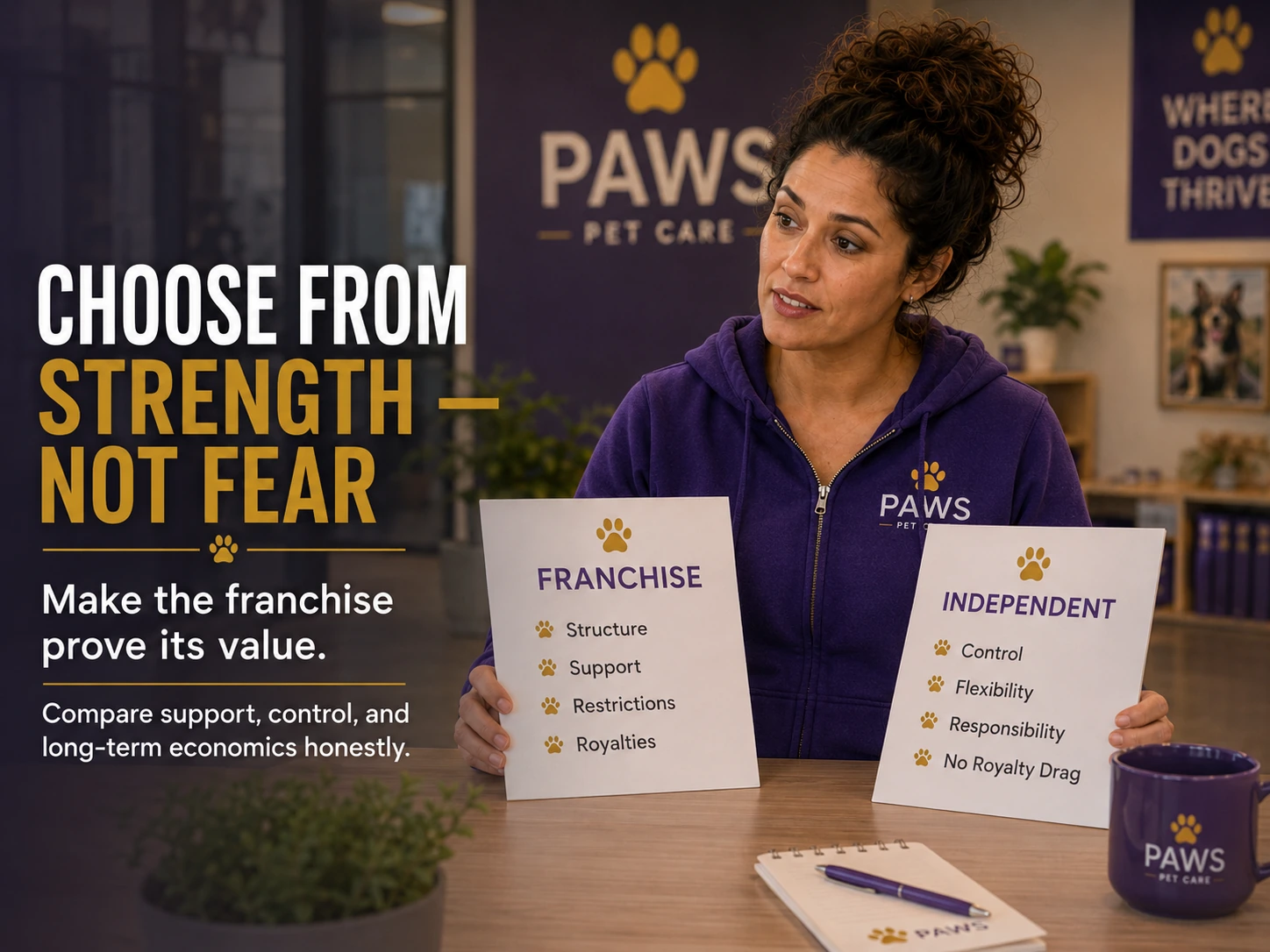
A dog daycare franchise can have value, but the value has to be proven. Startup help is not the same thing as long-term value. Brand recognition has to exist in the customer’s mind, not just in the franchise sales department. Royalties come off the top. Approved vendors are not automatically savings. Software can usually be replaced. National advertising is only valuable if it creates local customer demand. Ongoing support only matters if it solves real operating problems.
A franchise may be the right choice for some buyers. An independent startup may be the right choice for others. Some people need consulting. Some need a manual, a calculator, a lawyer, a better lease, and a reality check. Some should buy an existing facility. Some should not open anything yet because the numbers are ugly and enthusiasm does not pay rent.
But do not sell yourself short. If you are capable enough to gather the money, credit, or investor backing to open a dog daycare facility, you may also be capable enough to learn the business without giving up a piece of gross sales from now until hell freezes over. Maybe you still choose the franchise. Fine. Just make that decision from strength, not fear.
The stupid path is not franchising. The stupid path is signing a lease, buying epoxy, hiring three people, ordering a sign, and hoping the dog business fairy brings customers before the bank account starts making that sad trombone noise.
Ask the hard questions before the agreement is signed. That is not negativity. That is how adults buy businesses.
A franchise sales process can make you feel like you are being selected. Do not forget that you are also the customer, and you are the one writing the checks.
If the process starts making you feel like the lucky one for being considered as a potential franchisee, take a breath and flip the table back around. They are evaluating you, yes. But you are evaluating them harder.
The final decision should be written as an investment case. State the measurable benefits, full expected cost, contract restrictions, replacement alternatives, risks, owner capabilities, and specific reasons the chosen path is stronger than the rejected paths.
A confident no can be as valuable as a confident yes. Due diligence succeeds when the buyer can walk away from a polished opportunity that does not survive the numbers, local market, legal terms, or year-five value test.