Revenue Stacking, Add-On Services, and Smarter Facility Income
Dog Daycare Additional Income Ideas: How to Stack Revenue Without Breaking the Business
You already have the dogs, the building, and the customer relationship. The question is whether you are using them intelligently.
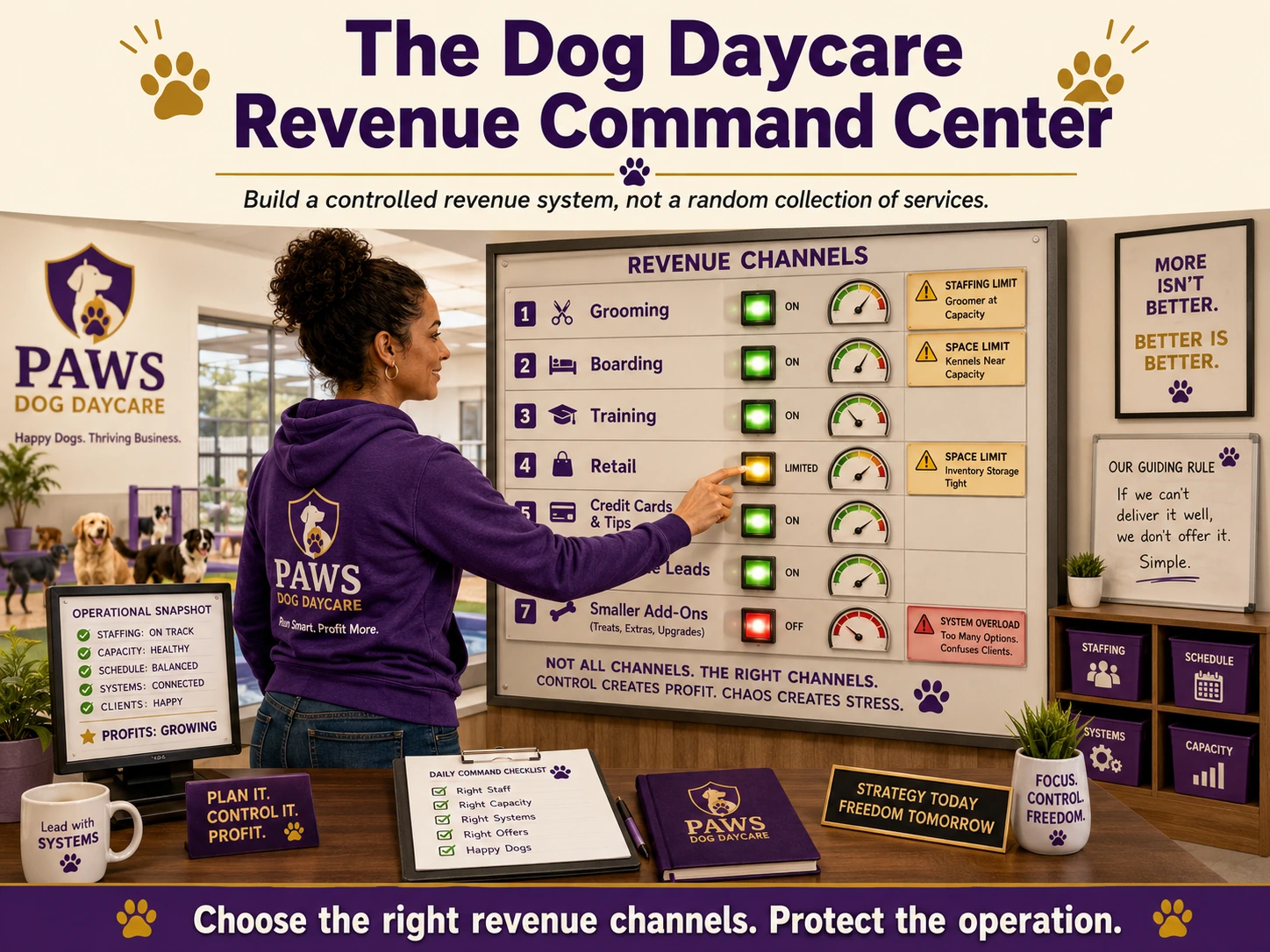
Additional income is one of the biggest missed opportunities in dog daycare. You already paid for the location. You already earned the customer. You already have the dog coming through the door. The smart move is figuring out whether that visit should produce one revenue line — or a controlled stack of revenue lines that actually fits your operation.
This page is the hub. It is not trying to cram the entire subject into one giant wall of text that makes your eyes bleed and your coffee give up. Each income stream has its own detailed page because grooming, boarding, training, retail, tips, website income, and small add-on services are not the same animal.
Done correctly, the right mix of add-on services can add tens of thousands of dollars per year to a dog daycare facility. Done stupidly, it can add payroll, clutter, stress, customer confusion, staff drama, cleaning headaches, and expenses faster than it adds profit. The trick is not adding everything. The trick is adding the right thing, in the right order, for the facility you actually have.
⚠️
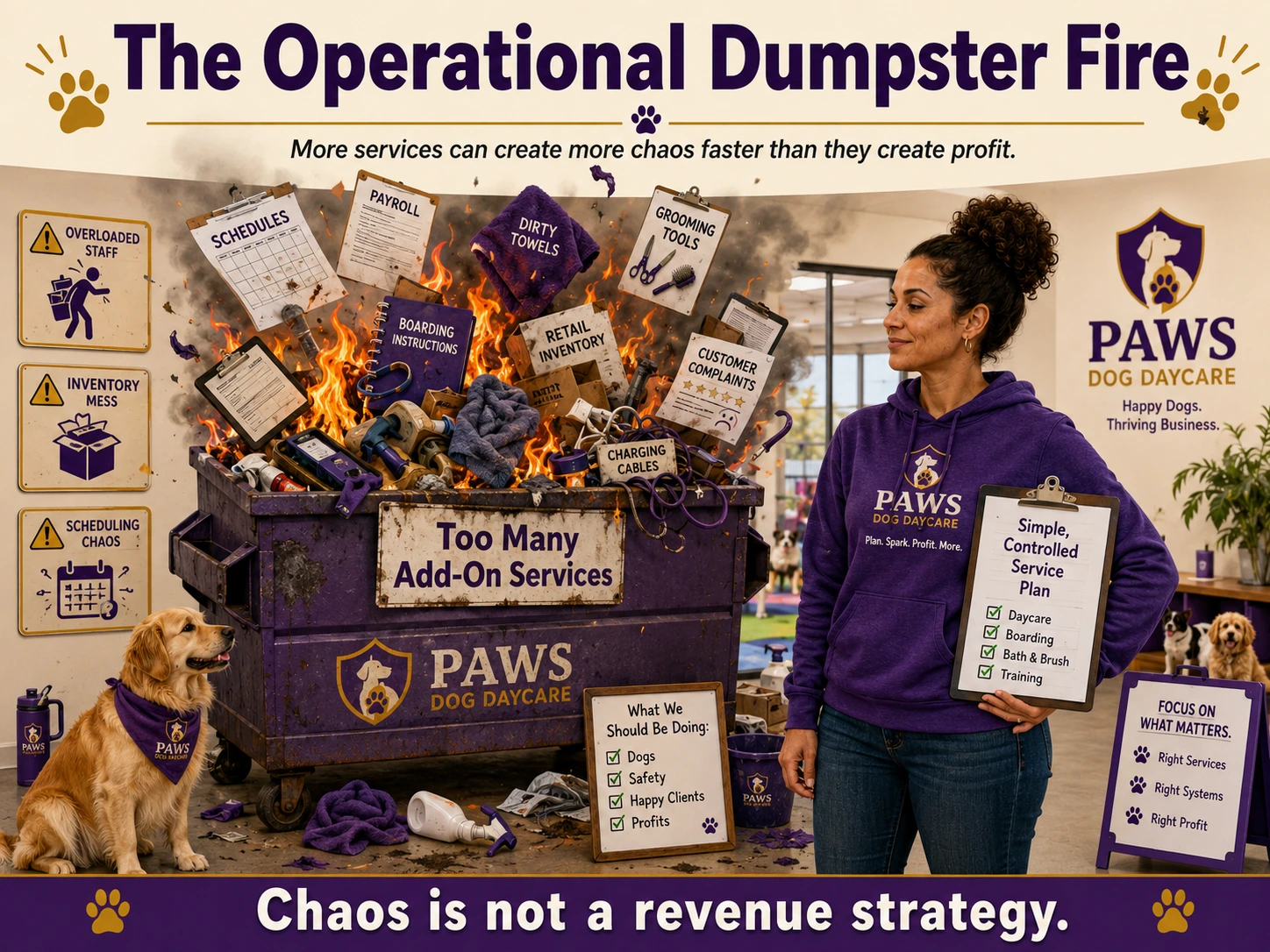
Operator warning: additional income is not automatically additional profit.
Every new service brings labor, equipment, scheduling, cleaning, insurance, customer expectations, management drag, and some fresh little monster hiding in the walls. The goal is not to bolt every possible service onto the business like a raccoon decorating a shopping cart. The goal is to add the right income stream without breaking the machine that already has to run every day.
🗺️
Use This Page Like a Revenue Map
Pick the income path that fits your facility first. Do not just chase the biggest number on paper. Paper numbers are adorable until payroll, staff coverage, space limits, and customer complaints walk in with steel-toed boots.
✂️
Grooming Income
Best for facilities with steady dog traffic, customer trust, and room for a clean grooming workflow. High potential, but staffing matters.
🌙
Boarding Income
The biggest facility-model shift. Can drive serious revenue, but changes staffing, cleaning, risk, and overnight responsibility.
🎓
Training Income
Potentially strong margin, but only if the skill, credibility, structure, and customer expectations are real.
🛒
Retail Income
Easy to add badly. Useful when tied to actual customer needs, not random inventory collecting dust like a sad little pet-store museum.
💳
Credit Cards & Tips
Not glamorous, but important. Better payment flow and tip behavior can improve revenue and staff compensation.
🌐
Website Income
The digital side of the business. Search traffic, service pages, local visibility, and conversion paths can produce customers while you sleep.
🧩
Lesser Add-On Services
Small services can help, but they should support the business instead of turning the front desk into a nickel-and-dime carnival.
🧠
The Big Rule: Stack Revenue Without Creating an Operational Dumpster Fire
More services only help if the business can actually absorb them.
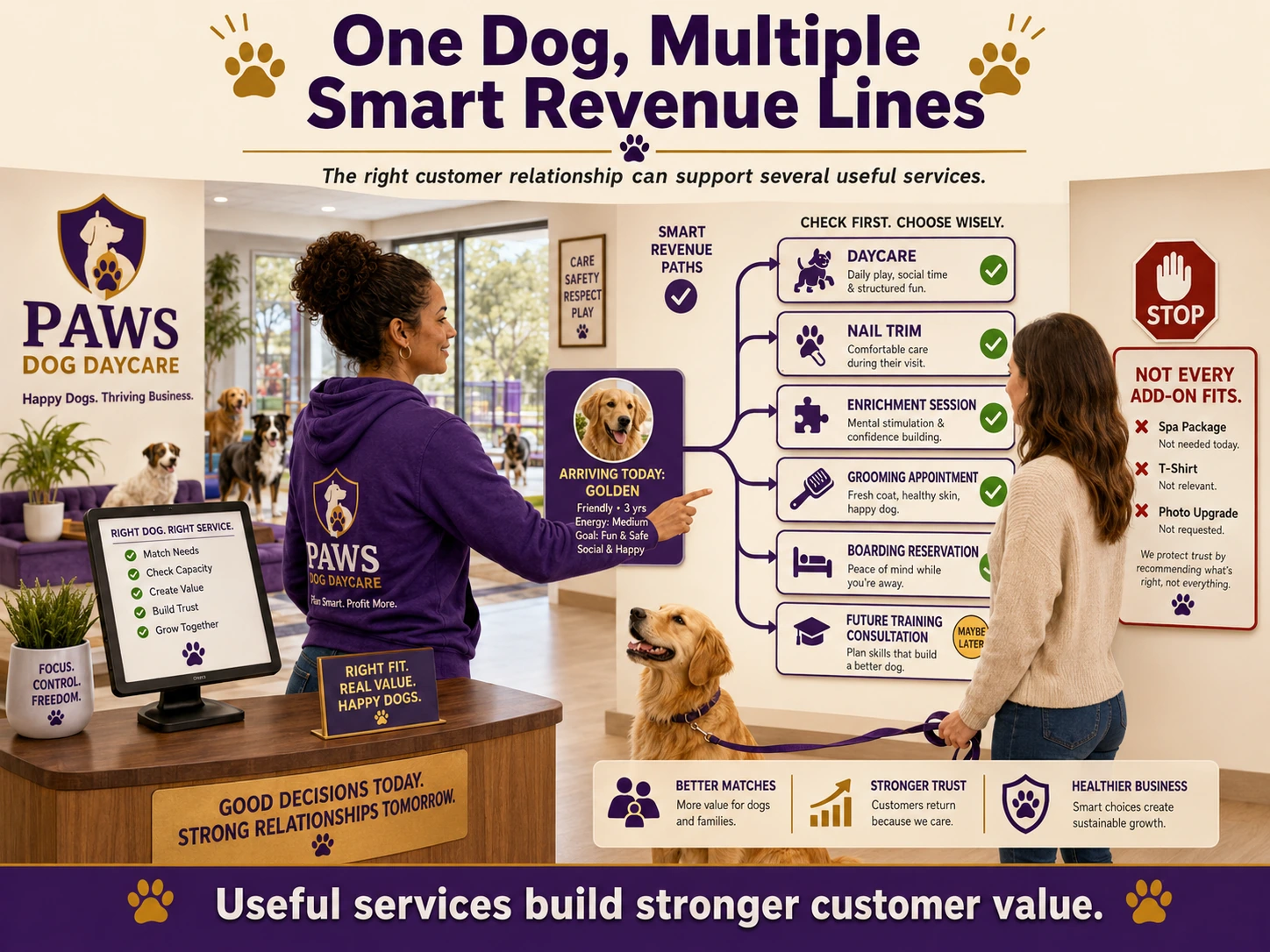
The easiest mistake is looking at a service and saying, “That could make money,” without asking what it will cost in staff time, space, cleaning, customer management, training, scheduling, and owner sanity. Grooming can make money. Boarding can make money. Training can make money. Retail can make money. A website can make money. But every one of them can also turn into a flaming wheelbarrow if you add it before the business is ready.
So use this page as a filter. If your daycare is already chaotic, fix the core daycare operation before stapling new services onto it. If your staff is weak, do not add services that require stronger staff. If your building is maxed out, do not pretend you have secret square footage hiding under the welcome mat. Build income around reality, not fantasy math written on a napkin during a caffeine incident.
📌
Operator rule
The best add-on service is not always the one with the highest revenue potential. It is the one your facility can deliver consistently without damaging the main business.
✂️
Grooming Income
One of the most natural add-ons for a dog daycare, but only if you respect the workflow.
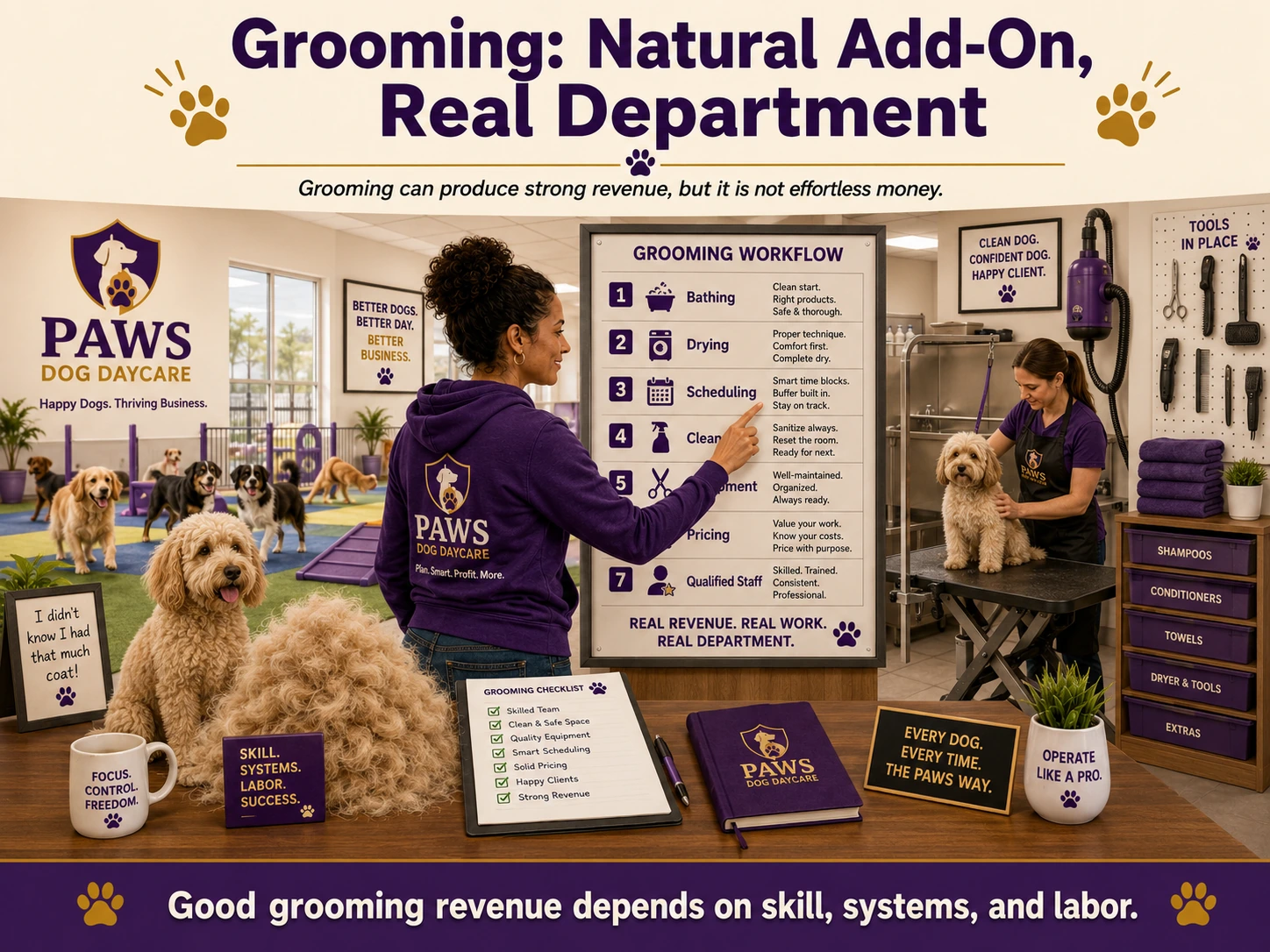
Grooming makes sense because your customers already trust you with their dogs. That is a huge advantage. You are not trying to convince a stranger to hand over a pet for the first time. You are offering another service to the same customer relationship. But grooming is not magic. It brings scheduling pressure, staff needs, equipment, water, drying, noise, mess, customer expectations, and the occasional doodle that looks like it was designed by a committee of carpet manufacturers.
✅
Best Fit
Facilities with steady daycare clients, a clean grooming area, and customers already asking for baths, trims, nails, or full grooming.
⚠️
Watch For
Groomer drama, bottlenecked scheduling, bad drying setups, underpriced services, and owners pretending grooming is “easy money.” It is not.
➡️
Detailed Page
Use the grooming income page to look at staffing, pricing, workflow, and whether grooming belongs inside your model.
🌙
Boarding Income
Boarding can change the whole financial shape of the business. It can also change the whole headache shape.
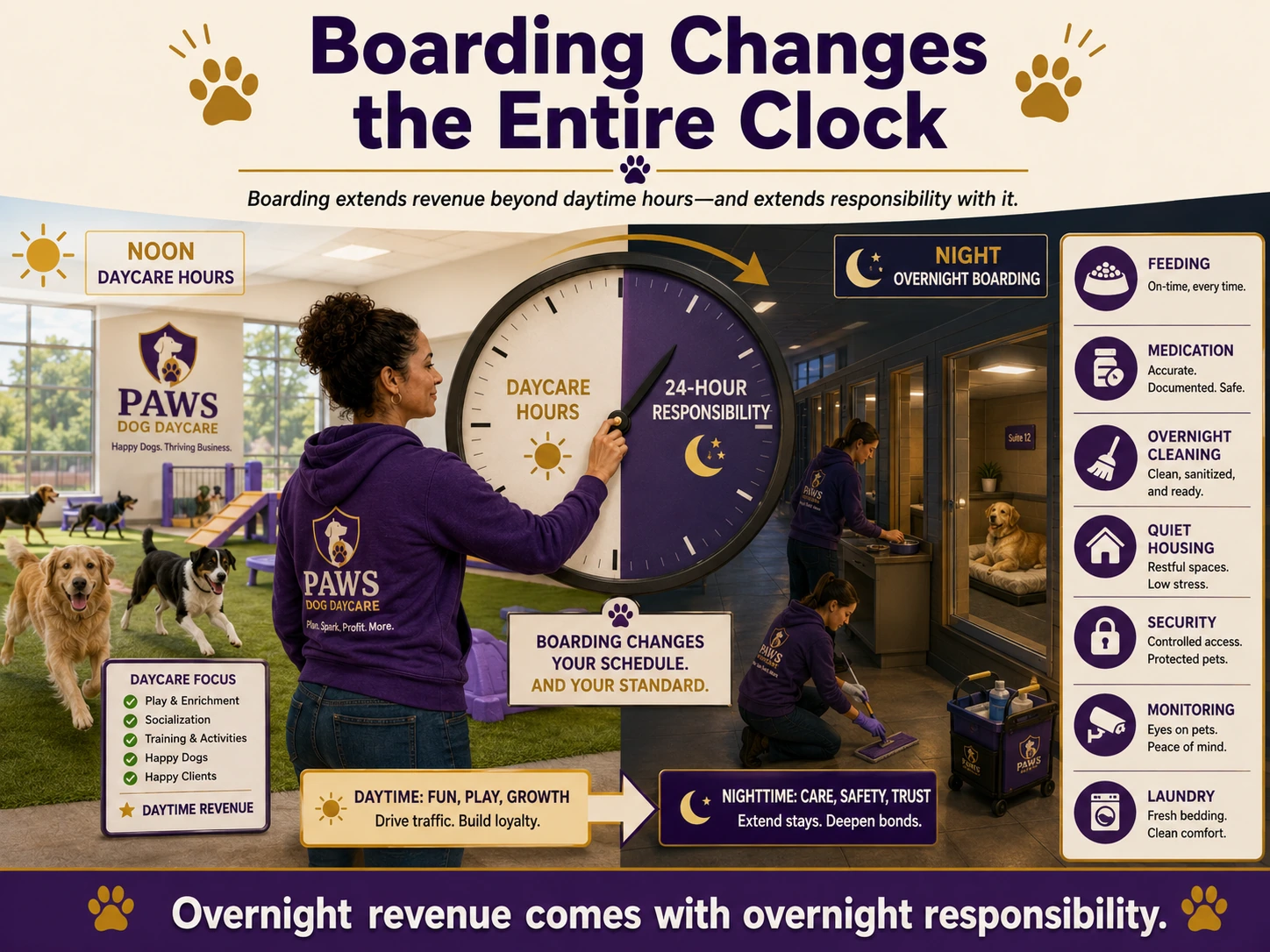
Boarding is one of the strongest additional income paths because it uses the facility beyond normal daycare hours. That sounds beautiful on paper. The building is sitting there at night anyway, right? Sure. So is a chainsaw, but that does not mean you juggle it. Boarding brings overnight responsibility, staff coverage, cleaning demands, customer anxiety, insurance questions, feeding systems, medication handling, noise management, and facility design issues that daycare-only operators can sometimes ignore.
✅
Best Fit
Facilities with proper kennel/suite space, overnight procedures, cleaning systems, staff coverage, and customers already asking where their dogs can stay.
⚠️
Watch For
Trying to “just add boarding” without overnight systems. That is not a revenue stream. That is a lawsuit wearing pajamas.
➡️
Detailed Page
Use the boarding income page to decide whether boarding belongs in your facility model or whether it should wait.
🎓
Training Income
Training can be excellent revenue, but only if the expertise is real and the offer is clean.
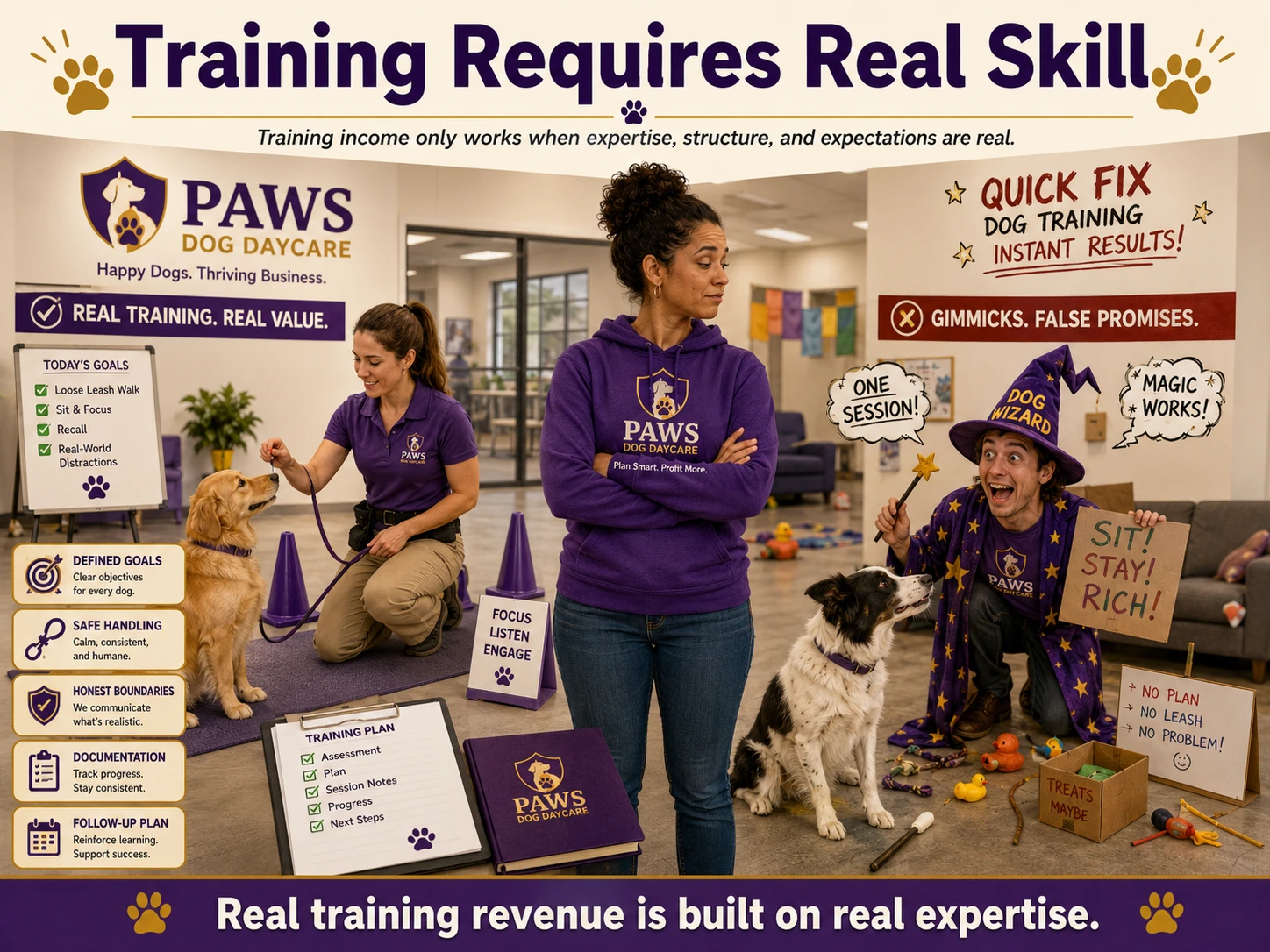
Training sounds attractive because customers already ask daycare staff for behavior advice. The problem is that “the dog jumps on grandma” and “the dog has serious behavior issues” are not the same conversation. Training income works best when the facility has real skill, a defined program, clear boundaries, honest marketing, and the discipline not to promise miracle behavior fixes like some wizard in cargo pants.
✅
Best Fit
Facilities with a credible trainer, structured programs, customer demand, and enough space or scheduling control to run sessions professionally.
⚠️
Watch For
Overpromising, weak trainer quality, unclear outcomes, mixing serious behavior cases into daycare, and selling training like a magic button.
➡️
Detailed Page
Use the training income page to decide what type of training, if any, belongs beside your daycare operation.
🛒
Retail Income
Retail can help, but dead inventory is not a business plan. It is a slow-motion shelf funeral.
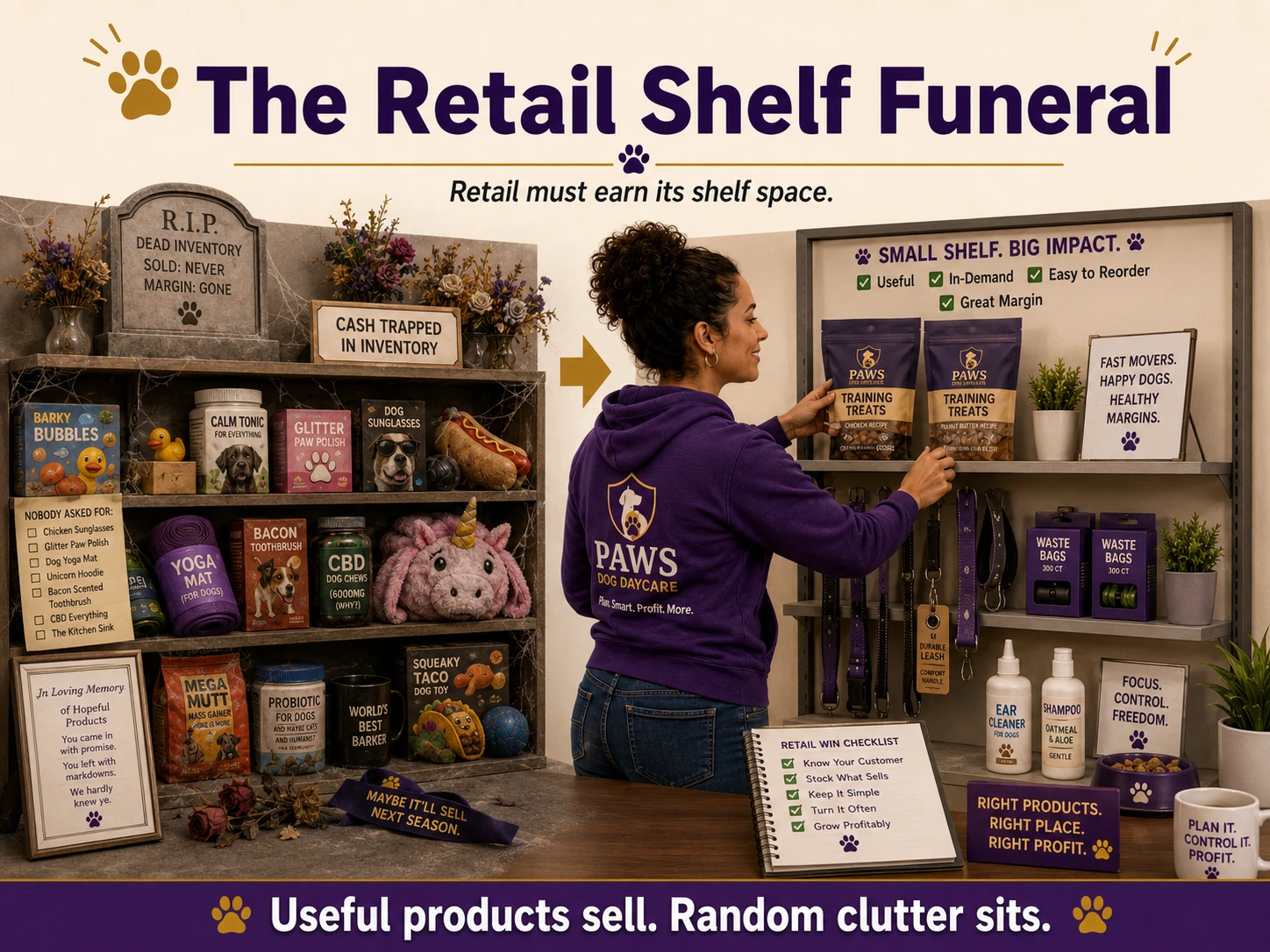
Retail looks easy because it feels simple: put stuff near the front desk and sell it. The reality is less cute. Bad retail ties up cash, gathers dust, clutters the lobby, and makes the facility feel like a yard sale with dog treats. Good retail is focused, useful, easy to explain, easy to reorder, and tied to things customers already need or ask about.
✅
Best Fit
Facilities with front-desk discipline, clear customer demand, and a small, curated product selection tied to actual pet-care needs.
⚠️
Watch For
Too many products, weak margins, poor display, no reorder system, staff that never mention items, and inventory that just sits there judging you.
➡️
Detailed Page
Use the retail income page to decide what belongs in the lobby and what should stay far away from your cash flow.
💳
Credit Card and Tip Income
This is not the sexy revenue stream. It is the boring one that can quietly matter.
Payment flow affects customer behavior. Tip prompts affect staff compensation. Card handling affects convenience. Small checkout changes can add up over time, especially in a service business where customers come back repeatedly. This is not where you build the whole empire, but ignoring it can leave money sitting on the counter while everyone walks around it like it is invisible.
✅
Best Fit
Nearly every facility, especially if checkout is clunky, staff are under-tipped, or customers regularly buy repeat services.
⚠️
Watch For
Awkward tip handling, confusing fees, weak POS setup, and letting payment friction annoy customers right at the finish line.
➡️
Detailed Page
Use the credit card and tip income page to tighten checkout and capture small gains that repeat.
🌐
Website Income
Your website should not be a digital brochure lying face-down in a ditch.

A good dog daycare website can bring in daycare clients, grooming clients, boarding clients, training clients, retail interest, email leads, local search traffic, and trust before the customer ever calls. A bad website does the opposite. It makes the facility look outdated, confused, invisible, or suspicious. Website income is not just ads or affiliate links. For a real dog daycare, the biggest website income is usually customer acquisition and conversion.
✅
Best Fit
Every serious facility, especially if local customers search online before choosing daycare, boarding, grooming, or training.
⚠️
Watch For
Pretty pages that do not convert, weak local SEO, missing service pages, no pricing guidance, and websites that look abandoned by civilization.
➡️
Detailed Page
Use the website income page to understand how digital visibility turns into real facility revenue.
🧩
Lesser Add-On Services
Small services can help. They can also become tiny operational mosquitoes.
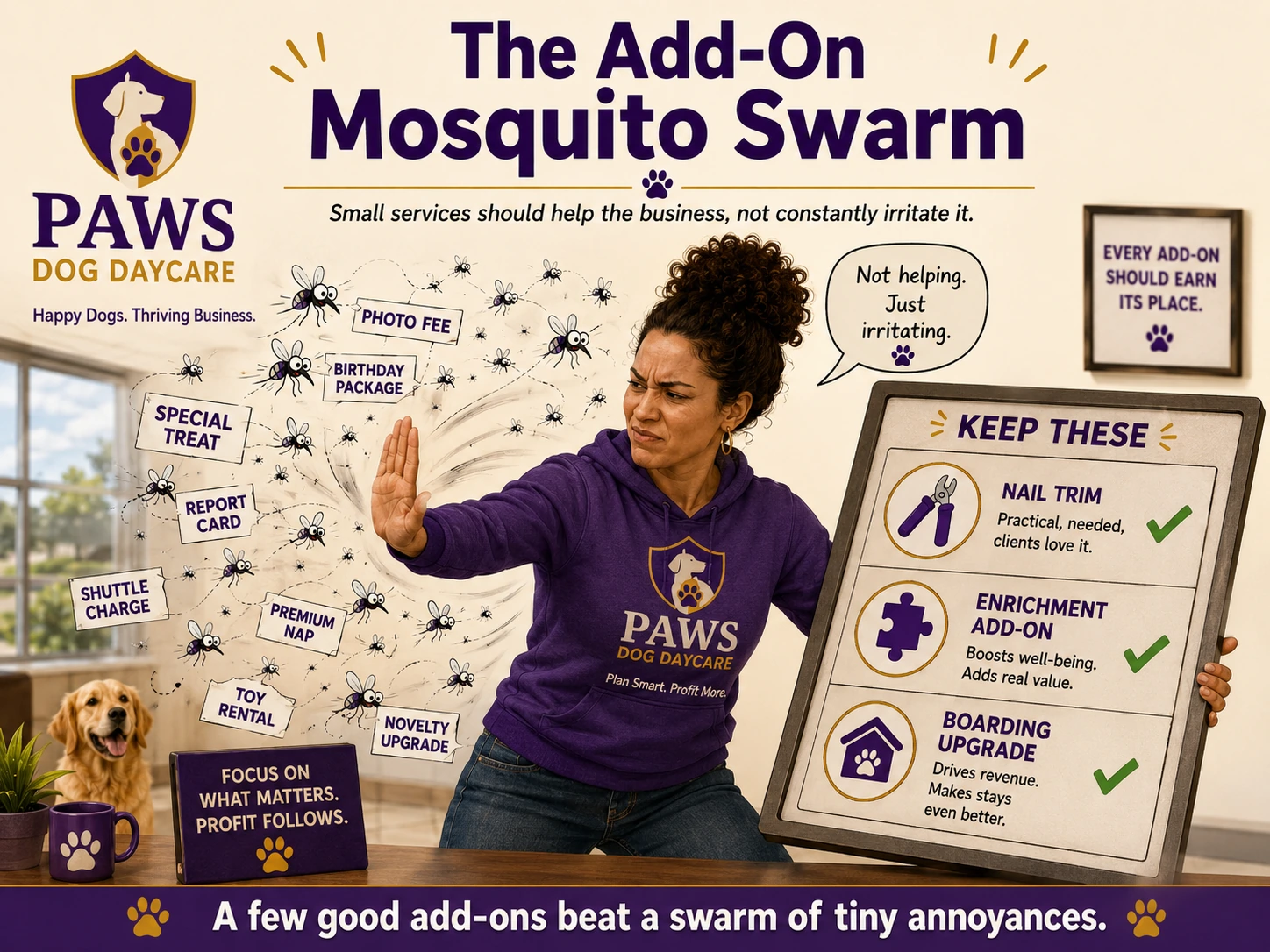
Not every income stream has to be a major department. Nail trims, baths, shuttle options, enrichment add-ons, special treats, photo packages, birthday extras, report cards, late pickup fees, and other smaller services can improve revenue when they are simple, clean, and useful. The danger is letting small add-ons clutter the business until staff need a treasure map just to explain the menu.
✅
Best Fit
Facilities that want simple add-ons without adding an entire new department, new payroll category, or new operational beast.
⚠️
Watch For
Too many tiny offers, confusing menus, staff forgetting to sell them, and owners mistaking complexity for opportunity.
➡️
Detailed Page
Use the lesser services page to sort useful small add-ons from annoying little profit goblins.
🧭
Which Additional Income Stream Should You Add First?
Start where your facility already has leverage. Do not drag the business into a service it is not ready to carry.
🏠
Small or Home-Based
Start with simple add-ons, website visibility, basic retail, and maybe grooming partnerships. Do not cosplay as a resort if the business is still wearing training wheels.
🏢
Lean Commercial Daycare
Grooming, nail trims, baths, structured enrichment, and website improvement may make sense before boarding.
🌙
Unused Overnight Capacity
Boarding may be the big move, but only if the building, staff, procedures, and cleaning systems can handle it.
👥
Strong Staff and Customer Trust
Training, grooming, enrichment, and premium add-ons become more realistic when staff can actually deliver them.
🧯
Weak Systems
Fix the core operation first. If daycare is already chaos, adding more services is just pouring syrup into the printer.
📊
Additional Income Reality Matrix
A quick operator-level look at the seven paths before you jump into the detailed pages.
| Income Path | Revenue Potential | Difficulty | Hidden Risk | Best For |
|---|---|---|---|---|
| Grooming | High | Medium | Staffing, scheduling, quality control | Facilities with demand, trust, and grooming workflow space |
| Boarding | Very High | High | Overnight responsibility, cleaning, facility design | Facilities built for overnight care and extended operations |
| Training | Medium to High | Medium to High | Credibility, outcomes, behavior complexity | Facilities with real training skill and customer demand |
| Retail | Low to Medium | Low to Medium | Dead inventory, clutter, weak staff selling | Facilities with disciplined front-desk systems |
| Credit Cards & Tips | Low to Medium | Low | Awkward checkout flow, unclear fees, weak POS setup | Nearly every facility with repeat service transactions |
| Website Income | High Long-Term | Medium | Weak content, poor local SEO, bad conversion | Owners willing to build traffic, trust, and service pages |
| Lesser Services | Low to Medium | Low | Menu clutter, staff confusion, nickel-and-dime feel | Facilities wanting simple add-ons without huge operational load |
🧪
Additional Income Priority Sorter
This is not a magic calculator. It is a quick reality check so you do not let the revenue goblin talk you into building the wrong thing first.
Pick the realities that match your facility.
The sorter will point you toward the income paths most likely to make sense first, and warn you where the business may need systems before expansion.
❓
Dog Daycare Additional Income FAQ
Detailed answers to the profitability, grooming, boarding, training, retail, payment, website, staffing, add-on, measurement, launch-order, and removal questions that determine whether another revenue stream will actually strengthen the business.
What is the best additional income stream for a dog daycare?
The best income stream is the one the facility can deliver reliably while protecting the core daycare operation. Grooming and boarding often have strong revenue potential because they connect naturally to existing dog traffic and customer trust, but they also create substantial staffing, space, cleaning, insurance, and management demands. Smaller services or website improvements may be a better first move for a lean operation. The correct answer depends on demand, collected margin, capacity, staff skill, and whether the service strengthens or weakens the main business.
Should I calculate profit before adding a new service?
Yes. Estimate the expected selling price, realistic sales volume, direct labor, supplies, equipment, software, payment fees, insurance changes, cleanup time, scheduling burden, and management time. Then calculate what remains after those costs rather than celebrating gross sales. A service that adds revenue but consumes more payroll, space, and attention than it returns is not helping. Build the financial model before buying equipment or announcing the offer.
How do I decide which service to add first?
Start where the business already has leverage. Existing customer requests, underused space, available skilled staff, predictable scheduling gaps, strong website traffic, or a clean front-desk process can point toward the first move. Avoid choosing only by the largest possible revenue number. The best first service is usually the one with proven demand, manageable startup cost, clear responsibility, and limited risk to the daycare operation.
Should I add grooming to my dog daycare?
Grooming can be an excellent fit when customers already ask for baths, nail trims, de-shedding, trims, or full grooming. It requires a qualified groomer, water and drainage, drying capacity, equipment, scheduling, cleanup, pricing discipline, customer communication, and risk paperwork. A poorly designed grooming workflow can disrupt daycare and create quality complaints. Treat it as a real operating department rather than a casual add-on.
Can bathing and nail trims be added before full grooming?
Yes. Limited services can test customer demand and staff workflow without immediately building a complete grooming department. Baths, nail trims, brush-outs, or de-shedding may require less equipment and specialized labor than full grooming, but they still need authorization, pricing, scheduling, sanitation, handling skill, and clear limits. Track the time and margin honestly. A simple service is useful only when it remains simple during a busy day.
Is boarding a good way to increase revenue?
Boarding can produce substantial revenue by using the facility beyond normal daycare hours, but it changes the business model. Overnight care adds feeding, medication, housing, cleaning, security, monitoring, staff coverage, customer updates, emergency procedures, and abandonment risk. The building, zoning, insurance, licenses, and lease must support it. Boarding should be added only after the overnight operating system is designed and tested.
Should a small daycare add boarding first?
Not automatically. A small or early-stage facility may benefit more from website improvements, nail trims, baths, enrichment, tightly controlled retail, or partnerships before accepting overnight responsibility. Boarding can look attractive because the revenue per stay is larger, but the operational load is also larger. If the space, staffing, cleaning system, licensing, and emergency coverage are weak, boarding can destabilize the entire company.
Can training create profitable additional income?
Yes, when the expertise is real and the program is clearly defined. Training may include private lessons, group classes, manners work, puppy programs, or structured day training, but serious behavior cases require appropriate qualifications and boundaries. The business should avoid guaranteed outcomes and vague promises. Profit depends on trainer compensation, scheduling, space, customer participation, follow-up, and the ability to deliver consistent results.
Can daycare staff sell training without a qualified trainer?
They can reinforce routine facility manners and explain daycare policies, but that is not the same as operating a professional training service. Selling formal training without sufficient skill creates customer disappointment and can expose staff to difficult behavior they are not prepared to handle. Use a qualified employee, contractor, or referral partner and define the scope of services. Do not let casual advice quietly become a department the business cannot support.
Is retail worth adding?
Retail can contribute when the product selection is small, useful, easy to explain, and tied to real customer needs. Fast-moving items may include treats, leads, collars, grooming products, enrichment products, or supplies customers frequently forget. Poor retail ties up cash, occupies space, creates inventory work, and gathers dust. Every product should justify its shelf space through margin, turnover, or clear service support.
How much inventory should a daycare carry?
Start conservatively. Track what customers request, what staff can confidently recommend, how quickly products sell, reorder time, shelf life, and the cash tied up in each item. Avoid broad selections that imitate a pet store without pet-store traffic. A narrow collection of dependable products is usually easier to manage and more profitable than a lobby full of slow inventory.
How can credit-card systems and tip prompts improve income?
A clean point-of-sale process can reduce payment friction, support deposits and cards on file, simplify package sales, and make tipping easier. Tip prompts may improve staff compensation, especially for grooming, boarding care, transport, or personalized service, but the process should not pressure customers. Review payment-processing fees and local rules before adding surcharges or convenience fees. Small checkout improvements can matter because they repeat across thousands of transactions.
Can the website be an additional-income channel?
Yes. For an operating daycare, the website’s largest financial value usually comes from attracting and converting local customers rather than displaying advertisements. Strong service pages, pricing guidance, reviews, local search visibility, online forms, tour requests, and clear calls to action can produce daycare, boarding, grooming, and training leads. Track calls, forms, tours, and bookings so the website is measured as a sales system. A pretty site that generates no action is not producing income.
What are good small add-on services?
Useful examples include nail trims, baths, de-shedding, enrichment sessions, special treats, birthday packages, report cards, shuttle service, late-pickup fees, boarding upgrades, or limited photo services. The best small add-ons are easy to explain, schedule, perform, document, and price. They should fit naturally into the dog’s visit. Remove any offer that creates repeated confusion or consumes more staff time than the margin supports.
How many add-ons should be offered at once?
Keep the menu small enough that staff can explain it correctly and customers can understand it quickly. Too many choices reduce sales, create scheduling errors, and make the business feel like it is charging separately for every small action. Start with a few services tied to common customer needs. Add another only after the existing offers are stable, measured, and profitable.
Should several new services launch at the same time?
Usually not. Launching one service at a time makes it easier to train staff, correct the workflow, measure demand, identify costs, and understand customer response. Multiple simultaneous launches hide which service is causing labor problems, complaints, or weak margins. Stabilize the first addition before opening the next. Controlled expansion is slower on paper and faster in reality because fewer mistakes need to be repaired.
How should staff be compensated for add-on services?
Compensation should reflect the service, required skill, labor time, existing wage structure, tip treatment, and local employment law. Grooming or training may involve commissions, production pay, hourly pay, or contractor arrangements, while small add-ons may fit normal hourly duties. Model the total labor cost before setting the price. A commission plan that encourages rushed or unnecessary services can damage quality and trust.
How do I measure whether an add-on is profitable?
Track gross sales, discounts, refunds, direct labor minutes, payroll burden, supplies, equipment wear, software costs, payment fees, cleanup, repeat purchase rate, complaints, and the effect on the main service. Calculate contribution margin rather than relying on revenue alone. Also watch capacity: an add-on that blocks a higher-value service may carry an opportunity cost. Review the numbers by service each month until the pattern is clear.
When should an add-on service be removed?
Remove or redesign it when demand stays weak, the margin is poor, staff cannot perform it consistently, complaints are frequent, equipment or inventory sits unused, or the service repeatedly disrupts daycare. Continuing an unproductive service because money was already spent is a sunk-cost mistake. Set a review date and performance threshold before launch. A disciplined business is allowed to stop selling something that does not work.
When should a daycare avoid adding any new income stream?
Avoid expansion when the core operation is unstable. Chronic understaffing, weak cleaning, poor dog control, schedule confusion, inaccurate records, cash shortages, customer complaints, and owner burnout are signs that new services will add risk rather than profit. Repair the operating system first. A stable daycare is the platform that makes additional income possible.
🐾
The Bottom Line
Additional income should make the business stronger, not just busier.
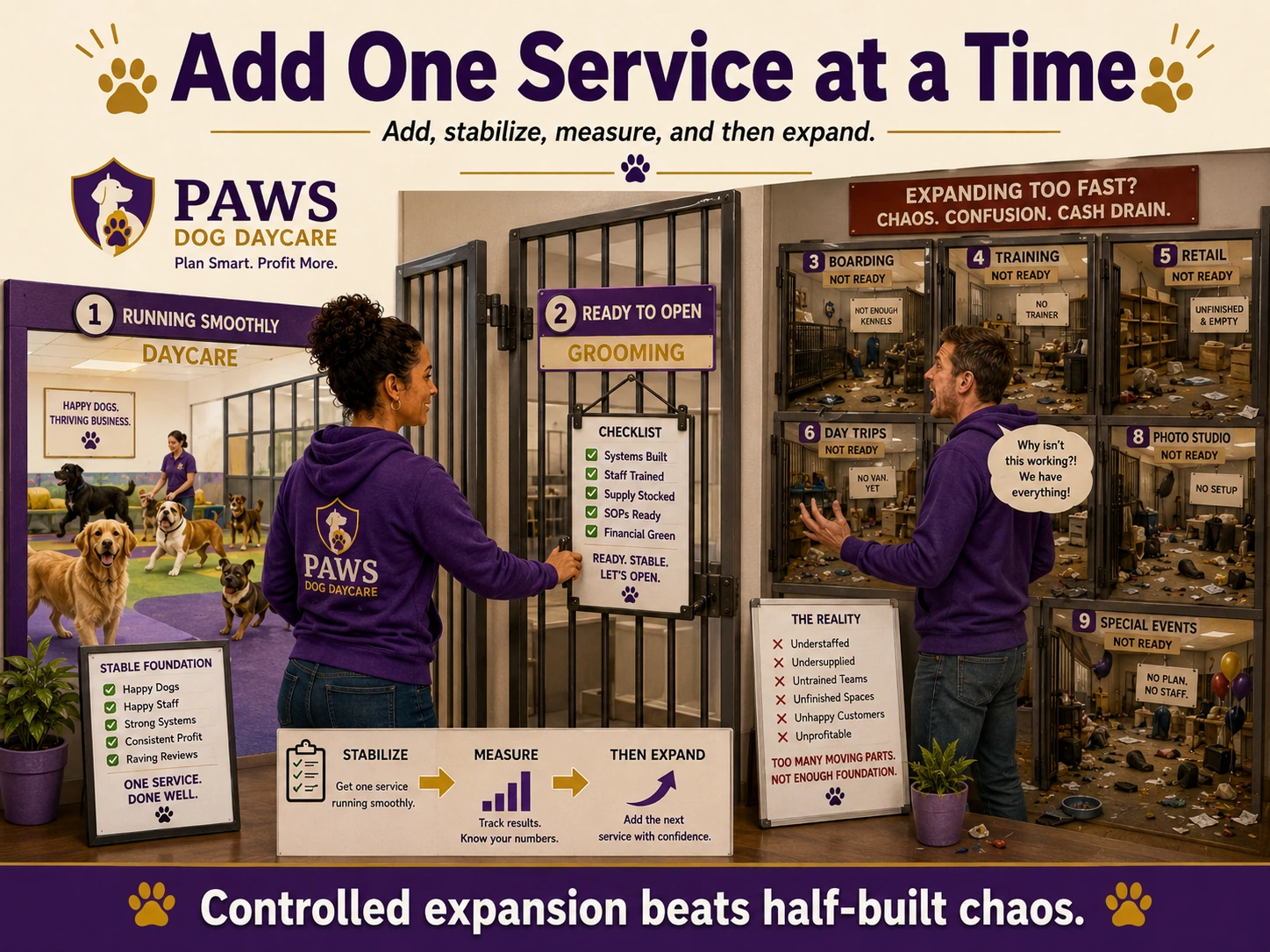
The right add-on income can help a dog daycare facility survive, grow, and become more useful to customers. The wrong add-on income can bury the owner in staff problems, clutter, scheduling chaos, and expenses that quietly eat the money it was supposed to create.
So do not add services because they sound good in theory. Add them because the facility, staff, space, customer base, and systems can support them. Revenue is not the same as profit. Busy is not the same as healthy. And a business with seven half-built services is usually weaker than a business with two strong ones.