Dog Daycare Insurance Scenario, Break-In, Vandalism, Theft, Commercial Glass, Crime Coverage, Property Damage, Premises Liability, Business Interruption, Police Reports, Security Cameras, and Insurance Claims
Dog Daycare Insurance Scenario: The Burglar Broke In, Bled Everywhere, and Still Tried to Sue
Dog daycare insurance is not only about dogs biting dogs. Sometimes the claim starts with a sheriff’s deputy knocking on your door at three in the morning.
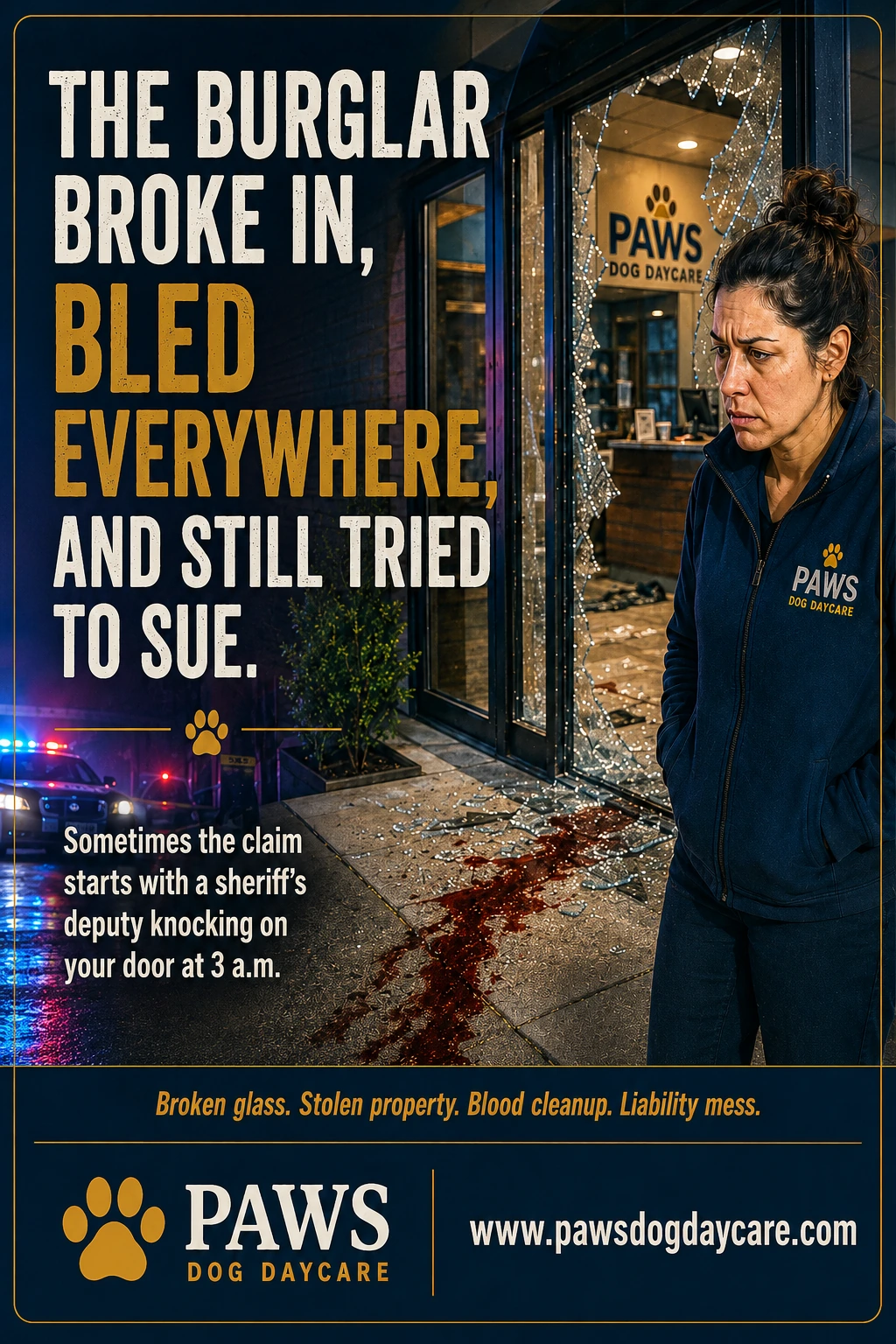
This one is not a made-up insurance campfire story. This actually happened to me.
A sheriff’s deputy knocked on my front door in the middle of the night and told me somebody had broken into my dog daycare.
So now I am awake, annoyed, confused, and driving to the facility because apparently my business decided to become a crime scene while I was trying to sleep like a normal person.
I get there and the front commercial glass door is smashed. The register is gone. Wires are ripped out. The grooming room has been rummaged through. Dumb little electronics and anything that looked useful to a criminal with bad decision-making skills had been messed with or stolen.
And there is blood everywhere.
Blood on the sidewalk. Blood near the door. Blood around the broken glass. It looked less like a normal break-in and more like my building hosted a discount horror movie after closing.
Later, the police figured out who did it because they followed the blood trail, checked hospitals, and found the guy in the emergency room. From what I remember, he had cut his arm badly, apparently nicked an artery, and nearly bled out after breaking through the glass.
The reason he broke in was even dumber. He thought my dog daycare was a veterinary office and believed there might be medications, narcotics, dog drugs, or whatever magical pharmacy he imagined was sitting behind the front desk.
There were no drugs. No morphine. No veterinary medication stash. No secret Scooby-Doo pharmacy. Just daycare dogs, grooming tools, a cash drawer, and the normal supplies of a dog business.
So, technically, I had a cat burglar at a dog daycare. The dogs did not bite him. The door did. Just a moron, seeking nonexistent drugs, without a plan, and making bad decisions with an artery that apparently did not support his career path.
Then, months later, I got the next surprise: an attorney tried to make a claim because the criminal injured himself on the glass he broke while breaking into my building.
That is the point of this scenario.
Insurance is not just for neat, normal claims where everyone behaves like adults and the facts line up politely. It is for stupid reality. Broken glass. Stolen property. Police reports. Blood cleanup. Old building issues. Lost time. Equipment replacement. Attorneys. And criminals who somehow decide your front door was the real villain.
🐈⬛
We Had a Cat Burglar at a Dog Daycare
The joke writes itself. The operating lesson is that criminals may misunderstand what kind of business you run and what they think is inside.
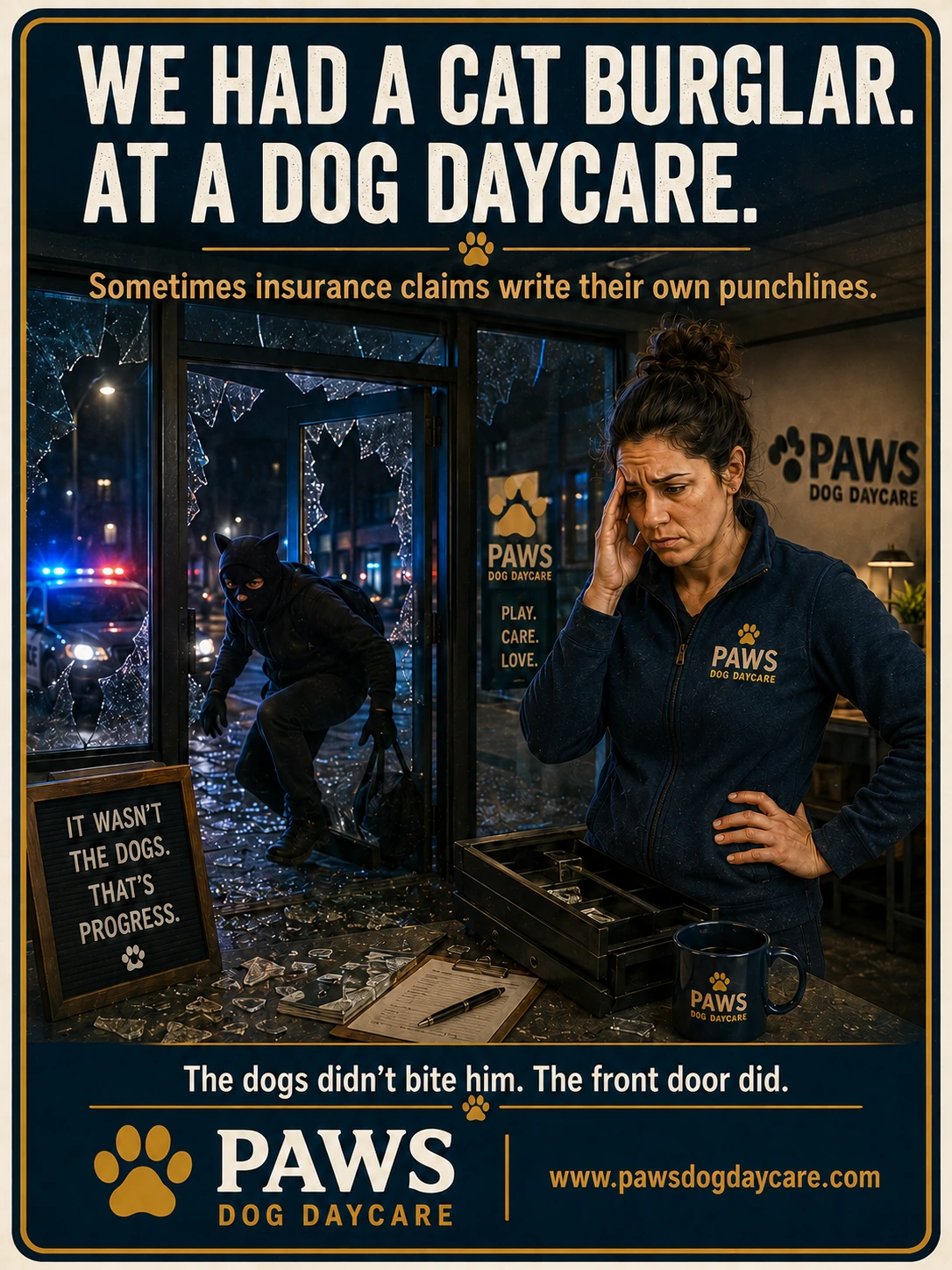
In my case, the burglar apparently thought the daycare was a veterinary office and expected to find medications. There were no narcotics, no secret drug cabinet, and no veterinary pharmacy hiding behind the front desk—just a normal dog business that now had a smashed door and a criminal bleeding across the sidewalk.
That changed how I thought about signage and after-hours security. I cannot make a criminal read, think, or make good decisions, but I can make the building's identity clearer, avoid keeping unnecessary valuables or medications onsite, and make the next bad assumption less inviting.
⚠️
Operator warning
The break-in itself may be over in minutes. The cleanup, glass repair, police report, insurance claim, missing equipment, POS workaround, security review, and idiot lawsuit threat can drag on long after the burglar is sitting in a hospital bed explaining his life choices.
🚔
1. Stand There at 3 A.M.: Your Dog Daycare Is Now a Crime Scene
Nothing says “responsible business owner” like boarding up your own front door at stupid o’clock.
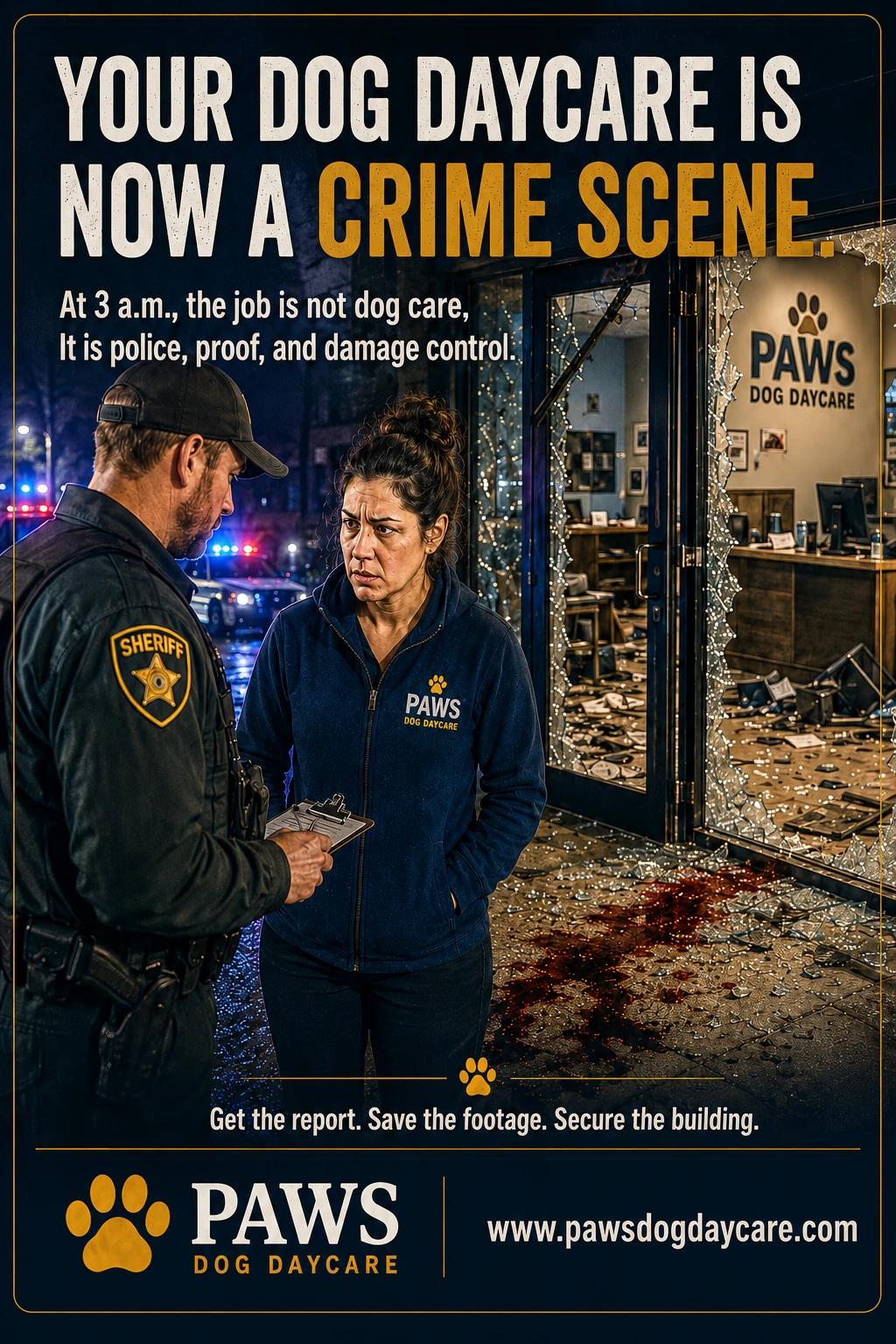
The first thing you feel is disbelief.
You are not thinking about policy language yet. You are thinking, “What in the hell happened to my building?”
You pull up and there is glass everywhere. The commercial door is busted. The register is gone. The wires are ripped out. The police are there. You are tired. You are irritated. You are trying to understand what was stolen, what was damaged, whether the building is secure, whether anybody is still inside, and how fast you can get the place functional again.
And then there is the blood.
The sidewalk looks like somebody tried to film a homicide scene with a cash drawer budget. Blood outside. Blood near the broken glass. Blood where this genius apparently cut himself badly enough that the police later found him through the emergency room.
Then morning comes, because of course morning still comes. Customers start showing up around 6:30 or 7:00 for early drop-off, and they are walking past the building trying to figure out why there is glass everywhere, why the front door looks like it lost a fight, and why I am outside hosing blood off the sidewalk.
There is something very strange about watching crimson water run off the sidewalk while customers are arriving with their dogs like it is supposed to be a normal business day.
That is the part people miss. The break-in happens at night, but the business still has to face the morning. You cannot just leave the front looking like a crime scene and pretend customers will not notice. The dogs still need to come in. Staff still need direction. The door still needs fixed. The glass still needs swept. The sidewalk still needs cleaned. The police report still needs to exist. And somehow, through all of that, the business has to look like a business again.
That part matters operationally. You are not just sweeping up broken glass. You are dealing with a scene. Police need to investigate. Evidence may need to be preserved. Photos matter. Video matters. You need the police report number. You need to know what can be touched, what can be cleaned, and when.
Then the cops leave, and now the glamorous business-owner part begins.
You need plywood. You need tools. You need to secure the door. You need to figure out whether you can open in the morning. You need to call a commercial glass company. You need to check cameras. You need to see what was stolen. You need to start documenting the damage. You need to clean enough blood off the sidewalk that customers do not arrive to a crime-scene breakfast special.
In my case, I even had to go buy a longer hose because the hose I had would not reach far enough to wash the blood off the sidewalk.
That is the kind of stupid detail nobody puts in a clean insurance brochure.
📌
Crime scene rule
Do not rush in and start cleaning, touching, fixing, and rearranging everything before police clear the scene and you document what happened. The broken door is annoying. Losing the proof can be worse.
🌅
Morning Still Comes
The police may be done with the scene, but customers, dogs, staff, payments, cleanup, and opening decisions still show up on schedule.

This is the operational part I remember most clearly: the break-in happened overnight, but the business still had a morning. I still had customers arriving, staff needing direction, a building that had to be made safe, and a front entrance that could not keep looking like a crime scene.
I want an opening-after-incident decision built into the response plan. Somebody needs authority to decide whether we open on time, delay, redirect customer entry, communicate with clients, or stay closed until the glass, blood, security, and building access are under control.
💸
2. The First Insurance Lesson: Theft Is Usually Not the Biggest Problem
Sometimes the stolen thing is annoying. The business disruption is the real kick in the teeth.
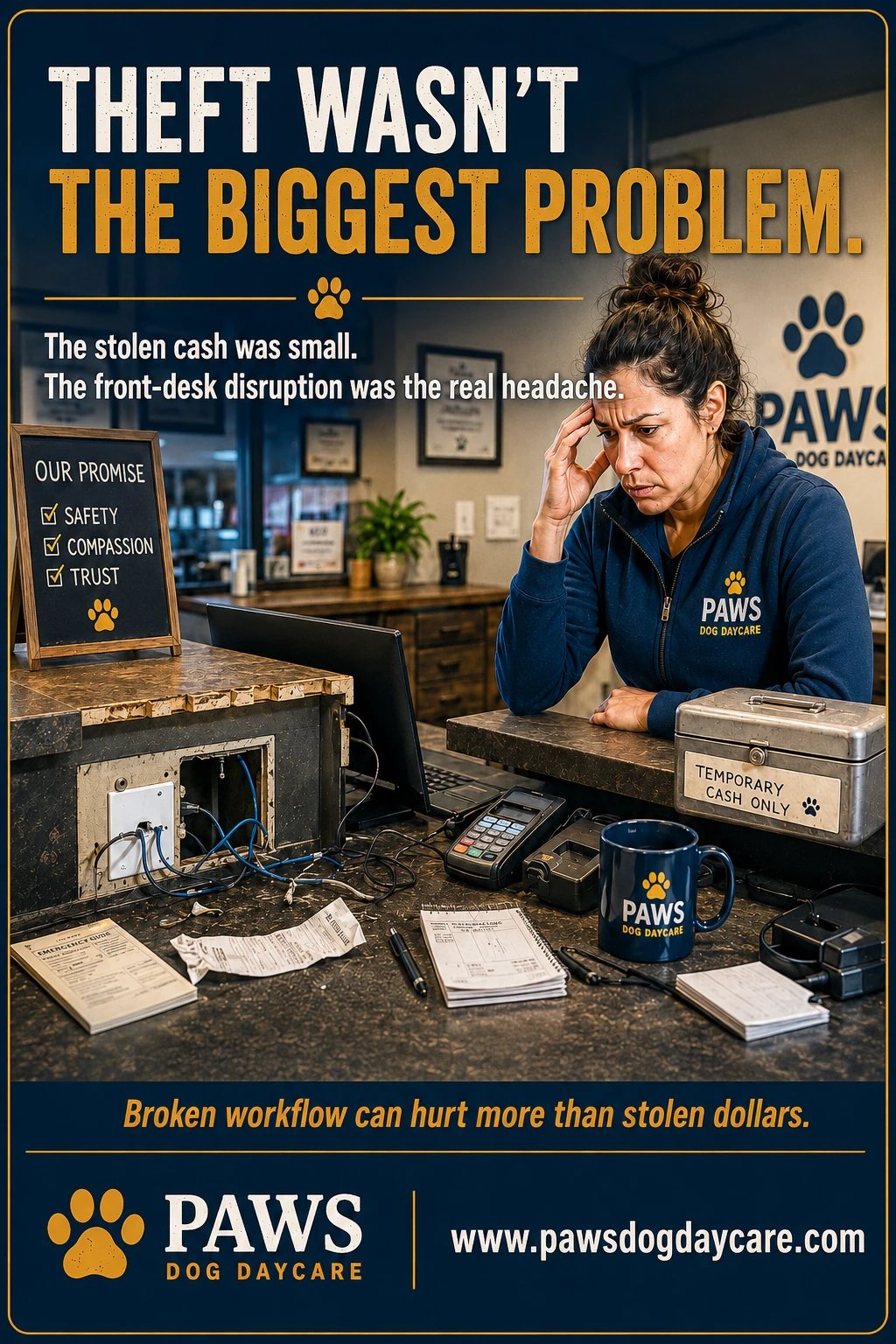
In this scenario, the burglar stole the register.
That sounds worse than it was. I did not keep a pile of money in the drawer. It was basically starting cash. Around $150 or so. Enough to make change. Not enough to buy a yacht unless the yacht was made of paper clips and bad choices.
The commercial glass door was not even the worst part. It was a pain, but it was solvable. Commercial door and glass companies deal with this kind of thing. You call them, they come out, they charge you because they know you are over a barrel, and by early afternoon the door can be fixed.
I think the door glass cost around $400 at the time. Annoying, yes. Business-ending, no.
The cash drawer was the bigger headache.
The business had been operating for a while, and the cash drawer was tied to the point-of-sale system. The POS company had updated its systems, and the old compatible cash drawer was no longer easy to get. So now the criminal stole the drawer, and I am trying to run a real business with a payment system that still mostly works, a credit card machine that still functions, and cash handling that suddenly looks like a church bake sale.
I ended up running cash out of a little tin box for around two weeks while I tried to find a compatible replacement cash drawer online.
That was more aggravating than the door.
This is why insurance and recovery planning should not only ask, “What was stolen?” It should ask, “What does that stolen thing connect to?”
💵
Cash Loss
The cash in the drawer may be small if you cash out properly every night.
🧾
POS Disruption
A stolen register or cash drawer can break your normal workflow for days or weeks.
🚪
Door and Glass
Broken commercial glass can usually be fixed quickly, but it still costs money and emergency pricing is real.
🧹
Cleanup
Glass, blood, police tape, damaged entry areas, and customer-facing messes all have to be handled.
⏱️
Lost Time
You may lose sleep, opening time, staff time, owner time, and normal operations.
📷
Evidence
Camera footage, photos, invoices, police reports, and stolen-item records become part of the claim.
🐾
Operator lesson
The stolen $150 may not hurt nearly as much as the missing piece of equipment that keeps your front desk functioning. Inventory the things that keep the business moving, not just the things that look expensive.
⚖️
3. The Criminal Injury Problem: Yes, Even the Burglar Can Create a Liability Mess
You have not lived until the guy who broke into your business tries to make your door the villain.

Here is where the story turns from annoying to absurd.
The police eventually found the guy. He cut himself badly going through the broken door glass, apparently nicked an artery in his arm, and ended up at the emergency room. That is where they caught him.
You would think that would be the end of it.
Criminal breaks into business. Criminal steals register. Criminal injures himself breaking in. Criminal gets arrested. Business fixes door. Everyone moves on.
That would be too normal.
Months later, I get a nastygram from an attorney. The basic angle was that the glass in the commercial door was not tempered or not up to current code, and because the burglar injured himself on the glass he broke while committing the break-in, he was going to try to make that my problem.
Let that sit for a second.
He broke into my business, nearly bled out doing it, and then tried to turn around and argue that my building hurt him unfairly while he was robbing me.
This is the kind of thing that makes normal people stare at a wall and wonder if civilization was a mistake.
Nothing ultimately came of it, but it still created a mess. I had to deal with an attorney. I had to contact insurance. I had to pull records. I had to take it seriously because once a claim threat exists, ignoring it because it sounds stupid is not a business plan.
That is the insurance lesson.
You can be right in the normal-person sense and still need defense in the paperwork-person sense.
From what I remember, he ended up getting years for the break-in, but the insane part for me was not just that he broke into the business. It was that after all of that, after the glass, the blood, the stolen register, the police, the hospital, and the arrest, I still had to deal with the possibility of a claim because the criminal hurt himself committing the crime.
📌
Liability rule
Do not assume an absurd claim can be ignored just because it is absurd. Notify your insurance carrier, preserve records, keep invoices, save photos, and let the proper people handle the legal circus.
🪟
4. Old Buildings, Glass Doors, Code Issues, and the “I Didn’t Know” Problem
Older commercial buildings can carry old problems that nobody notices until something breaks.
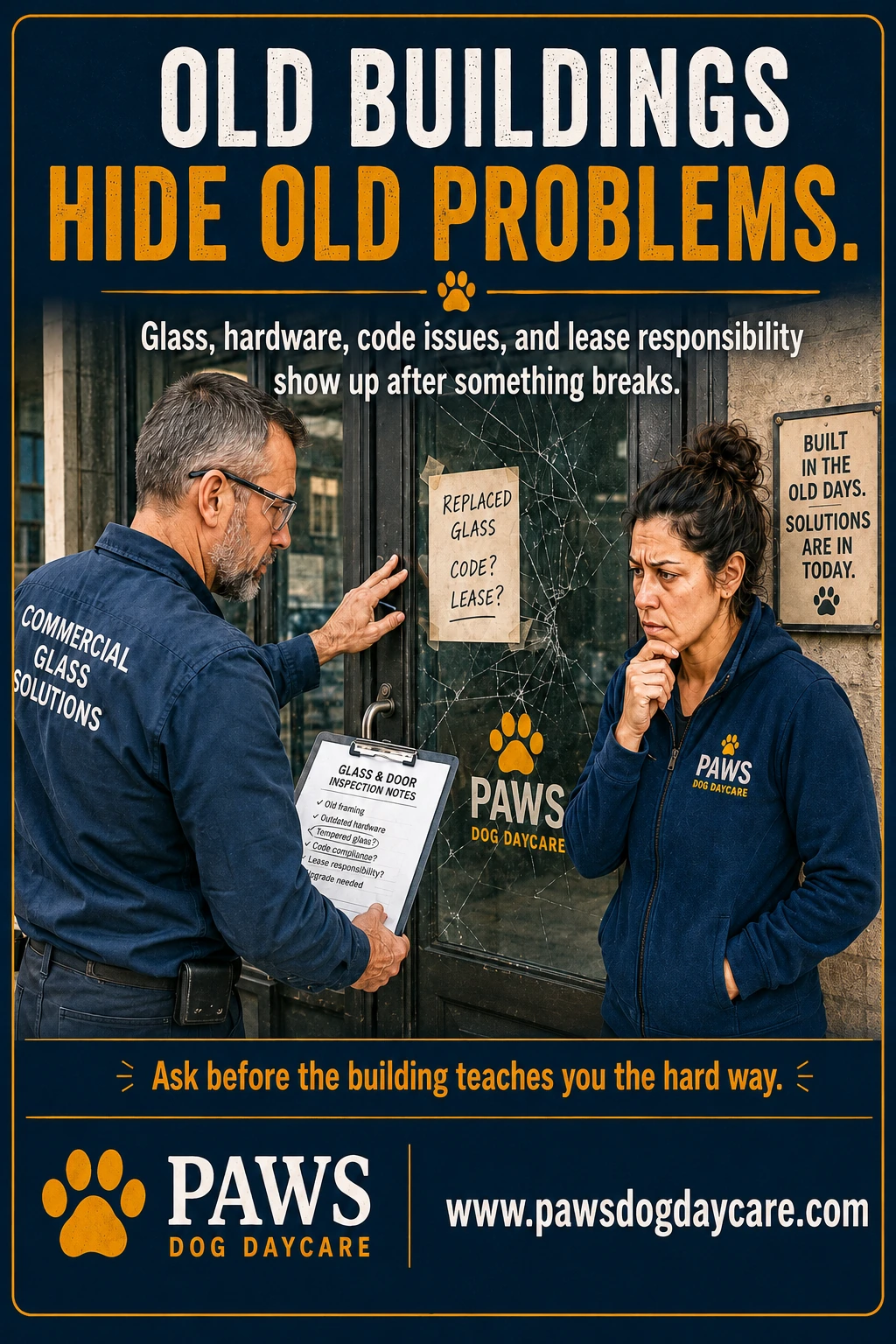
The building in this scenario was old. It had been something else before it was a dog daycare. In my case, it was originally built long before I owned it, and the glass was already there when I bought the building.
I did not wake up one morning thinking, “I should inspect whether every piece of old commercial glass in this building is ready for a future burglar’s artery.”
I checked the dogs. I checked the kennels. I checked the grooming space. I checked fencing, signs, customer flow, staff, pricing, website, phones, and all the obvious dog-business things. I did not stand in front of the door wondering whether some idiot might break it, climb through it, cut himself, and later use the glass type as a legal argument.
But that is exactly why this matters.
Commercial buildings have parts that owners and tenants take for granted until something fails:
- Glass doors and windows.
- Locks and panic hardware.
- Alarm contacts and sensors.
- Exterior lighting.
- Security cameras.
- Old wiring and door hardware.
- Lease responsibility for repairs.
- Building code upgrades after damage.
- Commercial glass requirements.
- Ordinance or law coverage questions.
This is not about becoming a building-code expert overnight. It is about knowing enough to ask better questions before the building teaches you with broken glass.
If you lease, know what the landlord handles and what you handle. If you own, know the weak points. Either way, commercial doors, storefront glass, security, and code-related repair issues should be part of the insurance conversation.
📌
Building rule
A dog daycare is not just playrooms and cute photos. It is a public commercial building. Doors, glass, alarms, locks, sidewalks, lighting, and old code issues can become part of the insurance story fast.
🛡️
5. Coverage Questions This Scenario Should Make You Ask
“I have insurance” is not the same as knowing what happens when your front door gets turned into a bloody jigsaw puzzle.
This kind of scenario pulls on several different parts of the insurance conversation.
It is property damage. It is theft. It is vandalism. It may involve glass coverage. It may involve business interruption. It may involve premises liability. It may involve legal defense. It may involve building code upgrades. It may involve landlord/tenant responsibility.
That is why you should not wait until after the police leave to start learning what your policy actually says.
I would also ask how the policy treats emergency board-up, locksmith work, after-hours glass service, cleanup, temporary protection, and replacement of the equipment that keeps the front desk operating. Those costs can hit before anybody has time to read the declaration page.
I want the claim-reporting process written down with the after-hours contact information. A policy is much more useful when the manager who gets the 3 a.m. call already knows who to notify, what evidence to preserve, and what expenses need receipts.
Swipe left/right to see the full table.
| Coverage / Issue | Why It Matters | What to Ask Your Agent |
|---|---|---|
| Commercial property | Covers damage to covered business property, depending on policy terms. | What building/property damage is covered after burglary, vandalism, and forced entry? |
| Glass coverage | Commercial glass can be expensive and urgent. | Is storefront glass covered? Are doors, windows, labor, emergency board-up, and after-hours service included? |
| Crime / theft coverage | Stolen cash, registers, equipment, computers, grooming tools, or office electronics may be treated differently. | What theft is covered? What are the cash limits? What documentation is required? |
| Vandalism | Damage may go beyond stolen items. | Does the policy cover damage from vandalism and malicious mischief? |
| Business interruption / loss of income | You may lose hours or days if the building cannot safely open. | Does coverage apply if a break-in forces closure or delayed opening? |
| Ordinance or law / code upgrade | Repairs may trigger newer code requirements in older buildings. | If damaged glass, doors, wiring, or hardware must be upgraded to current code, is that covered? |
| General liability / premises liability | Absurd injury claims can still require a defense. | If someone is injured on the premises, even under ridiculous facts, when does the carrier provide defense? |
| Tenant improvements / betterments | If you lease, improvements you paid for may need separate attention. | Are tenant improvements covered, and who is responsible under the lease? |
| Security requirements | Some policies may care about alarms, locks, cameras, or reporting. | Are there alarm, camera, lock, reporting, or police report conditions I need to follow? |
⚠️
Insurance question
Do not just ask, “Am I covered for theft?” Ask, “What happens if someone breaks the glass, steals the register, bleeds all over the sidewalk, forces me to close or delay opening, and then claims the building hurt him?” That is the real conversation.
📋
6. What to Do When You Get the 3 A.M. Break-In Call
The first rule is simple: do not turn yourself into the second problem.
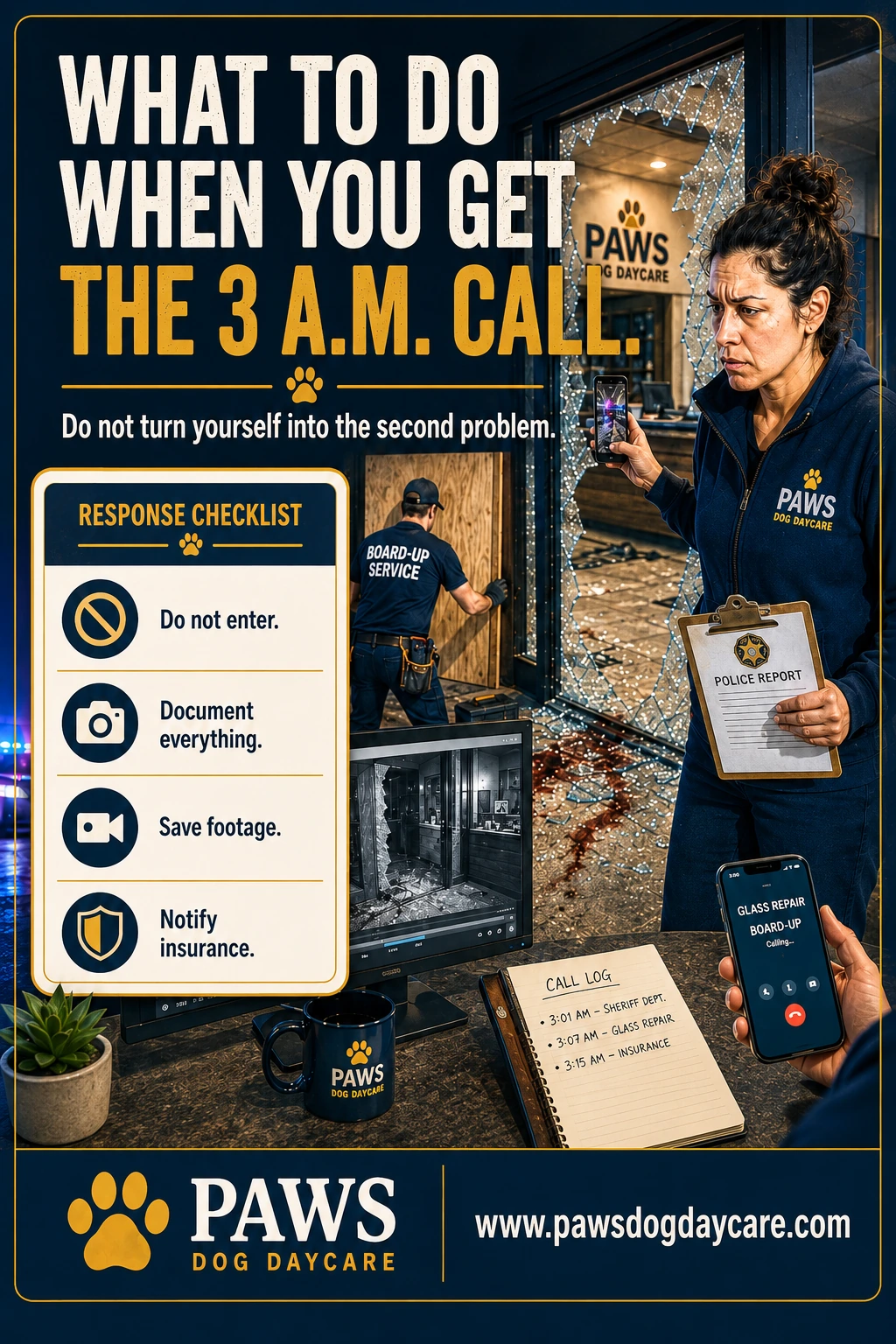
When you get the call, you are tired, irritated, and probably not thinking like a calm insurance checklist.
That is why you need the checklist before the break-in.
- Do not enter before police clear the building. The person may still be inside, or the scene may not be safe.
- Check whether animals are onsite. Boarding, grooming holdovers, cats, or hospitalized-style care areas need immediate safety review if your business offers those services.
- Get the police report number. Insurance will likely want it.
- Preserve camera footage. Save it before it overwrites.
- Photograph and video the damage. Door, glass, register area, blood, stolen areas, wires, office, grooming room, exterior, and any disturbed spaces.
- Do not clean or move everything before documenting. Get proof first, then clean.
- Secure the building. Board-up, lock repair, glass company, alarm company, or emergency maintenance.
- Inventory stolen and damaged items. Register, cash drawer, POS equipment, computers, grooming tools, cameras, tablets, phones, office electronics, and supplies.
- Check payment systems and customer data. Make sure devices, records, cards, computers, and software access are not compromised.
- Notify insurance promptly. Follow claim-reporting requirements.
- Save invoices and receipts. Glass repair, board-up, cleanup, replacement equipment, locksmith, alarm repair, extra staff time if tracked.
- Set a temporary front desk plan. If the POS drawer is gone, decide how cash is handled until the replacement is working.
- Decide whether to open, delay, or notify customers. Do not let customers walk into broken glass, blood, police activity, or an unsecured building.
- Clean safely. Blood and broken glass are not normal dust. Treat cleanup seriously.
- Review security after the incident. Lighting, cameras, locks, alarm contacts, cash handling, signage, and opening/closing procedures.
I would keep this checklist with the alarm contacts, police non-emergency number, insurance claim number, glass company, locksmith, alarm vendor, camera-login information, landlord contact if applicable, and the people authorized to make an after-hours closure decision.
The checklist also needs a customer-facing recovery step. Staff should know how to reroute drop-off, delay opening, message customers, and keep dogs away from broken glass, police activity, contaminated areas, or an unsecured entrance.
🐾
Response rule
You are not just fixing a door. You are preserving evidence, protecting the building, restarting operations, documenting the claim, and making sure tomorrow morning does not become a second disaster with customers stepping over glass.
🧾
7. The Dumb Operational Stuff That Becomes the Real Headache
The door may be fixed by lunch. The cash drawer may ruin your mood for two weeks.
This is the part nobody thinks about until they are living it.
The obvious damage gets attention. Broken door. Glass everywhere. Register stolen. Police report. Blood on the sidewalk. That is the dramatic part.
But the annoying part is often the boring operational dependency that breaks your normal workflow.
In my case, it was the cash drawer.
The drawer was tied to the point-of-sale system. The newer version of the system did not use that same drawer anymore. Replacement was not as simple as walking into a store and buying a random box that opens when you click “cash sale.” I had to find the right compatible drawer, and that took time.
For a couple of weeks, we were running cash out of a little tin box like the front desk was selling raffle tickets at a church picnic.
Credit cards still worked, so the business could function. But it was annoying. It was one more thing staff had to think about. One more temporary process. One more place for cash-handling mistakes. One more reminder that the burglar did not just steal an object. He stole part of the workflow.
That is why your recovery plan should identify the boring equipment that keeps the business running.
- Cash drawer compatibility.
- Receipt printer compatibility.
- Credit card terminal backup.
- Front desk computer login access.
- Software admin access.
- Tablet or check-in device replacement plan.
- Manual receipt process.
- Temporary cash control policy.
- Backup payment method.
- Who can order replacements.
The criminal may steal the drawer. The real business problem is figuring out how to take payments, make change, track cash, and keep the front desk from turning into a shoebox economy.
I would inventory the workflow dependencies at the front desk the same way I inventory expensive equipment. A cheap cash drawer, receipt printer, card terminal, tablet, router, or login credential can stop a process that generates thousands of dollars a day.
For each dependency, I want a temporary workaround: manual receipts, alternate payment method, replacement source, emergency admin login, cash-control procedure, and the name of the person who is allowed to buy or activate the replacement.
📌
Recovery rule
Do not only insure the expensive things. Identify the annoying little things that make the business work. A missing cash drawer, broken printer, dead terminal, or stolen tablet can create more daily friction than the item is worth on paper.
🔐
8. Security Lessons After the Idiot Leaves
After the glass is fixed, look at the building like the next stupid person might also own shoes.
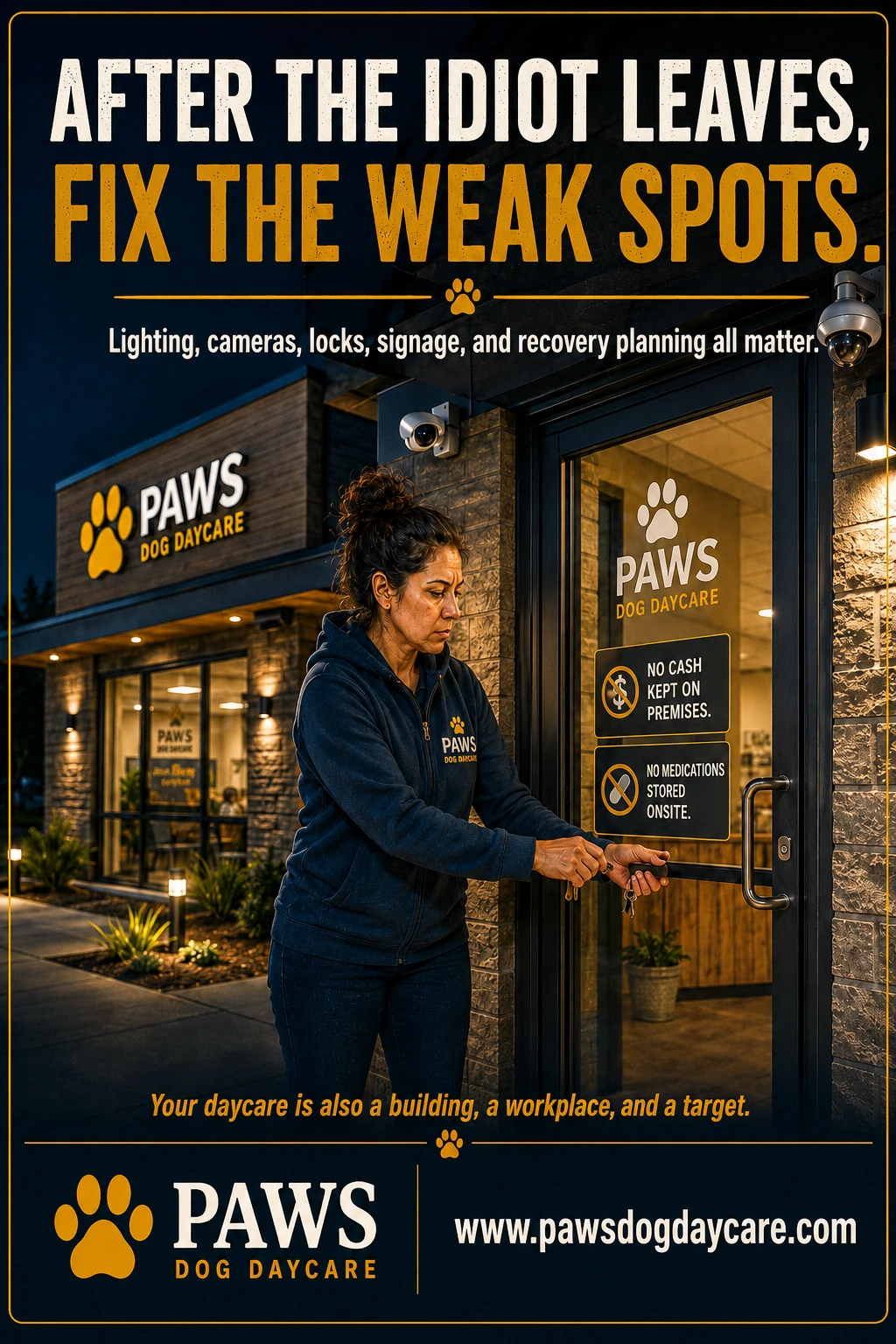
Once the emergency is handled, the door is fixed, the blood is washed off, the register problem is being solved, and the police report exists, you still need to review the building.
Not because you can prevent every break-in. You cannot. If somebody wants to make a terrible life choice with enough commitment, they can break glass.
But you can make the business less attractive, improve evidence, reduce damage, speed recovery, and avoid making the next one easier.
- Do not leave meaningful cash onsite. Cash out nightly and keep starting cash limited.
- Consider a “no cash kept on premises” notice if it fits your business and local security advice.
- Use cameras that actually capture faces, doors, parking areas, and register areas.
- Make sure footage is saved long enough and can be exported quickly.
- Check exterior lighting. Criminals love dark corners because apparently shame needs mood lighting.
- Check alarm contacts on doors and windows.
- Know who gets the alarm call and who has keys after hours.
- Secure POS equipment, tablets, and office electronics.
- Do not leave medications onsite unless your business truly requires them.
- Use clear signage if people may mistake you for a veterinary clinic.
- Review locks, glass, and door hardware.
- Know who to call for emergency glass repair.
- Keep insurance contact information accessible after hours.
In my case, after learning the guy apparently thought we were a veterinary office, I put language on the door making it clear this was not a veterinary office and that no medications were kept onsite.
Will a sign stop every criminal genius? No.
But if someone is breaking in because they think there are drugs or medications inside, telling them there are no drugs or medications inside is at least better than letting their imagination do inventory.
After a break-in, I would review not only hardware but habits. Who arms the system, who responds to alarms, where keys and access codes live, whether camera alerts are being ignored, whether cash is still being left where it should not be, and whether staff are propping doors or bypassing controls during normal operations.
I would also test whether the cameras actually answer the questions I will need later. A camera that records a beautiful view of the ceiling but cannot identify the person at the door or show what happened at the register is decoration, not useful evidence.
🐾
Final operator rule
Insurance is not just for dog bites. It is for the dumb, bloody, inconvenient, middle-of-the-night nonsense that reminds you your daycare is also a building, a workplace, a public business, a target, and sometimes a magnet for people who make terrible decisions near glass.
❓
Dog Daycare Break-In, Theft, and Liability FAQ
Practical operator answers about burglary, property damage, business interruption, evidence, security, insurance, reopening, and the strange liability problems that can follow a break-in.
What is the first thing I should do if police call me about a break-in?
Do not rush into the building. Allow law enforcement to clear the property first, especially if there is any chance the person is still inside or the scene is unsafe. Once it is cleared, start documenting before cleaning or repairing.
What should I photograph after a break-in?
Photograph the entry point, broken glass, doors, locks, alarm hardware, register area, office, grooming area, damaged wiring, blood or other contamination, exterior conditions, disturbed rooms, and anything missing or broken. I would rather have too many useful photos than realize later that I cleaned away something I needed.
How quickly should I save security-camera footage?
Immediately. Do not assume the system will keep it forever. Export the relevant time before and after the event, verify that the file actually plays, and preserve a working copy somewhere the normal overwrite cycle cannot erase.
What if animals are still inside the facility when the break-in happens?
Their safety becomes part of the response as soon as police say you can enter. Check containment, gates, doors, room conditions, injuries, escape risk, and whether any area has glass or other hazards. One break-in is enough; you do not want the recovery process to create a loose-dog emergency.
Why can the stolen item be less important than the operational disruption?
That happened to me with the cash drawer. The money itself was not huge, but the missing drawer disrupted the POS workflow for weeks. Look at what each piece of equipment does for the business, not just what it costs to replace on paper.
What front-desk systems should have a backup plan?
You want a fallback for payment processing, cash handling, receipts, customer check-in, software access, internet, tablets, printers, terminals, and admin credentials. The goal is to keep one stolen or broken component from turning the entire front desk into a manual scramble.
Should I keep cash in the daycare overnight?
It is fine to keep a small amount of cash onsite if the operation reasonably needs it. The exact amount depends on your business, but you do not want a criminal finding a meaningful payday in the register, and you do not need more cash sitting in the building than staff require to make change.
What insurance coverage should I ask about before a break-in?
Ask about commercial property, theft or crime coverage, vandalism, storefront glass, emergency board-up, business interruption, tenant improvements, ordinance-or-law upgrades, general liability, and claim-defense issues. You want to know the limits, deductibles, exclusions, and notice requirements before the door is broken.
Does ordinary property insurance automatically cover stolen cash?
Never assume it does. Cash may have its own coverage limit, deductible, exclusion, or documentation requirement that is very different from the coverage on your furniture or equipment. Ask specifically how much cash is covered after a burglary and what proof the carrier will want. Then ask the same question about your register, computers, tablets, grooming equipment, POS hardware, and anything else a burglar could walk out with.
Why does business-interruption coverage matter after a burglary?
Because the real financial damage may not be what the burglar stole. If the entrance cannot be secured, the building cannot safely open, the alarm system is down, or critical equipment is missing, you may lose hours or days of normal business. Ask what has to happen before business-interruption coverage applies, how the loss is calculated, and what records you need to prove the income you lost.
What should I do before cleaning blood or broken glass?
First make sure law enforcement has released the scene. Take your photos, preserve your video, document the damage, and ask before moving anything that may still matter to the investigation. Once the scene is released, treat blood and broken glass like the hazards they are. Keep dogs and customers away, use proper protective equipment and cleanup procedures, and do not reopen that area until it is actually safe.
How do I decide whether to open the next morning?
Make that decision based on safety and whether you can actually operate, not because you hate the idea of closing. If customers would be walking through broken glass, blood, police activity, an unsecured entrance, exposed wiring, or a front desk that cannot function, delay opening or close until those problems are under control. You can recover from opening late. Creating another injury because you were determined to open on time is a much worse problem.
What should I tell customers if a break-in delays opening?
Keep it simple and factual. Tell them there was an overnight security incident, everyone is safe, the building is being secured or cleaned, and normal opening or drop-off will be delayed. Give them the revised plan and update them if it changes. They do not need a blow-by-blow police report, crime-scene photos, or your theory about who did it.
Can a burglar who gets hurt still create a liability problem?
Apparently, yes. I learned that one personally. The guy who broke into my building cut himself on the glass he broke, nearly bled out, got caught, and I still later had to deal with an attorney trying to turn his injury into my problem. The lesson is not that every burglar has a valid claim. The lesson is that even a ridiculous claim can create insurance notices, attorney time, document requests, and defense costs. Do not ignore it just because common sense tells you the claim is stupid.
What should I do if I receive a demand letter after the break-in?
Do not fire off an angry response, call the other attorney to explain how stupid the claim is, or start arguing about fault by email. Save the letter, preserve the police report, photos, repair records, video, and other evidence, and notify your insurance carrier or attorney as required. Once somebody is making a formal claim, treat it like a claim even if the facts sound ridiculous.
Why should I care about old glass, locks, or building-code issues?
Because old commercial buildings can carry old problems that nobody notices until something breaks. You do not need to become a building-code inspector, but you should know what you own, what the landlord owns, who is responsible for repairs, and whether replacing damaged glass, doors, wiring, or hardware can trigger a current-code upgrade. Ask your insurance agent how ordinance-or-law coverage handles that difference before a $400 repair turns into a much larger project.
What security changes should I review after a break-in?
Start with the way the person got in and work outward. Check the glass, locks, door hardware, alarm contacts, exterior lighting, cameras, cash handling, POS equipment, key control, after-hours access, and who receives alarm calls. Then look at staff habits. A great alarm does not help if people stop arming it, a great lock does not help if a door gets propped open, and a great camera does not help if nobody knows how to retrieve the footage.
How do I know whether my cameras are actually useful?
Test them before you need them. Can you identify a person coming through the door? Can you see the register, front desk, parking area, and major access points? Are the timestamps correct? Is nighttime footage usable? Can you export a clip without calling the installer? A camera that gives you a beautiful high-definition picture of somebody's hood, the top of their head, or an empty corner is not doing much for you when police ask what happened.
What records should go into the break-in claim file?
Keep the police report number, photos, exported video, stolen-property list, serial numbers when available, purchase records, repair estimates, final invoices, glass and locksmith bills, cleanup expenses, alarm records, replacement-equipment receipts, customer notices, opening delays, and insurance communications together. If the break-in disrupted operations, document that too. Six months later you do not want to reconstruct the entire event from your memory and a pile of random emails.
What is the biggest operating lesson from a break-in?
The actual burglary may be over in five minutes. The business problem can last for weeks. You still have to preserve evidence, secure the building, protect the dogs, deal with police, clean the mess, repair the entrance, replace equipment, keep taking payments, communicate with customers, file the insurance claim, and possibly answer an attorney later. Build that recovery process before somebody with a terrible plan and a piece of glass decides to test it.