Dog Nail Trims, Grooming Room Policy, Customer Anxiety, Staff Safety, Muzzles, Difficult Dogs, Owner Interference, Grooming Add-Ons, Dog Daycare Operations, Bite Risk, Documentation, and When to Say No
Dog Nail Trims: Customer Anxiety, Staff Safety, and When to Say No
Nail trims are one of those tiny services that can create stupid amounts of drama. The nail is small. The feelings are not.
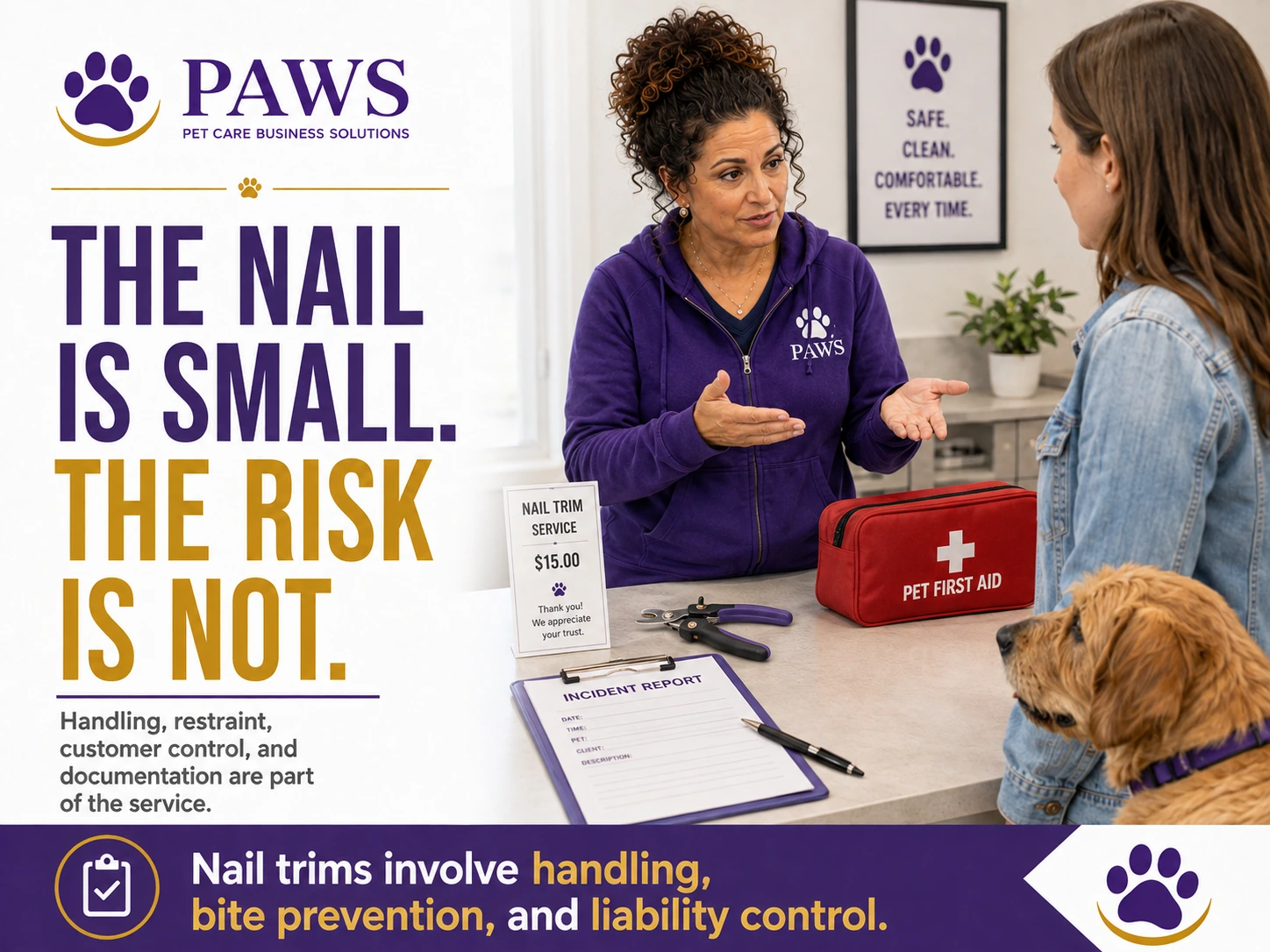
Another huge point of contention between customers and staff centers on nail trims. For as mundane and monotonous as it becomes to groomers, handlers, or someone like myself who has quite literally trimmed over 100,000 individual dog nails over the course of years in the business, nail trims can still turn into a full emotional production with the wrong owner and the wrong dog.
The actual service is simple in theory: hold the foot, identify the safe cut, trim the nail, avoid the quick, stop bleeding if needed, move to the next nail. That is the clean version. The real-world version sometimes involves an overprotective owner, a dog that has been conditioned to panic, a leash getting tighter, a voice getting higher, a dog feeding off the owner’s stress, and a grooming-room door opening at the exact worst second.
Nail trims are not hard because clipping keratin is complicated. Nail trims are hard because feet are sensitive, owners are nervous, dogs remember prior bad experiences, black nails can be harder to read, dogs yelp for reasons that are not always injury, staff can get bitten, and some customers want to supervise a procedure they are actively making worse.
This page is not a home nail-trim tutorial. This is an operator page about policy, staff safety, customer communication, muzzles, refusal, documentation, and why a low-dollar service can become a high-friction argument if the business does not control the room.
⚠️
Operator warning
The customer’s anxiety is not always harmless. Some owners physically and emotionally load the dog until the dog reacts, then blame the staff for the reaction.
🗺️
Use This Page Like a Nail Trim Policy Map
The goal is not to win an argument with the customer. The goal is to protect the dog, staff, and business while making a sane decision about whether the nail trim should continue.
💥
Why Nail Trims Cause Conflict
Low-dollar service, high emotion, sensitive feet, nervous dogs, anxious owners, quicks, yelps, and staff bite risk.
😬
Owner Anxiety
Some owners create the exact reaction they warned you about by tightening up, talking over staff, and loading the dog.
🚪
Grooming Room Policy
Customers usually do not belong in the grooming room during nail trims.
🐶
Muzzles and Safety
A muzzle is a safety tool, not a personal insult, punishment, or permission to force the dog through anything.
🩸
Yelp Does Not Always Mean Injury
Dogs may yelp from fear, pressure, anticipation, owner interruption, or actual quicking. Staff need to know the difference.
🛑
When to Stop
The fact that the customer wants the nails done does not mean the dog can be safely done today.
🎭
Case Study Dialogue
“He bites, but can I hold him?” The classic nail trim customer conversation.
🗣️
Staff Scripts
Exact language for owners, muzzles, yelping, refusal, and grooming-room policy.
🧾
Documentation
Record owner warnings, dog behavior, muzzle use, interruption, injury, refusal, and future restrictions.
❓
FAQ
Straight operator answers about customers holding dogs, yelps, black nails, muzzles, and refusal.
💥
Why Nail Trims Cause So Much Drama
Nail trims are cheap until they are not. The service may be ten bucks. The argument after it can cost you an hour.
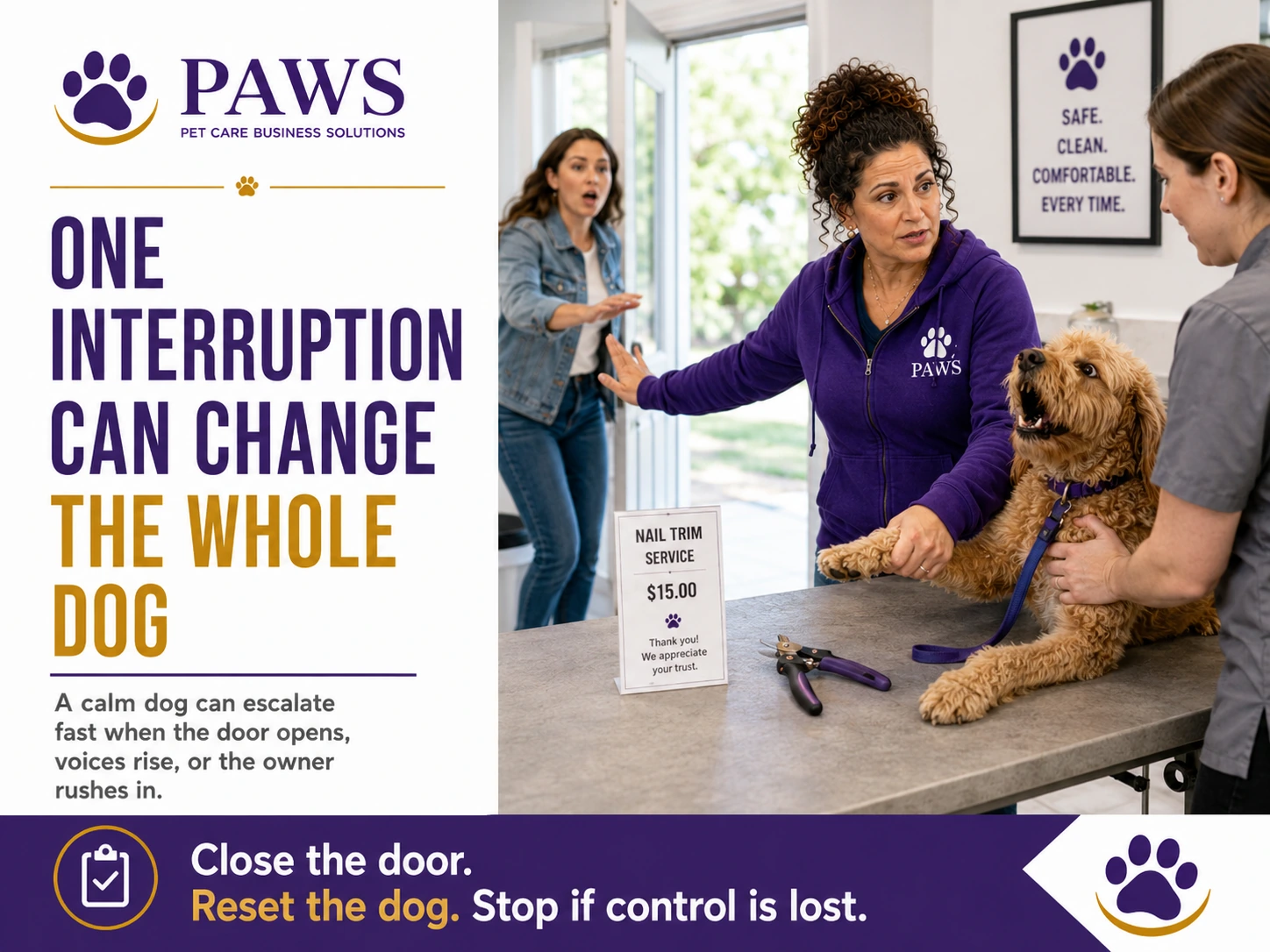
Nail trims create conflict because they are short, personal, noisy, and easy for customers to misunderstand. The customer sees clippers and hears a yelp. Staff see body language, foot sensitivity, restraint pressure, nail length, nail color, quick location, dog history, owner interference, and whether the dog is moving in a way that can hurt itself or bite someone.
Dogs often dislike having their feet handled. Some dogs were never trained to tolerate it. Some owners accidentally taught the dog that nail trims are a panic event by acting nervous every time the clippers appear. Some dogs have had a bad experience. Some have painful feet, arthritis, cracked nails, overgrown nails, mats between toes, old injuries, or just a low tolerance for being restrained.
Then there is the customer side. A worried owner may tighten the leash, hover, gasp, warn repeatedly, talk over the staff, open the door, reach for the dog, or yell right when the dog was starting to settle. The dog reads that like a billboard. The dog may have been workable when it walked in. By the time the owner has performed an emotional weather event in the lobby, the dog is now loaded.
That is why nail trims need policy. They are too small of a service to let them become a free-for-all. Staff safety matters. Dog safety matters. The customer’s feelings matter, but they do not get to run the grooming room.
The business should define who is qualified to attempt the service, what equipment must be available, how many staff members may be used, and what behavior immediately changes the plan. Without those limits, a ten-dollar add-on can quietly become an improvised restraint exercise performed by whoever happens to be free.
The intake conversation is part of the risk assessment. Bite history, prior quicking, foot pain, arthritis, recent injury, medication, past refusal, muzzle history, and how the dog behaves away from the owner all affect whether the appointment should proceed.
📌
Operator translation
Nail trims are not just grooming. They are dog handling, customer management, bite prevention, restraint judgment, and liability control packed into a few minutes with sharp clippers.
😬
The Owner as the Stress Amplifier
Some owners are not trying to cause a problem. They are just very good at causing the problem they fear.
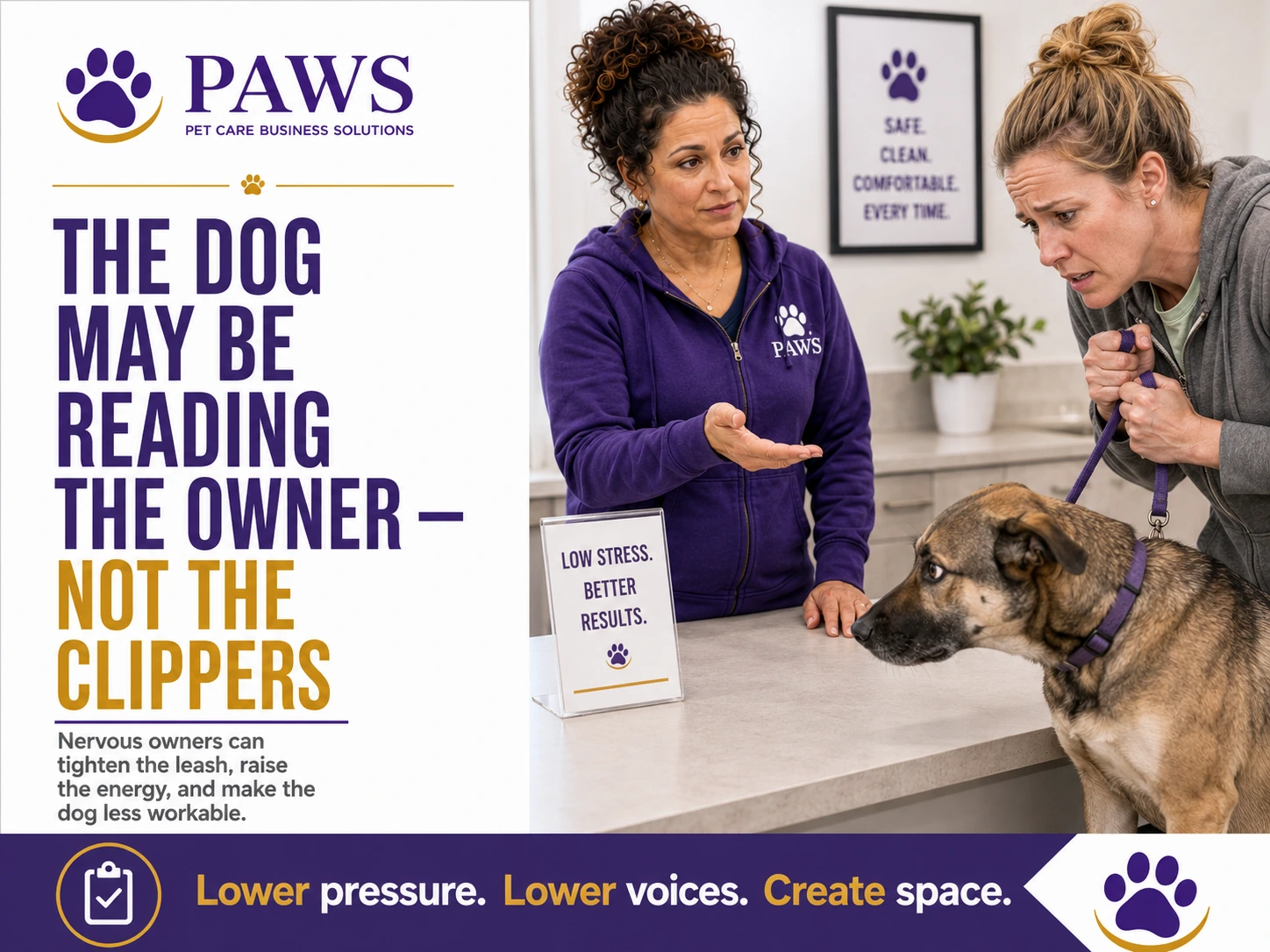
Dogs are masters at reading body language. They notice leash pressure, voice pitch, breath changes, eye contact, posture, tension, hesitation, and panic. A customer who keeps saying “be careful, he bites” while pulling the leash tight and staring at the dog may think they are helping. They may actually be telling the dog, “Something bad is about to happen.”
This is why removing the dog from the owner’s immediate influence can change the entire room. A dog that is nervous but workable may calm down once the owner is not hovering, crying, warning, gasping, or trying to hold the dog like a bomb with fur.
The customer may not understand that. From their side, they think they are the dog’s comfort person. Sometimes they are. Sometimes they are the reason the dog is coming apart. The operator has to know the difference and still explain the policy without turning it into a personal insult.
Staff should not diagnose the owner or argue that the owner is the problem. They should describe the observable effect: the leash tightened, the dog stopped taking food, the body stiffened, the dog pulled toward the doorway, or the reaction increased when the owner spoke.
A consistent handoff routine can lower the temperature. Staff acknowledge the warning, explain the handling plan, take the leash, move the owner away from the work area, and promise a factual report afterward without promising that every nail will be completed.
Swipe left/right to see the full table.
| Owner Behavior | What the Owner Thinks They Are Doing | What the Dog May Read | Operator Response |
|---|---|---|---|
| Tight leash | Keeping control. | Pressure, tension, and warning. | Ask calmly for the leash and create space. |
| Repeated warnings | Protecting staff. | Something bad is coming. | Acknowledge the warning once, then lower the room energy. |
| Hovering or staring | Being supportive. | Pressure and conflict. | Move the owner out of the grooming-room doorway. |
| Opening the door mid-trim | Checking on the dog. | Alarm, interruption, and escalation. | Stop and enforce policy immediately. |
| Asking to hold the dog | Helping the dog feel safe. | Mixed signals, emotional load, and unsafe restraint. | Use staff-only handling rules unless the business has a specific exception policy. |
🚪
Why Customers Usually Cannot Come Into the Grooming Room
The grooming room is not a public viewing gallery. It is a work area with animals, tools, equipment, and bite risk.
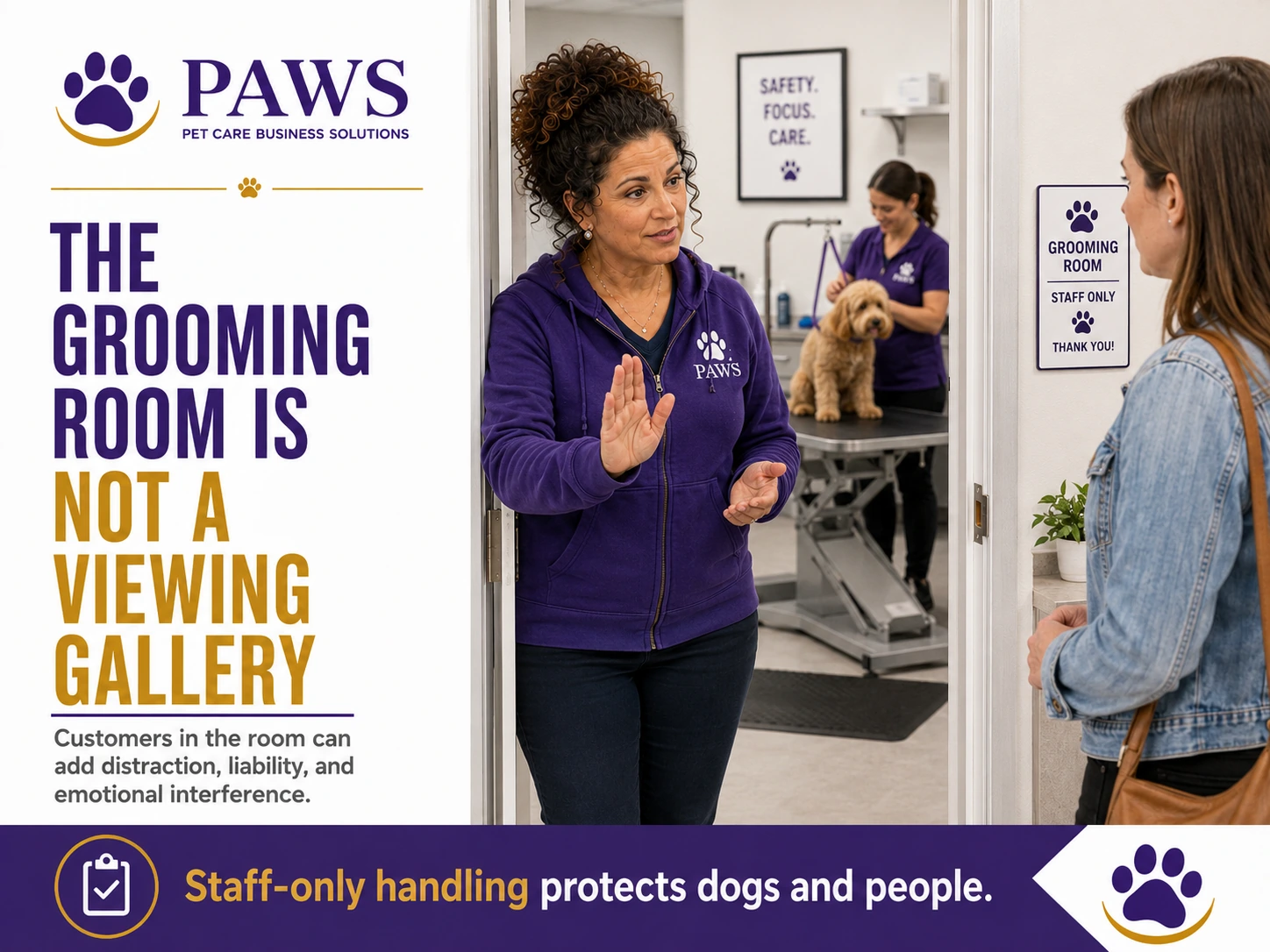
Customers often ask to come back and hold the dog. Sometimes they say the other groomer allowed it. Sometimes they say the dog “does better with me.” Sometimes they say they need to make sure staff do not hurt the dog. The answer still needs to be controlled by policy, not by the customer’s emotional pitch in the lobby.
There are good reasons to keep customers out of the grooming room during nail trims. Insurance. Liability. Staff safety. Dog safety. Trip hazards. Equipment. Bite risk. Distraction. Owner interference. Staff cannot manage the dog, clippers, quick, restraint, muzzle, foot position, customer emotions, and a doorway conversation at the same time.
Some dogs also behave worse when the owner is present. The dog may pull toward the owner, fight restraint harder, scream louder, guard the owner, or play the same panic script it has rehearsed for years. The owner may think that proves the dog “needs” them. Sometimes it proves the opposite.
A clean policy protects everyone. Customers are not allowed in the grooming room during nail trims unless the business has a specific, written exception procedure. That policy should be explained before the dog is halfway into a stressful service.
The rule should apply before conflict starts. Website language, appointment confirmation, front-desk signage, and staff scripts should all state that the grooming room is a staff-only work area and that the service may be stopped if the owner enters or interferes.
Any exception should be written, uncommon, and based on an operational reason rather than pressure at the counter. The business should know who approves the exception, where the owner may stand, who controls the dog, and what ends the attempt.
⚠️
Room rule
I cannot trim nails, manage the dog, manage the clippers, watch the quick, protect my hands, answer the customer’s emotional weather report, and run a public viewing gallery at the same time.
🐶
Muzzles Are Not a Personal Insult
If the owner says “he bites,” take that information seriously.
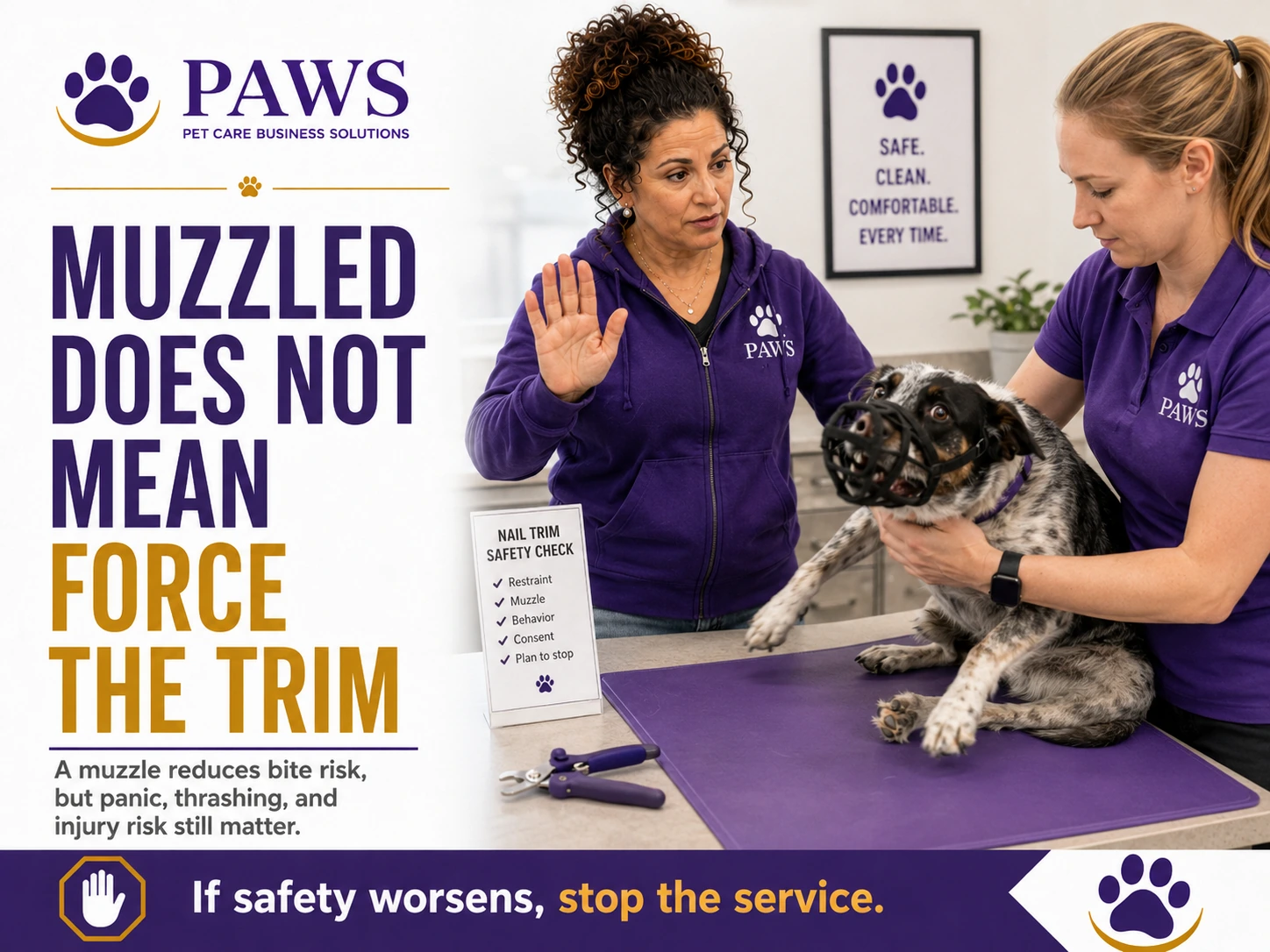
A muzzle is a safety tool. It is not revenge. It is not punishment. It is not an accusation that the dog is evil. It is a way to reduce bite risk during a short handling procedure when the dog has a known or suspected bite response.
That said, a muzzle is not a magic force field. It protects the mouth end. The rest of the dog still has legs, weight, panic, and opinions. A muzzled dog can still thrash, scratch, alligator-roll, injure itself, knock over equipment, or make the service unsafe.
Some dogs cannot be safely muzzled. Some dogs escalate when muzzled. Some dogs are too medically fragile, too panicked, too painful, or too dangerous for a quick nail trim attempt in a daycare/grooming setting. Muzzle use should never become an excuse to force the dog through a service that should be stopped.
Muzzle selection and use require training. The muzzle must fit, permit appropriate breathing for the brief procedure, remain secure, and be monitored continuously. A poorly fitted or casually applied muzzle can add panic without providing reliable protection.
The decision to muzzle and the decision to continue are separate. Staff may apply a muzzle and still stop immediately because the dog cannot tolerate restraint, has a medical concern, thrashes dangerously, or is becoming more distressed with each attempt.
- Use a muzzle when bite history, owner warning, body language, or staff judgment says mouth safety is needed.
- Do not surprise the owner with muzzle use if the business can explain it calmly first.
- Do not assume a muzzle makes the dog safe enough for anything.
- Stop if the muzzle makes the dog panic, fight harder, or creates a breathing or injury concern.
- Document muzzle use, owner warning, dog behavior, and whether the service was completed or stopped.
🩸
A Yelp Does Not Always Mean You Hit the Quick
Customers often judge by sound. Staff have to judge by what actually happened.
Dogs may yelp during nail trims for several reasons. Sometimes the nail was quicked. Sometimes the dog yelps because of anticipation, restraint, owner interruption, foot sensitivity, pressure on the toe, fear, prior conditioning, arthritis, cracked nails, mats, or plain old drama. A yelp is information. It is not automatic proof of injury.
Staff still need to check. Look at the nail. Look for blood. Look at the dog’s body language. Look at whether the dog is painful in a specific foot or reacting generally to handling. Do not dismiss the dog, but do not let a dramatic yelp turn into a false confession either.
Also be honest: if you trim enough nails, eventually one is going to bleed. That is not the end of civilization. Clean it, stop it, tell the truth, document it, and move on like an adult. Acting defensive makes the situation worse. Lying makes it worse than that.
Use a simple fact sequence when the dog vocalizes: stop movement, inspect the nail, look for blood or damage, reassess the foot and body language, and decide whether continuing is safe. Staff should neither dismiss every yelp as drama nor treat every sound as proof of injury.
When a quick is nicked, honesty should be immediate and boring. Control the bleeding, confirm that it stopped, explain what occurred, note any aftercare instructions within facility policy, and record the event before the details become an argument.
Swipe left/right to see the full table.
| Dog Reaction | Possible Cause | Operator Response |
|---|---|---|
| Yelp with no blood | Fear, anticipation, restraint, toe pressure, owner interruption, or prior conditioning. | Check the nail, lower pressure, and continue only if the dog is safe. |
| Yelp with blood | Quick was nicked or nail was already damaged. | Use styptic, stop bleeding, tell the owner honestly, and document. |
| Pulling foot back | Discomfort, fear, poor handling tolerance, or owner-created tension. | Reset the foot calmly. Do not yank harder and turn it into a fight. |
| Thrashing | Panic, pain, restraint fight, or unsafe escalation. | Stop or change the plan before the dog or staff gets hurt. |
| Bite attempt | Dog is over threshold or defending itself. | Use safety procedure, muzzle if appropriate, or refuse the service. |
🛑
The Nail Trim Stop Rule
The fact that the customer wants the nails done does not mean the dog can be safely done today.
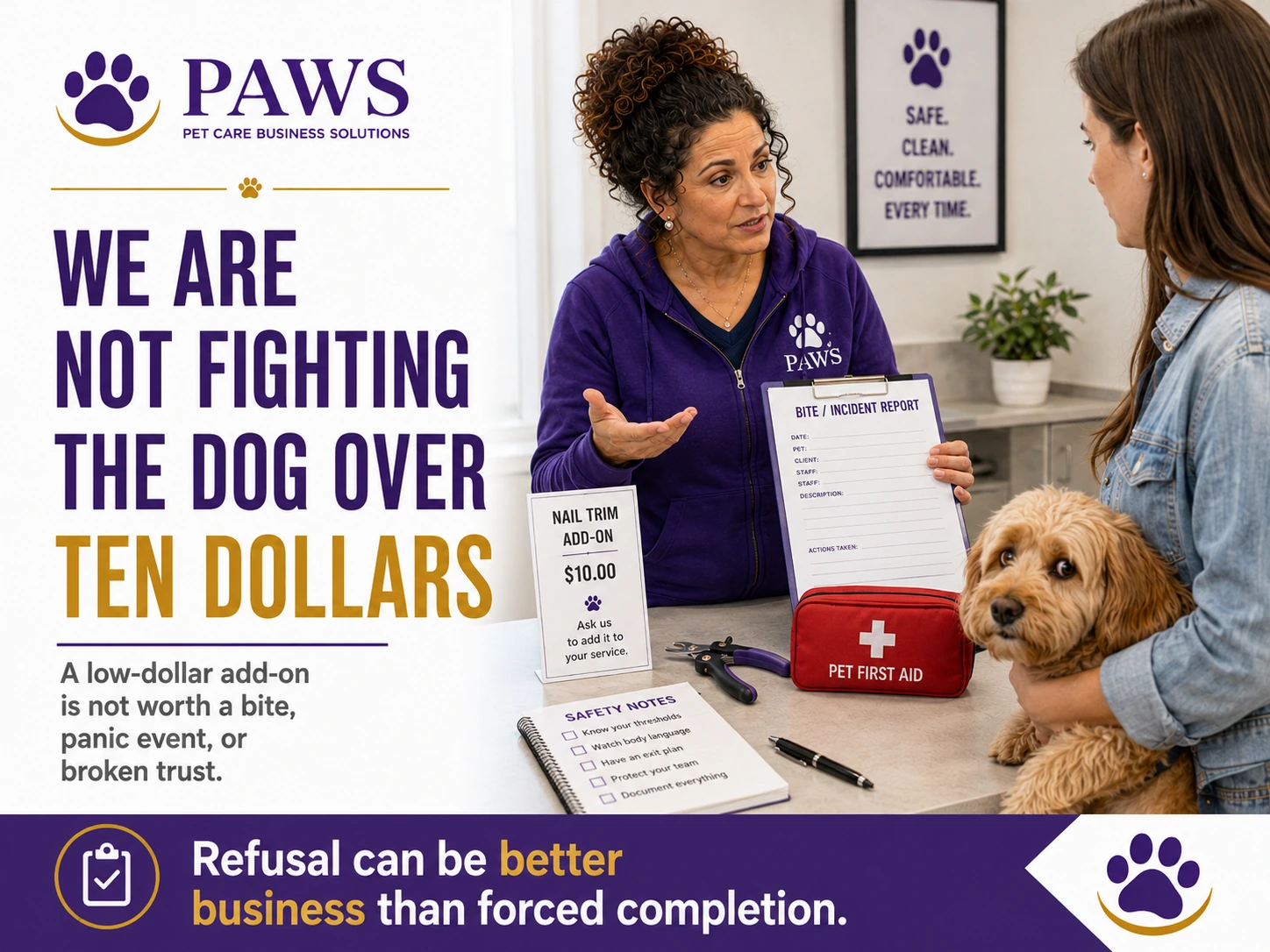
Staff need permission to stop. That should not be controversial, but in a lot of businesses it is. The customer wants the nails done, the front desk wants the customer happy, the groomer wants to finish, and everyone forgets that a nail trim is not worth a bite, a torn cruciate, a panic event, a broken clipper, or a dog that learns every future nail trim is a war.
Some nail trims should be completed. Some should be slowed down. Some should be done with a muzzle. Some should be broken into multiple visits. Some should go to a full-service groomer, trainer, or veterinarian. Some should simply be refused that day.
The stop rule should give frontline staff authority without requiring a manager to approve obvious danger in real time. A manager can review the account afterward, but the employee holding the dog must be able to release pressure and end the attempt the moment the risk becomes unacceptable.
Stopping should produce a next step instead of a vague failure note. Options may include a shorter cooperative-care plan, a quiet appointment, an experienced groomer, veterinarian involvement, medical evaluation for pain, prescribed pre-visit medication through the veterinarian, or no future nail trims at the facility.
- Stop if the dog is biting, attempting to bite, or escalating beyond safe handling.
- Stop if the dog is thrashing hard enough to injure itself or staff.
- Stop if the owner keeps interfering, opening doors, yelling, reaching, or loading the dog after being told not to.
- Stop if the dog cannot breathe normally, overheats, panics in the muzzle, or becomes medically concerning.
- Stop if the dog appears painful, medically fragile, elderly, injured, or unsafe for routine restraint.
- Stop if staff cannot identify a safe cutting range and the risk of quicking or injury is too high.
- Stop if the service is no longer worth the risk.
⚠️
Operator line
We are not going to fight your dog over a nail trim. If the dog becomes unsafe, we stop, document, and recommend the next safest option.
🎭
Case Study: “He Bites, But Can I Hold Him?”
This is the kind of nail-trim conversation that plays out in real dog businesses all the time.
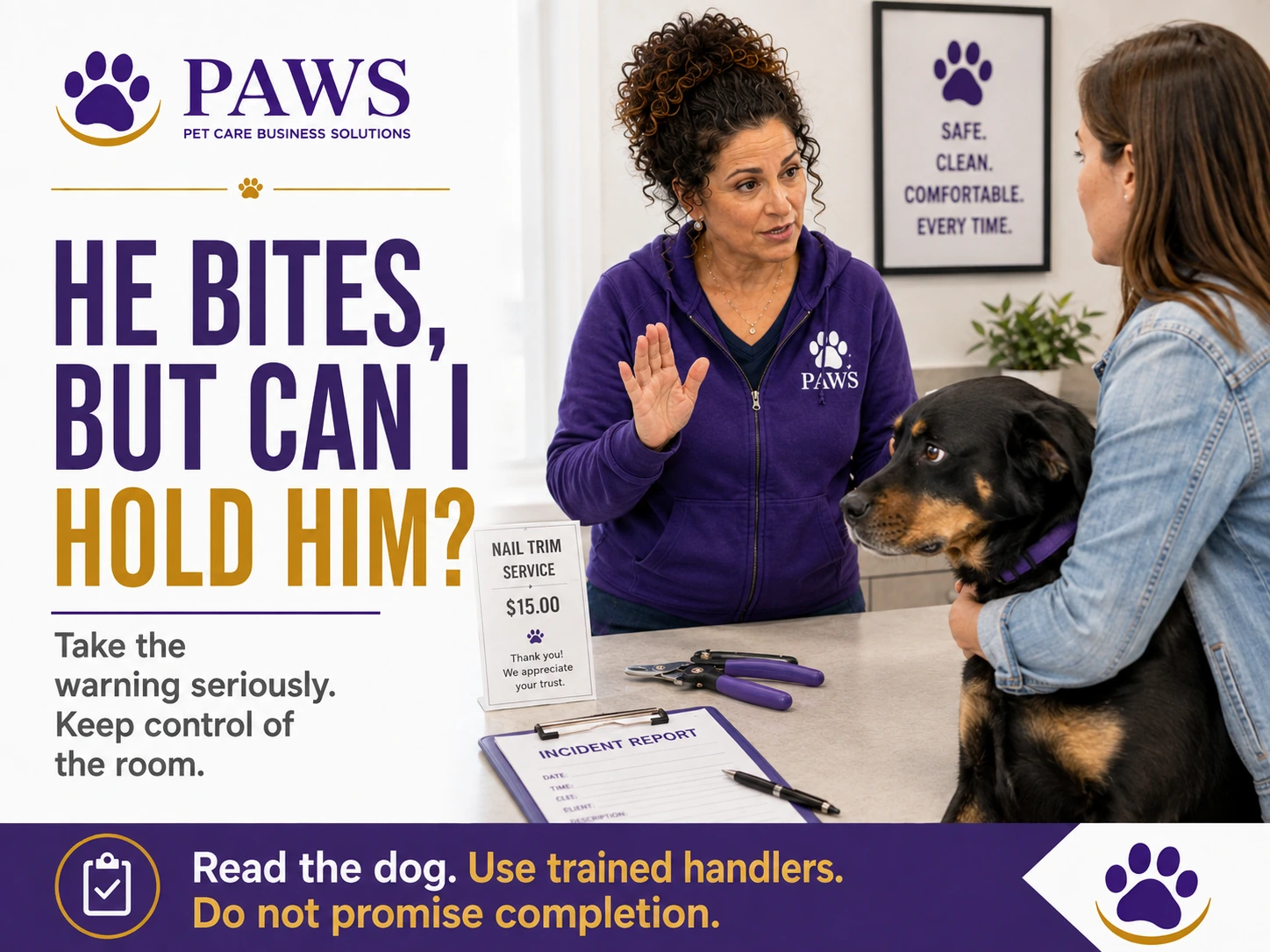
There are a hundred variations of this situation. The names change, the dog changes, and the leash color changes, but the basic structure is familiar: the owner warns that the dog bites, the dog is nervous but not impossible, the owner starts feeding the fire, and staff have to decide whether they can safely get the nails done without letting the customer turn the grooming room into a stress theater.
The case study also shows why the business needs a decision point before the owner opens the door a second time. Once a customer ignores a direct safety instruction, staff should pause the service and decide whether the room can be controlled before touching another paw.
A successful completion does not erase the risk. The account still needs notes about the bite warning, owner interference, muzzle use, dog response, and the conditions required for a future visit so the next employee does not unknowingly recreate the same scene.
🎬
How to read this case study
The dog is nervous but workable. The owner is anxious. The room gets worse when the owner interferes and better when the operator controls the environment.
1. The Warning
Pet Owner: A young lady brings in a large dog for a nail trim. “I would like to get his nails trimmed, but I warn you, he bites.”
Business Owner: Observes the dog. He looks nervous but not overtly aggressive. “No problem. I will see what I can do.” The dog is wagging nervously, reserved, but the overall tone is friendly and apprehensive.
Operator note: Take the bite warning seriously, but do not decide the dog is impossible before reading the dog in front of you. Nervous does not always mean dangerous. Nervous means slow down and read.
2. The Owner Starts Loading the Dog
Pet Owner: Gets tense, starts applying pressure to the leash, becomes visibly nervous, voice pitch changes, and again warns of the dog’s vicious nature.
Business Owner: Attempts to diffuse the situation and calmly asks the owner to hand over the leash.
Pet Owner: Hesitantly hands over the leash.
Business Owner: Creates space between owner and dog. The dog gets away from the nervous owner who is inadvertently adding stress and tension. Staff speaks to the dog in a calm, assertive way. The dog begins to calm down, wags shyly, complies, and starts toward the grooming area.
Operator note: The owner is now loading the dog. Sometimes the safest first move is getting the dog away from the owner’s panic before judging whether the dog is actually unsafe.
3. The Grooming-Room Policy Fight
Pet Owner: “Can I go in with you and hold him?”
Business Owner: “No ma’am. Only employees are allowed in the grooming room.”
Pet Owner: “Why? How do I know you are not going to hurt him?”
Business Owner: “Ma’am, we have a great deal of experience trimming dog nails, and having mom or dad around can sometimes make the pet behave in a negative way or act out because they feed on the owner’s stress.”
Pet Owner: “What do you mean?”
Business Owner: “Dogs are masters at reading body language. If you become stressed or keep trying to communicate with him while we are trimming nails, he may wiggle, pull, or act out, which puts both our staff and your dog at risk of injury.”
Operator note: This is where policy matters. Keep it calm, direct, and safety-based. Do not let the customer turn grooming-room access into a debate about whether you love the dog enough.
4. The Other Shop Fired the Dog
Pet Owner: “Well, the other grooming shop always lets me hold him when they trim the nails.”
Business Owner: “I understand, but that is their policy. Ours is different, and for safety and insurance reasons we cannot allow customers in the grooming room during nail trims. Why did you stop going to the other shop that let you hold him?”
Pet Owner: “They said he was too difficult and they couldn’t do him anymore.”
Business Owner: “No problem. If you would like, we can continue and I will see what we can get done.” Staff leads the dog into the grooming room, asks him to sit, observes body language, gives him a moment to calm, pets him, talks calmly, and then takes one paw to begin.
Operator note: There it is. The shop that “always allowed it” also fired the dog. Do not let another shop’s policy become your policy, especially when that policy apparently did not solve the problem.
5. The Door Opens and the Dog Escalates
Pet Owner: Opens the grooming-room door and shouts nervously, “Be careful, don’t hurt him.”
Dog: Gets upset, yanks the foot back, and body language changes.
Business Owner: “Ma’am, you need to close the door and not enter the grooming room while we trim his nails. Have a seat or browse the store. It will only take a second.” The dog is now more nervous, so staff muzzles him for safety and starts again.
Business Owner: One foot is secured and the first nail is trimmed. Clean cut. No quick. No injury. The dog yelps.
Pet Owner: Opens the door again and screams to stop hurting her dog.
Dog: Becomes more upset and begins to visibly struggle.
Business Owner: “Ma’am, please have a seat and allow us to finish, or we will be unable to safely trim your dog’s nails.”
Operator note: This is exactly how a workable dog becomes less workable. The interruption changed the dog. A yelp is not automatically a quicked nail, but the owner just turned sound into accusation and made staff’s job harder.
6. The Owner Leaves, the Dog Calms, and the Trim Finishes
Pet Owner: Begrudgingly closes the door. The atmosphere calms again.
Business Owner: Calms the dog again. With the owner out of sight, the dog relaxes enough for the nail trim to proceed without incident. Staff exits the grooming room and returns the dog to the owner.
Pet Owner: “You didn’t hurt him, did you?”
Business Owner: “No ma’am, he did just fine.”
Pet Owner: Visibly shaken: “But how do I know? He looks so upset.”
Business Owner: “There were no problems. He did very well. Just relax and he will relax. When you are stressed, he feeds on that and becomes upset too.”
Pet Owner: “I didn’t know that.”
Business Owner: “No problem, ma’am.”
Operator note: The room improved when the owner stopped injecting panic. The dog was not perfect, but the service became workable once the room was controlled. End calm, document the risk, and decide whether future nail trims require restrictions.
📌
Case study takeaway
The dog was nervous, but the owner was the accelerant. Once the owner stopped opening the door and broadcasting panic, the dog became easier to handle. That does not mean every dog can be done. It means the operator has to control the room before judging whether the dog is truly impossible.
🗣️
Nail Trim Staff Scripts
Staff need calm language before the customer turns the lobby into court testimony.
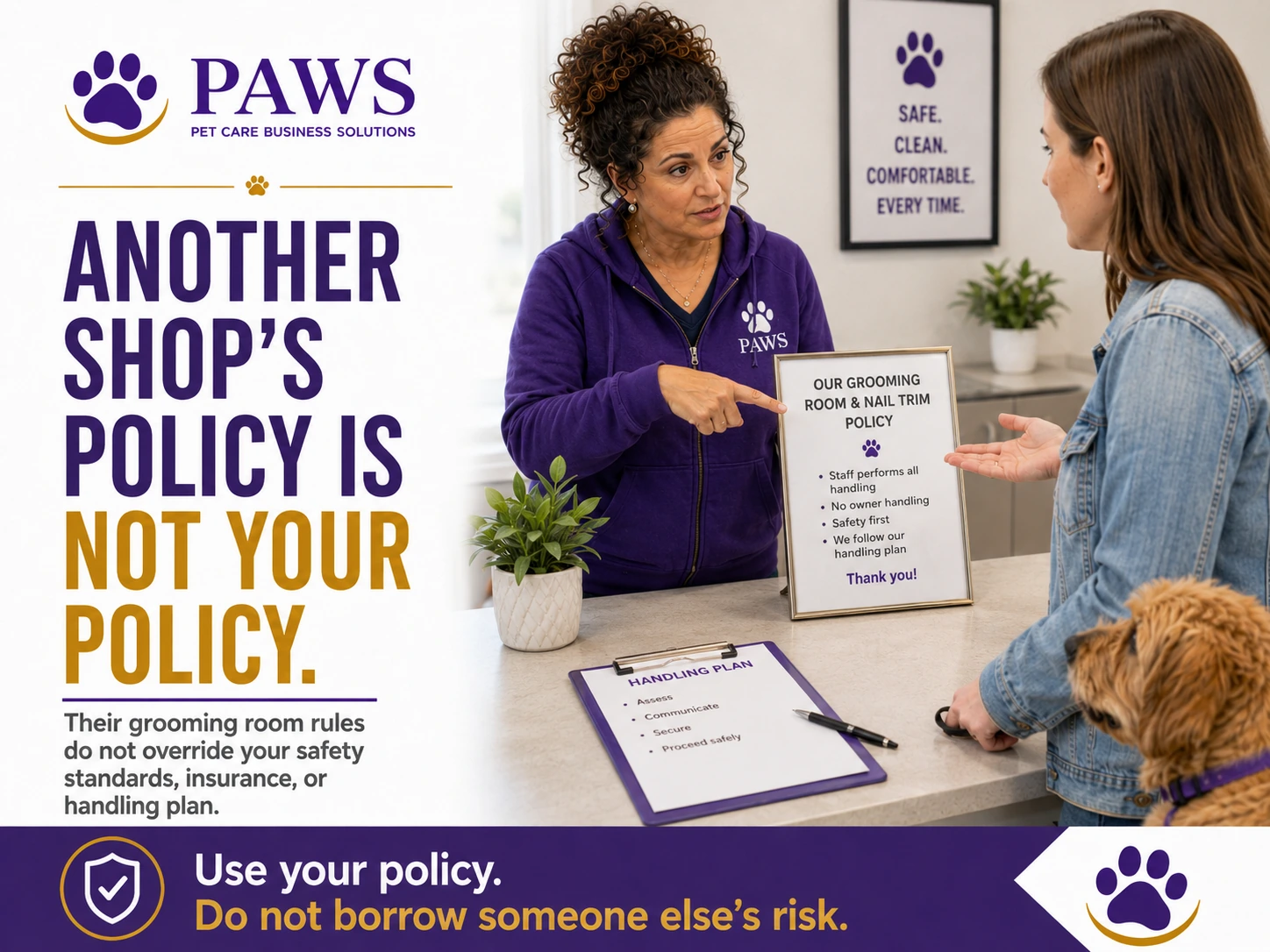
Scripts should keep the same boundary even when employees use different words. Staff need to acknowledge the customer’s concern, state the facility rule, explain the safety reason, describe the available options, and identify what will cause the service to stop.
The script should never promise completion. The safest statement is that staff will evaluate the dog, attempt only what can be done safely, and report what was completed, what was not completed, and what plan is recommended next.
Swipe left/right to see the full table.
| Situation | Staff Script | Why It Works |
|---|---|---|
| Customer wants to enter grooming room | “For safety and insurance reasons, customers are not allowed in the grooming room during nail trims.” | Short, policy-based, not personal. |
| Customer wants to hold the dog | “I understand you are trying to help. For safety, our trained staff handle restraint during the nail trim.” | Acknowledges intent while keeping control. |
| Customer says the dog bites | “Thank you for telling us. We will read his body language and may use a muzzle or stop if he is not safe today.” | Takes the warning seriously without promising completion. |
| Dog yelps | “A yelp does not automatically mean the nail was quicked. We will check the nail and let you know if anything happened.” | Stops the customer from turning sound into accusation. |
| Customer keeps interrupting | “We need you to stay out of the grooming room so we can do this safely. If the interruptions continue, we will stop the nail trim.” | Creates a clear consequence. |
| Dog is unsafe | “He is too stressed to safely finish today. We are going to stop and recommend a different plan.” | Protects the dog, staff, and business. |
| Customer argues | “I understand you want the nails done. We are not going to fight him over it. Safety comes first.” | Ends the debate without sounding weak. |
🧾
Document the Nail Trim When the Room Gets Weird
A difficult nail trim should not disappear into “he was dramatic.”
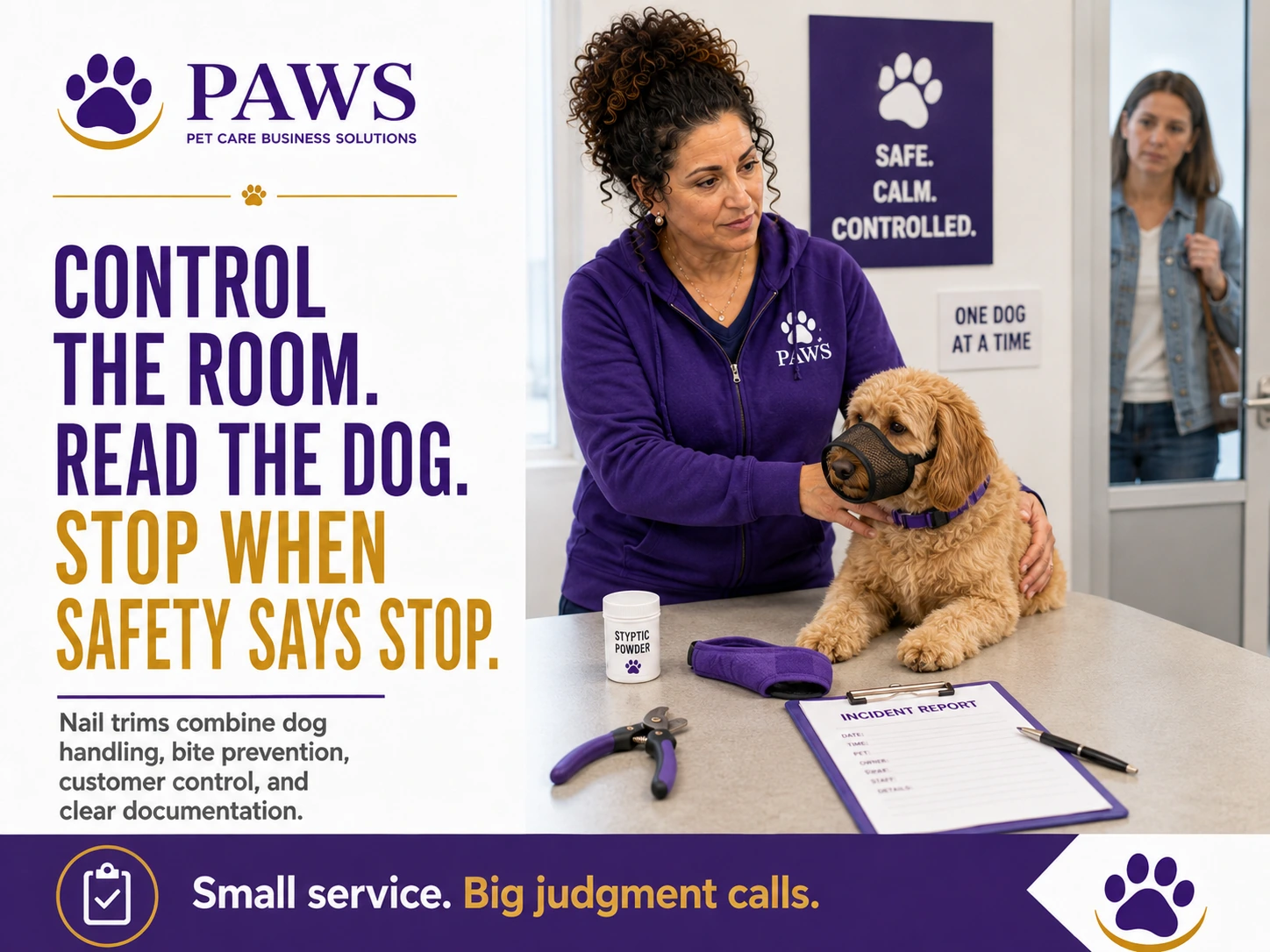
Not every nail trim needs a novel. But when the owner warns that the dog bites, the dog escalates, a muzzle is used, the owner interferes, the dog yelps, a nail bleeds, staff stop the service, or future restrictions are needed, document it.
Documentation protects the staff, the business, the dog, and the next person who has to handle that same animal. It also keeps the story from being rewritten later as “they hurt my dog for no reason.”
Good notes use observable facts rather than labels. “Dog stiffened, showed whites of eyes, pulled the foot repeatedly, snapped toward the handler, and could not recover after a break” is more useful than “dog was bad” or “dog was crazy.”
Documentation should also show the business response: who handled the dog, what restraint or muzzle was used, when the attempt stopped, whether bleeding occurred, what the owner was told, and what restriction or referral applies to future appointments.
- Record that the owner warned the dog may bite, if that happened.
- Record the dog’s body language before the nail trim: nervous, stiff, friendly, avoidant, growling, snapping, thrashing, or workable.
- Record whether the owner interfered, opened the door, yelled, reached for the dog, or refused to follow policy.
- Record whether a muzzle was used and why.
- Record whether any nail was quicked, whether styptic was used, and whether bleeding stopped.
- Record whether the service was completed, partially completed, stopped, or refused.
- Record future restrictions: staff-only handling, muzzle required, groomer-only, vet-only, no walk-in nail trims, or no future nail trims.
❓
Dog Nail Trim FAQ for Operators
Detailed answers about owner involvement, grooming-room access, muzzles, yelping, black nails, stop decisions, incomplete services, referrals, pricing, documentation, and future restrictions.
Should customers be allowed to hold their dog during a nail trim?
Usually no. A customer may believe their presence comforts the dog, but they may also add leash tension, mixed restraint, emotional pressure, sudden movement, and an untrained pair of hands near the dog’s mouth and the employee’s tools. The facility should use a written staff-only handling rule unless a specific exception has been approved.
Staff can respect the owner’s intent without surrendering control of the procedure. Explain how the handoff works, where the owner should wait, how the dog will be assessed, and that the service will stop if it cannot be completed safely. The customer receives information and a clear boundary instead of an argument.
What if the owner says the dog behaves better when they are present?
That may be true for some dogs, but it should be evaluated rather than assumed. Staff should compare the dog’s body language with the owner nearby and after a calm separation. Pulling toward the owner, guarding, escalating vocalization, tight leash pressure, and repeated interruption may make the dog less workable.
The business should not frame the decision as a judgment about the owner. Describe what staff observed and apply the same safety rule used for every client. When the owner’s presence genuinely improves handling, any exception still needs a defined position, staff control of restraint, and an immediate stop condition.
What if another groomer allowed the owner into the grooming room?
Another company’s policy does not control your insurance, staffing, layout, training, or safety obligations. The correct response is calm and direct: that facility may operate differently, but this business uses a staff-only work-area rule during nail trims.
Do not insult the other groomer or challenge the customer to leave. Explain what your rule protects and what options remain. It is also reasonable to ask why the client changed providers, because the answer may reveal prior refusal, repeated interference, a bite event, or a service the other facility could no longer complete.
Is a muzzle cruel during a nail trim?
A properly selected and properly monitored muzzle is a safety tool, not punishment. It may reduce bite risk when the dog has a known history, the owner warns that the dog bites, or current body language makes mouth protection appropriate.
The muzzle does not make every trim humane or possible. Staff must still monitor breathing, panic, thrashing, overheating, medical concerns, and the dog’s ability to recover. When the muzzle increases distress or the handling remains unsafe, the correct decision is to stop rather than use the muzzle as permission to force completion.
Does using a muzzle mean staff should finish the nail trim?
No. The muzzle addresses only one part of the risk. A dog can still twist, fall, scratch, injure a limb, overheat, damage equipment, or experience a severe panic response while the mouth is covered.
Staff should reassess after the muzzle is applied and after every escalation. If the dog cannot be positioned safely, cannot breathe normally, fights harder, appears painful, or cannot recover after a pause, the service should end and the account should receive a safer future plan.
What if a dog yelps but there is no blood?
Stop long enough to inspect the nail and the dog. Vocalization may come from anticipation, restraint, toe pressure, fear, owner interruption, arthritis, prior conditioning, or pain elsewhere in the foot. A yelp is meaningful information, but it is not automatic proof that the quick was cut.
Staff should explain only what they can verify. State that the nail was checked, whether blood or damage was found, how the dog responded after the pause, and whether the trim continued or stopped. Avoid dismissing the dog as dramatic and avoid admitting to an injury that did not occur.
What should staff do when a nail is quicked?
Pause the service, control the bleeding with the facility’s approved first-aid procedure, confirm that bleeding has stopped, and reassess whether the dog can safely continue. The employee should notify the owner honestly rather than hoping the small incident goes unnoticed.
Record which nail was affected, what product or procedure was used, when bleeding stopped, how the dog behaved, and what the owner was told. An ordinary minor quicking event becomes a larger trust problem when staff sound evasive, defensive, or inconsistent.
How should black nails be handled?
Black nails can make the quick harder to identify, so staff should use strong lighting, stable positioning, conservative cuts, and visual or tactile indicators appropriate to their training. The employee should stop before the work becomes guessing.
Difficulty increases when the dog is moving, panicked, painful, or unable to tolerate foot handling. A partial conservative trim or referral is better than chasing a shorter cosmetic result while the safe cutting range is uncertain.
When should staff stop a nail trim?
Stop when the dog attempts to bite, thrashes hard enough to risk injury, cannot breathe normally, panics in the muzzle, appears painful or medically fragile, cannot be positioned safely, or does not recover after a break. Stop as well when customer interference prevents controlled handling.
The stop decision should not depend on how many nails remain or how strongly the client wants completion. Staff need written authority to end the service, document what occurred, and recommend the next appropriate option without being pressured by the front desk or a low service price.
What should happen after an incomplete nail trim?
Tell the owner exactly what was completed, what behavior caused the stop, whether a muzzle or other handling aid was used, and whether any injury occurred. Avoid vague statements such as “he would not let us” when specific observations are available.
Give a next-step plan. That may involve a quieter appointment, shorter cooperative-care visits, an experienced groomer, veterinarian evaluation for pain, veterinarian-directed pre-visit medication, or a restriction that future trims cannot be performed at the facility.
When should a dog be referred to a veterinarian?
Referral is appropriate when the dog appears painful, has injured or abnormal nails, is medically fragile, has severe mobility limitations, cannot tolerate routine restraint, requires medical evaluation, or may need sedation or medication that the daycare or grooming facility cannot provide.
The referral should be framed as the safer level of care rather than punishment for difficult behavior. Document the observations that led to the decision and avoid promising what the veterinarian will do or whether medication or sedation will be appropriate.
Can a dog be referred to a trainer or cooperative-care program instead?
Yes, when the main problem is handling fear or a learned panic response rather than an urgent medical need. Slow conditioning to paw touch, equipment, positioning, brief restraint, and release can improve future care when performed by qualified people with realistic expectations.
Training is not a same-day shortcut for dangerously long or painful nails. The business should distinguish immediate veterinary needs from a longer behavior plan and should not sell guaranteed results or let repeated unsuccessful attempts make the dog more fearful.
Should nail trims be performed while the dog is attending daycare?
They can be, but timing matters. A dog pulled directly from high-arousal play may be panting, excited, physically tired, or less tolerant of restraint. Some dogs do better after a rest period, while others are calmer before group play begins.
The facility should define who authorizes the add-on, when the dog is removed from group, how arousal is assessed, where the trim occurs, and how the dog is returned. The nail trim should not be rushed between playroom duties or performed by staff who are simultaneously responsible for supervising a group.
How many staff members should restrain a dog for a nail trim?
There is no universal number because dog size, behavior, staff skill, equipment, positioning, and the service setting differ. The business should establish trained handling methods and prohibit piling more people onto the dog merely because the first attempt failed.
Adding hands can add pressure and panic. When the service requires escalating force, repeated repositioning, or more staff than the procedure can safely support, that is evidence to stop and choose a different plan rather than a reason to keep recruiting employees.
What if the owner keeps opening the grooming-room door or interrupting?
Pause the procedure immediately. Tell the owner that the interruption changed the dog’s response and that the work area must remain closed. State clearly that another interruption will end the service.
Do not continue trimming while arguing through the doorway. If the owner cannot follow the rule, return the dog safely, document the interference, record whether the service was partial or refused, and establish conditions for any future appointment.
What should be documented after a difficult nail trim?
Record the owner’s warnings, the dog’s body language, bite attempts, vocalization, restraint response, muzzle use, interruptions, which nails were completed, any bleeding or first aid, why the service stopped, and what the owner was told.
Use observable facts rather than emotional labels. The record should help the next employee make a safer decision and should support consistent future restrictions such as staff-only handling, experienced-groomer only, muzzle assessment, scheduled appointments, veterinarian referral, or no future nail trims.
Should the business charge for an incomplete nail trim?
The answer should be decided in the written pricing and cancellation policy before the conflict occurs. Staff still spent time, used trained labor, assessed the dog, prepared equipment, and accepted handling risk even when the service had to stop.
Whatever policy is chosen should be explained consistently and applied fairly. The business may use a handling fee, partial-service charge, or no-charge first attempt, but employees should not improvise refunds or promises at the counter while the owner is upset.
Should nail trims be included free with daycare, boarding, or grooming?
Free does not mean costless. Nail trims consume trained labor, work space, tools, sanitation, documentation, customer communication, and risk capacity. A difficult attempt can disrupt staff assignments far beyond the few minutes shown on the service menu.
The business should include the service only when the pricing of the larger package genuinely supports it and the same safety rules still apply. Free status must never create pressure to rush, skip screening, use unqualified employees, or force completion because the customer believes the service was promised.
Can the business refuse future nail trims for a dog?
Yes. A facility may decide that the service exceeds its training, equipment, staffing, insurance, or humane handling limits. Repeated bite attempts, dangerous thrashing, severe panic, owner interference, medical concerns, or inability to complete the service safely can justify a restriction.
The refusal should be specific and documented. Explain whether the dog may still use other services, whether a veterinarian or specialized groomer is recommended, and whether any future reconsideration would require changed conditions rather than leaving the account with an unclear warning.
What is the bottom-line operating rule for nail trims?
Control the room, read the dog in front of you, use only trained handling methods, communicate honestly, and stop when safety says stop. The customer’s request and the low price of the service do not override the employee’s responsibility to protect the dog and staff.
A successful nail-trim program is not one that finishes every dog. It is one that screens consistently, avoids preventable bites and panic, records difficult events, gives clients clear options, and refuses to turn a routine add-on into a fight.
🐾
Bottom Line: Nail Trims Are Small Services With Big Opinions Attached
The operator’s job is to keep the nail trim from becoming a staff-safety problem, dog-safety problem, or customer-performance problem.
Nail trims are routine for experienced handlers, but they are not emotionally routine for every customer or every dog. Some owners are nervous. Some dogs are conditioned to react. Some dogs have painful feet. Some dogs bite. Some customers want to hold the dog, supervise the staff, open the door, and then act surprised when the dog escalates.
The business needs policy before the argument starts. Customers should know whether they can enter the grooming room. Staff should know when to muzzle, when to slow down, when to stop, when to document, and when to refuse. The front desk should know what to say when the owner says, “But the other place let me hold him.”
The goal is not to prove the customer wrong or force every dog through the service. The goal is to handle the dog safely, protect staff, tell the truth, document the situation, and make the next decision based on reality.
Nail trims are small. The risk is not always small. Treat them like an actual service, not a throwaway favor with clippers.
The service menu should reflect the real operating cost. Time, trained labor, sanitizing tools, restraint judgment, recordkeeping, first-aid supplies, customer communication, and the possibility of an incomplete service all belong in the price and scheduling policy.
A good nail-trim program is not measured by forcing every appointment to completion. It is measured by consistent screening, calm handling, honest reporting, appropriate refusal, useful records, and dogs that are not made harder for the next visit.