Dog Boarding • Client Communication • Bedding Policies • Comfort Items • Ingestion Risk • Overnight Safety • Staff Rules
The Boarding Bedding Debate: Why “Just Let Him Have His Blanket” Is Not That Simple
The owner sees comfort. The boarding facility sees comfort, chewing, choking, obstruction, sanitation, and who gets blamed if the dog eats the sweatshirt at 3:00 a.m.
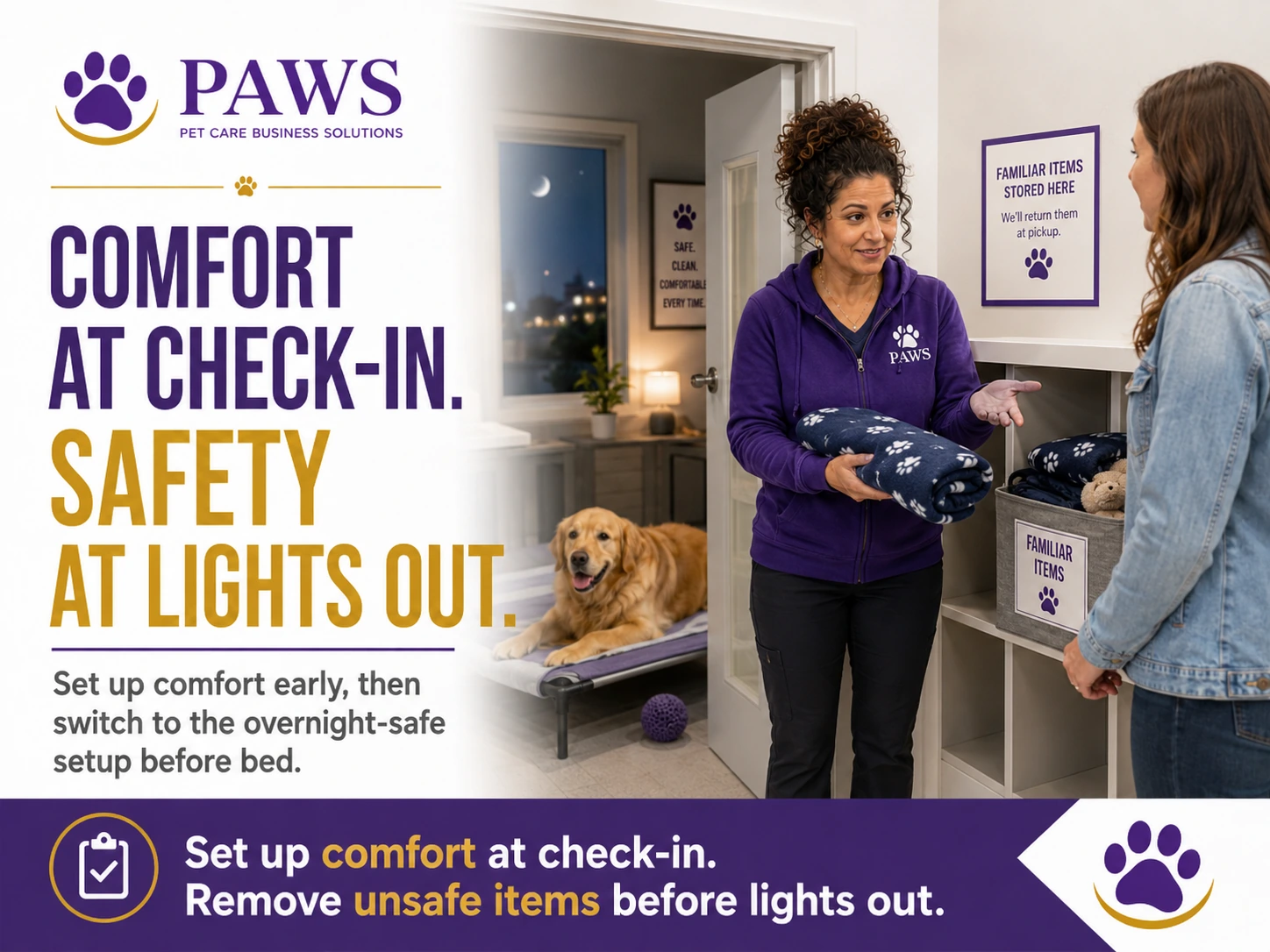
As a facility that provides boarding services, the great personalized bedding debate always rears its ugly head. A pet checks in, the owner arrives with a laundry basket full of blankets, old t-shirts, socks, stuffed toys, chews, bones, pillows, and sentimental items, and they want the dog’s boarding suite set up like a tiny emotional Airbnb.
The owner is not being stupid. Most of the time, the owner is trying to do something kind. They are leaving the dog behind and trying to send comfort into the room. The blanket smells like home. The t-shirt smells like the owner. The toy is familiar. The dog has had these things at home for years. The owner does not want the dog to feel abandoned.
The problem is that boarding is not home. At home, the dog has a known routine, known sounds, known smells, the owner nearby, familiar sleeping patterns, and normal daily life. In boarding, the dog has a new room, new dogs, new noises, new staff, new schedule, new smells, and sometimes a little stress that shows up as chewing, shredding, licking, guarding, pacing, or eating things that were never food.
That is where the debate lives. The owner is bringing comfort. The operator is managing risk. A good bedding policy respects both, but safety gets the final vote.
A practical policy separates emotional value from overnight suitability. Staff can acknowledge why an item matters, decide how it may be used, and preserve the familiar scent without promising that loose fabric, stuffing, strings, or chews will stay in an unsupervised room.
The policy also has to survive shift changes. What the front desk accepts, labels, promises, and documents at check-in becomes the boarding team’s responsibility later, so the safe answer must be clear before the owner leaves.
⚠️
Boarding rule
Love is not a risk assessment. A blanket can be sentimental and still be a bad idea in an unsupervised boarding suite.
🗺️
Use This Page Like a Boarding Bedding Policy Map
The bedding debate is not really about blankets. It is about comfort, guilt, safety, responsibility, and what happens when a familiar item becomes a foreign body.
❤️
Why Owners Bring Bedding
The basket is usually comfort, guilt relief, familiar scent, and love.
☠️
Why Facilities Restrict It
Fabric, stuffing, squeakers, strings, socks, and chews can turn into emergencies.
🏠
Not the Same as Home
“He never chews at home” is not the same as “he will not chew here tonight.”
🌙
The Overnight Rule
The suite can look homey at check-in and still be stripped back to safety at night.
👀
Supervised Comfort Items
Familiar items can be used safely during supervised one-on-one time.
🧾
Forms and Fine Print
The boarding agreement should allow bedding removal whenever safety requires it.
🩺
Bedding Exceptions
Senior dogs, orthopedic needs, medical comfort, and when exceptions need manager approval.
🛑
When to Say No
Some comfort items should not enter the suite no matter how emotional the story is.
❤️
Why Owners Bring a Laundry Basket Full of Home
Before you explain the safety issue, understand the emotional reason the basket exists.
When a boarding customer brings blankets, old t-shirts, socks, stuffed toys, pillows, and favorite items, they are usually not trying to make your life harder. They are trying to make themselves feel better about leaving the dog.
The owner sees the basket as comfort. The dog sleeps on this blanket at home. The t-shirt smells like the owner. The toy is familiar. The old sock may be disgusting to every normal adult human in the building, but to the owner it may smell like home, routine, and “please do not feel abandoned while I am gone.”
That last part matters. Many owners are not only worried that the dog will be uncomfortable. They are worried that the dog will think they left him. They know they are going on vacation, a work trip, a funeral trip, a hospital visit, or whatever else pulled them away. The dog does not know that. So the owner tries to send a piece of home into the room.
A good operator does not mock that. You can understand the emotion and still refuse the unsafe setup. That is the whole job.
The emotional concern should be answered with an operating plan, not dismissed. Staff can explain how the dog will be settled, what approved bedding is provided, how familiar items may be used under supervision, and how the owner will be told if an item is removed.
That conversation works best before the owner is standing in the lobby. Website language, reservation confirmations, boarding forms, and pre-arrival reminders should all prepare the customer for the same policy.
📌
Operator translation
The owner is not bringing a blanket. The owner is bringing guilt relief, familiar scent, comfort, and the hope that the dog feels loved while they are gone.
☠️
Why Boarding Facilities Restrict Personal Bedding
The facility is not trying to be mean. The facility is trying to avoid a dead dog, a surgery bill, and a public crucifixion.
Personal bedding becomes a risk because boarding suites are not watched every second of the night. Staff can clean, check, feed, medicate, observe, walk, and monitor. They cannot stare at every dog’s mouth at 3:00 a.m. waiting to see whether a stressed dog has decided to turn a family sweatshirt into a midnight snack.
Fabric can shred. Stuffing can come out. Socks can be swallowed. Strings can pull loose. Buttons, zippers, fringe, seams, squeakers, rope strands, and toy pieces can become choking or ingestion hazards. Chews and bones can become guarding problems, choking problems, cracked-tooth problems, or obstruction problems.
Even when the owner brought the item, the facility is still the one responsible for the boarding environment. The pickup conversation is not going to be, “Thank you for leaving all of that stuff in the room so he felt comfortable. Shame about the emergency surgery.” That is not how this works. If the dog eats it in your facility, the business is going to be the one explaining why it was available.
The rule is simple: comfort matters, but safety wins. A boarding business should never risk the dog’s life to avoid a slightly awkward drop-off conversation.
The policy also protects sanitation and operational control. Personal items can become urine-soaked, contaminated, mixed with another dog’s belongings, trapped in laundry, or damaged beyond recognition, creating disputes even when no ingestion occurs.
Facilities should define the default room setup first, then decide what owner items may supplement it. That keeps staff from treating every basket as a new negotiation and gives the overnight team a predictable safety standard.
Swipe left/right to see the full table.
| Item Type | What the Owner Sees | What the Facility Has to Consider |
|---|---|---|
| Blankets and comforters | Soft, familiar, smells like home. | Shredding, fabric ingestion, stuffing, soiling, laundering, choking, obstruction. |
| Old t-shirts | Owner scent, comfort, emotional connection. | Easy to chew, shred, swallow, twist, or ball up. |
| Socks and underwear | Familiar scent, personal item, dog loves it at home. | High ingestion risk. Small enough to swallow, large enough to obstruct. |
| Stuffed toys | Favorite toy, comfort object, bedtime routine. | Stuffing, squeakers, seams, eyes, loose pieces, ingestion, choking. |
| Rope toys | Chew toy, play item, familiar object. | Strands, strings, swallowing, linear foreign body risk, fraying. |
| Bones, rawhide, and long-lasting chews | Keeps the dog busy and happy. | Choking, obstruction, guarding, broken teeth, dietary problems, vomiting, diarrhea. |
| Pillows | Cozy and home-like. | Stuffing explosion, fabric ingestion, soiling, hard-to-clean seams. |
⚠️
Blame reality
“The owner brought it” will not protect the business if staff left an unsafe item in an unsupervised suite and the dog ate it. The facility controls the boarding room. The facility owns the safety decision.
🏠
The “He Never Chews at Home” Problem
That may be true. It is also not the same situation.
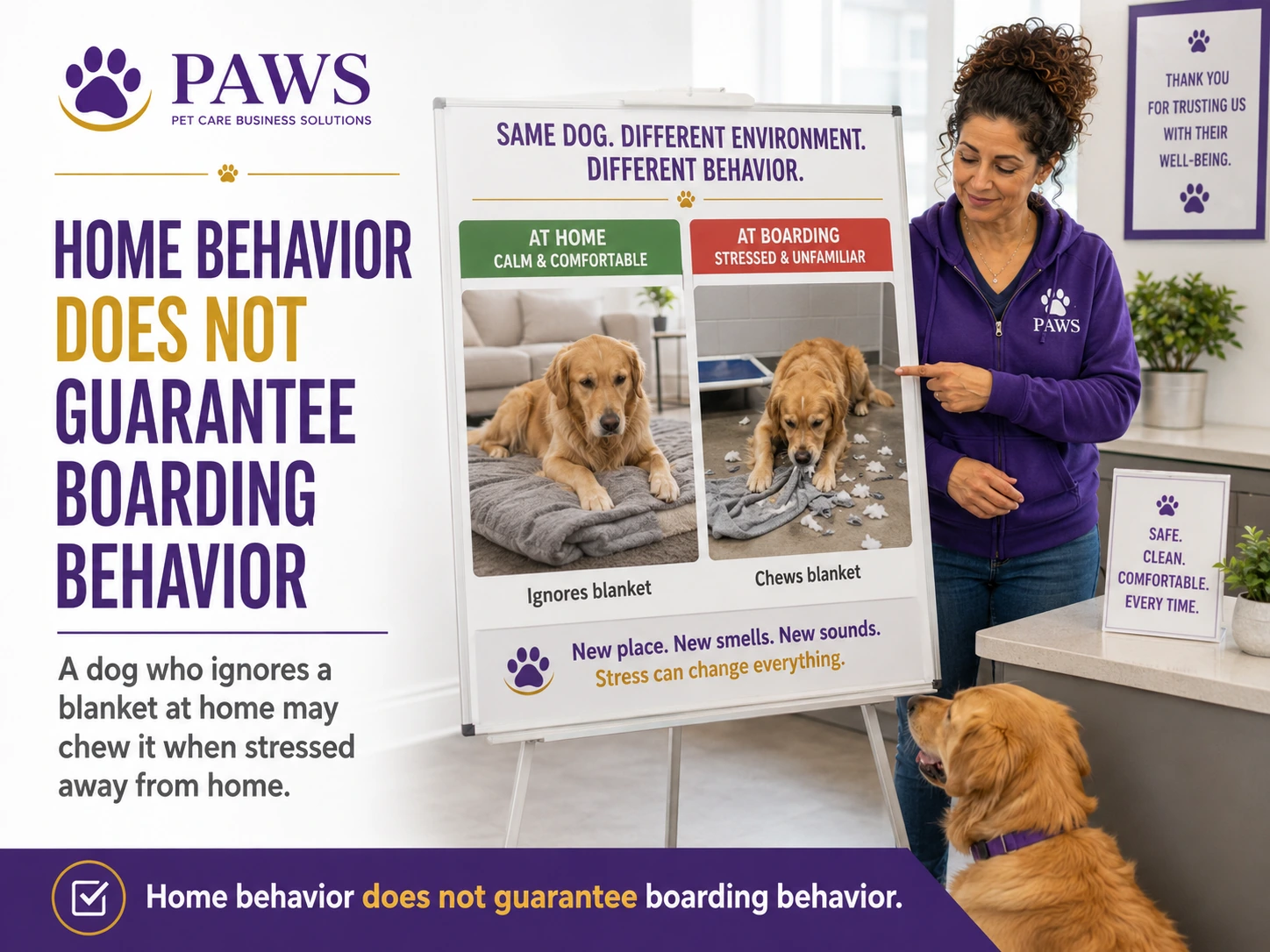
The most common owner response is predictable: “I don’t understand. He has all these things at home and there has never been a problem.”
That may be completely true. The dog may never chew bedding at home. The dog may sleep like a tiny angel on that same blanket every night. The dog may have a stuffed duck he has carried gently for six years like a little emotional support accountant.
But home behavior does not guarantee boarding behavior. At home, the dog knows the routine. At home, the owner comes back through the door. At home, the noises are familiar. At home, the dog knows where he sleeps, when he eats, what happens next, and what every hallway smells like.
Boarding changes the picture. The dog may hear other dogs barking. He may smell other animals. He may be tired from daycare. He may be excited. He may be anxious. He may be bored. He may wake up at night and realize the owner is not there. A dog who never chews at home can still chew in a boarding suite because the boarding suite is not home.
That is the part the client needs to understand. The facility is not calling the owner a liar. The facility is saying, “Your dog’s history matters, but it does not erase our responsibility for tonight.”
Staff should record the home history without treating it as a guarantee. Prior chewing, fabric ingestion, separation distress, guarding, destructive behavior, or crate panic should increase caution, while a clean history may inform supervised use but should not eliminate removal authority.
The dog’s behavior during the current stay matters most. A dog that begins mouthing seams, nesting aggressively, licking fabric, tearing corners, or guarding an item has changed the risk assessment, and staff should act on what they see now.
📌
Use this line
“He has never chewed this in your house, under your routine, with you nearby, on a normal day. That is not the same as tonight in a boarding suite.”
🌙
The Overnight Rule: Set the Room Up, Then Strip It Back to Safety
The owner can see the comfort. The dog still sleeps in a safe room.
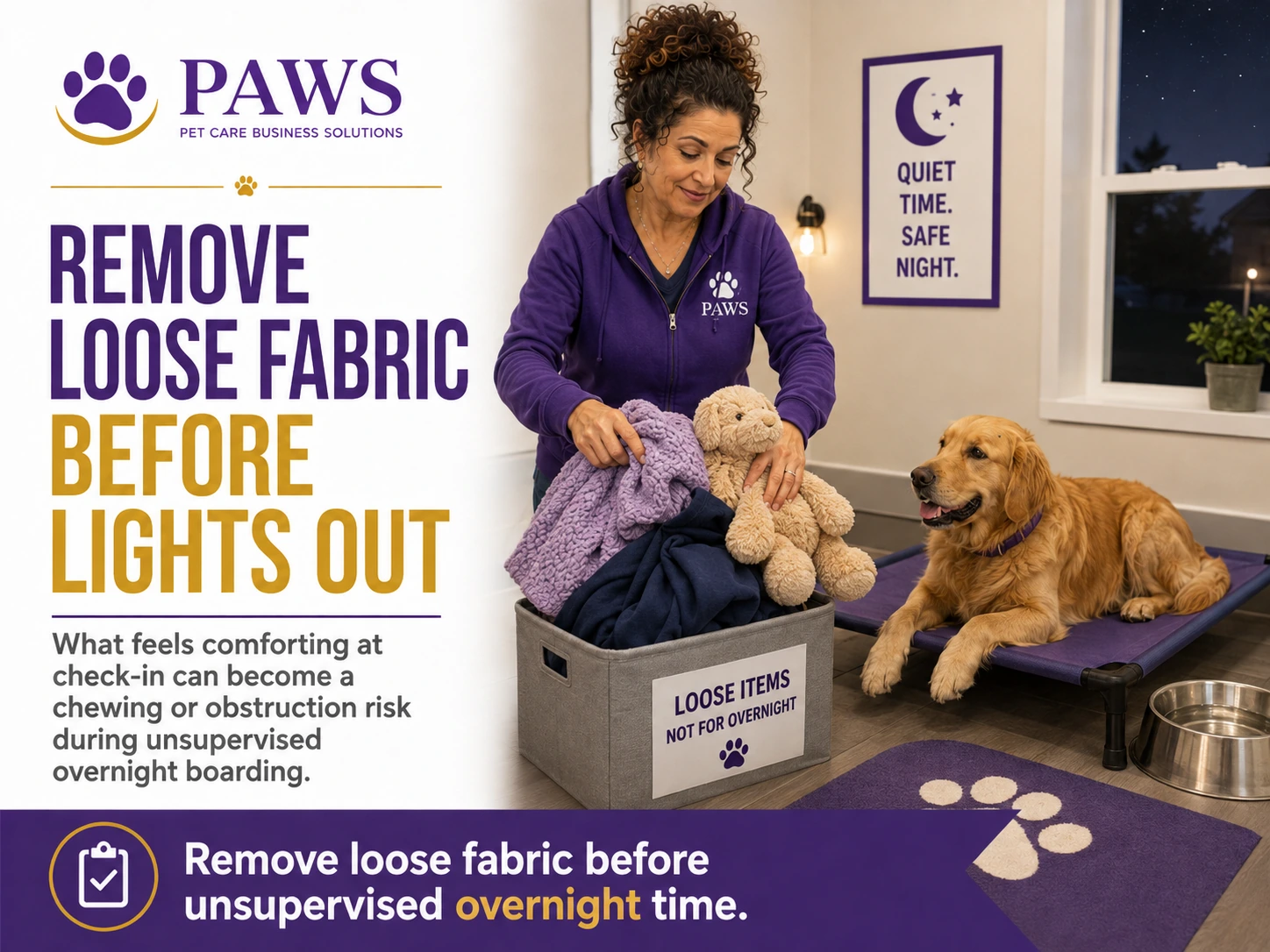
One practical way to handle the bedding debate is not to turn check-in into a courtroom. Some owners want to walk back to the boarding suite and see the room set up. Fine. Walk back there. Set up the blanket. Put the toy where they want it. Let the owner feel like the dog’s room looks homey. Let them see that you care.
Then say the important part clearly and calmly: “We may remove personal bedding or toys at any time if they become a safety concern, and we remove unsafe items when dogs are unsupervised overnight.”
That sentence matters. It should also be in the boarding agreement. The owner nods. The form says the facility can remove bedding. The staff note says what came in. Then, when the dog goes to daycare, feeding, potty rotation, or bedtime setup, staff can move unsafe items into the dog’s labeled bin and leave the room in a safe overnight condition.
This is not a trick. This is risk control. The owner got to see that the facility respected the comfort items. The dog can still have familiar smells and favorite items during appropriate supervised times. But when the lights go out, the priority is not interior decorating. The priority is giving the customer back a dog that is alive.
The bedtime reset should be a named task on the boarding checklist, not an informal habit. Staff should verify the dog, room, approved bedding, water, medical notes, removed items, and any chewing or soiling observed during the day.
When a facility uses cameras, alarms, rounds, or overnight staff, those controls supplement the safe-room setup; they do not make loose fabric harmless. Monitoring may identify a problem sooner, but prevention is still better than discovering shredding after material is missing.
- Let the owner know personal items may be removed if they become a safety hazard.
- Put the removal authority in the boarding agreement or check-in form.
- Label and bin personal items so they are not lost, mixed, or accidentally left overnight.
- Remove unsafe personal bedding, stuffed toys, socks, shirts, chews, bones, and loose items before unsupervised overnight time.
- Use facility bedding, raised cots, washable mats, or approved kennel-safe setups for unsupervised rest.
- Document any item removed because of chewing, soiling, guarding, damage, or safety risk.
⚠️
Night rule
If staff would not be comfortable explaining the item to an emergency vet, an insurance adjuster, or an angry owner after the dog swallowed it, it should not be left in the suite overnight.
📋
Boarding Bedding Policy Matrix
Decide the rule before the client is standing at the counter holding a laundry basket and making sad eyes.
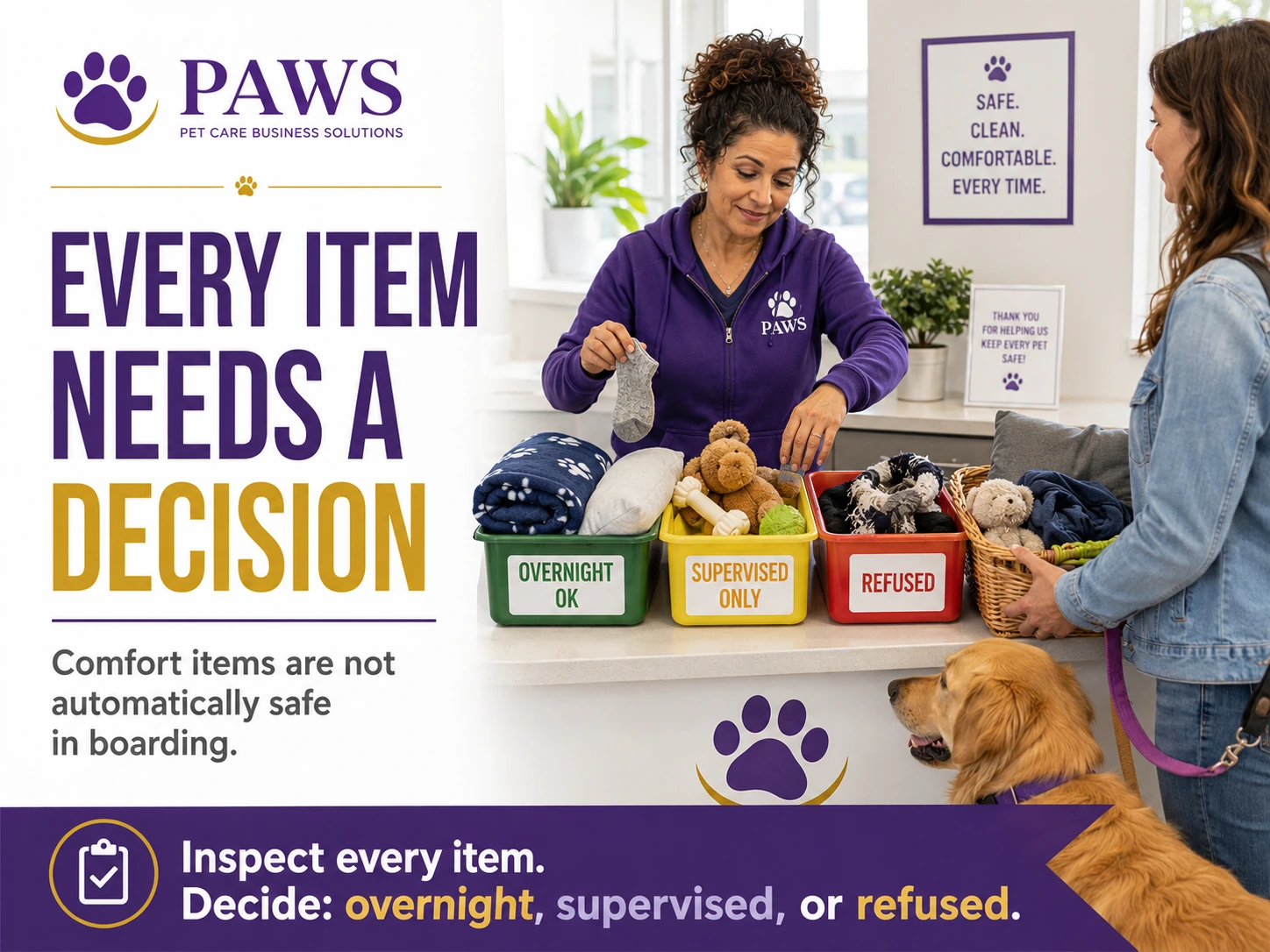
Every item should receive an actual decision at intake: approved for unsupervised use, supervised only, refused, or pending manager review. “The owner brought it” is not a category, and leaving the decision for bedtime creates inconsistency and pressure on the night team.
The decision should follow the item’s construction, the dog’s known history, the current stay, sanitation needs, and the facility’s ability to supervise. Staff should record the category and storage location so the same item is handled the same way on every shift.
Policy categories should be easy to teach and audit. A simple color, bin, or software-note system can show overnight approved, supervised only, and refused items without requiring every employee to reinterpret the entire policy.
Swipe left/right to see the full table.
| Item | Default Rule | Main Risk | Safer Option |
|---|---|---|---|
| Facility raised cot | Usually allowed | Lower risk when maintained and inspected. | Use as standard overnight bedding. |
| Facility washable mat | Allowed if dog does not chew it | Fabric chewing or soiling. | Remove if dog starts chewing, shredding, or soiling. |
| Owner blanket | Case-by-case or supervised only | Shredding, ingestion, sanitation, loss. | Use at check-in or supervised rest only; remove overnight if unsafe. |
| Owner t-shirt | Usually supervised only | Easy to chew, shred, and swallow. | Place in bin or use briefly during supervised comfort time. |
| Socks / underwear | Refuse for unsupervised suite use | High ingestion and obstruction risk. | Do not leave in suite. Store in owner-item bin. |
| Stuffed toys | Supervised only unless facility approves | Stuffing, squeaker, seams, fabric pieces. | Use during supervised one-on-one time and remove afterward. |
| Rope toys | Usually refuse unsupervised | Strings, fraying, swallowed strands. | Supervised play only, then remove. |
| Bones / rawhide / hard chews | Usually refuse or supervised only | Choking, guarding, broken teeth, obstruction, vomiting, diarrhea. | Follow written policy and dietary restrictions; avoid overnight use. |
| Medical orthopedic bed | Manager approval | Chewing, sanitation, size, cleaning, damage. | Written approval, inspection, removal authority, and notes. |
| Anything with buttons, zippers, fringe, loose seams, or stuffing | Refuse unsupervised | Small parts and fabric ingestion. | Store in bin or return to owner. |
👀
Supervised Comfort Items: The Middle Ground
The answer does not have to be “your dog can never see his favorite toy again.”
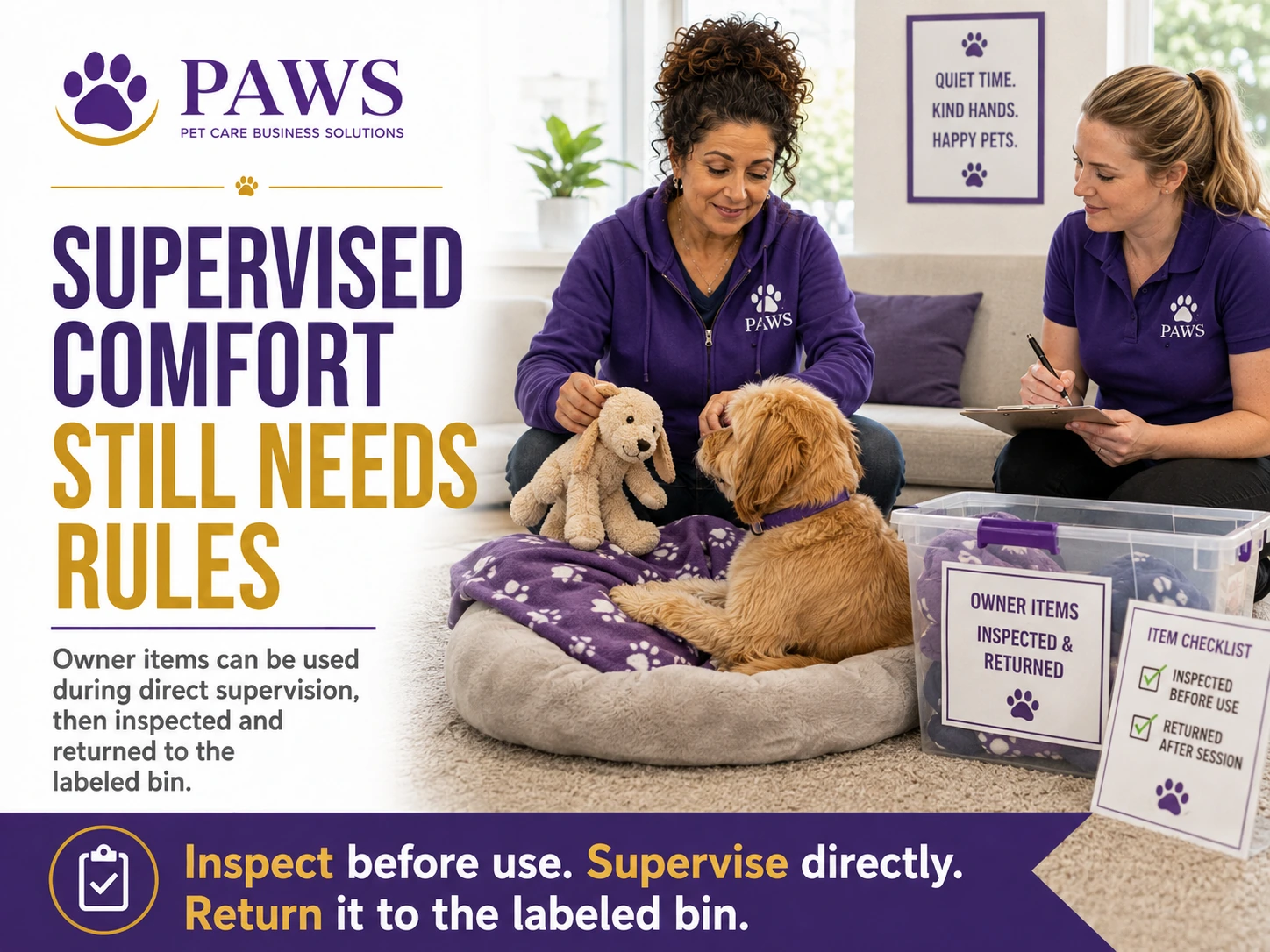
A smart boarding policy gives the owner a safe path when possible. You may refuse to leave personal bedding, t-shirts, stuffed toys, socks, or chews in the suite overnight, while still allowing the dog to enjoy familiar items during supervised one-on-one time.
This is where the conversation becomes easier. You are not saying, “No, your dog cannot have anything from home.” You are saying, “We can use familiar items in a safe and supervised way, but we are not going to leave ingestion hazards in the room overnight.”
If the dog has a favorite toy, a staff member can bring it out during individual playtime, cuddle time, or a controlled room visit, then remove it afterward. If the owner brings a t-shirt that smells like home, it can be used briefly during supervised comfort time and then returned to the dog’s labeled bin.
That keeps the emotional value without pretending a stuffed toy is safe because the owner loves the dog.
“Supervised” should mean a staff member is actively watching the dog and the item, not that an employee is somewhere in the building. The session should have a start, an end, and a clear removal point before attention shifts to another task.
The facility should avoid promising supervised-item use on a rigid schedule unless staffing can support it. The policy may allow the option without guaranteeing that every dog, item, or shift will qualify.
- Use familiar items only when staff are directly supervising the dog.
- Inspect the item before and after use.
- Stop immediately if the dog chews, shreds, guards, swallows pieces, or becomes overstimulated.
- Return the item to the labeled bin after the session.
- Document any damage, chewing, or removal.
- Do not sell supervised comfort time as a guarantee that every item is safe or every dog can use every item.
📌
Client-friendly wording
“We can absolutely use some of his familiar items during supervised one-on-one time. What we cannot do is leave items that could be chewed or swallowed in the suite overnight when staff are not directly watching him.”
💬
Sample Client Conversation: The Laundry Basket at Check-In
This is the conversation every boarding facility eventually has.
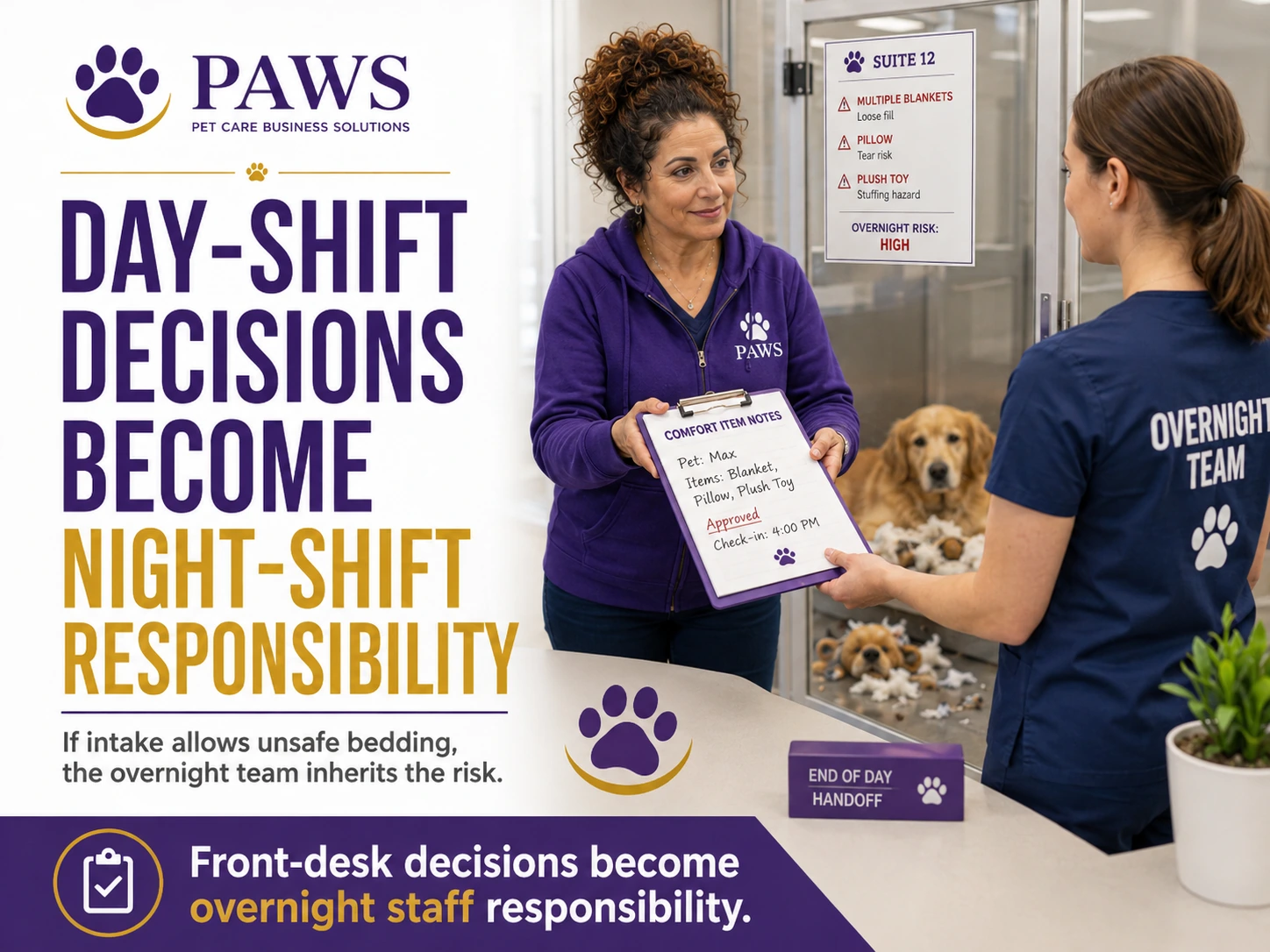
The goal is not to shame the owner. The goal is to acknowledge the comfort intent, explain the risk, set the safety boundary, offer a safe option, and move the check-in forward without turning the lobby into a hostage negotiation.
The front desk should not make a promise that the boarding team must reverse later. Staff should explain the overnight rule, classify each item, label the bin, and place the decision in the boarding notes before the handoff.
When the owner pushes back, repeat the same reason rather than inventing new explanations. The policy is based on the different boarding environment, limited unsupervised observation, item construction, and the facility’s responsibility for the room.
🧺
Typical setup
The client walks in with a basket of blankets, t-shirts, socks, stuffed toys, chews, and little comfort items. In their mind, they are building the dog a room full of home. In your mind, you are counting ingestion hazards with handles.
Pet Owner: “Here are the items I would like my dog to have in his room while he is here.”
Business Owner: “Absolutely, I understand why you brought these. It helps to have things that smell like home, and we want him to be comfortable while he is here. I do need to explain our bedding safety rule.”
Pet Owner: “I don’t understand. He has all these things at home and there has never been a problem.”
Business Owner: “That may be completely true at home. The difference is that boarding is a new environment. New room, new sounds, new dogs, new routine. Even a dog who does not chew at home may chew here if he gets bored, anxious, excited, or unsettled overnight.”
Pet Owner: “Well, he never chews at home. I just want him to be comfortable.”
Business Owner: “I understand that. Comfort matters to us too. Our job is to keep him comfortable and safe. The concern is that blankets, shirts, socks, stuffed toys, and chews can become choking or ingestion hazards if he starts chewing when staff are not directly watching him.”
Business Owner: “We can set the room up with some of these items while we get him checked in, and we can use approved items during supervised one-on-one time. But if anything becomes a safety concern, or when he is unsupervised overnight, we may remove those items and keep him on our safer bedding setup.”
Pet Owner: “Okay, that’s reasonable. I just didn’t want him to feel like we abandoned him.”
Business Owner: “I completely understand. We will make sure he is cared for, and we will keep the personal items labeled so they can be used safely when appropriate.”
🧾
Pickup wording if items were removed
Do not hide the fact that bedding or toys were removed. The owner already saw the room set up. If you say nothing, some owners will feel like you staged the room for their feelings and then secretly did something else. Say it plainly and make it boring.
If items were removed as part of the normal overnight safety rule:
“Just so you know, we set his room up with the comfort items at check-in, and then we moved the loose personal items to his labeled bin for overnight safety like we discussed. He slept on our safer bedding setup.”
If items were removed because the dog started chewing or shredding:
“We did remove the blanket/toy because he started chewing at it. We did not want that turning into an ingestion risk, so we moved it to his bin and documented it in his boarding notes.”
If pieces were missing or ingestion was possible:
“We found the item damaged and some material may be missing. We removed it immediately, checked him, notified the manager, and followed our safety policy. I want to walk you through exactly what we saw, what we did, and what we recommend next.”
Swipe left/right to see the full table.
| Owner Says | Do Not Say | Better Response |
|---|---|---|
| “He never chews at home.” | “That does not matter.” | “That is helpful to know. The difference is that boarding is a new environment, and behavior can change when the dog is away from home.” |
| “I do not want him to feel abandoned.” | “Dogs do not think like that.” | “I understand why that matters to you. We can use familiar items safely during supervised time, but overnight safety has to come first.” |
| “Another facility lets him have everything.” | “Then go there.” | “Different facilities have different policies. Our policy is based on how we manage overnight safety and ingestion risk here.” |
| “I will sign whatever waiver you want.” | “Fine, then it is on you.” | “A waiver does not make an unsafe item safe. We still have to manage the room responsibly.” |
| “He needs that stuffed animal to sleep.” | “No stuffed animals.” | “We can use it during supervised comfort time if he handles it safely, but we cannot leave stuffing and squeakers in the suite overnight.” |
| “He will be upset without his blanket.” | “He will get over it.” | “We will keep him comfortable with our bedding setup and monitor how he settles. If the blanket is safe during supervised times, we can use it then.” |
👥
Staff Rules for Personal Bedding and Comfort Items
The front desk cannot say yes to a fabric grenade and leave kennel staff to discover it at bedtime.
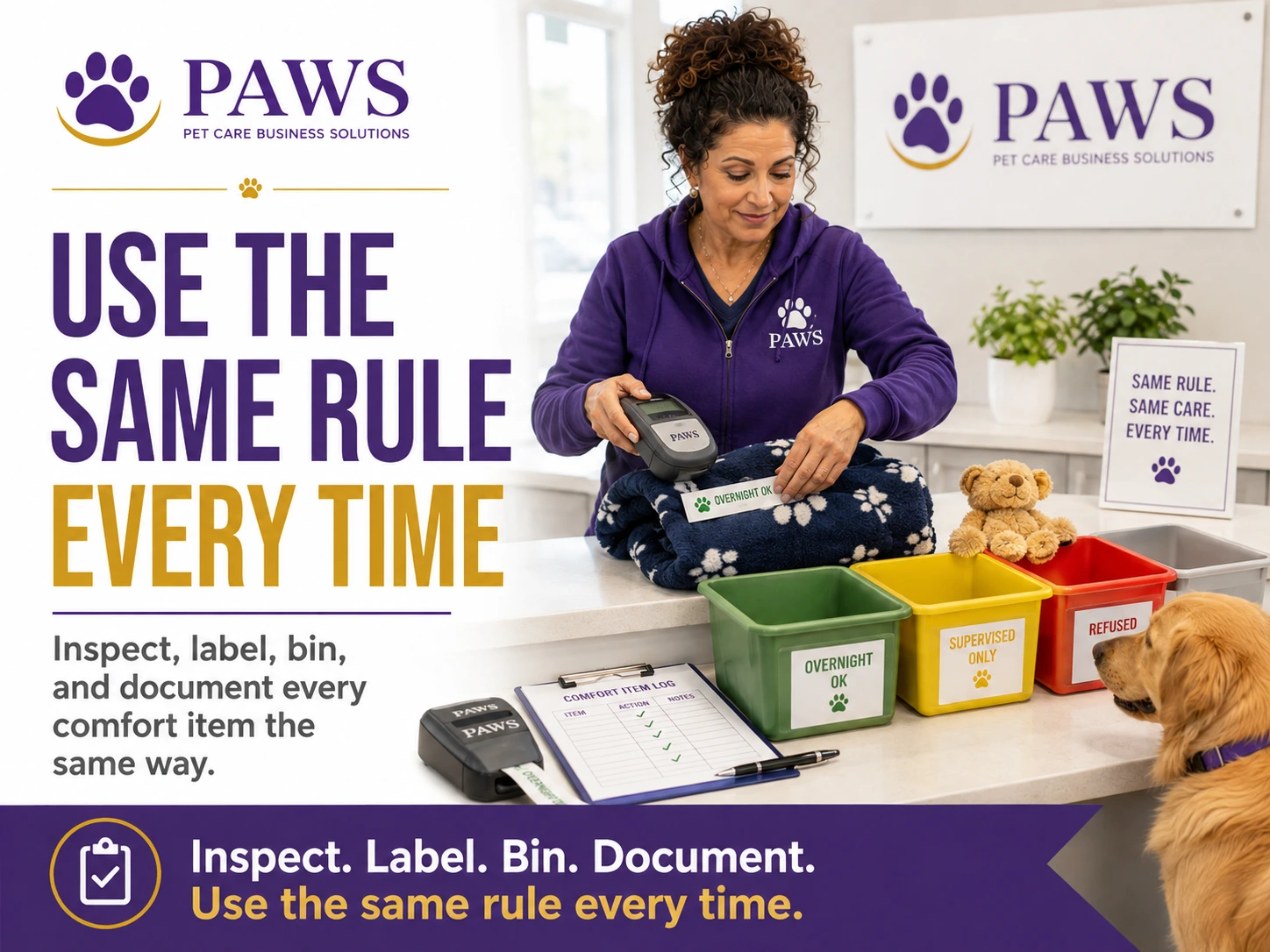
Bedding policy only works if staff are consistent. If one employee allows everything, another removes everything, and another tells the owner something different at pickup, the business looks disorganized and the client feels misled.
Staff need simple rules: inspect, label, bin, document, remove when unsafe, and do not make exceptions that the night staff have to survive.
The intake employee owns the first classification, but every later employee has authority to remove an item when the dog’s behavior, damage, sanitation, or supervision level changes. Safety decisions should not wait for the original employee to return.
Managers should audit boarding rooms and notes before lights out. The audit should compare the physical room with the intake record so an undocumented shirt, toy, chew, or exception is not discovered only after a problem occurs.
- Inspect every personal item at check-in.
- Refuse or restrict items with stuffing, loose seams, fringe, strings, squeakers, buttons, zippers, or obvious chewing risk.
- Label owner items with the dog’s name and place unused items in a labeled bin or bag.
- Tell the owner personal items may be removed at any time for safety, sanitation, chewing, guarding, or overnight supervision limits.
- Do not promise that personal bedding will remain in the suite overnight.
- Remove unsafe items before unsupervised overnight time.
- Document removed items and the reason: chewing, shredding, soiling, guarding, damage, or policy.
- Manager approval is required for exceptions, medical beds, senior-dog accommodations, and owner pushback.
🚨
Damaged item rule
A chewed blanket is not just a laundry problem. A shredded toy is not just a mess. If pieces are missing, staff should treat it as a possible ingestion event until the situation is checked, documented, and escalated according to facility policy.
- Remove the item immediately if the dog is chewing, shredding, swallowing pieces, guarding it, or using it unsafely.
- Preserve the damaged item instead of throwing it away immediately. Staff may need to show the owner, manager, veterinarian, or insurance carrier what was damaged.
- Check whether pieces appear to be missing: stuffing, squeaker, fabric strips, rope strands, buttons, seams, corners, or chew chunks.
- Notify a manager if pieces are missing, ingestion is suspected, or the dog shows vomiting, appetite loss, abdominal discomfort, lethargy, diarrhea, distress, or other concerning signs.
- Follow the facility’s veterinary escalation policy instead of guessing whether the dog “probably passed it.”
- Document the time, item, damage, dog behavior, staff action, owner contact, and any veterinary recommendation or referral.
⚠️
Staff warning
Do not create a safety problem at check-in because you wanted to avoid a thirty-second conversation with the owner.
🧾
Put the Bedding Rule in the Boarding Agreement
The “we may remove bedding” rule should not live only in one employee’s mouth.
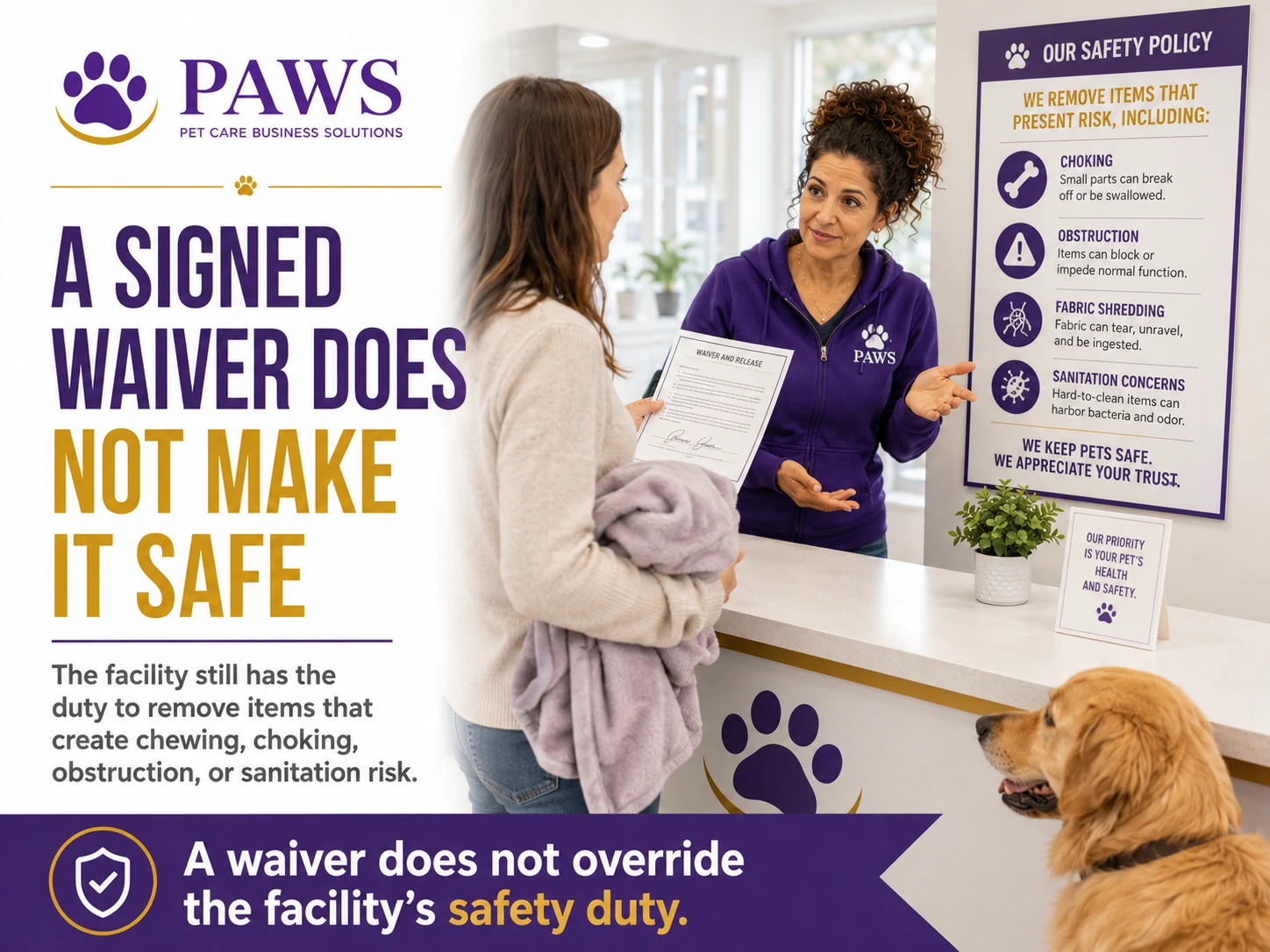
Personal bedding rules belong in the boarding agreement, check-in form, or boarding policy acknowledgment. The form should make clear that the facility may remove bedding, toys, chews, clothing, personal items, and comfort items at any time if staff believe the item creates a safety, sanitation, chewing, ingestion, guarding, or supervision concern.
This does not replace good communication. Fine print alone is not enough. But when the owner signs the policy and staff also explain it at check-in, the business is in a much better position than if everyone pretends the basket is safe and hopes nothing stupid happens overnight.
The form should describe the facility’s decision authority without pretending the owner can assume the risk on the business’s behalf. The dog remains inside a room controlled by the facility, so staff still have to remove hazards even when the owner offers to sign a separate waiver.
The check-in record should list the actual items accepted, their classification, existing damage, storage location, and any manager-approved exception. That record helps prevent lost-property disputes and proves that the policy was applied to the specific stay.
✍️
Sample form language
“Personal bedding, toys, chews, clothing, blankets, and comfort items are accepted at the facility’s discretion. For the pet’s safety, the facility may remove any personal item at any time due to chewing, ingestion risk, choking risk, sanitation, damage, guarding, stress, supervision limits, or any other safety concern. The facility may substitute facility-approved bedding or a safer rest setup when personal items are removed.”
- Include bedding removal authority in the boarding agreement.
- Include supervised-only language for comfort items.
- Include owner-item labeling and loss/damage language.
- Include medical and dietary restrictions for chews, treats, and edible items.
- Train staff to say the policy out loud instead of hiding behind the form after something goes wrong.
🩺
When Bedding Exceptions May Make Sense
A policy can be firm without being brain-dead.
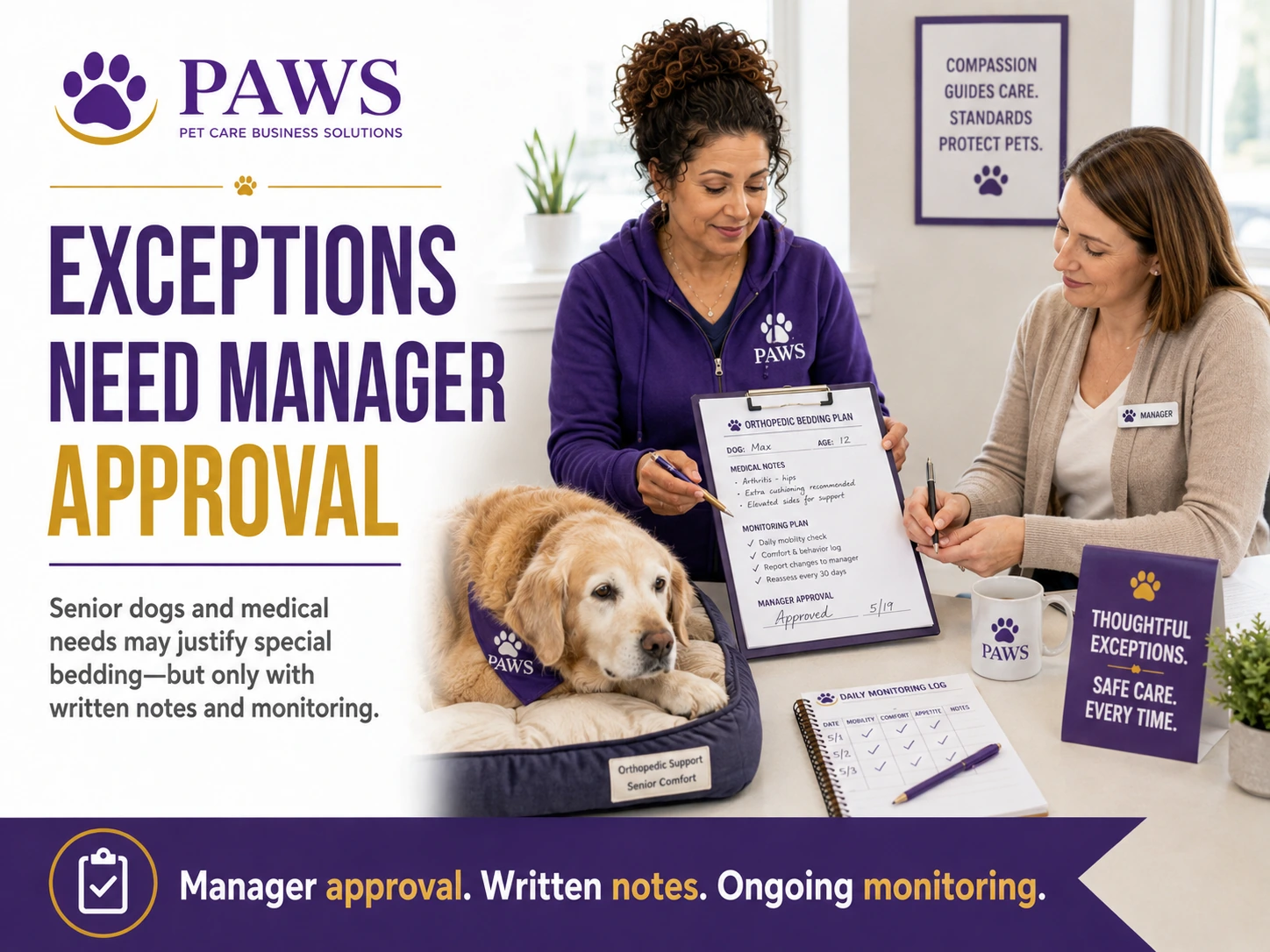
Some dogs have real needs. Senior dogs, orthopedic dogs, hospice dogs, thin-coated dogs, medically fragile dogs, or dogs with specific comfort needs may need a more customized bedding setup. The answer is not to ignore those needs. The answer is manager approval, inspection, documentation, and removal authority.
Exceptions should be deliberate. They should not happen because the owner was emotional, the front desk was tired, or someone said, “It will probably be fine.”
The exception plan should identify the need being addressed, the approved item, how it will be inspected, what supervision or monitoring applies, who may remove it, and what replacement setup will be used if the risk changes.
An exception should be reviewed on every stay rather than copied forever. Age, mobility, continence, medications, cognition, chewing behavior, and the condition of the bed can change, so last month’s approval is useful history but not permanent authorization.
Swipe left/right to see the full table.
| Situation | Possible Exception | Required Control |
|---|---|---|
| Senior dog | Extra padding, orthopedic mat, low-profile bedding. | Inspect, document, monitor chewing/soiling, remove if unsafe. |
| Orthopedic or medical need | Approved bed or facility-provided safer bedding. | Manager approval and clear notes in the boarding record. |
| Non-chewer with safe flat blanket | Limited use under policy. | Remove overnight if dog begins chewing, shredding, or soiling. |
| Anxiety comfort item | Supervised use only. | Use during one-on-one time, then return to labeled bin. |
| Owner insists on unsafe item | No exception. | Refuse unsupervised use and document the conversation. |
🛑
When to Say No
Some items should not enter the suite no matter how much the owner loves the story behind them.
The facility should say no when the item creates obvious risk, when the dog has a chewing or ingestion history, when the item cannot be cleaned, when it contains small parts, or when the owner refuses to accept removal authority.
A client who insists the dog must have unsafe items overnight is asking the facility to accept a risk the facility will be blamed for if it goes badly. That is not reasonable, and a waiver does not magically turn socks into safe kennel equipment.
The refusal should be specific and professional. Staff should identify the item or behavior that creates the problem, state the facility rule, offer the safer bedding or supervised-use option, and document persistent disagreement.
When the owner will not accept a safe room setup, the facility may need to decline boarding. A customer’s preference does not obligate the business to provide care under conditions the staff cannot responsibly manage.
- Say no to socks, underwear, small fabric items, and clothing that can be swallowed.
- Say no to stuffed toys, squeakers, rope toys, and loose-seam toys for unsupervised overnight use.
- Say no to chews, bones, rawhides, or edible items that violate medical, dietary, or safety rules.
- Say no when the dog has a known chewing, shredding, ingestion, guarding, or destructive history.
- Say no when the item is dirty, not washable, contaminated, or unreasonable to store safely.
- Say no when the owner refuses the facility’s right to remove the item.
⚠️
Hard line
The owner’s comfort with the risk does not transfer the risk away from the facility. If the dog eats it in your boarding suite, you will be the one explaining why it was there.
❓
Boarding Bedding Policy FAQ
Detailed answers about personal blankets, owner-scent clothing, stuffed toys, chews, anxiety, safer overnight setups, item inspection, documentation, damaged bedding, suspected ingestion, client communication, staff consistency, and manager-approved exceptions.
Can my dog have his blanket?
Maybe. The facility should evaluate the blanket’s size, construction, seams, stuffing, fringe, damage, cleanliness, and the dog’s behavior history before deciding whether it may be used. A blanket accepted at check-in may still be classified as supervised only or removed before unsupervised overnight time.
The owner should be told the decision clearly: what may remain in the room, what will be stored, when supervised use is possible, and that staff may remove the blanket immediately if chewing, shredding, soiling, guarding, or another safety concern appears.
Why is “he never chews at home” not a guarantee?
Home provides a familiar routine, familiar sounds, the owner’s presence, known sleeping patterns, and fewer environmental changes. Boarding introduces different rooms, dogs, staff, noises, smells, schedules, and periods when the dog may be tired, excited, anxious, or unsettled.
Staff should respect the owner’s history without treating it as permanent proof. The current stay controls the decision. Mouthing seams, licking fabric, nesting roughly, tearing corners, guarding, or increased distress should trigger removal even when the item has been harmless at home for years.
Can I leave a t-shirt that smells like me?
A t-shirt may carry useful familiar scent, but it is thin, easy to bunch, easy to tear, and capable of being swallowed in strips or larger pieces. Many facilities therefore store it in a labeled bin or use it only during direct supervised comfort time.
A safer plan may use the shirt briefly while a staff member sits with the dog, then remove and store it before attention shifts or the dog is left alone. The facility should never promise that owner clothing will remain in the suite overnight.
Are stuffed toys safe in a boarding suite?
Stuffed toys contain multiple possible hazards: fabric, seams, filling, squeakers, plastic eyes, rope attachments, and small pieces that can be chewed loose. A toy that has remained intact at home can be destroyed quickly by a stressed or excited dog in a different environment.
The safer default is supervised use only, followed by inspection and return to the labeled bin. If the toy is already worn, has loose seams, missing parts, exposed stuffing, or a history of being destroyed, staff should refuse it rather than trying to supervise a predictable failure.
Can a dog have bones, rawhide, or long-lasting chews overnight?
Usually not under a conservative boarding policy. These items may create choking, obstruction, guarding, broken-tooth, vomiting, diarrhea, dietary, and medication-related concerns, and staff cannot continuously watch the dog’s mouth during unsupervised rest.
When a facility permits any chew, the item, dog, medical restrictions, duration, supervision, and removal point should be defined. An owner-provided chew should not bypass the same dietary and safety controls applied to facility-provided items.
What if my dog has anxiety and needs something from home?
Anxiety supports a thoughtful comfort plan, but it also increases the need for caution because some anxious dogs lick, chew, shred, pace, swallow, or guard items they normally ignore. The facility should not answer anxiety by adding unsupervised hazards to the room.
Safer support may include a predictable routine, approved bedding, individual attention, supervised familiar-item use, quiet placement, enrichment, owner instructions, and veterinary guidance when appropriate. Staff should document how the dog settles and adjust the plan based on the dog’s actual response.
What bedding may be safer for unsupervised overnight use?
A facility may use maintained raised cots, approved washable mats, low-profile orthopedic options, or another standardized setup chosen for cleanability, condition, fit, and the individual dog. No bedding is automatically safe for every dog, so staff still need to inspect and remove items that are being damaged or used unsafely.
The overnight setup should also support sanitation and observation. Bedding should not hide vomiting, diarrhea, blood, destroyed material, or other signs staff need to notice during rounds, and it should be practical to clean or replace between dogs.
Why would staff set up comfort items at check-in and remove them later?
The check-in setup can acknowledge the owner’s intent and help the dog transition while staff are present. The overnight reset addresses a different supervision condition: the dog may be alone, less directly observed, and able to chew or swallow material before anyone can intervene.
This should not be hidden or presented as a trick. The facility should explain the removal rule before accepting the stay, record the items, store them safely, and tell the owner at pickup what was used, what was removed, and whether the dog showed any chewing or damage.
Should the owner be told when bedding was removed?
Yes. Routine removal can be explained calmly: the loose personal items were moved to the labeled bin for overnight safety and the dog used the facility’s approved bedding setup. Clear communication prevents the owner from feeling that the room was staged only for check-in.
When removal followed chewing, shredding, guarding, soiling, or damage, staff should state the reason and document it in the boarding record. If material may be missing, the conversation becomes an incident and should follow the facility’s escalation and owner-notification policy.
Does a signed waiver make an unsafe item acceptable?
No. A signature documents that information was provided; it does not change the physical properties of a sock, rope strand, stuffed toy, zipper, or blanket. The facility still controls the boarding room and must make a reasonable safety decision about what is left with the dog.
The boarding agreement should preserve the facility’s right to remove items rather than invite customers to purchase exceptions through waivers. Legal documents should support the operating policy, not replace staff judgment or turn avoidable hazards into accepted room equipment.
What if another boarding facility allows all personal bedding?
Facilities differ in design, staffing, monitoring, insurance, clientele, dog population, and risk tolerance. Another business’s policy does not establish what this facility can responsibly supervise or defend.
Staff should avoid criticizing the competitor. Explain the local policy, the overnight supervision limits, the types of hazards being controlled, and the safer options offered here. Consistency is more credible than changing the rule because a customer reports a different answer elsewhere.
How should staff inspect owner-provided items?
Staff should look at size, thickness, seams, stuffing, fringe, strings, buttons, zippers, squeakers, hard pieces, contamination, existing damage, and whether the item can be washed and stored. They should also consider the dog’s chewing, ingestion, guarding, anxiety, and destructive history.
The result should be recorded as overnight approved, supervised only, refused, or manager review. Photographing unusual or damaged items may help when the facility accepts property that could later create a loss or damage dispute.
What should happen if a dog starts chewing or shredding an item?
Remove the item as soon as it can be done safely, place it in the labeled storage area, and check the dog and room for loose material. Staff should not wait to see whether the dog loses interest once active destruction has changed the risk.
Document the time, item, observed behavior, damage, material found, staff action, and any change in the room setup. The owner can then be told exactly what happened instead of receiving a vague statement that the item was simply taken away.
What if pieces of the bedding or toy appear to be missing?
Treat missing material as possible ingestion rather than ordinary property damage. Preserve the item, search the room, check the dog, notify a manager, and follow the facility’s veterinary and owner-notification procedure instead of guessing that the dog will pass it.
The record should identify the estimated missing material, timeline, symptoms or lack of symptoms, calls made, professional direction received, transport or monitoring decisions, and what was communicated to the owner. Early escalation protects the dog and creates a defensible incident record.
How should bedding removal be documented?
The boarding record should identify the item, its original classification, when it was removed, why it was removed, where it was stored, whether damage occurred, and whether the owner or manager was notified. Staff should use the same reason categories so later reports are understandable.
Documenting routine policy removal separately from chewing, soiling, guarding, or suspected ingestion helps the next shift respond correctly. The physical room, software note, and labeled bin should tell the same story.
Who should approve bedding exceptions?
A manager or another specifically authorized person should approve exceptions involving senior dogs, orthopedic needs, medical beds, hospice care, unusual owner requests, or items outside the standard matrix. Front-desk pressure should not create a medical or safety accommodation by accident.
The approval should name the item, reason, controls, inspection schedule, supervision level, removal authority, and fallback setup. The exception should be reviewed on each stay because the dog’s condition and the item’s condition can change.
Can an owner insist that personal bedding remain overnight?
The owner may request it, but the facility should retain final control of the boarding room. A business should not accept a condition that prevents staff from removing an item when chewing, contamination, guarding, damage, or supervision limits make it unsafe.
When the owner refuses the facility’s removal authority, the appropriate answer may be to decline the item or decline boarding. Accepting the stay under an unmanageable condition transfers the conflict to the night staff and leaves the facility responsible for the outcome.
How should the policy be communicated before arrival?
Place the rule on the boarding page, reservation confirmation, packing instructions, agreement, and pre-arrival reminder. Tell owners what bedding the facility provides, which personal items are usually refused or supervised only, and that all items may be removed for safety or sanitation.
Early communication reduces emotional conflict at drop-off and gives the owner time to ask about senior, orthopedic, or medical needs. The same wording should be used by the website, front desk, boarding team, and manager so the customer does not receive competing promises.
What should staff do when a client becomes upset about the rule?
Acknowledge the comfort concern, explain that boarding behavior can differ from home, identify the specific item risk, state the overnight rule, and offer the safer alternative. Staff should not argue about whether the owner loves the dog or dismiss the emotional reason behind the request.
When the conversation remains stuck, involve a manager and document the final decision. The goal is a clear care plan, not winning the debate. Abuse, threats, refusal of removal authority, or demands for unsafe conditions may justify declining the item or the boarding stay.
What is the bottom-line standard for a bedding policy?
The policy should allow reasonable comfort without leaving avoidable choking, obstruction, ingestion, guarding, sanitation, or supervision hazards in the room. Every accepted item needs a category, every exception needs control, and every employee needs authority to remove an item when the risk changes.
The customer should understand the policy before boarding, the room should be safe at lights out, the dog should receive appropriate comfort, and the record should explain what staff did. Comfort matters, but safety gets the final vote because the facility is responsible for the environment it controls.
🐾
The Bottom Line: Comfort Matters, But Safety Gets the Final Vote
The owner is bringing home into the room. The facility is responsible for what happens in that room.
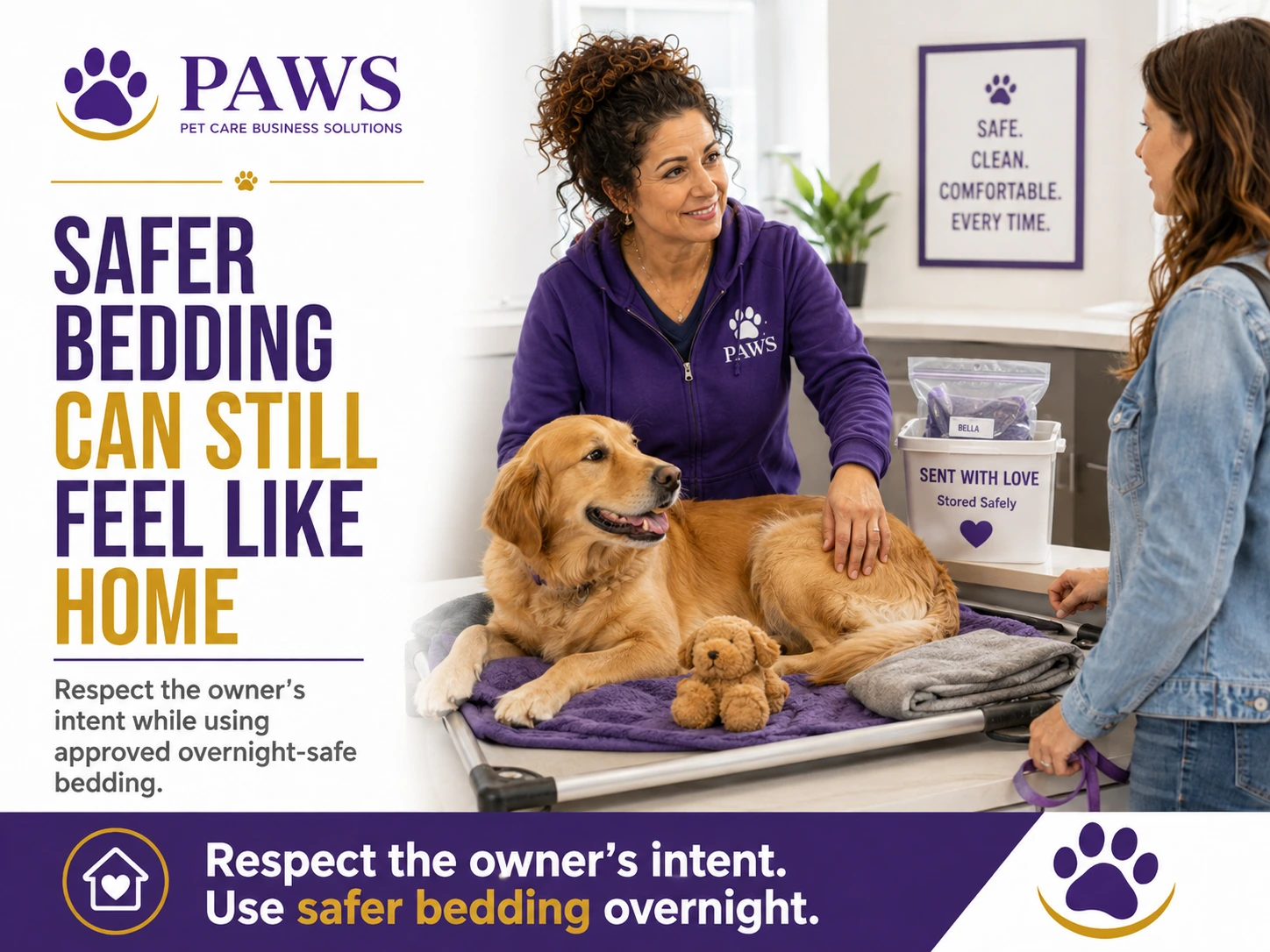
The bedding debate is not about whether the facility cares. A good boarding facility should care deeply about the dog’s comfort. But caring does not mean leaving socks, shirts, stuffing, rope, chews, and sentimental hazards in an unsupervised suite overnight.
A smart operator can let the owner feel heard, set the room up at check-in, explain the removal rule, use familiar items during supervised time, store everything in a labeled bin, and still strip the room back to safety before lights out.
The goal is simple: give the customer back a dog that is alive, safe, cared for, and as comfortable as possible without pretending comfort items stop being hazards because they came from home.
The strongest policy is visible before check-in, easy for staff to apply, flexible enough for controlled medical exceptions, and firm enough that emotional pressure does not rewrite the overnight room setup.
When every item is inspected, classified, labeled, stored, documented, and removed when necessary, the facility can preserve familiar comfort without asking the night team to gamble with fabric, stuffing, strings, or sentimental promises.