Client Forms, Waivers, Intake Paperwork, and Operational Sanity
Dog Daycare Forms, Waivers, and Client Intake Paperwork
The paperwork is not there to look professional. It is there to keep the business from drowning in confusion, missing vaccine records, emergency surprises, nonpayment, abandoned dogs, and customer nonsense.
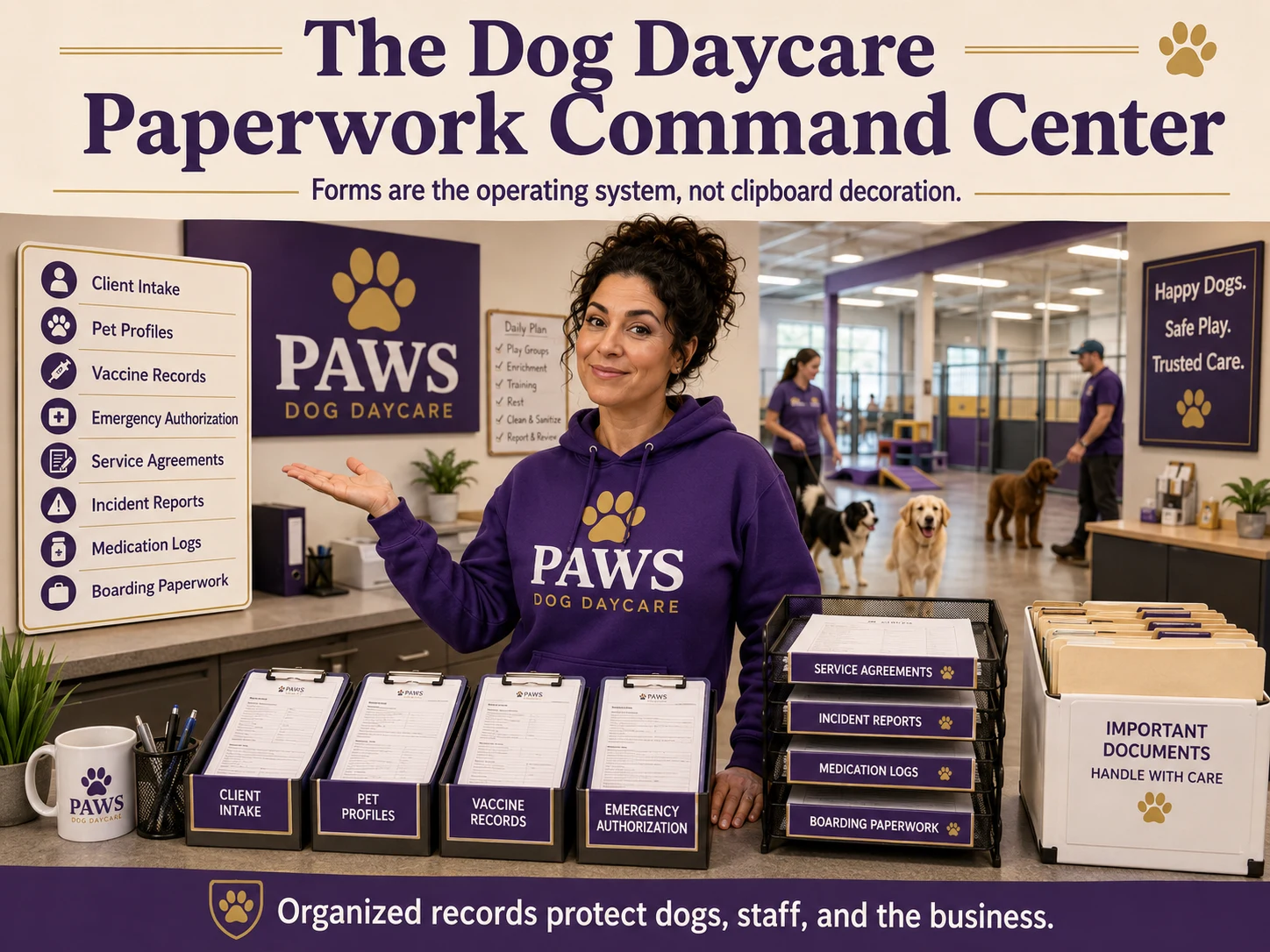
Dog daycare forms are one of those boring little business pieces that new owners love to ignore until the first real problem walks through the door wearing a collar and a mystery medical history.
Everybody wants to talk about floors, fencing, playrooms, websites, logos, cute dog photos, and what color the lobby should be. Fine. Those things matter. But if your intake paperwork is weak, your service agreement is vague, your vaccine policy is loose, your emergency authorization is missing, and your abandonment language was copied from some random internet cave, you are not “being relaxed.” You are leaving holes in the fence and acting surprised when the goats get loose.
Forms are part of the operating system. They tell the customer what the business does, what the business does not do, what risks exist, what information the facility is relying on, what happens in an emergency, what happens when a dog gets sick or injured, what happens if the dog is not picked up, what records the business needs, and what policies the customer is agreeing to follow.
That does not mean you grab a form off the internet, slap your logo on it, and declare yourself bulletproof. That is not risk management. That is arts and crafts with legal consequences.
⚠️
Legal warning, because this is where people get cute and then get bitten.
The information on this page is for planning, education, and operational research. It is not legal advice. Dog daycare forms, waivers, boarding agreements, grooming releases, abandonment procedures, lien rights, collection rules, photo releases, injury language, and emergency authorization rules vary by state, county, city, business model, insurance policy, and sometimes by the exact service being offered. Use this page to understand what the paperwork needs to cover. Then have a qualified attorney in your jurisdiction build or review the actual forms before customers sign them.
⚖️
Forms Do Not Stop Lawsuits
A waiver is not a magic spell. It will not make angry customers, dead dogs, grooming injuries, bite claims, unpaid bills, or bad facts disappear.
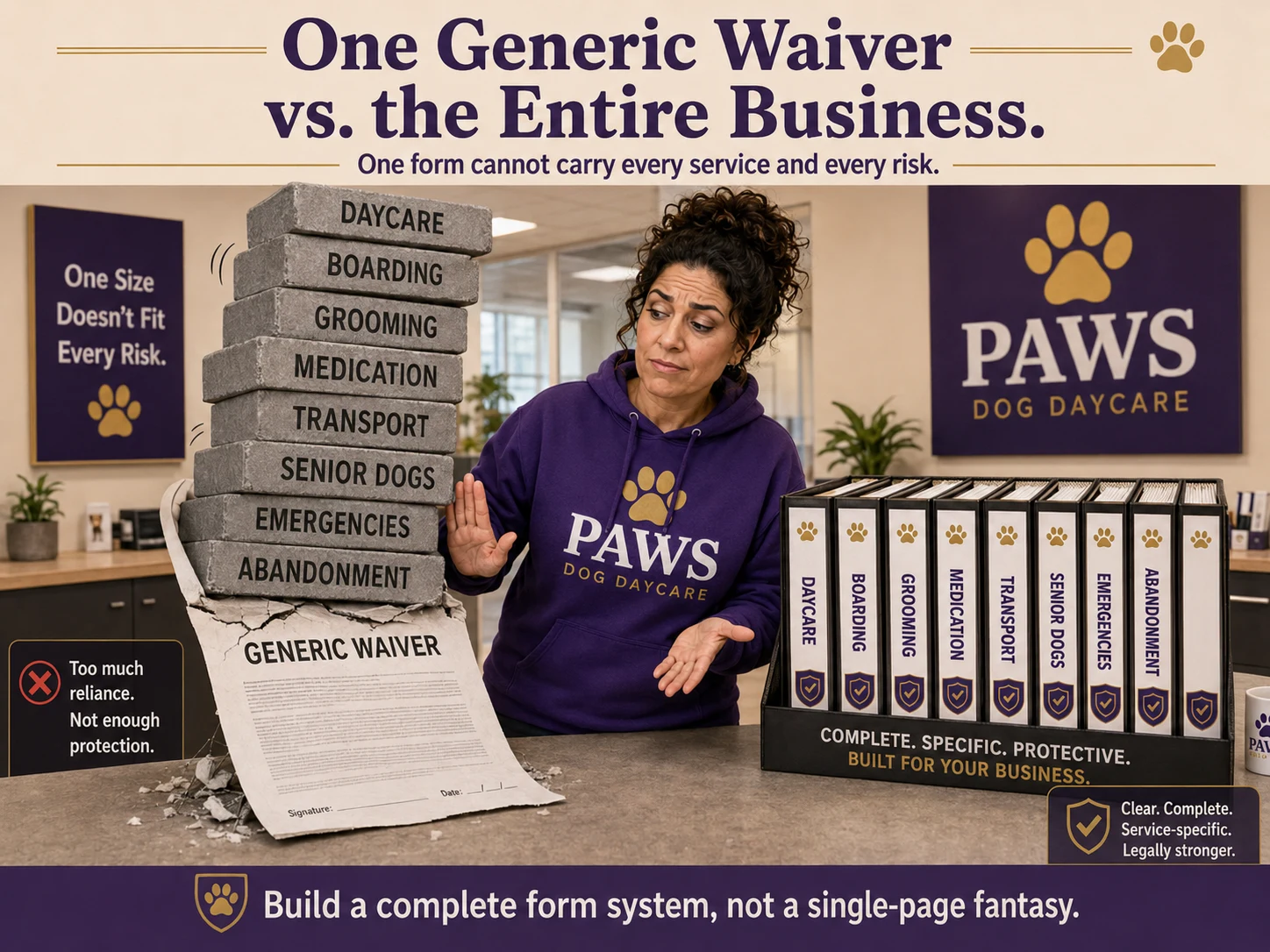
Anyone can sue anyone for almost anything. That is just the ugly background music of owning a business. A customer can sign every form you have, initial every box, read every policy, acknowledge every risk, and still sue you because something happened and they are angry, emotional, broke, embarrassed, or convinced the universe owes them money.
Forms do not prevent lawsuits. Good forms put you in a better legal and factual position when the lawsuit shows up. That is the real point. They help show what the owner disclosed, what the owner failed to disclose, what risks were explained, what services were authorized, what policies applied, what emergency authority existed, what the customer agreed to pay, and what the business was allowed to do when things went sideways.
I have been sued over dumb things. That is part of the business world. It does not mean every lawsuit is valid. It does not mean every customer complaint has merit. It means you need the paperwork, records, policies, insurance, staff training, and operating discipline to defend yourself when someone decides their feelings should become a court filing.
There is also a hard legal reality that many pet owners do not understand. In many places, including places like Florida, animals are generally treated as property for civil-damage purposes. That does not mean pets are emotionally meaningless. Anyone who has owned a dog knows better than that. It means the legal damage analysis may not match the emotional value the owner places on the animal. The value of an elderly, infirm, eight-year-old golden retriever may be very different legally than what that dog means to the family. That issue is state-specific and attorney territory, but it is one more reason the business needs proper paperwork and legal review.
But do not get cute with this. Forms do not cover stupidity. If the facility is negligent, grossly negligent, reckless, understaffed, unsafe, dirty, ignoring known behavior problems, leaving dogs unsupervised, using broken equipment, mishandling medication, overheating dogs, or letting employees act like dumbasses, the waiver is not going to sprinkle fairy dust on bad conduct. If bad facts exist and the customer can prove them, the paperwork may not save you.
The form helps most when the business acted reasonably, followed policy, kept records, disclosed the inherent risks, and the event was one of those awful things that can happen in animal care even when the facility is doing its job. That is where good forms, good records, and good operations work together.
| Reality | What the Form Helps With | What the Form Does Not Fix |
|---|---|---|
| Customer sues anyway | Shows signed acknowledgments, disclosed risks, agreed policies, and owner responsibility. | It does not stop the customer from filing something stupid. |
| Dog gets injured during normal care | Helps show the owner accepted ordinary animal-care risks if the facility acted reasonably. | It does not protect careless handling, unsafe groups, broken gates, or bad supervision. |
| Dog dies suddenly | Helps show medical-risk acknowledgment, emergency authority, owner contact procedure, and financial responsibility. | It does not excuse ignoring symptoms, failing to act, or hiding what happened. |
| Grooming injury occurs | Helps show grooming risk acknowledgment, matting disclosure, elderly-pet risk, and service authorization. | It does not excuse reckless clipping, poor restraint, overheating, or refusing to stop when a dog is clearly in trouble. |
| Customer disputes the bill | Helps show payment terms, late pickup charges, continuing care costs, and collection responsibility. | It does not fix sloppy invoices, unclear pricing, or staff making side deals with no record. |
| Owner failed to disclose behavior or medical history | Helps show the facility relied on the owner’s representations when accepting the pet. | It does not excuse ignoring obvious warning signs once staff see them. |
🛑
Operator warning
A waiver is a seatbelt, not permission to drive drunk through a fireworks tent. It helps when the business is operating reasonably and something bad happens anyway. It does not turn negligence, gross negligence, reckless handling, unsafe staffing, or dumb management into “the customer signed, so we’re fine.”
🗺️
Use This Page Like a Form System Map
A dog daycare does not need “a waiver.” It needs a paperwork system. One form will not carry the whole business unless that form is built like a mule and reviewed by someone who knows what they are doing.
🧾
Client Intake
Collect owner identity, contact information, emergency contact, veterinarian, and communication details.
🐕
Pet Profile
Collect pet identity, breed, age, weight, health, behavior, spay/neuter status, and special needs.
💉
Vaccine & Medical
Vaccination records, vet contact, medication, allergies, restrictions, and emergency care authorization.
⚖️
Service Agreement
The core agreement covers risk, owner representations, payment responsibility, policies, and service terms.
🚪
Late Pickup / Abandonment
Boarding customers sometimes vanish. Your paperwork needs a lawful procedure before you are stuck feeding someone else’s dog forever.
👵
Elderly / Infirm Pets
Older and medically fragile pets need special warning language, owner acknowledgment, and operational caution.
✂️
Service Addenda
Boarding, grooming, transport, medication, webcams, and photos can require separate form language.
📋
Internal Records
Incident reports, bite reports, temperament notes, cleaning logs, medication logs, and daily observations protect the operation.
🧠
Forms Are Not Magic Armor
A signed waiver is not a forcefield. It is one piece of a much bigger risk-management system.

Too many new owners think the form is the business version of a medieval shield. Customer signs it, dog gets hurt, problem solved. That is not how this works. A form does not replace good supervision, clean operations, proper staffing, safe playgroups, accurate records, working gates, trained employees, good insurance, and common sense.
The form is there to document what was disclosed, what was agreed, what the customer represented, what risks the customer acknowledged, what authority the business has in an emergency, what financial responsibility exists, and what policies apply. That matters. But a bad operation with a good form is still a bad operation. It just has prettier paperwork while the wheels come off.
The goal is to build forms that match the real services you offer. Daycare-only paperwork is not the same as overnight boarding paperwork. Grooming has different risks. Transport has different risks. Medication has different risks. Elderly pets have different risks. Webcams and photos have privacy and media-use issues. Retail may have separate receipt and return policies. If the form does not match the business, it is not protecting the business. It is just sitting there wearing a tie.
📌
Operator rule
Every form should answer a real operational question. Who owns the dog? Who can pick it up? Who pays the bill? Who is the vet? What vaccines are required? What medical issues exist? What happens if the dog gets hurt? What happens if the owner disappears? What services are authorized? What risks has the owner acknowledged?
🧾
Client Intake Form: Know Who You Are Dealing With
The intake form is not just name, phone number, and a smile. It is the business record that tells you who owns the dog, how to reach them, who to call when things go sideways, and what information you relied on when accepting the pet.
The first form in the packet should collect clean owner information. Not scribbled nonsense. Not “text me.” Not a phone number that no one checks. You need real information because when a dog gets sick, bites another dog, eats something stupid, gets picked up late, or the owner disappears into the fog like a magician with a boarding bill, you need records.
This is also where you collect how they found you, whether they are seasonal, whether they live locally, and what emergency contact is available if the main owner cannot be reached. In a seasonal or tourist-heavy market, that matters. Some customers are local regulars. Some are snowbirds. Some are passing through. Some are normal. Some are chaos wearing flip-flops.
| Client Intake Field | Why It Matters | Operator Warning |
|---|---|---|
| Owner full legal name | Identifies the contracting party and person responsible for payment and decisions. | Nicknames are fine for conversation. Forms need the actual person. |
| Address | Needed for notices, billing, collections, abandonment procedures, and contact records. | If the address is fake or incomplete, that is not a cute little typo. That is a future headache. |
| Cell, home, and work phone | Different emergencies require different contact attempts. | Do not rely on one number if the customer is unreachable during the workday. |
| Email address | Useful for confirmations, policies, invoices, vaccine reminders, incident notices, and written records. | Verbal conversations disappear. Email at least leaves footprints. |
| Emergency contact | Provides a backup person if the owner cannot be reached. | The emergency contact should be someone other than the owner, not the same unavailable human in a different hat. |
| Authorized pickup people | Controls who can remove the dog from the facility. | If you do not control pickup authority, expect drama eventually. |
| Seasonal / temporary resident status | Important in markets with snowbirds, travelers, or short-term residents. | Temporary customers can be excellent, but you need stronger contact and payment discipline. |
| How they found you | Helps track marketing sources and referral channels. | This is not legal protection, but it helps you stop wasting money on advertising that does nothing. |
🛑
Do not accept half-filled intake forms.
A blank emergency contact, missing address, fake phone number, unknown veterinarian, and “I’ll bring vaccine records later” is not customer service. It is you helping tomorrow’s problem sneak in through the front door.
🐕
Pet Profile Form: The Dog Is Not Just “Friendly”
Every dog is “friendly” according to somebody. That does not mean the dog belongs in group play, boarding, grooming, or around your staff.
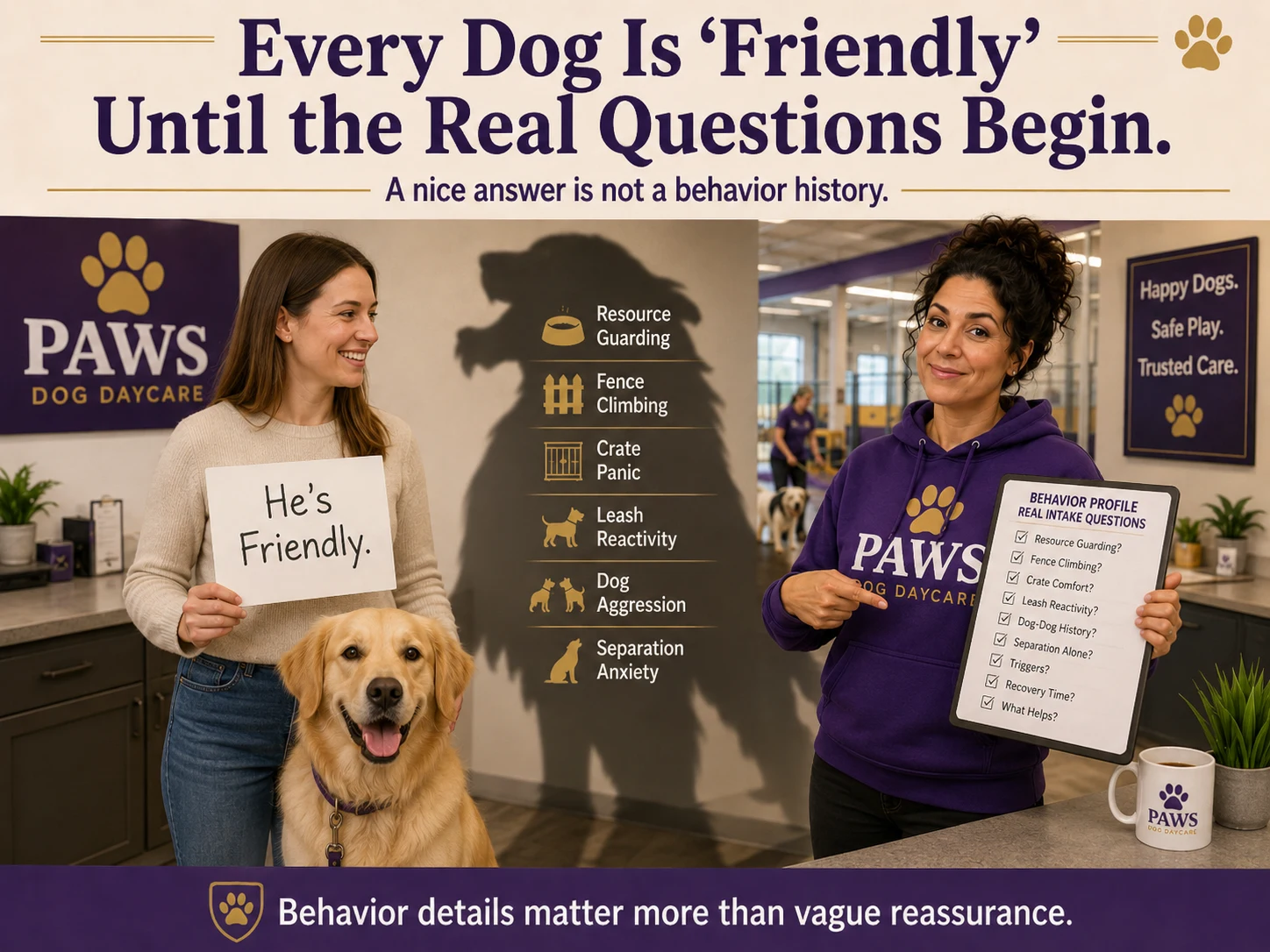
The pet profile is where you collect the dog’s basic information and the owner’s representations about health, behavior, spay/neuter status, age, breed, weight, color, medical conditions, and special needs.
The biggest mistake is letting owners summarize the entire dog as “he’s sweet.” That is not enough. Sweet dogs can resource guard. Sweet dogs can panic in crates. Sweet dogs can climb fences. Sweet dogs can hate intact males, small dogs, old dogs, loud dogs, staff with hats, grooming dryers, thunderstorms, mops, or the concept of personal space.
You are not trying to interrogate the customer like a detective in a basement. You are trying to get enough real information to avoid putting the dog, staff, other dogs, and the business into a stupid situation.
Identity
- Pet name.
- Breed or breed mix.
- Age and birthday if known.
- Sex.
- Spayed or neutered status.
- Color and markings.
- Weight.
Health
- Medical conditions.
- Allergies.
- Medications.
- Diet restrictions.
- Mobility issues.
- Seizure history.
- Recent illness or injury.
Behavior
- Bite history.
- Dog aggression.
- People aggression.
- Fear or anxiety.
- Escape attempts.
- Resource guarding.
- Crate or kennel stress.
📌
Operator rule
The pet profile should force useful disclosure. “Any history of biting, fighting, growling, snapping, escaping, climbing, fence fighting, resource guarding, severe anxiety, or injury?” is better than “Is your dog nice?” Nice is not a safety plan.
💉
Veterinarian, Vaccine, and Medical Authorization Forms
If you are responsible for dogs all day, you need medical records, vet contact information, and written authority to act when the owner is unreachable.
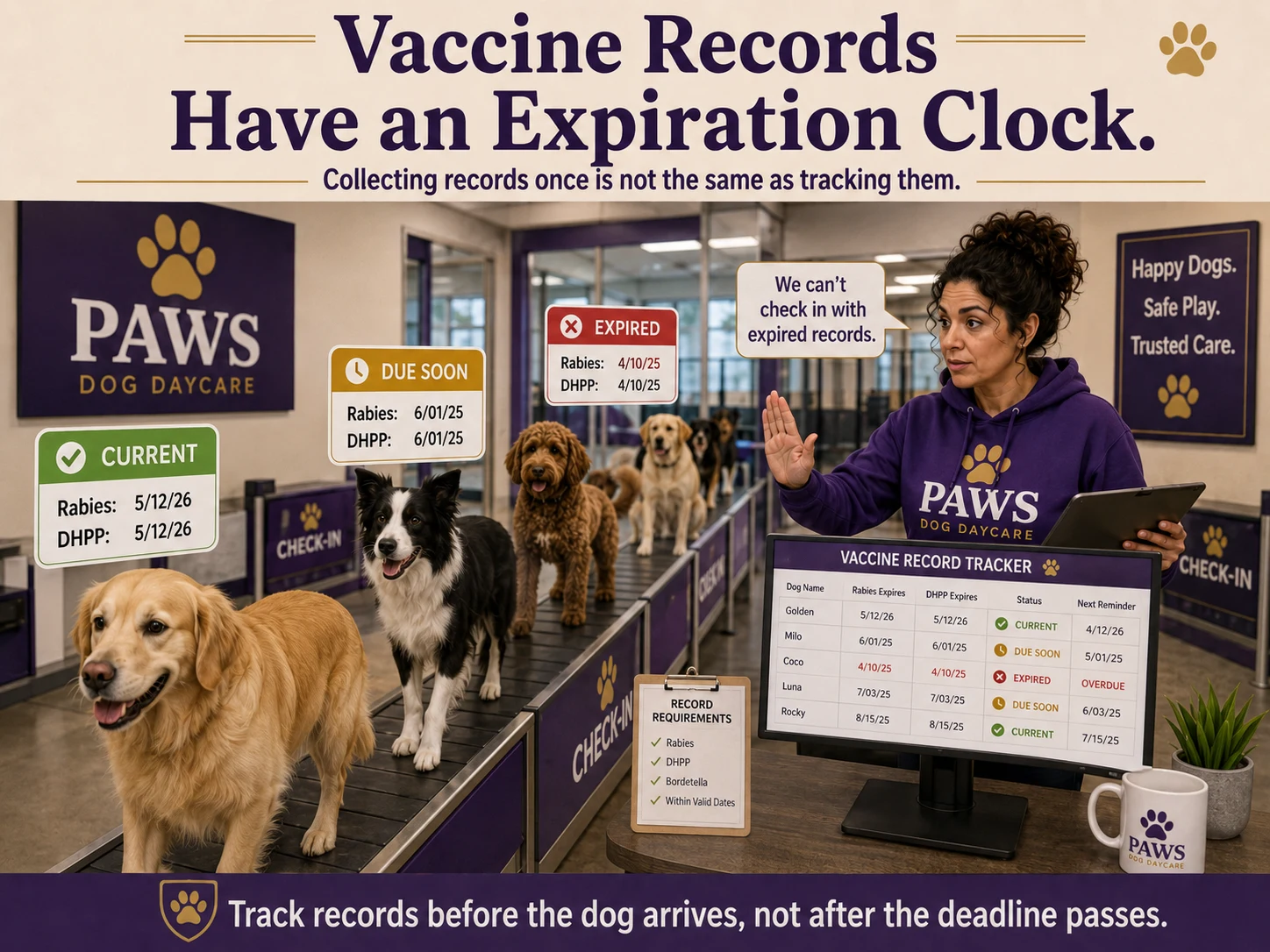
Medical paperwork is not just about checking a vaccine box. It is about knowing the dog is eligible for services, knowing what risks exist, knowing who the regular veterinarian is, and having written authorization to seek veterinary care if something happens.
Dogs get hurt. Dogs get sick. Dogs eat things. Dogs develop stomach issues at the worst possible time. Dogs hide symptoms until they suddenly stop hiding them. A facility that has no medical authorization is setting itself up for a panic scramble when the dog needs care and the owner does not answer the phone.
| Medical Form Section | What It Should Cover | Operator Warning |
|---|---|---|
| Veterinarian contact | Clinic name, doctor if known, phone, address, and after-hours emergency clinic if available. | Do not wait until the dog is sick to find out the vet name is “that place near Publix.” |
| Vaccination records | Required vaccines, expiration dates, proof received, and renewal tracking. | Expired vaccine records are not records. They are nostalgia. |
| Medical conditions | Known health issues, allergies, seizures, heart problems, breathing issues, orthopedic issues, diabetes, medications, and restrictions. | Some dogs look fine until they are not fine. Ask before the emergency. |
| Medication authorization | Medication name, dosage, timing, route, storage, purpose, start/end date, and owner signature. | Never run medication off memory, vibes, or “the owner said something at drop-off.” |
| Emergency veterinary authorization | Authority to seek care, who selects the clinic, owner financial responsibility, and notification procedure. | Emergency authority should be reviewed by counsel and matched to your state and insurance requirements. |
| Financial responsibility | Who pays for veterinary care, emergency care, continuing care, transport, medication, and related costs. | If the owner expects you to pay because the dog was in your building, you want the agreement to address that before the bill exists. |
🧠
Medical forms need operational muscle.
A vaccine policy that nobody enforces is not a policy. A medication form that staff cannot read is not a system. A vet authorization nobody can find during an emergency is just paper hiding from responsibility.
⚖️
The Core Pet Care Agreement
This is the main customer agreement. It should explain the relationship, the risks, the owner’s responsibilities, the facility’s authority, and the rules of the road.
The core agreement is where a lot of the heavy language lives. This is where you address the basic reality that dogs are animals, animals are unpredictable, group environments carry risk, grooming carries risk, boarding carries risk, handling carries risk, and even a well-run facility cannot promise that nothing bad will ever happen.
This does not mean you write a terrifying document that makes the customer feel like they are signing their dog into a pirate ship. It means you are honest. Dogs can get scratched. Dogs can get sore. Dogs can fight. Dogs can get stressed. Dogs can get sick. Dogs can injure themselves doing completely normal dog things. Dogs can come in with a problem the owner did not know about. Dogs can act differently in a facility than they act at home on the couch.
Your agreement should not be copied blindly. It should be written around your actual services, your state law, your insurance requirements, your facility, your policies, and your risk tolerance.
| Agreement Topic | What It Is Trying to Do | Plain-English Operator Translation |
|---|---|---|
| Animal unpredictability | Documents that dogs have individual personalities and may react differently in different situations. | A dog is not a toaster. It can behave differently when stress, excitement, noise, other dogs, or strangers enter the picture. |
| Assumption of risk | Explains that daycare, boarding, grooming, handling, and training can involve risks to pets, people, property, and staff. | Professional care reduces risk. It does not delete biology. |
| Owner representations | States that the business relies on the owner’s disclosure about health, aggression, behavior, and suitability. | If the owner hides bite history, medical issues, or aggression, that matters. |
| Financial responsibility | Clarifies who pays for medical care, continuing care, property damage, injury-related costs, or other expenses. | Do not let “who pays?” become a surprise after the bill arrives. |
| Facility discretion | Allows staff to make reasonable decisions in the best interest of the animal when a problem occurs. | When the dog is sick at 2:00 p.m. and the owner is unreachable, the facility cannot wait for a committee meeting. |
| Photo and media permission | Addresses whether the business may use pet photos, videos, webcam images, social posts, or promotional materials. | Dog photos are marketing gold, but permission still needs to be handled correctly. |
| Policy acknowledgment | Confirms that the customer has received, reviewed, and agrees to current business policies. | Your rules should not live only on a corkboard next to a faded flyer from 2012. |
🐾
Risk Language: Say the Quiet Part Clearly
Dog care has real risk. Pretending otherwise does not make you more customer-friendly. It just makes your paperwork weak.
The customer needs to understand that group dog care is not the same as watching a goldfish in a bowl. Dogs move, jump, wrestle, bark, chew, slip, trip, panic, get overexcited, guard things, chase things, and occasionally make terrible life choices with stunning confidence.
The form should explain that injuries can happen even when staff are careful. That does not excuse sloppy operations. It simply acknowledges reality. A clean, staffed, well-managed daycare can still have scratches, sore muscles, broken nails, hot spots, stress diarrhea, minor wounds, or sudden medical issues.
Good risk language is not there so you can be careless. It is there so the customer understands that animal services involve living animals, not plastic furniture.
🐕
Dog-to-Dog Risk
Scratches, bites, play injuries, fear reactions, overexcitement, group incompatibility, and social stress.
🧍
Human Handling Risk
Staff handling, leash transfers, grooming restraint, lifting, moving, separating dogs, and emergency intervention.
🏢
Facility Risk
Slips, falls, broken nails, kennel stress, flooring issues, gates, fencing, play equipment, noise, and movement.
🛑
Do not let your form make promises your building cannot keep.
If your marketing says every dog will be safe, happy, calm, loved, entertained, socialized, and returned home perfect, congratulations, you have written a check reality may cash at the worst possible moment.
🩺
Sudden Illness, Collapse, or Death in Care
This is the part nobody wants to talk about, but anyone who handles thousands of dogs long enough eventually learns: sometimes dogs just go down.
Dogs can suffer sudden medical events with little or no warning. Heart problems, seizures, strokes, bloat, hidden disease, respiratory issues, stress reactions, age-related decline, congenital conditions, excitement, anxiety, and plain bad luck can all show up at the worst possible moment.
I have had dogs check in happy, wagging, and normal, and then die before they ever made it to the boarding area. Not after a fight. Not after neglect. Not after hours of ignored symptoms. One minute the dog was alive on the leash, the next minute the dog was lying on the floor dead while I was standing there talking to the owner about grooming.
In that situation, I had taken the dog’s leash and was walking back toward the kennel area. The owner was still near the entrance asking grooming questions, so I stopped to answer. I felt the dog lie down and assumed it was just resting while we talked. A few minutes later, I tugged the leash to move forward, and the dog did not move. I looked down, and the dog was gone. No breathing. Nothing.
Then the emergency circus starts. You are checking breathing, starting mouth-to-snout CPR, doing chest compressions, trying to process what just happened, trying to comfort the owner who is understandably losing her mind, and at the same time new customers are walking through the front door while you have a dead dog in the back lobby. That is not something they put in the cute dog daycare brochure.
The customer in that case understood. It was awful, but she understood that the dog had a sudden medical event. About a year later, she even brought another dog back. But that kind of event burns itself into your brain because it shows you how fast a normal check-in can turn into a medical emergency, a customer-relations crisis, a documentation issue, and an operational problem all at the same time.
I have also seen dogs die shortly after check-in while sitting in a boarding suite. I have found dogs dead in the morning after they seemed fine the night before. That is not me being dramatic. That is the law of averages when you handle thousands of check-ins over years. Eventually, somebody is not going to check out.
That does not mean every death is negligence. It also does not mean the business gets to shrug and act like nothing happened. It means the paperwork, emergency procedures, staff training, camera coverage, incident documentation, veterinary authorization, owner contact information, body-handling policy, and internal records need to be ready before the nightmare happens.
Your agreement should make clear that pets may become ill, collapse, suffer injury, or die while in care due to known or unknown medical conditions, age, stress, excitement, preexisting disease, or causes unrelated to facility negligence. That language needs attorney review, because this is serious territory. But ignoring the issue because it feels uncomfortable is not a plan. It is hiding from the bear and hoping the bear respects your feelings.
📌
Operator case study
A sudden death does not give you time to build a procedure. You need the procedure before it happens. Who checks the dog? Who calls the vet? Who speaks to the owner? Who moves incoming customers away from the scene? Who documents the timeline? Who preserves video if available? Who handles the body? Who follows up later? If you are answering those questions for the first time while the owner is crying on the floor, you are already behind.
| Medical Event Issue | Form / Policy Should Address | Operator Warning |
|---|---|---|
| Sudden collapse | Emergency veterinary authorization, owner contact procedure, transport authority, CPR response, staff roles, and documentation. | When a dog collapses, staff do not have time to argue over who is allowed to call the vet. |
| Unexplained death | Owner notification, veterinary consultation, body-handling procedure, records, video preservation, and possible necropsy discussion. | This is emotionally brutal. Handle it with documentation, compassion, and a process. |
| Preexisting or hidden medical condition | Owner disclosure duties, known medical history, medication list, age-related risk, and veterinary information. | Some dogs arrive carrying problems nobody can see from the front desk. |
| Stress or excitement-related event | Boarding stress, separation stress, elderly pet risk, grooming stress, excitement, anxiety, and owner acknowledgment. | A dog can look happy and still have a medical grenade hiding inside. |
| Veterinary cost responsibility | Who pays for emergency care, transport, examination, treatment, after-hours service, necropsy if requested, and related costs. | Do not wait until a crisis to discover the owner thinks the business should eat the bill. |
| Scene management | Staff procedure for moving other customers, securing other dogs, protecting privacy, and preventing lobby chaos. | Customers walking into a death-in-care scene is bad for everyone. Have a plan. |
| Communication records | Time of event, staff observations, contact attempts, veterinary contact, owner response, witnesses, and follow-up. | Write it down. In a serious event, memory turns into soup fast. |
Form Language Should Cover
- Sudden illness or collapse.
- Known and unknown medical conditions.
- Stress-related decline.
- Emergency veterinary authorization.
- Owner financial responsibility.
- Facility authority to act when the owner cannot be reached.
- Death-in-care notification and next-step procedures.
Staff Procedure Should Cover
- Who checks breathing and pulse.
- Who calls the veterinarian.
- Who contacts the owner.
- Who moves other dogs or customers away.
- Who documents the timeline.
- Who preserves video if available.
- Who handles cleanup and privacy.
Internal Records Should Include
- Time of check-in.
- Observed condition at arrival.
- Time symptoms were noticed.
- Staff actions taken.
- CPR or emergency response performed.
- Veterinary contact.
- Owner communication and follow-up.
🛑
Operator warning
Do not use “dogs can suddenly die” as an excuse for sloppy care. That is not the point. The point is that even a clean, careful, well-run facility can face sudden medical events. The difference between a professional operation and a circus fire is whether you have emergency authority, records, staff procedure, owner contact information, and a calm plan before it happens.
🚨
Emergency Readiness Checklist
If a dog collapses, dies, seizes, bloats, crashes, or goes sideways in your care, this is not the moment to start inventing a procedure with panic sweat running down your back.
📸
Photo, Video, Webcam, and Social Media Permission
Dog photos help sell the business, but you still need to know what customers agreed to.
Dog daycare is a visual business. Photos of happy dogs, clean playrooms, staff interaction, holiday events, birthday boards, enrichment activities, and boarding updates can build trust fast. But photo and video use should not be an afterthought buried in someone’s memory.
If you plan to use photos or videos for your website, social media, printed material, ads, lobby displays, customer updates, webcams, or promotional content, the customer agreement should address it clearly. The old style was usually a broad photo permission. Today, I would think more carefully because customer expectations have changed, online privacy concerns are higher, and not every owner wants their pet used in every possible context.
| Media Use | Question to Answer | Operator Warning |
|---|---|---|
| Website photos | Can the pet appear on public website pages? | Use clear permission and avoid posting customer personal information. |
| Social media | Can the pet be posted on Facebook, Instagram, TikTok, or other platforms? | A cute post can still upset a customer if permission was not clear. |
| Customer updates | Can staff send photos or videos directly to the owner? | Direct updates are different from public marketing. |
| Webcams | Can the dog appear on a live or recorded camera feed? | Webcams create operational, privacy, staff, and customer expectation issues. Do not treat them like a toy. |
| Promotional material | Can the image be used in ads, flyers, brochures, banners, or paid promotions? | Promotional use should be addressed more carefully than casual update photos. |
🚪
Late Pickup, Nonpayment, and Abandoned Dogs
This is the section nobody thinks about until they are feeding a dog for free and the owner has vanished like smoke.
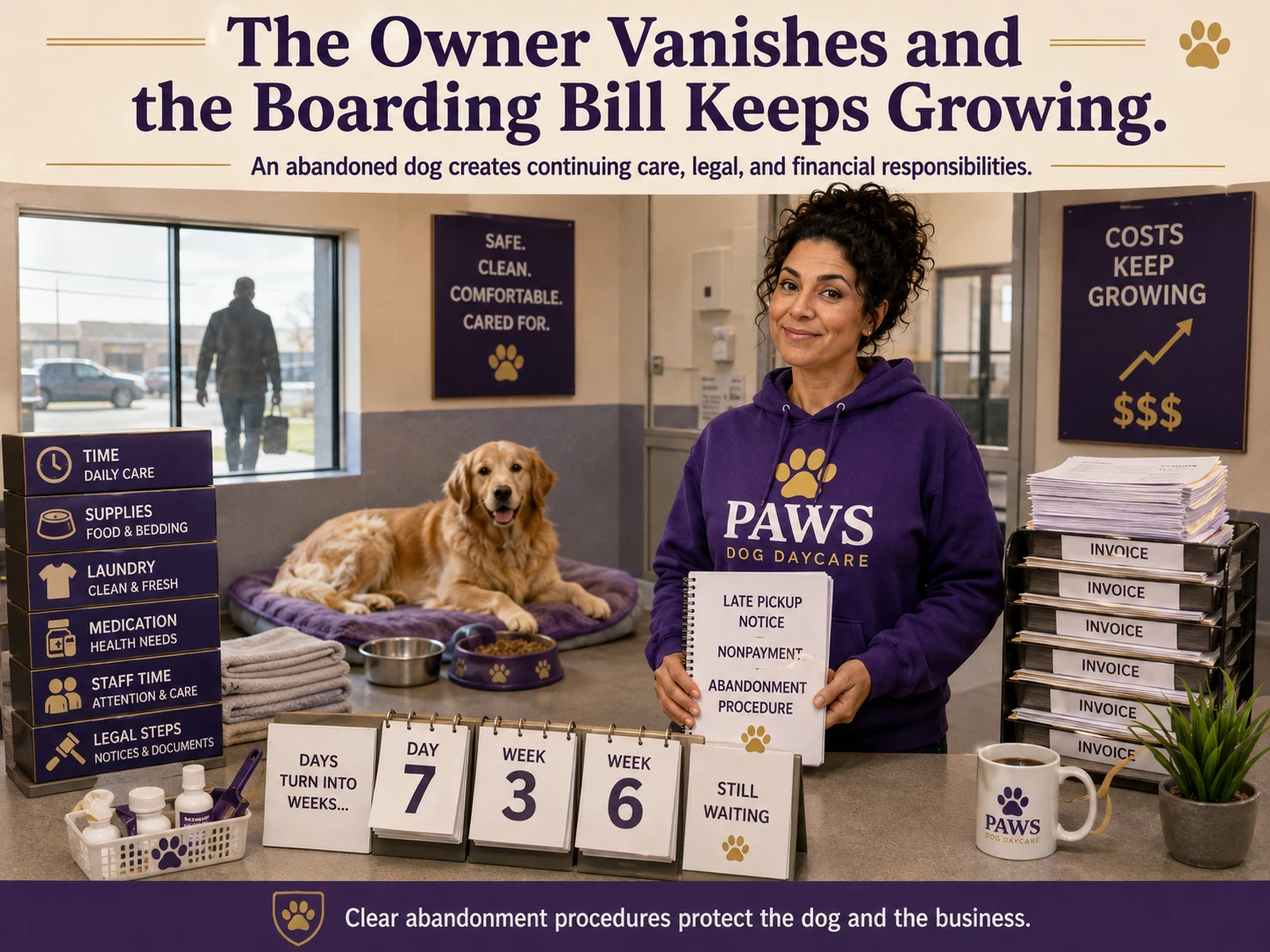
Here is the ugly little truth: sometimes people board a dog and do not come back. Sometimes they mean to come back, but life punches them in the teeth. Sometimes they cannot pay. Sometimes they disappear. Sometimes they stop answering the phone. Sometimes it feels like they used your nice clean boarding facility as a socially acceptable alternative to dumping the dog on the side of the road.
This is not theoretical operator drama. It happens. I have seen dogs left behind, bills rack up, owners go silent, and the business get stuck caring for the animal while trying to figure out the legal and practical mess. I have also seen situations where taking less than the full bill, or getting some weird “paid with a chainsaw” type settlement, was better than turning the whole thing into a bigger problem. Something can be better than nothing when the alternative is continuing to house, feed, clean, supervise, and manage a dog that the owner cannot or will not retrieve.
But you cannot just make up the rules in the moment. Abandonment, lien rights, notice requirements, rehoming authority, surrender, collections, and animal-control involvement are legal issues. They vary by state and local law. Your agreement needs to address the process, but your attorney needs to review the wording.
| Problem | Form Language Should Address | Why It Matters |
|---|---|---|
| Late pickup | Late fees, grace period, closing-time rules, emergency boarding charges, and customer communication. | Staff time is not free because someone “got busy.” |
| Extended care | Authority to continue care if the pet is not picked up as scheduled. | The dog still needs food, water, housing, cleaning, supervision, and care. |
| Nonpayment | Payment responsibility, deposits, card-on-file rules, collection costs, and service suspension. | A boarding bill can grow fast. Your policy needs teeth before the bill becomes a monster. |
| Owner cannot be reached | Contact attempts, emergency contact use, written notice, and escalation procedure. | Document your attempts. Memory is not a record. |
| Possible abandonment | State-specific notice, timing, animal-control or shelter procedures, surrender options, and legal authority. | You need lawful options before the business becomes an unpaid dog hotel with no checkout date. |
| Rehoming / adoption | Only if allowed under applicable law and properly reviewed. | Do not improvise ownership transfer. That is how a simple problem grows horns. |
🛑
Operator warning
Do not assume you can keep, sell, adopt out, surrender, or rehome a dog just because the owner did not pay. Your state may have specific notice requirements, timelines, lien rules, animal-control procedures, or restrictions. This section is exactly why your forms need local legal review.
👵
Elderly and Infirm Pet Waiver
Older dogs are not just regular dogs with gray faces. They come with different risk, different stress tolerance, and less physical bounce-back.
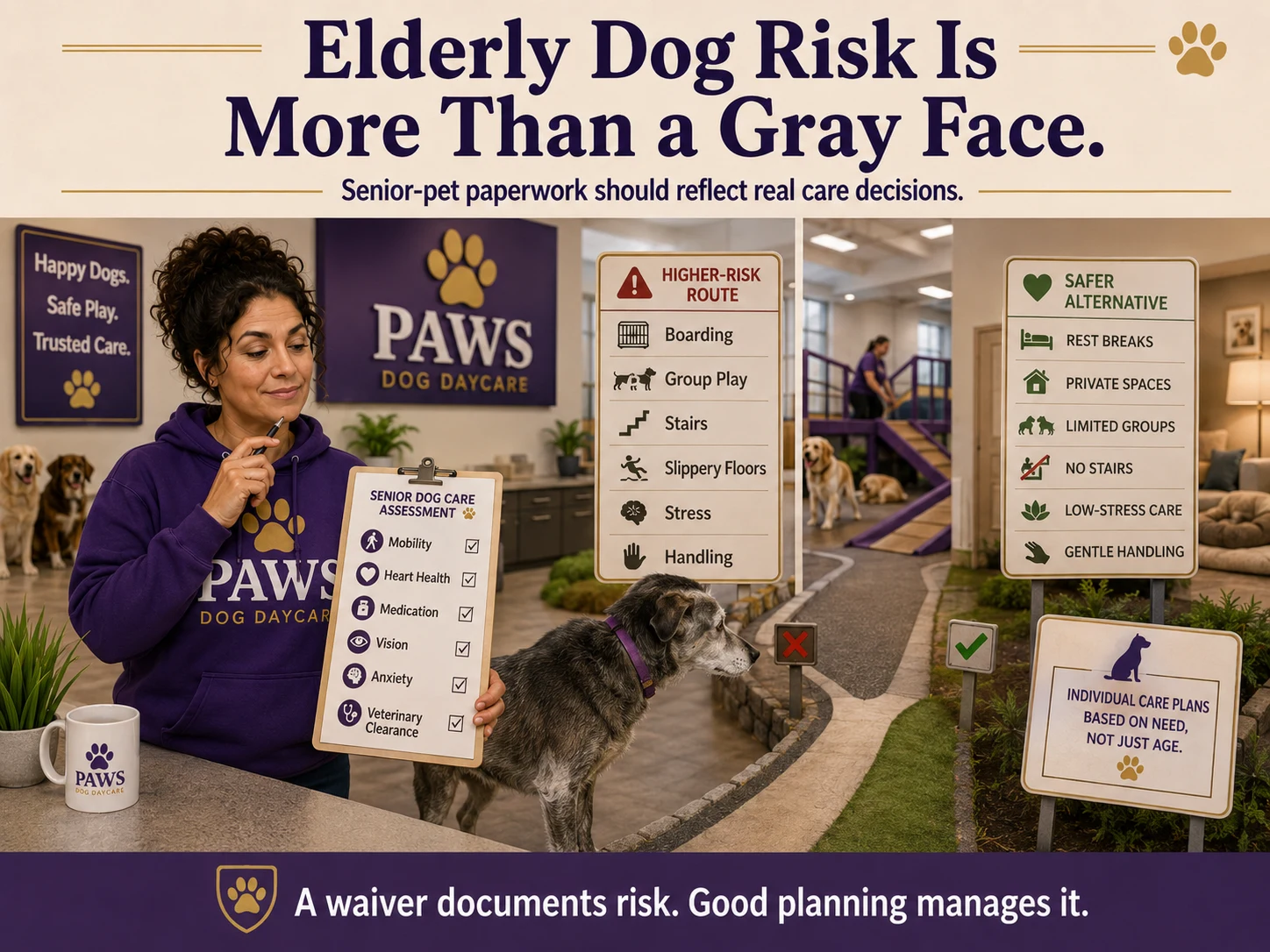
An elderly or infirm pet waiver is not about being cold. It is about being honest. Older pets and medically fragile pets can struggle with changes in routine, boarding stress, grooming stress, new environments, slippery floors, handling, stairs, bathing, drying, restraint, other dogs, and separation from home.
Older dogs may have arthritis, hip problems, joint issues, organ problems, heart conditions, neurological issues, vision problems, hearing loss, anxiety, weakness, or medical conditions the owner does not even know about yet. They may look fine at drop-off and then decline because stress and age are a bad cocktail.
The form should make the owner acknowledge that age and medical fragility create additional risk. It should also help staff identify whether the pet should be accepted, refused, handled differently, given rest breaks, kept out of group play, boarded separately, groomed only with special procedures, or referred back to a veterinarian.
What to Ask
- Is the pet elderly, infirm, disabled, or medically fragile?
- Does the pet have arthritis, hip, joint, bone, heart, breathing, organ, seizure, or neurological issues?
- Does the pet have trouble standing, walking, climbing, seeing, hearing, or regulating stress?
- Has the pet recently declined, fallen, been injured, or changed behavior?
What to Explain
- Boarding and grooming can be stressful.
- Older pets may be more susceptible to injury.
- Older pets may not recover as quickly.
- Preexisting conditions may become visible during care.
- Stress can affect health.
What to Decide
- Accept normally.
- Accept with restrictions.
- Require vet clearance.
- Provide private care only.
- Decline service if the risk is too high.
- Refer to veterinary boarding or medical grooming.
🧠
Operator rule
If a pet looks fragile enough that your gut says, “This could go sideways,” slow down. A waiver does not make a high-risk pet low-risk. It just documents that the risk was discussed.
✂️
Service Addenda: Daycare, Boarding, Grooming, Medication, Transport, and More
The more services you offer, the more your paperwork needs to match the actual operation.
A daycare-only business has one set of risks. A daycare plus boarding facility has another. Add grooming, bathing, medication, transport, webcam access, outdoor play, retail, training, or special events, and the paperwork needs to grow up with the business.
This does not mean you need a 400-page form packet that scares customers into needing a nap. It means each service should be covered clearly enough that expectations, authorization, payment, risk, and policy are not being invented by the front desk at 6:58 p.m. while a customer is late and a dog is vomiting on the mat.
| Service | Possible Form / Addendum | What It Should Cover |
|---|---|---|
| Daycare / group play | Daycare participation agreement | Group-play risk, temperament evaluation, removal from group, vaccination requirements, injuries, behavior, and owner representations. |
| Boarding | Boarding agreement | Check-in/out dates, feeding, belongings, medication, emergency care, late pickup, extended stay, nonpayment, abandonment, and after-hours policies. |
| Grooming / bathing | Grooming release | Matted coat, skin issues, elderly pets, handling, restraint, shave-down permission, injury risk, fleas/ticks, and service limitations. |
| Medication | Medication administration form | Medication name, dosage, frequency, storage, start/end date, side effects, missed-dose policy, and owner authorization. |
| Transport | Transport authorization | Pickup/drop-off location, access instructions, vehicle risk, timing, custody transfer, emergency contact, and insurance limitations. |
| Webcams / photo updates | Media and communication acknowledgment | Photo/video permission, webcam visibility, customer expectations, privacy limitations, and staff discretion. |
| Retail sales | Retail policy | Returns, damaged goods, special orders, food/treat disclaimers, and customer responsibility for product suitability. |
| Training | Training agreement | Training goals, owner participation, no guaranteed results, handling methods, behavior risks, and homework expectations. |
✂️
Grooming, Bathing, and Checkout Injuries
Grooming is not just “make the dog smell pretty.” It is handling, restraint, water, dryers, tools, skin, nails, ears, mats, stress, and a moving animal with opinions.
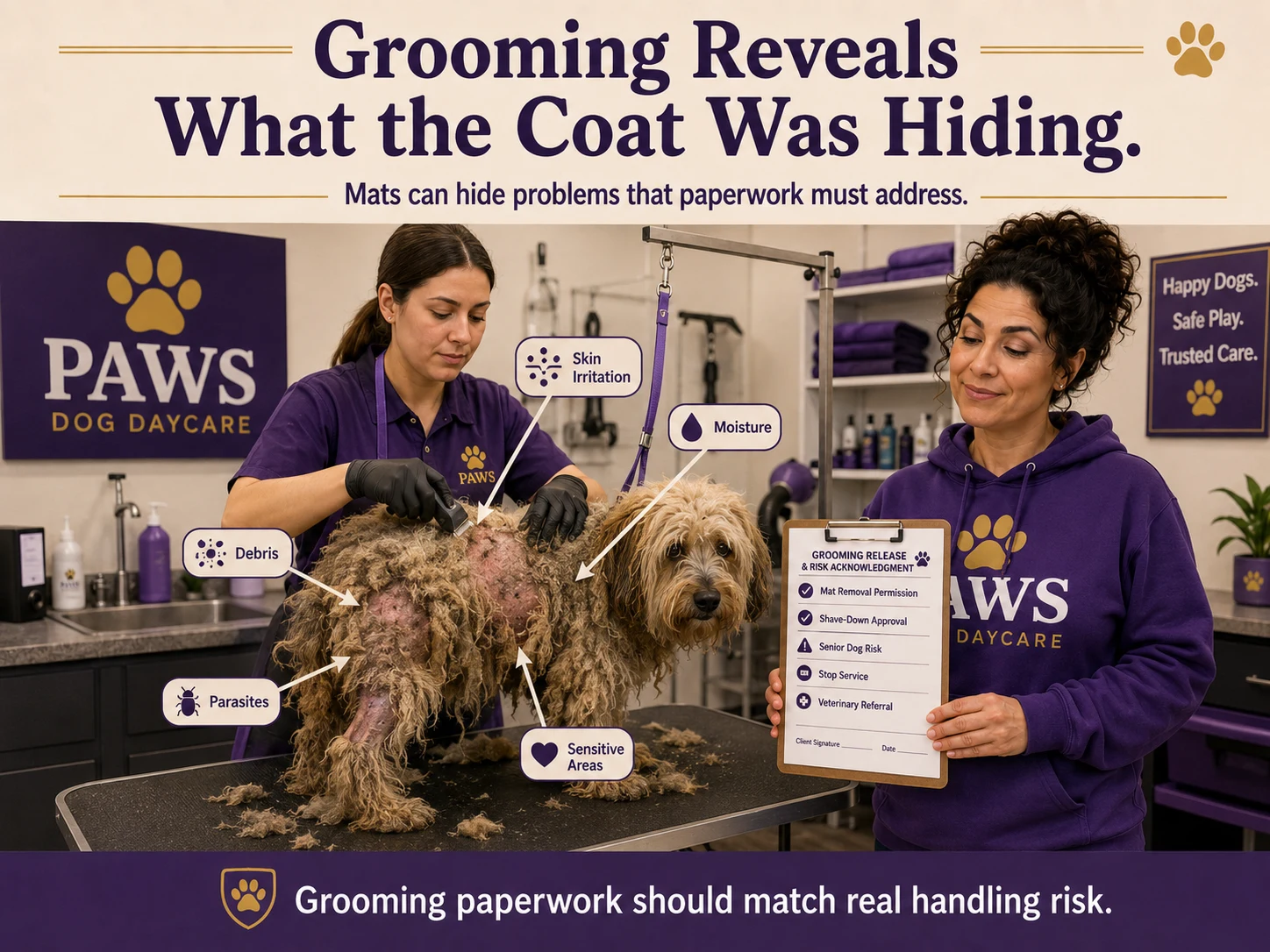
A lot of daycare and boarding facilities also bathe or groom dogs. Sometimes grooming is a separate paid service. Sometimes it is an add-on. Sometimes it is a courtesy bath before checkout, especially after boarding. That may be good customer service, but it still carries risk.
Dogs can get nicked. Nails can be quicked. Skin can be irritated. Matted coats can hide sores, bruises, hot spots, parasites, wounds, thin skin, or nasty little surprises nobody saw at check-in. Older dogs can struggle with standing. Nervous dogs can fight the dryer. Flat-faced dogs can have breathing issues. Heavy dogs can be difficult to lift. A dog that was fine in daycare can become a gremlin on the grooming table because the universe enjoys variety.
The forms should not treat grooming and bathing like harmless fluff. They should explain the risks, especially for matted, elderly, anxious, aggressive, medically fragile, or difficult-to-handle pets. They should also explain what the facility is authorized to do, what the owner is responsible for, what happens if the groomer discovers a problem, and when the facility can stop or refuse the service.
| Grooming / Bathing Issue | Form Should Cover | Operator Warning |
|---|---|---|
| Matted coat | Permission to shave or alter the groom if mats prevent safe brushing or normal styling. | Mats are not just ugly hair. They can hide skin problems and turn grooming into a medical scavenger hunt. |
| Skin irritation or hidden sores | Owner acknowledgment that skin issues may be discovered during bathing, drying, brushing, or clipping. | The groomer may be the first person to see what the owner missed under the coat. |
| Nicks, cuts, and nail quicking | Risk acknowledgment for tools, clippers, scissors, nail trimming, paw handling, and moving animals. | A dog jerks at the wrong second and suddenly everybody is having a bad afternoon. |
| Elderly or fragile dog | Special waiver or acknowledgment for standing, slipping, stress, heart issues, breathing issues, and fatigue. | Old dogs do not always bounce back from stress like young dogs. Respect that. |
| Aggressive or anxious dog | Authority to stop service, refuse service, muzzle where lawful and appropriate, or require veterinary grooming. | No haircut is worth getting an employee shredded. |
| Courtesy bath before checkout | Whether bathing is authorized, included, optional, refused, or subject to the same grooming risk language. | Free does not mean risk-free. A courtesy bath still needs permission and procedure. |
| Discovery of medical concern | Owner notification, veterinary referral, stopping service, documentation, and emergency care if needed. | If you find something ugly under the fur, document it like an adult. |
📌
Operator rule
Any dog that gets bathed, dried, brushed, clipped, shaved, trimmed, lifted, restrained, or handled for grooming needs paperwork that matches the risk. Do not let the grooming side of the business ride around without a seatbelt just because it feels like an add-on.
📋
Internal Forms: The Customer Does Not Sign Everything That Matters
Some of the most important forms are not customer-facing. They are internal records that show what actually happened.
Do not confuse signed client forms with operational records. You also need internal documentation. Incident reports, bite reports, injury logs, medication logs, feeding logs, cleaning logs, temperament notes, behavior warnings, staff observations, and customer communication records are the paper trail that keeps the business from relying on memory and panic.
Memory is a terrible filing cabinet. Staff forget. Customers remember things creatively. Details blur. If something serious happens, “I think Jessica said the dog seemed weird around lunch” is not a record. Write it down.
Safety Records
- Incident reports.
- Bite reports.
- Injury reports.
- Escape or gate failure reports.
- Aggression or removal-from-group notes.
Care Records
- Medication logs.
- Feeding logs.
- Boarding notes.
- Bathroom / elimination notes when needed.
- Special handling instructions.
Facility Records
- Cleaning logs.
- Disinfectant tracking.
- Maintenance notes.
- Playroom checks.
- Inspection preparation records.
📌
Operator rule
If you would want proof later, create the record now. Do not wait until a customer is angry, a dog is hurt, or an inspector is standing in the lobby with a clipboard.
💻
Web Forms Versus Downloaded Forms
A modern daycare should probably use both. Digital intake is convenient, but printable forms still have a place.
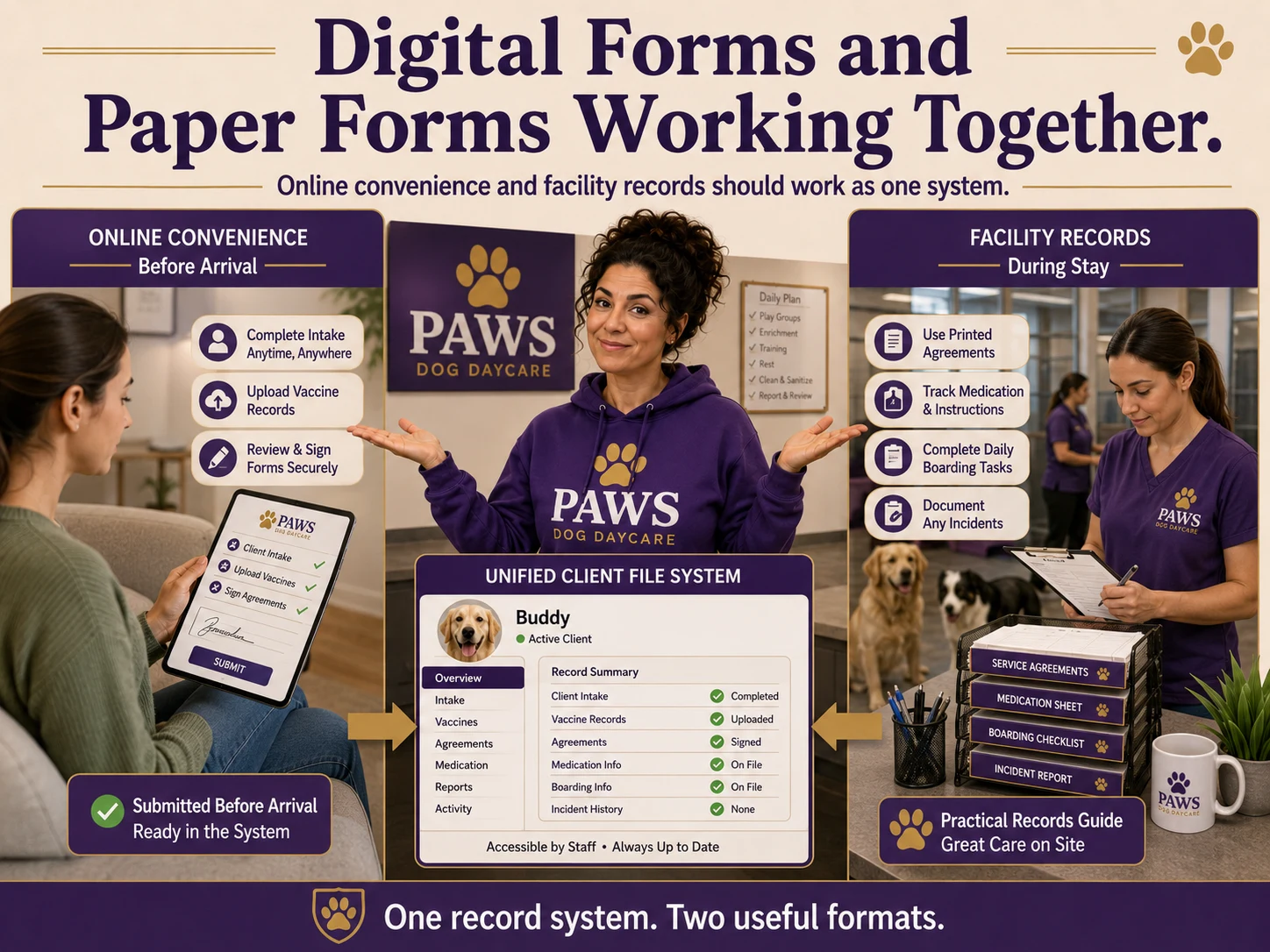
Back in the day, a lot of dog daycare paperwork was printed, clipped to a board, signed with a pen, and shoved into a file folder. That still works if the system is organized. But today, customers expect online forms, digital signatures, upload fields, vaccine tracking, email confirmations, and mobile-friendly intake.
That does not mean every form must be a fancy web app. It means your system should match how the business actually runs. A web intake form can collect information before the first visit. A printable agreement may still be useful for in-person review. A digital vaccine upload can save staff time. A medication form may need a daily printed log. A boarding agreement may need both online booking and signed check-in confirmation.
| Format | Best Use | Operator Warning |
|---|---|---|
| Web form | New client intake, pet profile, vaccine upload, contact info, service interest, and pre-screening. | Make sure submissions are stored, backed up, and easy for staff to find. |
| Digital signature form | Core agreements, waivers, service addenda, policy acknowledgments, and renewals. | Use a system that preserves the signed version and timestamp. |
| Printable PDF | In-person intake, backups when systems are down, medication sheets, boarding check-in, and attorney-reviewed agreements. | Paper forms still need version control. Old forms floating around are a mess waiting to happen. |
| Internal staff form | Incident reports, cleaning logs, feeding logs, medication logs, and temperament observations. | If staff hate the form, they will avoid using it. Make internal forms clear and fast. |
🧠
Best practical setup
Use web forms for intake and convenience, attorney-reviewed signed agreements for legal terms, and internal forms for daily documentation. Do not rely on one giant form to do every job. That is how you build a paperwork casserole.
🧰
Basic Dog Daycare Form System
This is the practical form stack I would want in place before opening the doors.
| Form | Who Completes It | When It Is Used | Operator Warning |
|---|---|---|---|
| New client intake | Owner | Before first visit. | Do not accept incomplete contact and emergency information. |
| Pet profile | Owner | Before evaluation, daycare, boarding, grooming, or training. | Ask about behavior and health directly. Do not settle for “friendly.” |
| Vaccination record form | Owner / staff verification | Before service and at renewal. | Track expiration dates or the system will rot quietly. |
| Core service agreement | Owner signs | Before any paid service. | Attorney review is not optional if you are serious. |
| Emergency veterinary authorization | Owner signs | Before care begins. | Do not wait until the dog is sick to ask who can authorize treatment. |
| Photo / media release | Owner signs or opts in/out | Before public use of pet images. | Separate public marketing from private customer updates if needed. |
| Boarding agreement | Owner signs | Before overnight care. | Late pickup, nonpayment, belongings, feeding, medication, and abandonment need attention. |
| Grooming release | Owner signs | Before grooming or bathing. | Mats, skin conditions, senior pets, and shave-down decisions are where fights start. |
| Medication form | Owner plus staff log | Any time medication is handled. | No medication from memory. Ever. |
| Elderly / infirm waiver | Owner signs | For older, fragile, disabled, or medically risky pets. | A waiver documents risk. It does not make a fragile dog sturdy. |
| Incident report | Staff | Any injury, fight, bite, escape, illness, or unusual event. | Write it while the facts are fresh. |
| Temperament evaluation notes | Staff | Before group play and as behavior changes. | Behavior records protect dogs, staff, and the business. |
🧰
Dog Daycare Form Packet Builder
Check the services you plan to offer and this will show the form categories your paperwork stack should probably include. This is the map, not the attorney-reviewed legal package.
🧩
Sample Web Form Sections
This is the kind of structure a modern online intake page can use without giving away the full attorney-reviewed form language.
Owner Information
- Owner full name.
- Street address.
- City, state, ZIP.
- Cell phone.
- Work phone.
- Email address.
- Seasonal resident status.
- How did you hear about us?
Emergency Contact
- Emergency contact name.
- Relationship to owner.
- Phone number.
- Alternate phone.
- Authorized to pick up?
- Authorized to approve emergency care?
Pet Information
- Pet name.
- Breed or mix.
- Age / birthday.
- Sex.
- Spayed or neutered?
- Weight.
- Color / markings.
- Medical conditions.
Veterinary Information
- Veterinarian name.
- Clinic name.
- Clinic phone.
- Clinic address.
- Emergency clinic preference.
- Vaccine upload.
Behavior Disclosure
- Bite history.
- Dog aggression.
- People aggression.
- Resource guarding.
- Fence climbing / escape.
- Separation anxiety.
- Fear triggers.
Agreement Acknowledgments
- Risk acknowledgment.
- Owner representation.
- Emergency veterinary care.
- Financial responsibility.
- Photo/media permission.
- Policy acknowledgment.
- Signature and date.
🚫
Common Dog Daycare Form Mistakes
Most paperwork problems are not exotic. They are boring mistakes that grow teeth later.
01
Using One Generic Waiver for Everything
Daycare, boarding, grooming, medication, transport, elderly pets, photos, and training do not all create the same risk.
02
No Attorney Review
A form copied from another state may be worse than no form because it gives you confidence you did not earn.
03
No Vaccine Expiration Tracking
Collecting vaccine records once and never tracking renewal dates is how the record system starts growing mold.
04
No Emergency Authority
When a dog needs veterinary care and the owner will not answer, weak paperwork turns into a very expensive staring contest.
05
No Abandonment Procedure
If you board dogs, you need a lawful procedure for late pickup, nonpayment, and owners who disappear.
06
Forms Staff Cannot Use
If the paperwork is buried, confusing, outdated, or unreadable, staff will avoid it like a wet mop in August.
08
No Death-in-Care Procedure
If you handle enough dogs, one may collapse, die overnight, or suffer a sudden medical event in your care. Pretending that cannot happen is not compassion. It is poor planning wearing a blindfold.
⚖️
Attorney Review: Where the Internet Needs to Shut Up
Use sample forms to understand the structure. Use a qualified attorney to build the actual legal tool.
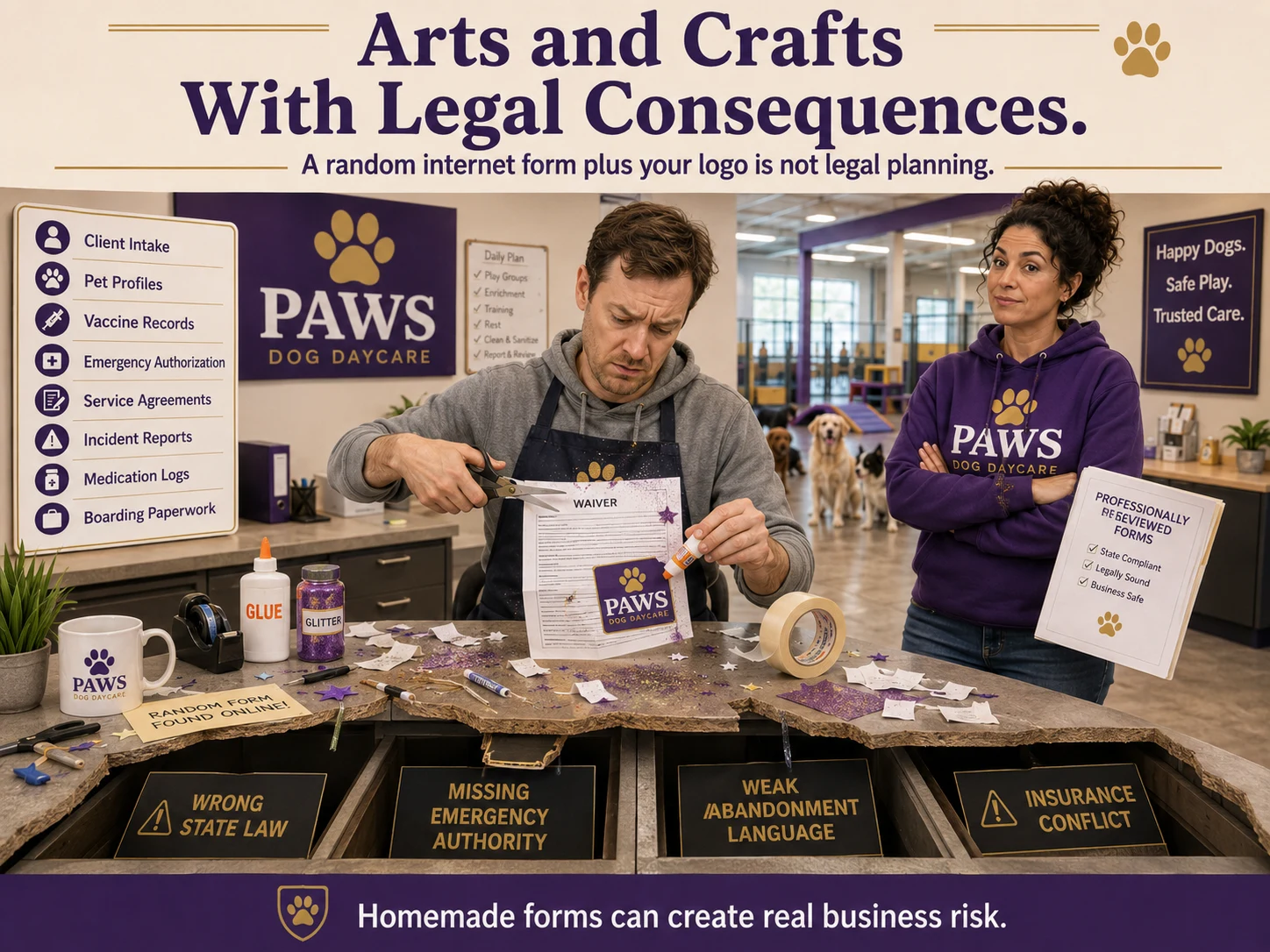
There is nothing wrong with using sample forms as research. That is exactly what they are good for. They help you see the categories, the topics, the risks, and the operational questions that need to be answered.
But the final customer-facing legal documents need to be reviewed in your state. Your attorney should look at your services, your insurance, your business entity, your state law, your abandonment procedure, your emergency-care language, your photo release, your grooming and boarding terms, your payment policy, your employee procedures, and your actual operating model.
Do not ask a form downloaded from the internet to do the job of a lawyer. That is like asking a tennis ball to run payroll. Wrong tool. Wrong expectations. Bad afternoon.
Bring Your Attorney
- Your service list.
- Your state and local licensing requirements.
- Your insurance policy requirements.
- Your boarding and late-pickup policy.
- Your vaccine policy.
- Your emergency veterinary procedure.
- Your photo and media use plan.
- Your payment and collections policy.
Ask Your Attorney
- Are the waiver and release provisions enforceable here?
- What notice is required for abandoned animals?
- Can the facility hold a pet for nonpayment?
- What should the emergency veterinary authorization say?
- How should photo/media permission be handled?
- What should be signed annually versus once?
- What records should be retained and for how long?
- Does the form match the insurance policy?
🛑
Do not skip this step because money is tight.
If you cannot afford attorney review for the documents customers sign, you definitely cannot afford the mess that can happen when the documents fail.
❓
Dog Daycare Forms FAQ
Detailed answers to the intake, waiver, vaccine, medical, boarding, grooming, senior-pet, abandonment, emergency, digital-record, and internal-documentation questions that determine whether the paperwork can support the operation.
What forms does a dog daycare need before opening?
At minimum, a serious daycare should have a client intake form, pet profile, vaccination record process, core service agreement, emergency veterinary authorization, policy acknowledgment, temperament evaluation record, incident report, and internal care logs. Boarding, grooming, medication, transport, senior or medically fragile pets, photos, webcams, training, and retail can require additional agreements or addenda. The correct packet depends on the actual services, state law, local rules, insurer requirements, and operating model. One generic waiver is not a complete paperwork system.
Can one waiver cover daycare, boarding, grooming, medication, and transport?
It can address some shared terms, but forcing every service and risk into one generic document often produces vague or incomplete language. Daycare group play, overnight boarding, grooming, medication handling, transportation, senior-pet care, abandonment, and media use create different operational questions. A core agreement may be supported by service-specific addenda or clearly separated sections. The structure should be easy for customers to understand and easy for staff to use.
Do dog daycare waivers prevent lawsuits?
No. A signed form does not stop an angry customer from filing a claim or lawsuit. Good forms help document the risks explained, information disclosed, owner representations, policies accepted, authority granted, and financial responsibility agreed upon. They are most useful when the business also operated reasonably, followed its procedures, maintained safe staffing, and preserved accurate records. Paperwork cannot erase negligence, reckless conduct, unsafe equipment, ignored warning signs, or dishonest documentation.
Should I download a free waiver from the internet?
Free samples can help identify topics to discuss, but they should not become the final legal document without qualified review. A form copied from another business may use the wrong state law, conflict with your insurance policy, omit emergency authority, mishandle abandonment, or fail to match the services you offer. Use samples as research, then have local counsel build or review the documents customers will sign. A confident-looking form can still be legally and operationally weak.
What information belongs on the client intake form?
Collect the owner’s legal name, address, reliable phone numbers, email, emergency contact, authorized pickup people, veterinarian, payment responsibility, and any other contact information needed for notices or emergencies. The form should also identify seasonal or temporary residency when that matters and record how the customer found the business for marketing analysis. Do not accept incomplete contact records and plan to fix them later. Missing information becomes most expensive when the owner cannot be reached.
What should a strong pet profile ask beyond breed, age, and weight?
A strong profile asks about medical conditions, allergies, medications, seizures, mobility limits, recent illness, spay or neuter status, bite history, dog and people aggression, resource guarding, escape behavior, crate stress, separation anxiety, fear triggers, and prior daycare or boarding experience. The goal is not to label the dog; it is to uncover information that affects acceptance, group placement, handling, housing, grooming, and emergency planning. The vague answer that a dog is friendly is not enough.
How should behavior questions be written?
Ask about specific events and patterns rather than broad labels. Questions about biting, snapping, growling, fighting, guarding food or toys, climbing fences, escaping, reacting on leash, panicking in confinement, or becoming aggressive during handling produce more useful answers than asking whether the dog is nice. Include space for explanations, dates, triggers, severity, and what happened afterward. The form should support the temperament evaluation, not replace it.
How should vaccination records be managed?
The business needs a system that records the vaccine type, documentation source, expiration date, renewal reminder, staff verification, and whether the dog may enter services. Collecting a record once is not enough because it can expire quietly. Use current, due-soon, and expired statuses and make the check-in rule consistent. The policy should match local requirements, veterinary guidance, insurer expectations, and the services offered.
What should emergency veterinary authorization cover?
It should address when the facility may seek care, how the owner and emergency contact will be notified, which veterinarian or emergency clinic may be used, who may transport the dog, what happens if the owner cannot be reached, and who is financially responsible. It should also fit the facility’s actual emergency procedure and be available to staff immediately. This language needs local legal review because authority and financial responsibility can be treated differently by jurisdiction.
Do I need a separate medication authorization form?
Yes, whenever the business administers medication. The form should identify the medication, strength, amount, route, timing, purpose, storage, start and end dates, possible side effects, veterinarian, owner signature, and what staff should do if a dose is missed or refused. Administration should be recorded each time. Medication should never depend on memory, a rushed verbal comment, or an unlabeled container.
What paperwork is needed for boarding?
Boarding paperwork should address arrival and departure dates, feeding, medication, belongings, overnight housing, emergency care, late pickup, extended care, payment, nonpayment, abandonment procedures, and owner contact. It may also address what happens when travel is delayed or the dog becomes ill. Boarding creates continuing care obligations after closing time and after the scheduled pickup date. The form must match the facility’s actual procedures and local law.
What should abandonment and nonpayment language address?
The agreement should explain late fees, continuing-care charges, contact attempts, written notices, card-on-file rules, collection responsibility, and the state-specific process that applies when an owner does not reclaim the dog. It should not assume the business can automatically keep, transfer, sell, surrender, or rehome the animal. Abandonment and lien rules vary, so local legal review is essential. Staff also need a written escalation procedure and complete communication records.
Do grooming and bathing require separate paperwork?
They often should. Grooming and bathing involve handling, restraint, water, dryers, nails, ears, clippers, scissors, mats, skin conditions, senior-pet stress, and stop-service decisions. The release should address shave-down approval, hidden problems under the coat, injury risk, fleas or parasites, aggressive or anxious behavior, medical referral, and the facility’s right to stop or refuse unsafe work. Even a free checkout bath carries risk and should have authorization.
Why is special paperwork important for senior or medically fragile dogs?
Older and infirm dogs may have reduced mobility, arthritis, heart or breathing problems, sensory loss, weakness, anxiety, or hidden disease. Boarding, group play, grooming, stairs, slippery floors, handling, and separation can create more risk for them than for a healthy young dog. The form should support a case-by-case decision about restrictions, private care, rest breaks, veterinary clearance, or refusal. A signed waiver documents the discussion; it does not make a high-risk dog low-risk.
Should photo, video, webcam, and social-media permission be separate?
Clear separation is often useful because private owner updates, public social posts, website use, live webcams, printed advertising, and paid promotions are not the same thing. Customers may agree to one use and decline another. The form should explain how images may be used and whether the customer can opt in or out. Staff should also avoid posting personal information or creating promises about continuous camera access that the operation cannot maintain.
What internal forms should staff complete?
Useful internal records include temperament notes, incident and bite reports, injury reports, medication and feeding logs, boarding observations, cleaning and disinfecting logs, gate or escape reports, maintenance notes, customer communication records, and emergency timelines. These documents show what actually happened after the customer-facing forms were signed. Staff forms should be fast, clear, consistent, and available where the work occurs. A form nobody uses is only decorative paperwork.
How should sudden illness, collapse, or death in care be documented?
The facility should record the dog’s observed condition, timeline, staff actions, contact attempts, veterinary communication, emergency response, witnesses, owner notification, video preservation, body handling, and follow-up. Staff roles should be assigned before an emergency: who evaluates, who calls the veterinarian, who contacts the owner, who manages other customers and dogs, and who documents. The agreement and internal procedure should address known and unknown medical conditions without using that language to excuse poor care.
Are digital forms better than paper forms?
Digital forms improve convenience, searchability, vaccine uploads, signatures, reminders, and remote intake. Paper or printable records can still be useful for medication administration, boarding tasks, incident documentation, system outages, and staff work in the facility. The strongest setup often uses both while keeping one controlled client and pet record. Version control, storage, backup, access, and retrieval matter more than whether the form began on a screen or a clipboard.
How often should agreements and forms be reviewed?
Review them at least annually and whenever the business adds a service, changes a policy, changes insurers, moves, updates pricing or payment rules, experiences a serious incident, or receives new legal or regulatory guidance. Remove old versions so staff and customers do not sign conflicting documents. Decide which forms renew annually, which renew when information changes, and which are completed for every visit or service. Record the version and effective date of every customer-facing agreement.
What is the final test for a dog daycare paperwork system?
Run a realistic scenario from intake through an ugly day. Can staff identify the owner, dog, emergency contact, veterinarian, vaccine status, behavior history, medication, authorized services, pickup authority, and payment responsibility without guessing? Can they document an incident, seek emergency care, preserve records, and follow the correct boarding, grooming, or abandonment procedure? A workable system produces fast, consistent answers under pressure. If the answer lives only in one employee’s memory, the paperwork system is not finished.
🧠
The Bottom Line
Forms are boring until they are the only thing standing between you and a very expensive mess.
A serious dog daycare needs serious paperwork. Not because paperwork is exciting. It is not. Paperwork is the broccoli of business ownership. But when a dog gets hurt, a customer lies about behavior, vaccine records are missing, a boarding dog is not picked up, an old dog declines after grooming, or someone disputes what they agreed to, the paperwork suddenly matters a lot.
Build the system before the problem. Client intake. Pet profile. Vaccine tracking. Emergency veterinary authorization. Service agreement. Photo release. Boarding addendum. Grooming release. Elderly/infirm waiver. Medication form. Incident report. Internal logs. Policy acknowledgment. Attorney review.
Do that work now, and the business has a spine. Skip it, and you are trusting memory, goodwill, and customer honesty to carry legal and operational risk. That is not a business plan. That is leaving the gate open and hoping the dogs respect the concept of boundaries.
🖨️
Printable Forms Audit Checklist
Print this before opening, before annual review, before adding a new service, or before pretending the old clipboard from 2011 still counts as a paperwork system.