Grooming Business • Facility Tours • Customer Access • Room Placement • Staff Motion • Groomer Interruptions • Safety • Revenue Loss
Grooming Inside a Pet Care Facility: Tours, Room Placement, and Wasted Motion
Grooming can be one of the best additional services inside a dog daycare or boarding facility, but only if it is designed to fit into the business correctly. Grooming is not just a table, tub, dryer, and a person with clippers. Grooming is a business within the business of a pet care facility, and where that business is located matters.
The grooming room location affects customer flow, facility tours, staff movement, safety, front-desk communication, production time, and how often your groomer gets dragged away from the dog they are working on because a customer wants to ask “one quick question.”
The problem is that “one quick question” is almost never just one quick question.
In many instances, if your grooming room is buried in some faraway dungeon inside the building, the customer is going to want a tour of the grooming room. They want to build trust. They want to check cleanliness. They want to make sure their pet is going to be groomed in a safe, clean, professional environment.
That is not unreasonable. The customer is leaving their dog with you. They want to know the dog is not disappearing into some mystery back room where a stressed groomer, a wet doodle, and a shop vac are all fighting for their lives.
Sadly, grooming room location is not something many dog daycare owners put enough thought into during the initial design and buildout phase of the business. In many facilities, grooming is an afterthought added into a layout that was never designed for it. “Grooming” gets placed wherever space is available, which may mean converting a few boarding suites closest to adequate plumbing and electrical into the “new grooming room” seven layers deep in the facility, in what is normally a staff-only area.
In most modern pet businesses, big-box pet chains, and more expensive upper-tier pet resorts, the grooming room is often placed up front or near the customer path, frequently with a window customers can see through. That visibility helps customers understand what is happening, builds trust, and reduces unnecessary staff interruption from people who want to see the tables, tub, dryers, and grooming setup like they are grading the launch safety checklist for the space shuttle.
This brings us to the issue of tours when you have added a grooming room after the fact, never planned for it correctly, and now have to provide peace-of-mind tours for worried pet parents.
A customer asking for a tour may sound like a simple request. It is not. The front desk radios the back, dogs stop moving, staff secure animals, groomers pause, and the business pays for that reassurance in time, labor, production, and safety control.
A customer tour is not free. A grooming consult is not free. A walk to the front is not free. Your staff is not pausing for free. Your building is not idling for free. Every conversation, tour, walk-through, interruption, and reassurance moment costs the business something.
That is the point of this page. Grooming can make money, but a bad grooming-room location can quietly bleed that money back out of the business one interruption, one walkout, and one wasted trip at a time.
⚠️
Operator rule
A customer wanting reassurance is not the problem. Building a facility where reassurance requires stopping the back of house is the problem.
🗺️
Use This Page Like a Grooming Layout and Customer Access Map
This page connects customer tours, grooming-room placement, wasted motion, safety, and the real cost of stopping the back of house.
🚪
The Tour Request
A customer asks to see the facility. That simple request starts a whole back-of-house reset.
💸
Tour or Walkout
Give the tour and operations pause. Refuse the tour and you may lose trust or lose the sale.
⏱️
Design the Cost Out
Customer reassurance is normal. The facility should be designed so reassurance does not stop the machine.
✂️
Why Grooming Matters
Grooming is the first place bad customer access and bad room placement start charging rent.
🚶
The Groomer Walkout
When grooming is buried in the back, every customer question becomes a paid interruption.
🔥
Unattended Dog Safety
Tables, tubs, dryers, cages, and “just five minutes” can become a disaster.
📊
Pedometer Case Study
An extra mile and a half per day, 18 minutes per dog, and $18,720 a year lost because the grooming room was in a stupid location.
🐜
Economy of Motion
Stop making skilled staff walk around the building like confused ants.
🏗️
Better Room Placement
Grooming should be close enough for customer access and controlled enough for safety.
📋
Tour and Consult Policy
Customer access has to be controlled before the lobby turns into a backstage pass.
❓
FAQ
Facility tours, customer access, grooming consults, room placement, and production loss.
🚪
The Customer Tour Request
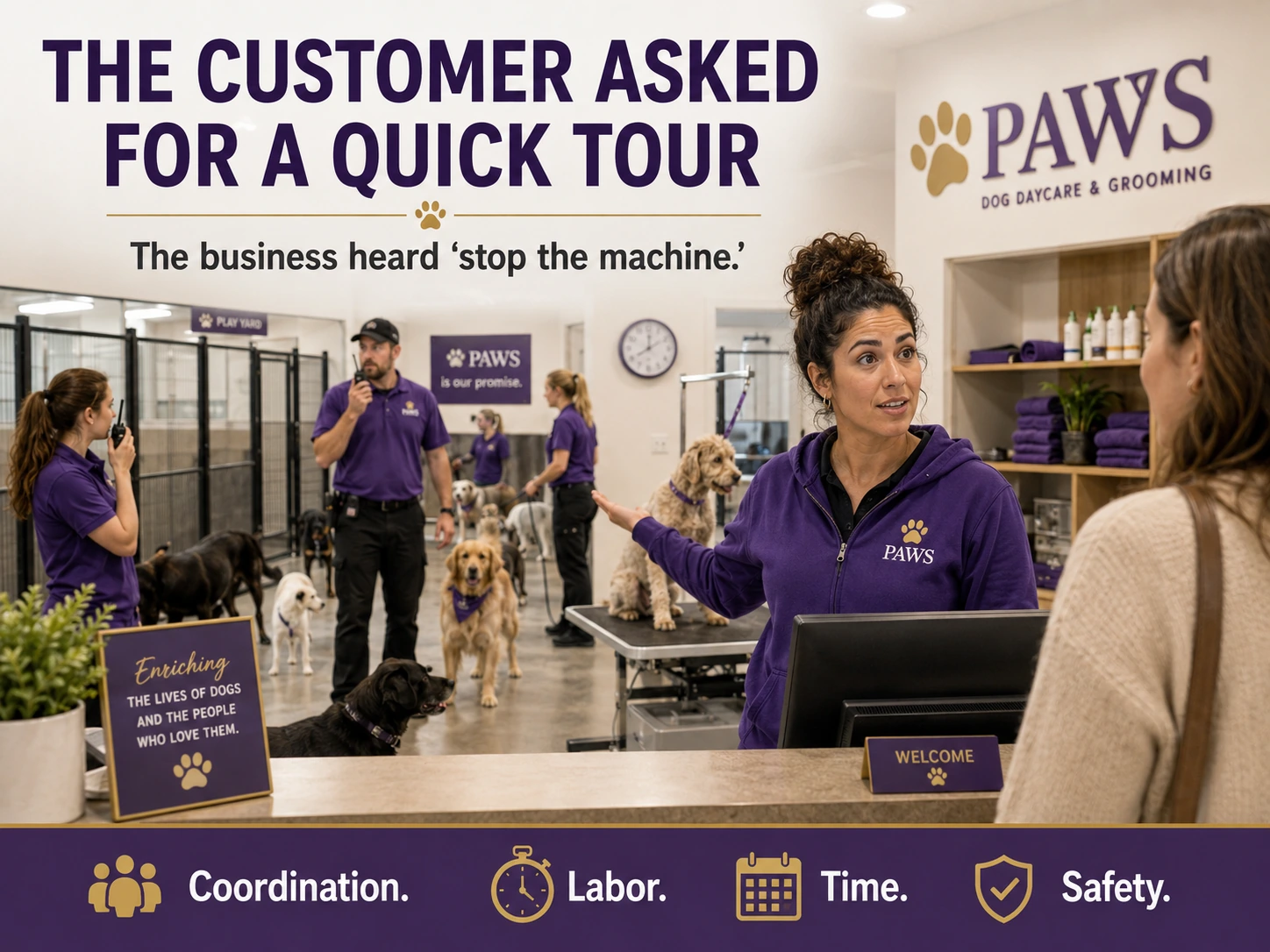
The customer thinks they asked for a quick look around. The business just heard the opening bell for a miniature operational shutdown.
A customer comes in and asks to see the facility. That is not unreasonable. They are thinking about leaving their dog with you. They want to know where the dog will play, where the dog will sleep, where the dog will be groomed, and whether the place looks clean, safe, organized, and professional.
From the customer’s side, it sounds simple: “Can I get a tour?”
From the business side, that simple sentence triggers work.
The front desk has to radio or alert the back of the facility. Kennel staff need to know a customer is coming through. Groomers need to know a new face may appear near the grooming room. Dogs moving through the building may need to be paused. Play areas need to be checked. Boarding dogs may need to stay put. Dogs going to or from potty breaks may need to wait.
A dog on a grooming table, in a tub, in a dryer, or being actively handled by staff has to be made safe before a stranger appears in the working area. The customer cannot just wander into the back while the facility is in full animal-care motion. That is not professional, and it is not safe.
So the business slows down. Staff reset the back of house. Dogs are secured. Movement pauses. The tour path is made safe. The customer sees a controlled version of the facility, which is exactly what they should see.
But make no mistake: a “quick tour” is not just a walk. It is coordination, interruption, and safety control wearing a customer-service smile.
📌
Operator translation
The customer asked for trust. The business paid for it with motion, labor, coordination, interruption, and time.
💸
Tour or Walkout: Either Way, There Is a Cost
The business pays when it gives the tour. The business may also pay when it refuses the tour.
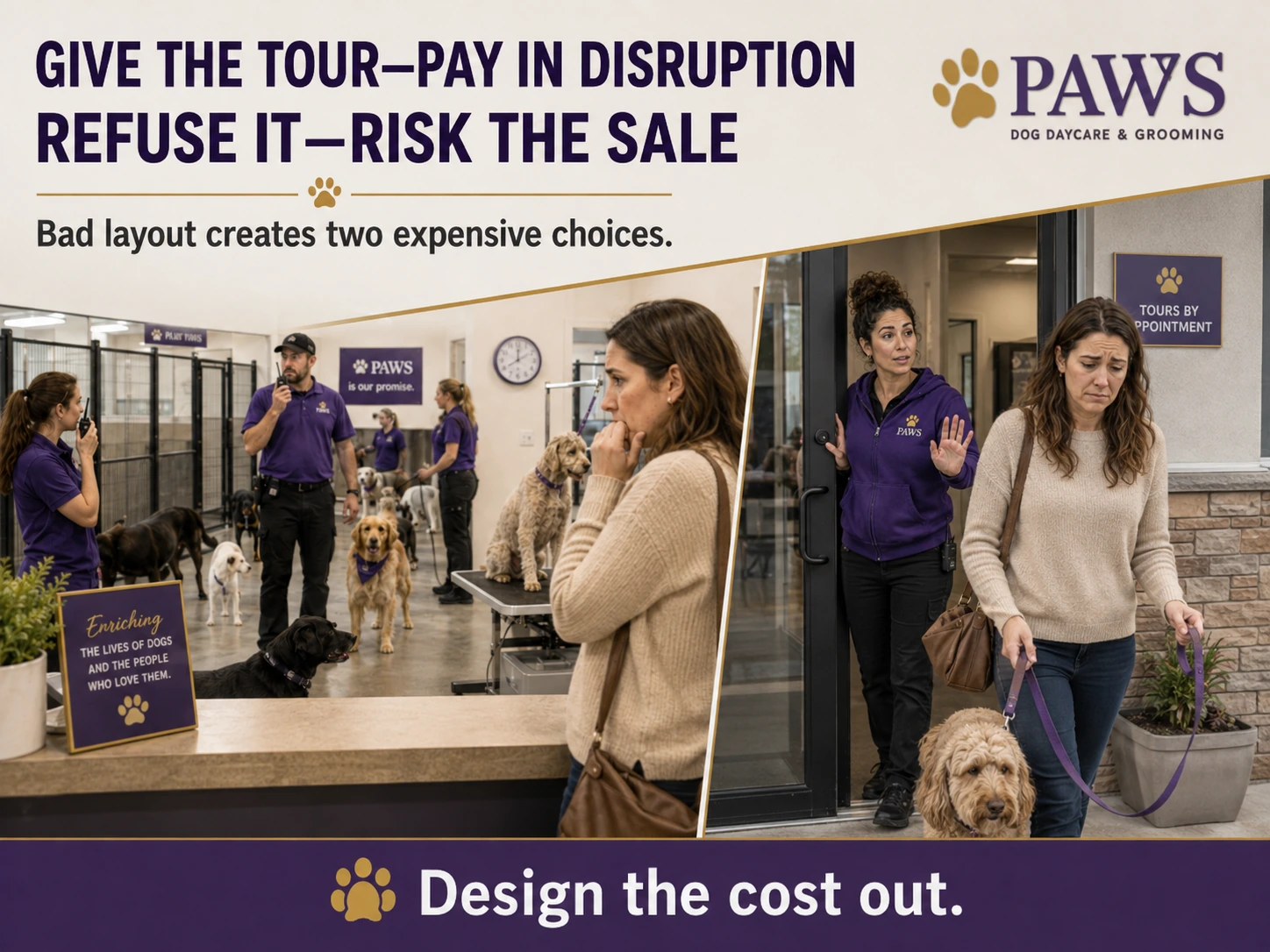
In either instance, tour or walkout, there is a cost to you, the business owner, in both time and money.
If you provide the tour, much of your facility may grind to a halt for a few minutes. That becomes especially laborious and difficult during high-traffic portions of the day when daycare dogs are checking in or checking out, boarding dogs are being moved, or multiple grooming dogs arrive at the same time.
Other customers may have to wait while you provide the required tour. The front desk may be tied up. Kennel staff may have to stop what they are doing and make sure play areas are clean, dogs are secure, and no dogs are moving through the facility to or from potty breaks, boarding suites, grooming, or play areas.
Likewise, grooming staff may have to stop what they are doing so the dog they are working on is not suddenly startled or excited by a new face in the back of the facility.
If you refuse the tour, you may save the interruption but lose the customer’s trust. Some customers will understand. Some will not. Some will assume you are hiding something. Some will walk out and take their dog, future boarding stays, grooming appointments, daycare packages, and referrals with them.
That is the ugly little math of customer reassurance. Give the tour and you pay in disruption. Refuse the tour and you may pay in lost revenue.
The goal is to stop treating each request like a surprise. The front desk should know who can authorize a tour, where the customer waits, how the back of house is contacted, what path may be used, and when the answer has to be “not right now.” A repeatable process protects trust without making every request a new argument.
Track when tours and lengthy reassurance conversations occur. If the same request repeatedly forces staff to stop dog movement, leave the lobby, or interrupt grooming, the problem is no longer an unusual customer request. It is a predictable operating cost that should be reduced through layout, scheduling, visibility, and policy.
⚠️
Tour reality
The solution is not to let customers roam the back of the building like they bought a backstage pass at a dog circus. The solution is to design customer access so trust can be built without throwing a wrench into the whole machine.
⏱️
Design Customer Trust Into the Layout
Customers need reassurance. The mistake is designing a building where reassurance requires stopping the back of house.
This is one of those business realities that new owners often miss. Every service you provide, every conversation you have, every tour you give, every customer you reassure, every dog you move, and every time staff stop what they are doing costs time or money.
Even if nobody writes a check during that moment, the meter is still running. Payroll is running. Utilities are running. Grooming production may be paused. Other customers may be waiting. Dogs may be held in place. Staff are shifting attention from one task to another. The business is spending.
This does not mean you should refuse to talk to customers. That would be stupid. Pet care is a trust business. Customers need answers. They need reassurance. They need to feel like the place caring for their dog is clean, safe, competent, and honest.
What it does mean is that customer trust should be designed into the operation. Visibility, controlled tour paths, front-desk scripts, consult stations, viewing windows, scheduled tours, and smart room placement all reduce the number of times the facility has to stop and reset just to prove it is not hiding a disaster in the back.
Swipe left/right to see the full table.
| Customer Need | Bad Layout Response | Better Design Response |
|---|---|---|
| Wants to know the facility is clean | Walk them through active dog-care areas during a busy period. | Use controlled viewing, scheduled tours, photos, clean visible areas, and a safe tour route. |
| Wants to see grooming | Drag them to a back-room grooming area and interrupt the groomer. | Place grooming near the customer path or use a viewing window/consult station. |
| Wants to talk to the groomer | Make the groomer cross the building, secure the dog, talk, return, and restart. | Create a short controlled consult process near the grooming workflow. |
| Wants reassurance during peak traffic | Stop check-in, dog movement, and back-of-house work to satisfy the request immediately. | Explain the safety rule and schedule the tour when the back confirms it is safe. |
| Wants access because they are nervous | Let emotion override the facility’s safety flow. | Acknowledge the concern, control the access, and protect staff, dogs, and production. |
✂️
Why Grooming Becomes the Big Example
Grooming is where bad layout, customer questions, and wasted motion start costing real money fast.
Grooming fits naturally inside a pet care facility because the same customer already trusts you with the dog. The daycare customer may want a bath. The boarding customer may want the dog cleaned before pickup. The grooming customer may become a daycare customer. The services feed each other when they are built correctly.
But grooming is also different from daycare. A groomer is working with tools, water, dryers, tables, tubs, restraints, nervous dogs, matted dogs, older dogs, sharp blades, slippery floors, and customers who often have very specific expectations about how the dog should look.
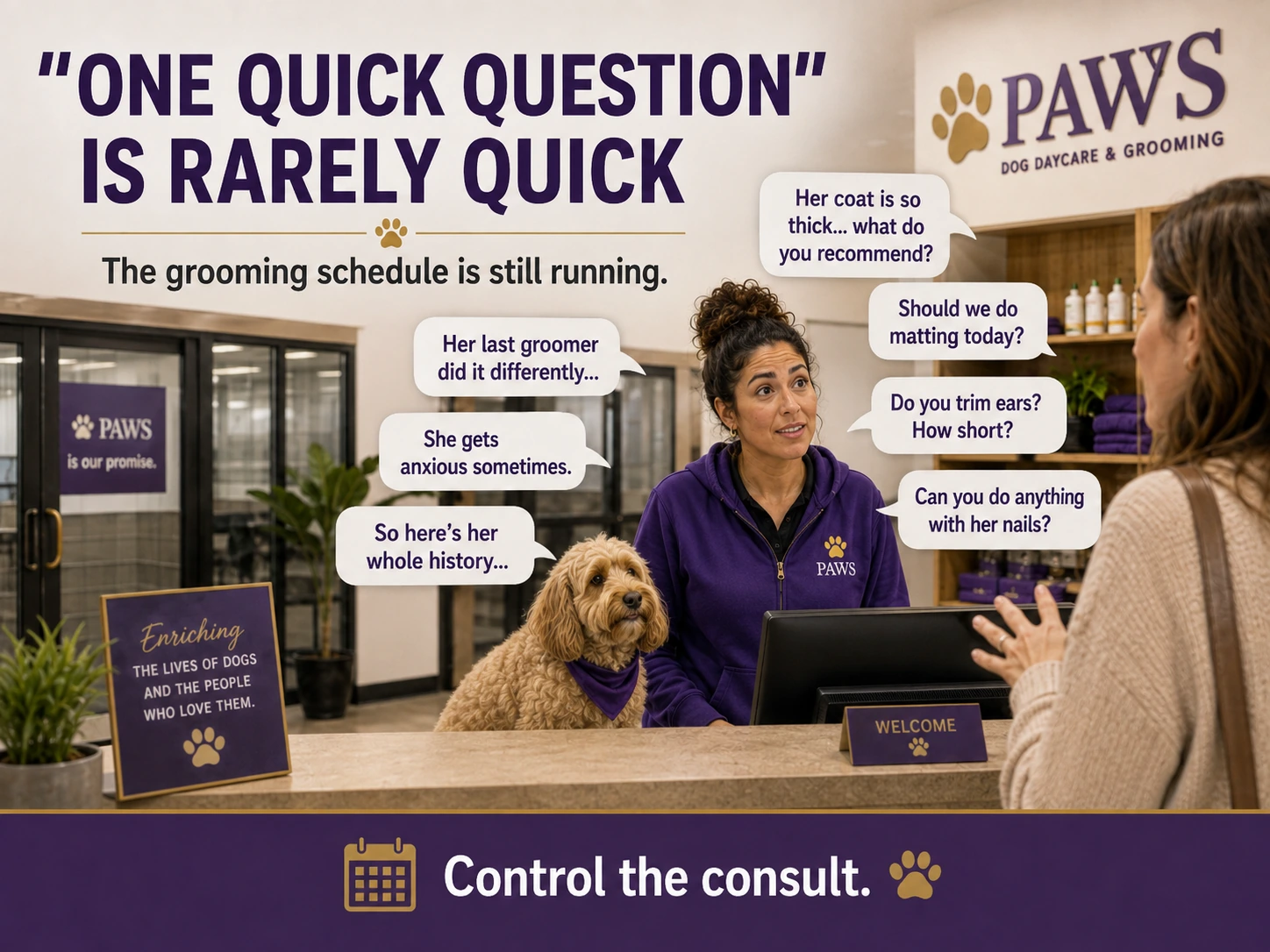
Many customers, and I would say the majority, have a desire to speak with the person who will actually be working on their dog. That is not an unreasonable request. If someone is going to cut your dog’s hair, shave a matted coat, trim nails, bathe the dog, handle the ears, or manage a nervous animal, it makes sense that the owner wants to talk to that person.
The problem is not the request. The problem is what happens when the grooming room is set up in an out-of-the-way location and every normal customer question forces the groomer to leave the work area.
A controlled intake process should collect the routine information before the groomer is interrupted: the service requested, coat condition, prior grooming concerns, behavior warnings, pickup expectations, and any instructions the customer wants documented. The groomer can then address the details that actually require professional judgment instead of starting every conversation from zero.
The point is not to keep customers away from the groomer. The point is to protect the groomer’s production time and the dog’s safety by making the conversation deliberate. A short, documented handoff is customer service. Repeated unscheduled walkouts are a workflow failure.
📌
Grooming business rule
Grooming can add serious income to a pet care facility, but only if the workflow is built so the groomer can produce safely instead of spending the day walking to the front and restarting dogs.
🚶
The Groomer Walkout Problem
A badly placed grooming room turns customer reassurance into cardio.
In terms of monetary loss, setting up the grooming area in an out-of-the-way location creates a loss in economy of motion. As a result, your grooming staff may be forced to leave their work area multiple times during the day to come up front and speak with customers, costing you time and money.
Likewise, if a customer tours a grooming room in the back of the facility, the grooming staff may have to stop what they are doing so the dog they are working on is not suddenly startled or excited by a new face in the back of the facility.
It is also not uncommon for a customer touring a grooming room to decide to have a long conversation with the groomer about what they would like, what they thought of their last groomer, what the dog hates, what the dog loves, why the ears should look a certain way, what happened two groomers ago, and everything in between, including a complete life history on the dog in question.
All the while, your staff is in standby mode.
The customer thinks they are being thorough. The business hears the schedule slipping. The groomer has stopped producing. The dog being worked on has been interrupted. The next dog is waiting. The front desk is waiting. The whole thing may look like customer service, but it is still paid time bleeding out of the day.
Swipe left/right to see the full table.
| What Happens | Why It Costs Money | Why It Creates Risk |
|---|---|---|
| Groomer leaves the room to talk to a customer. | Production stops and the current groom loses rhythm. | The dog must be safely secured before the groomer leaves. |
| Customer conversation runs long. | Five minutes becomes ten or fifteen minutes quickly. | Dogs waiting in the grooming workflow may become stressed or delayed. |
| Groomer returns to the dog. | The dog must be taken back out, reset, calmed, and restarted. | Restarting nervous or tired dogs can be harder than continuing steady work. |
| Multiple customers ask for the groomer in one day. | The lost minutes stack into hours. | Fatigue and rushing increase the chance of mistakes. |
| Grooming is buried far from the lobby. | Every consult requires walking, stopping, securing, and returning. | The farther the room is, the more likely someone eventually cuts a safety corner. |
🔥
Grooming Safety Is Not Compatible With Random Interruptions
A groomer stepping away is not the same as someone leaving a desk. There may be a live animal in a dangerous position.
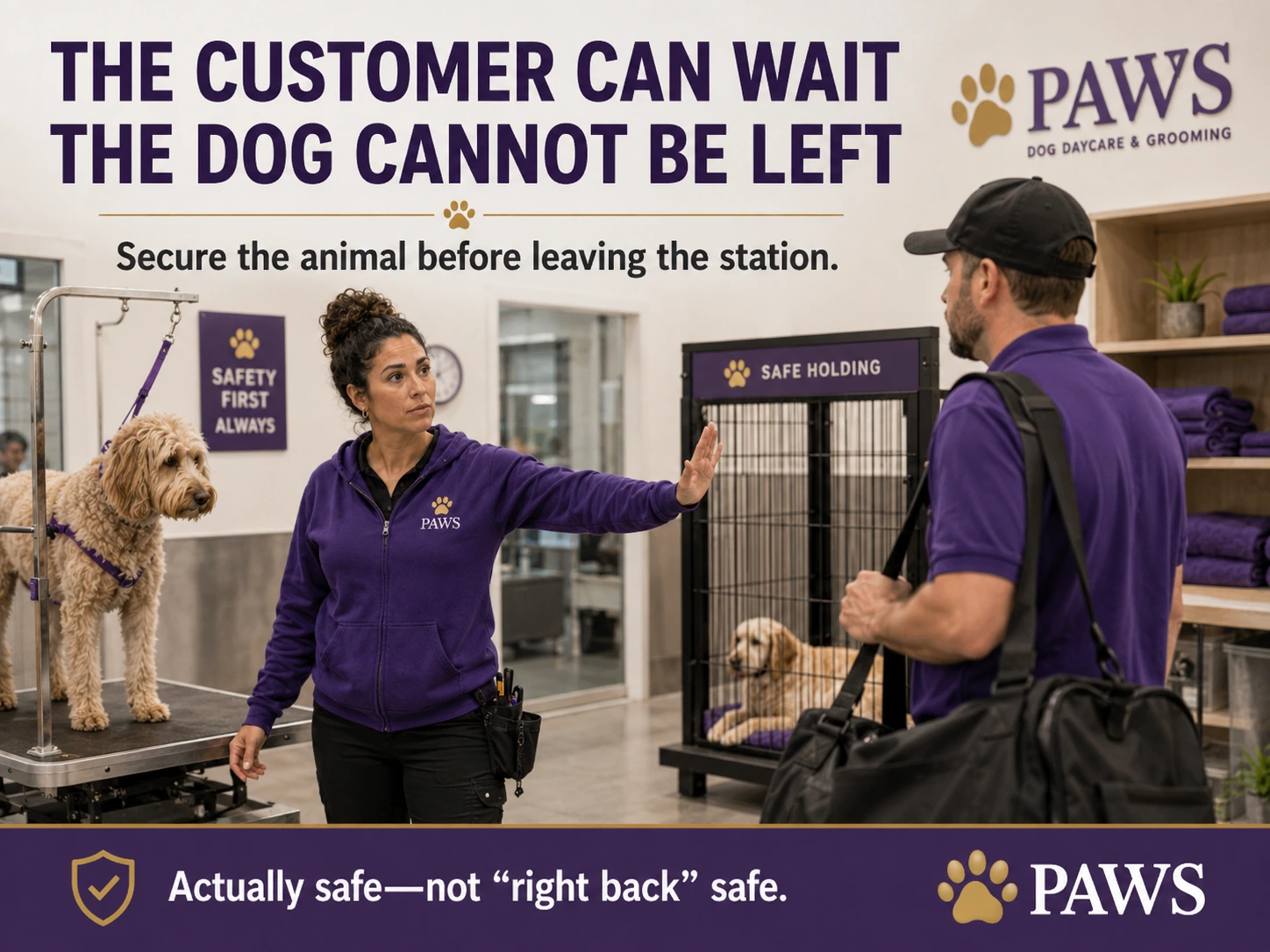
This also creates safety issues. Perhaps it is an extremely busy day and there are dogs being cage dried. In order to be safe, the groomer should shut off or check dryers according to facility policy and ensure that all animals are secured properly before leaving the station.
No dog should be left unattended on a grooming table. No dog should be left unattended in a tub. No dog should be left in an unsafe drying setup because the groomer had to walk to another part of the building to answer a customer question.
But the groomer is human. If he or she is being run ragged by having to stop what they are doing multiple times during the day to speak with customers in another part of the store, perhaps they forget. Perhaps they think, “I will only be gone for a second.” Perhaps the customer keeps talking. Perhaps the second turns into five minutes.
This sets the stage for an unattended dog to become overheated by a dryer, panic in a cage, hang or injure itself if it attempts to leap from a tub or table, or otherwise get hurt while unsupervised.
It is not uncommon for a groomer to spend five or ten minutes speaking with a customer. That is more than enough time for a dog left unattended in the wrong situation to die.
The facility should define what a safe pause actually means. The dog must be secured in an appropriate enclosure or otherwise placed in a condition allowed by facility policy, tools must be put down safely, dryers must be checked or managed, and another employee must understand the handoff when supervision is transferred.
That safe-pause procedure has to be followed even when the customer is standing at the counter waiting. The customer may be inconvenienced for a few minutes. The dog cannot be exposed to a preventable table, tub, restraint, dryer, or escape hazard because staff felt pressured to answer quickly.
⚠️
Hard safety line
If the groomer has to leave the grooming station, the dog has to be made safe first. Not mostly safe. Not “I will be right back” safe. Actually safe.
- Do not leave dogs unattended on grooming tables.
- Do not leave dogs unattended in tubs.
- Check, shut off, or manage dryers according to facility policy before leaving the grooming station.
- Secure the dog in an appropriate enclosure before leaving for a customer consult.
- Do not let customer conversations override animal safety.
- If the dog cannot be safely paused, the customer conversation waits.
📊
The Pedometer Case Study: When Bad Layout Becomes Payroll
This is what wasted motion looks like when you finally count it.
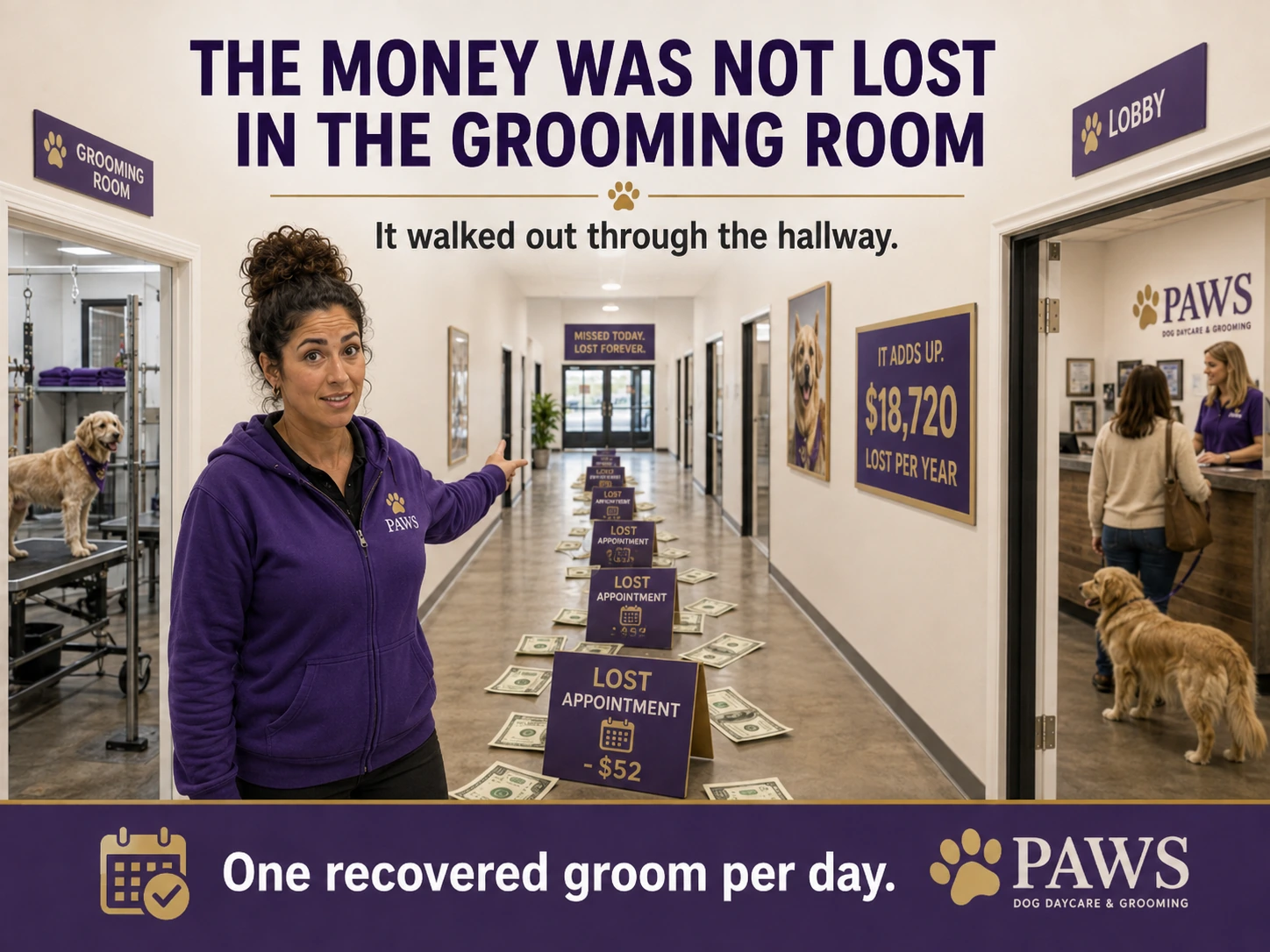
There is also the issue of stress and fatigue. In a facility we helped remodel, we placed a pedometer on the groomer before and after relocating the grooming room from the rear of the building to an area adjacent to the lobby.
What we found when we compared the results was that, on average, the groomer walked an additional mile and a half every day just going to and from the front to the rear of the building.
We also observed that prior to relocating the grooming room there was an average loss of 15 minutes of work time for each trip. She was forced to stop what she was doing, cage the dog she was working on, go up front to talk to the customer, then come back, take the dog she was working on back out, settle the dog, and start again.
In almost every case, she was never able to work from start to finish on a dog, typically a two-hour process, without at least one interruption. It became quite apparent that this was not only grossly inefficient, but extremely aggravating and tiresome for the groomer.
It also added around 18 minutes to the time needed to complete each dog.
A similar facility can run its own motion audit without expensive equipment. For one normal week, record every front-to-back trip, the reason for it, the time away from the station, and the time needed to restart the dog. The pattern will show whether the loss is being caused by room placement, customer consults, missing supplies, poor communication, or several problems stacked together.
Recovered time only becomes recovered revenue when the schedule is protected. Once the waste is removed, the business must use the capacity intentionally through better booking, bather support, realistic appointment timing, or fewer forced gaps. Otherwise the extra time will simply be consumed by a different interruption.
Swipe left/right to see the full table.
| Measurement | Observed Impact | Business Meaning |
|---|---|---|
| Extra walking | About 1.5 additional miles per day. | The groomer was burning energy walking instead of grooming. |
| Lost time per front/back trip | About 15 minutes of work time. | Stopping, securing, walking, talking, returning, and restarting all counted. |
| Added time per dog | About 18 minutes per groom. | Interruptions made each dog take longer than it should have. |
| Dogs groomed per day | 8 dogs. | Small delays multiplied across the full schedule. |
| Daily wasted time | 8 dogs × 18 minutes = 144 minutes, or 2.4 hours. | More than two hours per day disappeared into bad layout and interruptions. |
| Weekly wasted time | 2.4 hours × 6 days = 14.4 hours per week. | Nearly two full working days per week were being eaten by motion waste. |
| Conservative modern ticket | One additional groom per day at $55 = $330 per week. | $330 per week × 52 weeks = $17,160 per year. |
| Strong modern ticket | One additional groom per day at $60 = $360 per week. | $360 per week × 52 weeks = $18,720 per year. |
💵
The money lesson
By simply relocating the grooming room, we were able to save enough wasted time to groom an additional dog per day, which in turn generated the necessary revenue to help justify hiring a bather. At a $55 ticket, that recovered capacity is $17,160 per year. At a $60 ticket, it is $18,720 per year.
That is not some vague “efficiency improvement.” That is almost twenty thousand dollars a year walking back and forth through the building because the grooming room was put in the wrong damn place.
🐜
Economy of Motion: Stop Making Staff Walk Like Confused Ants
Economy of motion is not corporate nonsense. It is whether skilled people spend the day producing or wandering.
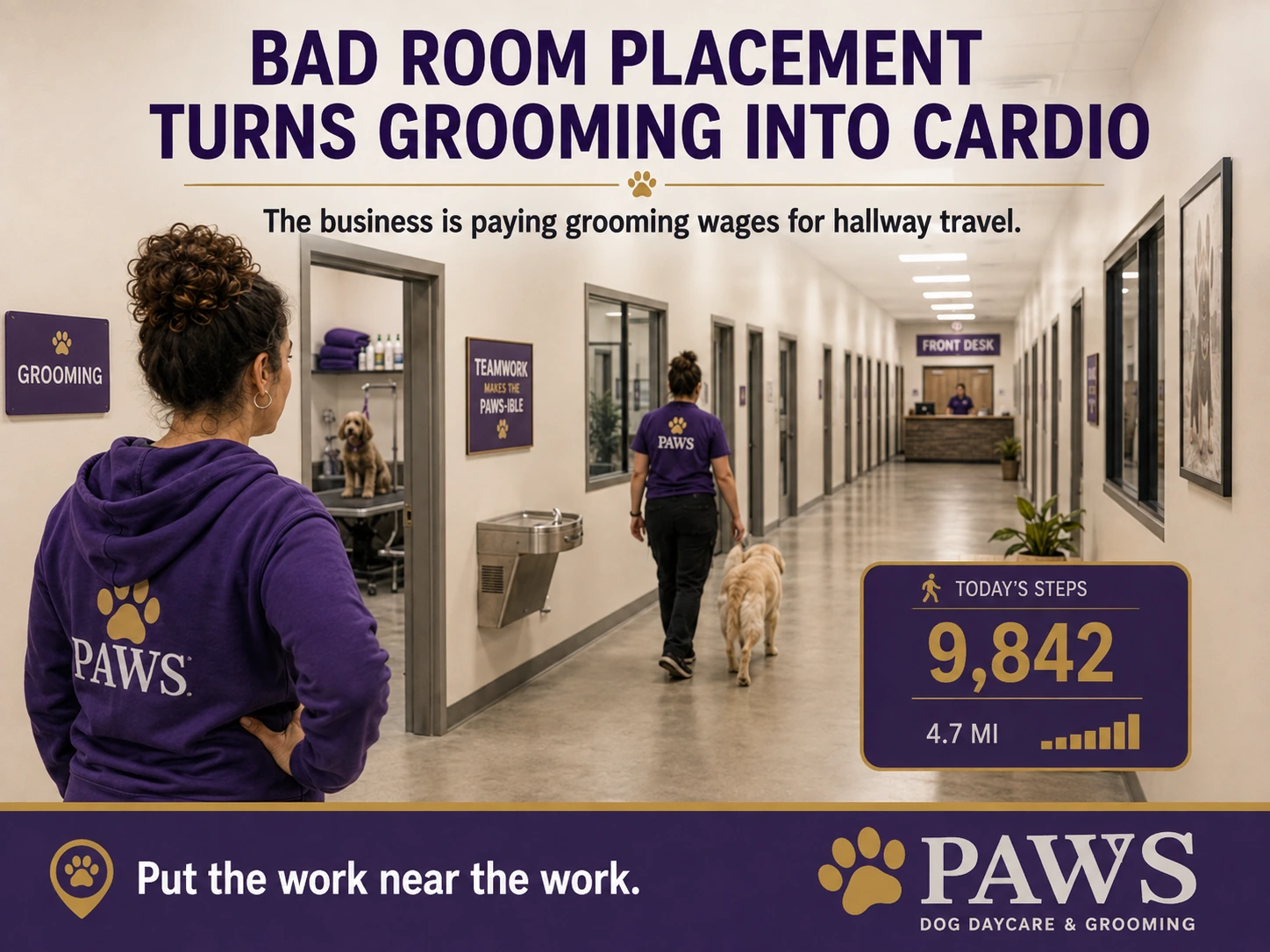
Economy of motion simply means the work should be located where the work actually happens. The tools should be where the tools are used. The staff should not have to cross the building repeatedly to answer normal customer questions. The groomer should not have to walk a mile and a half every day because the room was placed wherever it fit on a lazy floor plan.
In grooming, wasted motion is especially expensive because the groomer is not just walking away from paperwork. The groomer is walking away from a live animal, a schedule, tools, dryers, tables, tubs, and production time.
Every unnecessary walk creates a stop-and-restart penalty. Secure the dog. Leave the room. Talk to the customer. Walk back. Get the dog back out. Settle the dog. Restart the groom. Rebuild the rhythm. Lose a few more minutes. Do that enough times and you do not have a small inconvenience. You have a business leak.
A badly placed grooming room is not just farther away. It is a money leak with a door.
Measure the path instead of guessing. Count how many times the groomer leaves the room, how long each interruption lasts, and how much restart time follows. The visible walk may take only a few minutes, but securing the dog, answering the question, returning, resetting the station, and settling the dog can make the real loss much larger.
Sometimes the fix is a major room relocation. Sometimes it is a smaller operational change such as a consult point closer to grooming, a viewing window, a front-desk intake form, or a scheduled handoff period. The correct solution is the one that removes repeated motion without weakening supervision or customer trust.
⚠️
Motion warning
If your groomer spends the day walking to the front, the business is paying grooming wages for hallway travel.
🏗️
What Better Grooming Room Placement Looks Like
The grooming room should be accessible enough to support customer trust and controlled enough to protect the work.
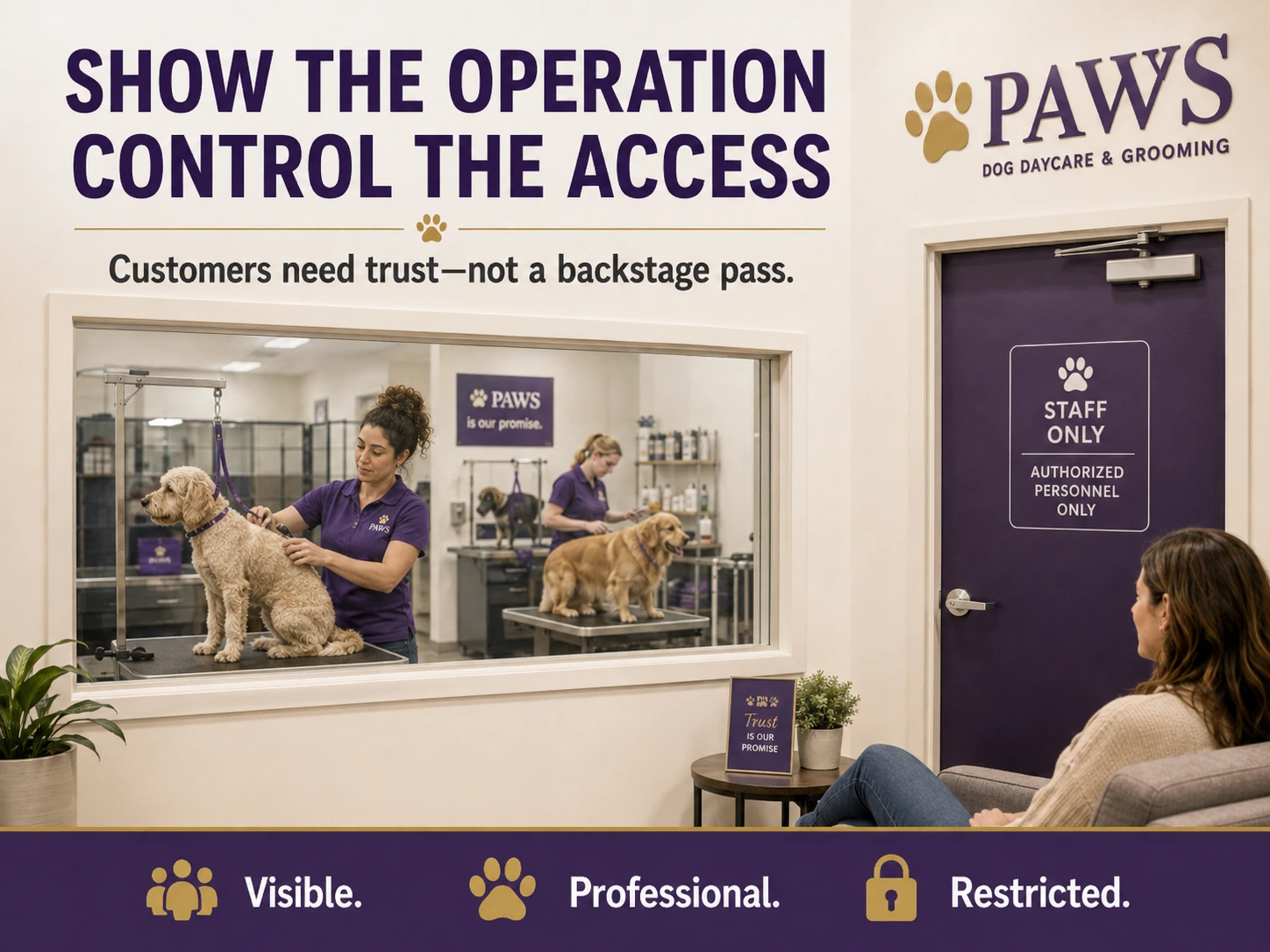
The answer is not automatically to put grooming in the middle of the lobby like some kind of wet dog theater. That creates its own problems: noise, hair, water, smell, customer distraction, dog excitement, and staff feeling like they are working in a fishbowl.
The better answer is controlled access and smart placement.
In many facilities, grooming should be close to the lobby or adjacent to the customer path, but still separated enough to control water, noise, hair, dryer sound, dog movement, and staff workflow. The customer should be able to understand that grooming is clean, professional, and real without needing to march through every working area in the building.
A good grooming-room location should allow quick consults, easy handoff, front-desk communication, safe dog movement, controlled visibility, and minimal wasted walking. The groomer should be able to speak with a customer without turning every conversation into a cross-building expedition.
Test the proposed location during the busiest parts of the day, not when the building is empty. Walk the customer path, the dog handoff path, the groomer path, the front-desk path, and the route used for boarding and daycare movement. A room that looks convenient on a floor plan may still place customers, wet dogs, staff, and active dog traffic in conflict.
Controlled visibility also requires a boundary. A window, half wall, consult point, or nearby door can show customers that the operation is clean and professional while still making it obvious that the grooming room is a staff work area. Visibility should reduce the need for access, not become an invitation to enter.
- Place grooming close enough to the lobby for controlled customer consults.
- Keep grooming separated enough to control noise, hair, water, smell, and dog excitement.
- Avoid customer paths that run through active daycare, boarding, or dog-movement zones.
- Create a designated consult point so groomers are not dragged across the building.
- Use controlled visibility, not uncontrolled customer access.
- Make sure dogs can be safely secured before the groomer steps away.
- Keep front-desk communication simple so staff are not playing hide-and-seek with the groomer.
📋
Tour and Groomer Consult Policy
Customer access should be controlled by policy, not improvised while dogs are moving.
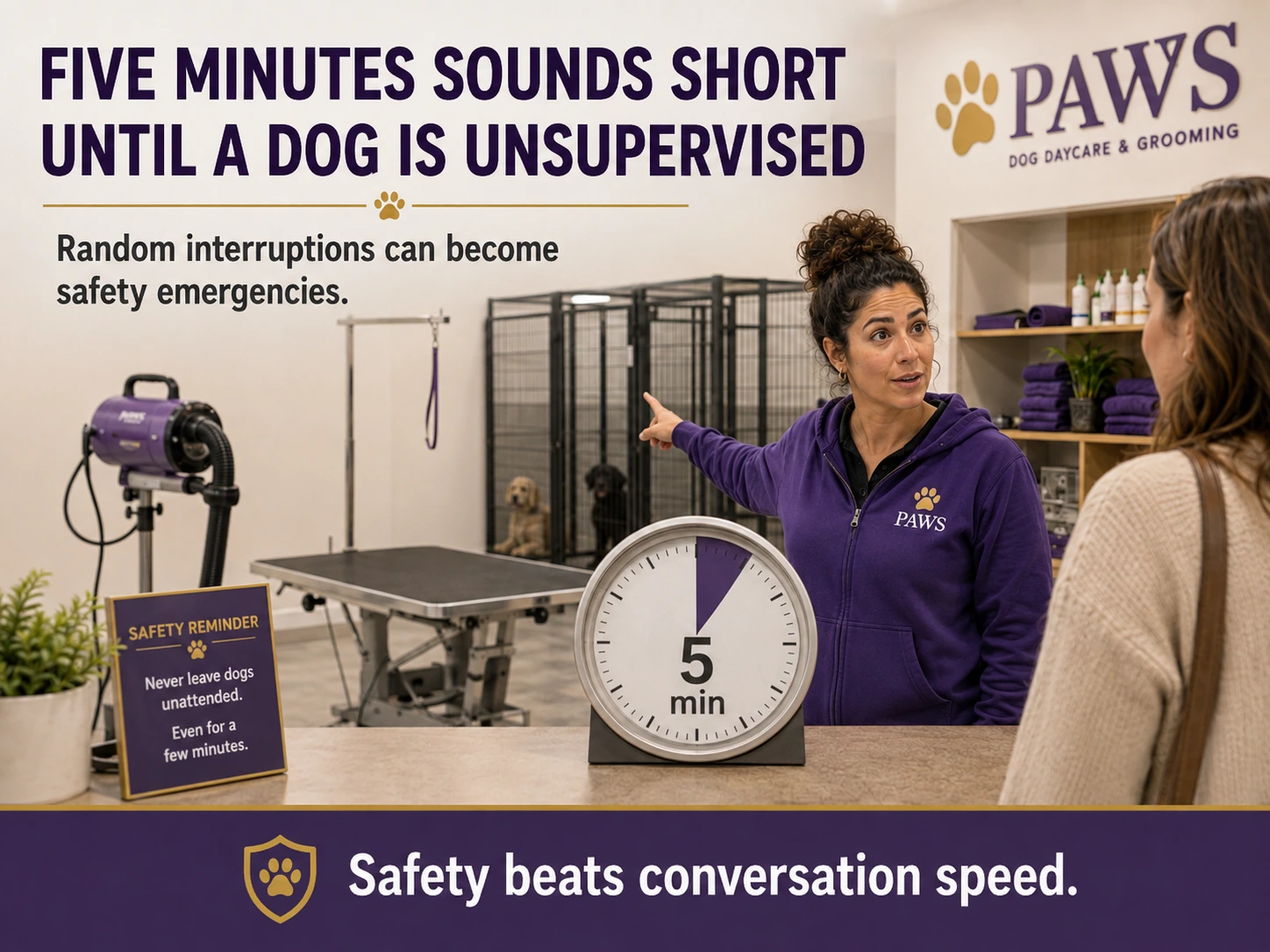
Tours and groomer consults are not bad. They can build trust, answer questions, prevent misunderstandings, and help customers feel comfortable leaving their dog.
The problem is unmanaged access. Customers should not be walking into active dog-care areas without warning. Groomers should not be pulled away from dogs without securing them. Kennel staff should not find out a tour is coming when a stranger suddenly appears behind them. The back of house should not have to guess whether a customer is about to appear in the middle of dog movement.
The facility needs rules. Not complicated rules. Useful rules.
The policy should state who approves access, where the customer waits, who escorts the customer, which areas are off limits, and what conditions stop or delay the tour. It should also make clear that the groomer does not leave an animal until the dog has been placed in a safe pause condition.
Grooming instructions should be documented during the consult so the same conversation does not have to be repeated later. A short written record of coat length, problem areas, behavior concerns, requested services, and customer expectations protects the groomer, the front desk, and the customer from relying on memory after a busy handoff.
Swipe left/right to see the full table.
| Situation | Bad Version | Better Policy |
|---|---|---|
| Customer asks for tour during check-in rush | Front desk leaves the lobby and drags customer through active dog movement. | Schedule the tour or wait until back of house confirms it is safe. |
| Customer wants to see grooming room | Customer walks into grooming while dogs are on tables, in tubs, or drying. | Use controlled viewing, scheduled access, or a safe consult point. |
| Customer wants groomer conversation | Groomer walks to the front repeatedly and restarts dogs all day. | Use a designated consult process and time-boxed handoff. |
| Groomer is actively working on a dog | Groomer leaves the dog “for just a second.” | Dog must be safely secured before the groomer leaves the station. |
| Back of house is not ready | Customer sees chaos, dogs get startled, staff scramble. | Tour waits. Safety beats speed. |
💬
Front desk wording
“We are happy to show you the facility when it is safe to walk through. Let me check with the back first so we are not interrupting dog movement or grooming work.”
✅
Grooming Room Placement Checklist
Use this before deciding that “the back room will be fine.”
- Can the groomer speak with customers without crossing the entire building?
- Can the front desk reach the groomer quickly without abandoning the lobby?
- Can customers see enough cleanliness and professionalism to build trust without entering working zones?
- Is there a safe place for a groomer to secure a dog before stepping away?
- Can dryers, tubs, tables, and cages be monitored properly?
- Does the tour route avoid active daycare play areas, dog-transfer paths, and boarding movement?
- Does the layout reduce unnecessary staff walking?
- Does the grooming room support controlled customer consults?
- Does the room placement protect grooming production instead of interrupting it all day?
- Would the layout still work during check-in rush, checkout rush, boarding movement, and multiple grooming arrivals?
⚠️
Layout warning
A floor plan can look efficient on paper and still be stupid in real life. Walk the actual customer path, dog path, groomer path, and staff path before deciding the room location works.
❓
Grooming Room Placement and Facility Tour FAQ for Pet Care Operators
Detailed operator answers about customer tours, grooming consults, room placement, wasted motion, supervision, and the cost of stopping production.
Should customers be allowed to tour the facility?
In many cases, yes, but tours should be controlled rather than granted automatically. A customer wanting to see where a dog will stay, play, or be groomed is reasonable. Staff should first confirm that dog movement is paused, active grooming work is safe, the route is clear, and someone is available to escort the customer without abandoning another responsibility.
Why should tours not be given at any time?
The back of a pet care facility is an active animal-care environment, not an open showroom. Dogs may be moving between play areas, boarding suites, potty areas, grooming, and the lobby. An unscheduled visitor can startle dogs, interrupt staff, block transfer paths, delay other customers, and force employees to secure animals before the tour can proceed.
Is it rude to make a customer wait for a tour?
No. The delay should be explained as a safety requirement, not as an inconvenience the business resents. The front desk can tell the customer that staff are happy to provide a tour once the back confirms the route is safe. That response shows that the facility controls access instead of letting customer pressure override dog handling.
What should the front desk say when a tour cannot begin immediately?
A useful response is: “We are happy to show you the facility when it is safe to walk through. Let me check with the back first so we are not interrupting dog movement or grooming work.” The wording acknowledges the request, gives a clear reason for the wait, and keeps the front desk from promising access before the working areas are ready.
Why does grooming-room location matter so much?
Grooming customers often want to speak with the person who will actually work on the dog. When the room is buried in the back, every normal question can require the groomer to stop, secure the dog, walk to the lobby, talk, return, reset the station, and settle the dog again. That repeated stop-and-restart cycle reduces production and creates more opportunities for a safety shortcut.
Should the grooming room be visible to customers?
Controlled visibility can build trust because customers can see that the room is real, clean, organized, and professionally operated. Visibility does not mean customers should have unrestricted entry. A viewing window, nearby consult point, or controlled doorway can provide reassurance while keeping active dog-care space restricted to staff.
Is a viewing window enough by itself?
Not always. The window helps, but the facility still needs a front-desk explanation, a consult process, and rules about when a customer may speak with the groomer. If customers can see the room but still have to interrupt the groomer for every detail, the layout has improved appearance without fully fixing the workflow.
Why is walking such a serious grooming cost?
The walk is only the visible part of the loss. Before leaving, the groomer must place the dog in a safe condition. After returning, the groomer may need to retrieve the dog, calm it, reset tools, reestablish handling, and rebuild the work rhythm. A few minutes of hallway travel can therefore create a much longer production interruption.
How should a groomer consultation be handled?
Use a designated consult point and a controlled handoff process. The front desk should collect routine information first, and the groomer should address the issues that require professional judgment. The dog being worked on must be safely secured before the groomer leaves, and the final instructions should be documented so the conversation does not have to be reconstructed later.
What information should the front desk collect before interrupting the groomer?
The front desk can document the requested service, preferred coat length, matting or coat concerns, behavior warnings, prior grooming problems, pickup expectations, and any areas the customer wants handled carefully. This gives the groomer a focused starting point and prevents a routine intake from becoming an open-ended conversation while another dog waits.
What if the dog cannot be safely paused for a customer conversation?
The customer waits. A groomer should not leave a dog on a table, in a tub, in an unsafe drying arrangement, or in any other condition that requires direct supervision. Customer service does not require the business to create an avoidable animal-safety hazard.
Can a dog remain on the grooming table during a quick front-desk conversation?
No dog should be left unattended on a grooming table. The phrase “I will only be gone for a second” does not control how long the customer talks, whether another issue appears in the lobby, or how the dog reacts while the groomer is away. The dog must be placed in an appropriate safe condition before the groomer leaves the station.
How should dryers be handled before the groomer steps away?
The groomer should follow the facility’s written dryer and supervision policy before leaving the area. That may require checking the dog, shutting off or adjusting equipment, confirming the enclosure is safe, and transferring supervision to another trained employee. The important point is that the dryer setup cannot be ignored because the interruption is expected to be brief.
How can an operator measure the cost of the current layout?
Run a motion and interruption audit for a normal week. Record each trip between grooming and the lobby, why it happened, how long the groomer was away, and how much time was required to restart the dog. The resulting pattern will show whether the main loss comes from room placement, customer consults, missing supplies, poor communication, or several causes working together.
Can bad grooming-room placement really cost thousands of dollars per year?
Yes. On the page’s example, adding 18 minutes to each of eight dogs creates 144 minutes of lost time per day. Across a six-day week, that becomes 14.4 hours. Recovering enough capacity for one additional groom per day produces $17,160 per year at a $55 ticket or $18,720 per year at a $60 ticket.
Where should the grooming room be located?
The best location depends on the building, but the room should usually be close enough to the customer path for efficient handoffs and controlled consults. It should still be separated enough to manage noise, hair, water, smell, dryers, dog excitement, and staff workflow. The goal is convenient communication without turning grooming into a public pass-through area.
What can an existing facility do when the grooming room is already buried in the back?
Start by measuring the interruption pattern before assuming a full remodel is the only answer. A closer consult point, controlled viewing, scheduled groomer conversations, better front-desk intake, radios, written instructions, or a revised handoff route may remove part of the waste. If those changes do not solve the repeated motion, relocation may be financially easier to justify with real time and revenue data.
Should facility tours be scheduled?
Scheduled tours are often easier to control because staff can avoid peak check-in, checkout, feeding, dog-transfer, and grooming periods. The facility may still allow some same-day tours when conditions permit, but the front desk should never promise immediate access without confirmation from the back of house.
How long should a grooming consultation last?
There is no single correct number, but the consult should be long enough to capture the instructions that affect the dog and the finished groom, then end before it becomes an uncontrolled life history. A prepared intake form, reference photos, and focused questions help the groomer obtain useful information without allowing every handoff to consume production time.
What is the main operating lesson?
Normal customer requests should not break the operation. Customers will ask for tours, reassurance, and access to the groomer. The building, staffing plan, scripts, and safety rules should make those requests manageable without leaving dogs unsecured, stopping the back of house, or paying skilled grooming wages for repeated hallway travel.
🐾
Bottom Line: Design the Building So Normal Customer Questions Do Not Break the Machine
Trust matters. Tours matter. Groomer conversations matter. But none of them are free.
Customers are going to ask to see the facility. They are going to ask where the dog goes. They are going to want reassurance. Grooming customers are going to want to talk to the person actually working on their dog. None of that is strange.
The mistake is pretending those requests do not cost anything.
A tour can slow the back of house. A groomer consult can stop production. A bad grooming-room location can make skilled staff walk an extra mile and a half per day. A five-minute conversation can become a safety issue if a dog is not properly secured. A room buried in the back can turn every customer reassurance moment into wasted motion, and in the example above that wasted motion can represent $17,160 to $18,720 a year from one recovered groom per day.
Grooming can be a strong business inside a dog daycare or boarding facility, but it has to be designed like a real business unit. Room placement, customer access, consult flow, dryer safety, staff motion, and production time all matter.
The groomer is walking. The dog is waiting. The dryer is paused. The customer is talking. The schedule is slipping. The money is leaving. And all of it may have started because the grooming room was put in the wrong damn place.