Pricing, Market Research, and Revenue Discipline
Dog Daycare Prices: How to Set Rates That Actually Work
Your price is not a guess, a wish, or whatever number makes you feel competitive. It is one of the main things deciding whether the business survives.
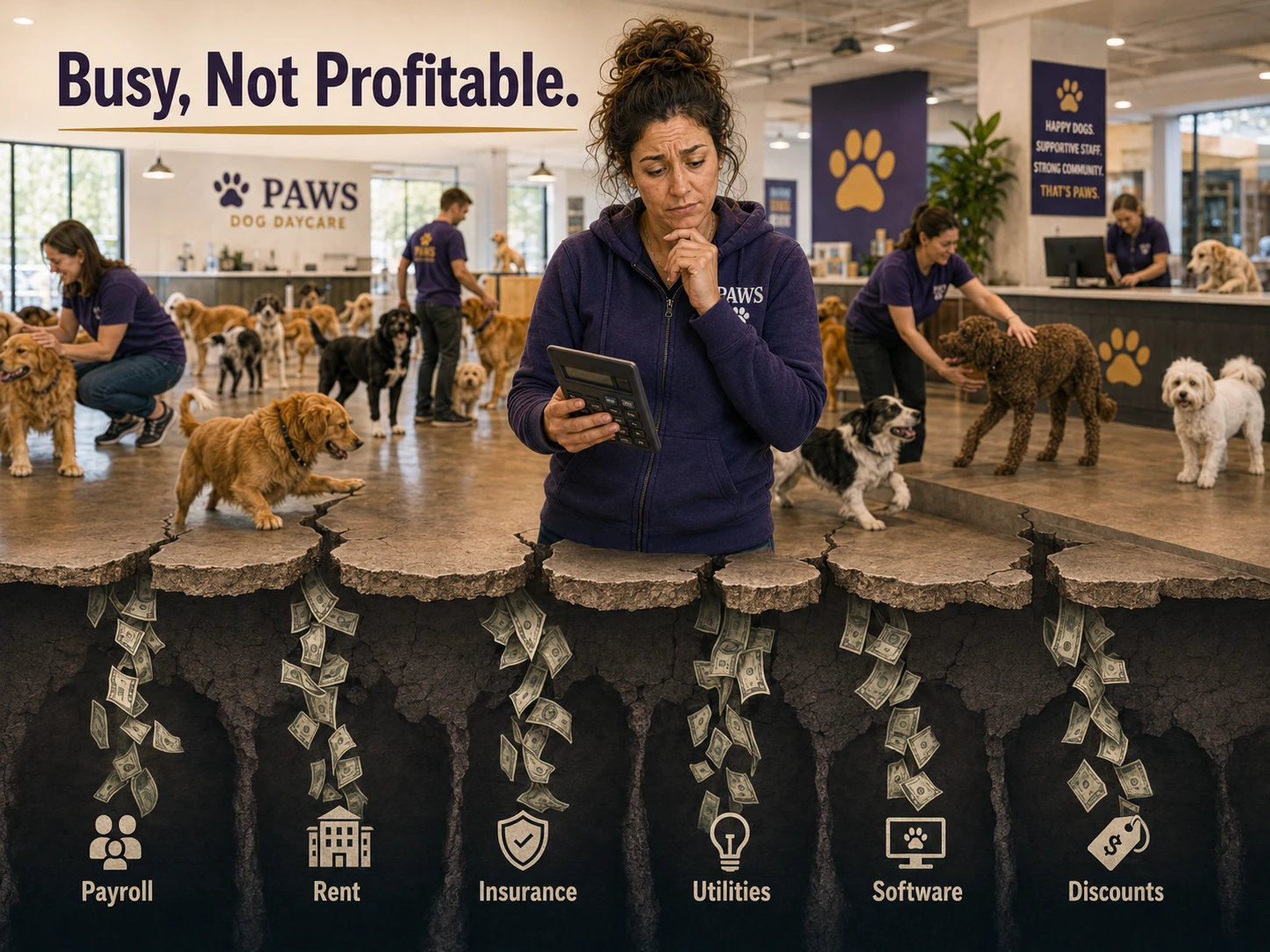
Setting dog daycare prices is one of those decisions new owners like to oversimplify. They look at one competitor, shave a few dollars off the rate, and tell themselves customers will come running because they are “more affordable.” That may sound clever on paper, but it can be a fast way to build a busy business that still does not make enough money.
The real pricing question is not just, “What should I charge?” That is the surface question. The better question is, “Can the price this market will support produce enough real collected revenue to keep this specific daycare alive?”
That distinction matters. A posted price is the number on the wall. Realized revenue is the money that actually lands in the bank after packages, memberships, discounts, free days, add-ons, and customer behavior get done chewing on it. If you post $35 but collect $31.75 on average, you are not running a $35 daycare day. You are running a $31.75 dog-day with a prettier sign.
Pricing goes back to solid research, doing your homework, understanding your local demographics, knowing your survival floor, and being honest about the type of facility you are actually building. A facility in an upper-income commuter corridor can often charge differently than a facility tucked behind auto shops in an industrial strip, even if the two buildings are only a few miles apart.
People will pay more for convenience, trust, cleanliness, professionalism, location, safety, and a facility that feels like it knows what it is doing. They will not always pay more just because you spent too much money on build-out. Customers do not care that your rent is high because you got excited and signed a bad lease.
⚠️
Operator warning: cheap prices are not automatically smart prices.
A low price can help get customers in the door, but if the number does not support payroll, rent, insurance, utilities, cleaning, repairs, software, taxes, debt, and a reasonable profit, you are not building a business. You are subsidizing other people’s dog care until your bank account gets tired.
🗺️
Use This Page Like a Pricing Workbook
Pricing is not one number. Work through the survival floor, quick ballpark, market-supported retail price, realized revenue, and final price gate in the right order.
🧠
Pricing Mindset
Start with the hard truth: price is not what you post. Price is what you actually collect.
🧱
Survival Floor
Find the minimum average revenue per paid dog-day the business needs before it can breathe.
🧮
Quick Ballpark
Use trade-area household income to get a napkin-number starting point before the deeper math begins.
🌎
Market-Supported Price
Estimate what the market can probably bear without handing the whole advanced model away for free.
💵
Realized Revenue
Packages, memberships, discounts, and add-ons decide what you actually collect.
📊
PAWS Price Gate
Compare realized revenue against the survival floor. If it fails, the model needs fixing.
🧾
Method Proof
See why the pricing method works as a diagnostic instead of spreadsheet theater.
🌎
Market Reality
National averages are guardrails, not marching orders. Local reality still gets a vote.
🔎
Competitor Research
Know what other facilities charge, but do not blindly copy them.
📋
Competitor Worksheet
Collect full-day, half-day, package, membership, discount, fee, and add-on pricing.
🏘️
Demographics
Income, household type, commute patterns, and lifestyle matter more than wishful thinking.
📍
Location Reality
A good location can support stronger pricing. A bad one can punish even a beautiful facility.
💳
Modern Overhead
Software, payment fees, cameras, payroll tools, reviews, SMS, and digital records are part of modern daycare pricing.
🐕
Capacity Math
The right price depends on how many dogs you can safely and profitably handle.
📦
Packages
Full-day rates, half-day rates, memberships, packages, and add-ons should support the business model.
📈
Raising Rates
If your costs rise and your prices never move, the business quietly gets weaker.
🧠
Pricing Is Not What You Charge. It Is What You Collect.
Posted price is the easy part. Collected revenue is where the business either works or starts coughing blood.
The lazy way to price dog daycare is to call three competitors, pick a number somewhere in the middle, and move on. That is better than nothing, but it is not enough if you are trying to build a real business. You need to understand what the business needs, what the market supports, what customers actually pay after packages and discounts, and whether the final collected number clears your survival floor.
A dog daycare price has to do several jobs at the same time. It has to be acceptable to the customer. It has to match the value of the service. It has to fit the neighborhood and commute pattern. It has to support the staff required to supervise dogs safely. It has to cover the boring expenses nobody wants to think about. It has to leave enough margin that the owner is not just buying themselves a stressful job.
If your price is too high for the market, customers may never give you a chance. If your price is too low, they may love you right up until you cannot afford to stay open. Neither one is smart. The goal is not to be the cheapest. The goal is to be priced correctly for the market, the service, the facility, and the financial reality.
📌
Operator rule
The formula is not really asking, “What should I charge?” It is asking whether the price this market will support can produce enough real collected revenue to keep this specific daycare alive.
🧱
Step 1: Calculate the Survival Floor
Before you care what the market might pay, you need to know what the business must collect per paid dog-day to stay alive.

The workflow starts with the survival floor because it answers the first and most important question: what does the business need per paid dog-day to stay alive?
Before you care what the market might pay, you need to know what the business must collect. Otherwise, you are just pricing emotionally. That is how people end up with a busy lobby, tired staff, happy customers, and a bank account that looks like it was attacked by raccoons.
The survival floor is not the price you want. It is not the price the market likes. It is not the price that looks cute on your website. It is the minimum average collected revenue per paid dog-day the business needs before it can breathe.
🧾
Survival Floor Formula
Survival Floor = Fixed Monthly Costs ÷ (Safe Dog Capacity × Open Days Per Month × Realistic Utilization) + Variable Cost Per Dog-Day
| Survival Floor Input | What It Means | Operator Warning |
|---|---|---|
| Fixed Monthly Costs | Rent, payroll base, insurance, utilities, software, repairs, debt, admin, taxes, and owner draw target. | These costs do not disappear because attendance is light. |
| Safe Dog Capacity | The number of dogs the facility can safely handle with proper staffing and supervision. | This is not the number of dogs you can physically cram into the building. |
| Open Days Per Month | Usually around 20–26 days depending on your schedule. | More open days can create more revenue, but they also create more labor and wear. |
| Realistic Utilization | Expected attendance percentage, not fantasy full capacity. | If your plan only works when every spot is full every day, your plan is weak. |
| Variable Cost Per Dog-Day | Cleaning, supplies, waste, laundry, payment fees, incremental labor, wear, and dog-related consumables. | More dogs create more cost. Do not pretend they are free after the door opens. |
Survival Floor Example
Suppose the facility has $22,000 in fixed monthly costs, a safe capacity of 50 dogs, 22 open days per month, 70% realistic utilization, and $4 in variable cost per dog-day.
Paid Dog-Days = 50 dogs × 22 days × 70% utilization = 770 paid dog-days
$22,000 fixed monthly costs ÷ 770 paid dog-days = $28.57 fixed-cost load per dog-day
$28.57 + $4 variable cost = $32.57 survival floor
That means this business must collect about $32.57 per paid dog-day to work.
Not charge.
Collect.
That distinction matters because packages, memberships, discounts, and free days can drag the real collected number below the posted price. A daycare that posts $35 but collects $31.75 on average is not beating a $32.57 survival floor. It is standing there with a smile on its face while the floorboards get soft.
A $22,000/month owner-operated facility can make ordinary daycare pricing work if capacity, utilization, staffing, and service mix are disciplined. A $35,000/month facility has a very different problem. At the same 50-dog capacity, 22 open days, 70% utilization, and $4 variable cost, the survival floor jumps to about $49.45 per dog-day. That is no longer ordinary pricing territory. That is premium pricing, higher utilization, stronger add-ons, lower costs, or a business model that needs to be rebuilt before it eats the owner alive.
| Fixed Monthly Cost | Survival Floor | Operator Translation |
|---|---|---|
| $15,000 | $23.48 | Bare-bones owner-operated or low mortgage model. Possible, but thin. |
| $18,000 | $27.38 | Lean owner-operated model. Ordinary pricing may work if discipline is strong. |
| $22,000 | $32.57 | Practical owner-operated planning average. This fits ordinary daycare pricing much better. |
| $25,000 | $36.47 | Owner-operated with cushion. A $35 price starts getting tight unless add-ons or utilization help. |
| $30,000 | $42.96 | Manager/front-desk/staffed model. Now the business needs stronger pricing or better revenue mix. |
| $35,000 | $49.45 | Premium, heavily staffed, high-cost, or manager-run territory. Ordinary $35 daycare pricing will not carry this without help. |
🛑
Do not price below your survival floor just because the market is cheap.
If the local market will not support a price that covers the real cost of safe, clean, staffed dog care, the answer may not be “charge less.” The answer may be “this location, model, lease, or market does not work.”
🧮
Step 2: Use the Quick Ballpark Price
This is the fast first-pass number. It is useful, but it is not the whole pricing machine.
The simplest way to get oriented is to take the median household income of your real customer trade area and divide it by 2,000. This gives you a rough full-day daycare price tied to local buying power.
Quick Ballpark Price = Trade-Area Median Household Income ÷ 2,000
This is not the final price. This is the napkin number. It tells you whether you are somewhere near reality or already wandering into the weeds with a flashlight and bad math.
This quick method is useful because it gets you in the neighborhood fast. But it is too straight-line for serious pricing. Low-income markets still have a category floor because staffed daycare cannot be run for pocket change. High-income markets do not automatically let you charge $90 just because the spreadsheet got excited.
Use this number to get oriented. Then you run the real workflow: survival floor, market-supported retail price, realized revenue, and the PAWS Price Gate.
| Trade-Area Median Household Income | Quick Ballpark Price | Operator Translation |
|---|---|---|
| $50,000 | $25.00 | The math gives a low number, but real staffed daycare still has a category floor. |
| $70,000 | $35.00 | A practical middle-market starting point, depending on competition, location, and cost floor. |
| $90,000 | $45.00 | Often a believable starting point for stronger suburban or commuter markets. |
| $110,000 | $55.00 | Higher-income market signal, but the service still has to earn the number. |
| $140,000 | $70.00 | Now you need to be careful. The market may be affluent, but the competitor band and customer value still have to agree. |
📌
Operator rule
The quick ballpark tells you the neighborhood. The PAWS Price Gate tells you whether the business can survive in that neighborhood.
🌎
Step 3: Estimate the Market-Supported Retail Price
This is the posted full-day price the market may support if the facility, location, demand, and service quality justify it.
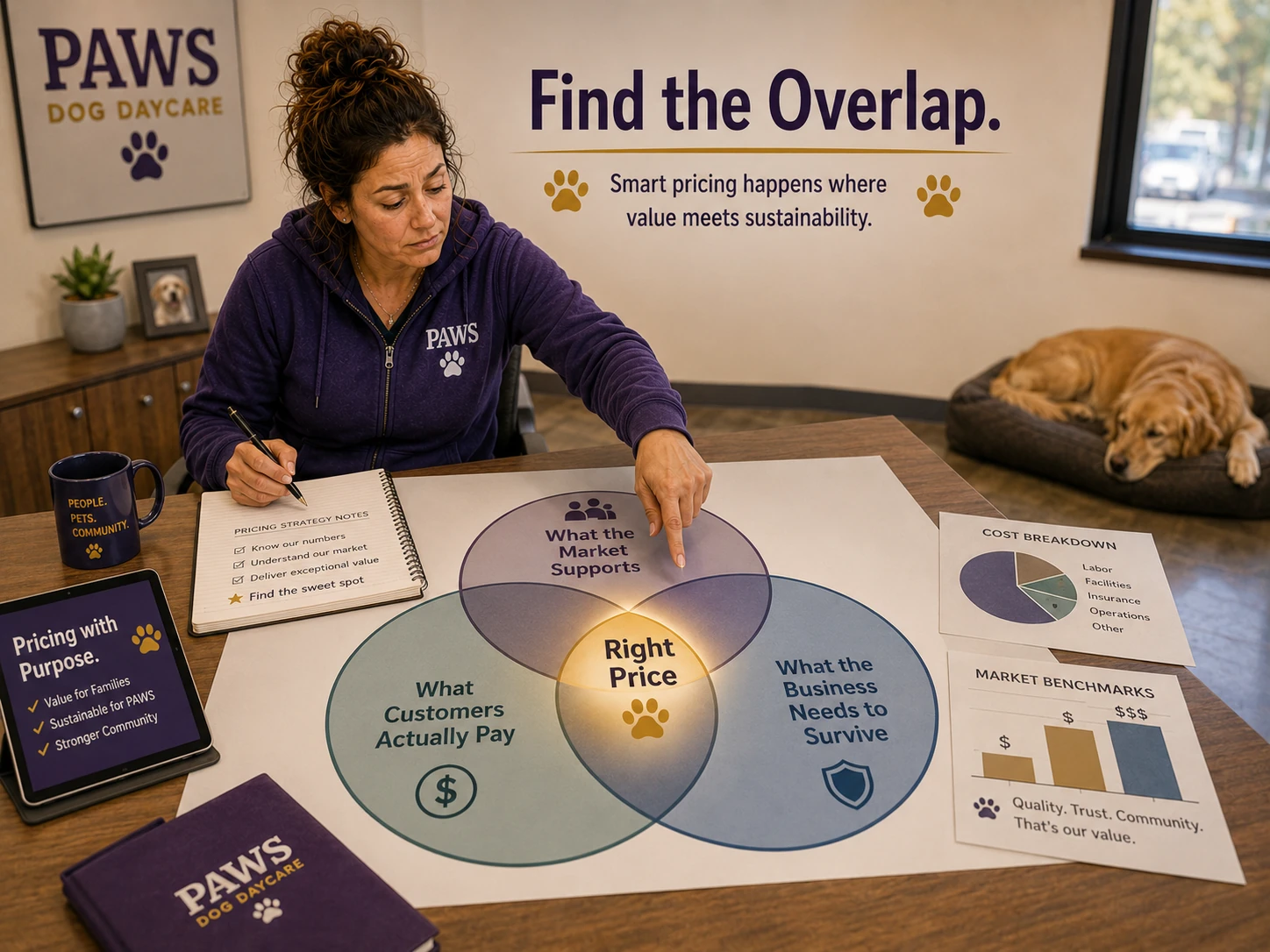
Once you know the survival floor and the quick ballpark, you can work on the market side. This asks a different question: what can this market probably bear as a posted full-day retail price?
This is where the full PAWS model gets more advanced. It uses a compressed income curve and multiple market modifiers instead of pretending household income moves in a perfect straight line forever. That matters because dog daycare has a floor, a ceiling, and a lot of messy local-market pressure in between.
I am not going to turn this free page into a giant wall of scoring tables. That belongs in a calculator, spreadsheet, web app, or full manual. But the idea is simple enough to understand: income gives you the base, then local reality pushes the retail price up or down.
Demand Density
How large and compact is the realistic customer area around the facility? Raw population is not enough. Usable demand is what matters.
Operating-Cost Pressure
How expensive is it to survive as a staffed animal-care business in this market? Rent, wages, insurance, utilities, and regulation matter.
Buyer-Pool Correction
Does the actual customer area have more or less buying power than the city median suggests? Do not price off the mayor’s city boundary.
Market Composition
College towns, hospital districts, military bases, tourist markets, tech corridors, and state capitals can distort the buyer pool.
Commuter Convenience
A daycare on the customer’s life path can charge more than a daycare buried behind warehouses and a tire shop.
Format and Quality Proof
A basic facility daycare, structured professional daycare, pet resort, and luxury high-touch model are not the same product.
Market Velocity
If competitors are full at $45, $45 may be too low. If competitors are empty at $35, $35 may be too high.
Competitor Band
Customers compare you against what they can actually buy nearby. You do not need to copy competitors, but you do need to know the field.
Customer Value
Premium pricing requires premium proof. Not nice paint. Proof.
🧠
Operator rule
The advanced model is not “what number makes me happy?” It is a structured way to ask whether the local market, facility format, buyer pool, convenience, and proof of quality can support the posted retail price.
💵
Step 4: Convert Posted Price Into Realized Revenue
The posted price is the sign on the wall. Realized revenue is the money that actually hits the bank.
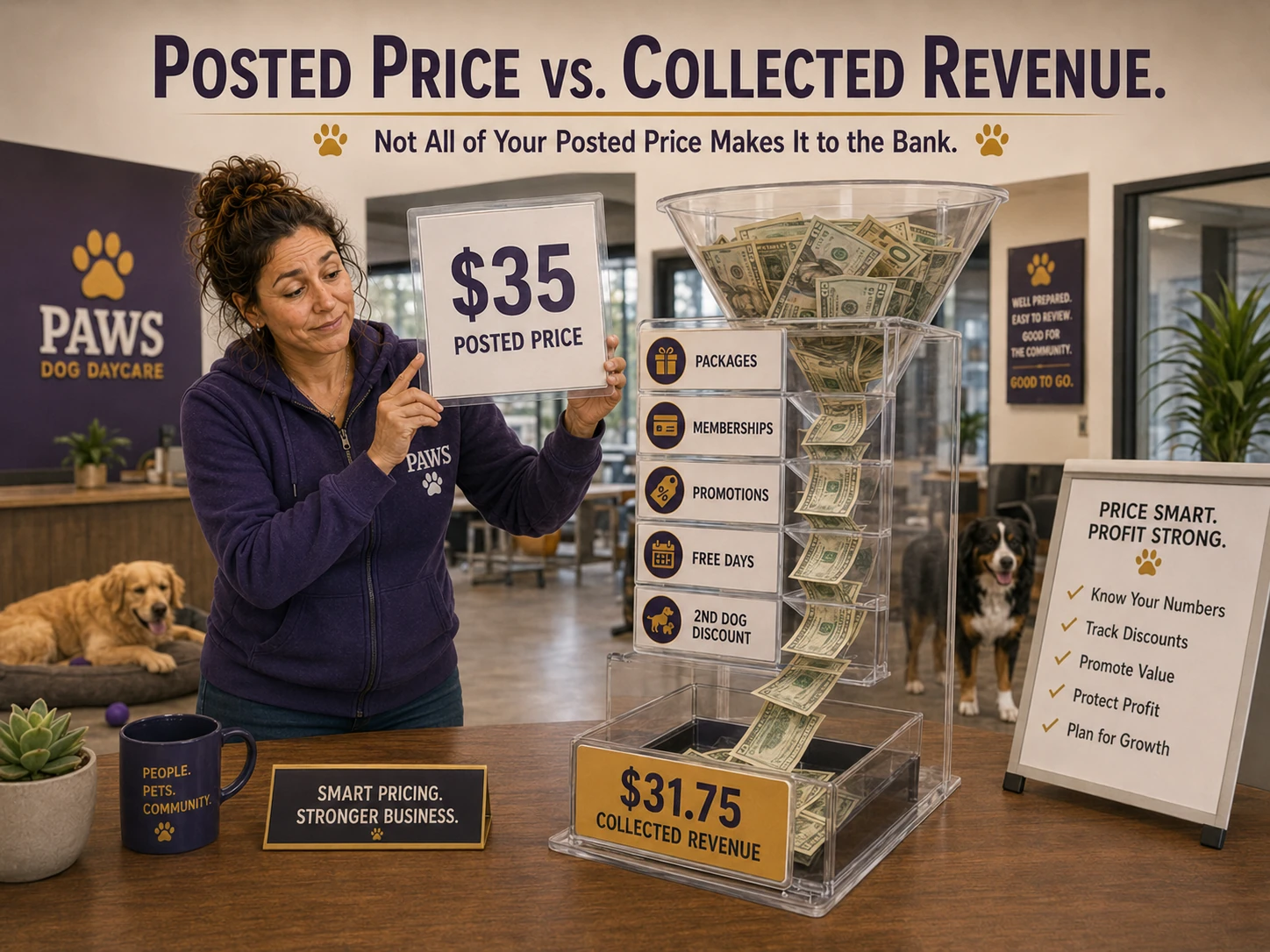
This is where pricing gets real. A lot of daycare owners brag about the posted rate and then ignore the fact that their packages, memberships, promotions, second-dog discounts, free trial days, and unlimited plans drag the actual collected revenue down.
A $35 retail price does not mean the business collects $35 per dog-day. If customers mostly buy discounted packages or memberships, the average collected number may be much lower. Add-ons can help bring that number back up, but only if customers actually buy them.
🧾
Realized Revenue Formula
Realized Revenue Per Dog-Day = Posted Retail Price × Service Mix Factor + Average Add-On Revenue Per Dog-Day
| Service Mix Pattern | Typical Service Mix Factor | What It Means |
|---|---|---|
| Mostly drop-in retail, light packages | 0.95–1.00 | Most customers are paying close to posted price. This is clean, but not always realistic once packages become popular. |
| Normal package use | 0.88–0.94 | This is common for a practical daycare. The posted price and collected price are close, but not identical. |
| Heavy package or membership use | 0.80–0.87 | The posted price and collected price are starting to separate. This can quietly eat a $35 price alive. |
| Unlimited or monthly model | 0.70–0.79 | Revenue can compress hard if heavy users consume too much capacity too cheaply. |
| Extreme compression | Below 0.70 | The business may be training customers to burn capacity at a price the facility cannot survive. |
Realized Revenue Example
Suppose the posted full-day retail price is $35, but your service mix factor is 0.90 because many customers use discounted packages, prepaid passes, second-dog discounts, or membership pricing.
$35 × 0.90 = $31.50
If add-ons average $2 per dog-day, then:
$31.50 + $2 = $33.50 realized revenue
So the business is not really collecting $35.
It is collecting $33.50.
If the survival floor is $32.57, that price technically passes, but it does not have much cushion. A bad month, sloppy discounting, lower utilization, higher payroll, higher insurance, or a few too many “special deals” can turn that little margin into a raccoon fight in the dumpster.
Now make the service mix weaker. If the same $35 posted price has a 0.85 service mix factor and $2 in average add-ons, the realized revenue becomes:
$35 × 0.85 = $29.75
$29.75 + $2 = $31.75 realized revenue
That fails a $32.57 survival floor. That business is still underwater. The posted price may look fine. The actual business model is leaking through the floorboards.
✅
Step 5: Run the PAWS Price Gate
This is the final test. Does the real collected revenue beat the survival floor?

The PAWS Price Gate is the whole diagnostic in one brutal little test. It does not care how pretty the lobby is. It does not care how excited you are. It does not care that your friend said the logo looks professional. It asks one thing:
Can the price this market supports produce enough real collected revenue to keep this specific daycare alive?
🧾
The public PAWS Price Gate
Realized Revenue Per Dog-Day ≥ Survival Floor
| Gate Result | What It Means | What You Do Next |
|---|---|---|
| Realized revenue is meaningfully above survival floor | The price has a spine and some meat on the bone. | Validate competitor fit, customer value, packages, launch strategy, and rate-review timing. |
| Realized revenue barely clears survival floor | The model technically works, but it is standing too close to the edge. | Improve add-ons, tighten discounts, increase utilization, protect payroll, and build a cushion before one bad month shoves you into the ditch. |
| Realized revenue is below survival floor | The market price may be popular, but the business model is bleeding. | Raise price, improve value, reduce discounts, add revenue, increase utilization, cut costs, change model, or walk away. |
🧠
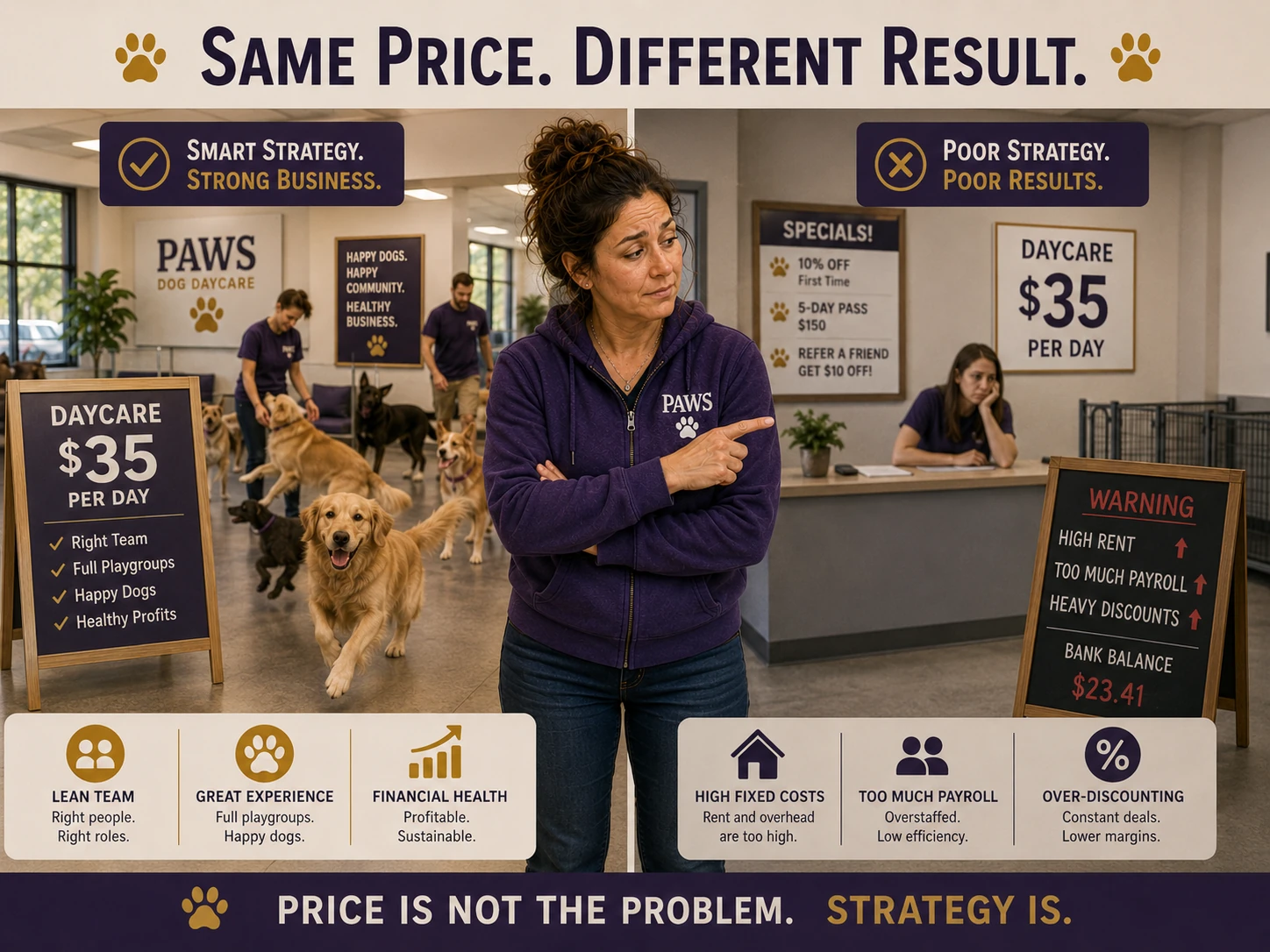
The $35 problem
A $35 daycare price can work beautifully in a lean owner-operated model with disciplined payroll, good utilization, sane packages, and light add-on revenue. The same $35 price can be a disaster in a high-rent, manager-run, overstaffed, over-discounted facility. Same posted price. Completely different business.
If the gate passes, the price may work. If the gate fails, something has to change. You either raise the retail price, improve value, reduce discounts, improve add-ons, increase utilization, cut fixed costs, reduce variable costs, change the service model, or walk away.
What you do not do is keep the weak number because it feels customer-friendly. Customer-friendly pricing that bankrupts the business is not kindness. It is slow-motion self-harm with a cute brochure.
🧠
Operator rule
The right price lives where market support, realized revenue, safe capacity, customer value, and business survival overlap. Anything outside that zone eventually starts causing problems.
📊
Why the PAWS Pricing Method Holds Water
A pricing method is only useful if it survives real markets. Otherwise it is just spreadsheet theater.
The quick income ballpark works because dog daycare is paid from household buying power. It is not emergency medical care. It is not rent. It is not groceries. Customers can leave the dog home for free, ask family for help, work from home, use a dog walker, use daycare fewer days per week, or skip the service entirely.
That means dog daycare pricing tends to live in the same economic neighborhood as the households around the facility. Not perfectly. Not magically. But close enough that ignoring household income is a good way to make a dumb pricing decision with confidence.
The problem is that household income by itself is too clean for a dirty real-world business. It works well near the national middle. It gets too linear at the extremes. It does not know whether your facility is on a commuter route, whether competitors are full, whether your city median understates the actual buyer pool, whether rent is brutal, or whether your service is worth a premium.
That is why the PAWS pricing method uses layers. The quick ballpark gives the first sanity check. The market-supported retail model applies local pressure. The service mix converts posted price into collected revenue. The survival floor tells you whether the business can live. The price gate forces the truth.
In PAWS testing across 200+ city markets, the pricing model landed within about 4% average absolute error against observed pricing signals. That does not mean every daycare should blindly charge the model output. It means the model is strong enough to be useful as a pricing diagnostic. The operator still has to check the actual competitor band, the actual facility, the actual service mix, and the actual survival floor.
| Pricing Layer | What It Does | Why It Matters | Operator Translation |
|---|---|---|---|
| Quick Ballpark | Uses trade-area median household income divided by 2,000. | Gets you into the pricing neighborhood fast. | The napkin number keeps you from wandering off into nonsense. |
| Market-Supported Retail Price | Adjusts for demand density, operating cost, buyer pool, commuter convenience, format, quality, and market velocity. | Shows what the market may support as a posted price. | The market gets a vote, whether you like it or not. |
| Realized Revenue | Converts posted price into actual collected revenue after service mix and add-ons. | Packages and memberships can quietly drag the real number down. | The posted rate is not the bank deposit. |
| Survival Floor | Calculates the minimum average revenue per paid dog-day the business needs. | This is the business reality check. | If you do not clear this, the business bleeds. |
| PAWS Price Gate | Tests realized revenue against survival floor. | Tells you whether the pricing model has a spine. | Pass, fix, or walk away. |
📌
Operator rule
The simple formula can teach you the neighborhood. The full PAWS Price Gate tells you whether the business can survive in that neighborhood.
🌎
Current Market Reality Check
National averages are useful, but they are not magic. They are guardrails, not marching orders.
The dog daycare market is more crowded, more professional, more visible, and more expensive to operate than many new owners realize. There are more facilities, more software tools, more customer expectations, more online reviews, more cameras, more payment systems, more insurance pressure, more payroll pressure, and more competition for attention.
You will see dog daycare averages thrown around online, and they are not useless. They can help you spot when your proposed price is wildly out of line. But they are not enough by themselves. A national average does not know your parking lot, your lease, your payroll, your insurance, your competition, your local income, your facility quality, your dog capacity, or whether your building smells like wet carpet and poor decisions.
For ordinary commercial daycare, a practical planning range is often closer to the $30–$45 zone, with basic or lower-cost markets below that and premium urban, luxury, or high-touch operations above it. A $35 full-day rate may be normal in one market, too high in another, and too low to support the business in a third.
That is why pricing has to be validated locally. You use national numbers to get oriented. You use local competitor research, survival-floor math, capacity, service mix, add-ons, and customer value to make the real decision.
Ordinary facility pricing
Many standard full-day daycare rates live around the $30–$45 range, depending on market, location, facility quality, and package structure.
That is the practical everyday zone for a lot of normal operators.
Premium pricing
Rates in the $45–$60+ range usually need stronger proof: better location, stronger staff, cleaner facility, higher-cost market, premium service, or more convenience.
You can charge more only when the customer can see why.
Business reality
Your price has to support payroll, rent, insurance, software, cleaning, repairs, taxes, payment fees, staffing ratios, and profit.
A market-acceptable price can still be a bad business price.
🔎
Competitor Research: Know the Market, But Do Not Worship It
Competitor prices are evidence. They are not commandments.

You should absolutely research competing dog daycare facilities in your area. Look at their full-day rates, half-day rates, package pricing, membership plans, boarding add-ons, grooming add-ons, temperament test fees, late pickup fees, cancellation policies, and any other charges that affect what customers really pay.
But do not make the beginner mistake of assuming every competitor knows what they are doing. Some facilities are underpriced and slowly bleeding. Some are overpriced and surviving only because they got there first. Some have old rent, inherited property, family labor, weak staffing, or no real profit target. Some are busy and still financially stupid.
Research competitors so you understand the market. Then price your business based on your market position, your cost structure, your facility, your location, your capacity, your service mix, and your value.
What to collect
- Full-day daycare rate.
- Half-day daycare rate.
- Package pricing.
- Membership or subscription pricing.
- Second-dog discount.
- Temperament test or evaluation fee.
- Boarding rates and daycare add-ons.
- Late pickup, cancellation, and no-show fees.
- Grooming, bathing, training, and transport add-on pricing.
- Hours, location, facility quality, reviews, and service differences.
What to ignore
- One random lowball competitor who may not be profitable.
- Prices from a facility with a completely different location.
- Rates from a business with worse staffing or lower service quality.
- Discounts that are really desperation in disguise.
- Outdated prices from old websites that no one has maintained.
- Prices that do not match your rent, payroll, capacity, or service model.
📌
Operator rule
Do not copy a competitor’s price unless you would also copy their rent, payroll, debt, building, staffing, capacity, reputation, location, and owner paycheck. You are not running their business.
📋
Local Competitor Research Worksheet
Do not just write down “Competitor charges $35.” That is lazy research. You need the whole pricing structure.
Customers do not compare your business from one number. They compare convenience, hours, location, facility quality, reviews, staff confidence, photos, webcam access, boarding options, grooming options, package prices, discounts, late pickup rules, and whether the whole thing feels professional.
So when you research competitors, collect the full picture. A competitor with a slightly higher full-day price may actually be cheaper after packages. A competitor with a lower daycare rate may hammer customers with add-on fees. A facility may look expensive until you realize they include services others charge extra for.
This is not about stalking competitors like a weirdo. It is about knowing the market you are about to enter before you bet real money on it.
| What to Collect | What to Write Down | Why It Matters |
|---|---|---|
| Full-day daycare rate | Standard daily rate for a full day of daycare. | This is the main number customers will compare first. |
| Half-day rate | Price, time cutoff, and whether it is actually useful to customers. | A bad half-day price can cannibalize full-day revenue. |
| Prepaid packages | 5-day, 10-day, 20-day, or larger packages, expiration rules, refunds, and transfer rules. | Packages change the real average daily revenue. |
| Memberships | Monthly memberships, recurring plans, unlimited plans, attendance limits, and cancellation rules. | Memberships can smooth cash flow or create a capacity nightmare. |
| Second-dog discounts | Discount amount, restrictions, and whether it applies to packages or only daily rates. | Multi-dog households are valuable, but two dogs still create real work. |
| Evaluation or temperament test fee | Fee amount, whether it is required, refundable, credited, or waived. | Screening takes staff time and protects the playgroup. |
| Boarding add-ons | Overnight rate, daycare inclusion, late checkout, private suite fees, holiday rates, and add-on services. | Boarding can change the customer’s total spend and the facility’s revenue model. |
| Grooming, baths, and nail trims | Add-on pricing, package bundles, daycare customer discounts, and scheduling rules. | Add-ons can make a lower daycare rate more profitable if structured correctly. |
| Late pickup fees | Fee amount, grace period, enforcement policy, and repeat-offender rules. | Closing time abuse costs labor and creates staff resentment fast. |
| Cancellation or no-show policy | Required notice, fees, package-day loss, reservation rules, and holiday exceptions. | Reserved capacity has value. Customers who no-show still cost you opportunity. |
| Hours and convenience | Opening time, closing time, weekend options, holiday policies, and drop-off/pickup flexibility. | Convenience can justify price differences better than a paragraph of marketing fluff. |
| Reviews and reputation | Google rating, review volume, complaints, photos, social proof, and local reputation. | A trusted facility can often charge more than an unknown facility. |
📌
Operator rule
Competitor research is not “they charge $38, so I’ll charge $36.” That is not research. That is guessing with extra steps.
📊
Competitor Band Builder
Keep this light. This is not the full competitor analysis machine. It is a quick way to organize local full-day rates and see whether your proposed price is standing in the same parking lot as the market.
🏘️
Demographics Matter More Than Your Feelings
Your customer base decides what is realistic. Not your rent, not your dream, not your logo, and not the fact that you really love dogs.
Check the local area. Does your proposed location sit in a middle-income area, an upper-income area, a commuter-heavy suburb, a rural pocket, a retirement area, a young professional corridor, or an industrial district where people only pass through during working hours? Those differences matter.
In many cities there may be two competing dog daycares only a few miles apart, yet one is in an upper-income district and one is in a middle-income district. That is a fact you can easily miss if you do not study the local economy closely, and missing it can cost you valuable revenue in the beginning when the business is most fragile.
You are not just looking for people who own dogs. You are looking for people who own dogs, have disposable income, have a reason to use daycare, trust professional care, and live or commute in a pattern that makes your facility convenient.
| Demographic Signal | Why It Matters | Pricing Impact |
|---|---|---|
| Median household income | Gives a rough sense of local buying power. | Higher-income areas may support stronger rates, but only if the service and convenience justify them. |
| Commuter routes | Customers pay for convenience when the facility fits their routine. | A convenient location can support better pricing than a hidden location with the same square footage. |
| Household type | Dual-income households, young professionals, and busy families may use daycare differently. | Stronger recurring-use households can support packages, memberships, and multi-day plans. |
| Competitor density | Too many similar facilities can pressure pricing unless you are clearly better or better located. | More competition does not always mean lower prices, but it does mean you need a reason to be chosen. |
| Dog ownership culture | Some markets treat dog care as a serious service; others still see it as optional luxury. | The more accepted professional dog care is locally, the easier it is to sell value instead of begging on price. |
📍
Location Changes What You Can Charge
Two dog daycares can be five miles apart and live in two completely different pricing worlds.
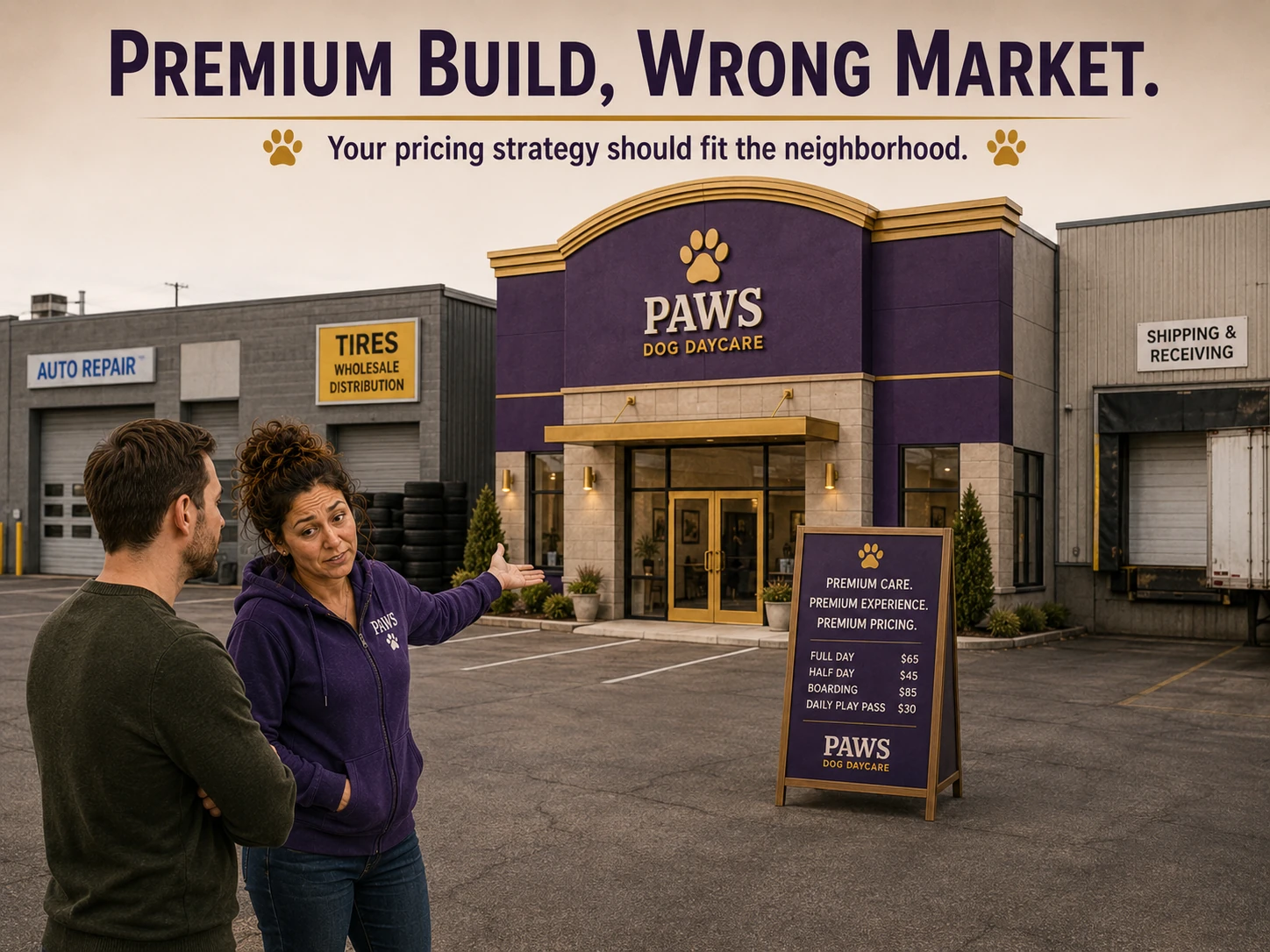
Understand the commuter routes for your local area and try to position yourself along daily traffic lanes. Do not expect to get the same price in an industrial zone that your competitor is getting on the main highway, even though you may only be geographically minutes apart. People are willing to pay more for convenience, and a better location reflects more positively on the dog daycare as a whole.
This does not mean every facility has to be on the fanciest road in town. It means your pricing has to match the reality of where you are. A hidden facility can still work, but it may need stronger marketing, better retention, better referrals, better parking, and a more careful pricing strategy. A premium commuter location may support stronger pricing, but it may also come with higher rent and higher expectations.
The trap is building one kind of business in the wrong kind of location. It does not make sense to build a high-end, polished, premium-price facility around auto shops and convenience stores unless the local market, access, visibility, and customer base actually support that decision. Customers are not obligated to fund your fantasy.
Rural or hidden location
May need more conservative pricing, stronger word-of-mouth, clear signage, easy access, and a reason for customers to go out of their way.
Suburban commuter location
Often supports practical, middle-to-upper pricing if drop-off and pickup fit the customer’s daily routine.
Premium corridor location
May support higher pricing, but only if service, facility quality, staffing, cleanliness, and customer experience match the higher expectation.
🛑
Do not overbuild in the wrong location.
A beautiful facility in a bad pricing location can become an expensive monument to bad judgment. Build for the market you are actually in, not the market you wish you had.
💳
Modern Overhead: The Quiet Bills That Eat Weak Pricing Alive
Dog daycare pricing has to carry more than rent and dog bowls. The little monthly charges matter because they pile up like wet towels in a laundry room.
A dog daycare today is not just a room full of dogs and a cash box at the front desk. Customers expect convenience. They expect online forms, fast replies, card payments, vaccination tracking, reminders, photos, reviews, mobile-friendly websites, and professional communication that does not feel like it was taped together in somebody’s garage.
None of those tools are free. Some are worth every penny. Some are shiny little parasites that quietly nibble your bank account every month. Either way, they belong in your pricing math. If you ignore them, they do not disappear. They just wait until the end of the month and laugh at you from the expense column.
This is one of the reasons cheap daycare pricing gets dangerous fast. A low daily rate may look attractive on the website, but that number has to drag payroll, software, payment fees, insurance, customer communication, cleaning records, camera systems, booking tools, and administrative time behind it. If the rate cannot carry the load, the business starts limping.
You do not need every fancy system on the market. You do need to know what systems your business actually requires, what they cost, and whether your daycare price supports them. Convenience is not magic. Professionalism has a bill attached.
Customer-facing overhead
- Online booking software.
- Customer portal or app access.
- Digital waivers and forms.
- Vaccination upload tools.
- Email and SMS reminders.
- Website hosting and maintenance.
- Google Business Profile and review management.
Operating overhead
- Payroll software.
- Staff scheduling tools.
- Time tracking.
- Cleaning logs.
- Incident documentation.
- Security camera systems.
- Live camera or webcam infrastructure.
Money-handling overhead
- Credit-card processing fees.
- Online payment fees.
- Refund and chargeback risk.
- Accounting software.
- Bank fees.
- Sales-tax or local-fee tracking where applicable.
- Bookkeeping or CPA support.
📌
Operator rule
Every $19.99 subscription looks harmless until you have twenty of them, three payment fees, two software platforms, a camera system, and no idea where the margin went. Modern overhead is quiet. That is why it is dangerous.
🐕
Capacity Math: A Cheap Rate Can Break a Full Building
Price cannot be separated from how many dogs you can safely handle and how much staff those dogs require.
Dog daycare is not software. You cannot just add customers forever with no added cost. More dogs mean more staff, more cleaning, more wear and tear, more risk, more management, more noise, more odor, more incidents, and more operational pressure.
If your price is too low, you may need too many dogs to make the numbers work. That can create a dangerous cycle where the business depends on high volume, but high volume creates supervision problems, staff burnout, customer complaints, facility damage, odor problems, and higher incident risk.
A price that only works when every room is packed all day is not a safe pricing strategy. The business needs to work at realistic utilization, not fantasy capacity.
| Capacity Question | Why It Matters | Pricing Lesson |
|---|---|---|
| How many dogs can you safely supervise? | Safe capacity may be lower than the number of dogs you can physically cram into the building. | Do not price based on unsafe fantasy capacity. |
| How many staff members are required? | Labor is one of the biggest ongoing costs in daycare. | If the rate does not support staffing, the rate is wrong. |
| What is your realistic utilization? | You will not be full every day, especially at the beginning. | Build pricing around realistic attendance, not best-case dreams. |
| What happens on slow days? | Rent, insurance, software, payroll, and utilities do not disappear because attendance is light. | Packages and memberships can help smooth revenue. |
| What happens on peak days? | If busy days create chaos, your pricing may be attracting volume without enough margin. | Charge enough to operate safely and professionally. |
💸
Opening Discounts: Useful Tool or Financial Hole?
A short-term opening discount can help get dogs in the door. A permanent low-price identity can turn into a trap.
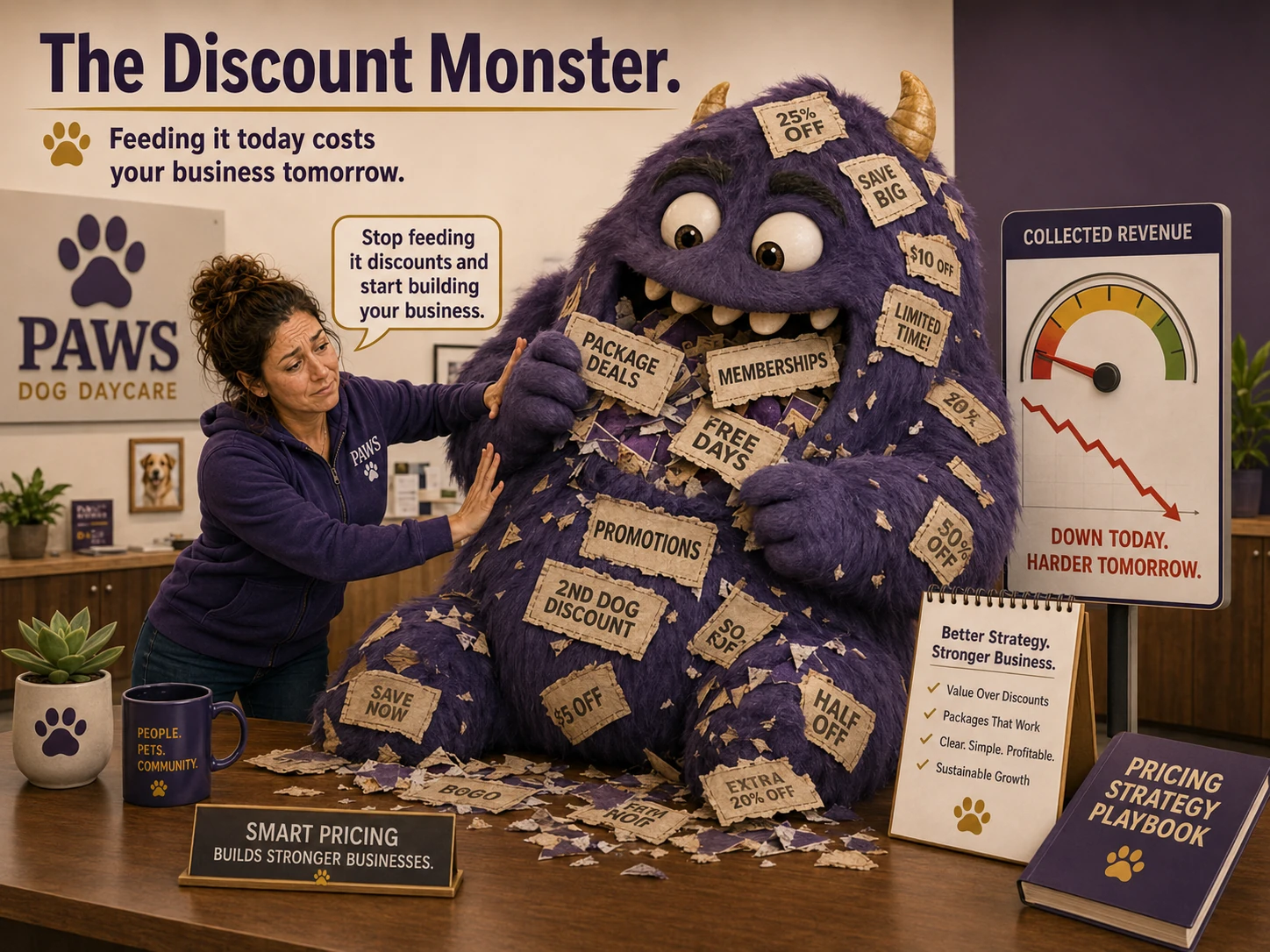
In the beginning you need customers to survive and get off the ground. If an established daycare is getting a higher rate and you are brand new, it may make sense to use a temporary introductory price, founding-member offer, or package discount to get customers in the door.
But understand what you are doing. You are not proving that your service is worth less. You are reducing friction while you build trust, reviews, routine, and customer habit. That discount should have a purpose, a time limit, and an exit plan.
Never get overly greedy and overprice your services before the market trusts you. But also do not get so desperate to look affordable that you teach customers your service is cheap. A reputation as overpriced is hard to get rid of. A reputation as the bargain daycare is not always much better.
Remember that a small part of something is better than a large part of nothing, but that does not mean you should build your whole business around being the cheapest thing on the menu.
Smart discounts
- Limited-time opening offer.
- Founding-member package with clear terms.
- Prepaid package discount that improves cash flow.
- Second-dog discount that still protects margin.
- Referral credit with limits.
- Trial day or evaluation credit tied to enrollment.
Dangerous discounts
- Permanent low pricing with no profit math.
- Unlimited discounts because you are afraid to charge.
- Deep discounts that attract poor-fit customers.
- Discounts that train customers to wait for deals.
- Package deals that create too much liability or scheduling pressure.
- Second-dog discounts that turn two dogs into one bad-margin account.
🛑
Do not use discounts because you are scared.
Use discounts with a plan. If your entire pricing strategy is “maybe they will like me if I am cheap,” you are not pricing. You are panicking.
📦
Build a Price Structure, Not Just One Daycare Rate
A serious daycare price sheet usually needs more than one number.
The full-day daycare rate is the anchor, but the rest of the price structure matters. Half-day rates, prepaid packages, memberships, boarding add-ons, grooming add-ons, training, transport, late pickup fees, and no-show policies all affect revenue and customer behavior.
Do not create packages just because they look cute on a website. Packages should support cash flow, encourage repeat use, reduce friction, and still protect your margin. If a package gives away too much, creates scheduling headaches, or lets customers hoard cheap days forever, it can become a mess.
| Price Item | Purpose | Operator Warning |
|---|---|---|
| Full-day daycare | Main anchor rate for standard daycare service. | This number has to support the business model. |
| Half-day daycare | Allows shorter use without giving away a full day of capacity. | Do not make half-day so cheap that everyone downgrades. |
| Prepaid packages | Improves customer commitment and cash flow. | Expiration rules and refund policies need to be clear. |
| Memberships | Creates recurring revenue and predictable attendance. | Do not oversell membership capacity if staffing cannot support it. |
| Second-dog discount | Encourages multi-dog households to enroll. | Two dogs still create work, space, and supervision needs. |
| Evaluation or temperament test fee | Covers intake time and reinforces that group play is not automatic. | Do not skip screening just because you want the revenue. |
| Late pickup fee | Protects staff time and discourages abuse of closing hours. | A policy you do not enforce is just a suggestion. |
| No-show or cancellation fee | Protects reserved capacity and staffing plans. | If customers reserve space and do not show, the business still loses opportunity. |
| Boarding add-on | Adds revenue when dogs stay overnight. | Boarding is a different service with different labor, risk, and regulation. |
| Grooming, bathing, or nail trims | Adds convenience and service revenue. | Price for labor, supplies, cleanup, scheduling, and facility wear. |
⭐
Charge More Only If You Are Actually Worth More
Premium pricing without premium operations is just arrogance with a credit card processor.
Reputation and prestige can allow you to increase prices and generate additional revenue, but you have to earn that position. Customers will pay more when they trust you, when the facility is clean, when the dogs are handled well, when communication is strong, when staff appears competent, and when the business makes their life easier.
If you want premium pricing, the customer experience has to support it. That means clean floors, controlled odor, safe groups, clear policies, good communication, professional staff, reliable hours, convenient drop-off, proper records, and a facility that looks and feels like it is being run by adults.
Do not confuse expensive construction with premium service. A shiny lobby does not fix sloppy dog handling. A fancy logo does not fix poor communication. Customers may try you because the place looks nice, but they stay because the service works.
🧼
Cleanliness
Odor, hair, waste, and dirty floors quietly destroy pricing power.
🐕
Dog Handling
Customers pay for safe supervision, not chaos with cute pictures.
💬
Communication
Clear updates, honest policies, and professional staff support stronger rates.
📈
Raising Prices Without Making a Mess
If your prices never move while your costs rise, the business slowly gets weaker.
New owners often fear raising rates because they imagine every customer will leave. Some may complain. A few may leave. That does not automatically mean the increase was wrong. If your rates are too low, keeping every underpriced customer may be the thing hurting the business.
Rate increases should be planned, clear, and tied to the reality of the business. Payroll goes up. Insurance goes up. Rent goes up. Utilities go up. Cleaning supplies go up. Repairs happen. Software costs money. If pricing never changes, the owner absorbs the pressure until something breaks.
The goal is not to surprise people every other month. The goal is to build pricing discipline. Review rates regularly, communicate clearly, give customers reasonable notice, and avoid apologizing like you did something wrong by keeping the business healthy.
| Rate Increase Step | What to Do | Why It Matters |
|---|---|---|
| Review costs | Look at payroll, rent, insurance, utilities, cleaning, software, repairs, taxes, and supplies. | You need a reason based in business reality, not vibes. |
| Check competitors | Compare your current rates against similar local facilities. | This helps you know whether you are underpriced, aligned, or pushing the market. |
| Protect loyal customers carefully | Consider notice periods, package transition rules, or phased increases. | Loyalty matters, but loyalty should not require the business to lose money. |
| Communicate simply | Explain the new rate, effective date, and any package or membership changes. | Confusion creates more anger than the increase itself. |
| Do not over-apologize | Be professional, direct, and respectful. | A healthy business has to charge enough to provide the service customers expect. |
🚫
Common Dog Daycare Pricing Mistakes
Most pricing mistakes are not complicated. They are usually caused by fear, ego, laziness, or bad math.
01
Pricing Only Against the Cheapest Competitor
The cheapest competitor may be underpriced, poorly run, desperate, or operating under totally different costs.
02
Confusing Posted Price With Collected Revenue
A $35 posted rate does not help if discounts, packages, and memberships drag the real collected average below survival.
03
Ignoring the Survival Floor
If you do not know what the business must collect per dog-day, you are not pricing. You are guessing with confidence.
04
Ignoring Location
A hidden industrial location and a premium commuter route are not the same pricing environment.
05
Forgetting Payroll
Dog daycare is labor-heavy. If the rate does not support staffing, the model is broken.
06
Discounting Without an Exit Plan
Discounts should be a tool, not a permanent confession that you are afraid to charge properly.
📝
Copy This Into Your Pricing File
Treat pricing like a working decision, not a random number you typed into the website because you got tired.
| Pricing Field | What to Record | Why It Matters |
|---|---|---|
| Fixed monthly costs | Rent, payroll base, insurance, software, utilities, debt, repairs, admin, taxes, and owner draw target. | This is the top half of the survival-floor calculation. |
| Safe dog capacity | Realistic number of dogs you can handle safely with proper staffing. | Price and capacity work together. |
| Realistic utilization | Expected paid attendance percentage, not fantasy full capacity. | Your pricing must work on normal days, not perfect days. |
| Variable cost per dog-day | Cleaning supplies, waste disposal, laundry, wear and tear, payment fees, and dog-related consumables. | More dogs create more cost. |
| Survival floor | Minimum average revenue the business needs per paid dog-day. | This is the number realized revenue must beat. |
| Trade-area median household income | Income for the real customer area, not just the whole city if your customers come from a specific corridor. | Helps estimate local buying power. |
| Quick ballpark price | Trade-area median household income divided by 2,000. | Gives a fast first-pass price, not the final price. |
| Competitor full-day rates | List comparable facilities and their full-day daycare rates. | Shows the current market range. |
| Competitor packages | Record prepaid packages, memberships, discounts, expirations, and restrictions. | Customers compare total value, not just the daily sticker price. |
| Service mix factor | Estimate how much packages, memberships, and discounts reduce the posted price. | This converts posted price into realistic collected revenue. |
| Average add-on revenue | Average enrichment, grooming, retail, late pickup, transport, or other add-on revenue per dog-day. | Add-ons can help bridge the gap between posted price and survival floor. |
| Price gate result | Realized revenue per dog-day compared against survival floor. | This tells you whether the price has a spine. |
❓
Dog Daycare Pricing FAQ
Detailed answers to the survival-floor, market, competitor, package, membership, discount, capacity, add-on, location, rate-increase, and collected-revenue questions that determine whether a daycare price can support the business behind it.
Should I calculate the survival floor before researching market prices?
Yes. The survival floor tells you the minimum average collected revenue required per paid dog-day before the business can support its fixed costs, realistic attendance, and variable dog expenses. Competitor and demographic research then tell you whether the market is likely to support a posted price capable of producing that collected amount. Starting with competitors alone can produce a popular price that does not support the facility. The correct sequence is survival requirement first, market support second, and realized revenue testing after the proposed price structure is built.
What is the difference between posted price and realized revenue?
Posted price is the public full-day rate shown on the website or price sheet. Realized revenue is the average amount actually collected per dog-day after packages, memberships, second-dog discounts, promotional offers, free days, credits, and add-on purchases are included. A daycare may advertise $35 and collect only $31.75 on average. Payroll, rent, insurance, and utilities are paid from the collected number, not the number printed on the sign.
How do I calculate a dog daycare survival floor?
Divide fixed monthly costs by realistic paid dog-days, then add the variable cost created by each dog-day. Realistic paid dog-days are based on safe capacity, actual open days, and a believable utilization rate rather than fantasy full occupancy. Fixed costs should include payroll base, rent, insurance, utilities, software, debt, repairs, administration, taxes, and a reasonable owner-compensation target. The result is not automatically the retail price; it is the minimum collected average that the pricing structure must beat.
Should owner pay be included in the pricing calculation?
Yes. A pricing model that works only because the owner provides full-time labor without reasonable compensation is understating the real cost of the business. Owner pay may be structured differently during opening, but the long-term model should recognize management, administration, customer service, dog handling, financial oversight, and risk. Otherwise, the spreadsheet may report a profit while the owner has simply purchased an exhausting unpaid job. The business eventually needs enough margin to compensate ownership and replace owner labor when necessary.
Can I simply copy the prices charged by nearby competitors?
No. Competitor prices are useful evidence, but you do not know the rent, mortgage, payroll, staffing ratios, debt, ownership arrangement, facility condition, package use, discount pressure, or profitability behind the visible rate. One competitor may own the building, another may use family labor, and another may be busy while steadily losing money. Compare the complete price structure and service level, then test your proposed rate against your own survival floor. You are not operating the competitor’s cost structure.
Should a new daycare open below the competitor price?
A temporary opening offer may reduce customer hesitation while the facility builds trust, reviews, and routine. That is different from permanently positioning the business below the market without margin analysis. Any opening offer should have a defined purpose, expiration, customer limit, and transition to standard pricing. The realized revenue during the promotion must still be understood. A launch strategy should create trial and retention, not establish an underpriced customer base that becomes angry when the real rate finally appears.
Is being the cheapest dog daycare a workable strategy?
Usually not for a normal staffed facility. Dog daycare is labor-heavy, cleaning-heavy, insurance-heavy, and capacity-limited, so low-margin volume can create more operational pressure faster than it creates profit. A true low-price strategy requires unusually efficient operations, controlled overhead, disciplined staffing, high utilization, and enough safe capacity to make the volume work. Most new facilities do not have those advantages. Competing on trust, convenience, professionalism, safety, and service quality is usually more defensible than competing only on cheapness.
How should demographics influence dog daycare prices?
Demographics help estimate the size and buying power of the realistic customer pool. Median household income matters, but so do dual-income households, commuter patterns, housing density, age distribution, professional employment, dog ownership, and whether customers already use paid pet services. Use the actual trade area rather than a citywide average that may include neighborhoods unlikely to use the facility. Demographics do not dictate one exact price, but they help show whether the required rate is plausible in that market.
How does location affect what a daycare can charge?
Customers pay for convenience as well as dog care. A visible facility along a strong commuter route may support a higher price than an equally attractive building hidden behind warehouses, difficult turns, or unrelated industrial uses. Location also shapes customer perception, parking ease, drop-off time, local income, competitor access, and the strength of repeat use. Premium rent does not automatically justify premium pricing, but a genuinely convenient and trusted location can increase customer willingness to pay.
Can an expensive or luxury facility charge premium prices automatically?
No. Customers are not obligated to reimburse the owner for an expensive lease, elaborate build-out, or poor construction decisions. Premium pricing requires visible value: strong location, professional staff, clean and controlled operations, excellent communication, safe handling, convenient hours, dependable policies, and a customer experience that is meaningfully better than ordinary alternatives. A luxury-looking facility in a market that does not support the required rate can still fail. Construction cost and customer value are not the same thing.
How should I price half-day daycare?
A half-day rate should provide a useful option without making the full-day service financially irrational. The dog still uses intake time, records, staff attention, cleaning, space, and part of the facility’s limited daily capacity. If the half-day rate is too low, full-day customers may downgrade and reduce collected revenue without reducing the operating burden proportionally. Set clear time limits and evaluate how half-day attendance affects staffing and capacity. The price should reflect the value and operational cost of the shortened service.
How much of a discount should prepaid packages receive?
Enough to reward commitment and improve cash flow, but not enough to drag average collected revenue below the survival floor. The correct discount depends on package size, expiration, refundability, transfer rules, expected usage, capacity pressure, and the standard retail rate. Model the effective revenue per visit before publishing the package. A package that looks attractive to customers but gives away too much margin or creates long-lived scheduling liability is not a successful product.
Are unlimited daycare memberships dangerous?
They can be. Unlimited plans create predictable monthly cash flow, but heavy users can consume far more capacity than the monthly fee can support. The plan must be modeled against likely attendance, peak-day congestion, staffing, reservation controls, cancellation rules, and the effective collected revenue per visit. If the business sells too many unlimited memberships, the best customers financially may become the most expensive customers operationally. Capacity must remain controlled.
How should second-dog discounts be structured?
A second dog may reduce some customer-acquisition and transaction costs, but it still requires play space, supervision, cleaning, records, handling, and risk management. Do not treat two dogs as though the second creates almost no cost. Test the effective rate for the household against the survival floor and expected service use. The discount should encourage multi-dog families without turning a valuable account into two underpriced dog-days.
Can grooming, baths, enrichment, and other add-ons support a lower daycare rate?
Add-ons can improve average revenue per dog-day, but only when customers actually purchase them and the margin is measured honestly. Grooming and bathing create labor, supplies, cleanup, equipment, scheduling, and facility costs. Enrichment, transport, retail, late pickup, and training also consume staff time or operating capacity. Do not use optimistic add-on revenue to rescue a weak base price unless the purchase rate is supported by real experience or conservative planning. The daycare service should not depend on imaginary upsells.
How do capacity and staffing affect the correct price?
Price and capacity cannot be separated. A low rate may require more dogs than the facility can safely handle, while more dogs often require more staff, cleaning, equipment, and management. Calculate using safe capacity and realistic utilization, not the number of dogs that can physically fit in the building. If the model only works when every playgroup is full and labor remains unrealistically low, the pricing model is unsafe and financially fragile.
Why can a busy dog daycare still lose money?
Attendance creates revenue, but it also creates labor, cleaning, waste, payment fees, wear, incidents, administrative work, and facility pressure. A daycare can appear successful while package discounts, excessive payroll, high rent, modern software costs, insurance, utilities, and weak add-on margins consume the revenue. Busy is an operating condition, not a profit measurement. Profitability depends on the collected revenue left after the complete cost of serving those dogs is paid.
How often should dog daycare prices be reviewed?
Review the complete pricing structure at least annually and whenever payroll, rent, insurance, utilities, software, payment fees, taxes, capacity, or service mix changes materially. Do not review only the public daily rate. Recalculate package economics, membership usage, second-dog discounts, add-ons, late fees, cancellations, and realized revenue. A price that worked two years ago may quietly become inadequate even while customer volume remains strong.
How should a daycare communicate a rate increase?
Give clear notice, state the effective date, explain which rates or packages are changing, and describe how existing credits or memberships will transition. The message should be professional and direct rather than defensive. Customers understand that payroll, insurance, utilities, supplies, software, and facility costs rise, especially when the service remains dependable and valuable. Confusion and inconsistent enforcement usually create more anger than the increase itself.
What should I do if the market price is below the survival floor?
Do not simply charge below survival and hope volume fixes the problem. Rework the model by reducing fixed costs, improving safe utilization, controlling payroll, changing the facility, reducing discount drag, strengthening add-ons, altering the service mix, improving customer value, or selecting a different market. If the realistic collected revenue still cannot clear the survival floor, the location or business model may not be viable. Walking away before opening can be the most profitable pricing decision available.
What is the final test for a proposed daycare price?
Convert the posted price into realistic collected revenue using the expected package, membership, discount, and add-on mix. Then compare that collected amount with the survival floor under believable utilization and staffing assumptions. A meaningful cushion indicates that the model may be workable; a narrow pass requires tighter control and continued testing; a failure means the price or business model must change. The final decision is not whether the number looks competitive. It is whether the market-supported number can keep this specific daycare alive.
🧠
The Bottom Line
Pricing is where a lot of dog daycare dreams either become a business or quietly become an expensive hobby.

You need customers in the beginning. That is true. But you also need the price to support the business. Do not start with what feels competitive and hope the numbers behave later. Start with the survival floor. Then check the quick ballpark. Then estimate the market-supported retail price. Then convert that posted price into realized revenue. Then run the PAWS Price Gate.
If realized revenue beats the survival floor, the price may have a spine. If it does not, something has to change. Raise the price, improve the value, reduce discount drag, strengthen add-ons, increase utilization, lower fixed costs, reduce variable costs, change the service model, or walk away.
Dog daycare pricing is not about squeezing every dollar out of people. It is about charging enough to provide safe, clean, professional care without starving the business that provides it.