Dog Daycare Pricing, Cost Reality, and Financial Survival
Dog Daycare Survival Floor: The Number Your Price Has to Beat
Before you care what customers might pay, you need to know what this specific business must collect per paid dog-day just to stay alive.

Most new dog daycare owners do pricing backward. They ask what competitors charge, what customers might tolerate, or what number feels “competitive.” That is not the first question.
The first question is much colder and much more useful:
What does this specific business need to collect per paid dog-day before it can breathe?
That number is the survival floor.
But there are really two survival floors. One tells you what the business needs to keep the lights on. The other tells you what the business needs if the owner also expects to eat, pay bills, have a car, live indoors, and not survive on fumes, ramen, and emotional damage.
If you skip this step, you are not pricing. You are guessing with a calculator nearby. That is how people build a busy lobby, tired staff, happy customers, and a bank account that looks like it was dragged behind a truck.
⚠️
Operator warning: market price does not automatically mean business survival.
A daycare can charge a price customers like and still lose money. If the realized revenue is below the survival floor, the market price may be popular, but the business model is bleeding.
And if the business-only survival floor works only because the owner is making nothing, the business still does not work. It just found a new way to underpay the person taking all the risk.
🗺️
Use This Page Before You Set Your Daycare Price
This page is Step 1. It tells you what the business needs before you start arguing with the market, competitors, packages, discounts, and customer expectations.
🧱
What It Is
The survival floor is the minimum collected revenue per paid dog-day the business needs.
🧮
The Formula
Business costs, owner pay, safe capacity, open days, utilization, and variable cost per dog-day.
🍜
Owner Pay
The owner has to make a living too. Otherwise the business is just eating the owner.
🧼
Variable Costs
More dogs are not free just because the lights are already on.
🧮
Calculator
Use the free basic calculator to get a quick business-only and owner-real number.
🧱
What the Survival Floor Is
The survival floor is the business reality check. It is the minimum average collected revenue per paid dog-day the business needs before it can breathe.
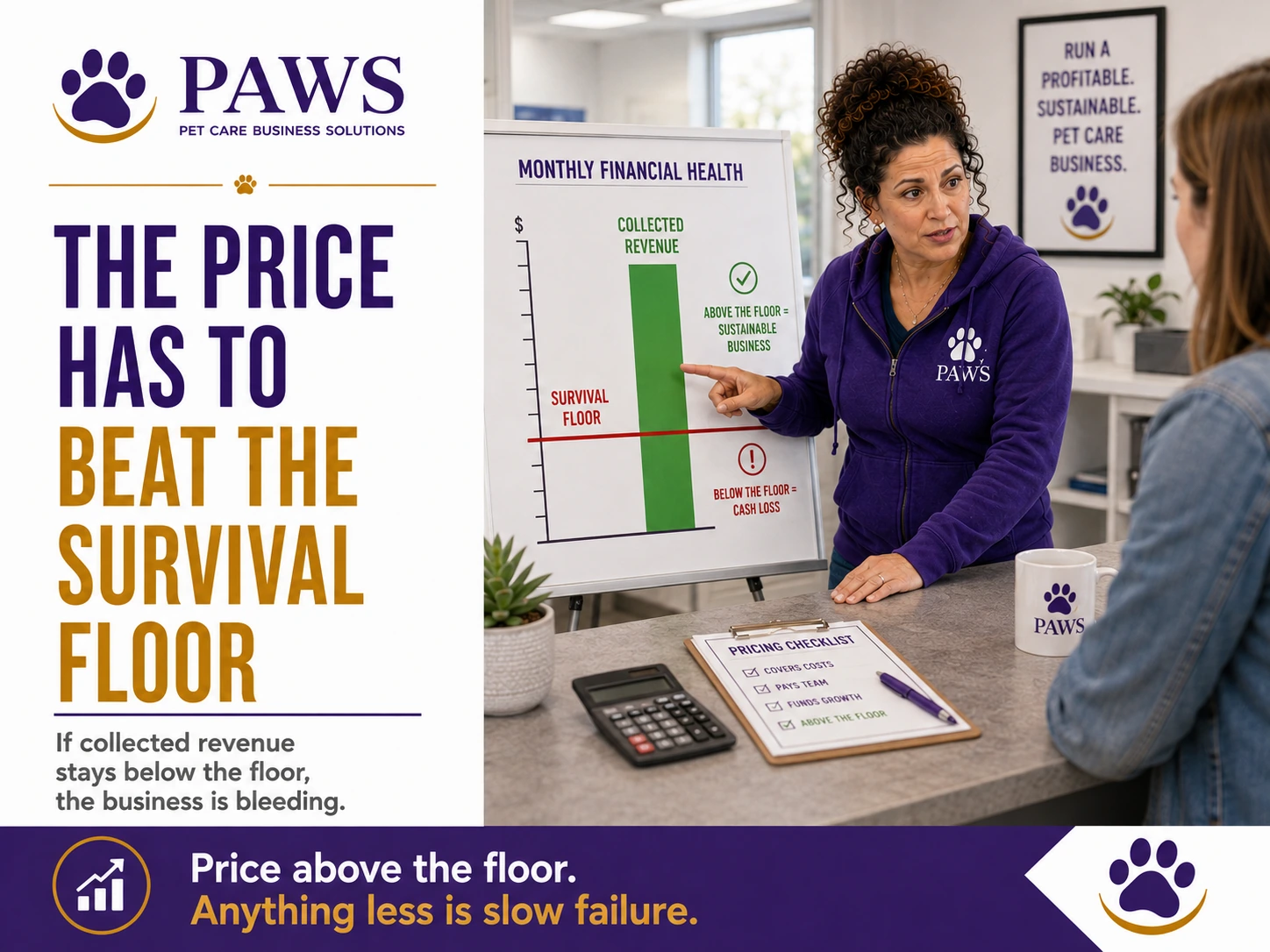
The survival floor is the minimum average collected revenue per paid dog-day the business needs to cover its basic monthly cost structure and variable dog-day costs.
Not posted price.
Not package price.
Not “what you hope customers pay.”
Collected revenue.
That distinction matters because a dog daycare can post $35, collect $31.75, and still walk around pretending it runs a $35 dog-day. It does not. It runs a $31.75 dog-day with nicer handwriting.
If your realized revenue is below your survival floor, the market price may be popular, the customers may be happy, and the lobby may look busy. But the business model is bleeding under the table.
The other trap is calculating only the business-only survival floor and then acting like the owner does not exist. That lower number may keep the lights on, but it may quietly ignore that the owner still needs to pay rent, groceries, insurance, taxes, debt, family expenses, and life outside the kennel.
The floor should be compared with realized revenue every month, not only when the business plan is written. Package mix, discounts, refunds, memberships, credits, attendance, and service changes can move the collected number even when the posted rate never changes.
A useful dashboard therefore shows three separate numbers: posted price, average collected revenue per paid dog-day, and the owner-real survival floor. Blending those numbers together lets a weak model hide behind a strong-looking price board.
📌
Operator rule
Your survival floor does not tell you what customers will pay. It tells you what the business must collect before customer demand even matters.
🧮
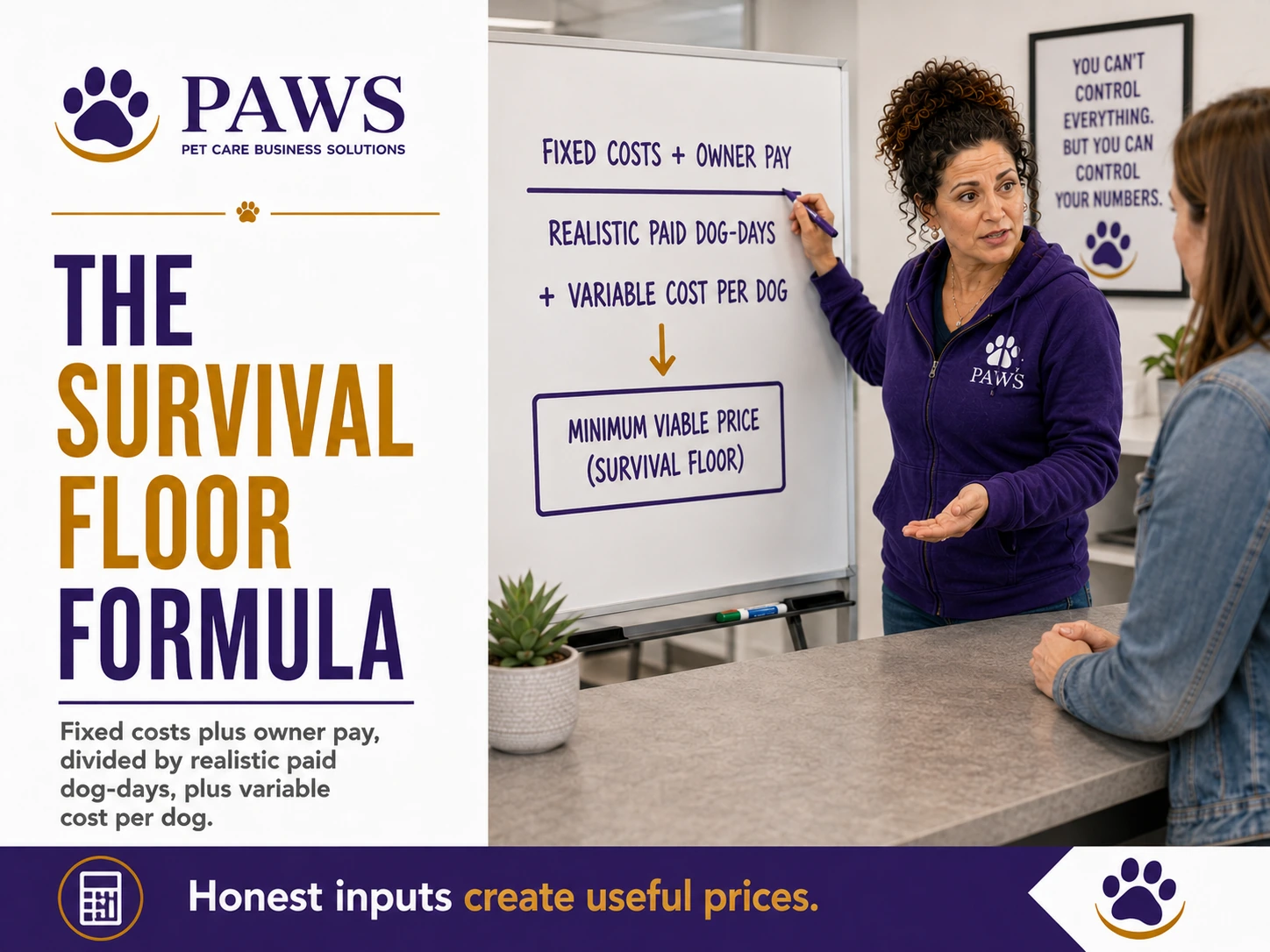
The Survival Floor Formula
This is the basic public formula. It is simple enough to understand and powerful enough to expose weak pricing fast.
🧾
Business-Only Survival Floor
Business-Only Survival Floor = Fixed Business Monthly Costs ÷ (Safe Dog Capacity × Open Days Per Month × Realistic Utilization) + Variable Cost Per Dog-Day
Owner-Real Survival Floor
Owner-Real Survival Floor = (Fixed Business Monthly Costs + Owner Monthly Compensation Target) ÷ (Safe Dog Capacity × Open Days Per Month × Realistic Utilization) + Variable Cost Per Dog-Day
Actual Owner Monthly Pay Available
Actual Owner Monthly Pay Available = (Test Realized Revenue Per Dog-Day − Variable Cost Per Dog-Day) × Paid Dog-Days − Fixed Business Monthly Costs
| Formula Piece | What It Means | Operator Translation |
|---|---|---|
| Fixed Business Monthly Costs | The monthly business costs the daycare carries whether attendance is strong or weak. | These bills do not care if Tuesday was slow. |
| Owner Monthly Compensation Target | The monthly income the owner needs the business to produce for the owner to live like a functioning adult. | If this is zero, the business may survive while the owner slowly becomes kennel furniture. |
| Test Realized Revenue Per Dog-Day | The average collected revenue per paid dog-day after packages, memberships, discounts, and add-ons. | This is the number that tells you what the owner actually gets after the business eats first. |
| Safe Dog Capacity | The number of dogs the facility can safely handle with proper staffing and supervision. | Not how many dogs fit before the room looks like a furry riot. |
| Open Days Per Month | The number of days the daycare is open and able to generate paid dog-days. | More open days can help revenue, but they also create more labor and wear. |
| Realistic Utilization | The percentage of safe capacity you realistically expect to fill on average. | Do not price like every day is full. That is spreadsheet cosplay. |
| Variable Cost Per Dog-Day | The costs that rise as dog volume rises. | More dogs are not free just because the lights are already on. |
Simple Example
Suppose the facility has $35,000 in fixed business monthly costs, an owner monthly compensation target of $6,000, a safe capacity of 50 dogs, 22 open days per month, 70% realistic utilization, and $4 in variable cost per dog-day.
Paid Dog-Days = 50 × 22 × 0.70 = 770
$35,000 ÷ 770 = $45.45 business fixed-cost load per dog-day
$6,000 ÷ 770 = $7.79 owner pay load per dog-day
$45.45 + $4 = $49.45 Business-Only Survival Floor
$45.45 + $7.79 + $4 = $57.25 Owner-Real Survival Floor
Operator translation:
If your realized revenue is below $49.45, the business model is bleeding. If your realized revenue is below $57.25, the business may keep the lights on while the owner slowly gets eaten alive.
The formula is only as honest as the assumptions entered. Inflated capacity, full-calendar utilization, missing payroll, understated repairs, and a symbolic owner-pay target can produce a comforting floor that the real business will never experience.
Run the formula as a range rather than a single answer. Test lower utilization, higher payroll, rent escalation, owner absence, equipment repair, slower growth, and heavier discount use so the price is not built around one perfect month.
💸
Fixed Monthly Costs: The Bills That Do Not Care If You Had a Slow Tuesday
Fixed costs are the bills that keep showing up whether the daycare is full, half-full, or sitting there listening to crickets.

These costs do not vanish because three customers canceled and it rained. The building still wants rent. Insurance still wants money. Software still charges you. The utility company does not care that Duke the Labradoodle stayed home.
This is where new owners get themselves into trouble. They think about the daily daycare rate, but they do not fully load the monthly cost structure the rate has to carry. Then they open, get busy, and realize the money is disappearing faster than expected because the business has more fixed weight than the price can lift.
Fixed costs should be taken from a monthly operating budget and supported by leases, quotes, payroll plans, insurance proposals, debt schedules, software contracts, and realistic maintenance allowances. A rounded guess is not strong enough for a long-term pricing decision.
Some costs are step-fixed rather than perfectly fixed. Payroll, management, cleaning, software tiers, and insurance may jump when capacity or hours expand. The model should identify those thresholds before assuming each additional dog creates only variable cost.
Building and facility costs
- Rent or mortgage.
- Common area maintenance charges.
- Property taxes where applicable.
- Utilities.
- Waste disposal.
- Repairs and maintenance.
- Security and camera systems.
People and admin costs
- Base payroll.
- Payroll taxes and burden.
- Management or office support.
- Bookkeeping and accounting.
- Professional services.
- Phones and internet.
- Administrative systems.
Operating support costs
- Insurance.
- Software.
- Licensing and permits.
- Marketing baseline.
- Loan payments.
- Cleaning contracts.
- Website and customer communication tools.
🛑
Do not undercount fixed costs to make the number feel better.
If the survival floor looks ugly, the answer is not to hide costs under the rug. The answer is to fix the model before the model fixes you.
🍜
Owner Compensation: The Owner Has to Eat Too
A business-only survival floor can look clean while quietly ignoring that the owner may be surviving on fumes, ramen, and emotional damage.
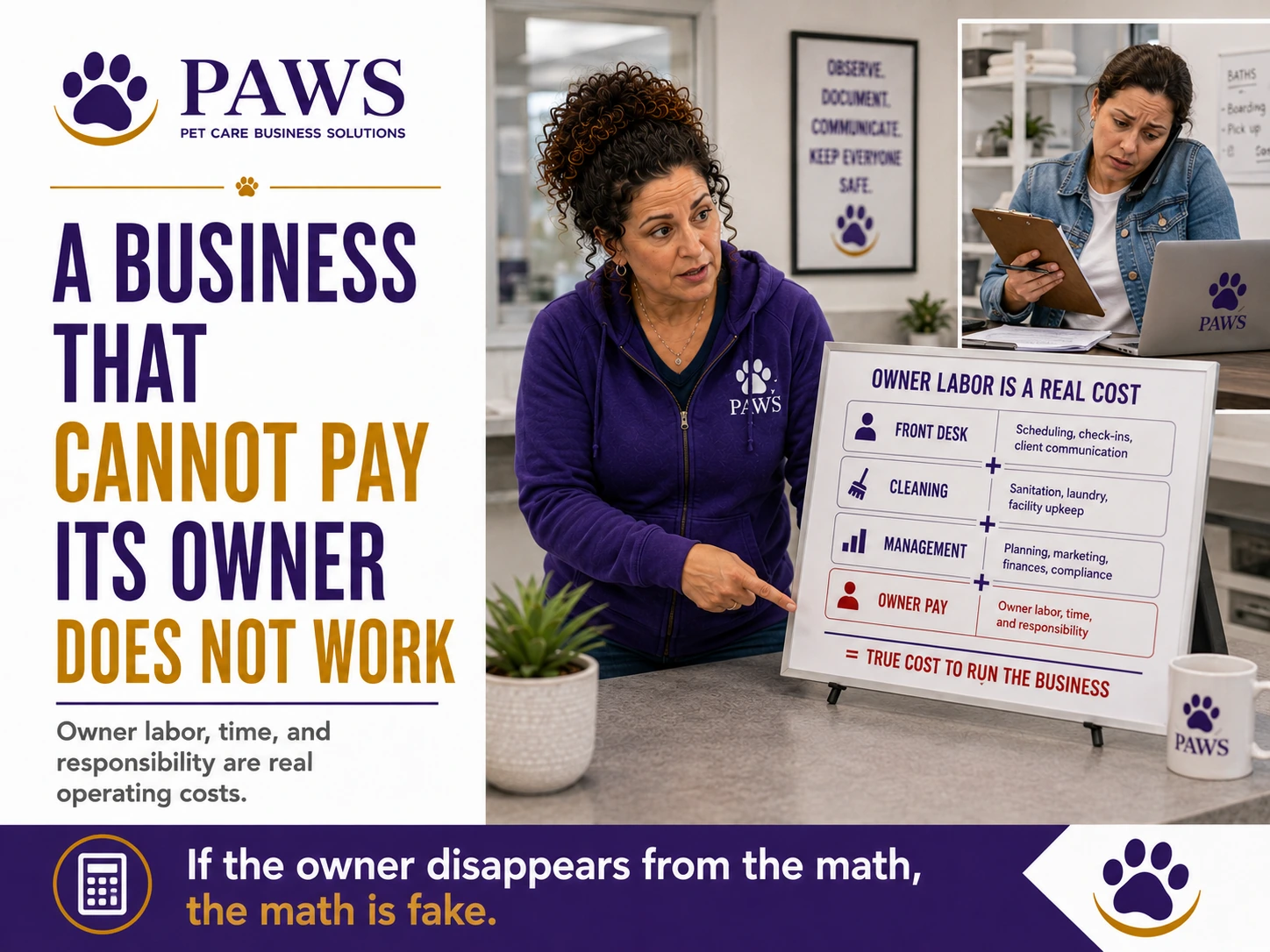
This is the part a lot of startup math politely lies about. It calculates what the business needs to survive, but it forgets that the owner is not a ghost haunting the lobby for free.
The owner still has rent or a mortgage, groceries, a car payment, insurance, taxes, debt, family expenses, medical expenses, emergencies, and life outside the dog kennel. If the daycare survives only because the owner makes nothing, the business did not pass the test. It just built itself a human chew toy.
This is why the calculator separates the business-only survival floor from the owner-real survival floor. The first number tells you what keeps the daycare from bleeding out. The second number tells you what the daycare needs if the owner also expects to make a living.
Owner compensation should reflect the actual role. An owner covering management, front desk, cleaning, sales, bookkeeping, hiring, maintenance, and emergencies is replacing several paid functions, not merely taking an optional profit distribution.
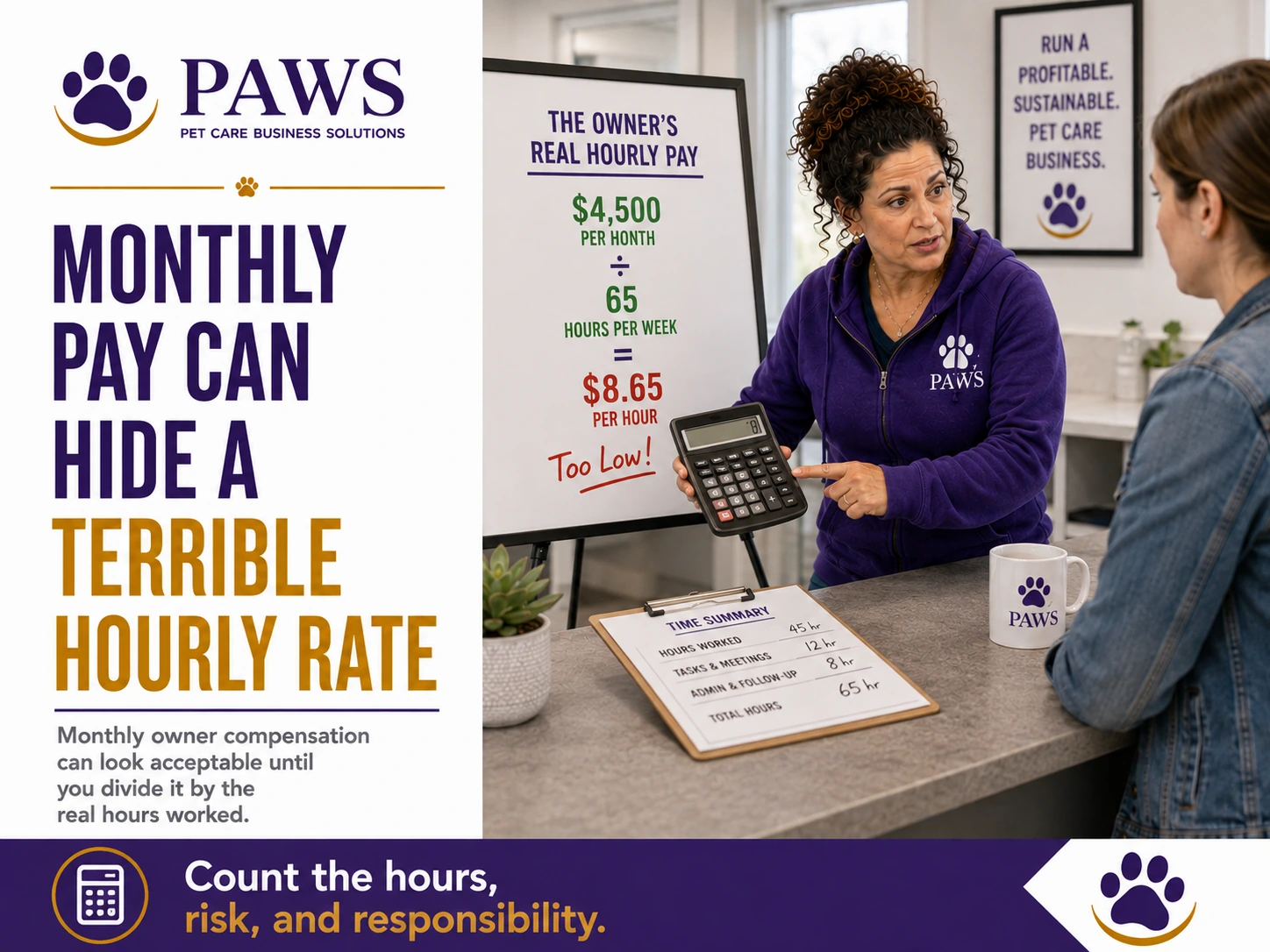
Track both monthly pay and effective hourly pay. A model that produces $4,500 per month may still be unacceptable when the owner works sixty-five hours per week without benefits, paid time off, retirement contribution, or protection from business risk.
| Owner Pay Assumption | What It Means | Operator Translation |
|---|---|---|
| $0/month | The owner is not paying themselves. | This is not a business model. This is volunteer work with liability insurance. |
| $2,667/month | About $32,000 per year before taxes, benefits, paid time off, retirement, and owner risk. | This is the “do not pretend the owner is invisible” minimum planning check. |
| $3,000/month | Minimal owner draw. | Better than nothing, but may still be too low for real adult bills. |
| $6,000/month | Practical owner compensation target for stronger planning. | This keeps the owner from being quietly erased from the math. |
| $8,000+/month | Stronger owner income target or higher-cost personal situation. | The business needs either stronger pricing, higher volume, better margins, or additional revenue streams. |
📌
Operator rule
Do not let the business “work” only because the owner disappears from the math. A daycare that cannot pay its owner is not healthy. It is just borrowing the owner’s life to make the spreadsheet look nicer.
🐕
Safe Dog Capacity Is Not Fantasy Capacity
Safe capacity is not how many dogs you can physically cram into the building before it looks like animal-care soup.
Safe dog capacity is the number of dogs the facility can handle safely, cleanly, and professionally with the staffing, layout, and supervision available.
This is not a game of “how many dogs fit in the room.” That kind of thinking is how you get noise problems, odor problems, injuries, staff burnout, angry customers, and playgroups that look like somebody dropped a tennis ball into a tornado.
Capacity has to be tied to the real operating design of the facility. The survival floor gets dangerous when owners use fantasy capacity to make the math look better.
Capacity should be calculated by operating zone and time of day. The building may hold fifty dogs overall while the lobby, gates, yards, rest rooms, staff coverage, or cleaning workflow becomes unsafe at a lower number.
Use a management capacity below the theoretical maximum. Weather, incompatible dogs, illness separation, employee absence, maintenance, boarding movement, and behavior problems all consume space and supervision that the floor plan may not show.
Facility limits
- Square footage.
- Playroom layout.
- Dog size separation.
- Outdoor space.
- Nap or rest areas.
- Cleaning workflow.
Operating limits
- Staffing levels.
- Real supervision.
- Temperament mix.
- Noise control.
- Customer drop-off flow.
- Incident response ability.
Outside limits
- Local rules.
- Fire or occupancy requirements.
- Insurance expectations.
- Lease restrictions.
- Animal-control expectations.
- Neighbor tolerance.
📌
Operator rule
If your survival floor only works because you used an unsafe or unrealistic dog count, the math is not strong. It is lying with confidence.
📊
Realistic Utilization: Stop Pricing Like Every Day Is Full
Utilization is the difference between what the building can hold and what the business actually fills on an average day.
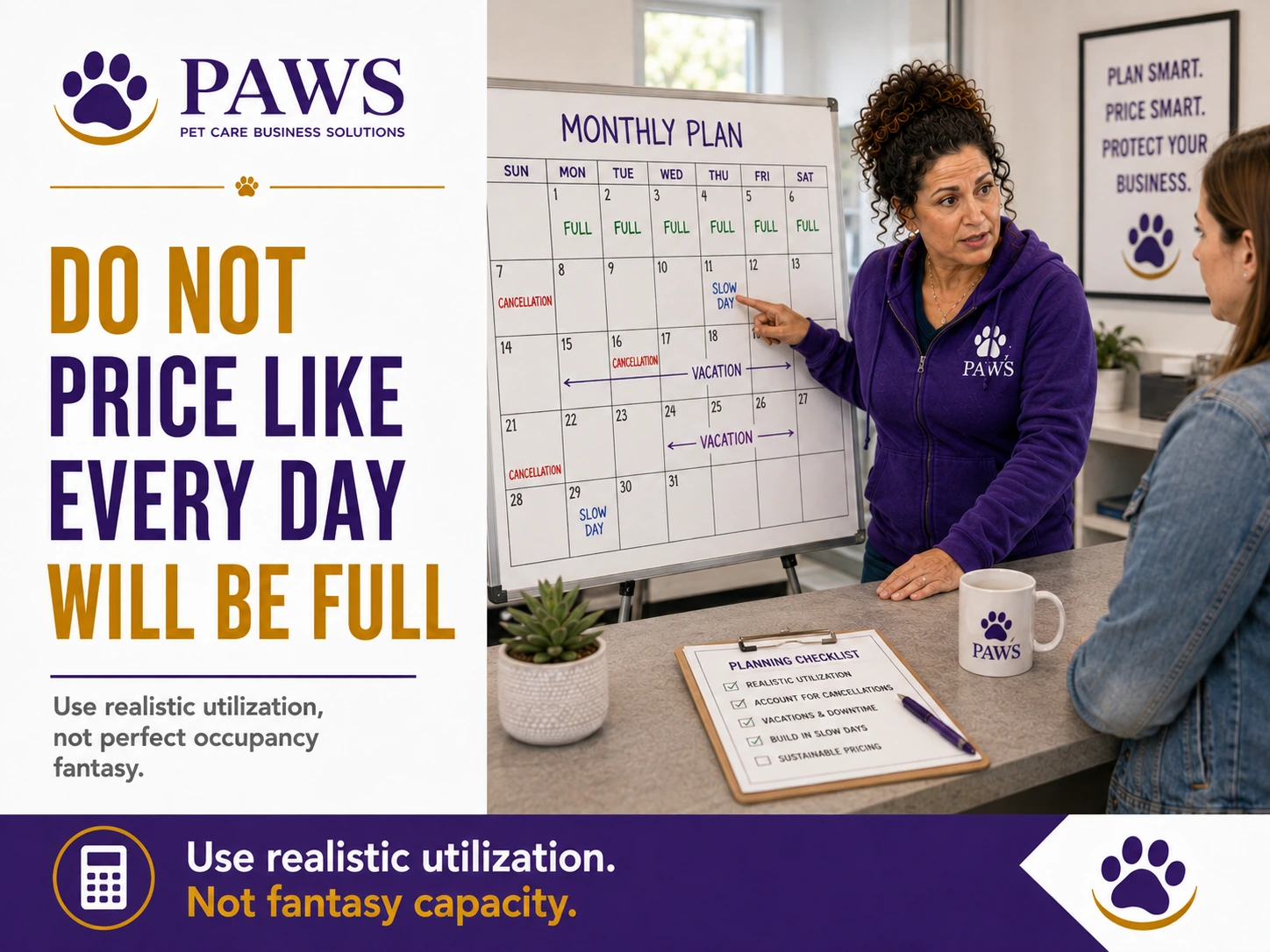
A plan that only works at 100% capacity is not a plan. It is a prayer wearing spreadsheet shoes.
You will have slow days. You will have weather problems. You will have customers on vacation, dogs out sick, cancellations, holidays, school schedule changes, and new-customer ramp-up periods. The business needs to survive normal attendance, not fantasy attendance.
Utilization should be based on paid attendance, not reservations created, package credits sold, or the best weeks of the year. Cancellations, no-shows, holidays, school schedules, weather, and customer turnover all affect the denominator that must carry fixed costs.
Model the ramp separately from the mature business. A new location may spend months below the long-term utilization target while rent, payroll, marketing, software, and debt are already due. Working capital must cover that difference.
| Utilization Level | What It Means | Operator Translation |
|---|---|---|
| 50% | Half of safe capacity filled on average. | Early-stage, weak demand, or conservative planning. If the model fails here, that is not surprising. |
| 60% | Better customer base, but still not humming. | Useful for cautious planning, especially before the business is established. |
| 70% | Practical planning level for many working daycare models. | A good middle-ground assumption if demand, location, and operations are credible. |
| 80% | Strong utilization. | Possible in a good operation, but do not assume it before proof. |
| 90%+ | Very strong average utilization. | Great if real. Dangerous if invented because the spreadsheet needed help. |
🧠
Operator rule
Price your survival floor around realistic attendance. If the business only works when every slot is full, every day, with no mistakes, no cancellations, and no slow months, the business is too fragile.
🧼
Variable Cost Per Dog-Day: More Dogs Are Not Free
Variable costs are the costs that rise as dog volume rises. They may look small one at a time, but they pile up.
More dogs are not free just because the lights are already on. Every dog creates some combination of cleaning, waste, laundry, wear, supervision pressure, customer communication, risk, and administrative work.
The mistake is thinking the only cost of one more daycare dog is a little water and some mop solution. That is too cute. More dogs create more mess, more pressure, more staff attention, more incident risk, and more wear on the building.
Variable cost should include the marginal labor created when dog volume crosses a staffing threshold. The next dog may not require another employee by itself, but the next five or ten may create an entire shift, attendant, cleaner, or front-desk need.
Review actual spending by paid dog-day after opening. Cleaning, laundry, payment fees, waste, supplies, repairs, customer communication, and incident work may differ materially from the original estimate.
Cleaning and facility use
- Cleaning chemicals.
- Laundry.
- Waste bags.
- Water use.
- Accident cleanup.
- Odor control.
Dog-related costs
- Wear and tear.
- Toys and enrichment supplies.
- Facility damage.
- Consumables.
- Play equipment replacement.
- Dog handling supplies.
Transaction and labor pressure
- Payment fees.
- Incremental labor pressure.
- Administrative time.
- Customer communication.
- Incident documentation.
- Scheduling and record work.
🧾
Survival Floor Examples
This is where the math starts slapping assumptions around. Same capacity. Same utilization. Different fixed costs. Very different survival floor.

The following examples assume a safe capacity of 50 dogs, 22 open days per month, 70% realistic utilization, $4 variable cost per dog-day, and a $6,000 monthly owner compensation target.
That produces:
50 dogs × 22 days × 70% utilization = 770 paid dog-days
$6,000 owner compensation ÷ 770 paid dog-days = $7.79 owner pay load per dog-day
The examples show why a market price cannot be judged in isolation. The same customer-facing rate may be healthy in a lean facility and disastrous in a high-rent, heavily staffed, debt-loaded operation.
Each owner should rebuild the examples with local costs and multiple attendance levels. The purpose is not to select the row that feels most comfortable; it is to discover which cost structure the planned business actually resembles.
| Fixed Business Monthly Cost | Paid Dog-Days | Variable Cost | Business-Only Floor | Owner-Real Floor | Operator Translation |
|---|---|---|---|---|---|
| $20,000 | 770 | $4 | $29.97 | $37.77 | Bare-bones owner-operated or low mortgage model. Possible, but the owner-real number is the one that matters. |
| $25,000 | 770 | $4 | $36.47 | $44.26 | Lean but real. Ordinary pricing may work if discipline is strong and discount drag is controlled. |
| $32,500 | 770 | $4 | $46.21 | $54.00 | Normal modern daycare planning baseline. This needs stronger pricing, add-ons, utilization, or a solid service mix. |
| $40,000 | 770 | $4 | $55.95 | $63.74 | Strong staffed facility. The market, service quality, and customer value all need to justify the number. |
| $50,000 | 770 | $4 | $68.94 | $76.73 | Premium metro or heavy-cost model. Ordinary daycare pricing will not carry this without serious help. |
| $65,000 | 770 | $4 | $88.42 | $96.21 | High-cost market or premium buildout. The business needs premium pricing, excellent utilization, strong add-ons, or a different model. |
💵
The $35 Daycare Problem
A $35 full-day price can be perfectly reasonable in one business and financially stupid in another.

This is why copying competitors can get dangerous. A $35 full-day price can work in a lean, owner-operated, disciplined facility with sane fixed costs, good utilization, limited discount drag, and an owner-real survival floor that the price can actually beat.
The same $35 price can fail miserably in a high-rent, manager-run, overstaffed, over-discounted facility with expensive software, high payroll, weak utilization, no real add-on revenue, and an owner who still needs to make a living.
Same posted price.
Completely different business.
This is why the survival floor comes first. It tells you whether the price the market might accept is even capable of carrying the business you are trying to build.
The posted price should be reconciled with package sales, memberships, sibling discounts, promotions, staff discounts, credits, refunds, and free days. The business does not operate on the price displayed on the wall; it operates on the money that arrives.
A lower effective price may be intentional when it improves frequency, retention, or prepaid cash flow, but the discount must still leave realized revenue above the owner-real floor. Volume that loses money faster is not a pricing strategy.
🛑
Do not use another business’s price without understanding another business’s costs.
You are not running their rent, their payroll, their debt, their staffing model, their building, their owner compensation target, or their customer base.
🚧
What Happens If the Market Price Is Below the Survival Floor?
Sometimes the math is not telling you to charge less. Sometimes the math is telling you the business model is bad.
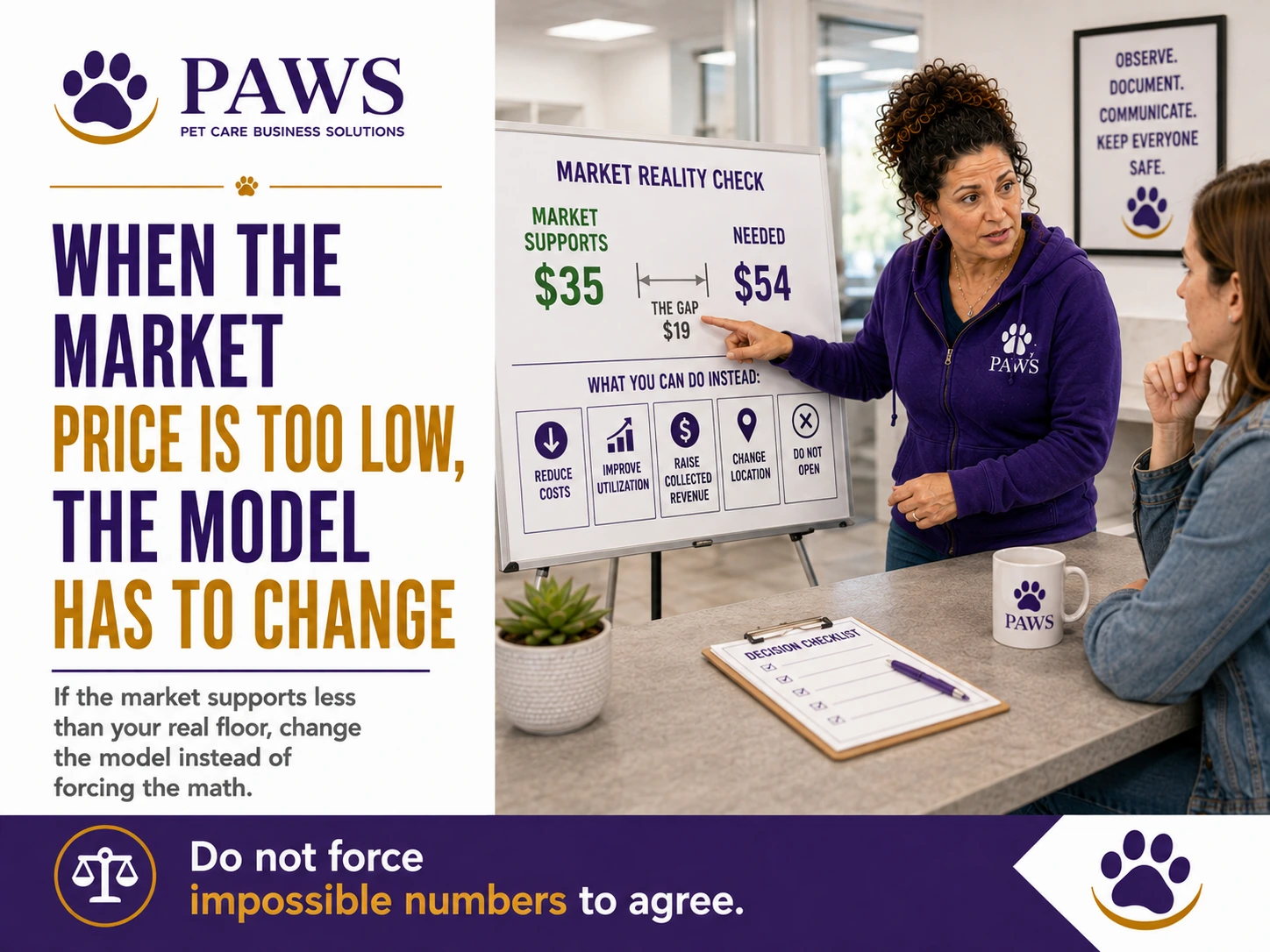
If your market can realistically support $35, but your owner-real survival floor is $54, you have a problem. The problem is not that customers are mean. The problem is that the business structure, owner income requirement, and market price do not agree.
That does not always mean the idea is dead, but it does mean something has to change. You cannot just smile at the spreadsheet until it behaves.
The gap between market-supported revenue and the survival floor should be quantified before deciding what to change. Separate the effects of rent, payroll, capacity, utilization, discounts, variable cost, debt, and owner compensation so the owner knows which levers matter most.
Some gaps cannot be repaired with small efficiencies. When the market supports far less than the model requires, changing the site, service mix, build-out, staffing design, financing, or opening decision may be more responsible than forcing an unrealistic price.
Ways to improve the model
- Raise price if the value and market can support it.
- Improve the service value so the higher price makes sense.
- Reduce fixed business costs.
- Reduce payroll pressure.
- Improve utilization.
- Reduce discount drag.
- Add grooming, bathing, enrichment, or other revenue.
Ways to avoid a bad opening
- Change the lease or location.
- Change the service model.
- Reduce the build-out burden.
- Rework capacity assumptions.
- Delay hiring management too early.
- Build cash reserve before opening.
- Do not open if the numbers are screaming.
📌
Operator rule
If the market will not support the price your business needs to survive and pay the owner, the answer may not be “charge less.” The answer may be “this version of the business does not work.”
🧮
Dog Daycare Survival Floor Calculator
This is the basic free version. It gives you the business-only and owner-real survival floor using the public formula, not the full paid diagnostic machine.
Use the calculator as a screening tool, then reconcile each input with a supporting schedule. The output becomes more useful when the user can explain where every cost, capacity assumption, utilization rate, and owner-pay target came from.
The owner-hour field is not decorative. It exposes whether the monthly compensation target produces a professional return for the labor and risk or merely disguises a low-wage job inside a business entity.
❓
Dog Daycare Survival Floor FAQ
Detailed answers about collected revenue, fixed costs, owner compensation, safe capacity, utilization, variable costs, discounts, market-price gaps, add-on revenue, working capital, recalculation, and turning the survival floor into a sustainable pricing decision.
What is a dog daycare survival floor?
It is the minimum average collected revenue per paid dog-day needed to cover the business’s monthly fixed-cost load and the variable cost created by each dog-day. It is a cost-and-capacity reality check, not a prediction of what customers will pay.
The owner-real version also includes a defined owner compensation target. That second number exposes businesses that can keep the doors open only because the owner works without receiving a sustainable return.
Why should I use collected revenue instead of the posted daycare price?
The posted price does not account for packages, memberships, sibling discounts, promotions, credits, refunds, staff discounts, or free days. Those adjustments can reduce the average amount the business actually receives for each paid dog-day.
Use sales and attendance records to divide collected daycare revenue by the paid dog-days delivered. That realized number is what must beat the survival floor.
What is the difference between the business-only floor and the owner-real floor?
The business-only floor covers the business’s fixed costs and variable dog-day cost. It answers whether the operation can keep paying its bills before owner compensation is considered.
The owner-real floor adds the owner’s monthly compensation target. It answers whether the business can support both the operation and the person carrying the ownership labor, guarantees, debt, and risk.
Should owner compensation be treated as a real cost?
Yes. The owner may be performing management, front desk, cleaning, bookkeeping, sales, maintenance, hiring, scheduling, and emergency coverage. Those functions would require paid labor if the owner stopped doing them.
A plan that works only when owner pay is zero is not financially complete. Include a realistic monthly target and compare it with the actual hours the owner expects to work.
Why should owner work hours be included?
Monthly compensation can look acceptable until it is divided by the actual time required. Long weeks, weekend coverage, interrupted time off, and after-hours emergencies can turn a seemingly respectable draw into a very low effective hourly rate.
The hourly comparison should also recognize that the owner usually lacks ordinary employee benefits and carries lease, payroll, legal, insurance, and capital risk. The target should reflect more than bare survival.
What belongs in fixed monthly costs?
Include rent or mortgage, CAM charges, base payroll and burden, insurance, utilities, software, debt payments, bookkeeping, phones, internet, licensing, baseline marketing, security, cleaning support, maintenance allowances, and other costs that continue during slow attendance.
Use contracts, quotes, payroll schedules, and actual bills where possible. Omitting an uncomfortable expense does not reduce the future invoice; it only makes the floor inaccurate.
Are payroll costs really fixed?
Some payroll is fixed for the operating schedule and minimum staffing plan, while some is step-fixed and rises when attendance crosses a threshold. The model should reflect both the base team and the additional labor required at higher volume.
Do not treat all labor as a tiny variable cost per dog. One attendance increase may require an entire attendant, manager shift, cleaner, or front-desk position rather than a few extra dollars.
How should safe dog capacity be determined?
Safe capacity depends on room sizes, dog separation, staffing, supervision, gates, rest space, outdoor access, cleaning flow, customer traffic, licensing, insurance, and the ability to respond to incidents.
It should be lower than the number of dogs that physically fit. Use an operating capacity that allows for incompatible dogs, weather, illness separation, employee absence, maintenance, and behavior problems.
Why is 100 percent utilization a dangerous assumption?
Real businesses experience slow days, cancellations, illness, vacations, weather, seasonality, customer turnover, and a startup ramp. A model that needs every available space sold every day has no operating cushion.
Test several utilization levels and use a conservative figure supported by local demand and actual history. Higher utilization should be treated as upside until the business proves it can sustain it.
How do I calculate paid dog-days?
Multiply safe dog capacity by open days per month and realistic average utilization. A fifty-dog capacity open twenty-two days at seventy percent utilization produces 770 paid dog-days.
Use paid attendance rather than package credits sold or reservations booked. The fixed cost load is carried by services actually delivered and paid for during the period.
What belongs in variable cost per dog-day?
Include costs that rise with dog volume, such as cleaning chemicals, laundry, waste bags, consumables, payment fees, enrichment supplies, wear, incremental labor pressure, and dog-specific administrative work.
Review actual spending after opening and update the estimate. Small per-dog errors become material when multiplied across hundreds or thousands of monthly dog-days.
How often should the survival floor be recalculated?
Recalculate it during initial planning, before signing major commitments, before finalizing prices, and whenever rent, payroll, hours, capacity, insurance, debt, owner involvement, utilization, or service mix changes.
An annual review is a minimum for a stable operation. Faster-changing businesses should monitor the floor monthly or quarterly and compare it with realized revenue.
What if the market price is below the owner-real survival floor?
That means the current cost structure, volume assumptions, owner-pay target, and market-supported revenue do not fit together. The answer is not automatically to charge a price customers will reject or to erase owner compensation.
Evaluate rent, build-out, debt, staffing, utilization, capacity, discounts, service mix, add-ons, and location. When the gap remains large, this version of the business may not be viable.
Can higher utilization solve a pricing problem?
Sometimes, because more paid dog-days spread fixed costs across more units. But the attendance must be safe, supported by demand, and achievable without adding enough payroll or space pressure to erase the benefit.
Do not use invented utilization to rescue the spreadsheet. Model the extra labor, cleaning, wear, risk, and operating complexity created by the higher volume.
Can add-on services lower the required daycare price?
Profitable grooming, bathing, enrichment, boarding, retail, transportation, or training may contribute margin that helps support the overall business. The contribution must be measured after the direct labor and costs of those services.
Do not use hoped-for add-on revenue as a blank subsidy. Build a service-level forecast and identify how much reliable margin actually reduces the pressure on daycare pricing.
How should discounts and packages be tested?
Calculate the expected average collected revenue after the actual package mix, membership rate, sibling use, promotions, credits, and expiration rules. Then compare that realized amount with the owner-real floor.
A discount may improve retention or frequency, but it should not create a customer segment that consumes capacity below viability. Measure the behavior and margin rather than assuming prepaid cash means profit.
Why can a $35 daycare price work for one business and fail for another?
Facilities have different rent, payroll, debt, staffing models, capacity, utilization, owner involvement, software, insurance, discounts, and service mix. The same posted rate carries a different cost load in each operation.
Copying a competitor’s price copies none of the conditions that made the price possible. Build the floor from your own business and then test the local market.
Does the survival floor include startup working capital?
The basic monthly formula does not automatically fund construction overruns, deposits, launch losses, slow ramp-up, major repairs, or cash reserves. Those needs belong in the broader startup and cash-flow plan.
A business may have a workable mature floor and still fail before reaching mature utilization. Model the monthly ramp and maintain enough capital to cover the gap.
Is the survival floor the final price I should charge?
No. It is the minimum collected-revenue threshold the final pricing system must beat. The actual price must also account for market demand, customer value, service positioning, competitive alternatives, discount structure, profit, reinvestment, and risk.
A price equal to the floor leaves little room for error or future investment. Healthy pricing should create a margin above the owner-real floor rather than touching it exactly.
What is the bottom-line survival-floor rule?
Build the number from honest costs, safe capacity, realistic utilization, variable dog-day expense, and a real owner-pay target. Then compare it with collected revenue—not the number printed on the sign.
When the market cannot support the amount the business must collect, change the model before signing the lease, building the facility, or using the owner’s unpaid labor to hide the problem.
✅
Next Step: Take This Number Back to Pricing
Once you know your survival floor, you can test whether your posted price and realized revenue clear it.
The survival floor tells you what the business needs. The pricing page helps you test whether the market-supported price, service mix, packages, discounts, and add-ons can actually beat that number.
Do not skip this handoff. A survival floor by itself is not the final price. It is the number the final price has to beat after the market, customers, packages, discounts, owner compensation, and reality all take their bite.
Pricing must clear the floor after package discounts, membership economics, payment fees, promotions, and service mix are considered. The posted rate should contain enough room for ordinary customer behavior without pushing the collected average below viability.
Revisit the floor whenever rent, payroll, hours, capacity, owner involvement, debt, insurance, or service mix changes. A price that worked last year can quietly become inadequate while the sign remains unchanged.