Dog Grooming Tools, Grooming Arms, No-Sit Devices, Grooming Harnesses, and Grooming Room Equipment
Dog Grooming Hardware and Accessories for a Working Grooming Room
Just as there are many table types to choose from there are even more accessories and add-ons to use with them. There are numerous types of grooming nooses/loops, table arms, tool holders, etc. Not all of them are good and many will depend on the groomers’ preference and prior experience.
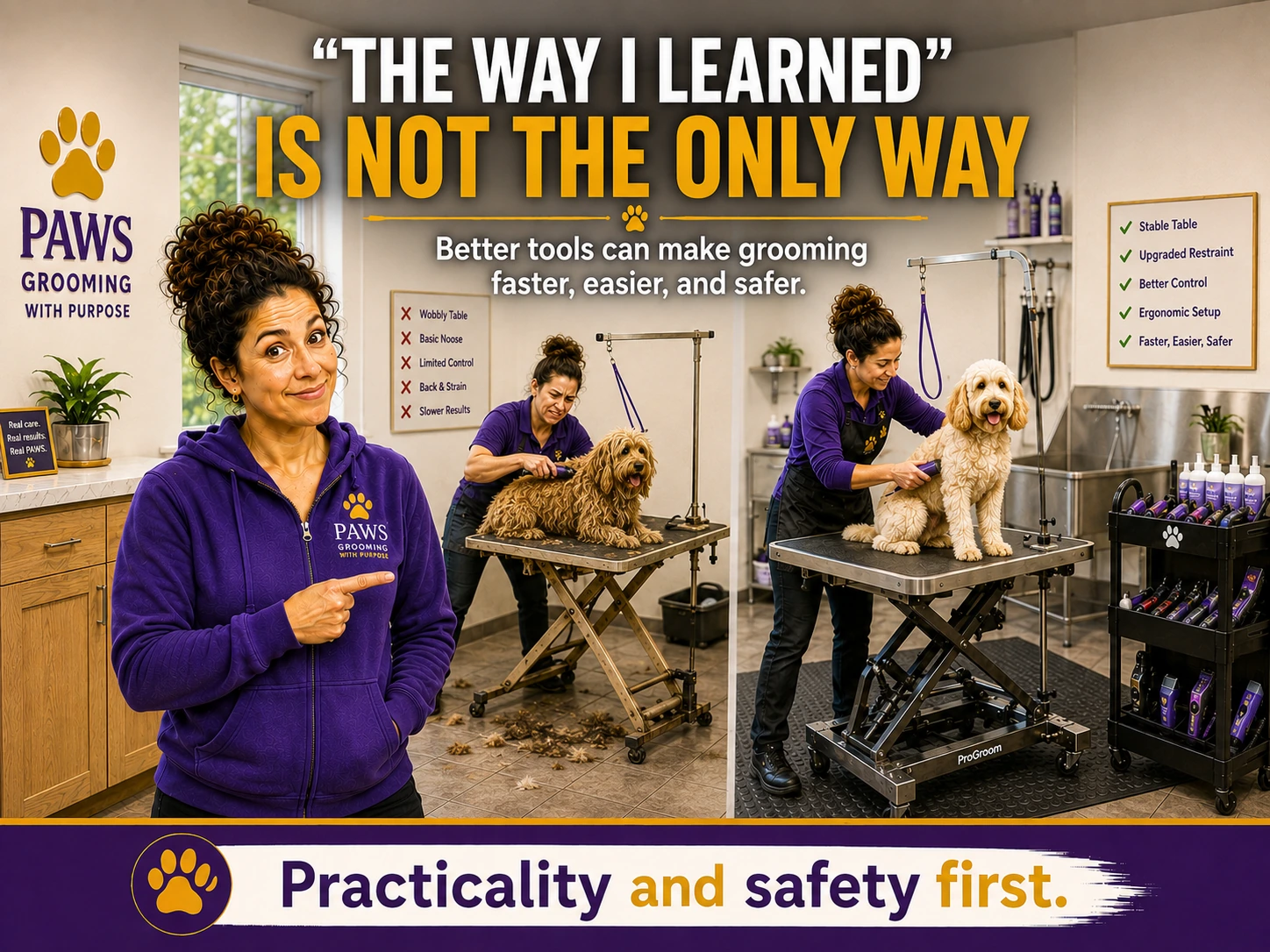
This again is not always a good thing as many pet groomers may have only worked in one or two shops and accordingly may not been exposed to many of the available accessory options to make grooming, faster, easier, and safer.
Groomers tend to get set in their ways rather quickly, they find a way that works and that becomes “the way”. From this point they will typically be very resistant to change or to the idea of utilizing other tools or options outside of their comfort zone that may in fact considerably ease the job of pet grooming. It is important to note that people, groomers included tend to complete a job in the manner in which they were trained to complete it, if your groomer/employee was trained improperly utilizing low grade tools or unorthodox methods to secure dogs they will carry that with them and will even fight to keep it that way as it works for them and it would take to much effort to learn a new way of doing things or how to properly utilize tools that coincide with advancements in technology.
That being said the following Grooming Table Hardware and Accessories section is based on my experience and opinions with a variety of different accessories and options. As always I look at practicality and safety above comfort and appearance.
⚠️
Operator warning
Cheap equipment is not cheap when it slows the groomer, scares the dog, breaks under daily use, creates a safety problem, or has to be replaced the minute the grooming room finally starts getting busy.
🦺
Restraint and Positioning Equipment
Restraint equipment is not about bullying the dog. It is about safer positioning so staff can work without turning every difficult dog into a strength contest.
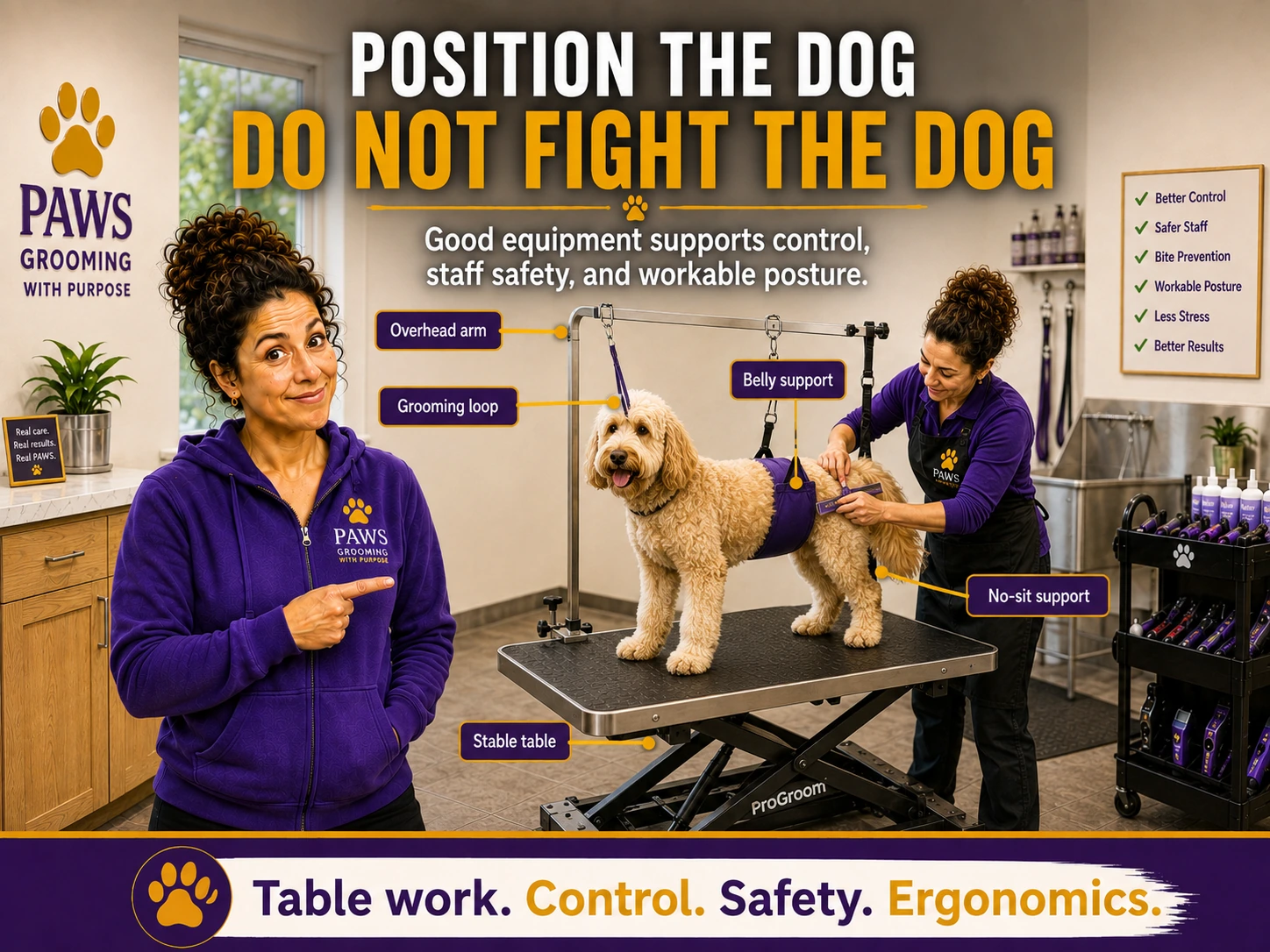
Restraint and positioning equipment is where table work, dog control, staff safety, bite prevention, and ergonomics collide. A good system does not simply keep the dog attached to the table. It helps position the dog in a stable, workable posture so the groomer can reach the areas that need attention without constantly lifting, twisting, wrestling, or leaning across the animal. The table, grooming arm, loop, belly support, harness, no-sit device, and other positioning accessories should work together as one coordinated handling system.
Each piece needs to match the dog’s size, behavior, physical condition, and the type of work being performed. Proper equipment can reduce unnecessary movement, improve access to feet and difficult coat areas, help prevent sudden spinning or jumping, and give staff better control when a dog sits, collapses, pulls away, or becomes reactive.
A poorly selected or badly adjusted setup can do the opposite. It can create false confidence, place pressure in the wrong location, interfere with the groomer’s posture, allow the dog too much uncontrolled movement, or turn a manageable dog into a dangerous handling problem. Restraint equipment should support skilled handling, not replace judgment, observation, or the decision to stop when the dog cannot be positioned safely.
⬆️
Overhead Grooming Arm
A grooming arm style intended to provide overhead support and better positioning options.
📐
Standard 90-Degree Grooming Arm
Common one-adjustment grooming arm style and its practical limits.
↔️
Dual Adjustable Grooming Arm
More adjustment can mean better positioning when the arm is actually built well enough to hold up.
📏
Telescoping Grooming Arms
Adjustable height and reach options for different dogs, tables, and grooming positions.
🧳
Folding Grooming Arms
Folding designs may help storage and portability, but commercial stability still matters.
🔄
Rotating Grooming Arm
Rotation can help positioning, but only when it improves control instead of adding movement you do not want.
🧱
Wall-Mount Grooming Arm
A fixed support option that changes the table relationship and how the grooming station is arranged.
🪑
No-Sit Devices
Gateway to no-sit positioning tools used when dogs keep sitting, collapsing, or refusing to stand.
🪢
Grooming Nooses
Grooming nooses are the basic restraint pieces behind most table setups, belly straps, harnesses, head control, no-sit support, and safer dog positioning.
❓
Grooming Arms and Table Hardware FAQ
Five practical answers for operators using this page as a gateway into grooming arms, no-sit devices, loops, and positioning systems.
What is this hub page meant to help me choose?
This page is the starting point for comparing grooming arms, loops, no-sit devices, harnesses, wall-mounted and table-mounted hardware, and other positioning systems. The linked pages provide the deeper product-type discussions. Use the hub to identify which branch matches the dog-control or table-work problem you are trying to solve.
Should a groomer keep using the setup they were trained on?
Familiarity matters, but it should not override safety, control, ergonomics, or better equipment. A groomer may be comfortable with a basic loop or weak arm because that is what they learned. The operator should still evaluate whether a more stable table, better support, or improved positioning system reduces fighting, fatigue, and risk.
Does better restraint equipment replace handling skill?
No. Hardware can improve positioning and reduce uncontrolled movement, but staff still need correct fit, observation, dog-specific judgment, and clear limits. No arm, loop, harness, or no-sit device makes every dog appropriate to continue grooming when fear, aggression, pain, or poor control creates an unsafe situation.
How should grooming arms and positioning accessories be evaluated?
Check table compatibility, attachment strength, adjustability, dog size, restraint angle, stability, cleaning, wear points, and how the equipment affects the groomer’s posture. The complete setup should help position the dog without creating false security, awkward force, or another weak point that fails under pressure.
What is the main rule for choosing table hardware?
Position the dog instead of turning every groom into a strength contest. Choose equipment that supports workable posture, safer control, bite prevention, and consistent table work. Practicality and safety should come before habit, appearance, or the fact that a groomer has always done it one particular way.