Interior Design, Customer Trust, and Facility Image
Dog Daycare Interior Design: Creating a Facility Customers Trust
Your lobby starts selling before your staff says hello. Make sure it is not selling fear, clutter, odor, and bad judgment.
Dog daycare interior design is not about throwing paw prints on the wall and pretending the business is cute now. It is about creating a facility that looks clean, safe, organized, warm, professional, and intentional the moment a customer walks through the door.
Your customer is making decisions before they fill out paperwork, before they meet the staff, and before their dog gets anywhere near the playroom. They are looking at the lobby, the floors, the smell, the clutter, the front desk, the visible play areas, the office mess, the staff behavior, and the general feeling of the place. Their brain is asking one question: Do I trust these people with my dog?
A daycare can be functional and still look terrible. A daycare can look cute and still operate terribly. The goal is the overlap: clean, practical, washable, professional, warm, fun, brand-consistent, customer-friendly, dog-safe, and not so overdecorated that cleaning becomes archaeology.
This is not the plumbing and floor-plan page. This is the page about first impression, customer image, visible cleanliness, lobby trust, play-area appeal, and whether your facility feels like a professional pet-care business or a converted storage unit with paw-print decals and a mop bucket having a nervous breakdown in the corner.
⚠️
Operator warning: cute is not the same as professional.
A dog daycare does not need to look like a luxury hotel vomited paw prints into a lobby. It needs to look clean, organized, safe, washable, and intentional. Cute helps only after the basics are handled. A pretty lobby attached to dirty corners, bad odor, weak storage, and chaotic dog flow is just a failure wearing a bow.
🗺️
Use This Page Like a Facility Image Walkthrough
Interior design should support trust, not just decoration. Walk through the page in the same order a customer experiences the facility.
🧠
Design Mindset
Interior design is silent sales staff. It is either helping you or quietly sabotaging you.
🏥
The Hospital Problem
Functional is not enough if the facility feels cold, sterile, depressing, or suspicious.
💰
Facility Tiers
Not every dream starts with a million dollars. Build for the wallet you actually have.
🔎
First Impression Audit
Check the lobby, smell, clutter, floors, office view, playroom view, and customer flow.
🧼
Visible Cleanliness
Customers judge the parts they can see and assume the hidden parts are worse.
🎨
Color and Controlled Fun
Use color, murals, photos, and play-area features without creating uncleanable nonsense.
🧭
Priority Sorter
Daycare, boarding, grooming, retail, and premium positioning do not need the same design priorities.
🚫
Do Not Buy This First
Before the startup goblin buys a lobby couch, make sure the core facility can breathe.
🧠
Interior Design Is Silent Sales Staff
Your facility is talking before your employees are. Make sure it is not saying something stupid.
When a customer walks into a dog daycare, they are not just looking for a place to leave the dog. They are looking for emotional permission. They want to feel like their dog is going somewhere happy, safe, clean, supervised, and professionally managed. They want to believe the dog is not being dropped into a kennel warehouse with fluorescent lights and resignation.
That feeling does not happen by accident. It comes from the way the space is presented: the lobby, front desk, paint, lighting, smell, clutter control, flooring, staff areas, visible playrooms, customer seating, dog-handling flow, signs, photos, and the general condition of the building.
The customer may not know what flooring you used, what disinfectant you use, how your playgroups are separated, or whether your staff understands dog body language. But they absolutely know when the place feels dirty, cramped, chaotic, cold, or cheap. They know when the office looks like a raccoon got promoted to general manager. They know when the lobby smells like wet carpet and poor decisions.
A strong interior does not have to be expensive. It has to be intentional. A tiny daycare can feel clean, warm, and trustworthy. A million-dollar facility can still feel fake, overbuilt, and operationally weak if it is all marble counters and no systems. The customer-facing image should support the actual business, not cosplay success.
📌
Operator rule
Interior design is not decoration first. It is trust first. Decoration comes after the customer believes the facility is clean, safe, organized, and run by adults.
📐
This Is Not the Facility Layout Page
Do not confuse interior image with construction layout. They overlap, but they are not the same job.
This section is not about where to put drains, kennels, grooming tubs, HVAC, isolation rooms, mop sinks, outdoor gates, customer doors, or staff doors. Those decisions belong in the facility design and layout work.
This page is about the part customers experience directly: the lobby, check-in area, visible play spaces, front desk, customer flow, wall finishes, color choices, play-area appearance, clutter control, office visibility, and the overall image of the facility.
A dog daycare can have excellent operational layout and still fail the customer image test. It can be escape-proof, easy to clean, easy to maneuver, have isolation rooms, grooming equipment, software, computers, landscaping, parking, and potty areas — and still feel like a hospital hallway where joy went to die.
That is the gap this page is fixing. The back of the house has to work. The front of the house has to make customers believe the back of the house works.
🏥
The Hospital Problem
Sanitary and functional is good. Cold, sterile, and emotionally dead is not.
A hospital is sanitary. It has equipment. It has systems. It has people who know what they are doing. It completes the tasks required of it. But nobody walks into a hospital and thinks, “This feels like a vacation.” It feels like a place sick people go to get fixed.
Some dog daycare facilities accidentally create the same feeling. The building is functional, but not inviting. The doors are secure, the playgroups are separated, the grooming room works, the software is installed, and the isolation space exists — but the customer-facing interior feels cold, dull, and mechanical.
That is a problem because the customer is not just buying function. They are buying the belief that their dog is going somewhere enjoyable. They want to picture their dog having fun, making friends, getting attention, and coming home happy. If the facility feels like a dog-processing center, you make that emotional sale harder.
The fix is not to make the facility silly. The fix is to make it warm, clean, cheerful, professional, and clearly built around dogs. Use color. Use light. Use real dog photos. Use organized check-in. Use visible cleanliness. Use play areas that look managed and safe, not barren or chaotic. Make the place feel alive without making it look like a cartoon exploded.
🧠
The customer is buying a feeling.
They want clean and safe, but they also want happy. If the place feels cold, cluttered, smelly, or depressing, the customer starts wondering whether the hidden areas are worse.
💰
Dog Daycare Facility Tiers: Interior Examples for Every Wallet
Not every dream starts with a million dollars. Build where you are, but build with a plan.
One of the fastest ways to scare off a realistic startup owner is to show only marble-counter, glass-wall, “my dog has a better vacation than I do” pet resorts. Those facilities exist, and they can be beautiful, but they are not where most people start.
A home-based side hustle, tiny mom-and-pop daycare, lean owner-operated facility, standard commercial daycare, professional full-service facility, premium pet resort, and glorious luxury dog hotel are not the same animal. They do not have the same budget, payroll, buildout, lobby, customer expectation, or burn rate.
The design lesson is simple: match the interior to the tier honestly. Do not make a Tier 2 daycare pretend to be Tier 7. Do not make a Tier 5 facility look like Tier 2 because the owner spent everything on the back room and forgot the customer has eyes. Build the best version of the tier you are actually in.
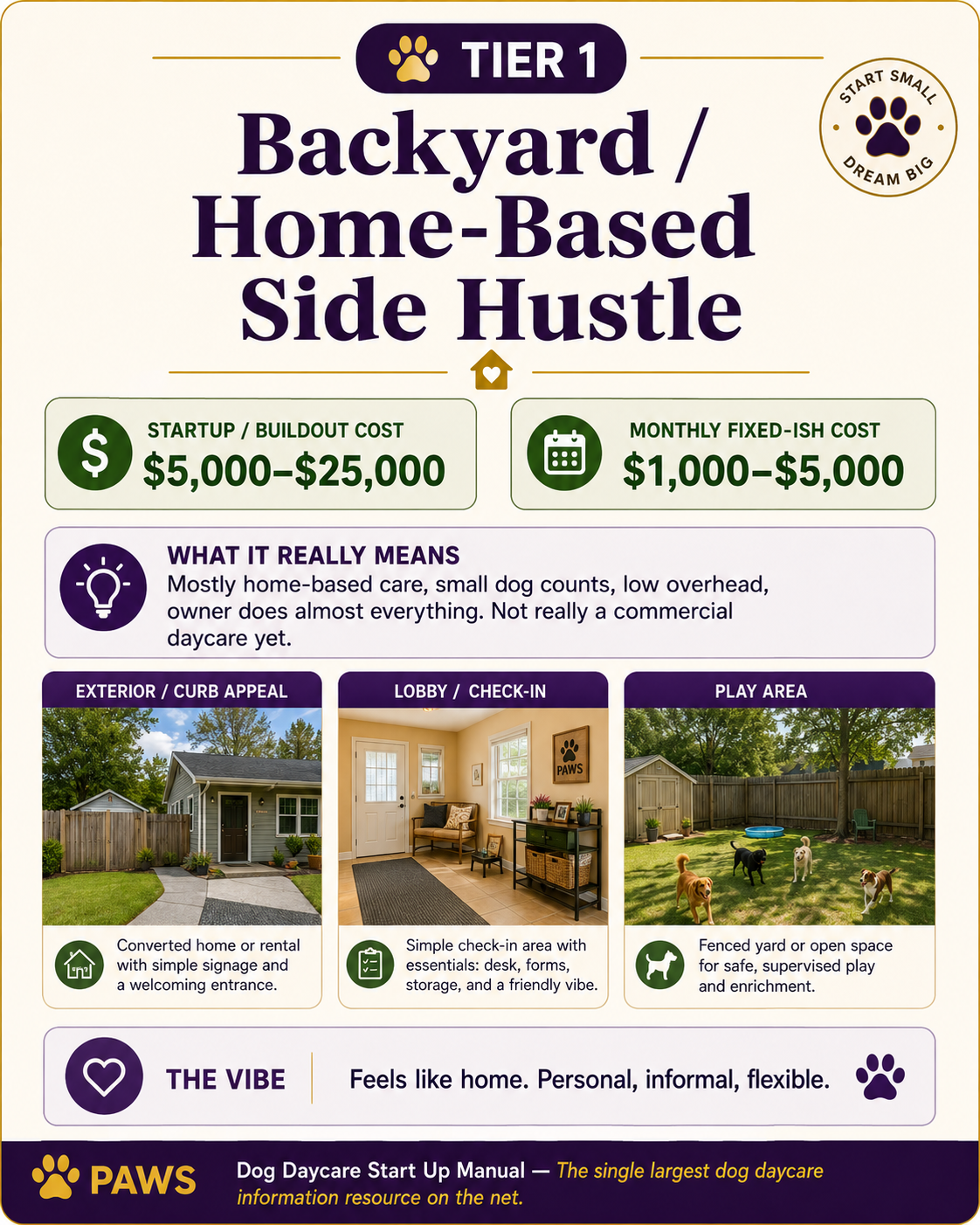
Tier 1
Backyard / Home-Based Side Hustle
Startup / Buildout: $5,000–$25,000
Monthly fixed-ish cost: $1,000–$5,000
Mostly home-based care, small dog counts, low overhead, and the owner does almost everything. This is not really a commercial daycare yet, but it can be a realistic starting point for someone learning demand, handling dogs, and proving whether the market exists.
Interior lesson: clean, personal, organized, safe, and honest beats fake luxury every time.
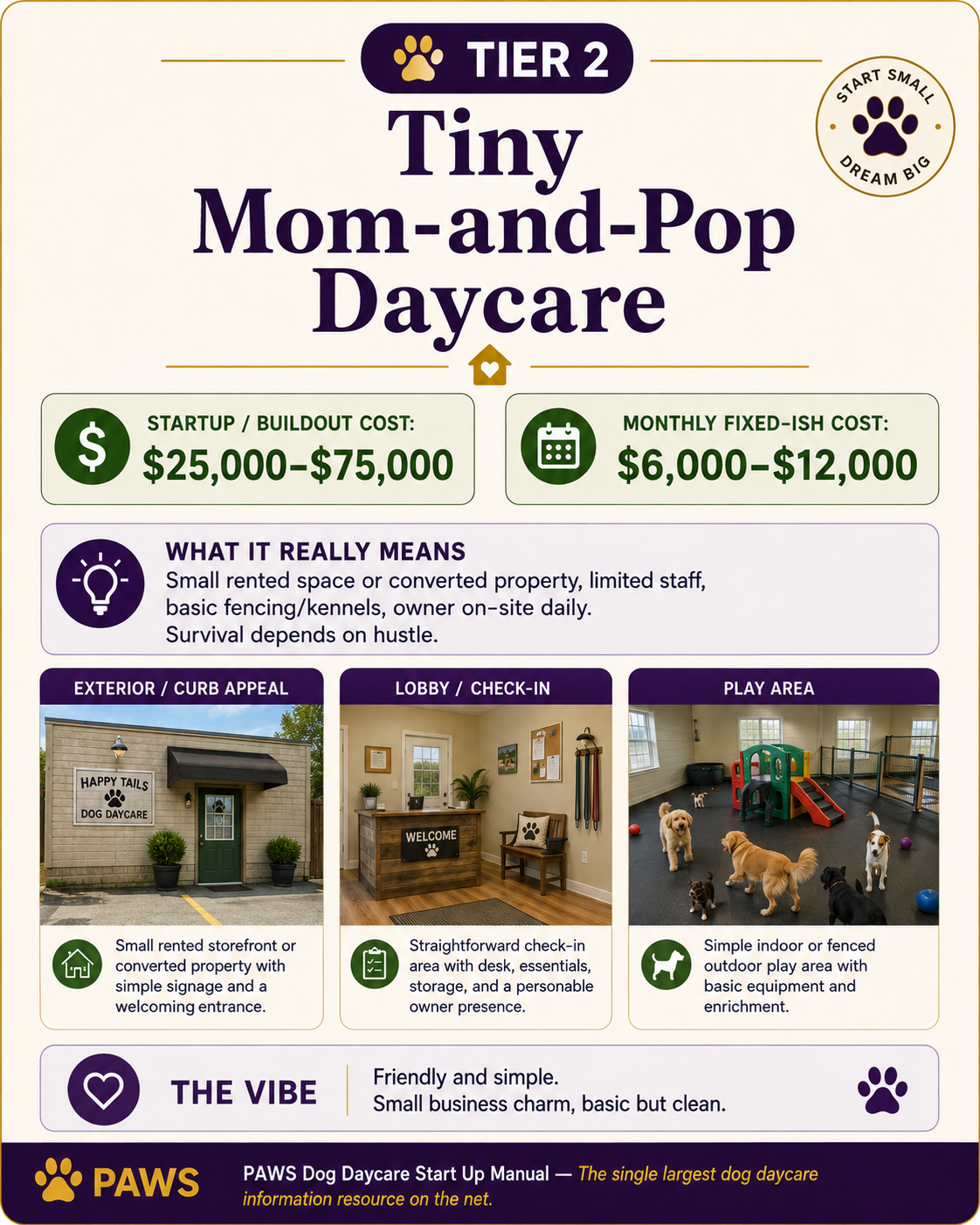
Tier 2
Tiny Mom-and-Pop Daycare
Startup / Buildout: $25,000–$75,000
Monthly fixed-ish cost: $6,000–$12,000
Small rented space or converted property, limited staff, basic fencing or kennels, owner on-site daily. Survival depends on hustle, clean habits, tight expenses, and not pretending the business is bigger than it is.
Interior lesson: simple, friendly, and clean. Customers will forgive small. They do not forgive dirty, chaotic, or sketchy.
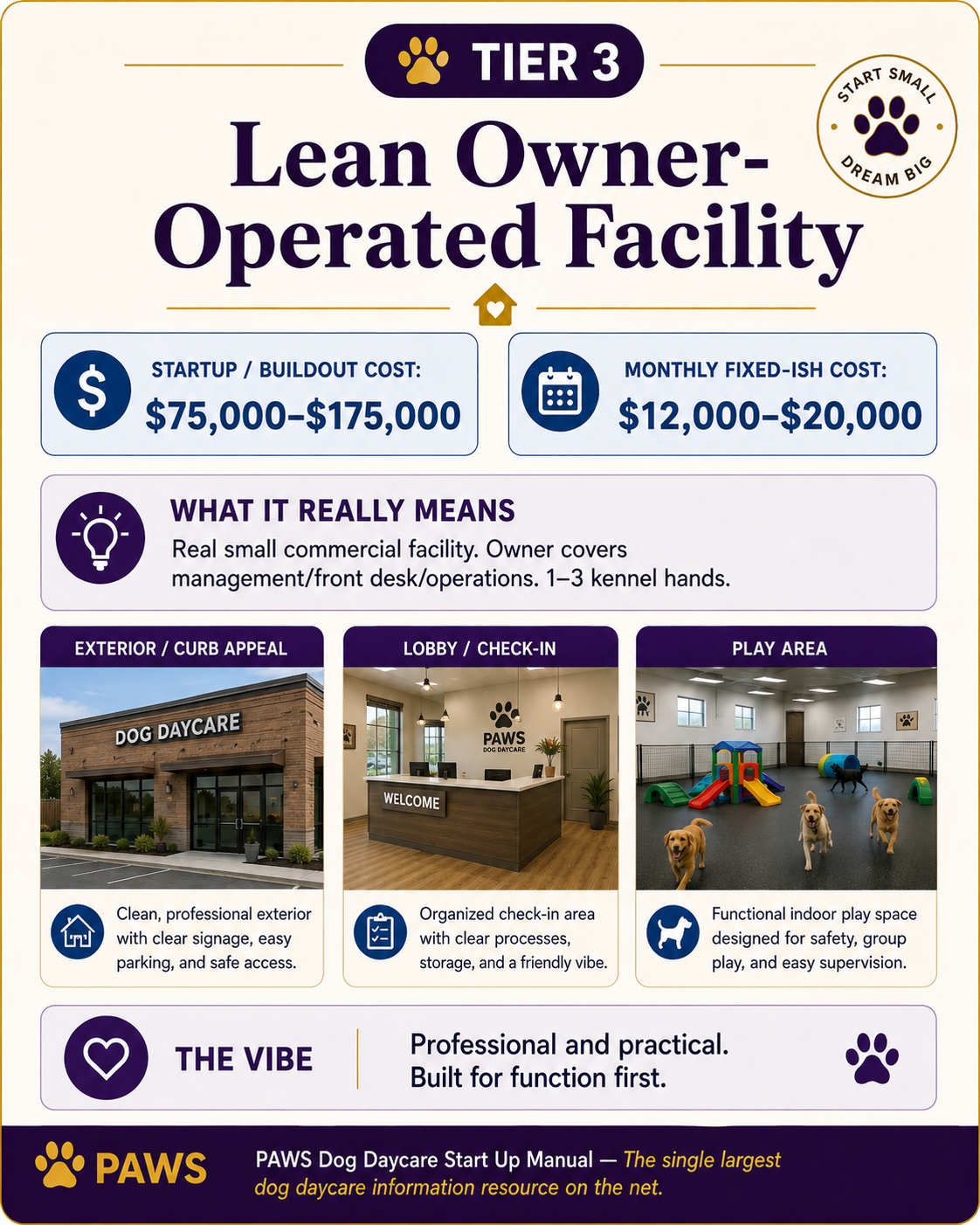
Tier 3
Lean Owner-Operated Facility
Startup / Buildout: $75,000–$175,000
Monthly fixed-ish cost: $12,000–$20,000
This is a real small commercial facility. The owner usually covers management, front desk, operations, and whatever else catches fire that day. Usually 1–3 kennel hands. Practical, no-frills, and workable if debt is low.
Interior lesson: professional and practical. Spend money on surfaces, storage, odor control, lighting, and dog flow before decorative nonsense.
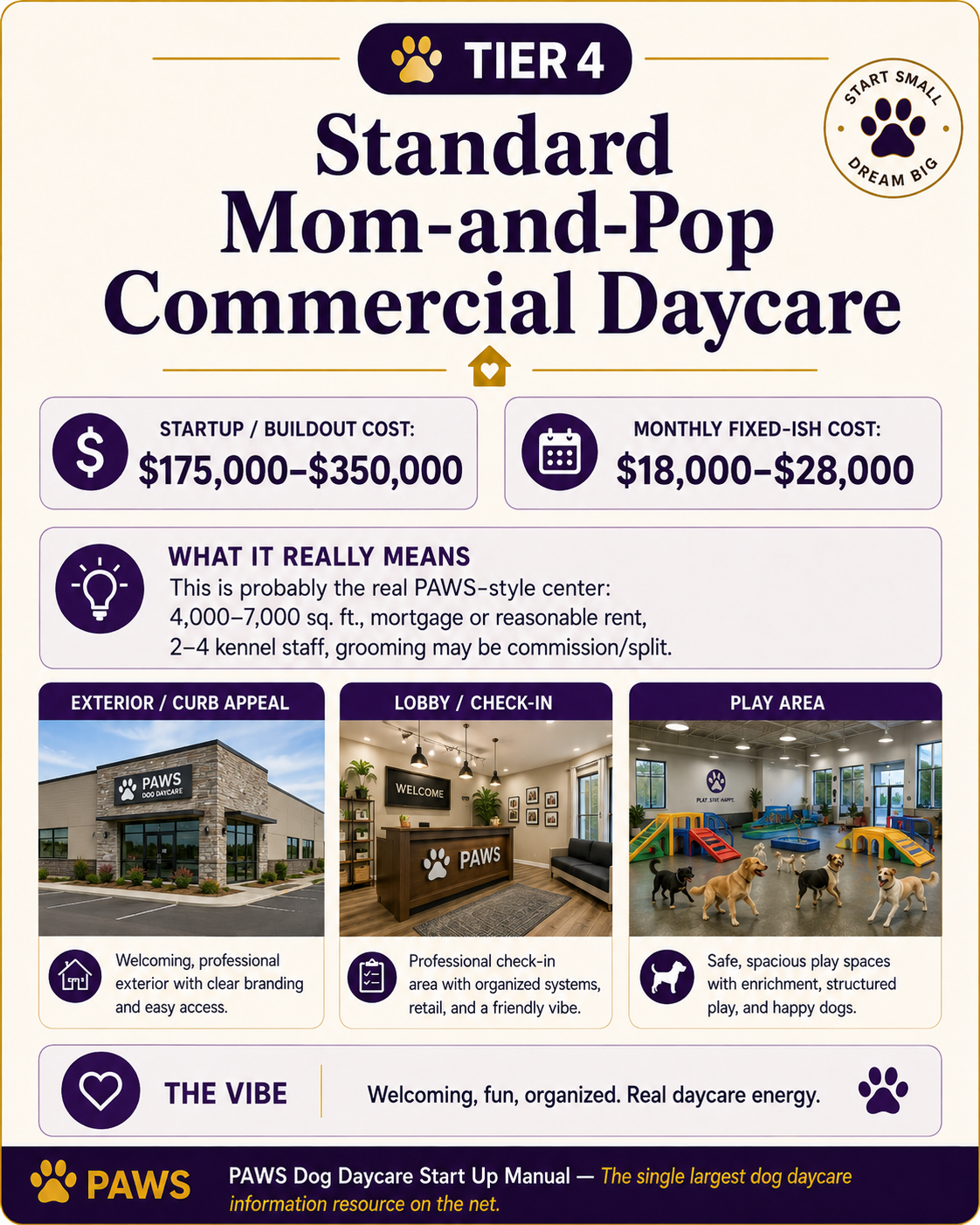
Tier 4
Standard Mom-and-Pop Commercial Daycare
Startup / Buildout: $175,000–$350,000
Monthly fixed-ish cost: $18,000–$28,000
This is probably the real PAWS-style center: 4,000–7,000 square feet, mortgage or reasonable rent, 2–4 kennel staff, and grooming may be commission or split. This is where a lot of serious small operators live.
Interior lesson: welcoming, fun, organized, and branded without getting stupid. The place should look like a real daycare, not a warehouse with a dog mural taped to the wall.
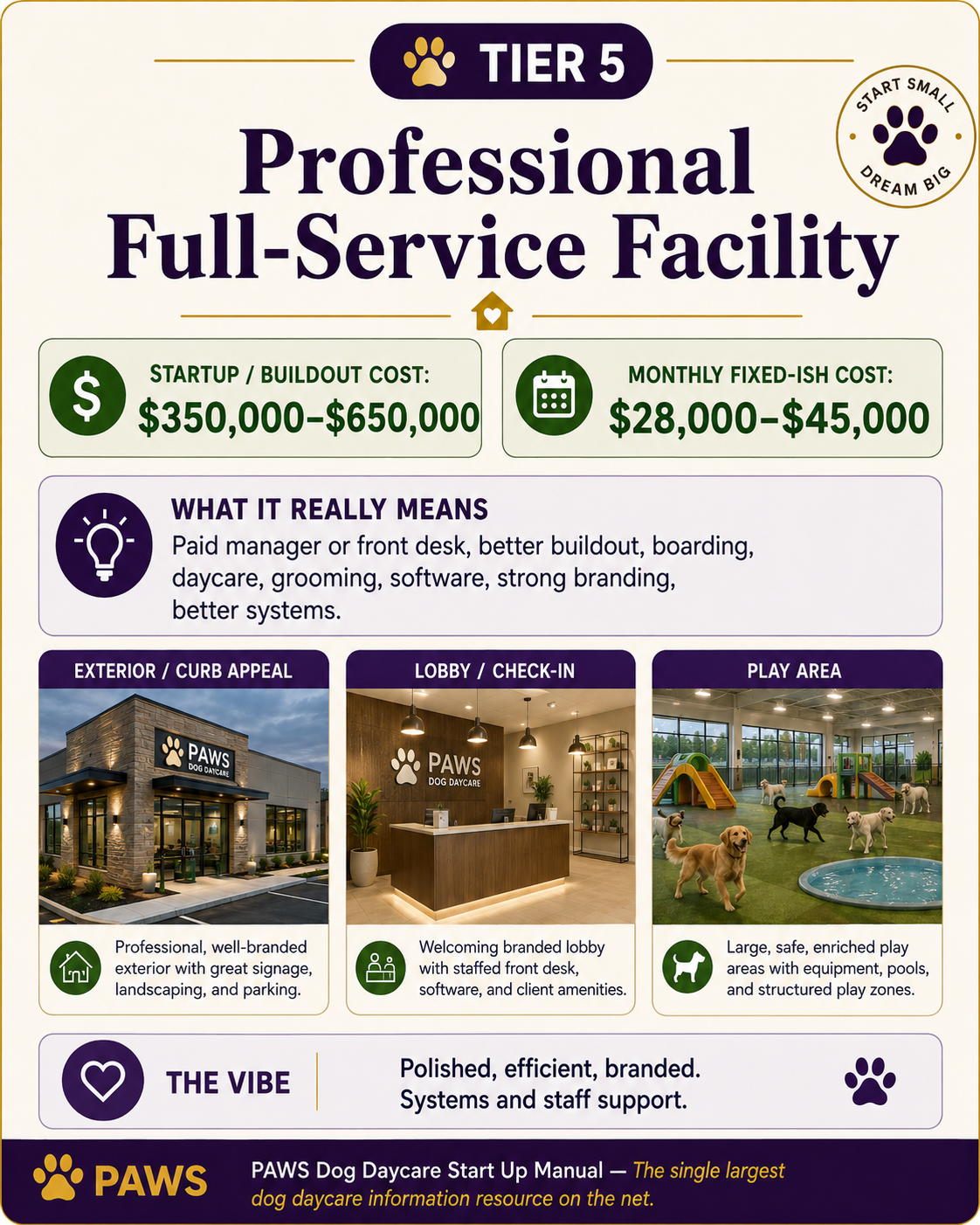
Tier 5
Professional Full-Service Facility
Startup / Buildout: $350,000–$650,000
Monthly fixed-ish cost: $28,000–$45,000
Paid manager or front desk, better buildout, boarding, daycare, grooming, software, stronger branding, better flooring, better drainage, better HVAC, and better systems. Less owner-dependent, but the monthly nut starts getting serious.
Interior lesson: polished, efficient, branded, and built for staff support. If the facility looks professional, the operations need to be professional too.
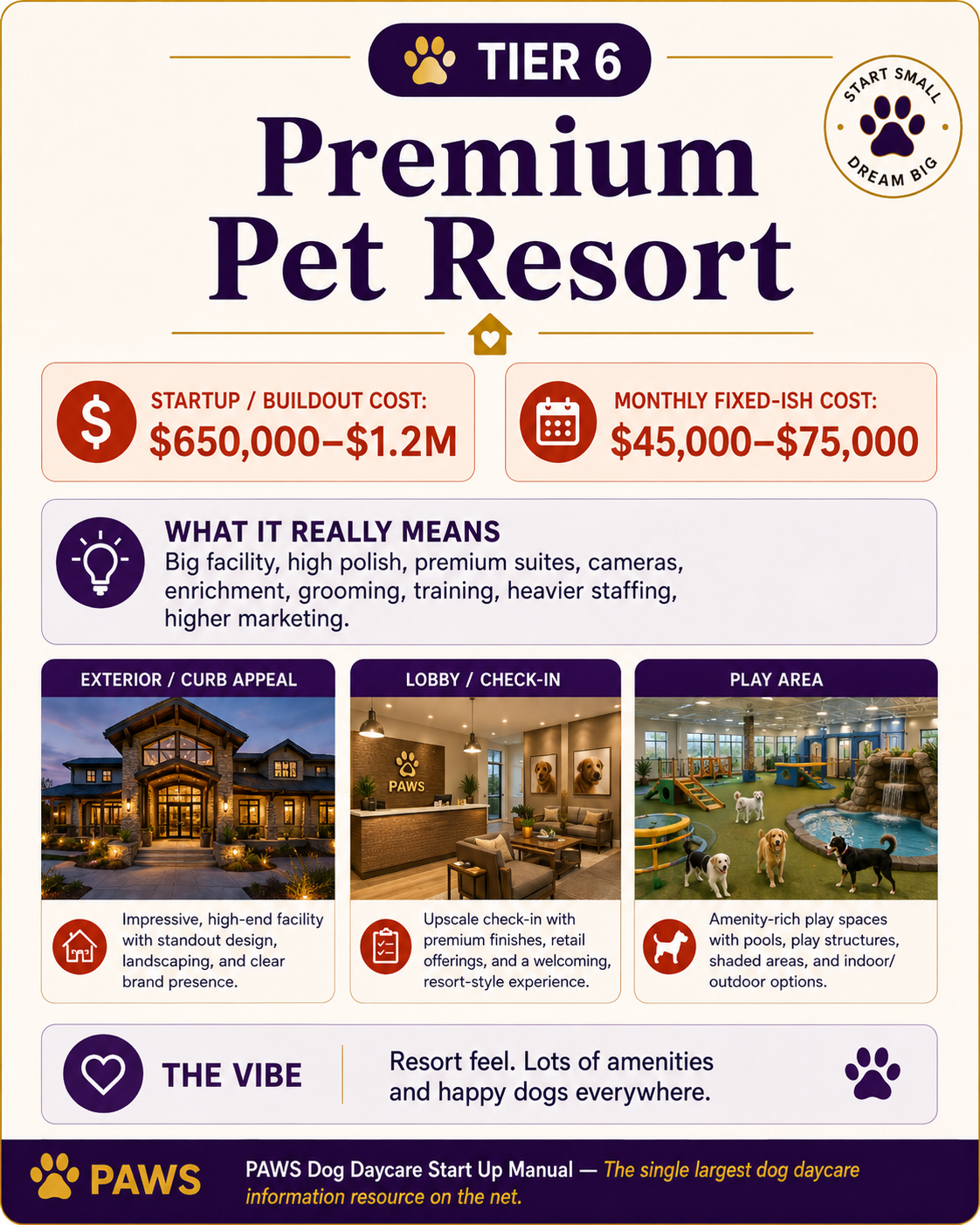
Tier 6
Premium Pet Resort
Startup / Buildout: $650,000–$1.2M
Monthly fixed-ish cost: $45,000–$75,000
Big facility, high polish, premium suites, cameras, enrichment, grooming, training, heavier staffing, higher payroll, and higher marketing. Revenue potential is higher, but so is the burn rate if the owner starts believing their own brochure too much.
Interior lesson: resort feel with real operational backbone. Amenities are great only if cleanliness, staffing, safety, and systems keep up.
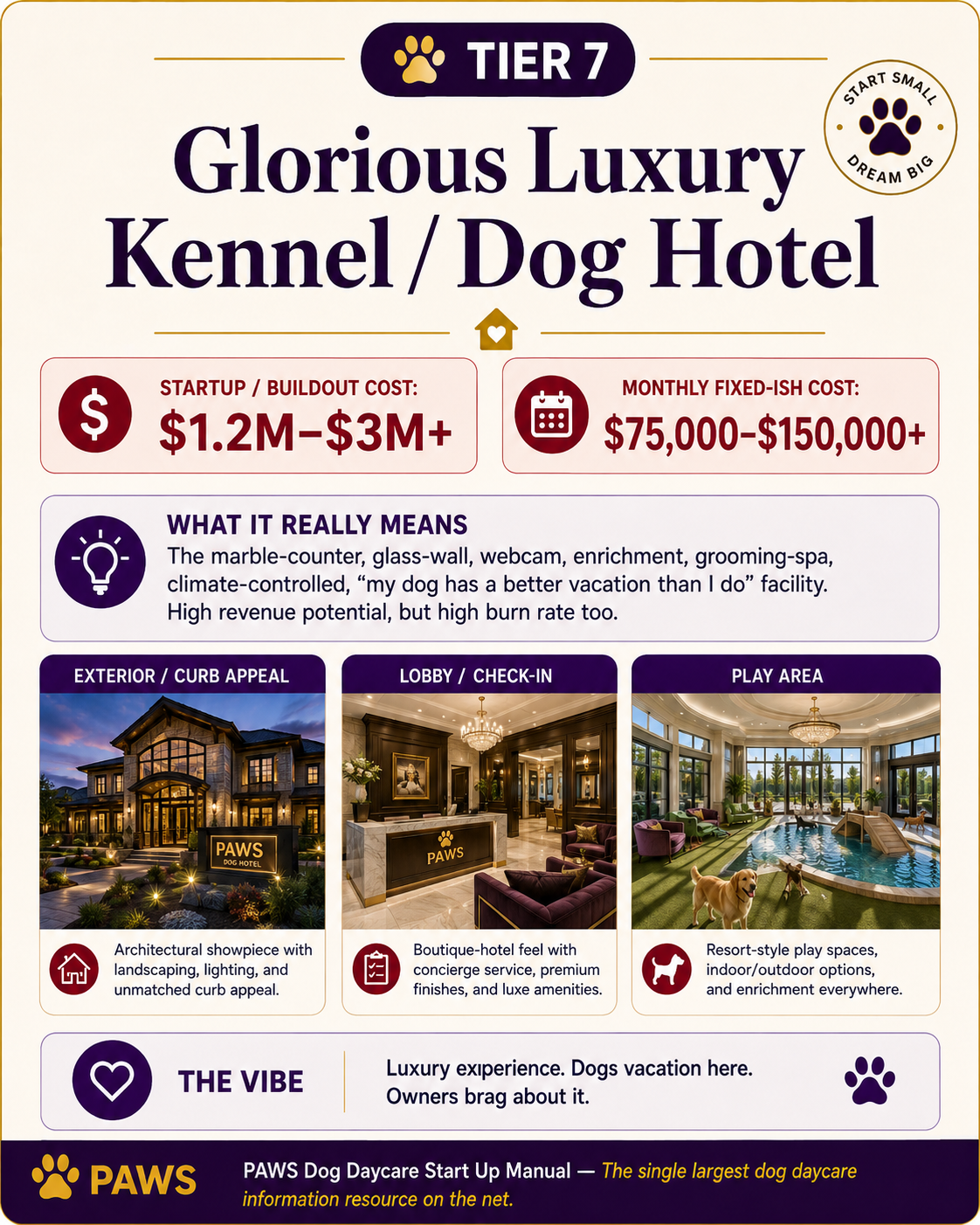
Tier 7
Glorious Luxury Kennel / Dog Hotel
Startup / Buildout: $1.2M–$3M+
Monthly fixed-ish cost: $75,000–$150,000+
This is the marble-counter, glass-wall, webcam, enrichment, grooming-spa, climate-controlled, “my dog has a better vacation than I do” facility. It can be impressive. It can also become a financial wood chipper if pricing, occupancy, payroll, and systems do not support it.
Interior lesson: luxury should feel effortless to the customer, but it is never effortless to operate.
🐾
You do not need Tier 7 to be successful.
You need the right tier for your market, your skills, your pocketbook, your staffing plan, and your customer base. A clean Tier 3 can beat a sloppy Tier 5. A warm Tier 2 can beat a sterile Tier 4. Customers notice whether the place makes sense.
🚪
Start at the Lobby and Walk In Like a Customer
Your lobby is not just a waiting area. It is the customer’s first evidence packet.
Stand outside. Walk in slowly. Pretend you do not own the place. Pretend you are a new customer with a dog pulling on the leash, a vaccination record in your hand, and a little anxiety about leaving your pet with strangers.
Is the lobby cramped and cluttered, or warm and inviting? Can two or three customers enter with dogs at the same time without everyone getting tangled in leashes and regret? Does the front desk look organized? Are the floors clean? Are the baseboards dirty? Are forms, leashes, retail, dog food, lost-and-found, and staff junk fighting for oxygen?
Does it smell clean without smelling like a chemical assault? Can customers see a messy office? Are staff drinks, fast-food bags, laundry piles, trash, personal bags, and mop buckets visible? Does the lobby look like a business, or does it look like someone is losing a fight with storage?
The customer does not know what is behind every door. That is why the visible areas matter so much. If the lobby is messy, the customer assumes the back is worse. That may not be fair, but it is how people think. Your job is not to complain about it. Your job is to stop feeding that suspicion.
🔎
First Impression Audit
Check what a customer sees before they decide whether the place feels trustworthy.
🧼
Cleanliness Is Visual
Customers cannot inspect your disinfectant log from the lobby, so they inspect what they can see.
Clean is not only sanitation. Clean is also what the customer sees, smells, and feels. You may have a good cleaning system in the back, but if the lobby corners are dirty, the windows are smeared, the baseboards are gross, and the trash can looks like it gave up last Tuesday, the customer does not care what disinfectant you bought.
Floors, baseboards, walls, doors, gate bottoms, counters, glass, trash cans, retail shelves, office areas, customer bathrooms, windows, and dog hair all communicate. The facility is always talking. Dirt speaks loudly.
If a customer sees grime in the lobby, they assume the hidden areas are worse. If they see clutter behind the desk, they assume the records are sloppy. If they smell odor at the door, they assume the playroom is a biological event. Sometimes they are wrong. Sometimes they are not. Either way, the facility has already planted the doubt.
| Customer Sees | Customer Thinks | Operator Fix |
|---|---|---|
| Dirty baseboards and corners | If the easy-to-see areas are dirty, the back must be worse. | Daily edge cleaning, weekly deep clean, washable wall protection. |
| Dog hair on counters, shelves, and lobby chairs | No one is staying ahead of the mess. | Front-area cleaning schedule and staff accountability. |
| Strong dog odor or chemical blast | Either the dogs are overpowering the building or the cleaner is. | Ventilation, proper cleaning, odor control, and not hiding problems with fragrance. |
| Visible trash, laundry, food bags, mop buckets | The facility is disorganized. | Closed storage, staff zones, and no customer-facing junk piles. |
| Smudged glass into play areas | The customer view is neglected. | Clean viewing glass often. Nose prints are not decorative frosting. |
🎨
Color, Murals, and Controlled Fun
Use fun without building a cleaning nightmare with a cartoon budget.
Dog daycare should not feel dull and boring. All-white walls can feel cold, and they get dirty fast. Play areas can use color. Ceilings can be a soft sky blue. Accent walls can separate zones. Murals can create energy. Photos of happy dogs using your services can help customers picture their own dog enjoying the place.
A big board with happy pet photos can do more for customer trust than a paragraph of marketing fluff. Real dogs, real smiles, clean facility, staff interaction, safe playgroups, and organized spaces all help the customer believe the story you are trying to tell.
But fun has to be controlled. Do not create surfaces that cannot be cleaned. Do not put porous decorations where dogs can pee on them. Do not put fragile retail displays where excited dogs and retractable leashes can commit war crimes. Do not buy cute props that become chewing hazards, trip hazards, or employee obstacles.
Play areas can have tunnels, slides, platforms, pools, murals, and enrichment equipment, but everything has to be safe, washable, inspectable, and appropriate for the dogs using the space. If staff cannot clean it, move around it, supervise around it, or remove it quickly when it becomes a problem, it is not a design feature. It is a future incident report.
Good Fun
Washable murals, bright accent walls, safe play equipment, real dog photos, good signage, and clean enrichment pieces.
Bad Fun
Porous rugs, fragile props, cluttered retail, sharp decor, fake grass you cannot clean properly, and anything dogs can chew into confetti.
Operator Test
Can it be cleaned, moved, repaired, disinfected, supervised around, and justified financially? If not, the wallet needs a leash.
🐕
Visible Play Areas Need to Look Safe, Fun, and Managed
Customers may not inspect the whole facility, but anything visible matters.
A visible play area should not look like a bare prison yard, a toddler daycare explosion, or a dog fight arena with primary colors. It should look clean, bright, supervised, and intentionally built for dog movement.
Use visual zones where possible. Keep sight lines clear. Avoid clutter that blocks staff visibility. Use equipment that supports safe play, not just customer photos. Make sure gates, doors, and transitions look secure. Keep walls, floors, and barriers clean because the customer is absolutely looking at them.
If customers can see the playroom, that view is part of the sales process. It should show energy without chaos. Dogs should look engaged, not overstimulated. Staff should look present, not trapped. The room should look like something being managed, not something that escaped containment.
🗂️
If Customers Can See the Office, the Office Is Part of the Lobby
The customer does not know where your “staff only” mess ends and your professionalism begins.
If clients can see into your office, treat that office like a customer-facing space. Chairs under desks. No overflowing trash. No fast-food bags. No soda cans. No paperwork avalanche. No employee hoodie nest behind the counter. No lost-and-found pile that looks like it needs a social worker.
This sounds small, but it matters. A messy office suggests messy records. Messy records suggest missed vaccine expirations, lost paperwork, weak incident notes, and “we are pretty sure your dog belongs to someone named Ashley.”
That may not be true, but the customer does not know that. They see clutter and build a story. Do not hand them the materials to build a bad one.
🦝
Raccoon office rule
If your office looks like a raccoon got promoted to general manager, customers will assume the records are not much better.
🧭
Interior Priority Sorter
Different facility models need different interior priorities. This keeps the design conversation from wandering into expensive nonsense.
💳
What to Spend Money on First
The lobby couch can wait. The cleaning system cannot.
Interior design gets dangerous when the owner starts buying pretty things before the facility has the boring things under control. Pretty is fun. Pretty photographs well. Pretty makes you feel like progress is happening. But pretty does not fix odor, dog flow, wall damage, dirty floors, bad lighting, weak storage, or a front desk buried under forms and leash hooks.
Spend money first on the pieces that make the business cleaner, safer, easier to run, easier to trust, and easier to maintain. Then decorate around those systems.
Spend First
- Flooring and wall protection.
- Odor control and ventilation support.
- Lighting.
- Storage.
- Clean front desk and customer flow.
- Safe gates and dog movement paths.
- Paint and washable finishes.
- Professional signs.
- Good photos of real dogs.
Spend Later
- Murals.
- Retail displays.
- Fancy lobby furniture.
- Instagram wall.
- Expensive decorative features.
- Luxury props.
- Decorative dog beds.
- Anything that creates more cleaning than value.
- Anything bought because the startup goblin got loose.
🛑
Do not buy a lobby couch before you can afford proper storage.
Walls, floors, odor, lighting, cleaning, storage, and dog flow come first. A couch in a dirty lobby is not hospitality. It is upholstered denial.
🚫
Do Not Buy This First
Use this before the startup shopping goblin gets loose and starts throwing money at cute nonsense.
⚠️
Interior Design Mistakes That Kill Trust
Most interior mistakes are not mysterious. They are usually caused by ego, fear, bad priorities, or a shopping cart with no adult supervision.
01
The White Wall Prison
Everything is white, cold, sterile, and dirty by noon. Clean is good. Emotionally dead is not.
02
The Paw-Print Explosion
Every surface has paw prints, but nothing looks professional. Branding is not a substitute for design.
03
The Cute but Uncleanable Trap
Decor looks nice until dogs, hair, urine, slobber, bleach, and time show up with baseball bats.
04
The Lobby Junk Drawer
Retail, forms, leashes, dog food, packages, laundry, and lost-and-found all fighting for oxygen.
05
The Fake Luxury Problem
A chandelier does not fix odor, poor handling, weak policies, dirty baseboards, or a business model bleeding behind the curtain.
06
The Back Room Must Be Worse Problem
If the customer-facing area is messy, customers assume the hidden areas are worse. Do not hand them that thought.
📝
Printable Interior Walkthrough Checklist
Use this as a simple facility walk-through before you start spending money on the wrong things.
❓
Dog Daycare Interior Design FAQ
The questions people ask after they stop thinking this is just a paint-color decision.
Do I need a luxury lobby to compete?
No. You need a lobby that feels clean, safe, organized, warm, and appropriate for your market. A small facility can compete if it feels trustworthy. A luxury lobby with poor operations is just expensive camouflage.
Should I use murals and bright colors?
Yes, if they support the facility and can be maintained. Color, murals, dog photos, and themed play areas can help the daycare feel fun and alive. Just do not create uncleanable surfaces or visual chaos.
What matters more: lobby appearance or play-area appearance?
Both matter. The lobby creates trust. Visible play areas prove the dogs are somewhere clean, safe, and managed. If customers can see it, it is part of the sales process.
What should I avoid buying first?
Avoid fancy furniture, fragile decor, Instagram walls, expensive props, and cute extras before flooring, walls, odor control, storage, cleaning, lighting, gates, and customer flow are handled. Cute does not save a weak facility.
Can a low-budget daycare still look professional?
Absolutely. Clean paint, organized storage, clear signage, good lighting, tidy front desk, clean floors, controlled odor, and a friendly layout can make a modest facility feel trustworthy. Low budget is not the same as sloppy.
🧠
The Bottom Line
Interior design is not the frosting. It is part of the trust system.
Your dog daycare interior should help customers believe the facility is clean, safe, professional, and worth trusting. It should match the tier of facility you are actually building. It should support staff workflow, cleaning, dog handling, customer flow, odor control, and the emotional sale.
You do not need to start with a million-dollar pet resort. You do need to start with intention. A small clean facility with good storage, safe flow, warm colors, visible organization, and real customer trust can beat a bigger facility that looks expensive but feels chaotic.
Do not decorate problems. Fix them. Then make the facility feel like a place customers are happy to leave their dog.