Franchise Fee, Build-Out, Lease, HVAC, Flooring, Drains, Equipment, Payroll Ramp-Up, Royalties, Ad Fund, Debt, and Working Capital
Dog Daycare Franchise Costs: What the Franchise Fee Does Not Show You
A blunt operator guide to the real dog daycare franchise cost stack: the fee you see, the build-out you underestimate, the payroll ramp-up you feel, and the ongoing charges that keep nibbling after opening.

The franchise fee is not the cost of opening a dog daycare franchise. The franchise fee is the ticket to enter the room where the real bills are waiting. It buys access to the system. It does not prove the system is worth the full cost of admission.
A dog daycare franchise fee may buy access to a brand, system, training, manuals, opening support, and the right to operate under someone else’s name. It does not build the facility. It does not pay the rent. It does not install the drains. It does not fix the HVAC. It does not cover payroll while the customer base slowly grows. It does not make the local market care that you opened.
The scary number is not always the franchise fee. The scary number is what happens after you pay it and still have to build the damn business.
Current public investment ranges for dog daycare, boarding, and pet resort franchise models can run from the low hundreds of thousands into seven figures, with larger facility-based models pushing deep into million-dollar territory. Some concepts are smaller and leaner. Some are full daycare, boarding, grooming, and pet resort facilities with major construction costs. The buyer has to know which animal they are actually buying.
This page does not use brand names because the point is not to promote or beat up one company. The point is to make the buyer understand the cost stack before the sales process turns a giant obligation into a neat little “estimated investment” box.
⚠️
Operator warning: the franchise fee is the cover charge.
It gets you into the room. It does not pay for the band, the drinks, the ride home, or the damage you do to your wallet once the real party starts. If someone keeps steering your attention back to the franchise fee, pull the whole cost stack onto the table.
💵
Franchise Fee Is Not Total Investment
Buyers get in trouble when they hear one number and emotionally ignore the rest of the stack.
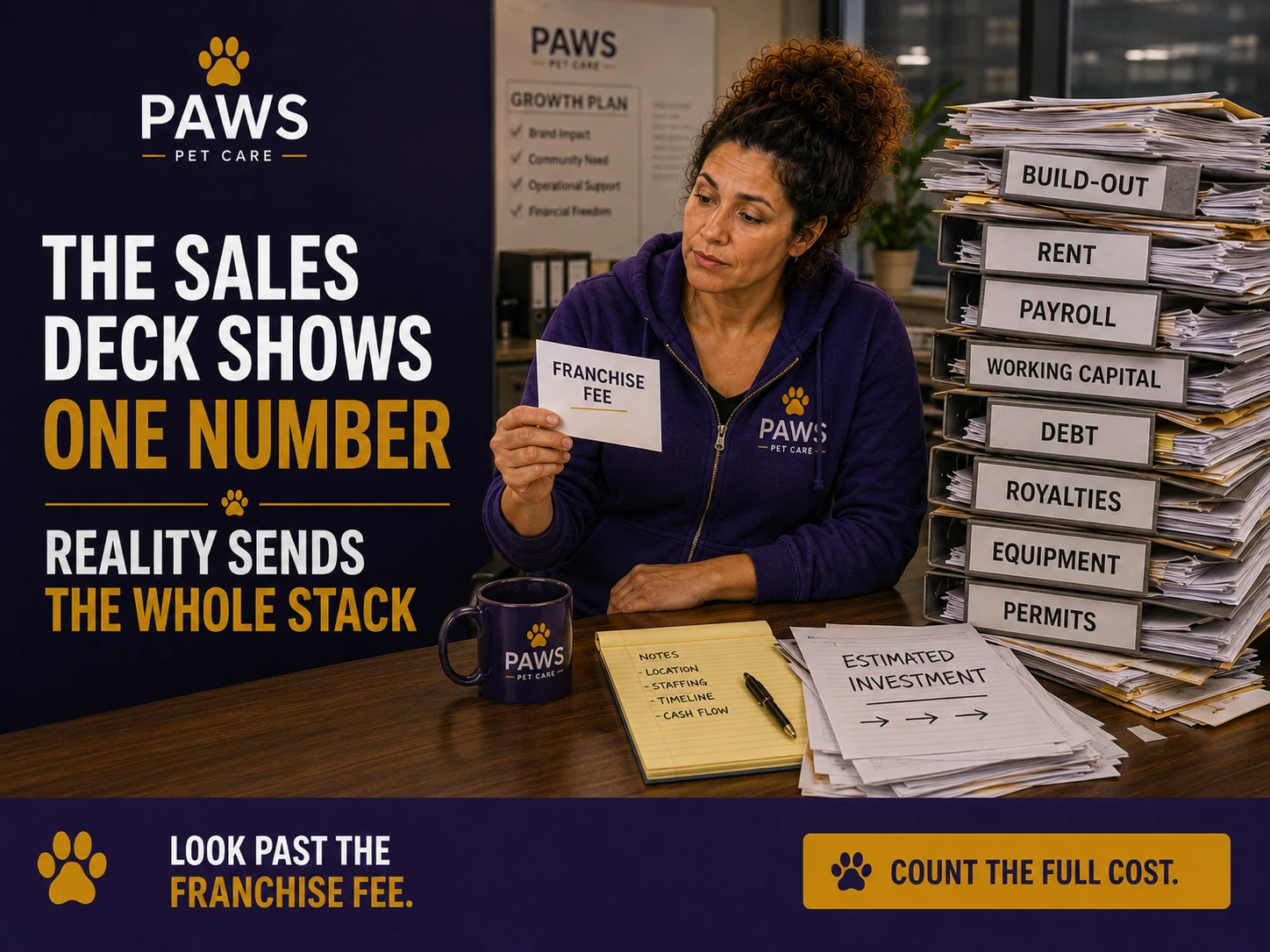
The initial franchise fee is usually the front-door price for access to the brand and system. It may include the right to use the name, access to training, manuals, opening support, brand standards, software direction, vendor guidance, and the franchisor’s process for getting started.
Total investment is different. Total investment includes the franchise fee plus real estate, deposits, design, permits, legal review, build-out, flooring, plumbing, HVAC, equipment, signage, technology, furniture, training travel, opening marketing, insurance, supplies, payroll ramp-up, and working capital.
Cash needed is different again. A lender may finance part of the project, but you still need liquid capital, contingency money, owner living money, and enough cushion to survive the ugly first months when expenses arrive faster than customers.
The buyer should build one consolidated sources-and-uses schedule before treating any individual estimate as meaningful. Every dollar needed before opening, every dollar reserved for ramp-up, and every recurring fee should appear in one model with a named source of funding.
Use separate columns for the expected case, the stressed case, and the delay case. A cost stack that only works when construction lands on budget, permits arrive on time, payroll stays low, and customers show up immediately is not a financing plan. It is a wish wearing a spreadsheet.
| Term | What It Actually Means | Why It Matters |
|---|---|---|
| Franchise Fee | The upfront fee paid for access to the franchise system, brand, training, and rights under the agreement. | Important, but it is usually only one line item in the larger opening cost. |
| Estimated Initial Investment | The broader opening range shown in the FDD, usually including build-out, equipment, training, deposits, supplies, and initial funds. | This is closer to the real number, but still depends heavily on your market, building, lease, construction, and timing. |
| Liquid Capital | Cash or accessible funds the buyer needs available before the franchisor, lender, or landlord takes them seriously. | You can be “approved” on paper and still choke the business if you do not have enough usable cash. |
| Working Capital | Money kept available to pay operating bills while the business ramps up. | This is oxygen. Run out of it, and the business starts making the kind of noises nobody wants to hear. |
| Ongoing Fees | Royalty, ad fund, technology, software, brand, required vendor, or other recurring charges. | These do not disappear after opening. They ride along while you are also paying rent, payroll, debt, insurance, and repairs. |
🎟️
What Are You Actually Buying With the Franchise Fee?
The franchise fee is not a Willy Wonka ticket. It is not ownership of the franchise company. It is not the building. It is not the customer base. It is not a guarantee.
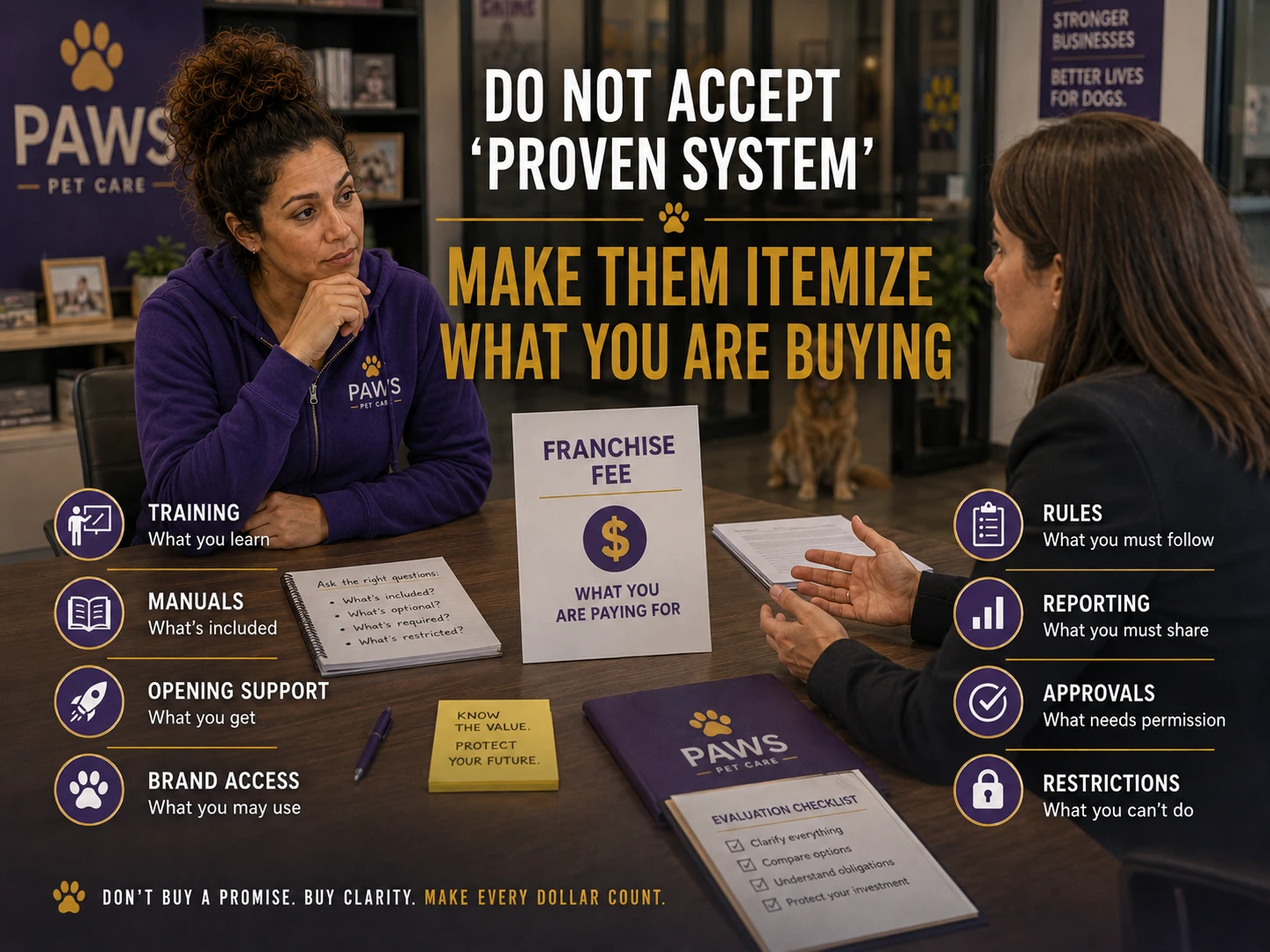
The initial franchise fee is basically the entry price for access to the franchise system. You are paying for the right to use the name, operate under the brand, access the startup process, receive initial training, use the operating model, and enter the agreement under the franchisor’s rules.
That fee also compensates the franchisor for the system it built. The brand, manual, training process, vendor relationships, software path, design standards, marketing templates, opening support, and operating playbook did not appear out of the sky. Someone built them, tested them, packaged them, and turned them into something that can be sold.
Fine. There can be value in that. If the system is strong, current, practical, and useful, the franchise fee may buy a real shortcut. A first-time owner may avoid mistakes, shorten the learning curve, and open with more structure than they would have created alone.
But the fee does not just buy access. It also buys admission into a controlled system. That is the part buyers do not always feel emotionally until later. You are paying to enter someone else’s business model, and that business model comes with rules.
A weird way to say it is this: you pay the cover charge to get into the restaurant, and then the chef gets to tell you what you can cook in your own kitchen. That sounds ridiculous, but that is the nature of the franchise trade. You get the recipes, the name, the training, the systems, and the brand structure. In return, you accept the rules, reporting, standards, approved methods, approved vendors, required branding, and whatever else the agreement gives the franchisor authority to control.
That does not make franchising evil. It makes franchising franchising. The whole point of the model is consistency. The franchisor cannot let every local owner freestyle the brand into a ditch. If one owner starts using cheap products, ugly signs, strange offers, sloppy procedures, weak vendors, or dangerous shortcuts, the damage can hit more than one location.
So yes, the franchisor needs control to protect the brand. But the buyer needs to understand the other side of that sentence: brand protection can become local restriction. The same control that protects the system can also limit your choices, slow your changes, block your preferred vendors, force certain costs, and keep your local business living inside someone else’s rulebook.
Do not romanticize the fee. You are not buying the company. You are not buying permanent ownership of the system. You are not buying immunity from bad leases, bad payroll, bad staffing, bad construction, bad pricing, bad local marketing, or bad dog decisions. You are buying access under a contract, and that contract can control more than buyers want to admit during the sales process.
That is why the buyer has to ask what the franchise fee actually buys today. Not what the founder did twenty years ago. Not what the sales deck says in soft lighting. Not what the happy dogs in the brochure imply. What do you actually receive, when do you receive it, how good is it, how current is it, what control comes with it, and what would it cost to buy or build the same help another way?
Ask for deliverables by date, format, and responsible person. “Training” should identify who attends, how long it lasts, what subjects are covered, what travel is required, and what happens when the owner needs help six months later. “Opening support” should explain who is on site, for how long, and what work that person actually performs.
Then price the restrictions alongside the deliverables. The fee may buy a shortcut, but the agreement may also require reporting, approvals, vendors, software, design standards, and methods that limit how the local owner responds when costs, staffing, or customer demand change.
| Franchise Fee Question | What You Need to Know | PAWS Operator Take |
|---|---|---|
| What does the fee actually include? | Training, manuals, opening support, brand access, software setup, site help, vendor lists, launch materials, or other startup support. | Do not accept “our proven system” as an answer. Make them itemize the system. |
| Is the fee refundable? | Many initial franchise fees are non-refundable or only refundable under limited conditions. | Once that money crosses the table, assume it may not come back. |
| Is the training current? | The dog daycare industry changes. Software, staffing, pricing, disease control, marketing, and customer behavior shift. | A twenty-year-old idea is not enough. The system has to be alive now. |
| What control comes with the fee? | Brand standards, operating rules, vendor requirements, marketing approval, reporting, software rules, design standards, inspections, and required updates may apply. | You are not just paying for help. You are paying to enter a system that gets a say in how you operate. |
| What would this help cost separately? | Compare the franchise fee against a lease attorney, zoning attorney, consultant, manual, software setup, accountant, contractor review, and marketing help. | Targeted help may hurt up front, but it may not follow you for ten years. |
| What does the fee not include? | Build-out, rent, deposits, payroll, equipment, working capital, local marketing, debt service, insurance, utilities, and operating losses. | The fee buys access to the dance. It does not buy the tux, the limo, the hotel room, or the aspirin the next morning. |
| What happens after opening? | Ongoing royalties, ad fund fees, technology fees, reporting rules, vendor restrictions, inspections, upgrades, and contract controls may continue. | The franchise fee is only the first bite. Read the menu before ordering the whole meal. |
⚠️
The franchise-fee reality
The fee may buy a real shortcut. It may also be an expensive ticket into a system you still have to fund, build, staff, market, operate, and obey. Do not judge the fee by the promise. Judge it by the deliverables, the restrictions, and the long-term control that comes with it.
📊
Current Dog Daycare Franchise Cost Reality
The numbers are not tiny. Facility-based dog daycare and boarding franchises can get expensive fast.
Publicly available franchise investment pages show a wide range because not every pet franchise is the same animal. A small urban daycare model is different from a large daycare, boarding, grooming, and pet resort facility. A training studio is different from a full overnight boarding operation. A 3,000 square foot concept is not the same cost problem as a 10,000 square foot building with playrooms, suites, bathing, laundry, cameras, outdoor space, and heavy mechanical needs.
As a practical current planning range, a buyer looking at dog daycare or boarding franchises should be mentally prepared for total investment ranges that may start in the low-to-mid hundreds of thousands for smaller models and can move past one million dollars for larger facility-heavy models. Some premium or larger resort-style facilities can push even higher.
Initial franchise fees commonly sit in the tens of thousands of dollars, with many facility-based concepts clustering around the $40,000 to $60,000 range. Ongoing royalties commonly show up as a percentage of gross sales, often around 6% to 7% in this category, with advertising, brand, marketing, technology, or similar fund fees sometimes stacked on top.
Do not memorize those numbers and pretend you are done. Read the current FDD. Read Item 5, Item 6, Item 7, Item 8, Item 11, Item 12, Item 17, and Item 19. Then have a franchise attorney and accountant tear through the numbers before you sign anything.
A planning range should be treated as a starting boundary, not a promise. The local building, labor market, utility capacity, permitting path, landlord contribution, financing structure, and service mix can move the project far away from the clean estimate shown during early sales conversations.
The responsible next step is to replace category estimates with local evidence: contractor pricing, lease terms, utility information, permit fees, payroll assumptions, insurance indications, equipment quotes, and a written opening timeline. The closer the buyer gets to signing, the less room there is for placeholder numbers.
📌
The cost-range warning
A low estimate is not a promise. A high estimate is not the ceiling. Construction, rent, permits, landlord delays, code issues, labor, equipment, and financing can all move the number while you are already committed.
🧱
The Dog Daycare Franchise Cost Stack
This is where the clean investment summary turns into real-world bills.
Use the stack as a reconciliation tool. Every category should have a current estimate, a source for that estimate, a payment date, a responsible party, and a contingency assumption. Blank cells are not savings; they are costs that have not introduced themselves yet.
Separate one-time construction costs, pre-opening carrying costs, recurring operating costs, and future brand obligations. That prevents a buyer from using opening capital to cover the building and then discovering that the first months of payroll, marketing, debt, royalties, and repairs were never fully funded.
Update the stack whenever the site, lease, design, lender, contractor, service mix, or opening date changes. The cost model should follow the actual project rather than remaining frozen at the version used to justify the original decision.
| Cost Category | What It Includes | Why Buyers Underestimate It | PAWS Operator Warning |
|---|---|---|---|
| Initial Franchise Fee | Access to the brand, system, training, manuals, territory rights, and franchise relationship. | Buyers treat it like the main cost because it is easy to understand. | It is the cover charge, not the whole night out. |
| Real Estate Search | Broker time, site visits, demographic review, traffic, parking, zoning, landlord conversations, and site approval. | Good sites are not always sitting there waiting with a bow on them. | The wrong building can turn a “good franchise” into a monthly punishment. |
| Lease Deposits and Pre-Opening Rent | Security deposits, first month’s rent, rent before opening, utility deposits, and possible personal guarantees. | Rent can start before revenue exists. | The landlord does not care that the dogs have not arrived yet. |
| Legal, Architectural, and Accounting Fees | Franchise attorney, lease attorney, zoning review, architect, accountant, business entity setup, and professional review. | Buyers hate paying professionals until a bad document costs ten times more. | Cheap legal review is how expensive surprises sneak in wearing a tie. |
| Permits and Zoning | Use approvals, special permits, kennel/daycare classification, parking, signage, outdoor use, noise, odor, and local code issues. | People assume “pet business” means the city will automatically say yes. | Do not let anybody wave you into a building until you know the city will let you run dogs in it. |
| Construction and Build-Out | Walls, doors, plumbing, electrical, HVAC, flooring, drains, lobby, suites, playrooms, grooming, bathing, laundry, and staff areas. | Dog buildings are not normal retail boxes. | A vanilla build-out becomes a dog facility build-out when urine, hair, barking, water, and odor get a vote. |
| Flooring | Dog-safe surfaces, sealers, cove base, wet-room finishes, slip resistance, urine resistance, and cleanability. | Cheap flooring looks fine until dogs start using it like dogs. | Bad flooring punishes staff every day and may punish your insurance later. |
| Drainage and Plumbing | Floor drains, trench drains, hose bibs, mop sinks, bathing drainage, hair traps, cleanouts, water heaters, and cleaning flow. | Buyers underestimate how much water, hair, mud, urine, and sludge dog facilities create. | Drains do not pull water uphill. Bad slope becomes payroll waste with a squeegee. |
| HVAC and Ventilation | Cooling, heating, fresh air, odor control, humidity, air movement, dog density, grooming heat, and customer comfort. | Dogs, staff, dryers, wet floors, and odor make HVAC more serious than a normal shop. | A weak HVAC plan can make a beautiful building smell like a damp sock full of regret. |
| Sound and Odor Control | Wall assemblies, doors, insulation, ventilation, outdoor noise, waste handling, cleaning systems, and neighbor issues. | Barking and smell do not stay politely inside the business plan. | Noise complaints and odor complaints can turn the city, landlord, and neighbors into your new hobby. |
| Gates, Fencing, and Dog Containment | Interior gates, playroom partitions, latches, vestibules, outdoor fencing, suite doors, and safety barriers. | Dog containment looks simple until the wrong dog tests every weak point. | Gates are not décor. Gates are what stand between a normal day and a lawsuit with fur on it. |
| Boarding Suites and Kennels | Overnight areas, suites, drains, walls, doors, bedding, monitoring, lighting, ventilation, and cleaning access. | Boarding creates 24-hour responsibility, not just another room with cages. | Overnight dogs do not stop being your problem when the lobby lights turn off. |
| Grooming and Bathing Setup | Tubs, dryers, tables, hair control, water heater capacity, grooming flooring, storage, and bather flow. | Grooming equipment is only the beginning. Hair and water are the real villains. | Grooming can make money, but it can also clog, flood, smell, and eat staff time. |
| Laundry | Washers, dryers, hookups, drains, venting, towels, bedding, chemicals, and staff time. | Boarding, bathing, accidents, and cleaning create endless laundry. | Ignore laundry and the business turns into a towel-eating machine. |
| Cameras, Security, and Technology | Cameras, monitors, networking, phones, internet, payment systems, access control, alarms, and customer-facing tech. | Tech is not just a one-time purchase. It needs installation, maintenance, subscriptions, and support. | Cameras are useful until they show a problem you failed to train for. |
| Software | Pet-care management software, reservations, vaccine tracking, payments, waivers, reporting, customer communication, and subscriptions. | Required software may not be the cheapest or most flexible option. | Software is a tool, not a rescue helicopter. |
| Furniture, Signage, and Lobby | Front desk, retail fixtures, seating, signage, wall branding, displays, customer check-in, and tour presentation. | Brand standards can make “simple lobby” turn into a branded environment. | The franchisor may care how the lobby looks. The contractor cares when the check clears. |
| Training and Travel | Owner training, manager training, travel, lodging, meals, staff training time, and possible on-site launch support. | Travel and training time still cost money even when training is “included.” | Included does not always mean free. |
| Opening Marketing | Grand opening, local ads, signage, direct mail, social content, referral offers, vet outreach, events, and early promotions. | Buyers assume the franchise logo creates demand by itself. | A logo on the sign does not automatically fill the playroom. |
| Insurance | General liability, animal bailee, property, workers’ comp, auto, umbrella, cyber, and other coverage depending on services. | Dog risk is not theoretical. Dogs bite, get hurt, get sick, and sometimes die. | If the policy does not match reality, reality wins. |
| Payroll Ramp-Up | Manager, front desk, daycare staff, boarding coverage, groomers, bathers, cleaning labor, training time, payroll taxes, and workers’ comp. | Staff get paid before the building is full. | The dogs do not care that you only have twelve customers. They still need enough staff. |
| Working Capital | Cash to cover rent, payroll, utilities, insurance, debt, software, supplies, repairs, marketing, and owner draw during ramp-up. | Buyers want this number to be smaller because it feels like dead money. | It is not dead money. It is oxygen. |
| Debt Service | Loan payments, interest, fees, collateral requirements, and repayment pressure. | Borrowed money feels helpful until the payment shows up before the profit does. | Debt does not wait for your Google reviews to improve. |
| Royalties | Ongoing percentage of gross sales or revenue paid to the franchisor. | A small percentage sounds harmless until it stacks over years. | The franchise fee hurts once. Royalties can nibble every month like a rat in the wall. |
| Ad Fund / Brand Fund | Ongoing contribution to brand, advertising, marketing, or related funds. | Buyers assume the money directly creates local customers. | Ask whether the fund fills your building or mostly supports the larger brand machine. |
| Forced Upgrades and Remodels | Future signage, colors, branding, technology, design, uniforms, software, equipment, or facility standard changes. | Buyers focus on opening cost and forget the brand may change later. | You may finally get the business breathing, then corporate decides the brand needs a facelift and your wallet gets volunteered for surgery. |
🐕
The Dog Facility Problem
This is not a quiet office with desks and a cute sign.
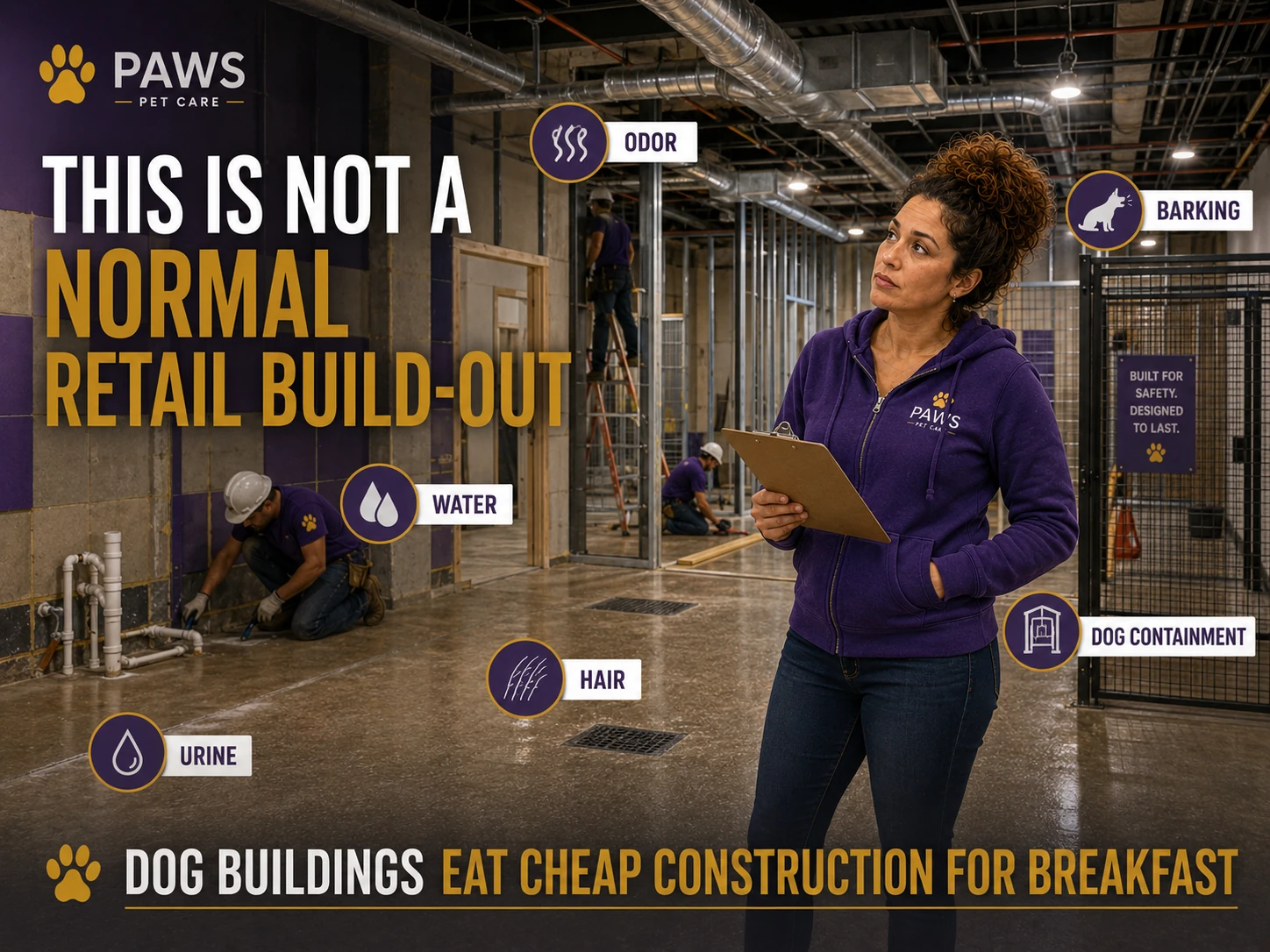
Dogs are hard on buildings. They pee, shed, bark, scratch, stink, slobber, chew, clog drains, test gates, smear glass, abuse flooring, overwhelm HVAC, and turn cheap construction into regret.
A normal retail space is not automatically ready for daycare, boarding, grooming, and bathing. The building has to survive water, odor, dog hair, noise, staff traffic, customer traffic, cleaning chemicals, waste handling, wet floors, outdoor movement, and dogs doing dog things because they did not read your business plan.
That is why dog daycare build-out can get ugly. The expensive part is not just making the place look nice. The expensive part is making the place cleanable, safe, durable, legal, ventilated, drainable, containable, staffable, and tolerable for customers, employees, neighbors, landlords, inspectors, and insurance carriers.
The design review should follow the work from dirty to clean and from arrival to departure. Staff need logical routes for waste, laundry, feeding, bathing, isolation, dog movement, customer traffic, chemical storage, and emergency access without repeatedly crossing the same choke points.
Durability also has to be priced as an operating decision. A cheaper material that increases cleaning time, absorbs odor, fails under moisture, or requires frequent repair may cost more over the lease term than the more expensive material rejected during value engineering.
💧
Water and Waste
Cleaning water, urine, hair, mud, and solids need a route. If water has nowhere smart to go, staff pay for it every day.
🌬️
Air and Odor
Dog density, wet floors, grooming dryers, and waste handling make HVAC and ventilation more important than buyers want to admit.
🔊
Noise
Barking does not politely stop at the lease line. Noise can become a landlord, neighbor, staff, and zoning problem.
🚧
Containment
Gates, latches, yards, vestibules, doors, and room flow matter because the wrong escape or dog mix can get ugly fast.
🧼
Cleaning Flow
A beautiful facility that cleans badly becomes a labor leak, odor problem, and morale killer.
🦠
Disease Control
Surfaces, airflow, intake rules, isolation options, cleaning, and staff habits all affect how a facility handles sickness.
🏗️
Build-Out Costs: The Franchise May Control the Look, But You Pay the Bill
Brand consistency may protect the franchise. Brand consistency is not free.

A dog daycare franchise may require specific design standards, signage, colors, finishes, flooring, technology, room layouts, lobby appearance, exterior branding, furniture, equipment, cameras, software, uniforms, and customer-facing presentation.
Some of that may be useful. A consistent look can help the brand. A smart layout can prevent expensive mistakes. A proven design can help a new owner avoid building a facility that fights them every day.
But the buyer needs to understand who pays for consistency. The franchisor may set the standard. The landlord may approve or reject pieces of it. The contractor may price it. The city may inspect it. The bank may finance part of it. But the owner is the one living with the bill.
This is where “approved” becomes expensive. Approved flooring, approved signage, approved furniture, approved equipment, approved technology, approved cameras, approved lobby materials, approved vendors, and approved layout may all have a reason. They may also reduce your ability to shop, substitute, value-engineer, or adapt the project to your local market.
Require a written distinction between mandatory standards, recommended standards, and items that may be substituted with approval. That distinction affects bidding leverage, construction timing, and whether the owner can solve a local code or supply problem without waiting for a distant approval process.
The buyer should also know who bears the cost when a standard changes after design work begins. Revisions to drawings, signage, finishes, equipment, software, or approved suppliers can create change orders even when the local owner did nothing wrong.
⚠️
Build-out warning
Before signing, ask which build-out standards are mandatory, which vendors are required, which items are recommended, and what happens if your building, budget, landlord, city, or contractor cannot match the preferred design without blowing up the numbers.
📍
Lease and Real Estate Costs Can Hurt Worse Than the Franchise Fee
A bad lease does not care how cute the franchise deck looked.
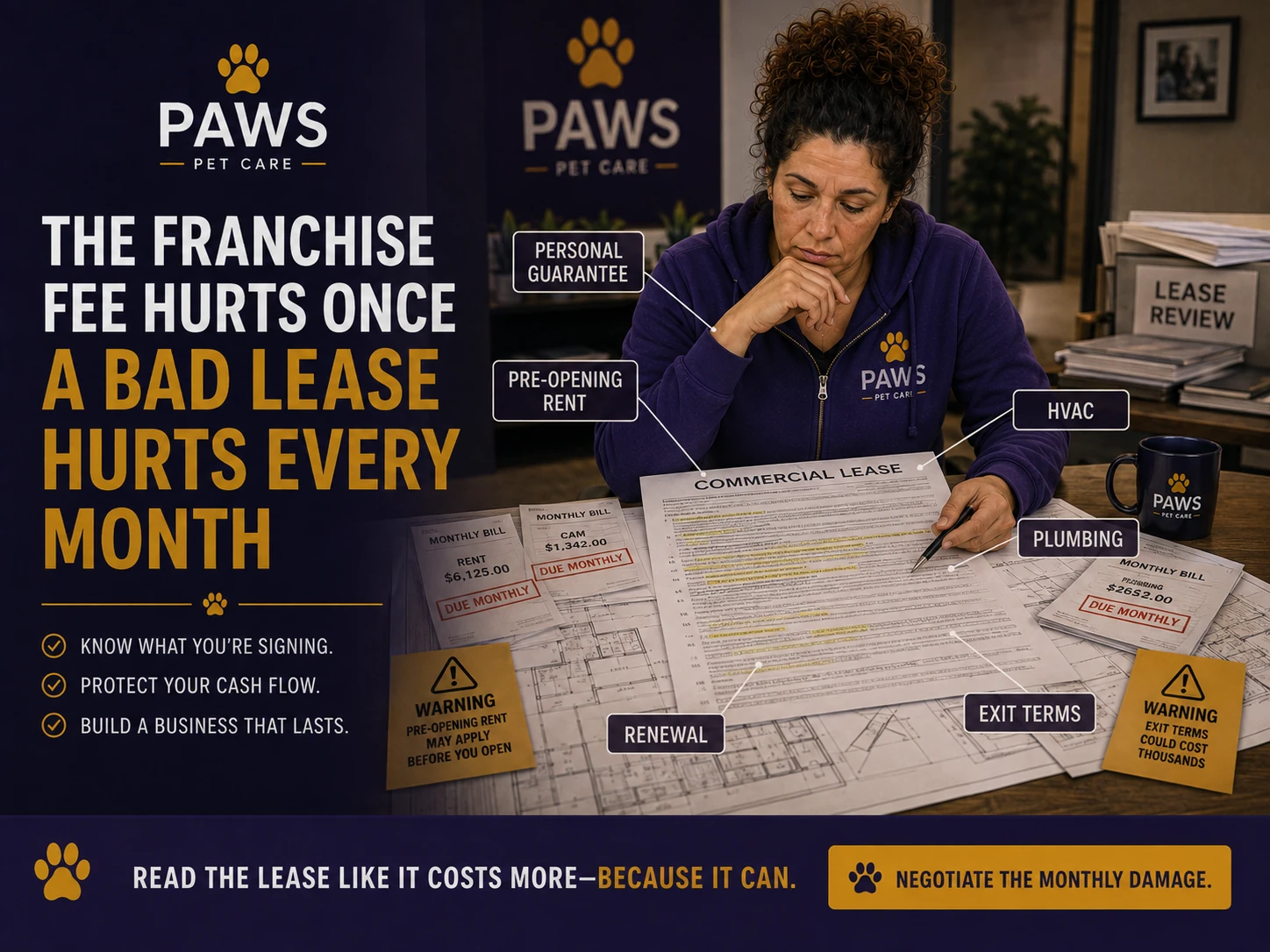
Dog daycare is location-sensitive. You need a building the market can reach, the city will allow, the landlord will approve, the dogs can use, the staff can clean, and the numbers can survive.
The lease can control use, signage, outdoor areas, parking, noise, HVAC responsibility, plumbing responsibility, landlord work, tenant improvements, renewal rights, assignment, subleasing, default, personal guarantees, exclusivity, and what happens if zoning or permits fail.
Franchise buyers sometimes assume the franchisor’s site process protects them from every real estate mistake. Maybe it helps. It should help. But the lease is still your lease. The rent is still your rent. The guarantee may still be your guarantee. The landlord will not care that you thought the franchise system made the building safe.
The lease model should include more than base rent. Add common-area charges, taxes, insurance pass-throughs, maintenance obligations, utility upgrades, repair responsibility, scheduled increases, deposits, guarantees, and rent owed during permitting and construction.
Match the lease term and renewal protection to the amount being buried in the building. A buyer should not spend heavily on drains, HVAC, flooring, sound control, and permanent improvements while holding weak renewal rights that allow the landlord to capture the value later.
- Does the lease clearly allow dog daycare, boarding, grooming, bathing, overnight care, outdoor dog use, signage, and all planned services?
- Who pays for HVAC upgrades, plumbing changes, drainage, electrical, grease/hair/waste issues, sound control, and code corrections?
- Does free rent last long enough to cover real build-out and permitting delays?
- What happens if permits, zoning, landlord approvals, or franchisor design standards delay opening?
- Are renewal terms strong enough to protect the money you are about to pour into the building?
- Does the franchisor require lease addendum language, notice rights, cure rights, or assignment rights?
- What happens if the franchise agreement ends but the lease continues?
📌
The lease truth
A bad lease can hurt worse than a bad franchise fee because you live with it every month. Get the lease reviewed before you fall in love with the building.
🏛️
Zoning and Approval Costs: The City Gets a Vote
The franchisor may like the site. The landlord may like the rent. The city still gets to decide what is allowed.
Zoning can be simple or miserable depending on the market. Dog daycare, kennel, boarding, grooming, veterinary, animal services, indoor recreation, retail, special use, conditional use, noise rules, outdoor dog areas, parking, waste, and occupancy classifications can all matter.
A franchise may help with site criteria and may point you toward what to check. That can be useful. But you still need to know what your local authority actually allows. Do not rely on a salesperson, landlord, broker, or hopeful guess. Read the local code. Call the planning office. Talk to compliance. Ask how similar businesses are classified. Look at veterinarians, kennels, groomers, and dog businesses in your area and see where they are allowed.
If the use is not allowed, or requires special approval, or triggers expensive conditions, your “perfect location” may become a very expensive daydream.
Document the approval path in writing: permitted use, conditional or special approval, hearing requirements, parking, outdoor use, animal limits, noise, waste, signage, occupancy, and any department that can stop or delay the opening. A verbal “should be fine” is not a construction authorization.
The budget should include delay costs as well as filing costs. Professional drawings, legal review, revised plans, additional studies, holding rent, loan interest, and contractor remobilization can cost more than the permit fee itself.
⚠️
No zoning fairy
Do not sign a lease, pay a deposit, order drawings, or celebrate the new location until zoning, use, permits, and local approval paths are clear enough for a serious adult to put money behind them.
👥
Payroll Ramp-Up: Staff Get Paid Before the Building Is Full
The first months can make the payroll account look like it got dragged behind a truck.
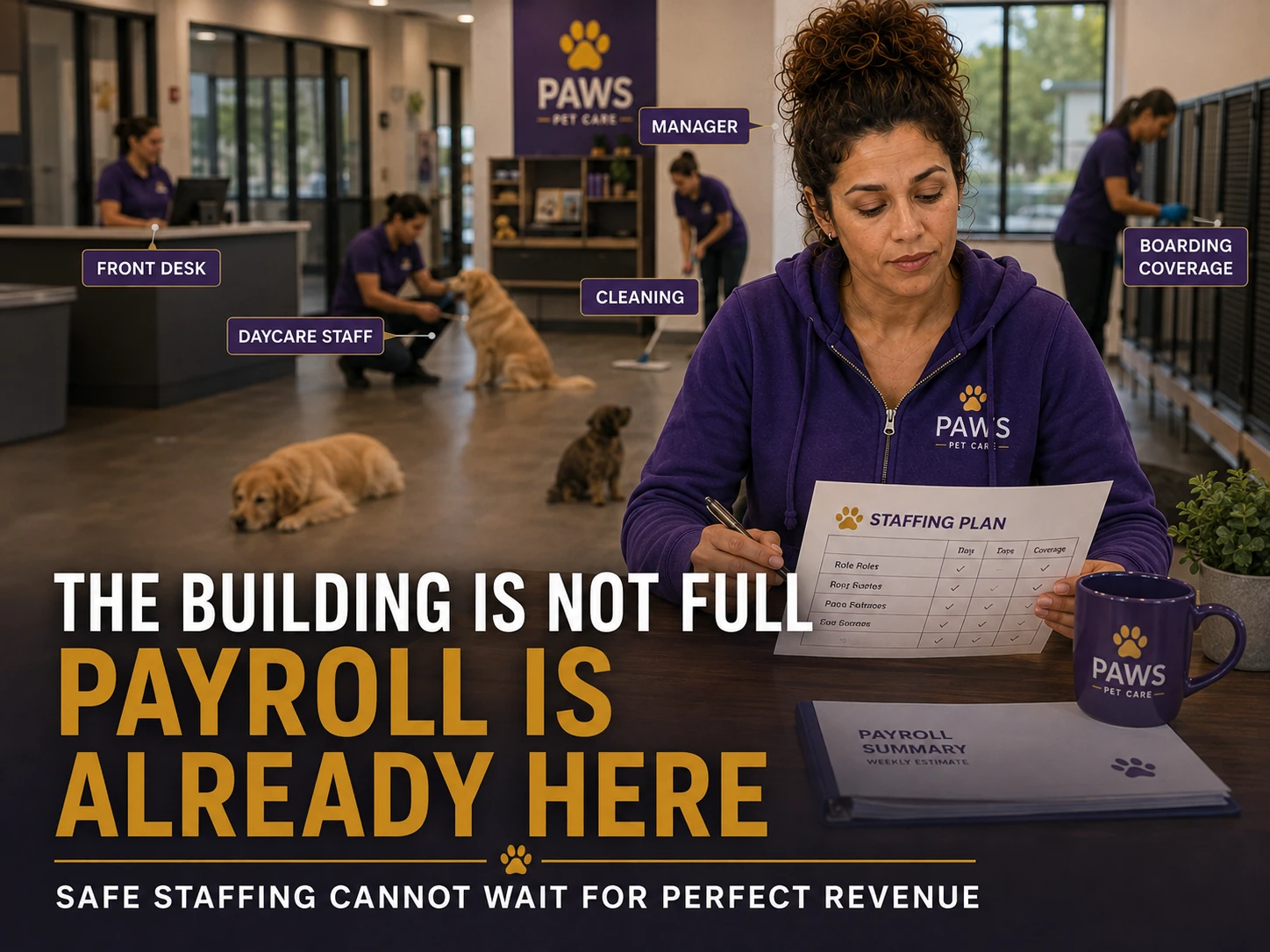
Dog daycare payroll does not wait politely for the customer base to mature. You may need a manager, front desk help, daycare staff, boarding coverage, cleaning labor, groomers, bathers, and trained people in the building before revenue feels comfortable.
Opening safely often means staffing ahead of demand. You cannot run a room full of dogs with a fantasy staffing plan just because the customer count is still low. The dogs do not care that you only have twelve customers. They still need enough staff to keep the room from turning into a furry prison riot.
Payroll also includes taxes, workers’ compensation, training time, turnover, uniforms, hiring ads, background checks, overtime, holiday coverage, and the cost of weak employees who interview well and then melt the first time a doodle screams at a water bowl.
Build the labor model by required coverage rather than by hoped-for revenue. Opening and closing, front desk, group supervision, cleaning, breaks, boarding, tours, training, and management coverage still consume hours when attendance is light.
Track the customer count needed to support each scheduled role. That shows when the business can responsibly add hours, when the owner is subsidizing coverage with unpaid labor, and when a service such as boarding or grooming creates payroll needs that its early sales do not yet support.
| Payroll Area | Why It Shows Up Early | What Buyers Miss |
|---|---|---|
| Manager | Needed to open, train, supervise, schedule, handle customers, and hold the building together. | A good manager costs money before the business feels ready to afford one. |
| Front Desk | Phones, tours, check-in, check-out, vaccine records, payments, and customer hand-holding start immediately. | A weak front desk leaks customers before they ever meet the dogs. |
| Daycare Staff | Dogs need supervision even when enrollment is still building. | Understaffing early can create incidents that damage the business before it has momentum. |
| Boarding Coverage | Overnight care creates morning, evening, weekend, and holiday needs. | Boarding is not passive income. It is responsibility after daycare goes home. |
| Cleaning Labor | Floors, suites, drains, laundry, yards, lobby, and odor control do not clean themselves. | Cleaning is either planned labor or hidden chaos. |
| Grooming and Bathing | Add-on services need trained labor, scheduling, equipment, cleaning, and customer handling. | Grooming revenue is attractive, but only if staffing and throughput make sense. |
📣
Marketing Costs: Franchise Brand Does Not Replace Local Demand
A logo on the sign does not automatically fill the playroom.
A franchise may provide marketing materials, brand assets, launch templates, campaign guidance, national messaging, and a broader brand story. That can help. But dog daycare is local. Customers still need to find you, trust you, tour you, review you, refer you, and believe their dog is safe with your staff.
That means local SEO, Google Business Profile work, reviews, vet outreach, apartment outreach, rescue relationships, events, referral programs, signage, social media, email follow-up, phone scripts, tour conversion, and old-fashioned community presence still matter.
If nobody in your market knows the franchise brand until you open, then you are paying to build local awareness for someone else’s name. That may still be worth it if the system helps enough, but do not pretend the brand magically replaced the local marketing grind.
Separate awareness spending from conversion work. Brand materials may make the location look polished, but tours, trial days, temperament tests, packages, boarding reservations, grooming appointments, and repeat visits are the events that move the local revenue model.
The opening budget should identify who owns each channel, what it costs, how leads are tracked, how quickly staff respond, and what percentage of inquiries become paying customers. Marketing support without local follow-through can create activity without enough deposits.
🎯
Marketing cost test
Ask how much grand opening marketing is required, how much local marketing is recommended, what the ad fund actually does, how leads are tracked, and how many customers come from the franchise brand versus your local work.
📣
The Advertising Double Stack: Brand Fund Plus Local Marketing
A franchise advertising fee does not mean your local marketing problem is solved.
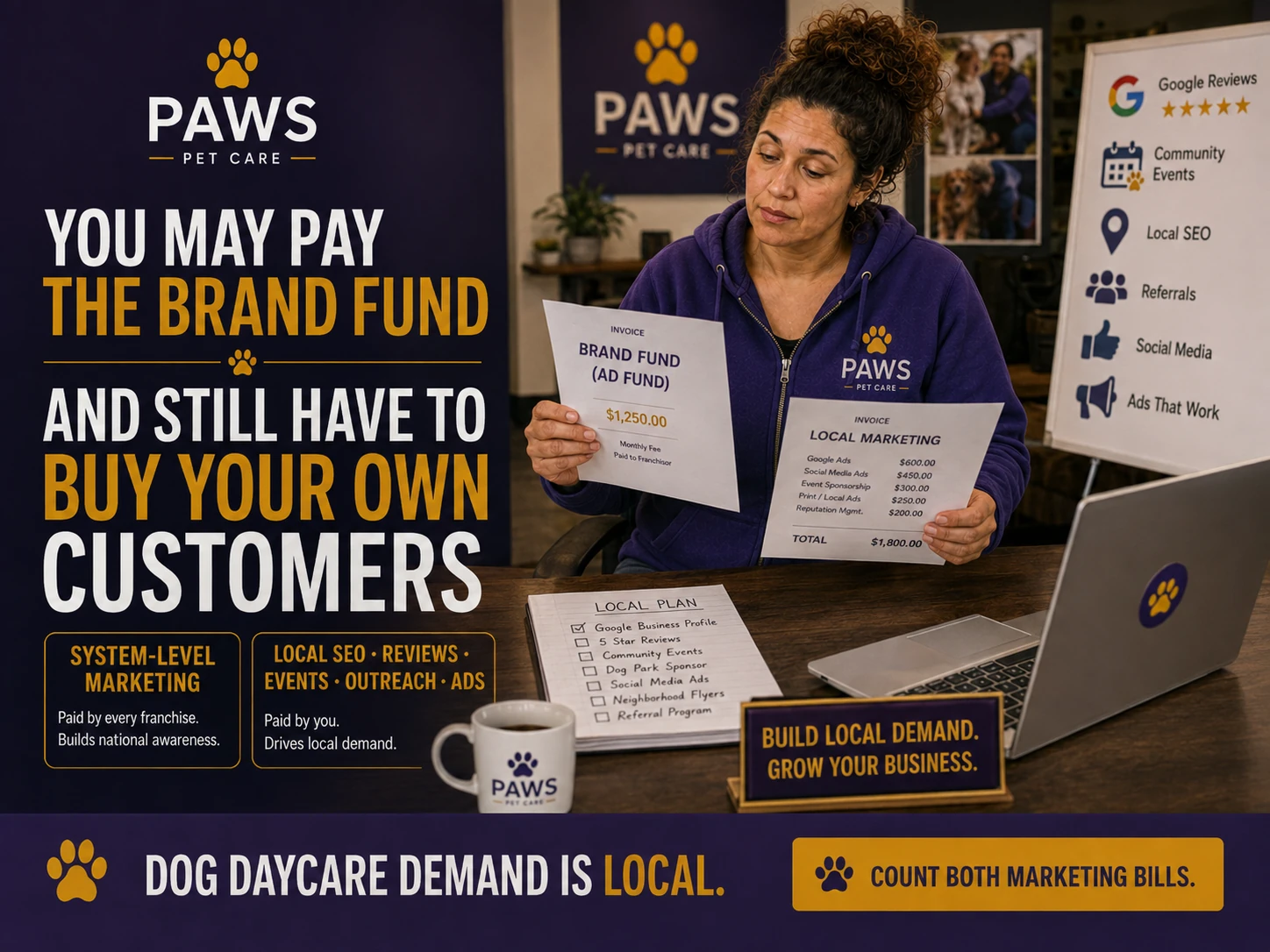
This is one of the most misunderstood cost issues in franchising. A buyer sees an advertising fund, brand fund, marketing fund, or national marketing fee and assumes, “Great, they handle advertising.”
Not so fast. That fee may support national campaigns, brand development, creative work, administrative costs, regional promotions, system-wide messaging, public relations, or broader franchise growth. It may help the brand. It may help the system. It may help you indirectly. But that does not mean it is buying the local customers your specific building needs this month.
Dog daycare is a local trust business. Your customers live near your building. They search locally. They read local reviews. They ask local vets, groomers, rescue people, neighbors, apartment managers, coworkers, and other dog owners. They want to see your facility, meet your staff, watch how you handle dogs, and believe their dog will be safe.
That means you may still have to pay for local advertising on top of the franchise advertising fee. Local SEO, Google Business Profile work, reviews, vet outreach, apartment outreach, events, referral programs, social media, email follow-up, grand opening offers, signage, direct mail, paid search, and tour conversion may still come out of your pocket.
So yes, you can end up paying twice. You pay into the system-level fund because the agreement requires it, and then you pay again locally because the phone still has to ring in your market. That does not automatically mean the fund is bad. It means the buyer needs to know what the fund actually does and what local marketing is still required.
Ask for the historical allocation and decision process for every mandatory fund. The buyer should understand whether money can support national creative, public relations, administrative costs, regional media, franchise recruitment, or local lead generation—and whether the local operator has any meaningful input.
The local budget should still stand on its own. If the location needs reviews, community partnerships, paid search, events, referral incentives, photography, email follow-up, and neighborhood outreach, those costs should appear even when a separate brand contribution is mandatory.
| Marketing Cost | What It May Pay For | Buyer Question | PAWS Operator Take |
|---|---|---|---|
| National / Brand Fund | Brand campaigns, creative assets, system-wide advertising, national messaging, public relations, administrative costs, or franchise-growth marketing. | Does this fund directly create leads for my location, or mostly support the larger brand machine? | Brand support is nice. Local dogs still live near your building. |
| Regional Advertising | Advertising across a market area, region, or cluster of locations. | Are there enough nearby locations for regional advertising to help me, or am I paying into a pool that spends somewhere else? | Regional money can be useful if the region actually includes your customers. |
| Local Marketing | Google Business Profile, local SEO, reviews, signs, vet outreach, events, referral offers, paid ads, social media, and direct local promotion. | How much am I required or realistically expected to spend locally on top of the brand fund? | This is usually where the actual daycare customers come from. |
| Grand Opening Marketing | Pre-opening campaigns, mailers, ads, events, launch promotions, tours, local partnerships, and customer acquisition. | Is this included, required, recommended, or completely separate from the national fund? | Grand opening is not magic. It is buying attention before trust exists. |
| Franchise Recruitment Marketing | Some system-level marketing may support attracting future franchisees instead of directly promoting your outlet. | Can any portion of the fund be used to recruit more franchise buyers? | If your fee helps sell the next territory, that should be disclosed and understood before you sign. |
| Local Ad Approval | The franchisor may require approval for local ads, promotions, signage, online content, offers, or brand use. | Can I buy my own ads quickly, or do I need permission before responding to local market conditions? | Marketing control can slow you down when the local market needs fast action. |
⚠️
The double-advertising warning
Do not assume the advertising fee replaces local marketing. Ask where the fund is spent, who controls it, whether franchisees have input, whether it promotes your location, whether it can be used to attract new franchise owners, and how much local marketing you still need to buy yourself.
🫁
Working Capital: The Bill Buyers Lie to Themselves About
Working capital is not extra money. It is oxygen.
Working capital is the money that keeps the business alive while the customer base catches up to the expense structure. Rent does not wait. Payroll does not wait. Insurance does not wait. Utilities do not wait. Software does not wait. Debt service does not wait. Cleaning supplies do not wait. Marketing does not wait. Repairs do not wait.
Buyers love to treat working capital like optional padding because it does not feel exciting. It is not shiny. It is not a sign. It is not a grand opening photo. It is just cash sitting there, keeping the business from making death-rattle noises when revenue ramps slower than the spreadsheet promised.
Underfunding working capital is one of the fastest ways to turn a decent business idea into a panic-driven mess. The first six months can be ugly. Sometimes the first year is ugly. If you need the business to feed you immediately while also paying rent, payroll, debt, royalties, and marketing, you better model that before signing anything.
Working capital should be tied to a monthly cash-flow model rather than a round number that feels comfortable. Model the timing of receipts, payroll dates, rent, debt, royalties, utilities, insurance, marketing, taxes, repairs, and owner living needs.
Include a minimum cash floor and a written response plan. The owner should know which discretionary costs can be slowed, which staffing decisions cannot be compromised, when additional capital must be raised, and what conditions require delaying an expansion or service launch.
- Rent and common-area charges.
- Payroll, payroll taxes, workers’ compensation, and hiring costs.
- Utilities, internet, phones, software, and payment processing.
- Insurance, licenses, permits, accounting, and professional fees.
- Cleaning supplies, laundry, waste removal, repairs, and maintenance.
- Local marketing, promotions, signage, events, and customer acquisition.
- Loan payments, interest, and lender-required reserves.
- Owner living expenses during ramp-up.
⚠️
The ugly cash-flow truth
The business can be “on track” and still run out of cash if the ramp-up is slower, payroll is higher, construction overruns, marketing takes longer, or the owner forgot they personally need to eat while waiting for the dog business to mature.
🧾
Royalties and Ad Fund Fees: The Costs That Keep Going
The initial franchise fee hurts once. Ongoing fees keep riding with you.

A royalty based on gross sales comes off the top. That means the franchisor may get paid before you know whether the month produced a real profit. The business can look busy, the lobby can feel active, and the revenue can look decent while rent, payroll, debt, repairs, insurance, cleaning, marketing, and staff turnover chew the bottom line down to a sad little nub.
Ad fund or brand fund fees may also apply. Those fees may support useful marketing, brand development, creative assets, national campaigns, public relations, or broader system growth. Fine. But the buyer needs to ask whether those fees create measurable local leads, tours, daycare packages, boarding reservations, grooming appointments, and customer demand for the specific location.
The dangerous thing about ongoing fees is that they sound small as percentages and get large as years. A 6%, 7%, 8%, or 9% combined fee stack can become serious money when applied to gross sales for five, ten, fifteen, or twenty years.
Run the fee stack against several revenue levels and several margin levels. The same royalty dollars can be manageable in a strong-margin location and destructive in a high-revenue location carrying heavy rent, payroll, debt, or repair costs.
The analysis should also separate the first-year value from later-year value. Training and opening support may be concentrated early, while the percentage obligation continues as the local staff, customer relationships, reviews, and operating knowledge increasingly come from the location itself.
🧮
Run the long-dollar math
If a $750,000 gross-revenue location pays an 8% combined royalty and ad fund stack, that is $60,000 per year before the business pays its own bills. Over ten years, that is $600,000. Percentages sound polite. Long-dollar totals are where the teeth show.
🧴
Approved Vendors and Cost Control
“Approved” only matters if approved also means better, cheaper, safer, or worth it.
Franchise systems often use approved vendors, required vendors, recommended vendors, purchasing programs, brand standards, product lists, software systems, equipment packages, and national or preferred supplier relationships.
Those arrangements can help. They can save research time. They can standardize quality. They can protect the brand. They can prevent a weak operator from buying junk that creates safety, cleaning, or customer-service problems.
They can also limit your ability to shop the market. If a required vendor is too expensive, slow, weak, backordered, or not the best fit for your local operation, you may not have the same freedom an independent owner has. If supplier rebates, commissions, discounts, purchasing incentives, or preferred-vendor arrangements exist, ask who benefits and how the pricing compares to open-market alternatives.
Compare the complete delivered cost, not only unit price. Freight, minimum orders, lead time, warranty, service response, compatibility, subscription terms, and the cost of downtime all affect whether an approved source creates value.
Create an exception process before a vendor fails. The owner should know who can approve an alternative, how quickly approval occurs, what documentation is required, and whether the location can protect dogs and operations when a required product is unavailable.
- Are approved vendors required or only recommended?
- Can you use local alternatives if they are cheaper, faster, or better?
- Are required products genuinely better for dog safety, cleaning, durability, or customer experience?
- Are vendor rebates, commissions, purchasing incentives, or supplier programs disclosed?
- Who benefits financially from the vendor relationship?
- Can you change vendors if pricing, quality, delivery, or service gets bad?
- What happens if the approved vendor cannot serve your market well?
⚠️
Vendor freedom warning
Independent owners can usually tell a bad vendor to go pound sand and buy somewhere else. Franchise owners may not have that freedom. Know that before the invoice starts annoying you every month.
🔁
Forced Upgrades and Remodel Exposure
The cost stack does not always end on opening day.
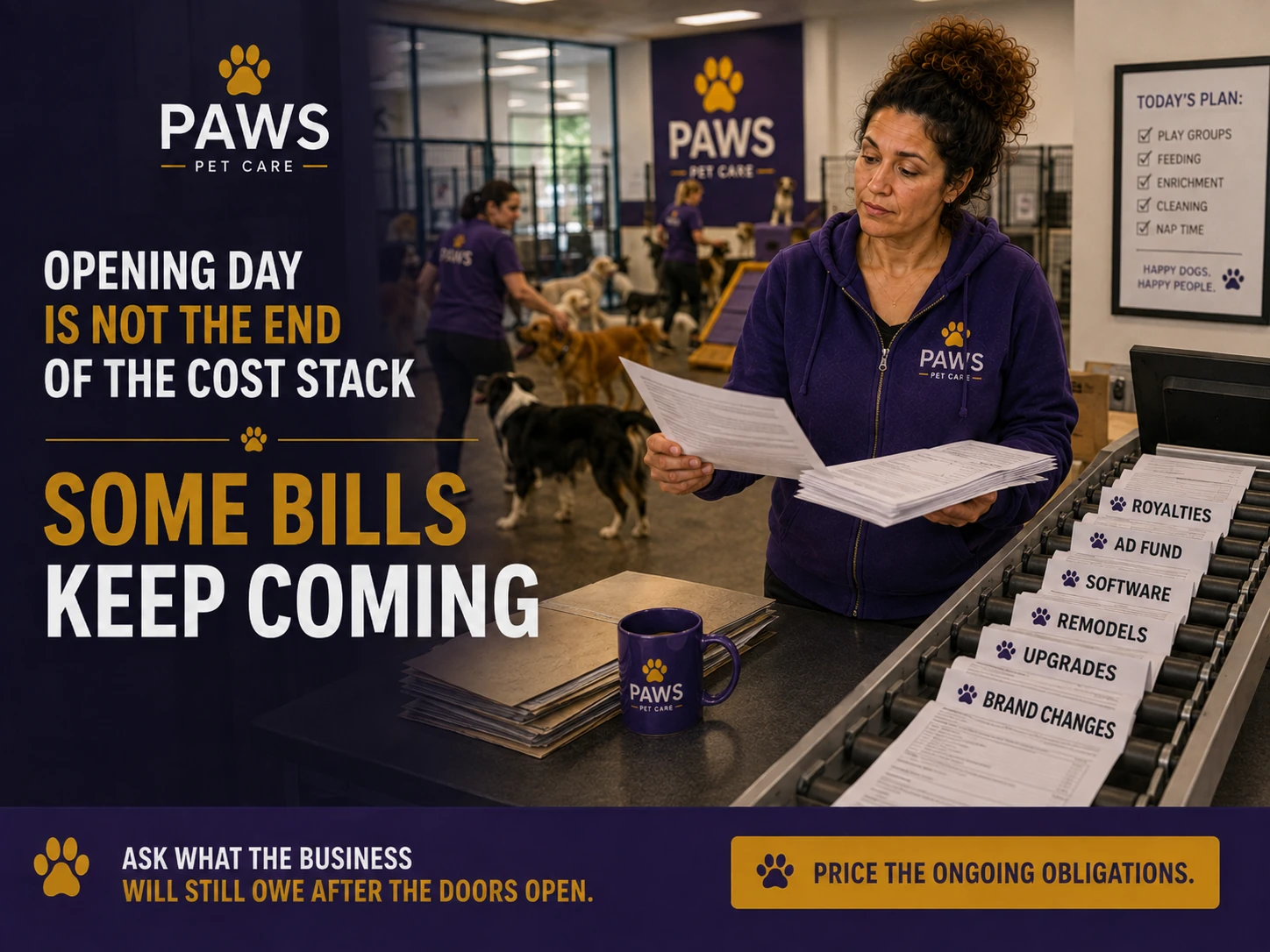
A franchise agreement may require the location to maintain current brand standards. That can mean future changes to signage, colors, lobby design, software, technology, equipment, uniforms, services, furniture, marketing materials, exterior appearance, or facility standards.
Some updates may be smart. A brand has to evolve. A stale facility can hurt customer trust. Better software, better safety systems, better equipment, or cleaner branding can help the business.
But upgrades cost money. They can arrive after the owner already spent heavily to open, while the business is still paying debt, royalties, rent, payroll, insurance, marketing, and repairs. You may finally get the business breathing, then corporate decides the brand needs a facelift and your wallet gets volunteered for surgery.
Model future brand compliance as a capital reserve instead of pretending it will never happen. Signage, technology, software, uniforms, finishes, equipment, and renewal remodels should be reviewed for timing, approval power, and any stated or practical spending limits.
The owner should also ask whether an upgrade produces local revenue, reduces operating cost, improves safety, or primarily refreshes the brand appearance. Useful upgrades may be worth funding. Unplanned upgrades still compete with payroll, debt reduction, maintenance, and owner return.
📄
Read the upgrade language
Ask what upgrades can be required, how often, what cost limits exist, whether remodel obligations apply at renewal, and whether the franchisor can change brand standards after you already paid to build the first version.
⚖️
Franchise Cost vs. Independent Cost
Independent is not free. It is a different way of buying help.
Starting independently still costs money. You may need a zoning attorney, lease attorney, architect, contractor, accountant, consultant, software, templates, forms, training, market research, pricing help, and marketing support. You may also make mistakes a franchise system might have helped you avoid.
But targeted help up front is not the same animal as a long-term royalty on gross sales. Paying a lawyer to review a lease hurts once. Paying a consultant to review your facility plan hurts once. Buying software, templates, or a manual hurts once or as a known subscription. A royalty and ad fund stack can keep eating for years.
The honest comparison is not “franchise costs money and independent is free.” That is nonsense. The comparison is whether you want to buy a packaged system with ongoing control and fees, or buy targeted help, build your own system, and keep the freedom.
For a fair comparison, place both paths on the same timeline. Include independent legal, consulting, design, training, software, and marketing expenses, then compare them with the franchise fee, required systems, recurring percentages, vendor restrictions, and future compliance costs.
The decision should focus on total cost of ownership and decision control, not only the opening check. A packaged system may reduce mistakes and save time. An independent system may require more early work but preserve vendor choice, pricing flexibility, and long-term cash flow.
| Need | Franchise Path | Independent Path | Cost Question |
|---|---|---|---|
| Zoning Help | May provide site criteria, guidance, and review. | You research code and hire local help where needed. | Is franchise help better than targeted local zoning help? |
| Lease Help | May provide preferred language or review expectations. | You hire a commercial lease attorney and review the deal directly. | Who is protecting you, and who is protecting the brand? |
| Facility Layout | May provide a layout model, brand standards, and design rules. | You hire design/build help and operator review. | Is the franchise design saving money or forcing a more expensive box? |
| Operations Manual | Provided as part of the franchise system. | You build, buy, adapt, or hire help creating procedures. | Is the manual worth ongoing fees after you learn the business? |
| Training | Usually structured through the franchisor. | You hire trainers, consultants, experienced staff, and build your own system. | How much of the value is front-loaded before opening? |
| Marketing Plan | May include templates, launch support, ad fund, and brand guidance. | You build local SEO, ads, reviews, referral systems, and outreach yourself. | Which path actually creates local tours and customers? |
| Vendor Research | Vendors may be recommended or required. | You shop the market and change vendors when needed. | Does approved mean better, cheaper, safer, or just mandatory? |
| Software Setup | Software may be required or integrated with the system. | You choose the platform that fits your facility and budget. | Is the required system better than open-market pet-care software? |
| Pricing Model | May provide pricing guidance based on system experience. | You research competitors, costs, capacity, payroll, and local demand. | Does either model survive the actual math in your market? |
🔍
Dog Daycare Franchise Cost Questions Before You Sign
If the answer is vague, slow down. Vague gets expensive.
These questions should produce documents, numbers, names, and deadlines. A verbal answer from a salesperson is useful context, but it should not replace the FDD, agreement, lease, bids, lender terms, vendor pricing, franchisee interviews, and professional review.
Create a due-diligence log showing who answered each question, when it was answered, what supporting material was provided, and what remains unresolved. Unanswered questions should stay visible instead of disappearing beneath sales momentum.
Do not sign simply because every question received an answer. Decide whether the answer is acceptable, whether the risk is funded, and whether the contract gives the buyer enough control to manage the cost when reality differs from the estimate.
- What exactly does the initial franchise fee buy?
- What does the franchise fee not buy?
- What is the current FDD estimated initial investment range?
- What costs are outside the FDD estimate or likely to exceed it in my market?
- How much liquid capital do I need before opening?
- How much working capital do I need after opening?
- What rent assumptions were used in the investment model?
- What payroll ramp-up assumptions were used?
- Does the model assume the owner takes a salary during ramp-up?
- What happens if construction costs exceed the estimate?
- What happens if permits, zoning, or landlord approvals delay opening?
- What build-out standards are mandatory?
- What vendors are required?
- Can I choose cheaper or better local vendors?
- Are vendor rebates, commissions, purchasing incentives, or supplier programs involved?
- When do royalties begin?
- Are royalties based on gross sales, adjusted gross sales, revenue, or something else?
- What ad fund, brand fund, technology, software, or other recurring fees apply?
- What local marketing will I still pay for?
- What upgrades, remodels, rebranding, technology changes, or equipment replacements can be required later?
- What happens if revenue ramps slower than projected?
- How many current and former franchisees can I speak with privately?
- What do existing franchisees wish they had known about opening costs?
🗂️
Keep Running the Numbers
Franchise cost is only one part of the decision. The royalty, contract, control, brand value, and independent alternative still need to survive review.
🧾
Dog Daycare Franchise Royalties
The long-term fee stack may cost more than the initial franchise fee. Run the year-five, year-ten, and year-twenty math.
⚖️
Franchise vs. Independent Startup
Compare the packaged system against building your own local brand, hiring targeted help, and keeping control.
📚
Franchise Operating System
A manual and training system can help. The buyer still needs to ask whether the rulebook is worth paying for forever.
🔒
Control and Approved Vendors
Cost is not only money. It is also vendor control, brand standards, software requirements, inspections, and future upgrades.
💵
Opening Cash Flow
The first six months can break a dog daycare even when the idea is good. Model the ugly part before signing.
🧮
Profit Simulator
Run revenue, pricing, payroll, occupancy, debt, and fee assumptions before the franchise sales process makes the deal feel inevitable.
❓
Dog Daycare Franchise Costs FAQ
Detailed answers about the franchise fee, full investment, build-out, leases, payroll, working capital, royalties, marketing, vendors, upgrades, financing, and due diligence.
How much does a dog daycare franchise cost?
The real cost depends on the franchise model, market, building, size, service mix, construction, financing, and opening timeline. The franchise fee is only one item. A serious estimate must also include lease costs, design, permits, build-out, HVAC, drainage, equipment, technology, insurance, payroll ramp-up, marketing, working capital, debt service, royalties, and future brand obligations.
Is the franchise fee the same as the total investment?
No. The franchise fee generally buys access to the brand and system under the agreement. Total investment includes every dollar needed to locate, approve, lease, design, build, equip, staff, market, and support the business through opening and ramp-up. Buyers should reconcile the fee, FDD estimate, lender budget, contractor pricing, and local cash-flow model instead of treating any one number as complete.
What should the franchise fee actually buy?
Require an itemized list of deliverables: training, manuals, site assistance, design guidance, software setup, vendor direction, marketing materials, opening support, and post-opening help. Identify when each item is delivered, who provides it, what travel or extra cost applies, and what restrictions accompany it. “Proven system” is not a useful cost explanation unless the system is broken into measurable parts.
What does the franchise fee usually not cover?
It commonly does not cover the full lease obligation, deposits, professional review, permits, construction, utility upgrades, flooring, drains, HVAC, equipment, furniture, cameras, signage, local marketing, payroll, insurance, supplies, debt service, owner living expenses, or operating losses during ramp-up. The exact exclusions must be confirmed from the current franchise documents and local project budget.
Why is dog daycare build-out more expensive than normal retail construction?
A dog facility must withstand water, urine, hair, odor, barking, heavy cleaning, wet floors, containment pressure, laundry, bathing, boarding, and dense occupancy by animals and staff. Drainage, slope, ventilation, sound control, durable surfaces, gates, waste flow, and isolation options affect daily labor and safety. A space that looks acceptable as ordinary retail may require major mechanical and structural work before it functions as pet care.
How much working capital should the buyer plan?
Working capital should come from a monthly cash-flow model rather than a comfortable round number. Model rent, payroll, taxes, utilities, insurance, debt, software, royalties, marketing, supplies, repairs, and owner living costs through a slower-than-expected ramp. Include a minimum cash floor and contingency for construction delays, weak early sales, staff turnover, and unexpected facility work.
Why does payroll become a problem before the building is full?
Safe coverage is driven by operating needs, not by how many customers have arrived. Management, front desk, dog supervision, cleaning, breaks, tours, boarding, and opening and closing duties consume labor from day one. Understaffing to match low early revenue can create incidents and poor service, while overstaffing without a ramp plan can drain cash. The schedule must connect required coverage with customer milestones.
What lease costs should be included beyond base rent?
Include deposits, pre-opening rent, common-area charges, taxes, insurance pass-throughs, maintenance obligations, scheduled increases, utility responsibility, repair obligations, personal guarantees, professional review, and rent owed during delays. Also value renewal, assignment, exit, and use rights. A favorable advertised rent can still become an expensive lease when the tenant absorbs major HVAC, plumbing, drainage, or building responsibilities.
How can zoning and permitting increase the budget?
The filing fee may be the smallest part. Special-use proceedings, legal review, drawings, revised plans, parking or outdoor-use conditions, sound studies, waste requirements, occupancy changes, and delayed construction can all add cost. Holding rent, loan interest, contractor remobilization, and redesign matter when approvals take longer than expected. The approval path should be documented before major money is committed.
How should royalties be evaluated?
Calculate the royalty at multiple revenue levels and compare it with the location’s likely operating margin. A percentage of gross sales is paid before rent, payroll, debt, repairs, and owner return are known. Then calculate five-, ten-, fifteen-, and twenty-year totals. Finally, identify what continuing services, brand demand, support, purchasing savings, software, and system improvement justify that ongoing payment after the startup period ends.
Does an advertising fund replace local marketing?
Usually not automatically. A brand or ad fund may support national creative, public relations, regional campaigns, administrative costs, or broader system goals. The local location may still need reviews, local SEO, paid search, events, community partnerships, referral programs, social content, signage, email follow-up, and tour conversion. The buyer should understand both bills and how each one produces measurable local demand.
Are approved vendors always cheaper?
No. Approved vendors may improve quality, consistency, safety, warranty support, or purchasing efficiency, but approval does not guarantee the lowest delivered cost. Compare price, freight, minimum orders, lead time, service, warranty, downtime, and available substitutes. Ask whether vendors are required, whether rebates or incentives exist, who benefits financially, and what exception process applies when the approved source fails.
What are forced upgrades and remodel obligations?
The agreement may require future changes to signage, colors, software, equipment, technology, uniforms, finishes, lobby design, or facility standards. Some changes can improve safety or customer trust, but they compete with debt, payroll, maintenance, and owner return. Review when upgrades can be required, whether they appear at renewal, who controls the scope, whether spending limits exist, and how much notice the location receives.
What should the buyer verify in the current franchise documents?
Verify the initial fee, other fees, estimated investment, supplier restrictions, training and support, territory, renewal, transfer, termination, financial-performance information, and all contracts the buyer will sign. The page’s general discussion is not a substitute for the current documents. A franchise attorney and accountant should compare those documents with the lease, lender terms, local bids, and the buyer’s own cash-flow assumptions.
How should construction overruns be handled in the plan?
Use current local bids, allowances, exclusions, and a contingency tied to project risk. Identify who pays for code corrections, utility upgrades, landlord work, design changes, franchise-standard revisions, and hidden conditions. The financing plan should show what happens when the contingency is used and whether additional capital is available. A project that fails after a normal overrun was underfunded before construction started.
Can financing solve the cash problem?
Financing can spread part of the investment, but it adds interest, fees, collateral requirements, payment timing, and lender controls. Debt service begins whether customer growth matches the sales forecast or not. The buyer still needs equity, reserves, working capital, and a plan for owner living expenses. Borrowing does not eliminate the cost stack; it changes when and how the stack is paid.
Should the owner include a salary during ramp-up?
Yes, the model should state whether the owner receives pay and how personal living expenses are covered. A plan that only works because the owner performs management, sales, cleaning, and operations without compensation may overstate business profitability. Even when the owner intentionally delays salary, the cash plan should show the duration, personal reserve, and revenue milestone required before compensation begins.
Is an independent startup automatically cheaper?
No. Independent owners still pay for legal review, zoning help, design, contractors, software, insurance, training, forms, marketing, equipment, and mistakes. The difference is how help is purchased and who controls the system afterward. A fair comparison places targeted independent costs and owner time beside the franchise fee, recurring percentages, required vendors, software, restrictions, and future brand compliance.
What costs do buyers most often underestimate?
Build-out, pre-opening carrying costs, payroll ramp-up, working capital, local marketing, and delays are common pressure points. Buyers focus on visible purchases and underestimate the cost of time: rent before opening, interest during construction, staff before utilization, and months of operating expense before recurring revenue matures. The best defense is a reconciled project budget and a stressed monthly cash-flow model.
What is the final cost decision the buyer should make?
Decide whether the complete, verified cost stack is funded and whether the franchise creates enough measurable value to justify the fee, recurring obligations, and loss of flexibility. The decision should survive a slower opening, higher construction cost, weaker early sales, and continuing local marketing needs. A manageable franchise fee does not rescue an underfunded building, weak lease, thin working capital reserve, or unsupported long-term royalty.
🐾
The Bottom Line: The Franchise Fee Is One Line Item
Do not buy the clean number and ignore the dirty pile behind it.
The franchise fee is not the cost of opening. It is one line item in a much larger stack. The building still has to be found, approved, leased, designed, built, staffed, cleaned, insured, marketed, and funded while customers slowly show up.
A franchise may reduce confusion. It may provide systems, support, training, standards, and a road map. That has value if the system is strong and the buyer actually needs it. But a franchise does not reduce reality. The money still has to come from somewhere, and most of it comes from you.
If the franchise helps enough to justify the fee stack, fine. Prove it. But do not sign because the franchise fee looked manageable while the build-out, working capital, royalties, debt service, and vendor rules were hiding in the weeds.
The final approval should come from a reconciled capital plan: committed sources of money, verified uses of money, contingency, working capital, owner living costs, and a stressed ramp-up case. Every gap should have an answer before the lease and franchise agreement make the gaps permanent.
A buyer does not need perfect certainty. The buyer needs enough evidence to know which risks are funded, which risks are controlled, which risks remain, and whether the promised franchise value is large enough to justify both the visible fees and the less visible loss of flexibility.