Gross Revenue, Royalty Drag, Ad Fund Fees, Brand Support, Local Marketing, Year-Five Value, and Long-Term Franchise Math
Dog Daycare Franchise Royalties: What Are You Still Paying For in Year Five?
A blunt operator guide to dog daycare franchise royalties, ad fund fees, gross-revenue drag, and whether the franchisor keeps providing enough value after the startup period is over.
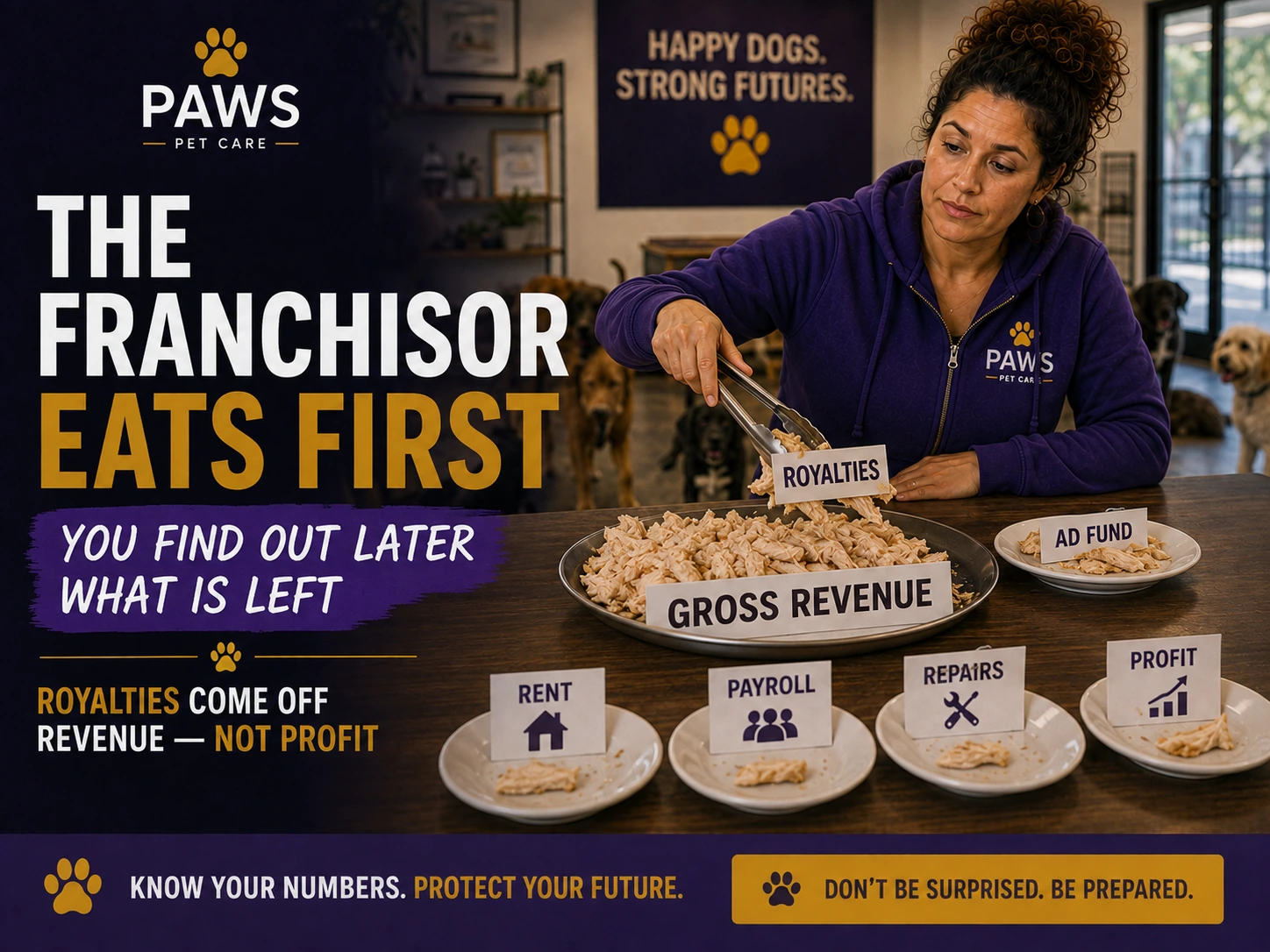
Royalties usually come off revenue, not whatever is left after the business survives the month. That one detail changes everything.
A dog daycare franchise royalty does not care that payroll was ugly, rent went up, the HVAC died, the groomer quit, the floor needs repair, or three dogs decided to turn Saturday boarding into a cage-rattling opera. If the royalty is based on gross revenue, the franchisor gets paid before the business knows what profit is left.
That does not automatically make royalties bad. A royalty can be fair if the franchisor keeps creating value. But the value has to keep showing up after the opening rush is over.
The first year may be where the franchise proves useful. Year five is where the royalty has to defend itself.
This page asks the question many buyers do not ask hard enough before signing: when the building is open, the staff is trained, the customers know the location, the forms are built, the software is running, and the local reviews belong to your team, what are you still buying every month?
⚠️
Operator warning: the franchisor eats first.
A royalty on gross sales means the franchisor eats first. You find out later whether anything was left on the plate.
📊
Gross Revenue Is Not Profit
This is the sentence that separates pretty sales math from real operator math.
Gross revenue is the money collected before the business pays its bills. Profit is what may be left after rent, payroll, payroll taxes, insurance, utilities, debt service, cleaning supplies, laundry, software, marketing, repairs, refunds, taxes, owner draw, staff mistakes, customer problems, and the normal little fires that show up in a dog business.
Franchise royalties are often calculated on gross revenue or gross sales. That means the royalty may be owed before the business knows whether the month actually worked. The lobby can look busy, the phone can ring, the daycare room can be full, and the owner can still be bleeding through the back pocket.
Also watch for minimum royalty language, definitions of gross sales, exclusions, late fees, reporting rules, and payment timing. A buyer may think, “Well, if the business has a bad month, at least the royalty shrinks.” Maybe. Maybe not enough. If the agreement has minimums, strict gross-sales definitions, or limited exclusions, the royalty can still bite during a weak month.
This is why a small percentage can be dangerous. Six percent sounds polite. Eight percent sounds manageable. Nine percent with other fees still looks like a normal business line item when it is sitting quietly inside a spreadsheet.
Then the month happens. Payroll lands. Rent lands. Utilities land. Insurance lands. A gate breaks. A dryer dies. A dog gets sick. The groomer quits. Local ads cost more than expected. Suddenly that little percentage is not cute anymore.
The useful calculation is contribution after the fee stack, not revenue before it. Owners should model royalties against labor, occupancy, discounting, package redemptions, payment costs, refunds, and the fixed expenses required to keep the building open.
A strong month can still be a weak month for cash. Membership sales, prepaid packages, gift cards, and deposits may create cash today while creating service obligations later, so the contract’s gross-sales definition and the accounting treatment both deserve careful review.
| Term | Plain Meaning | Why It Matters |
|---|---|---|
| Gross Revenue | Money collected before expenses. | Royalty calculations may start here, before rent, payroll, debt, insurance, repairs, and owner draw. |
| Net Profit | What may be left after the business pays expenses. | This is the money the owner actually cares about, but it is not always the number used for royalty calculations. |
| Royalty Fee | Ongoing fee paid to the franchisor, often as a percentage of gross revenue or gross sales. | The franchisor may be paid even during thin or ugly months. |
| Ad Fund / Brand Fund | Ongoing contribution to system-level advertising, brand, marketing, or related funds. | It may support the larger brand while you still pay for local marketing separately. |
| Combined Fee Stack | Royalty plus ad fund, technology, software, management, reporting, or other recurring fees. | The real pain is rarely one fee. It is the stack. |
📌
The gross-sales trap
Gross sales can make the business look strong while the owner is still fighting to keep enough cash after expenses. Never judge royalty pain by revenue alone. Judge it against the full operating reality.
🧾
The Royalty Stack Is Usually More Than One Line
Not every franchise charges every fee. That is exactly why the FDD matters.
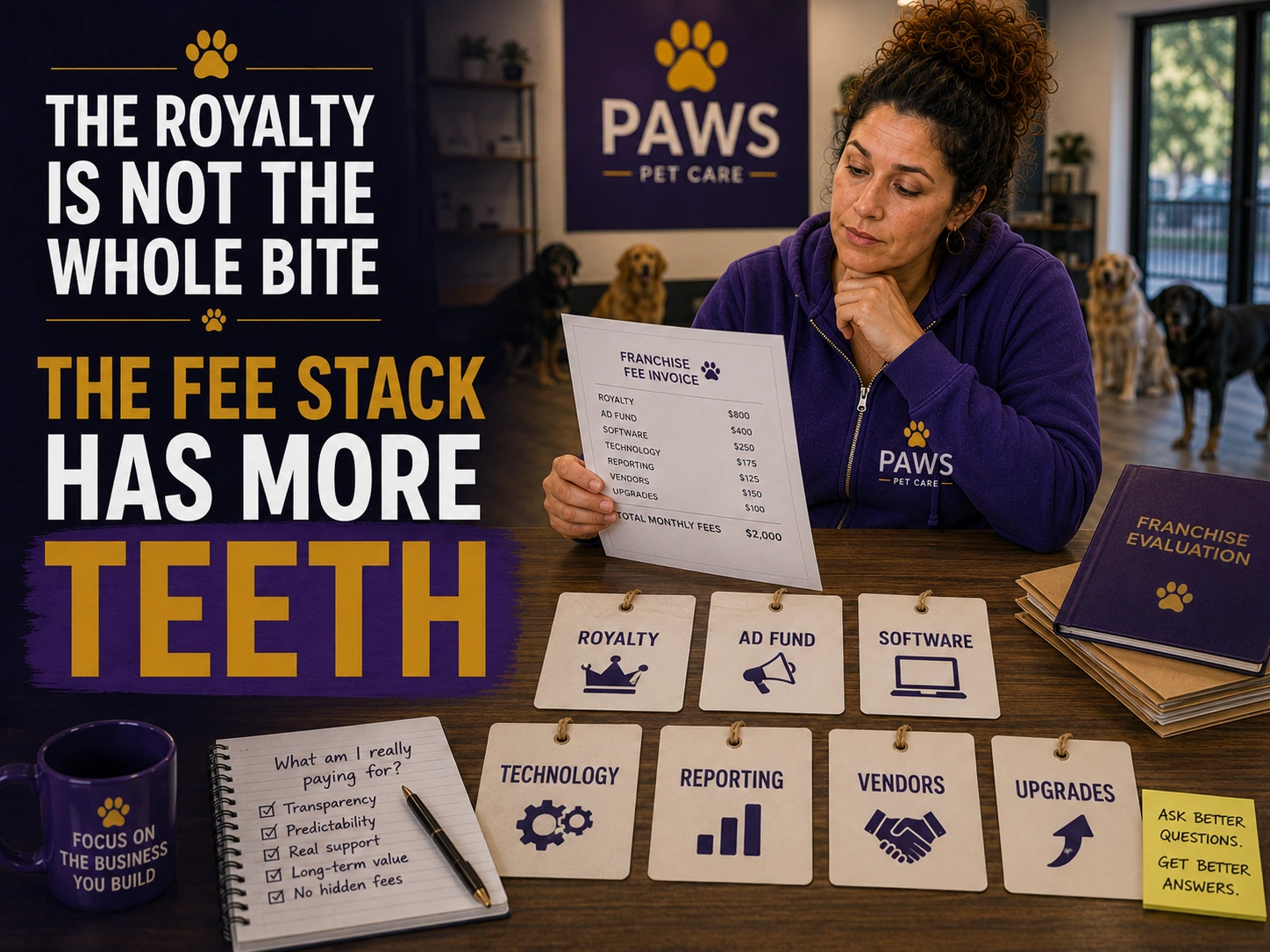
A buyer may hear “royalty” and think there is one simple fee. Sometimes there is. Many times there is a stack of recurring charges that travel together.
The royalty may be one percentage. The brand fund or ad fund may be another percentage. There may be technology fees, software fees, local advertising management fees, call-center fees, required accounting/reporting costs, required vendor costs, required training costs, required inspection costs, or future upgrade exposure.
The definitions matter. “Gross sales,” “gross revenue,” “net revenue,” and “adjusted gross sales” are not automatically the same thing. The agreement may include or exclude refunds, discounts, taxes, gift cards, package sales, memberships, no-shows, credits, third-party fees, online sales, grooming revenue, retail revenue, boarding revenue, or other service lines. Do not guess. Make the agreement define the number the royalty is riding on.
Not every dog daycare franchise has every fee. That is not the point. The point is that the buyer has to stop asking, “What is the royalty?” and start asking, “What is the total recurring fee stack, when is it due, what is it based on, who controls it, and what value does it produce?”
Build one recurring-fee schedule that shows every percentage, fixed charge, minimum, vendor obligation, software cost, required local spend, and renewal change. Looking at each fee separately makes the stack feel smaller than the business experiences it.
The owner should also identify which fees grow with revenue and which remain fixed when revenue falls. Percentage fees punish growth; fixed fees punish slow months. A combination can create pressure in both directions.
🧾
Royalty Fee
The core continuing payment to the franchisor. Often calculated as a percentage of gross sales or revenue.
📣
Ad Fund / Brand Fund
A required contribution that may support national, regional, brand, creative, PR, or other system-level marketing.
💻
Technology Fees
Software, reporting, website, customer systems, data, booking, or other platform-related costs may apply.
📋
Reporting Costs
Required bookkeeping, accounting systems, sales reporting, payment systems, or operational reporting can add cost and friction.
🛒
Vendor Cost Stack
Approved vendors may save time or protect quality, but they can also limit your ability to shop cheaper or better options.
🔁
Upgrade Exposure
Future technology, signage, remodel, equipment, branding, or software changes can create new costs after opening.
⏳
Year One Value vs. Year Five Value
Startup help and long-term value are not the same thing.
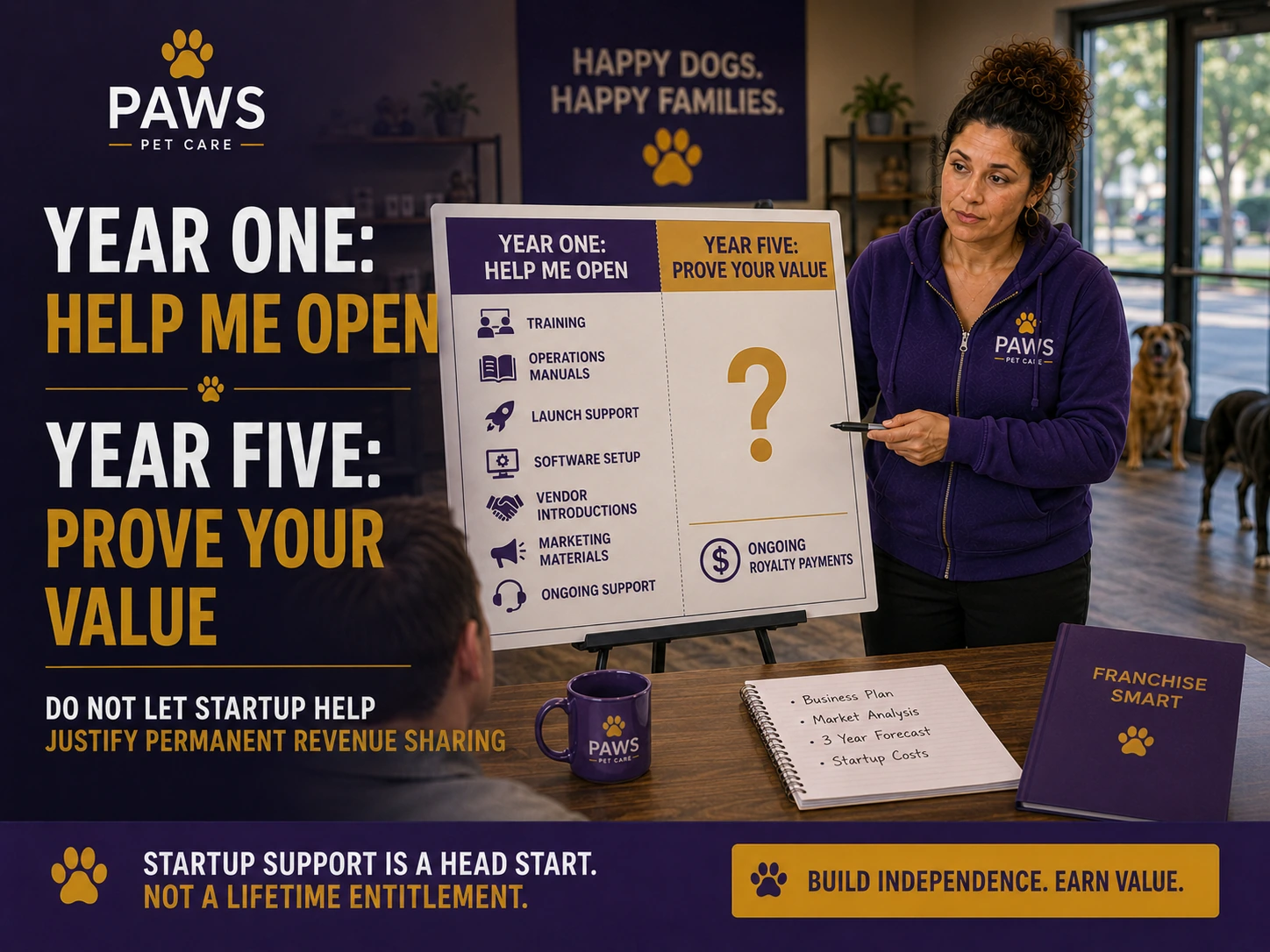
A franchise can create serious value before opening and during the first year. That is the strongest argument for buying one. The buyer may get help with site review, opening checklists, build-out direction, staff training, operating manuals, software setup, vendor lists, launch marketing, and early coaching.
That help can matter. A first-time owner may avoid mistakes that would have cost real money. The franchise may shorten the learning curve. The owner may open with cleaner systems than they could have created alone.
But year one value does not automatically justify year five royalties. That is the problem. Once the business is open, the staff is trained, the local customers know the building, the software is running, the forms are built, and the daily routine is stable, the royalty has to keep proving itself.
Do not let year-one hand-holding justify year-five rent on your gross revenue.
Also remember that year five is not just about whether the franchisor helped you open. It is about whether the relationship still improves the business enough to beat the alternative use of the money. By then, you may know your local market, staff patterns, holiday rushes, grooming bottlenecks, boarding risks, customer complaints, pricing pressure, and facility weak spots better than anyone at corporate. That does not make the franchisor useless. It means the support has to mature past opening-week hand-holding.
A useful franchise relationship should change as the operator matures. Early support may focus on opening. Later support should improve labor, pricing, utilization, service mix, manager development, crisis response, expansion, resale value, and system learning.
If the support never matures, the local owner may become more sophisticated while the royalty continues paying for beginner-level help. That mismatch should be visible in franchisee interviews before the agreement is signed.
| Startup Value | Year-Five Value Test | PAWS Operator Question |
|---|---|---|
| Initial Training | Is there meaningful ongoing training, retraining, staff development, manager support, and updated education? | Or did you pay a continuing fee for a class you took years ago? |
| Operating Manual | Are the procedures updated, useful, practical, and improved as the industry changes? | Or is the manual now a dusty binder with a royalty tail? |
| Opening Support | Does support continue after opening with real operational troubleshooting? | Or did the cavalry ride away after the ribbon cutting? |
| Vendor Setup | Do approved vendors still save money, improve quality, or improve safety? | Or are they just required invoices with a logo on them? |
| Brand Name | Does the brand create local customer demand today? | Or did you build the local trust yourself with your lease, staff, money, reviews, and marketing? |
| Launch Marketing | Does the ad fund keep producing measurable local leads? | Or are you paying the fund and then buying local ads anyway? |
| Franchise Coaching | Does coaching solve real problems, improve revenue, reduce costs, and prevent mistakes? | Or are you getting occasional check-ins that do not justify the fee? |
| Peer Network | Do other franchisees share useful operating knowledge, staffing solutions, pricing lessons, and crisis help? | Or is the network mostly brand cheerleading and polite silence? |
🔍
The “What Are They Still Providing?” Test
If the royalty is still coming out every month, the value should still be coming in.
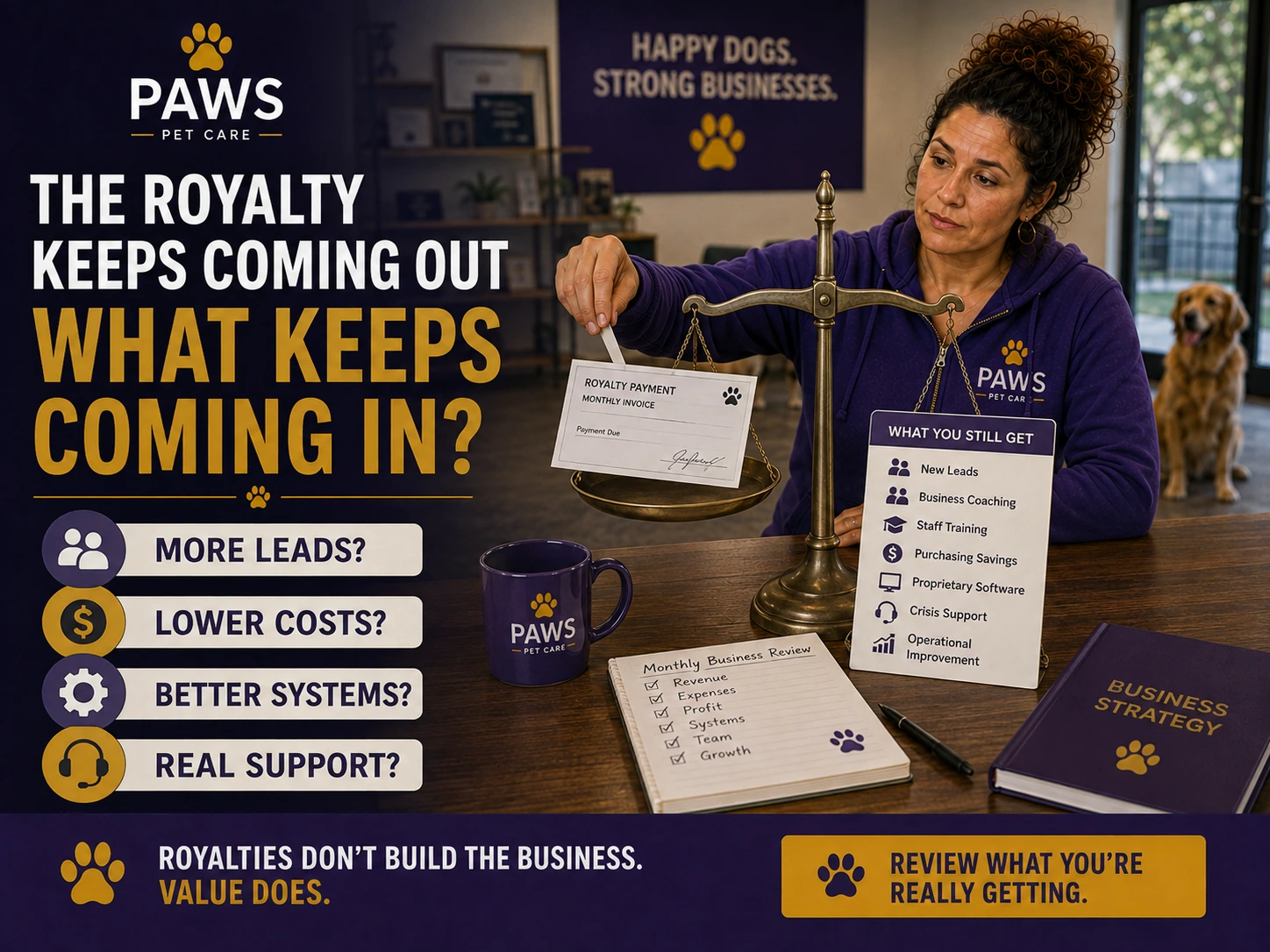
This is the test every franchise buyer should run before signing and every franchisee should keep running after opening. Do not ask whether the franchisor helped at the beginning. Ask whether the franchisor keeps helping enough to justify the ongoing claim on gross revenue.
Turn every claimed benefit into a recordable result. Leads should become inquiries and bookings. Vendor value should appear as lower cost or better quality. Training should change staff performance. Coaching should solve a defined problem. Brand value should show up in customer recognition or conversion.
Run the test annually instead of waiting until renewal. By then, years of payments and operating habits may make the relationship feel normal even when the measurable return has weakened.
- What did the franchisor provide before opening?
- What does the franchisor provide every month now?
- What support did existing franchisees actually use last year?
- What support saved money, made money, prevented a loss, or solved a real operating problem?
- What would that support cost if purchased separately from a consultant, attorney, accountant, marketing firm, software provider, trainer, or facility expert?
- Does the brand create local customer demand, or is the local owner creating demand for the brand?
- Does the ad fund produce measurable leads for the local location?
- Do approved vendors save money, improve safety, improve durability, or reduce operating headaches?
- Do system updates improve operations, or mostly create compliance work?
- Do current franchisees still believe the royalty is worth it?
- Do former franchisees disagree, and why?
- If the same money stayed inside the local business, would it create more value as payroll, marketing, debt reduction, repairs, cash reserve, or owner draw?
⚠️
Do not let the first-year value hide the fifth-year question.
The franchise may have been useful when the business was a blank page. Fine. But after the business is running, the royalty still has to answer a simple question: what are you still buying?
🧮
The Long-Dollar Problem
Percentages sound polite. Long-dollar totals are where the teeth show.

A royalty percentage can sound small because people hear the percentage instead of the dollars. Six percent. Seven percent. Eight percent. Add an ad fund and maybe some other recurring fees, and the total still feels like normal franchise math.
But the business does not pay percentages. The business pays dollars. Over years, those dollars can become enough money to hire a manager, fund serious local marketing, repair the building, replace flooring, pay down debt, build a cash reserve, improve HVAC, add equipment, or give the owner room to breathe.
The long-dollar table below uses fictitious examples. ABC Dog Daycare Franchise is not a real company. The point is to show what happens when a small-looking combined fee stack rides on gross revenue for years.
The examples are flat-dollar illustrations, not forecasts. Real revenue may grow, fees may change, and inflation may make later dollars different. That uncertainty is a reason to model several scenarios, not a reason to avoid the calculation.
Owners should compare the long-dollar total with realistic internal investments and with the cost of replacing specific franchise services independently. The decision becomes clearer when the alternatives have actual prices instead of vague labels.
| Annual Gross Revenue | Combined Fee Stack | Annual Fee Drag | 5 Years | 10 Years | 15 Years | 20 Years |
|---|---|---|---|---|---|---|
| $300,000 | 7% | $21,000 | $105,000 | $210,000 | $315,000 | $420,000 |
| $500,000 | 8% | $40,000 | $200,000 | $400,000 | $600,000 | $800,000 |
| $750,000 | 8% | $60,000 | $300,000 | $600,000 | $900,000 | $1,200,000 |
| $1,000,000 | 9% | $90,000 | $450,000 | $900,000 | $1,350,000 | $1,800,000 |
💵
The long-dollar reality
A percentage is how the fee is described. Dollars are how the business feels it. If the fee stack costs hundreds of thousands of dollars over time, the franchisor needs to prove that the support, brand, systems, vendor value, marketing, and network are worth that money.
🧮
PAWS Royalty Drag Calculator
Punch in gross revenue, royalty percentage, and ad fund percentage. Then look at what comes off the top before rent, payroll, insurance, cleaning, debt, repairs, and reality get paid.
This is not a full franchise financial model. It is a pain meter. It shows how a small-looking percentage turns into real money when it rides on gross sales year after year.
📣
Ad Fund Fees: Helpful Brand Machine or Local Money Leak?
You may pay into the brand fund and still have to buy the local advertising that makes your phone ring.
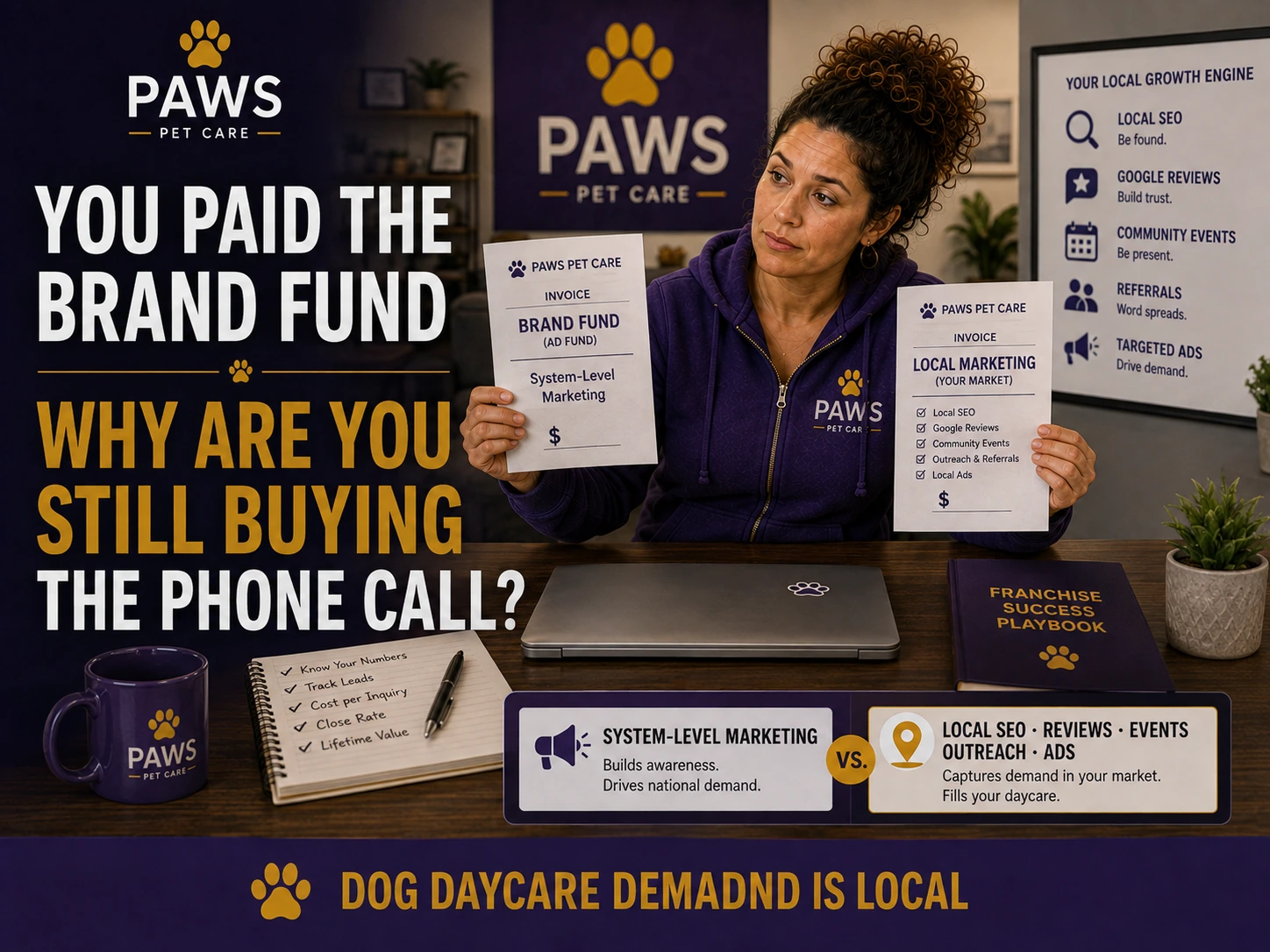
Advertising fees are one of the easiest places for buyers to misunderstand what they are paying for. A franchise may require a national fund, brand fund, marketing fund, regional fund, local advertising minimum, grand opening spend, or some combination of those.
System-level advertising can have value. It can build the brand, create assets, polish messaging, support campaigns, fund public relations, improve creative work, and help the franchise company grow. That may help franchisees indirectly.
But dog daycare is still a local trust business. The customer usually lives near the building. They search locally. They read local reviews. They ask local veterinarians, groomers, rescue people, apartment managers, coworkers, neighbors, and other dog owners. They want to tour the facility and meet the people touching their dog.
That means the local owner may still need local SEO, Google Business Profile work, local ads, vet outreach, apartment outreach, referral programs, social media, email follow-up, event marketing, signage, grand opening offers, and review-building systems. In plain English, you may pay the brand fund because the agreement requires it, then pay again locally because your building still needs customers.
If the national ad fund is polishing the brand while your local phone is not ringing, you still have to buy the ads that make the phone ring.
Ask for reporting that separates brand activity from location-level results. Impressions, reach, and awareness may be useful, but the local owner still needs to know whether the fund contributed to calls, tours, trials, memberships, boarding stays, grooming appointments, or repeat customers.
The agreement may also limit how quickly local owners can react. Approval requirements, required creative, offer restrictions, and regional coordination can matter when a competitor opens, demand softens, or a local opportunity appears suddenly.
| Advertising Fee Type | What It May Support | Buyer Question | PAWS Operator Take |
|---|---|---|---|
| National / Brand Fund | Brand campaigns, creative assets, public relations, national messaging, brand development, or broader system marketing. | Does this create measurable local leads for my location? | Brand support is nice. Local dogs still live near your building. |
| Regional Advertising | Advertising across a market area, region, or group of locations. | Are there enough nearby locations for this to help me? | Regional advertising only helps if the region actually includes your customers. |
| Local Marketing Minimum | Required local spend for ads, events, print, outreach, local SEO, mailers, or local promotions. | How much must I spend locally on top of the ad fund? | This is where the phone usually starts ringing. |
| Grand Opening Spend | Pre-opening campaigns, local offers, signage, direct mail, events, paid ads, and launch promotions. | Is this included, required, recommended, or separate? | Grand opening is buying attention before trust exists. |
| Franchise Recruitment Marketing | Some system-level marketing may support attracting future franchise buyers or broader franchise growth. | Can the fund be used to sell more franchises? | If your money helps sell the next territory, you should know that before signing. |
| Local Ad Approval | The franchisor may require approval for local ads, offers, signage, social posts, or brand use. | Can I move fast when my local market needs action? | Marketing control can slow down a local owner who needs to react now. |
⚠️
The double-advertising warning
Do not assume the advertising fee replaces local marketing. Ask where the fund is spent, who controls it, whether franchisees have input, whether it promotes your location, whether it can be used to attract new franchise owners, and how much local marketing you still need to buy yourself.
👥
Royalty Drag vs. Manager Money, Expansion Money, and Owner Wealth
Every dollar that leaves as royalty is a dollar that cannot stay inside the local business.
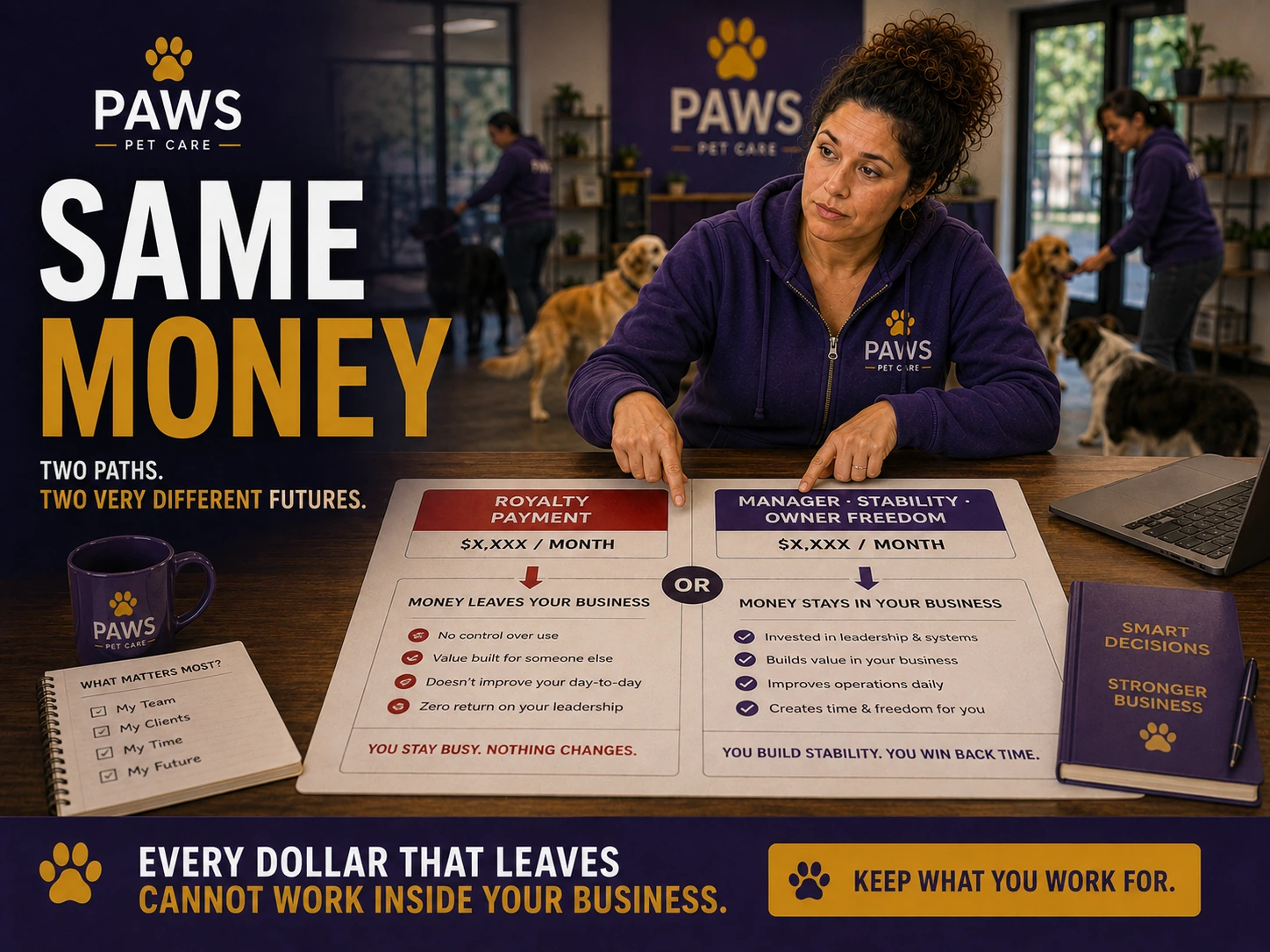
This is not just about whether the franchisor “deserves” the royalty. It is about opportunity cost. Money that leaves the local business cannot be used inside the local business.
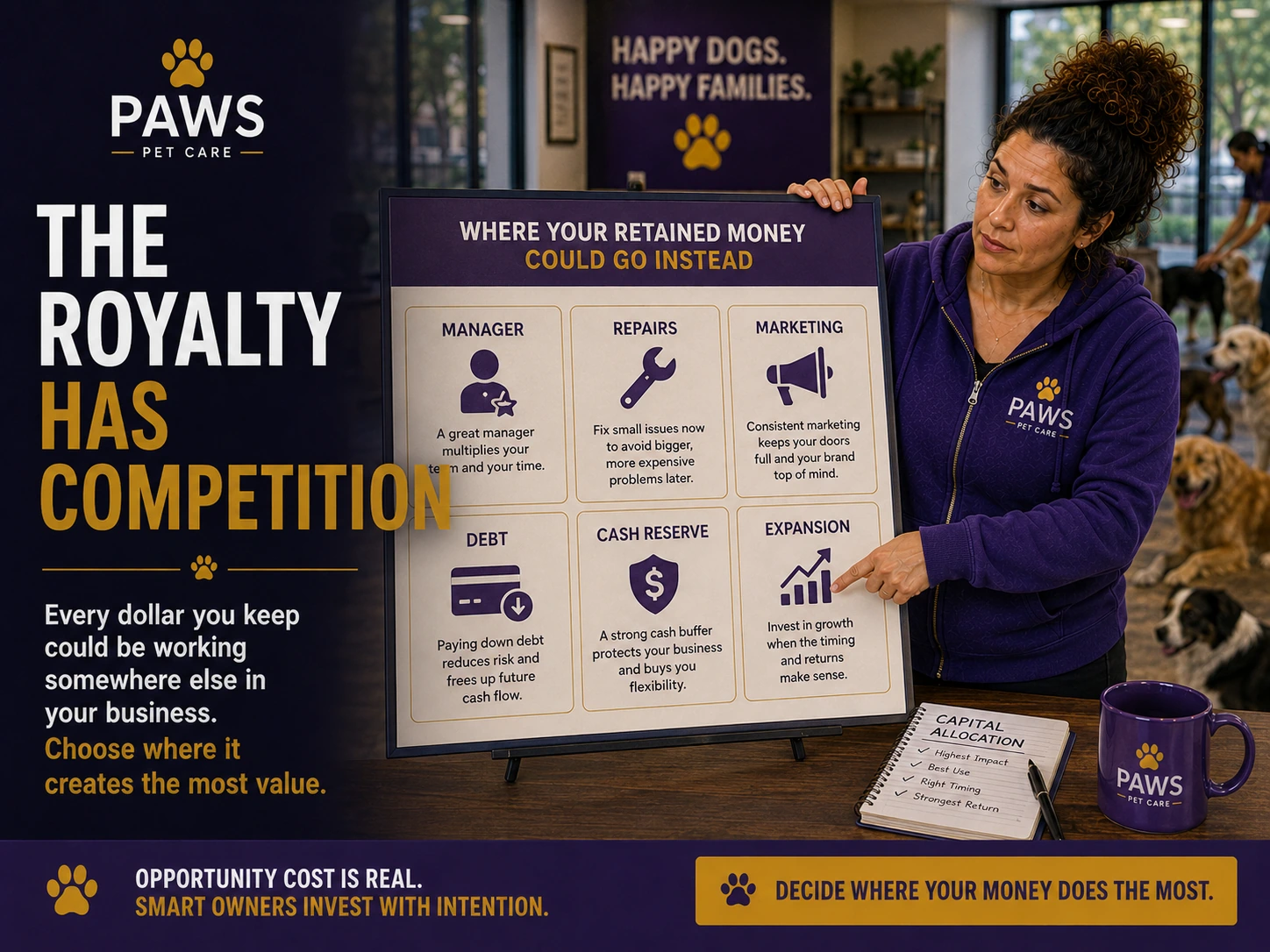
A $40,000, $60,000, or $90,000 annual fee stack might equal part of a manager salary, serious local marketing, debt reduction, new flooring, HVAC repair, better cameras, staff training, equipment replacement, owner draw, emergency reserves, or enough breathing room to stop making desperate decisions.
Over time, the numbers get much more serious. Five years of fees might be enough to fund a major repair reserve, wipe out debt, cover a strong local marketing push, or help pay for the kind of manager who lets the owner step out of the daily mud. Ten or twenty years of fees can become expansion-level money.
No, $200,000 or $500,000 does not automatically open a second dog daycare in every market. Build-out, rent, HVAC, drains, flooring, payroll ramp-up, deposits, and working capital can eat money fast. But those dollars can absolutely become the seed capital, down payment, equipment money, working capital cushion, or manager funding that makes another location possible.
That is the part buyers need to stare at. By year five or year ten, you may already know how to run the business. You know the customers. You know the staff problems. You know the holiday patterns. You know the grooming bottlenecks. You know the boarding crush. You know where dogs get stupid, where employees get lazy, where customers complain, where the building leaks money, and where the numbers work.
At that point, the royalty is not just paying for startup help. The startup help is old news. The question becomes whether the franchisor is still creating more value than those same dollars could create if they stayed with you.
Because those dollars are not small. They are not spreadsheet confetti. Over ten or twenty years, that money might have paid for a manager, another location, serious facility improvements, college savings, retirement savings, a stronger cash reserve, or simply the owner’s freedom to go fishing while the business runs under competent management.
That does not mean every royalty dollar is wasted. Sometimes the franchisor earns it. Sometimes the brand, software, support, network, vendor savings, coaching, and resale value justify the fee. But the royalty has to beat the alternative uses of the money. If it cannot, then your local business may be funding someone else’s system growth while your own next move waits in line.
Opportunity cost should be modeled by year and by priority. The first retained dollars may belong in working capital and repairs. Later dollars may support management depth, debt reduction, expansion, retirement, or owner freedom. The best alternative use can change as the operation matures.
Do not assume retained money automatically creates value. It still needs disciplined allocation. The comparison is between a proven franchise return and a realistic internal plan, not between a royalty and fantasy money that the owner would simply waste.
👔
Manager Support
Royalty dollars might fund part of a strong manager who gives the owner time, stability, and a path out of daily floor chaos.
📣
Local Marketing
The same dollars might buy ads, SEO, signs, events, referrals, and campaigns that drive actual local tours.
🧱
Facility Repairs
Flooring, gates, dryers, HVAC, plumbing, cameras, laundry, odor control, and repairs all compete for the same dollars.
💳
Debt Reduction
Paying down debt can reduce pressure and improve survival odds during slow seasons, ugly months, or expensive surprises.
🏢
Second Location Capital
Long-term royalty drag may be enough to help fund the next lease, equipment, working capital, manager bench, or expansion plan.
🎓
Owner Wealth
Money that leaves forever cannot fund college savings, retirement, owner draw, emergency reserves, or the personal freedom the business was supposed to create.
⚠️
The opportunity-cost question
If the royalty stayed inside the building, what would you do with it? Hire a manager? Pay down debt? Build a repair reserve? Buy local advertising? Fund another location? Save for retirement? If those answers create more value than the franchisor creates, the royalty has a problem.
✅
When Dog Daycare Franchise Royalties May Be Worth It
A royalty is not automatically bad. An unjustified royalty is bad.
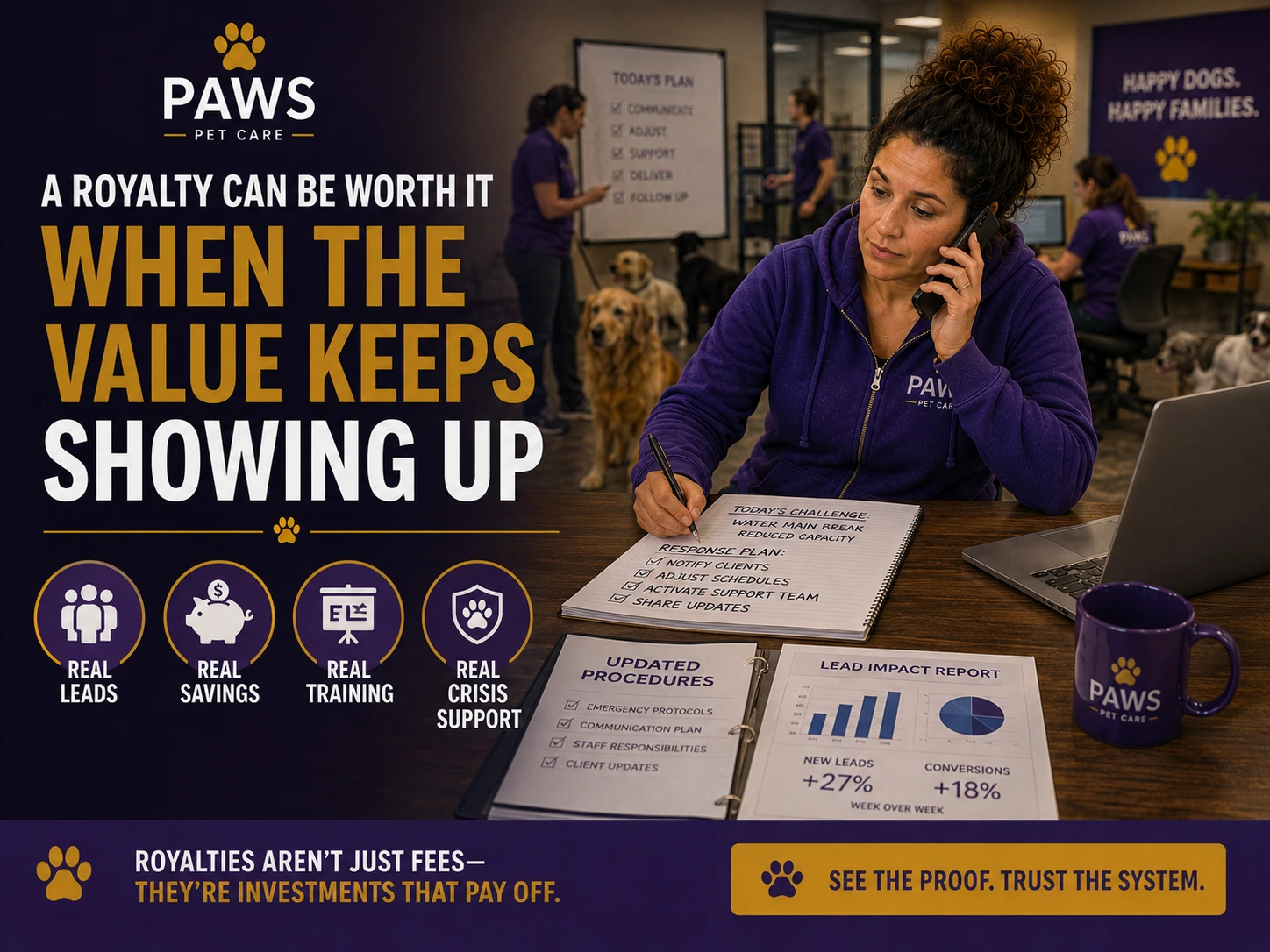
Royalties can make sense when the franchisor keeps providing value that would be difficult, expensive, or inefficient for the local owner to create alone.
If the brand creates real customer demand, the support improves operations, the vendor system saves money, the software helps, the coaching solves problems, the marketing drives leads, the network is useful, and the resale value is stronger because of the franchise, then the royalty has an argument.
The key is proof. Not vibes. Not brochure language. Not “we are a family.” Proof.
The evidence should be location-specific whenever possible. A system may create strong value in one market and weak value in another because brand recognition, regional density, staffing, vendors, rent, customer behavior, and competition differ.
The strongest proof comes from repeated outcomes across franchisees: lower costs, faster recovery from incidents, better labor control, stronger conversion, useful crisis support, improved resale demand, or other results that can be checked rather than merely described.
- Strong local or national consumer brand demand.
- Measurable local lead generation from franchise marketing.
- Useful ongoing coaching that solves real operating problems.
- Updated operating systems, forms, procedures, disease-control guidance, and training.
- Software, reporting, or technology that improves the local operation.
- Vendor savings, buying power, or quality control that actually benefits the franchisee.
- Crisis support when incidents, illness, staffing, customer blowups, or reputation problems happen.
- A useful franchisee network with real shared operator knowledge.
- Expansion help if the owner wants additional locations.
- Stronger resale value because buyers value the brand and system.
⚠️
When Royalties Become Expensive Fear Management
Sometimes the buyer keeps paying for confidence they only needed at the beginning.
Royalties start looking ugly when the business is open, customers know the building, staff know the routine, the owner rarely uses support, the brand does not produce local demand, the ad fund does not produce measurable leads, approved vendors do not save money, and the franchisor mostly shows up to collect reports, enforce standards, and cash the check.
At that point, the royalty starts looking less like ongoing support and more like rent on confidence purchased years ago.
This is the core question: are you paying for a living system that keeps making the business better, or are you paying forever because the startup phase once scared you?
A one-year knowledge problem should not automatically become a twenty-year revenue-sharing problem.
Fear-driven value often fades quietly because the owner becomes capable. The operator learns the market, builds staff, develops judgment, and stops using the support that once felt essential. The payment continues because the contract, not the current need, controls it.
That does not automatically create an exit right. The point is to recognize the risk before signing and compare the duration of the obligation with the likely duration of the knowledge gap.
🧠
The fear-management test
If the support is mostly emotional, occasional, generic, or unused, price it honestly. You may be able to buy better help with fewer strings somewhere else.
☎️
Questions to Ask Current Franchisees About Royalties
Current owners can tell you whether the royalty still feels worth it after the sales process is over.
Ask owners at different stages: newly opened, established, high-volume, struggling, rural, urban, single-unit, and multi-unit. A system may feel valuable at one stage and expensive at another.
Where permitted, ask for numbers or specific examples instead of adjectives. “Support is good” is weak. “They helped reduce labor by three points” or “they generated forty qualified leads during launch” is something the buyer can investigate.
- How often do you use franchisor support now?
- What did the franchisor help with in the last 12 months?
- What support directly saved you money?
- What support directly helped you make money?
- Does the brand bring local customers who already know the name?
- Do ad fund fees produce measurable leads, tours, packages, boarding reservations, or grooming appointments?
- How much do you still spend on local marketing on top of required ad fund fees?
- Are approved vendors cheaper, better, safer, or just required?
- Are the royalties still worth it after opening?
- What fees surprised you?
- What support faded after opening?
- Would you sign the same agreement again knowing what you know now?
📌
Ask more than one owner
One happy franchisee does not prove the system. One angry franchisee does not condemn it. Talk to enough current owners to see the pattern.
🚪
Questions to Ask Former Franchisees
Former owners may tell you what current owners are too polite, too busy, or too nervous to say.
Talk to current franchisees, but do not stop there. Former franchisees matter because they lived through the relationship and left the system. Some left for normal reasons. Some sold successfully. Some failed. Some fought. Some quietly walked away. You want to understand why.
Former franchisees should be heard without treating every complaint as proven fact. Compare their explanations with disclosure documents, outlet history, litigation, current franchisee accounts, and the franchisor’s response.
Pay close attention to exit economics: transfer fees, buyer approval, de-branding, noncompetition rules, software and data access, customer records, lease control, required repairs, and obligations that survived termination.
- Why did you leave the system?
- Were royalties still worth it after the startup period?
- What support was strongest before opening?
- What support faded after opening?
- What costs surprised you?
- What controls were harder than expected?
- Did the brand create local demand, or did you build demand yourself?
- Did the ad fund help your location?
- What happened when you tried to exit, sell, transfer, renew, or de-brand?
- Would you buy the same franchise again?
- What would you do differently if opening a dog daycare again?
⚠️
Listen for patterns.
One complaint can be personality. Repeated complaints about the same fee, same support gap, same vendor problem, same ad fund issue, or same exit friction are no longer personality. That is smoke. Go find the fire.
⚖️
Royalty Drag vs. Independent Help
Targeted help sends an invoice. Royalties build a pipeline.
Independent does not mean free. Independent owners still pay for help. They may need a franchise attorney, lease attorney, zoning review, contractor, architect, accountant, consultant, marketing help, software, templates, manuals, staff training, and expert review.
But that is not the same as giving away a percentage of gross revenue for the life of the agreement. Targeted help hurts when you buy it. Royalties can keep hurting quietly while pretending to be normal.
The comparison is not “franchise costs money and independent is free.” That is nonsense. The comparison is whether the ongoing franchise relationship produces more value than the same dollars could produce if spent directly on the local business.
Independent help can be purchased in modules, but the owner must coordinate it. The lawyer, consultant, software provider, trainer, accountant, and marketing firm may each solve a piece without creating one integrated operating system.
The fair comparison therefore includes management burden. A franchise may justify part of its fee by integrating support. Independent ownership may still win when the owner can coordinate better specialists and keep the resulting system.
| Use of Money | Franchise Royalty Path | Independent / Targeted Help Path | Buyer Question |
|---|---|---|---|
| Operating Advice | Ongoing franchisor support, manuals, coaching, and system updates. | Consultant, manual, operator mentor, trainer, or paid review. | Which option gives better answers for the actual problem? |
| Legal / Contract Help | Franchise system may provide preferred processes, but its priority is the brand system. | You hire your own attorney to protect your lease, entity, agreements, and risks. | Who is sitting on your side of the table? |
| Marketing | Brand fund, templates, campaigns, and system-level messaging. | Local SEO, reviews, ads, signage, vet outreach, referral systems, and tour conversion. | Which one actually makes the local phone ring? |
| Software | Required or approved platform. | Open-market pet-care software selected for your facility. | Is the required platform better, or just required? |
| Staff Training | Franchise training system and updates. | Experienced manager, trainer, consultant, internal training manual, and local supervision. | What keeps staff better six months after training? |
| Facility Improvements | Brand standards, required upgrades, and system-driven improvements. | Owner-directed repairs, HVAC, flooring, drainage, gates, cameras, and cleaning improvements. | Would the royalty dollars fix something the dogs and staff actually feel? |
| Cash Reserve | Ongoing fees leave the business. | Money can stay inside the business as survival cushion. | Would a bigger reserve make the business stronger than the franchise support? |
📄
FDD Royalty Questions Before You Sign
Item 6 is not bedtime reading. It is where recurring fee pain starts showing its face.
Build a written fee calendar from the disclosure and agreement. Record the trigger, calculation base, payment date, increase rights, audit rights, interest, late charges, minimums, post-termination obligations, and which fees can be changed by later manuals or standards.
Then have the franchise attorney reconcile the sales explanation with the actual documents. A verbal promise that is not reflected in the agreement may not protect the buyer when the relationship becomes difficult.
- What is the royalty percentage?
- Is the royalty based on gross sales, gross revenue, adjusted gross sales, net revenue, or something else?
- Are there minimum royalties?
- When do royalties begin?
- Are royalties owed even if the business is not profitable?
- What ad fund, brand fund, marketing fund, local advertising, technology, software, reporting, or management fees apply?
- Are any fees fixed monthly charges instead of percentages?
- Can fees increase during the term or at renewal?
- What local marketing is required in addition to brand fund contributions?
- Can the ad fund be used for national advertising, regional advertising, franchise recruitment, administrative costs, or other system purposes?
- Do franchisees control or vote on any ad fund spending?
- Are vendor rebates, ad placement rebates, commissions, or purchasing incentives involved?
- What happens if the franchisor does not provide promised support?
- What happens if you terminate early?
- What obligations survive termination?
- What changes can happen at renewal?
- What do current franchisees say about whether the royalty is still worth it?
- What do former franchisees say?
📌
The paper matters
The salesperson can describe the relationship. The FDD and franchise agreement define the relationship. Read the boring pages where the teeth are.
🗂️
Keep Testing the Franchise Numbers
Royalties are only one part of the decision. The opening cost, operating system, marketing, control, and independent alternative still need to be tested.
💵
Dog Daycare Franchise Costs
The franchise fee is not the cost of opening. Build-out, rent, HVAC, payroll, debt, and working capital matter.
⚖️
Franchise vs. Independent Startup
Compare packaged support against building your own system, hiring targeted help, and keeping local control.
📚
Franchise Operating System
A franchise manual can save mistakes. It does not automatically justify paying forever after you learned the system.
🔒
Control and Approved Vendors
A franchise is support with a leash attached. Vendor rules, brand standards, inspections, upgrades, and contract controls matter.
📣
Franchise Marketing Support
National brand support does not automatically replace local SEO, reviews, vet outreach, ads, and local demand-building.
🧠
Consultant vs. Franchise
A consultant should help you avoid expensive mistakes and then get out of your pocket. A franchise may stay there.
❓
Dog Daycare Franchise Royalties FAQ
Detailed answers about gross-sales royalties, minimums, advertising funds, long-term fee drag, year-five value, opportunity cost, franchisee interviews, renewal, and exit obligations.
What is a dog daycare franchise royalty?
A royalty is an ongoing payment made by the franchisee for the continuing right to operate under the franchisor’s brand and system. It is commonly calculated as a percentage of gross sales or revenue, although the exact base, exclusions, timing, minimums, and related fees depend on the disclosure documents and franchise agreement.
Are franchise royalties based on revenue or profit?
Many royalties use a top-line number such as gross sales rather than net profit. That means rent, payroll, insurance, debt, repairs, local marketing, and owner compensation do not necessarily reduce the royalty calculation. The agreement’s exact definition controls, so buyers should not rely on a salesperson’s shorthand.
Can royalties be due when the location loses money?
Yes, depending on the agreement. A location can owe a gross-sales royalty during an unprofitable month because the fee is calculated before many operating expenses. Minimum royalties or fixed charges may add pressure during slow periods, temporary disruptions, or an extended ramp-up.
What is a minimum royalty?
A minimum royalty is a floor below which the required payment may not fall, even when the normal percentage calculation would produce less. Buyers should identify when the minimum begins, whether it increases, whether exceptions exist, and how it interacts with closures, weak sales, or delayed opening.
What does gross sales include for royalty purposes?
The answer is contractual. It may include daycare, boarding, grooming, training, retail, memberships, packages, deposits, gift cards, cancellation charges, no-show fees, online sales, or other revenue. The agreement should also explain exclusions such as taxes, refunds, credits, and unredeemed obligations.
What other recurring fees can sit beside the royalty?
Possible charges include advertising or brand funds, technology, software, reporting, call-center, local marketing, inspections, training, vendor-related costs, and future upgrade requirements. Not every franchise has every fee, which is why the buyer should build a complete recurring-fee schedule from the current documents.
What is an advertising or brand-fund fee?
It is a required contribution to system-level marketing or brand activity. The fund may support creative work, campaigns, public relations, regional advertising, administration, or broader franchise development. Buyers should determine who controls the fund, what reporting exists, and whether spending creates measurable value for their location.
Will the brand fund replace local marketing?
Usually not completely. Dog daycare demand is local, so the owner may still need local SEO, reviews, referrals, events, veterinarian and apartment outreach, paid ads, signage, offers, and tour conversion. The buyer should model both the required fund contribution and the realistic local marketing budget.
How much can an eight-percent fee stack cost over time?
At $500,000 in annual gross revenue, an eight-percent combined stack equals $40,000 per year and $400,000 over ten flat years. At $750,000, it equals $60,000 per year and $600,000 over ten flat years. Growth, fee changes, and inflation can make the actual outcome different.
Why is year-five value different from year-one value?
Year one may include site help, manuals, opening support, training, software setup, vendor introductions, and launch marketing. By year five, the location may already possess those systems. Continuing royalties should therefore be supported by continuing brand demand, updated training, operational improvement, crisis help, savings, expansion support, or other measurable value.
How can an owner measure whether the royalty is still worth it?
List each ongoing benefit and attach an observable result. Leads should become bookings, vendor programs should reduce cost or improve quality, training should change staff performance, and coaching should solve defined problems. Compare that return with the total fee stack and with the cost of obtaining the same help elsewhere.
Can royalties limit hiring a manager or expanding?
Yes. Money paid out cannot also fund management depth, repairs, debt reduction, local marketing, reserves, owner compensation, or expansion. That opportunity cost does not prove the royalty is wasteful, but it means the franchisor’s return must be compared with realistic internal uses of the same dollars.
When can a royalty be a good business decision?
A royalty can make sense when the brand creates demand, support solves real problems, vendors create savings, software improves operations, training remains useful, marketing produces leads, crisis support protects the location, and the network or resale structure creates value that exceeds the cost.
When does a royalty start looking like expensive fear management?
It starts looking that way when the owner no longer uses support, the brand does not produce local demand, the ad fund does not produce measurable leads, vendors do not save money, and the location has already built the systems it once needed help creating. The contract may still require payment, which is why the mismatch should be investigated before signing.
Are royalties the same as hiring a consultant?
No. Consulting usually addresses a defined project or period and ends when the engagement ends. A royalty is tied to the continuing franchise relationship and may last for the term, renewal periods, or other contractual obligations. The fair comparison includes integration, brand rights, support, and the owner’s burden of coordinating independent experts.
What should I ask current franchisees about royalty value?
Ask what support they used in the last year, what produced revenue or savings, what local marketing they still buy, whether vendors help, what fees surprised them, how value changed after opening, and whether they would sign the same agreement again. Speak with owners at different stages and performance levels.
Why should I speak with former franchisees?
Former owners can explain support gaps, fee pressure, vendor issues, exit friction, transfer problems, de-branding, and whether the brand created local demand. Their accounts should be compared with documents, outlet history, current franchisees, litigation information, and the franchisor’s response rather than accepted uncritically.
Can fees increase during the agreement or at renewal?
They may, depending on the documents. Buyers should review increase rights, renewal terms, required current-form agreements, technology changes, local marketing requirements, and future brand standards. A franchise attorney should explain which costs are fixed, adjustable, or capable of changing through later manuals and system requirements.
What happens to royalty obligations if the relationship ends early?
The answer depends on the agreement and applicable law. Potential issues include unpaid fees, damages, post-termination obligations, de-branding, data and software access, restrictive covenants, transfer rules, lease rights, and continuing duties. This is a document-review issue for a qualified franchise attorney before signing.
What is the simplest royalty question to ask before buying?
Ask what concrete value will still be entering the local business every month when the royalty continues leaving it. Then require evidence for brand demand, leads, savings, training, software, support, vendor value, crisis help, expansion assistance, and resale value. The payment is permanent enough that the return should not remain vague.
🐾
The Bottom Line: The Royalty Has to Keep Earning Its Seat
The fee is not automatically evil. But it is automatically expensive over time.
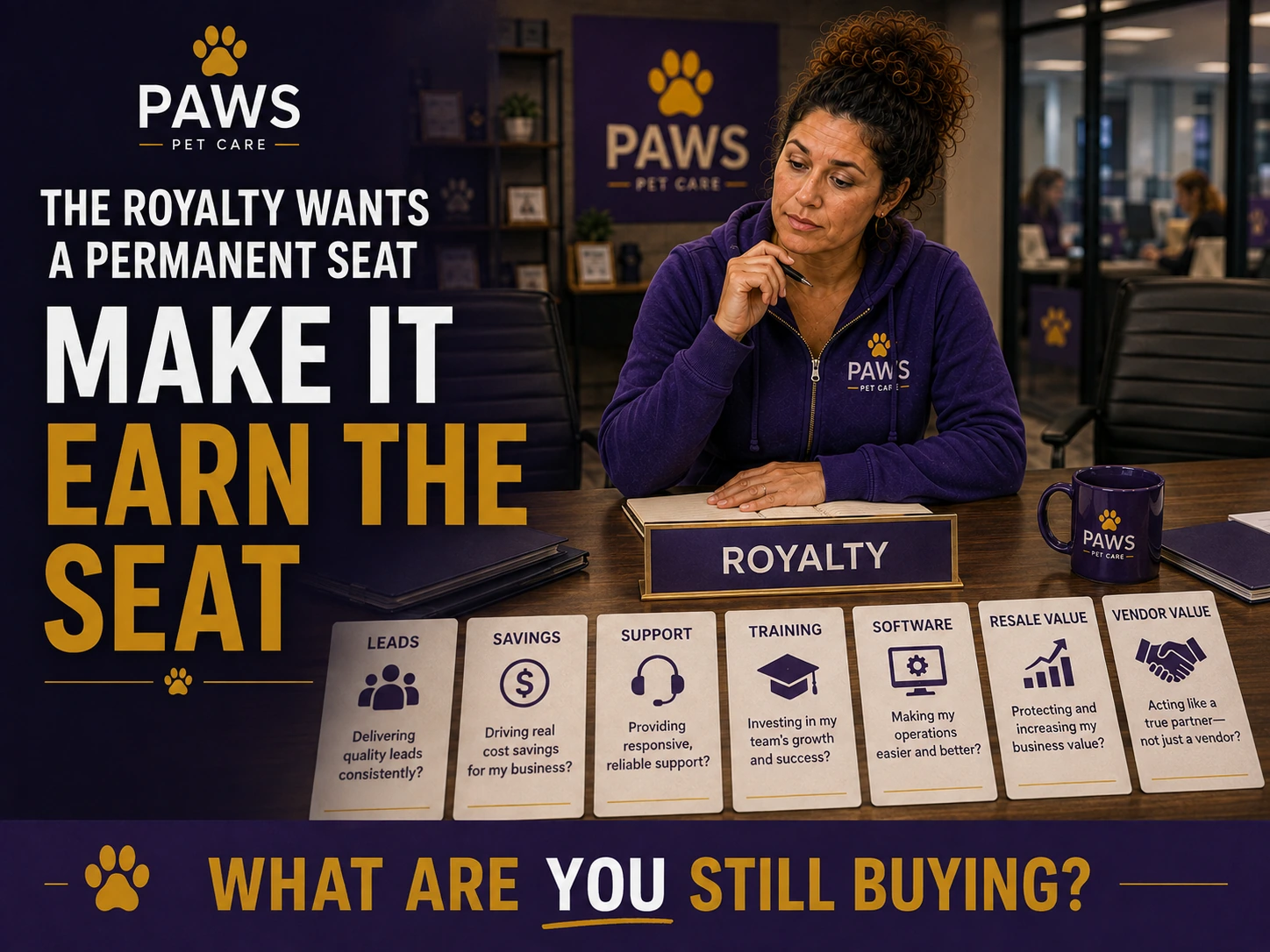
A dog daycare franchise royalty can be fair if the franchisor keeps creating value. The brand, system, training, support, marketing, software, vendor savings, network, and operating guidance all need to keep showing up after the opening rush is over.
But if the business is trained, the local brand is built, the staff knows the system, the customers trust the location, the ad fund does not create local leads, the owner rarely uses support, and the royalty keeps coming off gross revenue anyway, then the buyer has to be honest about what is happening.
You may not be paying for current value. You may be paying forever for the confidence you needed at the beginning.
The question is simple: what are you still buying?
The royalty should be reviewed as an investment decision, not merely accepted as the price of belonging to the system. The owner is buying continuing services, rights, brand association, and operating infrastructure with every payment.
A permanent seat at the table requires a continuing contribution. When the contribution is visible and valuable, the fee has an argument. When the payment is visible and the value is not, the owner has a problem that should have been investigated before signing.