Grooming Room Fixtures, Grooming Arms, Tool Tables, Grooming Carts, Holding Cages, and Grooming Room Equipment
Dog Grooming Tools and Equipment for a Working Grooming Room
Grooming equipment is not a shopping list. It is the physical system your staff has to use while controlling live animals with teeth, nails, wet coats, bad hips, fear, opinions, and owners who expect the finished dog to look like a magazine cover.
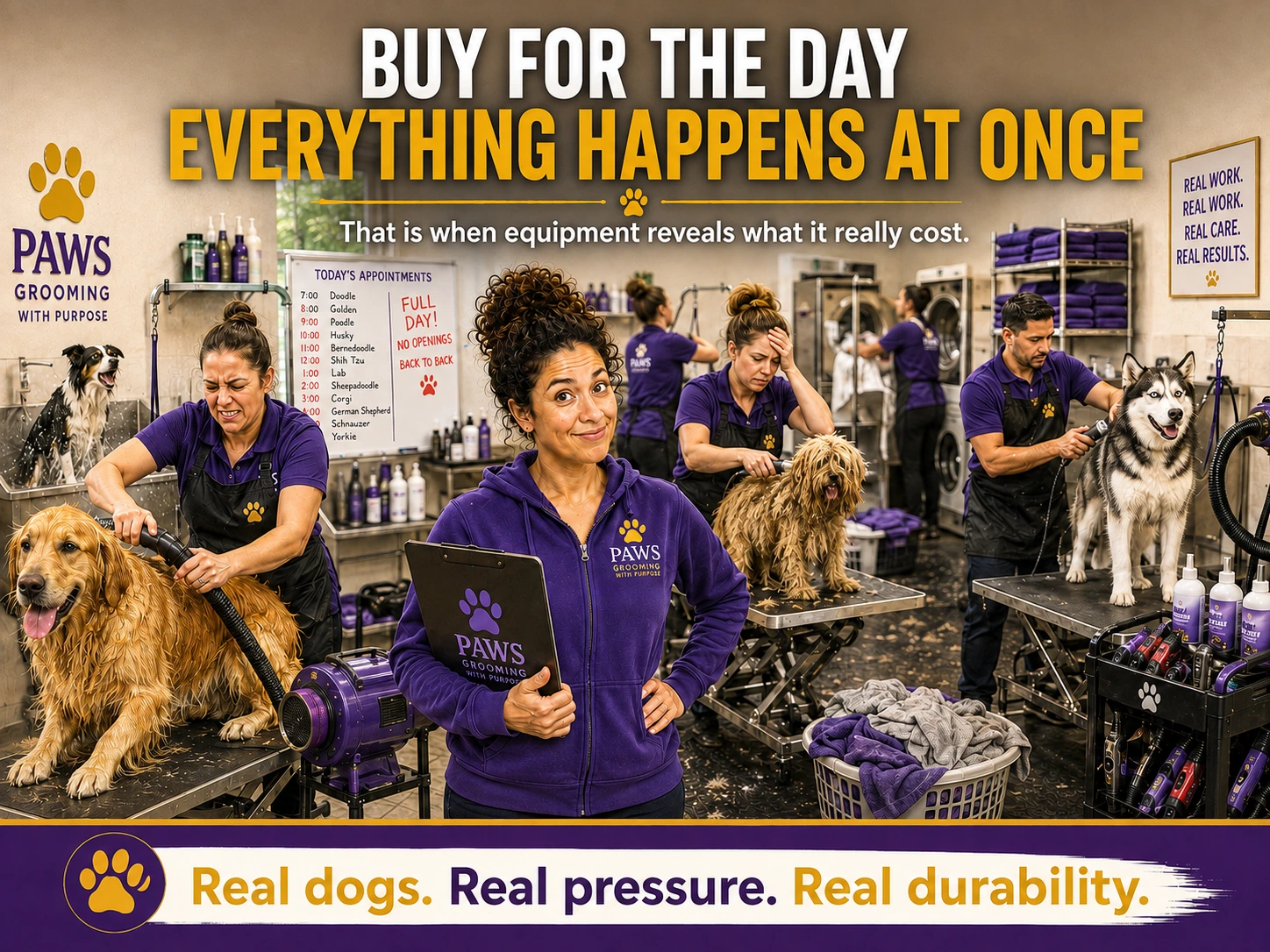
Let us now discuss the various tools and fixtures needed to operate an effective grooming room. In beginning your quest to either offer grooming services at an existing facility or open a standalone grooming salon, you are going to have to sort through a great deal of information in order to find quality tools and fixtures that can not only withstand the test of time, but also hold up to regular daily abuse.
That is the real issue. A grooming tool that works twice a month at home and a grooming tool that survives daily use in a business are not the same animal. Commercial grooming equipment has to deal with water, hair, dryers, cleaning, restraint pressure, nervous dogs, large dogs, matted dogs, staff fatigue, rushed schedules, and whatever fresh nonsense walks through the door that morning.
This page is the main gateway into the grooming equipment section. Grooming tables are the first major branch because they are the main workstation. But tables are only one part of the room. A working grooming setup also needs tubs, dryers, clippers, blades, shears, grooming arms, restraint systems, carts, storage, holding, cleaning support, and a plan for how all of it fits into the workflow.
⚠️
Operator warning
Cheap equipment is not cheap when it slows the groomer, scares the dog, breaks under daily use, creates a safety problem, or has to be replaced the minute the grooming room finally starts getting busy.
🗺️
Grooming Equipment Gateway
Use this page as the main entrance into grooming tools, fixtures, workstations, handling equipment, and future equipment branches.
🧰
Tools Are Production Equipment
A grooming tool is only good if it helps the work happen safely, efficiently, and repeatedly.
💥
What Equipment Must Survive
Water, hair, cleaning, nervous dogs, large dogs, restraint pressure, staff use, and daily abuse.
⬆️
Grooming Tables
The main workstation for grooming, restraint, posture, reach, clipping, scissoring, nails, and difficult dog handling.
🛁
Grooming Tubs
Tub type, height, access, large-dog handling, bather ergonomics, and water-zone workflow.
💨
Grooming Dryers
Force dryers, stand dryers, cage dryers, noise, airflow, heat, dog stress, and dryer placement.
✂️
Clippers, Blades, and Coat Tools
Clippers, blades, guard combs, shears, brushes, combs, rakes, and dematting tools.
🦺
Restraint and Positioning
Grooming arms, loops, no-sit devices, harnesses, positioning systems, and handling assist equipment.
📊
Equipment Selection Matrix
Compare each equipment category by what it does, what to look for, and where cheap equipment hurts you.
🧰
Grooming Tools Are Production Equipment, Not Decorations
Do not buy grooming equipment like a shopper. Buy it like an operator.
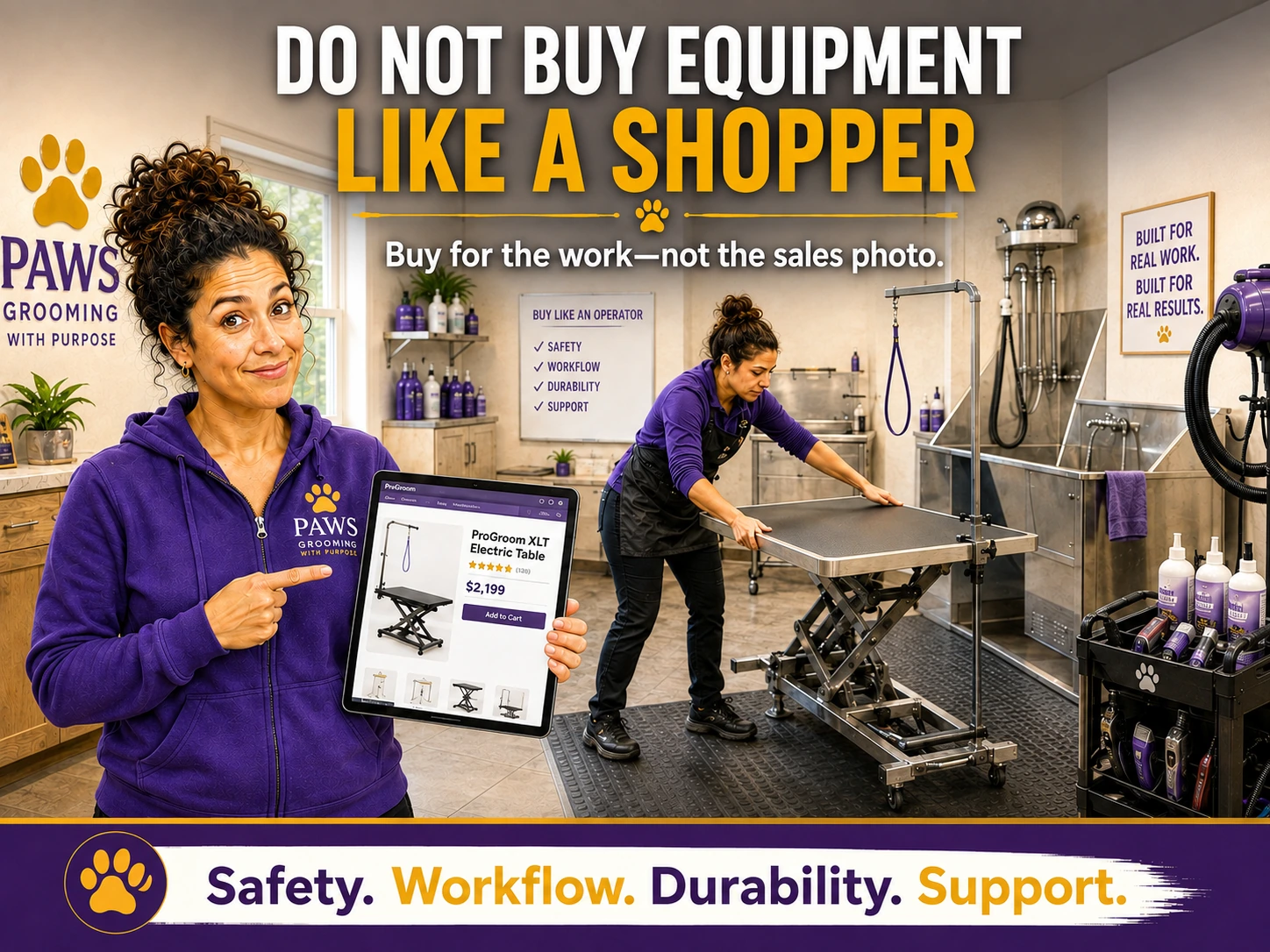
A grooming room does not need cute equipment. It needs equipment that survives the work. The table, tub, dryer, clipper, blade, arm, loop, harness, cart, and cage all have to help the grooming process happen safely and efficiently.
The wrong tool can slow the groomer, increase fatigue, make the dog harder to control, create cleaning problems, waste appointment time, and eventually cost more than the better tool would have cost in the first place.
This is why equipment selection has to be tied to workflow. A table is not just a table. It affects lifting, posture, restraint, reach, speed, and safety. A tub is not just a tub. It affects bather fatigue, large-dog handling, splash, water control, and dog movement. A dryer is not just a dryer. It affects noise, dog stress, airflow, heat, hair, staff communication, and production time.
Buy equipment by asking what it does to the work. Does it reduce lifting? Does it improve control? Does it save time? Does it hold up? Does it clean easily? Does it help the groomer’s body survive the day? Does it help the dog stay safer? Or does it just technically exist in the room while everyone suffers around it?
A product page can tell you dimensions, advertised capacity, included accessories, and a sales claim. It cannot tell you how the table feels when a large dog shifts its weight, whether the foot control is usable with wet shoes, whether the dryer hose fights the groomer, or whether replacement parts will still exist after the warranty ends.
Evaluate important equipment inside the work sequence. Test how it is cleaned, adjusted, moved, restrained, stored, serviced, and used while the employee still has to control the dog. The right question is not whether the product functions in isolation. The question is whether it improves the whole station.
💥
What Commercial Grooming Equipment Has to Survive
Home-use equipment and commercial grooming equipment live very different lives.

Commercial use is not occasional home use multiplied by a few appointments. The equipment is adjusted, cleaned, loaded, restrained, sprayed, heated, moved, and depended on repeatedly while staff are working under time pressure.
The real durability test includes the dog that braces against the table, the wet employee stepping on the control, hair packing into filters, disinfectant reaching seams, and a full schedule that cannot simply stop because a part loosened or a motor overheated.
Equipment selected for a business should be judged by its weakest operating point: the hinge, weld, control, hose, attachment, surface, replacement part, or support system most likely to fail under daily use.
- Water, splash, wet hands, damp floors, wet dogs, and cleaning routines.
- Hair, undercoat, clipped coat, dryer-blown coat, filters, drains, corners, and tool contamination.
- Nervous dogs, large dogs, old dogs, heavy dogs, matted dogs, dogs that sit, dogs that jump, and dogs that suddenly discover religion halfway through the appointment.
- Restraint pressure, table movement, repeated height adjustment, foot controls, arm pressure, loops, harnesses, and handling systems.
- Staff who are tired, rushed, wet, annoyed, behind schedule, or handling a dog that has turned a bath into a hostage situation.
- Cleaning chemicals, disinfectants, shampoo spills, towel piles, laundry flow, and daily reset.
- Regular daily abuse from a business that expects the equipment to work tomorrow, next month, and next year.
⚠️
Buying rule
Anything that holds, lifts, restrains, supports, dries, clips, or positions a dog should be judged harder than a normal household product. The dog is not a couch pillow. The dog may object.
🏗️
The Four Major Grooming Equipment Families
Before getting lost in individual tools, separate the grooming room into the big equipment families.
⬆️
Grooming Tables
The main workstation. Tables affect lifting, posture, restraint, reach, stability, dog control, and production speed.
🛁
Grooming Tubs
The bathing workstation. Tubs affect bather fatigue, large-dog access, wet-dog movement, water control, and cleaning.
💨
Grooming Dryers
The production accelerator that can also become a noise, heat, airflow, and dog-stress problem when chosen poorly.
✂️
Clippers, Blades, and Coat Tools
The hand-tool system that determines cutting speed, finish quality, coat handling, maintenance, and daily tool discipline.
⬆️
Grooming Tables: The Main Workstation
A solid, durable, easy-to-use grooming table is a staple item of any successful grooming operation.
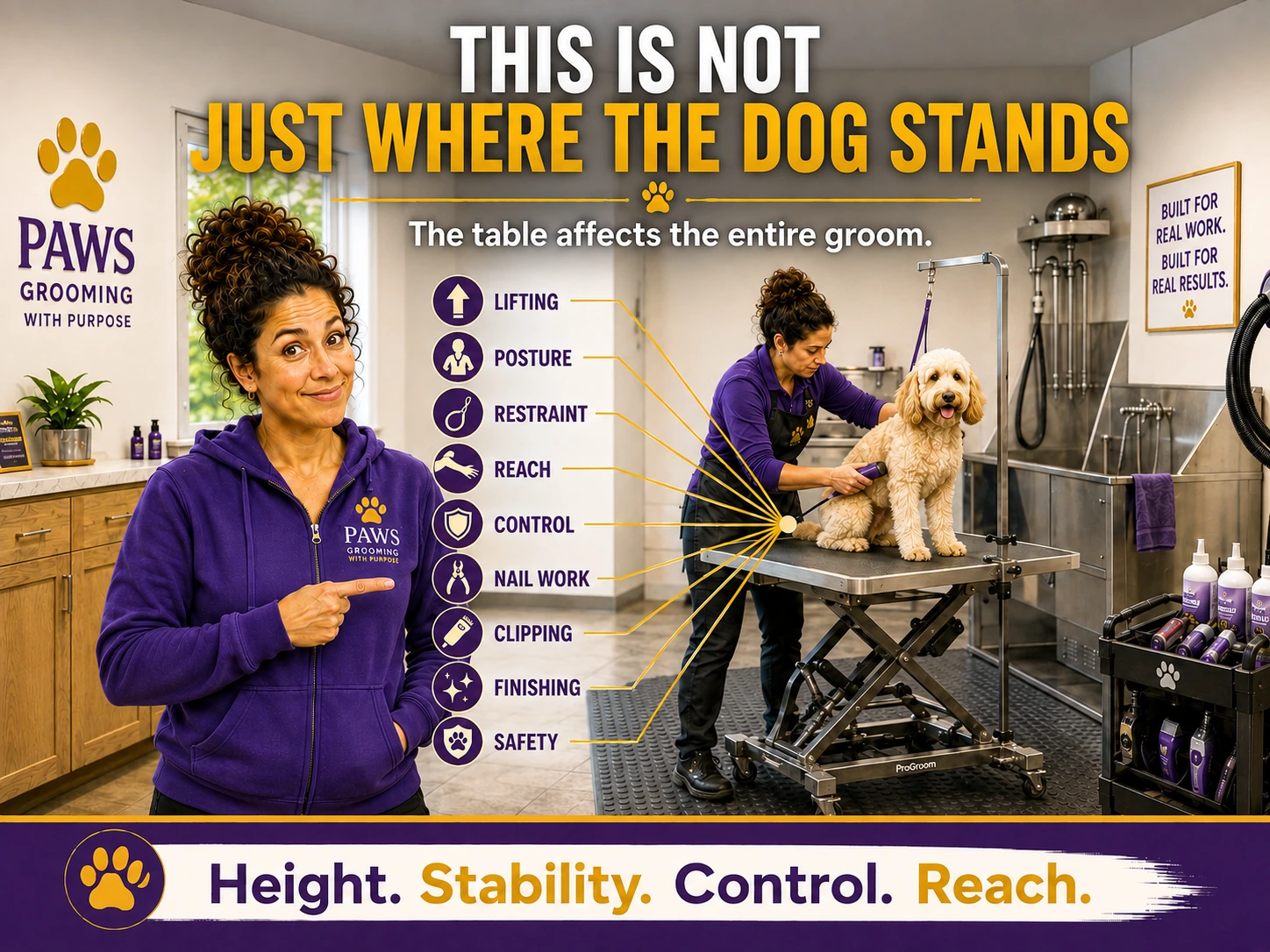
The first item I will cover is grooming tables. A solid, durable, and easy-to-use grooming table will be a staple item of any successful grooming operation. When selecting a grooming table there are a great many options available, and each type has advantages, disadvantages, and use cases.
The table affects more than where the dog stands. It affects how much lifting staff do, how the groomer’s shoulders and back feel at the end of the day, how stable the dog feels, how safely restraint equipment can be used, how quickly tools can be reached, and how much control the groomer has when the dog decides standing still is apparently a violation of its civil rights.
Table selection should begin with the dogs and services the business expects to handle. Dog size, mobility, behavior, coat work, nail service, restraint needs, employee height, and appointment volume all change what the table has to do.
The table should also be evaluated as part of a complete station. Grooming arms, loops, no-sit devices, tool reach, floor clearance, power location, and dog-transfer space need to work with the table rather than being bolted on later after the first difficult dog exposes the gaps.
🪑
Card Table Type
Cheap, light-duty table style. Usually tempting because of price, but generally a poor fit for serious commercial use.
💺
Barber / Salon Chair Type
A table style based around a chair-like lifting concept. Worth reviewing for its strengths, limits, and stability issues.
🦵
Four-Legged Pedestal Table
A more substantial table style with better stability than cheap folding setups, but still not the top of the commercial ladder.
💧
Commercial Hydraulic Tables
Heavy-duty, adjustable tables that can reduce lifting and support more serious daily grooming production.
⚡
Electric Grooming Tables
Adjustable electric tables can improve ergonomics and large-dog handling when they are commercial grade and properly selected.
📊
Grooming Table Selection Criteria
Before comparing table types, understand what actually matters.
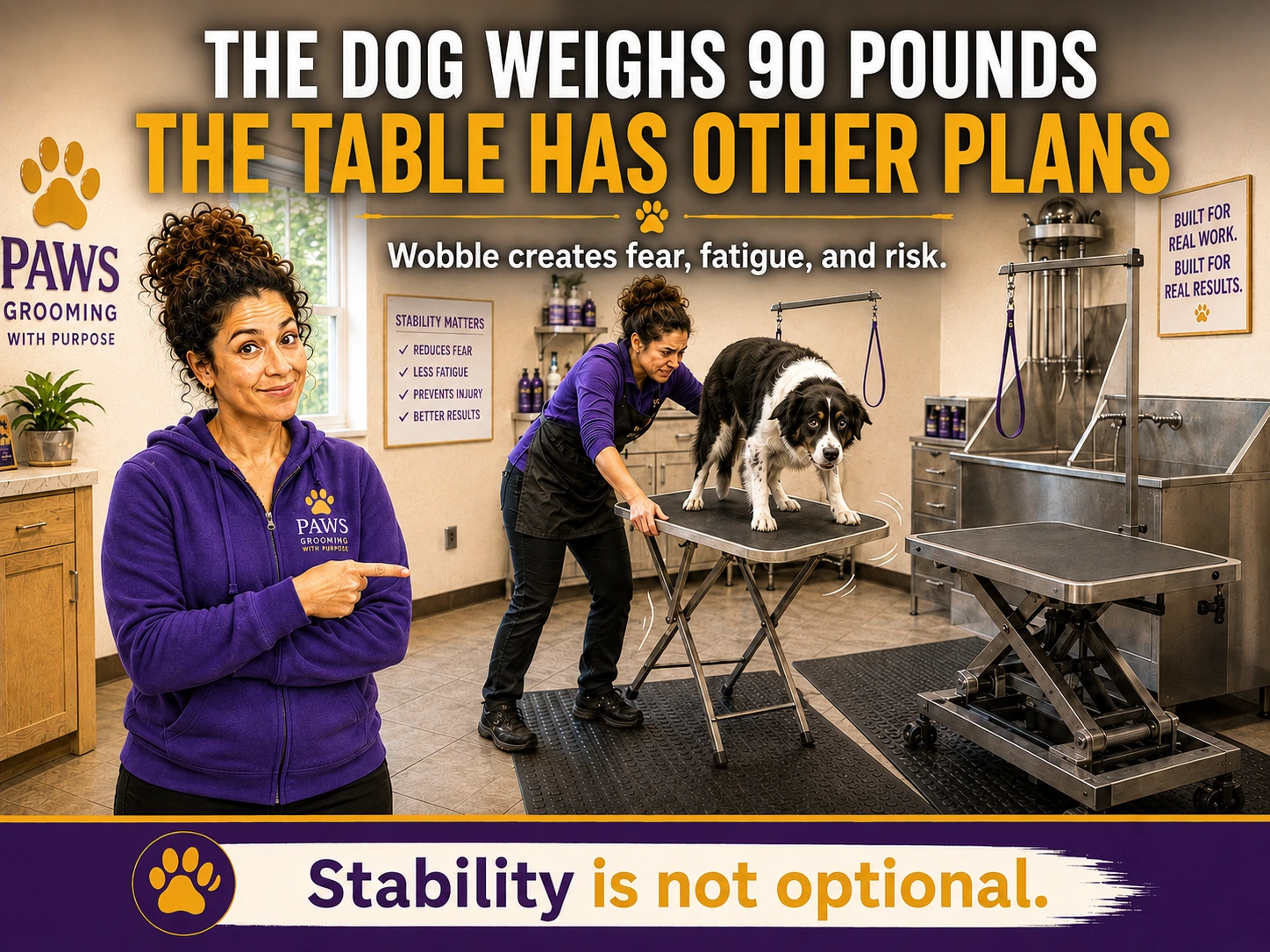
Table comparison should start with the dog standing on it, not with the price column. Stability, usable height range, lifting method, deck size, traction, restraint compatibility, controls, and access around the base all affect the actual groom.
A table can meet an advertised weight rating and still feel unstable when the dog shifts, scratches, leans, or resists. The operator should evaluate wobble, base movement, arm attachment, and how confidently staff can work around a large or nervous dog.
The table should also be serviceable. Controls, motors, pumps, pedals, mats, and hardware eventually wear. Parts availability and repair support matter because a broken main workstation can cancel appointments even when the original purchase looked inexpensive.
Swipe left/right to see the full table.
| Table Feature | Why It Matters | What Goes Wrong When Ignored | Operator Takeaway |
|---|---|---|---|
| Height adjustment | Reduces lifting and helps fit the table to the dog and groomer. | Staff lift more, bend more, and fatigue faster. | Adjustable height is one of the biggest ergonomic advantages. |
| Stability | Dogs need a stable surface, especially large or nervous dogs. | Wobble creates dog fear, poor control, and safety risk. | A grooming table should not feel like patio furniture with delusions. |
| Weight capacity | Commercial rooms handle different sizes, weights, and dog behaviors. | The table becomes unsafe under the dog you were already worried about. | Buy for real dog mix, not the easiest dog on the schedule. |
| Surface grip | Dogs stand, shift, sit, resist, and sometimes panic. | Slipping increases stress and makes the groomer work harder. | Surface traction affects dog confidence and staff control. |
| Restraint compatibility | Arms, loops, no-sit devices, harnesses, and assist systems may attach to the table. | You buy restraint equipment later and discover the table does not support it well. | Think about handling systems before buying the table. |
| Cleaning | Grooming tables collect hair, nails, product, drool, and whatever the dog brought with it. | Hard-to-clean surfaces waste time and look bad fast. | A table must survive daily cleaning, not just the sales photo. |
🛁
Grooming Tubs: The Bathing Workstation
Tub selection affects bather fatigue, large-dog movement, water control, cleaning, and wet-dog handling.
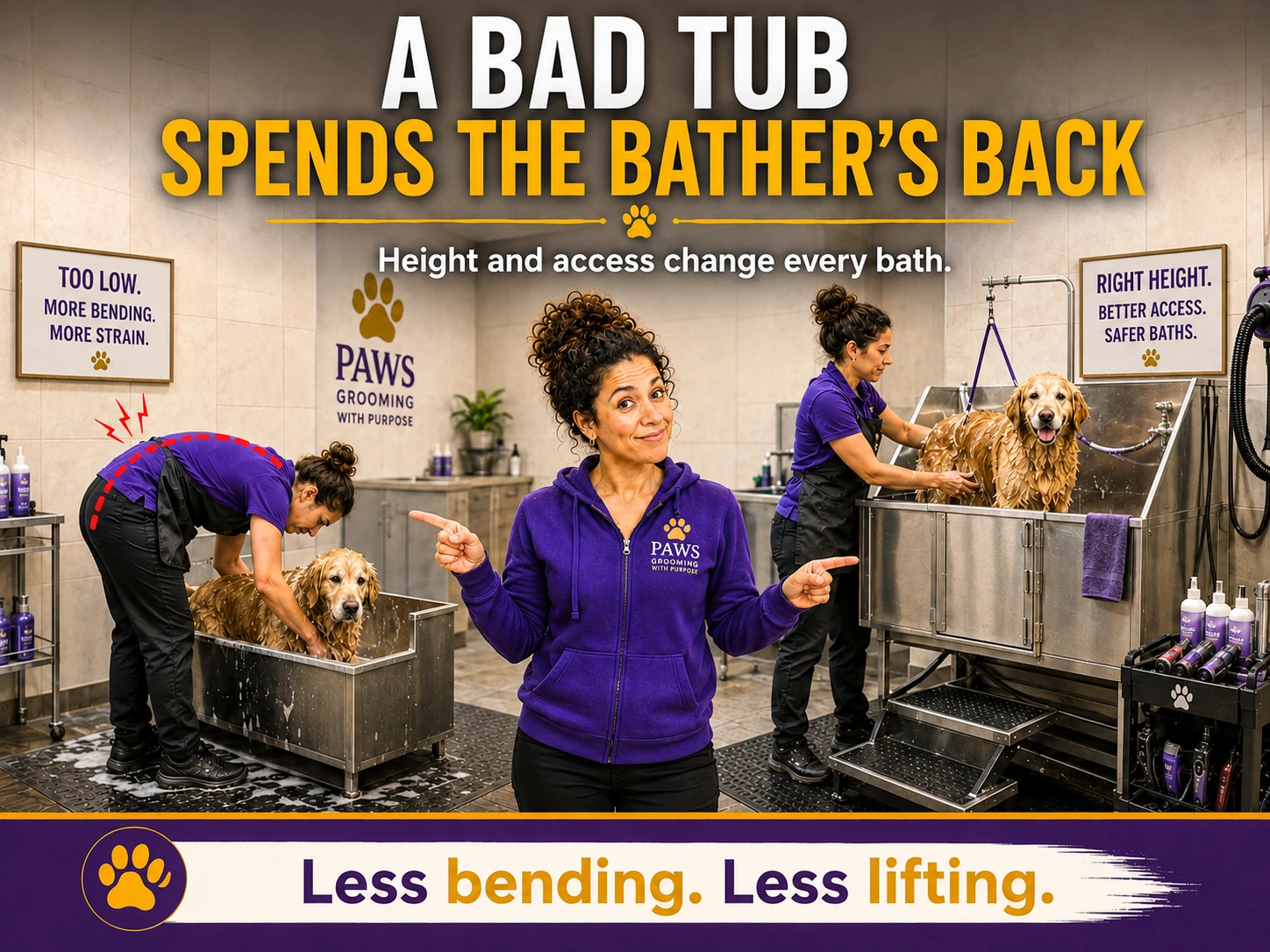
Grooming tubs deserve their own equipment branch. A bad tub setup will punish the bather’s back, slow the room down, increase lifting, create wet-floor problems, and make large or nervous dogs harder to handle.
This section now points into the grooming tub branch, where custom built tubs, plastic/HMWPE tubs, fiberglass tubs, stainless steel tubs, and questionable repurposed tub ideas are covered in detail.
Tub height and access determine how much bending, lifting, bracing, and dog wrestling the bather performs across the day. A workable setup allows staff to control the dog, reach products, use the sprayer, manage the drain, grab towels, and exit the dog without abandoning safe handling.
The tub should be judged under the hardest normal conditions: a large wet dog, a senior dog that cannot climb well, a nervous dog resisting the entrance, and a full schedule that does not leave time for staff to recover from a bad workstation.
🛁
Grooming Tubs
Review custom built tubs, plastic/HMWPE tubs, fiberglass tubs, stainless steel tubs, and the oddball tub ideas that do not belong in a professional-looking shop.
💨
Grooming Dryers: Production Speed, Noise, Heat, Airflow, and Dog Stress
Dryers can speed up production or turn the room into a loud, hot, hairy stress cannon.
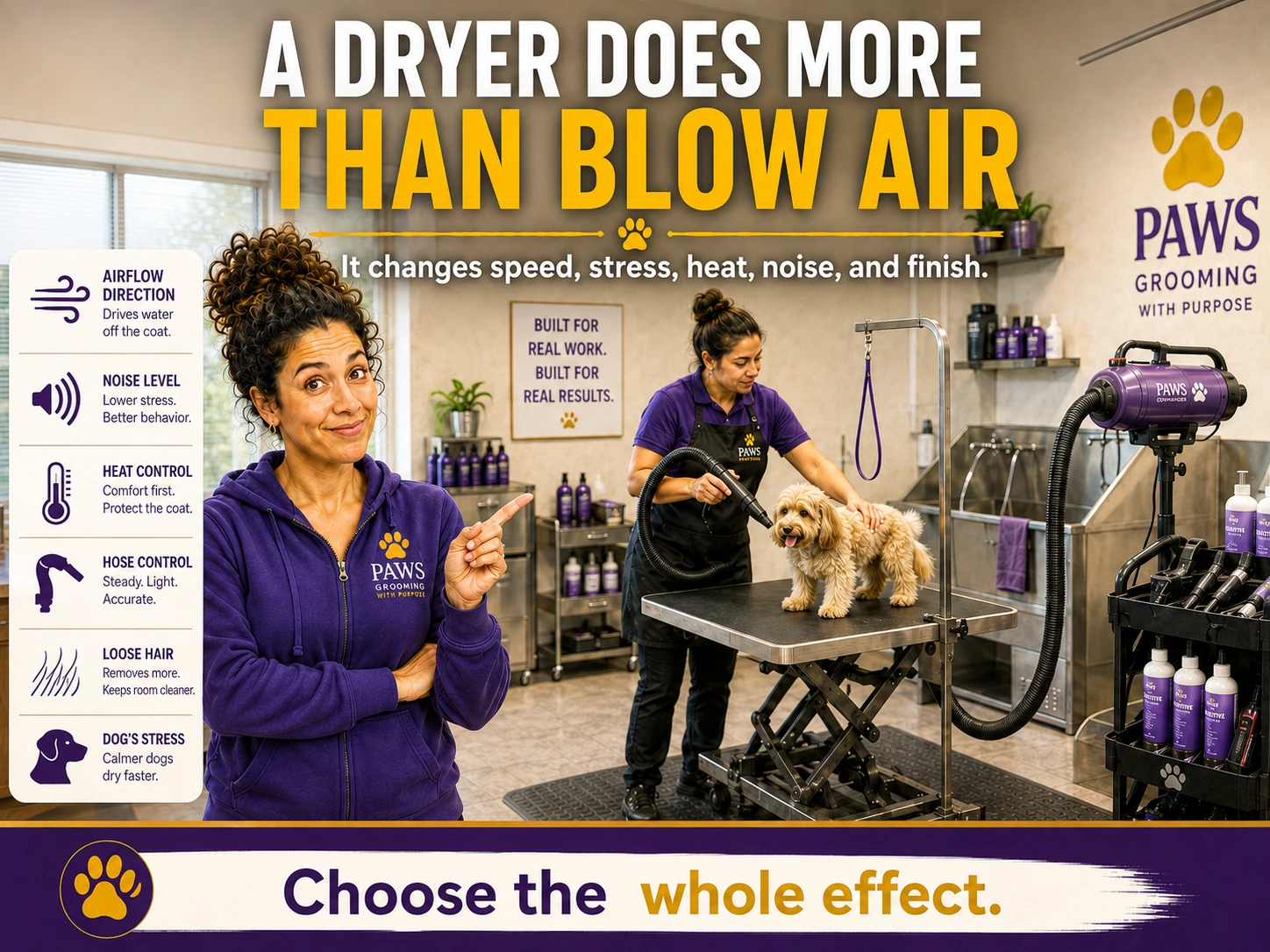
Dryers are not just accessories. Drying is one of the major production stages in grooming. Dryer choice affects appointment time, coat finish, dog stress, staff fatigue, noise levels, heat, airflow, loose hair, and where the room feels chaotic.
This dryer section is also a placeholder gateway for future pages. It needs its own branch because dryers are a major reason grooming rooms become loud, exhausting, and difficult to operate.
Dryer performance has to be evaluated as a system. Air volume, controllability, temperature, hose weight, nozzle options, filter access, noise, electrical demand, and the dog’s tolerance all affect whether the equipment actually saves time.
The room layout matters as much as the motor. Staff need a predictable hose path, a safe dog position, protected tools and products, and a place for loose coat to travel without turning the entire grooming room into a cleanup problem.
💨
Grooming Dryers
Dryers are not accessories. Drying is one of the biggest time, labor, safety, noise, heat, and coat-finish decisions in the grooming room.
✂️
Clippers, Blades, Shears, and Coat Tools
Hand tools are where coat quality, speed, maintenance, and daily discipline show up.
Clippers, blades, shears, guard combs, brushes, combs, rakes, and dematting tools are the hand-tool system of the grooming room. These tools do not get the same attention as tables and tubs, but they are used constantly.
Cheap or poorly maintained hand tools slow the groomer, pull coat, heat up, leave bad finish, frustrate the dog, frustrate the worker, and turn grooming into a fight with the equipment before the dog even gets a vote.
🔌
Corded Clippers
Planned deep dive: power, reliability, cord control, blade systems, daily production, and maintenance.
Planned page — add link when built.
🔋
Cordless Clippers
Planned deep dive: mobility, battery life, charging discipline, backup tools, and where cordless helps or hurts.
Planned page — add link when built.
🔪
Clipper Blades
Planned deep dive: blade lengths, blade heat, sharpening, cleaning, storage, coat type, and cut quality.
Planned page — add link when built.
📏
Guard Combs
Planned deep dive: finish length, coat prep, clipper compatibility, matting limits, and realistic customer expectations.
Planned page — add link when built.
✂️
Shears and Thinning Shears
Planned deep dive: straight shears, curved shears, thinning shears, finish work, hand fatigue, and quality control.
Planned page — add link when built.
🪮
Brushes, Combs, Rakes, and Dematting Tools
Planned deep dive: coat type, undercoat, matting, tool misuse, skin risk, and customer education.
Planned page — add link when built.
🦺
Restraint and Positioning Equipment
Restraint equipment is not about bullying the dog. It is about safer positioning so staff can work without turning every difficult dog into a strength contest.
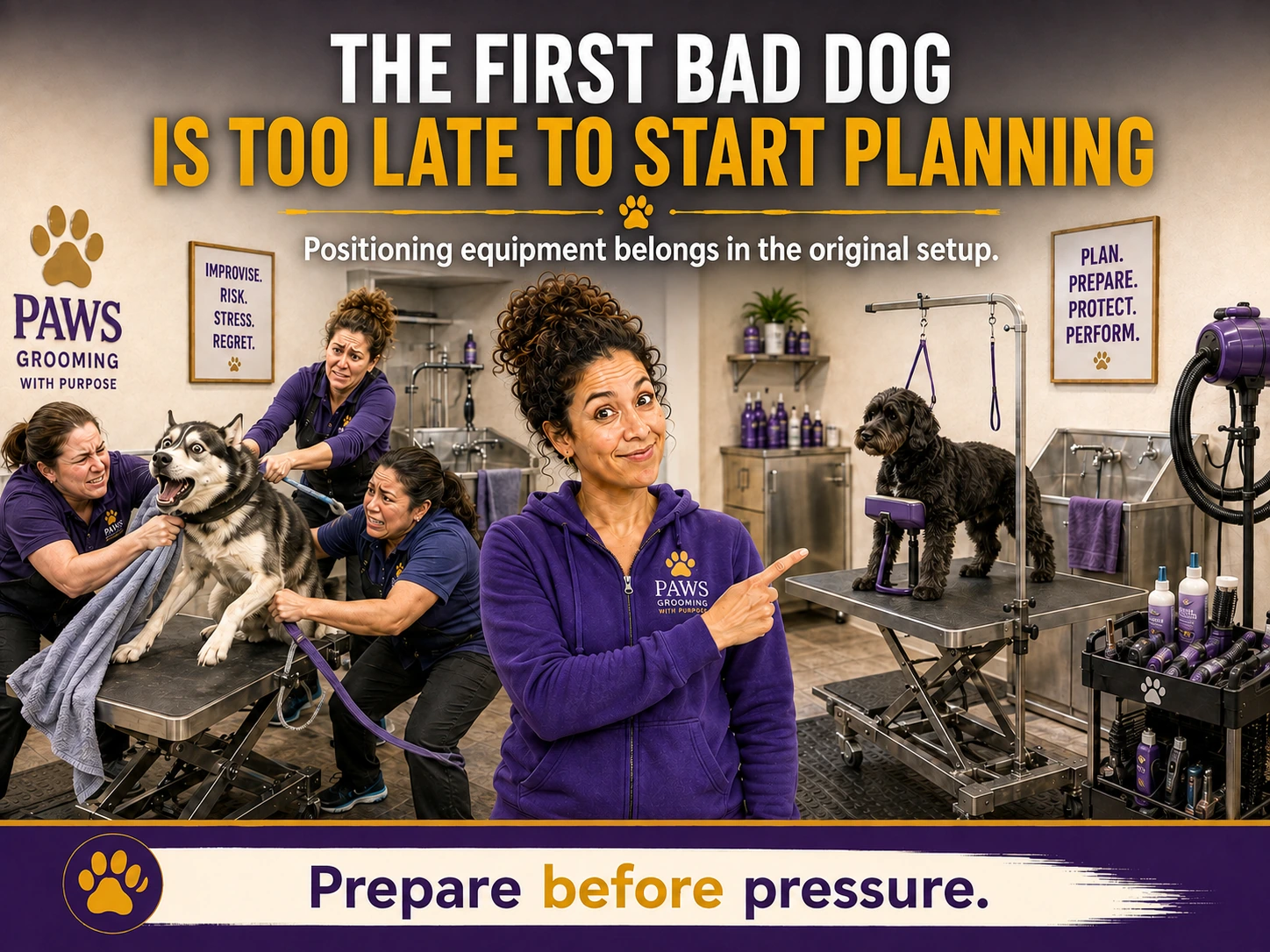
Restraint and positioning equipment is where table work, dog control, staff safety, bite prevention, and ergonomics collide. A good system helps hold the dog in a workable position. A bad system creates false confidence, poor control, or a dangerous mess.
These pages already exist in the grooming equipment sequence, so this section links directly into them.
Restraint planning should happen before the first dog sits, spins, bites at the loop, collapses under the belly, or tries to leave the table. The table, arm, attachment points, loops, harnesses, and assist devices should be selected as one compatible handling system.
Equipment does not replace staff judgment. Every device still requires correct sizing, observation, dog-specific adjustment, and a clear rule for when the setup is not controlling the dog safely enough to continue. Preparation reduces improvisation; it does not make every dog appropriate for every service.
🔩
Table Hardware and Grooming Arms
Main gateway for grooming arms and table hardware used to support restraint and positioning.
⬆️
Overhead Grooming Arm
A grooming arm style intended to provide overhead support and better positioning options.
📐
Standard 90-Degree Grooming Arm
Common one-adjustment grooming arm style and its practical limits.
↔️
Dual Adjustable Grooming Arm
More adjustment can mean better positioning when the arm is actually built well enough to hold up.
📏
Telescoping Grooming Arms
Adjustable height and reach options for different dogs, tables, and grooming positions.
🧳
Folding Grooming Arms
Folding designs may help storage and portability, but commercial stability still matters.
🔄
Rotating Grooming Arm
Rotation can help positioning, but only when it improves control instead of adding movement you do not want.
🧱
Wall-Mount Grooming Arm
A fixed support option that changes the table relationship and how the grooming station is arranged.
🪑
No-Sit Devices
Gateway to no-sit positioning tools used when dogs keep sitting, collapsing, or refusing to stand.
🦴
No-Sit Grooming Post
A specific no-sit approach for keeping the dog in a workable position.
🐾
The Pet Sitter
Existing positioning-device page in the no-sit / handling equipment branch.
❓
Unknown Dog No-Sit Device
A page for evaluating no-sit-style tools when the device or use case needs closer inspection.
🔗
Linked Interval Positioning System
A positioning system page for understanding how linked restraints affect dog control and handling.
🦺
Flexi Restraint System
Existing page for reviewing a restraint system used to help position and control dogs during grooming.
🐕
Grooming Harness
Harnesses can support safer positioning when used correctly and matched to the dog and table setup.
🛠️
Groomers Helper
Handling-assist system page for controlling dog movement and improving table safety during grooming.
🧺
Support Equipment People Forget Until the Room Is Already Annoying
Not every important item is a table, tub, dryer, or clipper.
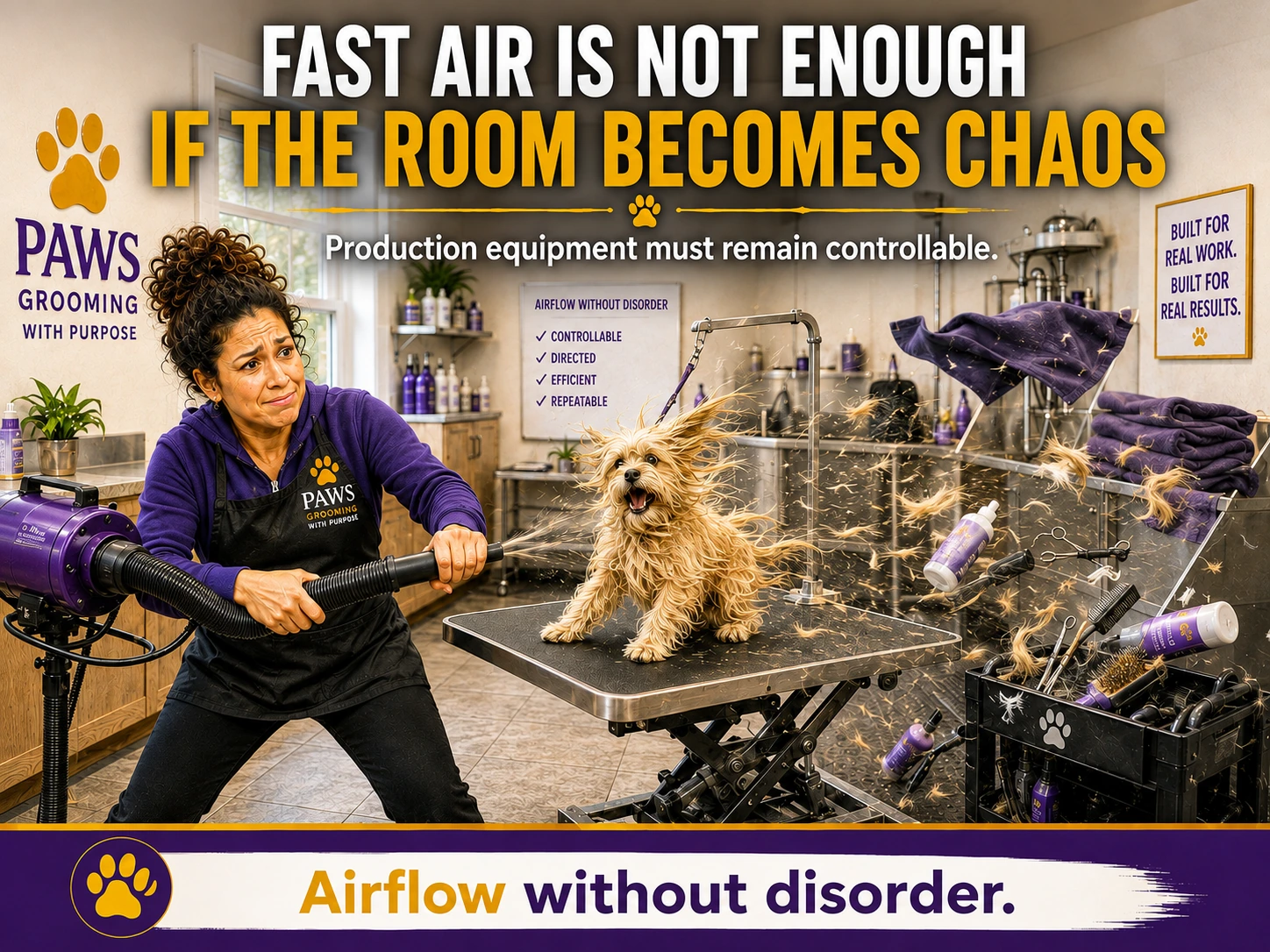
Support equipment determines whether the major equipment can be used without disorder. Carts, towel stations, hose storage, product storage, holding, laundry flow, filters, cleaning tools, and replacement parts keep the grooming station ready instead of forcing staff to improvise.
Dryer airflow is a good example. A powerful machine may shorten coat drying, but poor hose routing and loose products can scatter hair, towels, bottles, and tools through the room. The support system has to control what the main tool creates.
Every support item should have a fixed location, cleaning rule, refill trigger, and responsible person. Otherwise the room slowly converts useful equipment into clutter and makes every appointment slightly harder.
🛒
Tool Tables and Grooming Carts
Planned deep dive: carts, drawers, tool tables, reach zones, clutter control, and station organization.
Planned page — add link when built.
🏠
Cage Banks and Holding
Planned deep dive: staging, finished holding, drying, customer visibility, noise, dog stress, and scheduling flow.
Planned page — add link when built.
🧺
Towel and Laundry Support
Planned deep dive: clean towels, dirty towels, laundry volume, damp piles, storage, and workflow.
Planned page — add link when built.
🧴
Shampoo and Product Storage
Planned deep dive: shampoos, conditioners, ear products, degreasers, medicated products, labels, and reach.
Planned page — add link when built.
🧽
Cleaning and Disinfection Supplies
Planned deep dive: cleaning tools, chemical storage, daily reset, hair control, and preventing the room from turning gross.
Planned page — add link when built.
🔧
Replacement Parts and Maintenance
Planned deep dive: blades, filters, hoses, table parts, dryer parts, repair support, backups, and downtime planning.
Planned page — add link when built.
🧴
Automatic Shampoo Machines
Automatic shampoo machines can save product, control dilution, speed up bathing, and keep bathers from playing bottle-juggling circus all day. Used poorly, they become clogged, wasted, over-diluted, under-maintained support equipment nobody understands.
📊
Grooming Equipment Selection Matrix
Judge each equipment category by what it does to the work, not by whether it looked good online.
Swipe left/right to see the full table.
| Equipment Category | What It Does | What to Look For | Where Cheap Equipment Hurts You | Deep Dive |
|---|---|---|---|---|
| Grooming tables | Main table workstation for grooming, restraint, nails, clipping, scissoring, and finish work. | Stability, height adjustment, capacity, surface grip, cleaning, restraint compatibility. | More lifting, more wobble, more dog stress, more staff fatigue, more risk. | Start table reviews |
| Grooming tubs | Bathing workstation for wet dogs, shampoo, rinse, bather posture, and large-dog access. | Height, entry style, drainage, materials, sprayer setup, splash control, cleaning. | Back strain, wet floors, poor large-dog handling, slow bathing, and daily annoyance. | Planned tub branch. |
| Grooming dryers | Speeds drying, removes coat, prepares finish, and changes production time. | Airflow, noise, heat control, hose handling, filters, dog tolerance, durability. | Noise stress, dog panic, staff fatigue, overheating risk, and slow production. | Planned dryer branch. |
| Clippers and blades | Cutting system for coat removal, finish length, sanitary work, and detail areas. | Motor quality, blade system, blade heat, maintenance, backups, sharpening, compatibility. | Pulling coat, poor finish, hot blades, downtime, dog irritation, and groomer frustration. | Planned clipper/blade branch. |
| Grooming arms and hardware | Supports restraint, positioning, and table control. | Strength, adjustability, table compatibility, attachment method, dog size, movement control. | False security, weak positioning, unstable restraint, and more handling risk. | Open arms hub |
| No-sit and positioning systems | Helps keep dogs standing or positioned during difficult table work. | Correct use, dog tolerance, table compatibility, restraint safety, staff training. | Poor positioning, dog stress, misuse, false confidence, and bite risk. | Open no-sit hub |
| Tool carts and storage | Keeps tools within reach and supports station organization. | Reach, drawers, cleaning, mobility, tool separation, blade safety, cord control. | Tool hunting, clutter, lost time, contamination, and broken workflow. | Planned support branch. |
| Holding and cages | Supports staging, drying, finished holding, and appointment flow. | Size, cleaning, visibility, dog stress, airflow, noise, scheduling purpose. | Customer misunderstandings, barking, stress, poor staging, and chaotic flow. | Planned support branch. |
💵
Entry-Level vs Commercial-Grade Grooming Equipment
Not every startup has unlimited money. That does not mean every cheap purchase is smart.
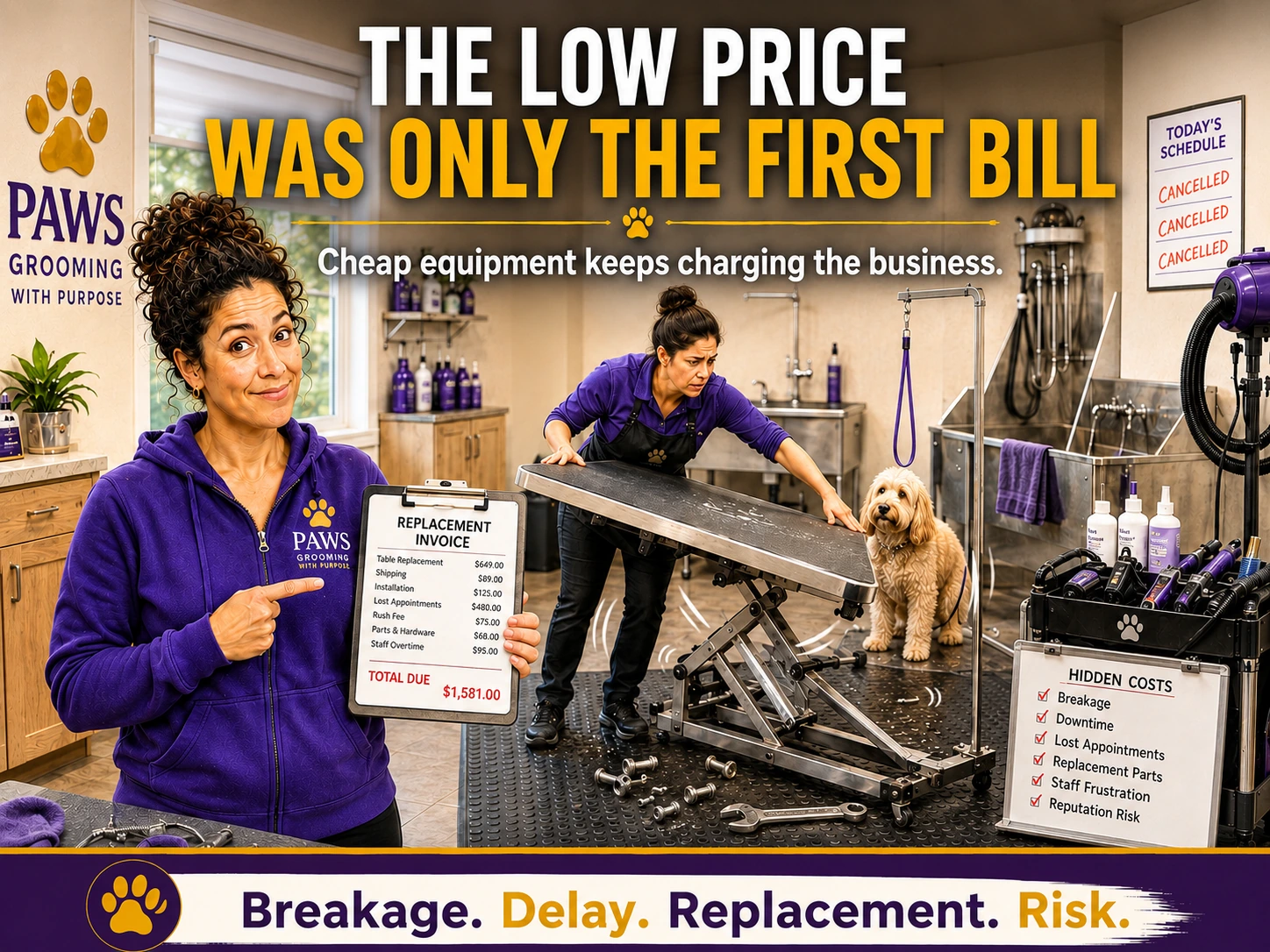
Startup operators have to make budget decisions. That is reality. But the cheapest version of a tool is only cheap until it breaks, slows the groomer, hurts production, creates a handling problem, or fails under the exact dog you were worried about.
Some items can start basic if the volume is low and the risk is low. Some items need to be decent from the beginning. Some items should be commercial-grade because they carry the dog, restrain the dog, lift the dog, dry the dog, or get used constantly.
Compare total ownership cost, not just purchase price. Include downtime, missed appointments, replacement shipping, unavailable parts, repair labor, staff frustration, slower production, and the possibility that a weak tool fails while supporting or restraining a dog.
A startup budget should identify where failure is merely inconvenient and where failure stops the department or creates a safety problem. Spending less on noncritical storage may be reasonable. Spending less on the main table, tub, dryer, or restraint system can simply move the cost into operations.
- Can sometimes start basic: some carts, non-critical storage, backup hand tools, brushes, combs, and support accessories.
- Should buy decent: clippers, blades, shears, table arms, loops, grooming carts, and daily hand tools.
- Should strongly consider commercial-grade: main grooming table, tub, dryers, heavy-use holding, table hardware, and restraint systems.
- Never buy junk: anything that supports the dog’s weight, restrains the dog, lifts the dog, handles wet/electrical work, or gets used all day.
🚫
Common Grooming Equipment Buying Mistakes
Bad equipment purchases usually look reasonable until real dogs, real staff, and real volume show up.
A common pattern is buying each item separately without checking whether the pieces create one usable station. The table may block the outlet, the arm may not fit the table, the hose may cross the dog path, and the cart may occupy the only safe place for the groomer to stand.
Before placing an order, build a compatibility list for dimensions, power, drainage, weight capacity, attachment method, service access, cleaning, replacement parts, and the dogs the business intends to accept. Equipment that cannot work together is not a bargain.
The final purchase review should be performed against a realistic full-day scenario, not an empty room. Include simultaneous bathing, drying, table work, holding, laundry, cleaning, and customer handoffs so the operator can see whether the equipment plan still works under pressure.
- Buying based on price alone instead of durability, safety, workflow, and daily use.
- Buying home-use equipment and expecting it to survive commercial abuse.
- Buying a grooming table that is too small, too weak, too wobbly, or too hard to adjust.
- Buying dryers without thinking about noise, heat, dog stress, hose control, filters, and staff fatigue.
- Buying restraint hardware after the first bad dog instead of planning safe positioning from the beginning.
- Buying tools before understanding the grooming room workflow.
- Buying for the easiest dog instead of the hard dog, large dog, old dog, scared dog, and matted dog.
- Forgetting cleaning, maintenance, replacement parts, sharpening, filters, hoses, and backup equipment.
⚠️
Operator rule
Buy grooming equipment for the day when the schedule is full, the towels are behind, the dryer is screaming, one dog hates its feet touched, one dog is matted, and the groomer is already tired. That is when bad equipment shows what it really cost.
➡️
Next Grooming Equipment Pages
This page is the gateway. The next step is to dive into the specific equipment branches.
⬆️
Start With Grooming Tables
Begin the existing table sequence with the lowest-end table type and work toward stronger commercial options.
🔩
Grooming Arms and Hardware
Review the existing grooming arm branch before choosing table hardware and restraint support.
🪑
No-Sit Devices
Review tools used when dogs sit, collapse, resist standing, or need additional positioning support.
🦺
Grooming Harnesses
Review harness-based support for safer positioning and dog control during table work.
🛠️
Groomers Helper
Review handling-assist equipment designed to help control dog movement during grooming.
⏱️
Grooming Time and Money
Equipment decisions connect directly to production time, staff fatigue, and grooming profitability.
❓
Dog Grooming Tools, Equipment, and Salon Setup FAQ
Detailed operator answers about tables, tubs, dryers, restraints, commercial durability, support equipment, maintenance, and total ownership cost.
What should I evaluate before buying any grooming equipment?
Start with the work the equipment must support: dog sizes, appointment volume, services, employee reach, room layout, restraint needs, cleaning, maintenance, and the consequences of failure. Then compare capacity, stability, controls, compatibility, service support, replacement parts, and total ownership cost. A sales photo and a low price do not answer those operating questions.
Which grooming equipment deserves the highest initial investment?
Prioritize items that support, lift, restrain, dry, or repeatedly control the dog. The main table, tub, dryers, table hardware, and primary restraint systems usually deserve stronger commercial review because failure can stop production or create a safety problem. Lower-risk storage and backup accessories may allow more budget flexibility.
How is commercial grooming equipment different from home-use equipment?
Commercial equipment works through repeated appointments, daily cleaning, water, hair, restraint pressure, large dogs, tired staff, and full schedules. Home-use equipment may perform acceptably for occasional use but wear quickly or become unstable when adjusted and loaded all day. Commercial suitability is about duty cycle, serviceability, and reliability under pressure.
Why is the grooming table considered the main workstation?
A large portion of the groom happens on the table. Its height, stability, traction, size, controls, and restraint compatibility affect lifting, posture, reach, dog confidence, nail work, clipping, scissoring, finishing, and handling difficult dogs. A weak table makes nearly every table-stage task harder.
How should I test grooming-table stability?
Evaluate the table at different heights with realistic dog weight and movement. Check base movement, deck flex, wobble, arm attachment, control response, and whether the table shifts when the dog leans or the groomer works from different sides. An advertised capacity does not prove that the workstation feels stable during actual handling.
When is an electric or hydraulic table worth the cost?
It is worth serious consideration when adjustment reduces repeated lifting, supports large dogs, fits different employees, and improves working height throughout the day. The benefit depends on durability, low-height access, control placement, stability, capacity, repair support, and whether the table actually fits the room and restraint system.
What should I look for in a grooming tub?
Review height, dog entry, door or ramp design, size, traction, drainage, hair control, sprayer reach, product placement, splash control, cleaning, and the transfer path to drying or table work. The bather should be able to control the dog and reach towels and supplies without repeated deep bending or unnecessary lifting.
Why can a low-priced tub become expensive?
A poor tub can slow every bath, tax the bather’s back, require more lifting, create wet-floor problems, and handle large dogs badly. Those costs appear as fatigue, longer appointments, staffing difficulty, injury risk, and eventual replacement. The purchase price is only one part of the operating cost.
What matters when comparing grooming dryers?
Compare controllable airflow, noise, heat behavior, hose weight and length, nozzle options, filters, electrical requirements, durability, dog tolerance, and service support. A dryer should reduce drying time without making the dog harder to handle or turning the room into a loud, hot, hair-filled mess.
How should dryer hose placement be planned?
The hose should reach the working positions without crossing the main staff or dog path, pulling against the groomer, knocking products over, or forcing awkward bracing. Plan where the dryer sits, where the dog stands, how the hose is stored, and where loose coat will travel before the equipment is installed.
What restraint equipment should be planned before opening?
Plan the table arm or overhead support, loops, harnesses, no-sit options, attachment points, and handling-assist devices that match the dogs and table system. Staff also need training, inspection rules, and clear limits for when restraint is not controlling the dog safely enough to continue the service.
Can restraint equipment make every dog safe to groom?
No. Equipment can improve positioning and reduce uncontrolled movement, but it does not erase fear, aggression, pain, medical limitations, or staff-skill limits. The operator still needs dog assessment, monitoring, correct fit, escalation rules, and authority to pause or refuse a service that cannot be performed safely.
What support equipment is most often forgotten?
Tool carts, towel storage, clean-and-dirty laundry flow, hose and cord storage, product organization, filters, cleaning tools, holding space, backup clippers, replacement parts, and maintenance supplies are commonly underestimated. These items determine whether the main workstations stay usable during a busy day.
How do I compare total cost of ownership?
Add the purchase price to expected repairs, replacement parts, maintenance, downtime, shipping, lost appointments, staff time, cleaning difficulty, reduced production, and likely replacement interval. A cheaper unit that fails during peak volume or slows every appointment may cost far more than the stronger purchase.
What equipment should have a backup?
Anything whose failure immediately stops appointments deserves a backup plan. Depending on the operation, that may include clippers, blades, dryer capacity, restraint loops, sprayer components, hoses, filters, table controls, and commonly worn hardware. The backup may be a second unit, spare part, local service relationship, or documented contingency.
How should equipment compatibility be checked?
Verify dimensions, weight capacity, attachment methods, power, drainage, clearances, control locations, table-arm fit, hose reach, cleaning access, and replacement parts before ordering. Place the equipment footprints into the room plan and test how staff and dogs move between them. Individual products can be good and still create a bad combined station.
Should a startup buy used grooming equipment?
Used equipment can be reasonable when condition, capacity, stability, electrical safety, hydraulics, controls, corrosion, parts availability, and cleaning can be verified. It becomes risky when the operator cannot inspect the load-bearing parts or obtain repairs. The discount should reflect the remaining service life and the cost of downtime.
What maintenance records should the grooming room keep?
Track inspections, cleaning, filter changes, sharpening, lubrication, hose and cord condition, table controls, restraint hardware, repair dates, replaced parts, and recurring failures. Records help the owner distinguish normal wear from a poor product, schedule preventive work, and avoid waiting until the equipment fails during an appointment.
How should equipment be evaluated after opening?
Review appointment time, worker fatigue, dog control, cleaning time, breakdowns, noise, heat, tool searches, and staff workarounds. Ask what employees repeatedly move, brace, unplug, replace, or avoid. Real operating evidence should guide station changes and future purchases more than the original sales description.
What is the main equipment-buying rule for a grooming business?
Buy for the busiest realistic day, the hardest dog the business intends to accept, and the employee who must use the equipment repeatedly. Judge safety, workflow, durability, cleaning, compatibility, maintenance, and support together. Equipment is successful when it keeps producing under real pressure—not merely when it looks professional while unused.
🐾
Bottom Line: Buy Grooming Equipment Like an Operator
Grooming tools are the working system of the room.
A grooming room needs more than a table, tub, dryer, and a pile of tools. It needs equipment that supports workflow, protects the groomer’s body, helps control dogs, survives daily abuse, cleans properly, and keeps production moving.
The table branch starts here because the grooming table is the main workstation. But the full equipment picture includes tubs, dryers, clippers, blades, shears, grooming arms, no-sit devices, harnesses, carts, cages, towels, cleaning supplies, product storage, and maintenance planning.
Do not buy equipment because it looked good online. Buy it because it can hold up to real dogs, real staff, real water, real hair, real cleaning, real fatigue, and real business pressure.