Starting an Independent Dog Daycare, No Franchise, No Training Wheels, No Royalty Drag, Market Research, Branding, Website, Location, Lease, Build-Out, Systems, Staffing, Marketing, and Startup Risk
Starting an Independent Dog Daycare: No Franchise, No Training Wheels, No Royalty Drag
Independent does not mean winging it. It means you build the system instead of renting someone else’s, and you keep the upside without royalty drag.
Starting independent is not a shortcut. It is a choice to own the whole thing: the freedom, the upside, the research, the mistakes, the brand, the systems, and the blame.
A franchise may hand you a brand, a system, training, software, vendor lists, marketing materials, and guardrails. Independent owners do not get that automatically. They either build it, buy pieces of help, hire targeted professionals, or figure it out the hard way.
That does not mean independent is wrong. I like independent when the owner is built for it. Some people can research, compare, call, visit, test the market, ask hard questions, and make decisions. Some people need a little help. Some people need a lot of help. Some people need a franchise because they want someone else’s system and guardrails.
This is the no-bull version: independent ownership can be excellent, but it is not freedom from responsibility. It is responsibility without royalty drag.
⚠️
Operator warning: independent does not mean “figure it out after opening.”
That is how expensive lessons happen. If you do not buy someone else’s system, you still need a system. You are just responsible for building it, finding it, buying pieces of it, or hiring the right help to create it.
🔧
Independent Does Not Mean Winging It
You are not avoiding a franchise system so you can have no system.
Some people hear “independent dog daycare” and think it means they can just lease a building, paint a paw print on the wall, buy some gates, open the doors, and see what happens.
No. That is not independent ownership. That is gambling with rent, payroll, dogs, customers, and your own money.
Independent means you build the system instead of renting someone else’s. You decide the brand, layout, pricing, services, software, forms, staffing model, marketing, vendor list, cleaning procedures, customer rules, intake process, and operating standards.
That is powerful. It is also a lot of work.
The franchise may hand you a binder. Independent owners still need the binder. They just have to build it, buy it, adapt it, or hire help to create it.
Treat every major operating area as a named system with an owner, written procedure, training method, inspection point, and record. Brand freedom does not excuse uncertainty about who approves dogs, stops play, gives medication, calls customers, or documents incidents.
Independent systems also need version control. Forms, prices, cleaning products, software, vaccination rules, staffing practices, and customer promises change, so staff must know which instructions are current and where obsolete versions have been removed.
📌
The independent ownership test
If you want freedom, good. But freedom without systems is just a more expensive way to make mistakes.
💼
Welcome to the Big Boys Club
Independent ownership means the decisions are yours. So are the consequences.
Starting independent is not a bad choice. It may be the best choice for the right person. But let’s not pretend somebody else is going to quietly handle the hard parts while you keep all the freedom.
If you do not buy a franchise system, then you are building the system. The name, logo, website, URL, local search, market testing, pricing, software, forms, lease questions, zoning questions, layout, construction decisions, staff rules, cleaning systems, dog intake, marketing, reviews, and opening plan all land on your desk.
Some people are built for that. They research, call around, visit facilities, test the market, study competitors, ask hard questions, hire the right help when needed, and make decisions.
Other people need more structure. There is no shame in that. The mistake is pretending you want independence when what you really want is someone to tell you exactly what to do.
Independent means you keep the upside without royalty drag. It also means there is no corporate office to blame when you skipped the homework.
🧠
Some Owners Need More Help Than Others
Independent does not mean alone. It means you choose how much help to buy.
Not every independent owner needs the same help. Some people may need a consultant, an attorney, an accountant, a good contractor, a marketing person, and software support. Some may only need a few targeted conversations. Some may not need anybody beyond normal local professionals.
That is fine. The point is not to shame people for needing help. The point is to make sure they know what kind of help they need and what happens if they choose not to get it.
If you do the whole thing yourself, then the research is on you. The name is on you. The market testing is on you. The pricing is on you. The website is on you. The lease risk is on you. The layout is on you. The staff training is on you. The operating procedures are on you.
There is nothing wrong with that if you are capable of doing it. Just do not call it independent ownership and then act surprised when nobody shows up to catch the pieces you forgot.
The right amount of help depends on the cost of being wrong. A logo revision is inconvenient; a bad lease, failed floor, weak drainage plan, missing insurance coverage, or unsafe dog-flow design can threaten the entire business.
Targeted help should produce usable deliverables and transfer knowledge to the owner. The goal is to make expensive decisions with better information while keeping control of the resulting brand, accounts, procedures, and customer relationships.
| Owner Type | What They May Need | Risk They Keep |
|---|---|---|
| Full DIY Owner | Research, local professionals, software, vendors, documents, and their own judgment. | Every missing answer is still their problem. |
| Targeted-Help Owner | Consultant calls, location review, design review, attorney, accountant, contractor, marketing help. | They still have to implement and manage the system. |
| Heavy-Help Independent Owner | Full consulting package, facility design help, manuals, launch support, post-opening support, and local professional team. | They still own the brand, decisions, staff, money, and outcome. |
| Franchise-Fit Owner | Brand, system, training, manuals, software, support, guardrails, and ongoing structure. | They trade money and control for the system. |
📋
What Falls on You When You Stay Independent
Nobody is automatically handing you the business in a box.
When you stay independent, you own the whole stack. That is the trade. No franchise fee, no royalty drag, no approved vendor leash, no corporate brand rules — but also no automatic roadmap.
You need to figure out the name, logo, website, web address, Google Business Profile, local SEO, market testing, competitor research, pricing, lease review, zoning, insurance, software, forms, employee policies, customer agreements, facility layout, flooring, drains, HVAC, gates, cleaning systems, staff training, dog intake, temperament testing, incident procedures, marketing, reviews, cash flow, and opening plan.
That list is not here to scare you. That is the job.
If you are the kind of person who reads that list and says, “Fine, I’ll figure it out,” independent may fit you. If that list makes you want someone else to hand you the answers, then be honest about that before you start spending money.
- Business name, logo, brand, URL, website, and local search presence.
- Market research, competitor calls, pricing review, and service demand testing.
- Lease, zoning, signage, parking, traffic, neighbors, landlord restrictions, and build-out risk.
- Facility layout, dog movement, customer flow, staff flow, grooming flow, boarding routines, drains, flooring, HVAC, gates, walls, and cleaning paths.
- Software, customer records, vaccination tracking, billing, packages, reservations, boarding, grooming, and reporting.
- Customer agreements, intake forms, temperament testing, incident reports, feeding procedures, medication procedures, cleaning schedules, and employee policies.
- Hiring, training, supervision, payroll, schedules, staff accountability, and daily operating discipline.
- Marketing, reviews, local outreach, vet relationships, apartment outreach, events, social media, phone handling, tours, and follow-up.
🧰
Build Your Independent Startup Battle Plan
Check what you have handled, what still needs work, and where you need professional help before the lease, build-out, dogs, staff, and payroll make the lesson expensive.
You said you want to go independent. Good. Here is the list. Start checking boxes. The building, dogs, staff, customers, city, landlord, insurance company, and payroll are not going to care that you meant well.
Independent Dog Daycare Startup Battle Plan
No-Franchise Startup Checklist Builder
Mark each item as Not Started, Researching, Done, Need Help, or Not Applicable. The tool will build a readiness report, stop-sign warnings, professional call list, and printable PAWS checklist.
Readiness 0%
Start checking items.
Operator warning: This tool does not replace an attorney, accountant, architect, contractor, engineer, insurance agent, zoning office, or local code official. It is here to help you see the holes before the holes get expensive.
Your Startup Readiness Report
Start checking boxes.
Stop Signs
Critical lease, zoning, build-out, insurance, and money items will appear here if they are missing.
Items Marked Need Help
Mark items as Need Help to build your professional call list.
Who to Call
Your custom attorney, zoning, contractor, insurance, consultant, marketing, software, and professional help list will appear here.
Phase-by-Phase Startup Plan
pawsdogdaycare.com
PAWS Independent Dog Daycare Startup Battle Plan
Generated from pawsdogdaycare.com
PAWS Independent Startup Battle Plan Builder • pawsdogdaycare.com
🔎
The Research Is Yours
Nobody is automatically doing the homework for you.
If you go independent with no franchise and no consultant, fine. Plenty of people start businesses that way. But understand what you are choosing.
You need to research the market. You need to visit other facilities. You need to call competitors. You need to look at pricing. You need to test whether people in your area actually want daycare, boarding, grooming, training, memberships, transportation, enrichment, retail, or whatever else you plan to sell.
You need to figure out your name, your logo, your web address, your website, your Google Business Profile, your local SEO, your opening offer, your review plan, your phone process, your tour process, and how you are going to make strangers trust you with their dogs.
You need to understand the lease, zoning, parking, signage, build-out, drains, floors, HVAC, gates, insurance, software, payroll, employee rules, customer agreements, temperament testing, cleaning procedures, feeding procedures, medication procedures, and incident reports.
That is not me trying to scare you. That is the work. If you want the freedom, this is what comes with it.
Research should produce decisions, not a folder of screenshots. Summarize demand, competitors, prices, drive times, service gaps, risks, customer expectations, and the assumptions used in the financial model.
Separate broad enthusiasm for dogs from demand for a specific service at a specific price in a specific location. A community may love dogs and still lack enough customers willing to use structured daycare, overnight boarding, grooming, or premium enrichment.
✋
Before You Sign Anything, Slow Down
The lease is where a lot of independent owners stop being “excited” and start being trapped.
Before you sign a lease, buy equipment, announce the business, or start acting like the building is already yours, stop and make the boring calls.
Call zoning. Call the city. Call the county. Ask about daycare. Ask about boarding. Ask about grooming. Ask about overnight animals. Ask about outdoor use. Ask about noise. Ask about waste. Ask about parking. Ask about signage. Ask about whether an animal-care facility is allowed in that exact location.
Do not let the landlord’s confidence become your due diligence. A landlord may honestly believe the use is fine. They may also be wrong. Their wrong answer does not pay your rent if the city says no.
This is where independent owners need to act like adults. You are not just leasing square footage. You are trying to put live animals, barking, cleaning water, waste, staff, customers, grooming dryers, outdoor movement, and daily drop-off traffic into a specific building under specific local rules.
Find the problems before the lease has your signature on it. After that, the problem usually has rent attached.
- Is dog daycare allowed at this address?
- Is overnight boarding allowed, or only daytime care?
- Is grooming allowed as part of the same use?
- Are outdoor play, potty yards, fencing, drainage, waste handling, or noise regulated?
- Does the city require a kennel permit, animal boarding permit, health inspection, special use permit, business license, or animal-care approval?
- Can the landlord legally allow this use under the lease and property restrictions?
- Who pays if the building needs drains, HVAC, electrical, plumbing, fire, walls, signs, gates, or code upgrades?
- Can you get out of the lease if the use is denied?
⚠️
Operator warning: do not fall in love with the building first.
A building can be cute, cheap, visible, and still be wrong. If the use does not work legally, mechanically, or operationally, the rent does not care how excited you were.
📞
Test the Market Before You Bet the Farm
Do not build a business around what you hope people want.
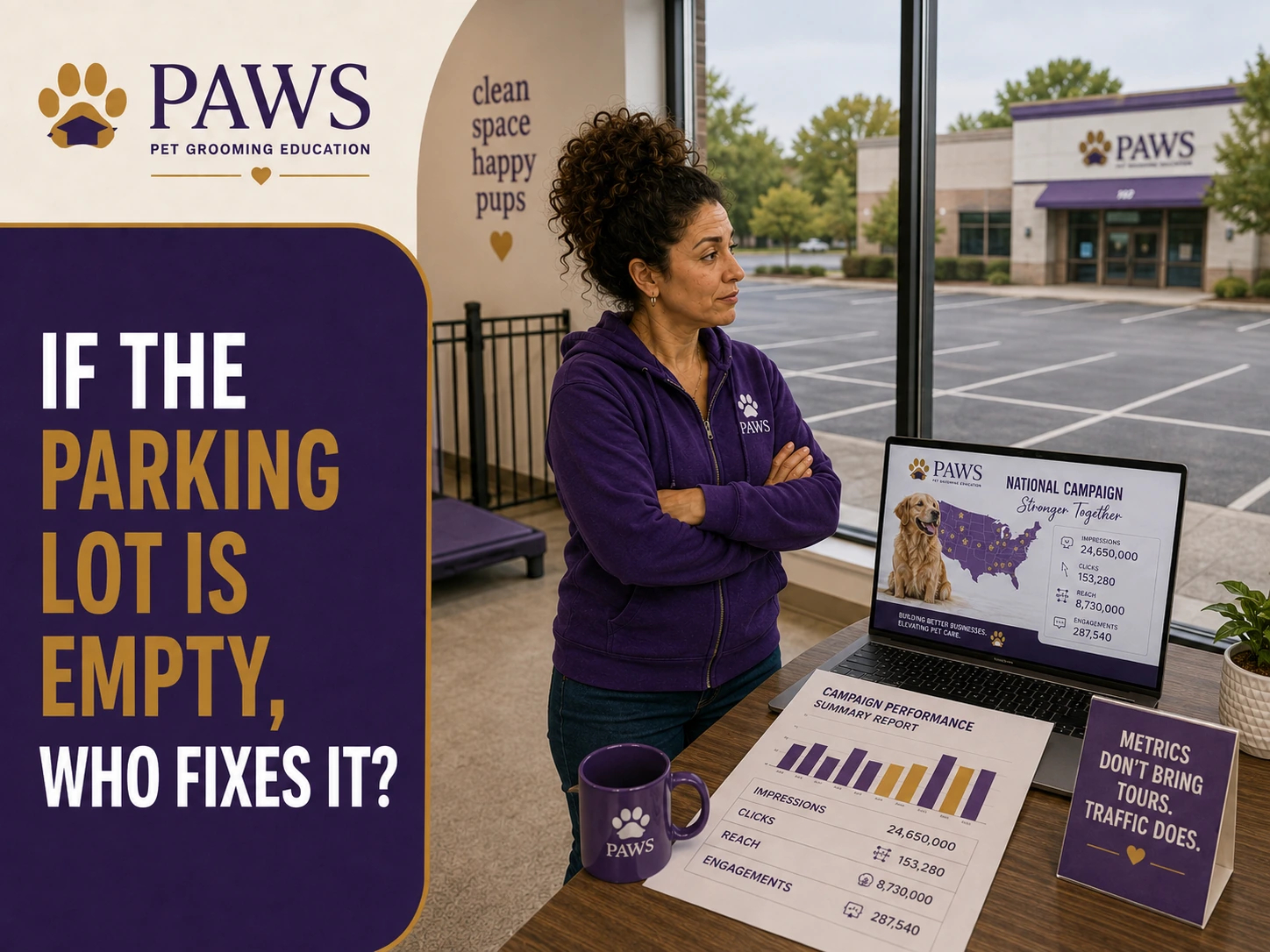
A lot of people fall in love with the idea of owning a dog daycare before they know whether the market wants what they are about to build.
Call competitors. Visit facilities. Look at reviews. Check prices. See who is full. See who is discounting. See what services are missing. Ask groomers what customers request. Talk to vets. Look at apartments, commute routes, income, parking, dog ownership, and how far people are likely to drive.
Do not just ask friends and family whether they like the idea. They are not always useful. Everybody loves your dream when it costs them nothing.
You need to know whether real customers in the real market will pay real money for the services you plan to offer.
Market testing should examine operating difficulty as well as customer interest. A service can be popular but unprofitable if customers expect long hours, heavy discounts, low prices, high staffing, or service levels the building cannot deliver efficiently.
Record the evidence behind every assumption. Competitor pricing, review themes, waitlists, service gaps, commute routes, apartment density, veterinary relationships, and search demand should connect directly to the planned capacity, staffing, prices, and marketing budget.
- Call local competitors and ask normal customer questions.
- Visit facilities if you can do it honestly and legally.
- Review pricing for daycare, boarding, grooming, memberships, packages, and add-ons.
- Study Google reviews to see what customers praise and complain about.
- Look for demand gaps: grooming, boarding, cat care, training, transportation, enrichment, or better hours.
- Check whether your planned location fits customer routines and commute patterns.
- Test whether people understand your service and trust your concept before you spend build-out money.
🏷️
Name, Logo, URL, Website, and Local Trust
Independent owners do not inherit a brand. They build one.
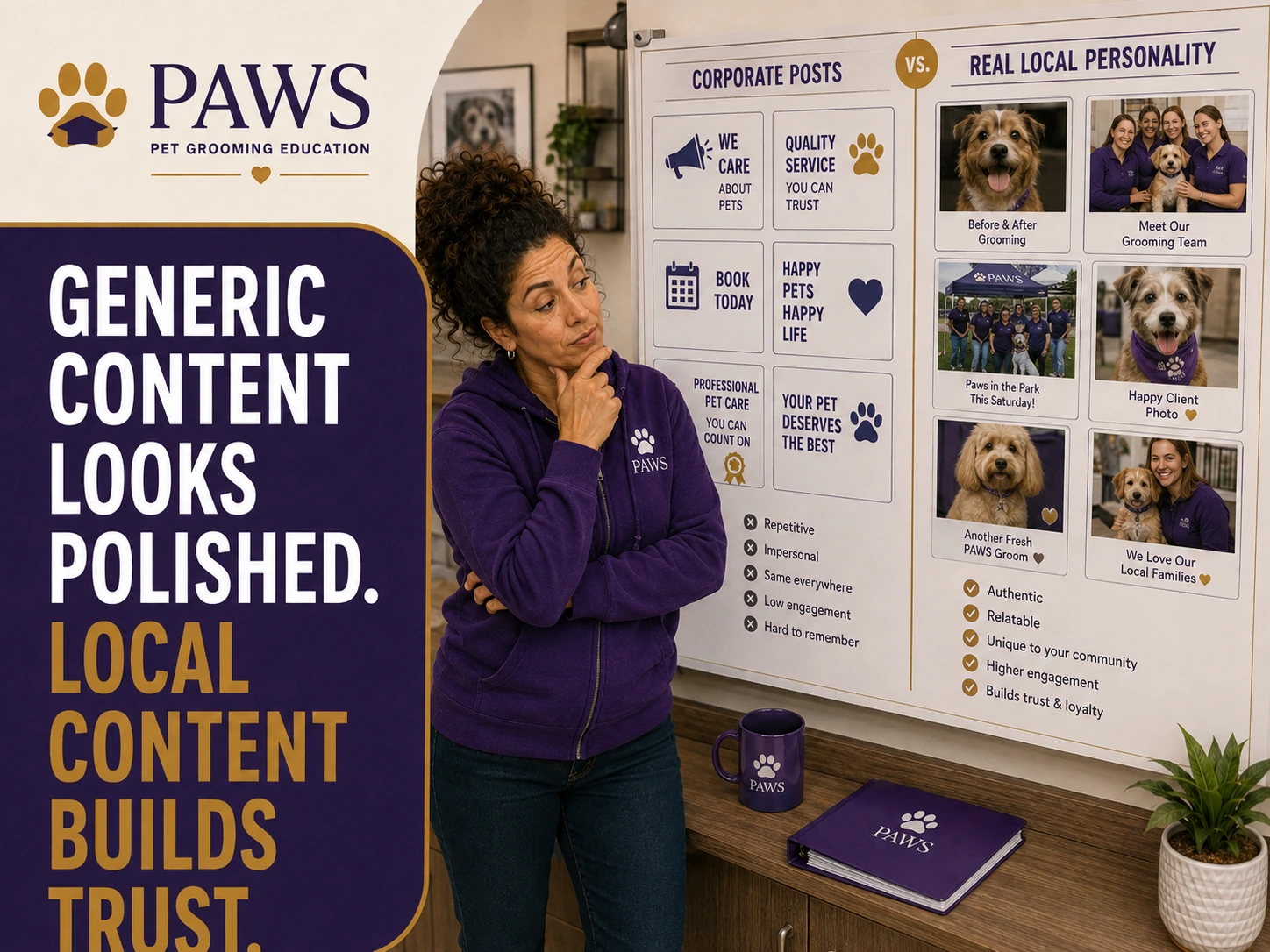
If you stay independent, you need a name. Then you need to make sure the name works. Can people remember it? Can they spell it? Is the domain available? Does it create confusion with another business? Does it sound like dog daycare, boarding, grooming, pet care, or whatever service mix you plan to sell?
Then you need a logo, colors, signs, website, local SEO, Google Business Profile, photos, service pages, pricing language, intake path, and enough trust that a stranger is willing to leave their dog with you.
That is a lot more than “make a cute logo.” Your website is your front desk before your front desk. Your Google listing may be the first thing customers see. Your reviews may become your best salesperson. Your photos may answer questions before the phone rings.
A franchise may give you brand polish. Independent owners have to create local trust from scratch. That is not impossible. It just has to be done on purpose.
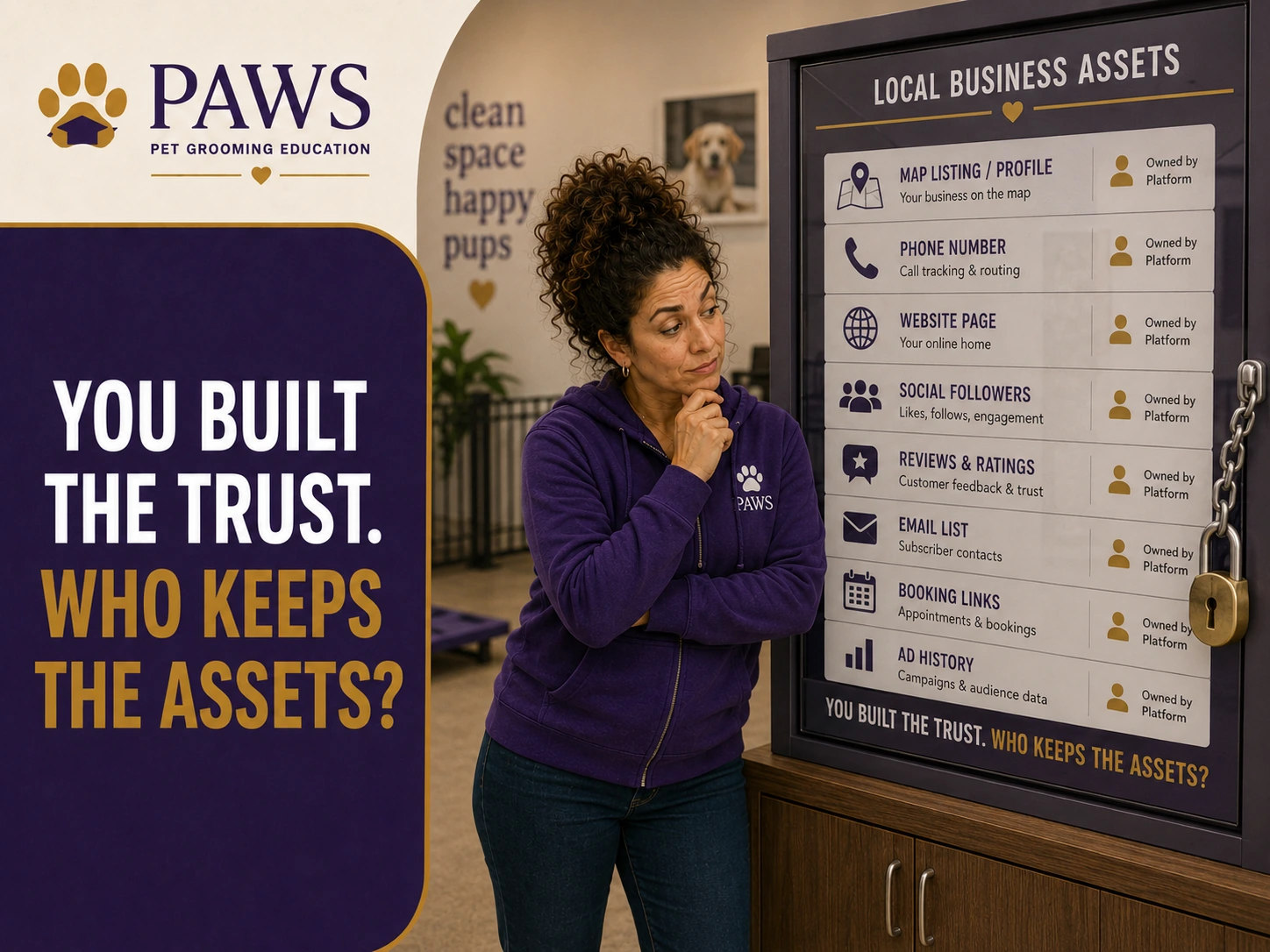
The business should control the assets created for the brand. Domain registration, hosting, Google Business Profile, phone numbers, social accounts, email lists, photographs, ad accounts, analytics, and booking links should not quietly belong to an outside vendor.
Brand work should be tested for clarity. A clever name has limited value when customers cannot tell whether the business offers daycare, boarding, grooming, training, transportation, or another service. The offer and next step should be understandable within seconds.
⚠️
Do not wait until opening week to think about the brand.
Your name, URL, website, Google listing, photos, reviews, phone process, and opening offer are part of the startup plan, not decorations you add after the building is finished.
🏢
Location, Lease, Zoning, and Build-Out
The first big trap is usually signed before the first dog ever walks in.
Location can make or break this business. A bad lease in a bad building can turn a good idea into a slow bleed.
Dog daycare is not a normal retail use. You have dogs, noise, odor, water, waste, cleaning chemicals, dryers, staff movement, customer traffic, barking, outdoor needs, drainage, HVAC, gates, and neighbors who may not love the sound of your dream.
Before you sign, you need to know whether the use is allowed, whether the landlord understands the business, whether parking works, whether signage works, whether outdoor space is possible, whether drains and plumbing make sense, whether HVAC can handle the load, whether the building can be cleaned properly, and whether the build-out cost is realistic.
This is where independent owners get hurt. They sign because the rent looks good or the building feels close enough, then discover the place needs expensive changes, zoning is ugly, neighbors complain, parking is weak, or the layout fights them every day.
- Is dog daycare, boarding, grooming, or kennel use allowed by zoning and lease language?
- Does the landlord understand noise, odor, drains, cleaning, outdoor areas, signage, and animal-care use?
- Is there enough parking and customer access during drop-off and pickup?
- Can the building support proper floors, drains, HVAC, gates, walls, wash areas, laundry, storage, and cleaning flow?
- Are there neighbors who may create noise or odor problems?
- Who pays for build-out, repairs, mechanical upgrades, plumbing, drains, electrical, signs, and code issues?
- Has a local attorney reviewed the lease before you sign?
📄
Licenses, Permits, and Inspections Are Not Optional Vibes
“I think we’re fine” is not a permitting strategy.
Independent owners have to figure out what their local government actually requires. That may mean a normal business license. It may mean a kennel permit. It may mean an animal boarding permit. It may mean a health inspection, fire inspection, zoning approval, special use permit, waste-control requirement, or limits on overnight care.
Do not assume the rules are the same because another town, county, or state allowed something different. Dog daycare rules can change by jurisdiction, and the words matter. “Daycare,” “boarding,” “kennel,” “grooming,” “animal services,” and “pet care” may be treated differently.
Also do not assume that because you are not breeding dogs, kennel rules do not apply. Some places use kennel language broadly. Some use animal boarding language. Some regulate by number of animals. Some care about overnight housing. Some care about zoning district, noise, waste, or inspections.
This is not the fun part of the business. Good. Do it anyway.
- What business license is required?
- Is there a kennel, animal boarding, pet-care, grooming, or daycare permit?
- Is overnight boarding treated differently from daytime daycare?
- Is an inspection required before opening?
- Are sanitation, waste, ventilation, capacity, noise, or outdoor-area rules written down?
- Does the local code limit animal count, hours, outdoor use, or proximity to residential areas?
- Do you need approval before construction starts?
- Who at the city or county will put the answer in writing?
📐
Facility Design: Dogs Are Not Furniture
Do not design the building like you are storing boxes on warehouse shelves.
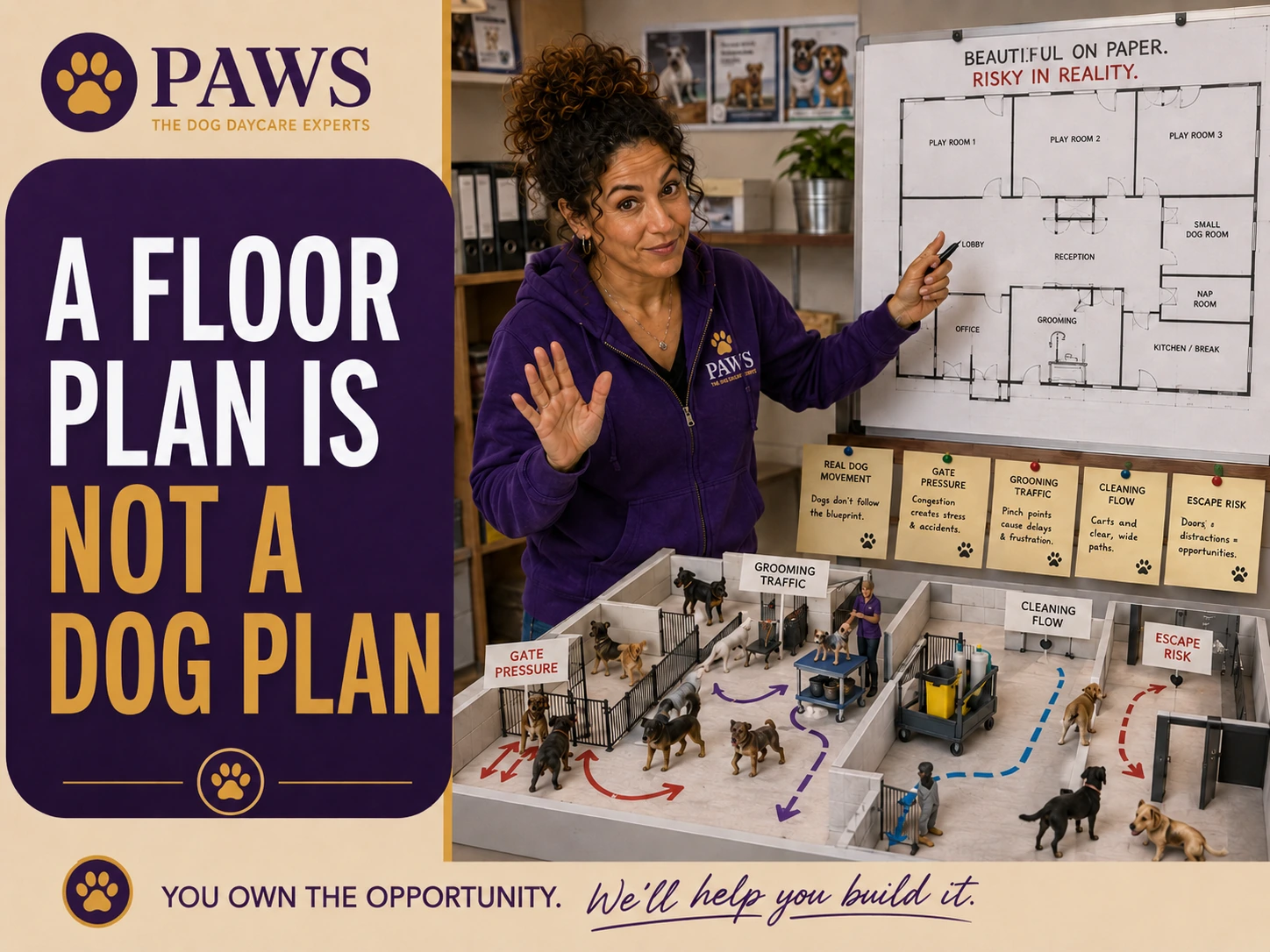
Independent owners have design freedom. That is good. It is also dangerous if nobody involved understands dog movement.
A rectangular building does not magically become a good dog daycare because someone drew rows of rooms inside it. Dogs move. Dogs rush gates. Dogs follow each other. Dogs hesitate. Dogs get excited. Boarding dogs that have been inside all night do not come out like office supplies on a cart.
You still need to maximize the areas that make money. Boarding matters. Grooming matters. Daycare capacity matters. But if you destroy flow, safety, cleaning, and supervision to squeeze in more suites, the building may punish you every morning.
Good design thinks about how dogs move from boarding to potty areas, daycare to grooming, grooming to checkout, lobby to playroom, and one controlled space to another. Good design protects the rule that dogs should not have a straight shot to freedom.
Pretty drawings are not enough. Economy of motion matters. Staff should not waste the day walking in circles. Groomers should not collide with checkout dogs. Boarding routines should not wreck daycare supervision. Cleaning should not drag dirty water through clean areas.
Walk every dog and staff route on the plan before construction. Trace intake, evaluation, daycare entry, boarding release, grooming transfer, potty movement, feeding, medication, cleaning, laundry, waste removal, customer pickup, and emergency evacuation.
Good design reduces the number of moments that require perfect employee behavior. Double barriers, controlled transitions, useful sightlines, appropriate separation, reachable cleaning tools, and clear traffic patterns make safe performance easier during busy periods.
📌
The design test
If the layout looks good on paper but creates dog movement problems, cleaning problems, staff traffic problems, or escape risk, it is not a good layout.
📦
Capacity Is Not Kennel Tetris
More dogs on paper does not always mean more money in real life.
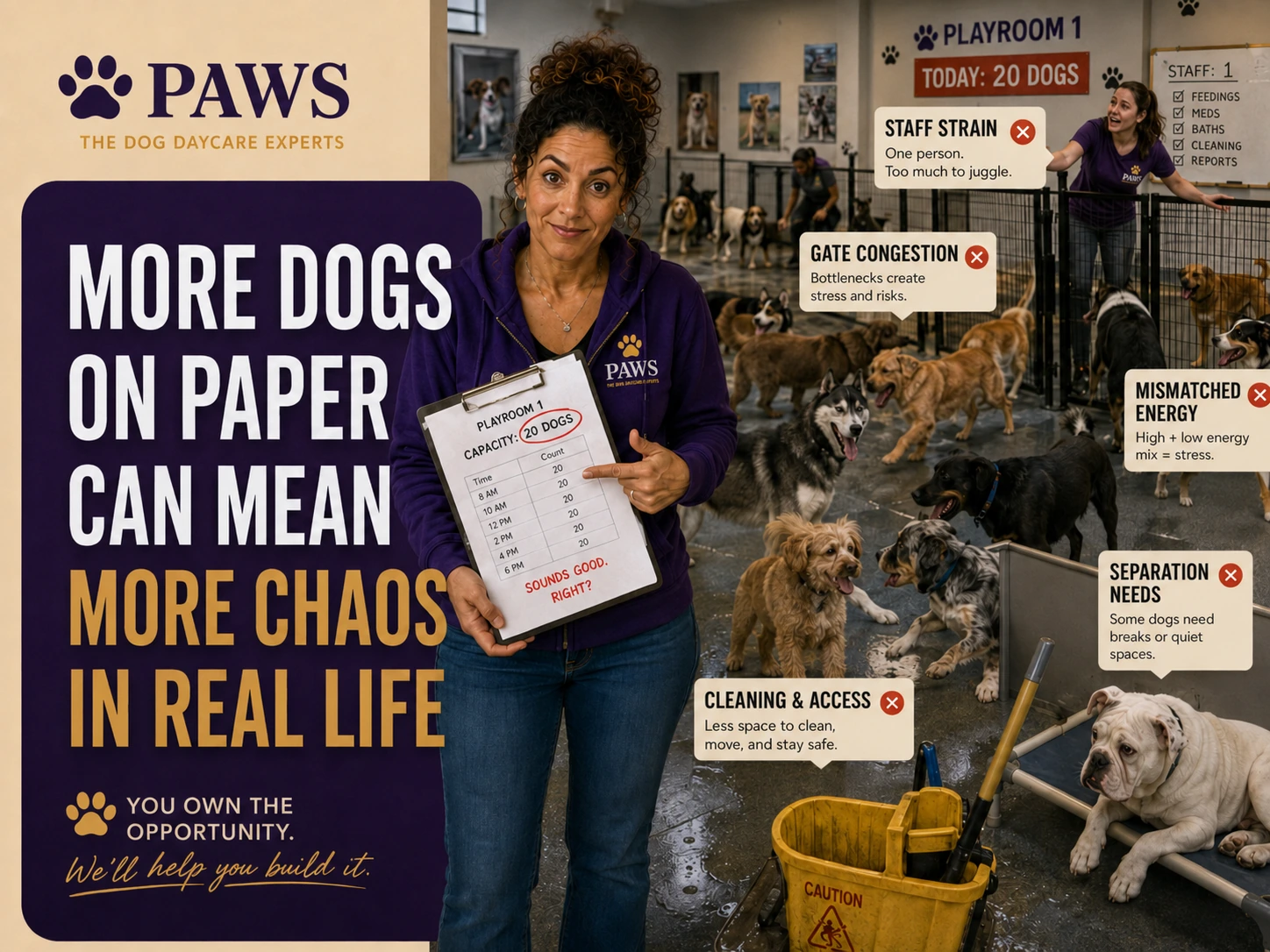
Independent owners love to count dogs. I get it. More daycare dogs, more boarding suites, more grooming appointments, more revenue. That is the dream.
But capacity is not just how many dogs you can physically cram into a building. Capacity is staff, supervision, dog mix, room size, noise, cleaning, potty flow, gate control, rest areas, grooming traffic, boarding movement, and what happens when the wrong group of dogs shows up on the same day.
A room that can hold twenty dogs on paper may be a nightmare with the wrong twenty dogs. A boarding hallway that adds ten suites may cost you more in staff time, cleaning problems, and dog movement headaches than it makes. A grooming room that looks profitable may become useless if groomers cannot safely pull dogs from daycare and boarding.
This is where spreadsheet owners get into trouble. Dogs are not inventory units. They are live animals with opinions, stress, energy, bladder pressure, teeth, friends, enemies, and bad timing.
Capacity should be calculated by operating zone and time of day. The building may hold a certain number of dogs overall while the lobby, gates, yards, hallways, rest areas, grooming room, or staffing plan becomes the real bottleneck.
Set a management capacity below the theoretical maximum. That buffer allows for incompatible dogs, illness separation, maintenance closures, employee absence, weather, boarding surges, and dogs that require more space or supervision than the average plan assumes.
- How many dogs can be supervised safely, not just physically stored?
- How many staff are needed at different times of day?
- Can dogs be separated by size, play style, energy, age, or behavior?
- Can boarding dogs move outside without creating a hallway stampede?
- Can grooming dogs move in and out without crossing unsafe traffic?
- Can staff clean without losing supervision?
- Does every added dog create revenue, or does it create chaos?
📌
The capacity test
If the only reason the design works is because every dog behaves perfectly and every employee does everything perfectly, the design does not work.
⚙️
Build the System Before the Dogs Show Up
The first week of operation is not the time to invent your procedures.
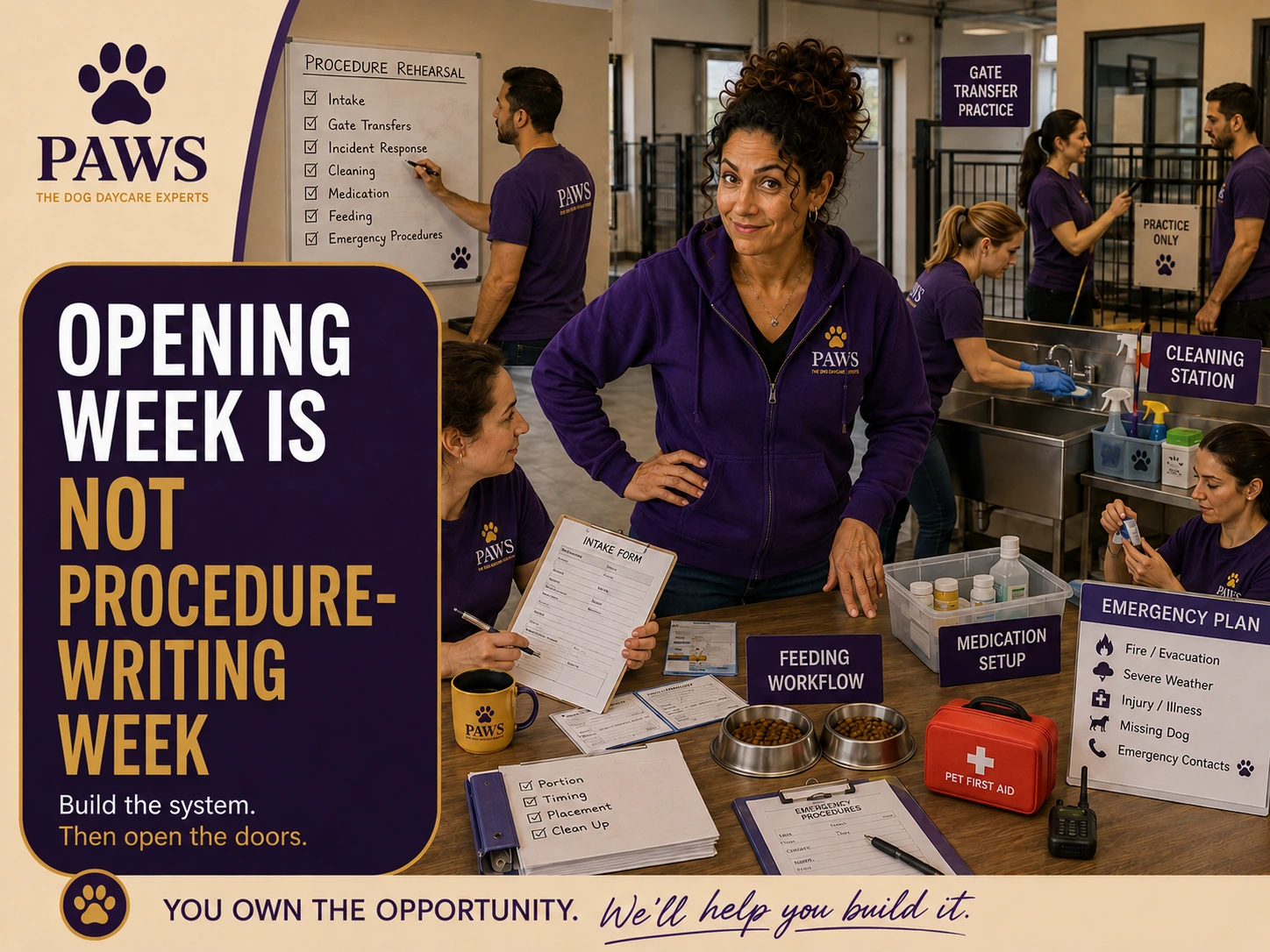
Freedom is great until the dog bites, the floor fails, the drains clog, payroll is due, and nobody wrote down how the business is supposed to operate.
Independent owners need operating systems just like franchise owners. You need intake rules, temperament testing, vaccination requirements, cleaning schedules, feeding procedures, medication procedures, incident reports, staff rules, closing duties, opening duties, boarding routines, grooming handoff procedures, and customer communication standards.
Do not wait until a staff member makes a mistake to decide what the rule should have been. Write the rule. Train the rule. Have employees acknowledge the rule. Then enforce the rule.
Your systems do not need to be fancy. They need to be usable. A perfect binder nobody follows is decoration. A simple checklist staff actually use is a business tool.
Rehearse procedures before customers and dogs expose the gaps. Role-play intake, rejected vaccinations, difficult transfers, medication questions, feeding changes, injuries, escapes, late pickups, customer complaints, illness, power loss, and emergency veterinary transport.
A procedure is not complete until staff can perform it, managers can inspect it, and the business retains a useful record. Written rules without practice, supervision, and documentation become decoration.
- Dog intake and temperament evaluation process.
- Vaccination, health, illness, parasite, and exclusion rules.
- Cleaning schedules, disinfectant rules, laundry, waste, odor, and closing procedures.
- Feeding, medication, boarding notes, belongings, and special-care procedures.
- Incident reports, customer notification rules, injury response, and documentation.
- Gate rules, leash-transfer rules, playroom supervision rules, and escape prevention.
- Employee handbook, signed acknowledgments, training records, and accountability process.
- Pricing, packages, billing, refunds, cancellations, no-shows, and late pickup rules.
📁
Build the Day-One Proof Pack
Before customers trust you with dogs, you need to show them you are not making this up as you go.
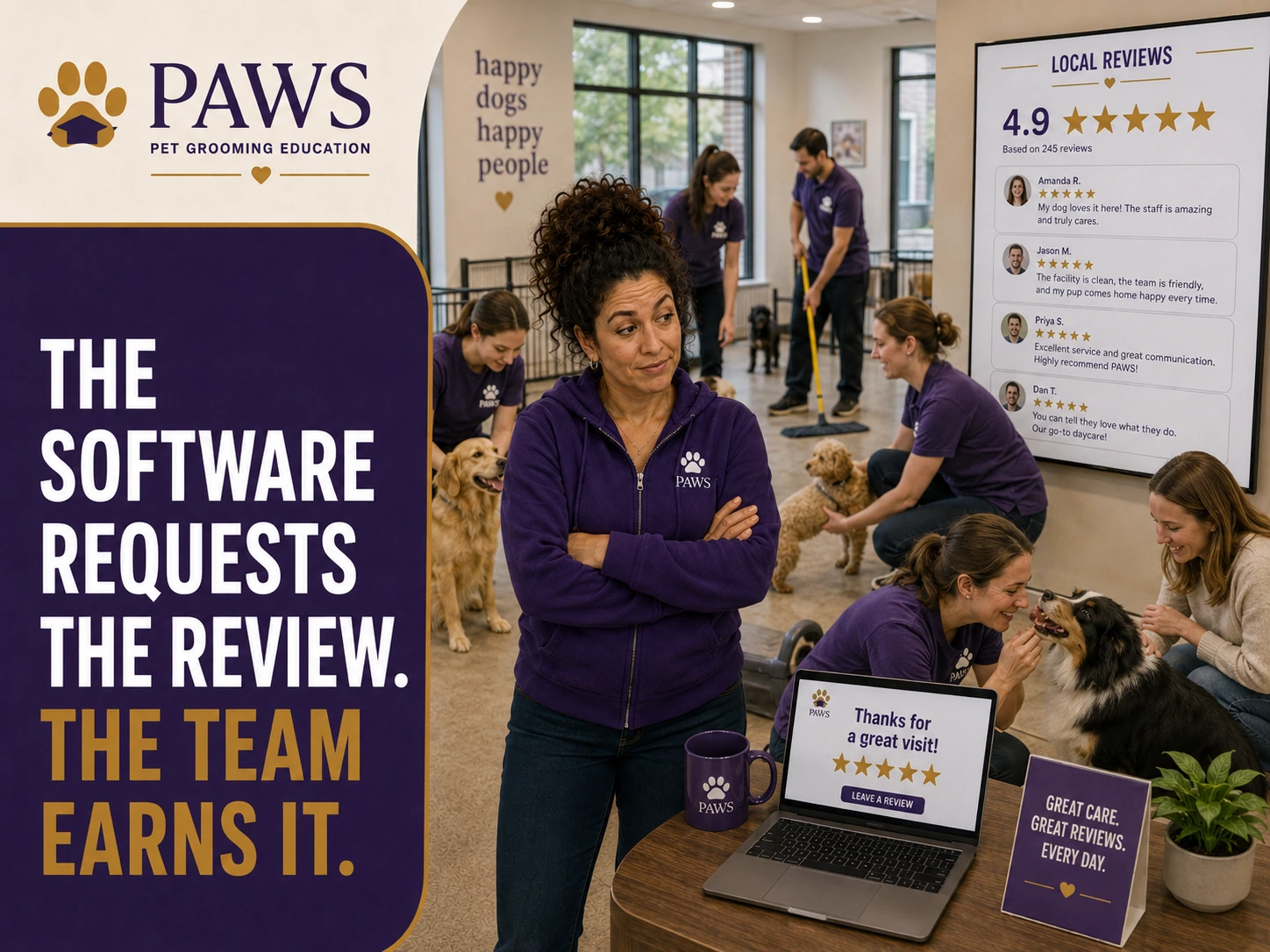
A new independent dog daycare has a trust problem. You do not have years of reviews yet. You do not have a franchise logo doing emotional support for nervous customers. You have to prove you are serious.
That proof is not just a cute name and a clean lobby. It is your website, photos, policies, intake process, vaccination rules, temperament test, staff training, cleaning rules, incident process, pricing, hours, FAQs, Google Business Profile, and how well your staff answers questions.
Customers are handing you a living animal. They want to know you have rules before there is a problem. If your answers sound like you are inventing them at the counter, trust leaves the building.
The proof pack should be consistent across the website, front desk, forms, tours, and staff answers. Conflicting vaccination rules, prices, hours, cancellation terms, or safety explanations tell customers the business has not finished building its system.
Use early customer questions to improve the pack without making customers test an unfinished business. Track what people repeatedly ask, the pages they cannot find, the forms they misunderstand, and the promises staff struggle to explain.
- Website with real service pages, hours, location, pricing language, FAQs, and contact path.
- Google Business Profile with accurate hours, address, phone, services, photos, and business description.
- Customer agreement, intake form, vaccination policy, and temperament evaluation process.
- Cleaning policy, illness policy, injury/incident policy, feeding policy, and medication policy.
- Staff rules for gates, leash transfers, supervision, customer handling, and emergency escalation.
- Tour script, phone script, email response, missed-call process, and follow-up process.
- Review request process ready before the first happy customer leaves.
💵
Startup Costs: Cheap Decisions Get Expensive
No royalty drag is only an advantage if you do not replace it with stupid mistakes.
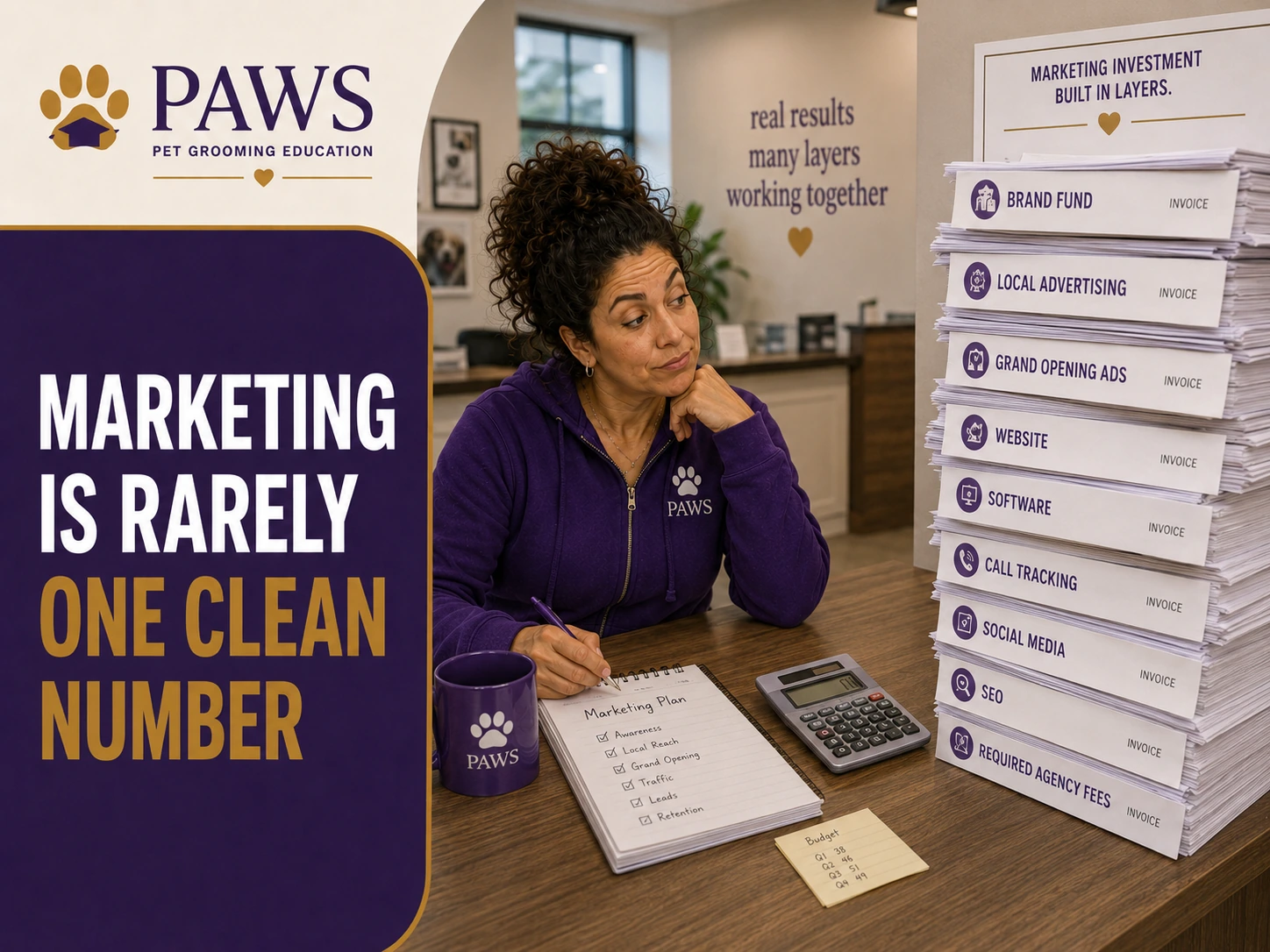
Independent does not automatically mean cheaper. It can be cheaper long-term because you are not paying royalties, ad fund fees, and system fees forever. But a bad independent startup can burn money faster than a franchise if the owner makes bad decisions early.
Cheap flooring that fails is not cheap. Bad drains are not cheap. Weak gates are not cheap. Bad HVAC is not cheap. Wrong pricing is not cheap. Opening with no working capital is not cheap. Poor marketing is not cheap. Hiring the wrong staff is not cheap.
The money you save by not buying a franchise should not become permission to guess. Use some of that control wisely. Spend where the business needs it: durable materials, safe gates, good cleaning systems, workable software, proper insurance, strong website, launch marketing, staff training, and enough working capital to survive the ramp-up.
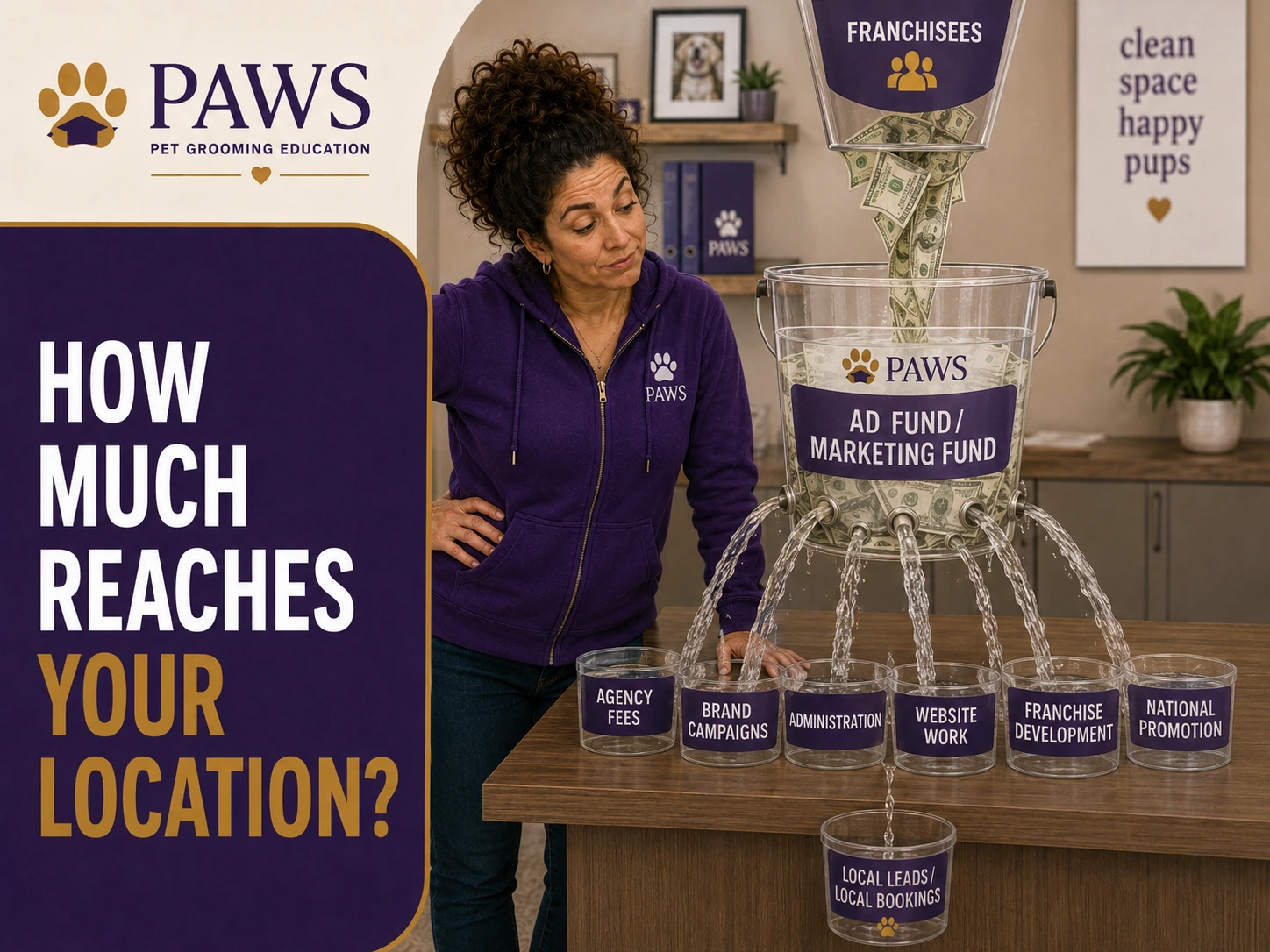
Independent owners avoid mandatory franchise fees, but still need a complete marketing and technology budget. Website work, local SEO, photography, call tracking, review tools, software, signs, launch ads, social media, printing, and paid campaigns can arrive as separate invoices.
Distinguish durable infrastructure from temporary appearance. Safe floors, drainage, ventilation, gates, software, training, insurance, and working capital protect the operation. Decorative upgrades should not consume the cash needed to survive a slow ramp-up or repair a real failure.
⚠️
The cheapest version of the business may be the most expensive version later.
Dog daycare beats up buildings, staff, equipment, and cash flow. Build cheap in the wrong places and the business will teach you why that was a bad idea.
⛽
Build a Runway, Not a Fantasy
Opening the doors is not the same thing as having enough customers to breathe.
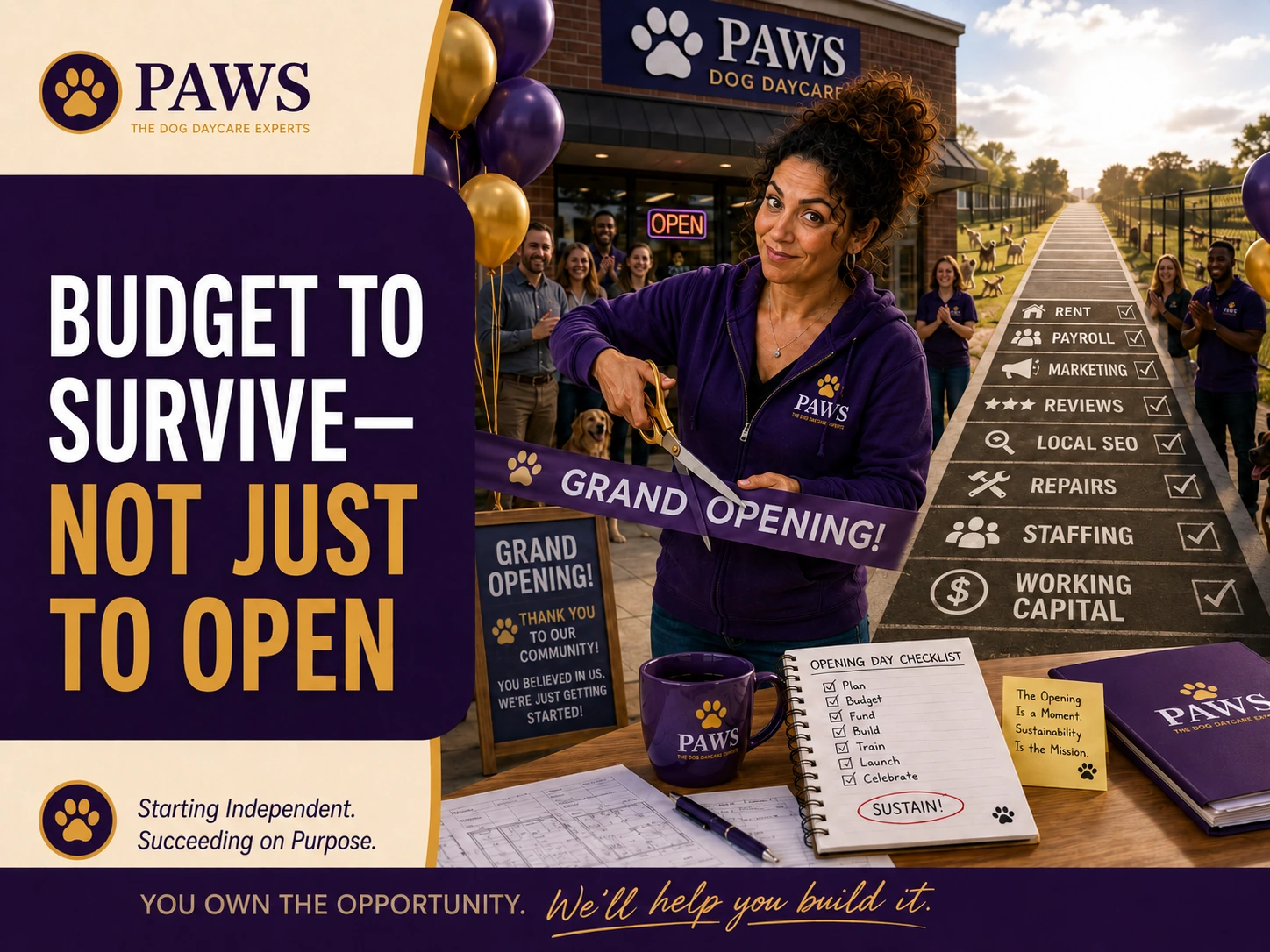
A lot of independent owners budget for opening and forget to budget for surviving.
You may open with excitement, a ribbon, a few tours, and some early customers. Good. That does not mean the business is mature. Daycare packages take time. Boarding takes trust. Grooming takes repeat customers. Reviews take time. Local SEO takes time. Staff training takes time. Word of mouth takes time.
Meanwhile, rent is not waiting. Payroll is not waiting. Insurance is not waiting. Software is not waiting. Utilities are not waiting. Cleaning supplies are not waiting. Marketing is not waiting. Repairs are not waiting.
If you are independent, nobody is sending a corporate rescue team because you underfunded the ramp-up. Build a runway. Have working capital. Know how many months you can survive if the building fills slower than your dream board said it would.
Build several ramp-up scenarios rather than one optimistic projection. Model slower daycare enrollment, weak weekday demand, seasonal boarding, delayed grooming growth, staff turnover, marketing underperformance, construction delay, and an early equipment repair.
The runway should include decision points. Know when to reduce spending, delay hiring, change marketing, adjust hours, revise pricing, seek more capital, or stop expansion before cash pressure forces a rushed decision.
- How many months of rent and payroll can you cover before the business stabilizes?
- How much local marketing money is reserved after opening?
- What happens if daycare fills slowly?
- What happens if boarding is seasonal and does not ramp right away?
- What happens if grooming takes longer to build than expected?
- What happens if the floor, drain, HVAC, gate, washer, dryer, or software creates a surprise bill?
- How long can the business operate before you personally need to pull owner pay?
🛡️
Insurance: A Waiver Is Not a Bulletproof Vest
You are handling live animals. Get insurance that understands that.
Independent owners sometimes think a customer waiver solves everything. It does not.
You still need insurance that actually matches the business you are running. Daycare, boarding, grooming, transportation, retail, employee dogs, customer injuries, dog injuries, bites, escapes, illness claims, property damage, workers’ comp, auto exposure, and business interruption are not all the same risk.
Do not just ask, “Do I have liability insurance?” Ask whether the policy covers animals in your care, custody, and control. Ask whether dog injuries, illness claims, bites, employee injuries, grooming services, boarding, transportation, property, equipment, and business income are handled correctly.
This is another grown-up part of independent ownership. You do not get to skip insurance because the form says the customer accepts risk.
- General liability.
- Care, custody, and control / animal bailee coverage.
- Property and equipment coverage.
- Workers’ compensation.
- Commercial auto or hired/non-owned auto if transportation is involved.
- Grooming coverage if grooming is offered.
- Boarding exposure if dogs stay overnight.
- Business interruption or income coverage if the facility has to close.
⚠️
Operator warning: ask the ugly questions before the ugly claim.
Ask the agent what happens if a dog bites another dog, bites a customer, gets injured in your care, escapes, gets sick, dies, or is hurt during grooming. That is the conversation that matters.
💻
Software, Forms, Manuals, and Procedures
Independent owners still need records, rules, reports, and repeatable procedures.
A franchise may require software. Independent owners get to choose software. That freedom is useful, but it also means you need to know what the software has to do.
Dog daycare software should help track customers, dogs, vaccinations, packages, reservations, boarding, grooming, billing, notes, communication, reports, and capacity. If it cannot support the way you actually run the business, it becomes another thing staff work around.
You also need forms and procedures. Customer agreements, intake forms, temperament testing notes, vaccination rules, incident reports, feeding instructions, medication logs, employee policies, cleaning schedules, and training records are not optional decorations.
Independent owners do not need a corporate manual to operate well. But they do need written rules that staff can understand and follow.
👥
Staffing and Training Without a Franchise Manual
“Hire people who love dogs” is not a staffing system.
Loving dogs is nice. It is not enough.
Staff need to know how to move dogs, read dogs, separate dogs, clean rooms, handle gates, answer phones, talk to customers, document incidents, follow feeding instructions, report illness, manage boarding routines, and avoid turning normal chaos into dangerous chaos.
Independent owners need to create training. That can be your own manual, purchased templates, consultant help, manager experience, written checklists, shadowing, signed acknowledgments, and daily correction. But it has to exist.
If staff are guessing, the business is guessing. And in dog daycare, guessing eventually shows up as bites, escapes, bad reviews, cleaning failures, customer anger, staff turnover, or insurance problems.
- Gate control, leash transfer, and escape-prevention rules.
- Dog body language, group management, separation rules, and escalation steps.
- Cleaning, disinfecting, laundry, odor control, and closing routines.
- Feeding, medication, belongings, boarding notes, and special-care instructions.
- Incident documentation, customer notification, and manager escalation.
- Phone scripts, tour process, pricing explanation, and package sales.
- Employee attendance, discipline, safety rules, and signed acknowledgments.
📢
Marketing Without a National Brand
You do not have a franchise logo doing the talking. You have to create local trust.
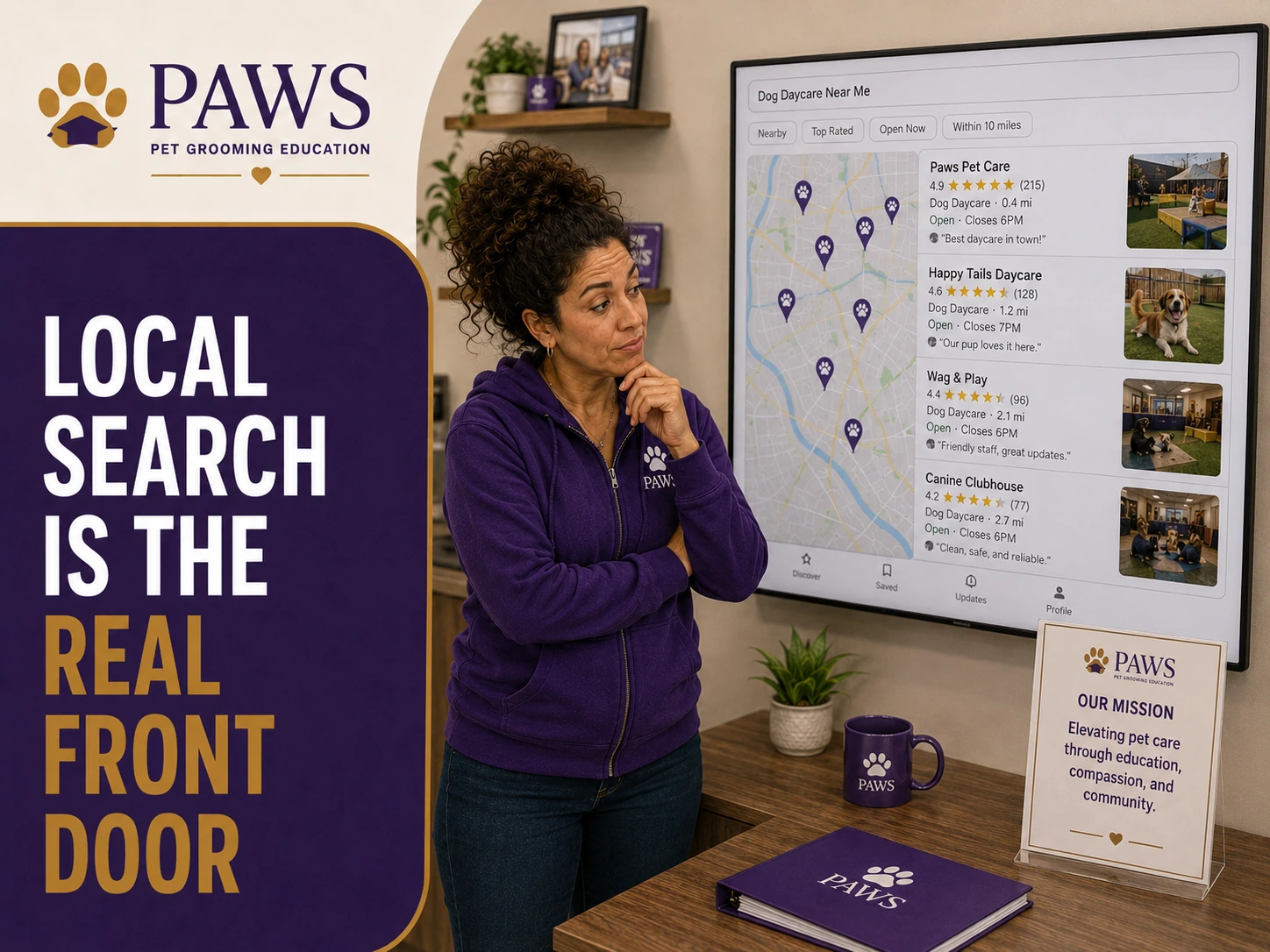
Independent dog daycare marketing is local. People search near them. They read reviews. They look at photos. They ask vets. They ask neighbors. They notice signs. They compare prices. They want to know whether the place looks safe, clean, professional, and trustworthy.
If you do not have a franchise brand behind you, you need to build your own local proof. That means Google Business Profile, website, service pages, photos, reviews, local SEO, social media, vet outreach, apartment outreach, rescue events, referral tracking, and a front desk that can convert inquiries into tours and customers.
You do not need a national brand to do that. But you do need a plan. Posting random dog pictures and hoping the building fills is not a plan.
The launch plan should begin before opening and continue after the initial excitement fades. Local search, photographs, reviews, veterinary and apartment outreach, rescue relationships, events, referral tracking, lead response, tours, and follow-up need owners, schedules, budgets, and measures.
Independent marketing has an important advantage: the owner can adapt quickly. That speed only matters when the business tracks what produces calls, tours, first purchases, repeat visits, boarding reservations, grooming appointments, reviews, and referrals.
📌
The local trust test
If a stranger finds you online today, can they quickly understand what you offer, why you are safe, what it costs, where you are, what other customers think, and how to contact you?
🚩
Where Independent Owners Usually Get Hurt
Most failures are not mysterious. They come from ignored basics.
| Problem Area | What Happens | How to Avoid It |
|---|---|---|
| Bad Lease | Rent, restrictions, neighbors, signage, zoning, or build-out terms trap the business. | Review use, zoning, build-out, landlord obligations, exits, signs, parking, and legal terms before signing. |
| Bad Layout | Dogs, staff, customers, groomers, cleaning, and boarding routines fight each other every day. | Design around movement, supervision, cleaning, safety, and escape control. |
| Cheap Materials | Floors fail, walls get damaged, gates flex, odor builds, and repairs start early. | Use durable dog-business materials where failure would hurt. |
| Weak Pricing | The business gets busy but does not make enough money to breathe. | Price from rent, payroll, capacity, demand, service mix, and profit targets, not fear. |
| No Working Capital | The owner runs out of oxygen before the customer base matures. | Budget for ramp-up, payroll, marketing, repairs, supplies, insurance, and surprises. |
| No Staff System | Every employee runs the business differently. | Write rules, train them, document them, and enforce them. |
| Weak Marketing | The building opens and nobody knows, trusts, or understands it. | Build local SEO, reviews, website, photos, outreach, referral systems, and follow-up before opening. |
| Owner Pride | The owner refuses help, ignores warnings, and learns everything through invoices. | Get the right help before the mistake becomes permanent. |
🧰
Use Help Without Buying a Franchise
Independent does not mean you have to know everything alone.
This is where people get stuck. They think the choices are franchise or total DIY. That is not true.
You can stay independent and still hire help. You can hire a dog daycare consultant for layout, location review, startup systems, or launch support. You can hire a local attorney for the lease and legal documents. You can hire an accountant for projections and bookkeeping. You can hire a contractor, architect, engineer, insurance agent, software provider, and marketing person.
That help may cost real money. Good help usually does. But targeted help does not automatically mean giving up your brand, vendors, software, service mix, marketing control, customer data, and a percentage of gross sales for years.
The smart independent owner does not brag about doing everything alone. The smart independent owner knows which decisions are too expensive to guess on.
Targeted professional help should be compared with the specific problem it solves. Paying an attorney to protect a major lease obligation or a consultant to prevent an unsafe layout is different from buying vague support that cannot be tied to a decision or deliverable.
The independent owner can direct money toward the local business instead of feeding a permanent systemwide fee stack. Contracts, scopes, account ownership, deliverables, deadlines, and knowledge transfer should be clear before any professional is hired.
| Help Source | What They Help With | Why It Matters |
|---|---|---|
| Dog Daycare Consultant | Location review, facility flow, dog movement, operating systems, forms, staffing, launch support, and startup mistakes. | Helps you avoid dog-business mistakes normal business advisors may not see. |
| Local Attorney | Lease, entity, liability language, employment documents, customer agreements, and local legal risk. | Keeps you from treating legal questions like internet homework. |
| Accountant / Bookkeeper | Startup projections, payroll, taxes, bookkeeping, cash flow, and financial controls. | Helps keep the dream attached to numbers. |
| Contractor / Architect / Engineer | Drawings, permits, code, mechanical systems, construction, build-out, and inspections. | Makes the plan legal, buildable, and real. |
| Insurance Agent | Liability, property, workers’ comp, auto, grooming, boarding, and employee risk. | Dog businesses carry risks that need proper coverage. |
| Marketing Specialist | Website, local SEO, Google Business Profile, reviews, ads, tracking, and launch campaigns. | Helps customers find and trust the business before they call. |
| Kennel Software Provider | Reservations, billing, packages, vaccination records, boarding, grooming, reporting, and customer communication. | Gives the business a record-keeping and customer-management backbone. |
🏆
What You Keep by Staying Independent
This is the upside. Own the system, own the brand, own the local goodwill.
If you do independent right, there are real advantages.
You are not paying royalties on gross sales. You are not paying an ad fund because the agreement says so. You are not locked into approved vendors unless you choose them. You are not asking corporate for permission to change your services, test a local offer, build a new page, choose software, add grooming, add boarding, change signage, adjust pricing, or improve the business.
You build your own brand. You own your local reviews. You own your customer relationship. You choose your vendors. You choose your service mix. You choose your software. You decide how the business grows.
That is worth something. But it is only worth something if you are good enough, disciplined enough, or helped enough to build a business that actually works.
Make ownership practical by documenting account control and intellectual property. The business should retain access to its domain, website, phone numbers, customer data, reviews, photographs, social pages, advertising history, procedures, training materials, and local partnerships.
Independent value also depends on transferability. A future buyer should be able to acquire the brand, systems, digital assets, customer relationships, vendor history, records, and operating knowledge without needing permission from a franchisor.
- No continuing royalty drag on gross sales.
- No mandatory ad fund unless you create one for yourself.
- Freedom to choose vendors, software, suppliers, materials, and marketing providers.
- Freedom to build your own brand, voice, website, local SEO, and customer experience.
- Freedom to adjust services, pricing, packages, grooming, boarding, training, retail, or add-ons.
- Local reviews and goodwill are built around your business, not someone else’s system.
- Exit, sale, rebrand, and growth decisions are not tied to franchise approval rules.
🛑
When Independent Is a Bad Fit
Some people should not start independent. That is not an insult. It is a warning.
Independent ownership is not for everybody.
If you need someone to tell you exactly what to do every step of the way, if you do not research, if you avoid numbers, if you hate making decisions, if you will not hire help when you need it, if you ignore warnings, or if you think loving dogs is enough, independent may be a bad fit.
A franchise may be better for someone who wants a brand, structure, manuals, software, training, operating rules, vendor guidance, marketing support, and ongoing guardrails. You may pay more and give up control, but some people need that structure.
There is nothing wrong with needing structure. The problem is lying to yourself about it.
- You want freedom but do not want responsibility.
- You do not want to research the market, competitors, pricing, lease, zoning, or build-out.
- You avoid numbers, payroll, working capital, and pricing math.
- You do not want to build forms, manuals, staff rules, and operating procedures.
- You are not willing to hire attorneys, accountants, contractors, consultants, or specialists when needed.
- You want someone else to blame when the plan does not work.
- You believe loving dogs is enough to operate a live-animal business.
📊
Independent Dog Daycare Startup Scorecard
Use this before you tell yourself you are ready.
| Score Area | Strong Sign | Warning Sign |
|---|---|---|
| Market Research | You know competitors, pricing, demand, customer habits, and local service gaps. | You are relying on friends saying “great idea.” |
| Location | Use, zoning, parking, signage, access, noise, neighbors, and lease terms have been checked. | You like the rent and hope the rest works out. |
| Build-Out | Floors, drains, HVAC, gates, walls, cleaning, laundry, grooming, and dog movement are planned. | The contractor is guessing what a dog daycare should look like. |
| Systems | Forms, software, procedures, staff rules, cleaning, intake, and incident reporting are ready before opening. | You plan to figure procedures out once staff are hired. |
| Pricing | Pricing is based on rent, payroll, capacity, demand, service mix, and profit needs. | Pricing is based on fear of being more expensive than competitors. |
| Marketing | Website, Google profile, photos, reviews, launch plan, outreach, and follow-up are planned. | You think people will show up because the business exists. |
| Help | You know where you need attorney, accountant, contractor, consultant, software, or marketing help. | You refuse help because you want to save money everywhere. |
| Owner Discipline | You are willing to research, document, train, measure, adjust, and make hard decisions. | You want independence but not the work that comes with it. |
❓
Questions to Ask Yourself Before Going Independent
Do not ask these after the lease is signed.
- Have I researched the local market enough to know whether people will pay for this service?
- Have I called, visited, or studied competitors enough to understand pricing, demand, and customer expectations?
- Do I have a name, URL, logo, website plan, Google Business Profile plan, and local SEO plan?
- Has a local attorney reviewed the lease before I sign it?
- Have I confirmed zoning, use approval, signage, parking, outdoor space, and landlord restrictions?
- Does the building layout make sense for dog movement, staff movement, grooming flow, cleaning, boarding routines, and escape prevention?
- Have I budgeted for build-out, equipment, software, supplies, insurance, payroll, marketing, working capital, and mistakes?
- Do I have written intake forms, customer agreements, employee policies, cleaning procedures, incident reports, and daily checklists?
- Do I know what software I am using and why?
- Do I know how I will hire, train, supervise, and hold staff accountable?
- Do I have a launch marketing plan before opening?
- Do I know what help I need, and am I willing to pay for the right help before the mistake gets expensive?
- Am I independent because I am prepared, or because I do not want anyone telling me hard truths?
🗂️
Keep Reading Before You Decide
Independent startup makes more sense when you compare it against franchise cost, control, royalties, and targeted help.
⚖️
Franchise vs. Independent
Compare the real trade: system and guardrails versus freedom, control, and responsibility.
💵
Franchise Costs
Understand the full franchise cost stack before assuming independent is automatically cheaper.
🧾
Franchise Royalties
No royalty drag is one of the biggest independent advantages, but only if you do not replace it with bad decisions.
🧠
Consultant vs. Franchise
Targeted help may solve specific problems without locking you into a continuing franchise relationship.
📢
Marketing Support
Independent owners need a local marketing engine because nobody is handing them national brand awareness.
🧰
Startup Help Options
Compare franchise, consultant, manual, software, templates, contractors, and other help before choosing a path.
❓
Starting an Independent Dog Daycare FAQ
Detailed answers about independent ownership, market research, leases, facility design, safe capacity, operating systems, software, staffing, working capital, insurance, marketing, asset control, professional help, and deciding whether independence fits the owner.
Can I start a dog daycare without buying a franchise?
Yes. An independent owner can build the brand, operating system, software stack, vendor relationships, training, forms, marketing, and customer experience without entering a franchise relationship.
The practical question is whether the owner will replace the missing franchise structure with deliberate research, written systems, capable professionals, trained staff, and enough capital. Independence is not the absence of a system; it is ownership of the responsibility to create and maintain one.
Is starting independent cheaper than buying a franchise?
It can be cheaper over time because the owner avoids the initial franchise fee, continuing royalties, mandatory ad-fund contributions, required system fees, and some controlled-vendor costs.
That does not make the startup automatically inexpensive. Lease mistakes, failed flooring, weak drainage, poor HVAC, bad pricing, inadequate insurance, ineffective marketing, and insufficient working capital can consume far more than the franchise fees avoided.
What does no royalty drag actually mean?
It means the business does not send a continuing percentage of gross sales to a franchisor merely because revenue was earned. The independent owner can retain that money for payroll, management, repairs, reserves, debt reduction, marketing, expansion, or owner compensation.
The advantage only matters when the retained money is managed well. An owner who wastes the savings through poor decisions, chronic underpricing, weak systems, or repeated repairs may gain little from avoiding royalties.
Do I need a dog daycare consultant to start independently?
Not every owner needs the same level of consulting. An experienced operator with strong local professionals may need targeted review, while a first-time owner may benefit from help with site selection, facility flow, procedures, staffing, pricing, software, and launch planning.
The decision should be based on the cost of being wrong. Paying for focused help before signing a lease or constructing a flawed layout can be far less expensive than correcting the mistake later.
What should I research before choosing a location?
Research local demand, competitor capacity, prices, services, reviews, drive times, commute patterns, nearby employers, apartments, veterinary relationships, grooming supply, boarding demand, parking, visibility, and how far customers realistically travel.
Then connect the market evidence to the site. A location may be affordable but too inconvenient, poorly zoned, hard to park at, close to sensitive neighbors, or unable to support outdoor use, drainage, ventilation, noise control, and safe customer traffic.
What should be confirmed before signing a lease?
Confirm the permitted use, zoning, boarding rights, grooming rights, outdoor use, animal limits, parking, signage, noise expectations, waste handling, construction feasibility, utilities, drains, HVAC, fire requirements, insurance availability, and landlord obligations.
The lease should be reviewed by a qualified local attorney and should contain protections tied to approvals, permits, financing, construction, and opening. A landlord's verbal assurance does not protect the owner when another authority disagrees.
Why is facility design more than drawing rooms on a floor plan?
A dog daycare is a movement system. Dogs travel between the lobby, evaluation areas, playrooms, yards, boarding, grooming, feeding, medication, rest spaces, and checkout while staff move supplies, laundry, food, waste, and cleaning equipment.
A usable design controls gates, prevents straight escape paths, reduces cross-traffic, protects supervision, separates incompatible dogs, supports cleaning, and minimizes wasted staff movement. A plan that maximizes square footage but creates dangerous transfers is not efficient.
How should I calculate safe daycare capacity?
Safe capacity is not the number of dogs that physically fit in the building. It depends on room size, staff skill, dog size, play style, energy, age, behavioral compatibility, rest needs, gate pressure, noise, cleaning, outdoor access, boarding movement, and separation options.
Set an operational capacity below the theoretical maximum and identify the real bottlenecks by time of day. Staffing shortages, incompatible dogs, illness isolation, maintenance, weather, grooming traffic, and boarding surges all reduce usable capacity.
What operating procedures should exist before opening?
The business should have written procedures for intake, temperament evaluation, vaccinations, illness exclusion, dog movement, gate control, playgroup supervision, cleaning, feeding, medication, boarding belongings, grooming handoffs, incidents, injuries, escapes, customer notification, billing, cancellations, and late pickups.
Those procedures should be rehearsed before dogs arrive. Employees need to demonstrate the tasks, managers need a way to inspect performance, and the business needs forms or software records that prove what occurred.
What software does an independent dog daycare need?
The software should support customer and dog records, vaccinations, reservations, daycare packages, memberships, boarding, grooming, billing, payments, notes, medications, communication, capacity, and reports.
Before selecting a system, test real tasks and confirm data ownership, exports, backups, payment costs, outage procedures, support, integrations, user permissions, and switching options. A cheap platform becomes expensive when staff maintain parallel spreadsheets.
How much working capital should I plan for?
The source page does not provide one universal number because rent, payroll, construction, market size, service mix, and ramp-up differ. Model several slower-than-planned scenarios and calculate how long the business can cover rent, payroll, insurance, utilities, software, supplies, marketing, repairs, and debt.
Working capital should include contingency reserves and decision points. Construction delays, weak presales, seasonal boarding, delayed grooming growth, equipment failure, employee turnover, or ineffective marketing can consume cash quickly.
What insurance should an independent daycare investigate?
Coverage commonly requires attention to general liability, care-custody-and-control or animal-bailee exposure, property, equipment, workers' compensation, business interruption, commercial auto or hired and non-owned auto, grooming, boarding, transportation, and other actual services.
Describe the real operation to an insurance professional and ask specific loss questions involving bites, dog-on-dog injuries, customer injuries, escapes, illness, death, grooming incidents, employee injuries, property damage, and temporary closure. A waiver does not replace suitable insurance.
How should I train staff without a franchise manual?
Build a local training program using written procedures, demonstrations, shadow shifts, checklists, competency observations, signed acknowledgments, coaching, and manager review. Loving dogs is not proof that an employee can manage gates, read body language, clean correctly, follow medications, or document incidents.
Training should continue after orientation. Managers need refreshers, daily observation, correction standards, retraining, and documented discipline so replacement staff receive the same core system.
How do I build trust before I have many reviews?
Create a day-one proof pack: a clear website, accurate Google Business Profile, real photographs, service explanations, hours, pricing language, vaccination policy, intake process, temperament evaluation, cleaning rules, staff training, incident procedures, FAQs, and a reliable contact path.
Consistency is critical. Staff answers, website language, forms, tours, and actual practice should match. Customers notice when rules are invented at the counter or different employees provide different explanations.
How should an independent daycare market without a national brand?
Build a local engine around search visibility, Google Business Profile management, useful service pages, real photographs, review generation, veterinary and apartment relationships, rescue and community events, referral partnerships, social media, phone response, tours, and follow-up.
Track the full path from source to revenue. Know which activities produce inquiries, completed tours, temperament evaluations, first purchases, repeat visits, boarding reservations, grooming appointments, reviews, and referrals.
What business assets should remain under my control?
The independent business should control its name, domain, website, hosting, phone numbers, Google Business Profile, social accounts, email accounts, customer and dog data, booking links, reviews, photographs, advertising accounts, analytics, procedures, training materials, and vendor relationships.
Account ownership should be documented before agencies or employees create the assets. The owner needs administrator access, recovery credentials, export rights, and a transition process.
What are the most expensive independent startup mistakes?
The source emphasizes bad leases, bad layouts, cheap materials, weak pricing, insufficient working capital, missing staff systems, weak marketing, and owner pride. These problems often compound and make one another harder to fix.
The best prevention is staged due diligence with written evidence. Review the market, lease, approvals, design, construction, insurance, pricing, procedures, software, staffing, marketing, and cash runway before each commitment removes another option.
When is independent ownership a poor fit?
It is a poor fit when the owner wants freedom but avoids research, numbers, documentation, difficult decisions, professional advice, staff accountability, or responsibility for correcting mistakes. Loving dogs and disliking corporate rules do not create the skills needed to operate a live-animal business.
The answer is not necessarily to force a franchise purchase. A partner, experienced manager, stronger professional team, smaller concept, delayed opening, or different investment may better match the owner's abilities.
When might a franchise be the better choice?
A franchise may fit an owner who values an established brand, manuals, training, software, approved systems, vendor guidance, marketing support, peer network, and continuing guardrails enough to accept the fees, restrictions, and long-term relationship.
The comparison should be based on evidence rather than fear. Evaluate what the franchisor actually provides, what independent replacement would cost, how much control and data are surrendered, and whether the value continues after the owner gains experience.
What is the bottom-line test before starting independently?
Ask whether the owner has a researched market, workable site, reviewed lease, feasible build-out, safe design, complete budget, sufficient runway, proper insurance, tested software, written procedures, trained staff, launch marketing, and a clear plan for professional help.
Then ask whether the owner is willing to maintain those systems after opening. Independent ownership succeeds through continuing measurement, correction, documentation, staff development, financial discipline, and local trust.
🐾
The Bottom Line: Independent Means It Is All Yours
The freedom, the upside, the homework, and the mistakes.
Starting an independent dog daycare can be a strong path. You can build your own brand, choose your own vendors, design your own service mix, control your own marketing, own your local goodwill, and avoid royalty drag.
But independent ownership is not for people who want freedom from responsibility. It is for people who want responsibility without royalty drag.
You do not need a franchise just because the business has moving parts. But you do need a plan. You need research, systems, documents, pricing, software, staff training, marketing, local professionals, and enough humility to get help where you are weak.
Welcome to the big boys club. If you stay independent, the whole thing is on you. That can be the best part of it, or the thing that buries you.
The independent model works best when control and accountability stay together. The owner who keeps the brand, data, vendor choices, service decisions, and upside must also accept responsibility for research, safety, training, documentation, financial discipline, and correction.
The real comparison is not franchise support versus isolation. It is a permanent franchise relationship versus a deliberately built independent system supported by the right professionals, software, employees, and operating discipline.